Rome
The Eternal City on the Tiber — three thousand years of capital, from a hilltop settlement of legend to the seat of modern Italy, with an empire, a papacy and a world heritage of monuments layered in between.
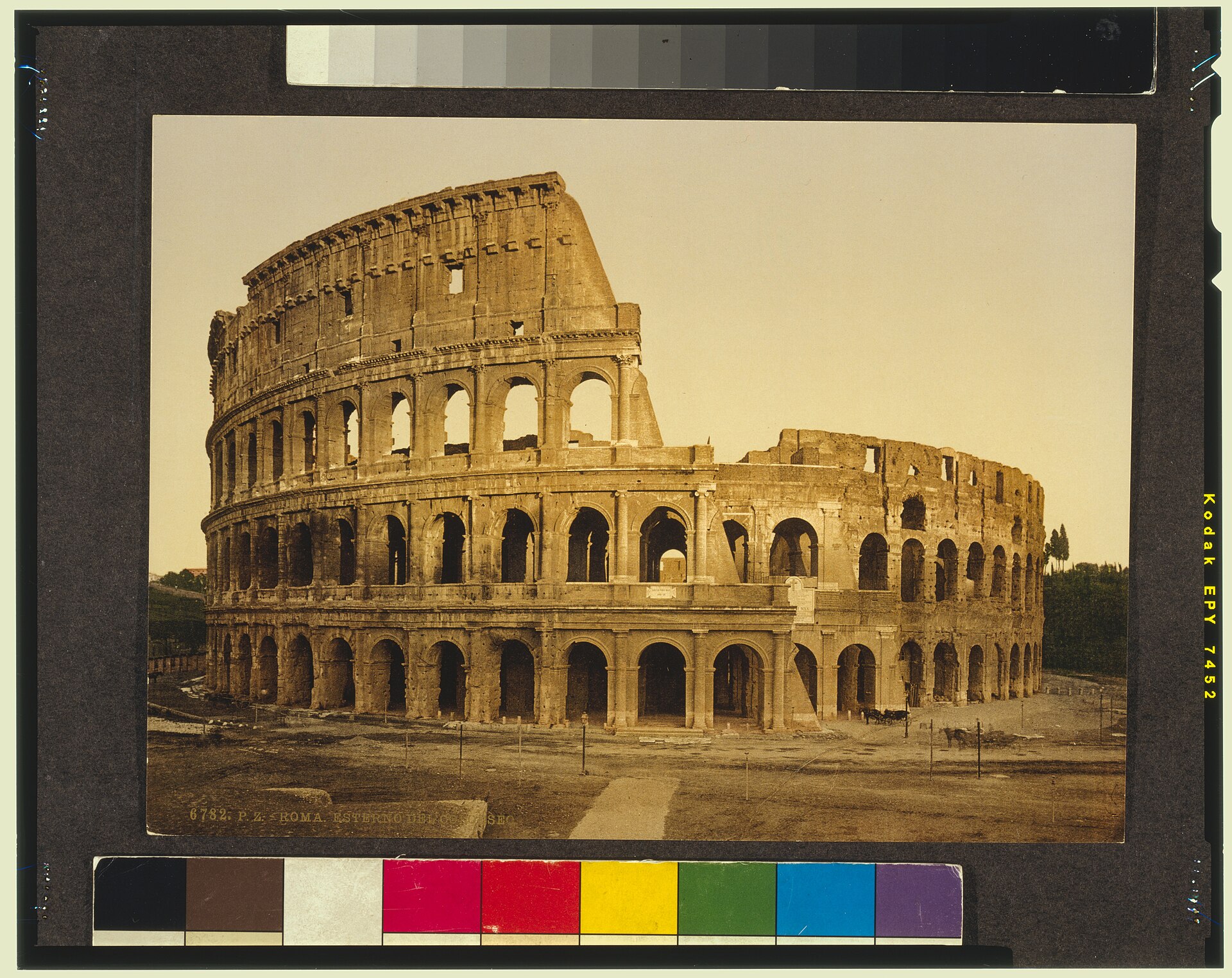
Rome is the capital of Italy and of the Lazio region, a city on the Tiber about 24 km (15 miles) inland from the Tyrrhenian Sea, with a municipal territory of 1,285 km2. Legend places its founding by Romulus and Remus in 753 BC — the anniversary is still kept on 21 April — and it was successively the centre of the Roman Republic (from 509 BC), of the Roman Empire (from 27 BC) and, from the 4th century, of the Christian world. The popes rebuilt it in the Renaissance and Baroque eras, and in 1871 it became the capital of a united Italy, with Vatican City — the world's smallest independent state, created by the 1929 Lateran Treaty — enclosed inside it. Its historic centre, ringed by the Aurelian Walls, entered the UNESCO World Heritage List in 1980 and was extended in 1990. The monuments of antiquity survive in extraordinary density — the Colosseum (dedicated AD 80), the Pantheon (rebuilt 118-125), Trajan's Column (106-113), Hadrian's mausoleum (135-139) and the Baths of Caracalla (206-216) — beside St Peter's Basilica, dedicated in 1626, and the Trevi Fountain, completed in 1762. ISTAT put the city's population at 2,745,062 on 1 January 2026.
A capital on the Tiber
Rome is the historic city and capital of the province of Rome, of the Lazio region, and of Italy, on the Tiber about 24 km (15 miles) inland from the Tyrrhenian Sea.1 The city of Rome covers 1,285 square kilometres, and its province covers 5,352 square kilometres.1 It is known as the Eternal City.1 Once the capital of an ancient republic and empire whose armies and polity defined the Western world, and later the spiritual and physical seat of the Roman Catholic Church, it remains today a political capital, a religious centre, and a memorial to the creative imagination of the past.1
The Tiber was above all a road over water, with large ports developed since Roman times and definitively demolished in the second half of the 19th century, when docks were built to free the city from continuous floods.2 Rome's monuments, hundreds of churches and spectacular fountains make it the city with the highest concentration of historical, archaeological and architectural heritage in the world, carrying over 16% of the world's cultural heritage.2 Its historic centre, delimited by the perimeter of the Aurelian Walls, is an overlapping of almost three millennia of testimonies.2 Heart of Catholic Christianity, Rome is the only city in the world to host a foreign state, the enclave of Vatican City, and is often called the 'Capital of two States'.2
The founding of Rome: legend and evidence
Rome was founded, according to legend, by Romulus and Remus in 753 BC.3 The city still keeps 21 April as the 'Birth of Rome', the date on which, according to tradition, Romulus founded the city in 753 BC.2 Rome's early development occurred in a multicultural environment, particularly influenced by the higher civilizations of the Etruscans to the north and the Greeks to the south.4 Roman religion was indebted to the beliefs and practices of the Etruscans, and the Romans borrowed and adapted the alphabet from them.4 The regal period (753-509 BC) and the early republic (509-280 BC) are the most poorly documented periods of Roman history, because historical accounts of Rome were not written until much later.4
The town that in the course of centuries grew up as Rome originally embraced, according to trustworthy testimony, only the Palatine hill, the 'square Rome' (Roma quadrata).5 The name came from the irregularly quadrangular form of the Palatine hill.5 The gates and walls that enclosed this original city remained visible down to the period of the empire, and many traces indicate that the Palatine was the centre and original seat of the urban settlement.5 Mommsen treats the story of the foundation of Rome by refugees from Alba under Romulus and Remus as a naive attempt of primitive quasi-history to explain why the place arose on so unfavourable a site.5
The town, which in the course of centuries grew up as Rome, in its original form embraced according to trustworthy testimony only the Palatine, or "square Rome" (-Roma quadrata-), as it was called in later times from the irregularly quadrangular form of the Palatine hill.
Theodor Mommsen, The History of Rome
Even the legend betrays its sense of the strangeness of the fact: the story of the foundation of Rome by refugees from Alba under the leadership of the sons of an Alban prince, Romulus and Remus, is nothing but a naive attempt of primitive quasi-history to explain the singular circumstance of the place having arisen on a site so unfavourable, and to connect at the same time the origin of Rome with the general metropolis of Latium.
Theodor Mommsen, The History of Rome
Republic and empire: how a town became a world power
Ancient Rome spans the founding of the city and the regal period, which began in 753 BC, through the founding of the republic in 509 BC and the establishment of the empire in 27 BC, to the final eclipse of the Empire of the West in the 5th century AD.4 Rome must be considered one of the most successful imperial powers in history.4 In the course of centuries Rome grew from a small town on the Tiber into a vast empire that embraced England, all of continental Europe west of the Rhine and south of the Danube, most of Asia west of the Euphrates, northern Africa, and the islands of the Mediterranean.4 The Roman Forum, the most important forum in ancient Rome, was the scene of public meetings, law courts and gladiatorial combats in republican times and was lined with shops and open-air markets.6 Under the empire it became primarily a centre for religious and secular spectacles and ceremonies, and the site of many of the city's most imposing temples and monuments.6
Where Rome excelled was in a powerful army and in law, government, city planning and statecraft, adopting contributions from other ancient peoples, most notably the Greeks.1 Roman society during the republic was governed by a strong military ethos, which helps explain the incessant warfare but does not account for Rome's success as an imperial power.4 Unlike Greek city-states, which excluded foreigners and subjected peoples from political participation, Rome from its beginning incorporated conquered peoples into its social and political system.4 Allies and subjects who adopted Roman ways were eventually granted Roman citizenship.4 The Roman Empire spread Roman culture, including the Latin language, across Europe and North Africa, Roman law formed the basis for legal codes in continental Europe and beyond, and the concept of a republic, with its assemblies and senates, has shaped modern representative democracies.1 The legacy of Rome includes the Romance languages, the Western alphabet, and the Gregorian calendar.1
In the second century of the Christian Æra, the empire of Rome comprehended the fairest part of the earth, and the most civilized portion of mankind.
Edward Gibbon, The Decline and Fall of the Roman Empire
Monuments and key dates
The Colosseum is an amphitheatre built in Rome under the Flavian emperors, also called the Flavian Amphitheatre.7 It is an elliptical structure made of stone, concrete and tuff, and it stands four stories tall at its highest point.7 Construction of the Colosseum began under Vespasian between 70 and 72 CE, and the completed structure was dedicated in 80 CE by Titus.7 Spectators were shielded from the sun by a massive retractable velarium, worked by hundreds of Roman sailors from masts rising out of the attic story.7 Trajan's Column was erected in 106-113 CE and survives intact in the ruins of Trajan's Forum; with its pedestal it measures 38 metres high.8
| Monument | Date | Source-backed note |
|---|---|---|
| Colosseum | Begun 70-72 CE; dedicated AD 80 by Titus; upper storey added in 82.7 | Measured 189 by 156 metres and seated about 50,000 spectators.7 |
| Trajan's Column | Erected 106-113 CE; 38 metres high with its pedestal.8 | A spiral band over 240 metres long carries a continuous narrative of the Dacian wars.8 |
| Pantheon | Rebuilt by Hadrian 118-125 AD; consecrated as Santa Maria ad Martyres in 609.9 | The dome spans just over 43 metres, larger than that of St Peter's Basilica.9 |
| Castel Sant'Angelo | Hadrian's mausoleum, built AD 135-139; converted into a fortress in the 5th century.10 | Later a papal refuge and prison, guarding the Ponte Sant'Angelo on the right bank of the Tiber.10 |
| Baths of Caracalla | Begun in 206 and completed in 216 AD.11 | Designed for about 1,600 bathers; the most extensive ruins of any Roman bathing establishment.11 |
| Trevi Fountain | Design competition won by Nicola Salvi in 1732; completed by Giuseppe Pannini in 1762.12 | A late Baroque masterpiece, 26 metres high and about 49 metres wide.12 |
| St Peter's Basilica | Dedicated in 1626; its fourth centenary falls in 2026.13 | The largest church in the world, built over the tomb of the Apostle Peter.13 |
| UNESCO World Heritage | Inscribed 1980; extended 1990 to the walls of Urban VIII.3 | The property covers the historic centre within the city walls at their widest extent in the 17th century.3 |
Christian Rome and the age of the popes
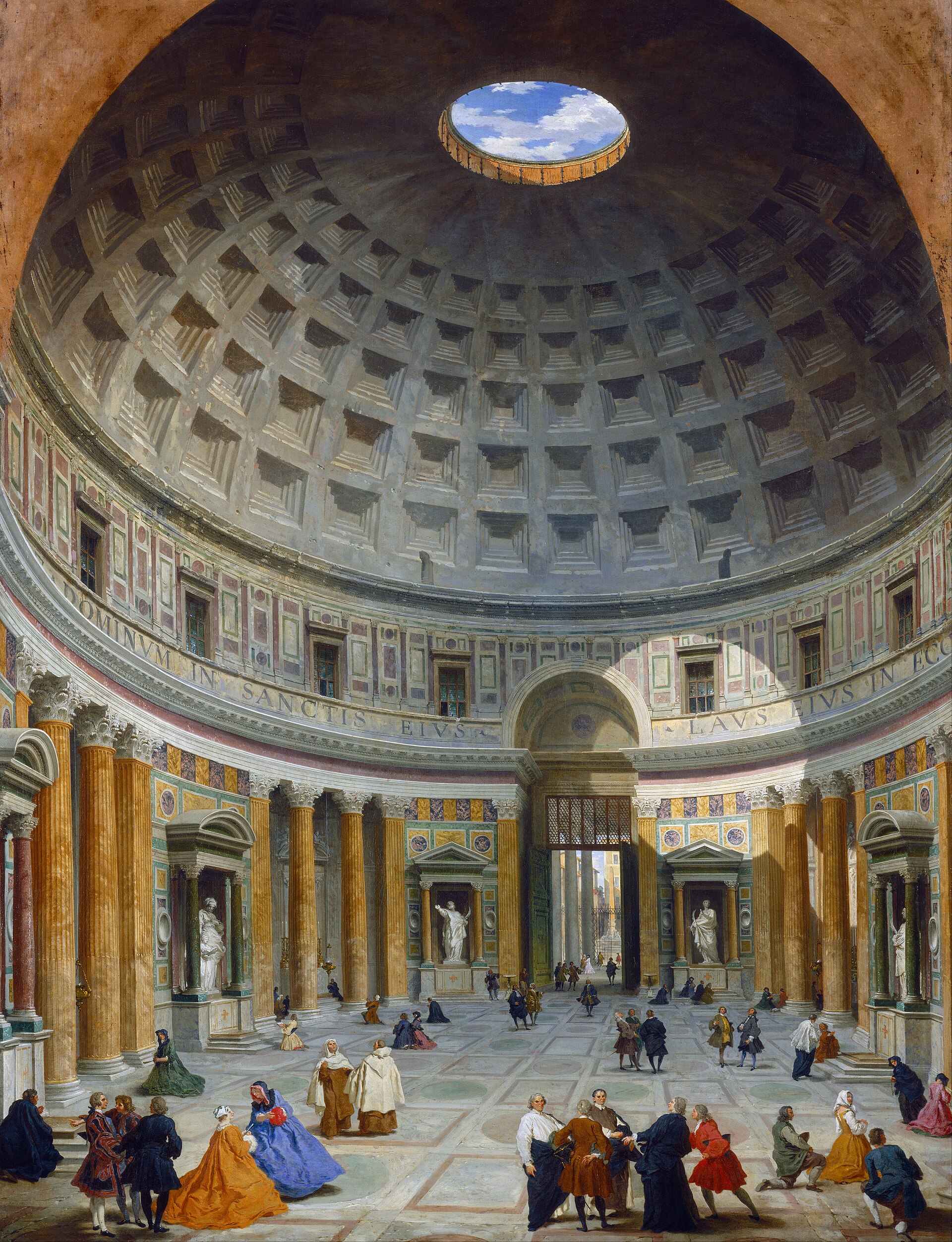
For well over a millennium Rome controlled the destiny of all civilization known to Europe.1 Ancient Rome was followed, from the 4th century on, by Christian Rome; the Christian city was built on top of the ancient city, reusing spaces, buildings and materials.3 Rome became the capital of the Christian world in the 4th century.3 The present Pantheon is the result of a radical reconstruction by Hadrian between 118 and 125 AD.9 Fallen into neglect and sacked by barbarians, it was donated in 609 by the Byzantine emperor Phocas to Pope Boniface IV, who consecrated it as Santa Maria ad Martyres, preserving it from the spoliation that affected many other ancient monuments in medieval times.9
Castel Sant'Angelo was built in AD 135-139 as the mausoleum of the emperor Hadrian and converted into a fortress in the 5th century.10 In 590 Pope Gregory the Great, leading a penitential procession to pray for the end of a plague, had a vision of the archangel Michael sheathing his sword over the castle.10 From that incident came the castle's modern name and the marble statue of the archangel that surmounts it.10 Throughout the Middle Ages the castle served as a refuge in times of trouble, especially for the popes, who could reach it from the Lateran through a protected passage.10 During the sack of Rome in 1527, Clement VII took refuge there from the troops of the Holy Roman emperor Charles V.10 Alongside the four hundred years since the dedication of the new St Peter's, one may look back to the ancient Constantinian basilica, built in the fourth century and perhaps consecrated in 326.13
Renaissance and Baroque renewal
From the 15th century on, the popes promoted a profound renewal of the city and its image, reflecting the spirit of the Renaissance classicism and, later, of the Baroque.3 St Peter's Basilica was the flagship of the renewal, the fruit of the combined genius of Bramante, Raphael, Michelangelo, Bernini and Maderno, erected over the tomb of St Peter the Apostle.14 At the centre of Vatican City it stands with its double colonnade and a circular piazza in front, bordered by palaces and gardens.14 St Peter's Basilica was dedicated in 1626 and marks its fourth centenary in 2026.13 The renewal was also an act of recycling: in 1625, under Urban VIII Barberini, the Pantheon was deprived of the bronze coatings of its portico to create the canopy of St Peter's and several cannons for the Castel Sant'Angelo.9 From the same decades came urban developments like Piazza Navona and the 'Trident' marked out by Sixtus V between 1585 and 1590, including Piazza del Popolo and Piazza di Spagna.3 The Trevi Fountain, considered a late Baroque masterpiece, was designed by Nicola Salvi and completed by Giuseppe Pannini in 1762.12
Capital of Italy, 1870-1945
Rome was the last city-state to become part of a unified Italy, and it did so only under duress, after the invasion of Italian troops in 1870.1 The pope took refuge in the Vatican thereafter.1 The city was made the capital of Italy, not without protests from Florence, which had been the capital since 1865, and the new state filled it with ministries and barracks.1 In 1870 the Pantheon was turned into a memorial chapel for the kings of Italy, and the tombs of Vittorio Emanuele II, Umberto I and Margherita of Savoy are to be found there together with that of Raphael.9 The Catholic church continued to reject Italian authority until a compromise was reached with Fascist dictator Benito Mussolini in 1929, when both Italy and Vatican City recognized the sovereignty of the other.1
Mussolini's public works and imperial nostalgia left their own mark on the capital.1 Rome's contemporary history reflects the long-standing tension between the spiritual power of the papacy and the political power of the Italian state capital.1 Since Mussolini's fall and the traumas of World War II, when the city was occupied by Germans, politics have continued to dominate Rome's agenda, although regionalism began in the 1980s to devolve some political power away from the capital.1
Vatican City, the state inside the city
Vatican City is the world's smallest fully independent nation-state and the seat of the Roman Catholic Church.15 It is a landlocked ecclesiastical state, an enclave surrounded by Rome.15 The pope, as head of the Holy See, has absolute executive, legislative and judicial powers within the city.15 Vatican City's independent sovereignty was recognized in 1929 by the Lateran Treaty.15 Its most imposing building is St Peter's Basilica, which was erected over the tomb of St Peter the Apostle.15 St Peter's Basilica is the largest church in the world, the heart of Christianity and a universal symbol of spirituality.13
The Vatican Palace houses the Sistine Chapel, known for its Renaissance frescoes by Michelangelo, and the Vatican Apostolic Library, while the Vatican Museums and Galleries comprise 26 museums with masterpieces and archaeological collections.15 Vatican City has its own telephone system, post office, gardens, astronomical observatory, radio station, banking system and pharmacy.15 The Swiss Guard has protected the pope since 1506, and almost all supplies are imported.15 The Vatican enjoyed a cultural golden age during the Renaissance, when the popes were among Italy's foremost patrons of the arts.15 Years of restoration work on the Sistine Chapel frescoes were completed in 1994, and in 2000 the millennial Jubilee focused world attention on Vatican City.15 Beneath every architectural development and every historical transformation lies the original core of it all: the tomb of St Peter, the place of his martyrdom and burial.13
UNESCO World Heritage: the historic centre
The property encompasses the whole historic centre of Rome within the city walls at their widest extent in the 17th century, as well as the Basilica of St Paul's Outside the Walls.3 It was first inscribed on the World Heritage List in 1980 and extended in 1990 to the walls of Urban VIII.3 The extension also covered the Holy See's extraterritorial properties and the Basilica of Saint Paul's Outside the Walls.3 The extension brought in major monuments of antiquity such as the Forums, the Mausoleum of Augustus, the Mausoleum of Hadrian, the Pantheon, Trajan's Column and the Column of Marcus Aurelius, as well as the religious and public buildings of papal Rome.3
Under criterion (i), the property includes testimonies of incomparable artistic value produced over almost three millennia of history, from monuments of antiquity like the Colosseum and the Pantheon to fortifications like the city walls and Castel Sant'Angelo.3 Under criterion (vi), Rome has been both a secular and a religious capital for more than two thousand years, the heart of a civilization that found its highest expression in law, language and literature and remains the basis of Western culture.3 Conservation work in Rome has gradually passed from individual monuments to the entire historic fabric of the city, with provisions for the protection of urban areas that made it possible to maintain the integrity of an immense historic district.3 The property remains exposed to threats including development and environmental pressures, decay of historic buildings, natural disasters, visitor and tourism pressure, and changes in the social and economic framework of the city centre.3 With the legal establishment of Roma Capitale as a public institution with extended powers, Italy has begun simplifying governance, uniting the institutional capacities for the property in a single subject.3
Rome today: people, economy and pressures
According to ISTAT's estimate for 1 January 2026, the resident population of the comune of Rome was 2,745,062.16 1,307,339 of the residents were men and 1,437,723 were women.16 Britannica's 2022 estimate was 2,761,632 in the city and 4,222,631 in the province.1 Rome cannot be called an industrial city, though it has a fair amount of medium and light industries.1 It is a major cultural, shopping and entertainment centre.1
Lagging behind Milan and Turin economically, Rome has maintained a peripheral place within the Italian and European economies.1 It has also been plagued with perennial housing shortages and traffic congestion.1 Rome has also been called the second 'greenest' capital in Europe.17 Roma Capitale's statistics office publishes a wellbeing report on the city; its ninth edition examines 145 indicators across 12 domains.17 For all the pressures, the pull is older than the problems: according to legend, those who toss coins into the waters of the Trevi will return to Rome.12
Rome in numbers
A study of city blocks in Pompeii and Ostia concluded that imperial Rome had roughly 450,000 inhabitants.18 The traditional founding date, 21 April 753 BC, is celebrated today as the 'Birth of Rome'.2 On ISTAT's estimate for 1 January 2026 the city's population stands at 2,745,062.16
| Item | Figure |
|---|---|
| City area (comune) | 1,285 km2.1 |
| Province area | 5,352 km2.1 |
| City population (ISTAT, 1 January 2026) | 2,745,062.16 |
| City population (2022 estimate) | 2,761,632.1 |
| Province population (2022 estimate) | 4,222,631.1 |
| Traditional founding | 21 April 753 BC.2 |
| Roman Republic founded | 509 BC.4 |
| Empire established | 27 BC.4 |
| Colosseum seating | about 50,000 spectators.7 |
| Pantheon dome | just over 43 metres across.9 |
| St Peter's Basilica dedicated | 1626; fourth centenary in 2026.13 |
| UNESCO inscription | 1980; extended 1990.3 |
| Vatican City sovereignty | recognized by the Lateran Treaty, 1929.15 |
| Imperial Rome population (Storey 1997) | roughly 450,000.18 |
Timeline: dates that built Rome
Traditional founding of Rome
According to tradition, Romulus founded the city on 21 April 753 BC — the date Rome still celebrates as the 'Birth of Rome' with costumed representations and cultural events.
The Roman Republic is founded
The events of 509 BC led to the founding of the republic — the beginning of the period, with the regal era that preceded it, that is the most poorly documented in Roman history.
The empire is established
The establishment of the empire in 27 BC marks the end of the period that began with the founding of the city and the regal period in 753 BC and passed through the founding of the republic in 509 BC.
The Colosseum is dedicated
The Flavian Amphitheatre, begun under Vespasian between 70 and 72 CE, was officially dedicated in 80 CE by Titus in a ceremony that included 100 days of games; Domitian added the uppermost story in 82.
Trajan's Column is erected
Trajan's Column, 38 metres high with its pedestal, was erected in 106-113 CE and survives intact in the ruins of Trajan's Forum; its base chamber served as the emperor's tomb.
Hadrian rebuilds the Pantheon
Agrippa's temple of 27 BC was radically rebuilt by Hadrian between 118 and 125 AD, expanded and reoriented with a large porticoed square in front; its concrete hemispherical dome, just over 43 metres across, is larger than that of St. Peter's Basilica.
Hadrian's mausoleum is built
Castel Sant'Angelo was built in AD 135-139 as the mausoleum of Hadrian and became the burial place of the Antonine emperors until Caracalla.
The Baths of Caracalla are completed
Begun by Septimius Severus in 206 and completed by Caracalla in 216, the baths accommodated about 1,600 bathers and remained in use until the 6th century.
The castle takes the name Sant'Angelo
During a penitential procession against a plague, Gregory the Great had a vision of the archangel Michael sheathing his sword over Hadrian's mausoleum — the origin of the name Castel Sant'Angelo.
The Pantheon becomes a church
The Byzantine emperor Phocas donated the Pantheon to Pope Boniface IV, who consecrated it as Santa Maria ad Martyres — preserving the building from the spoliation that stripped many other ancient monuments.
The sack of Rome
During the sack of Rome, Clement VII took refuge in Castel Sant'Angelo from the troops of the Holy Roman emperor Charles V.
The new St Peter's Basilica is dedicated
From 1626 to 2026: four centuries of history, art and spirituality in St Peter's Basilica, a place that preserves the memory of the Apostle Peter and still speaks to the whole world today.
The Trevi Fountain is completed
Nicola Salvi won the design competition in 1732; after his death in 1751 Giuseppe Pannini completed the fountain in 1762 — a late Baroque masterpiece 26 metres high and about 49 metres wide.
Rome becomes the capital of Italy
After Italian troops entered the city in 1870 — Rome was the last city-state to join a unified Italy, and did so only under duress — the city was made the capital, despite protests from Florence, and filled with ministries and barracks.
The Lateran Treaty creates Vatican City
Vatican City's independent sovereignty was recognized in 1929 by the Lateran Treaty, the compromise reached with Mussolini in which Italy and Vatican City recognized the sovereignty of the other.
The historic centre enters the UNESCO list
The historic centre of Rome was inscribed on the World Heritage List in 1980, together with the Basilica of St Paul's Outside the Walls and the Holy See's extraterritorial properties; in 1990 the property was extended to the walls of Urban VIII.
Frequently asked questions
Where is Rome, and what is it the capital of?
Rome is the historic city and capital of the province of Rome, of the Lazio region, and of Italy, on the Tiber about 24 km (15 miles) inland from the Tyrrhenian Sea.1
When was Rome founded, and what does the city celebrate on 21 April?
According to legend, Rome was founded by Romulus and Remus in 753 BC.3 The city still keeps 21 April as the 'Birth of Rome', celebrated with costumed representations and cultural events.2
How large did the Roman Empire become?
In the course of centuries Rome grew from a small town on the Tiber into a vast empire that embraced England, all of continental Europe west of the Rhine and south of the Danube, most of Asia west of the Euphrates, northern Africa, and the islands of the Mediterranean.4
Why does the Pantheon still stand?
After falling into neglect and being sacked by barbarians, the Pantheon was donated by the Byzantine emperor Phocas to Pope Boniface IV in 609, who consecrated it as Santa Maria ad Martyres and preserved it from the spoliation that affected many other ancient monuments in medieval times.9 Its dome, just over 43 metres across, is larger than that of St Peter's Basilica.9
When did Rome become the capital of Italy?
Rome was the last city-state to become part of a unified Italy, and it did so only under duress, after the invasion of Italian troops in 1870.1 The city was then made the capital of Italy, not without protests from Florence, which had been the capital since 1865.1
Is Vatican City part of Rome?
Vatican City is the world's smallest fully independent nation-state, a landlocked ecclesiastical state, an enclave surrounded by Rome.15 Its independent sovereignty was recognized in 1929 by the Lateran Treaty.15
Is the historic centre of Rome a World Heritage site?
It was first inscribed on the World Heritage List in 1980 and extended in 1990 to the walls of Urban VIII.3 The property encompasses the whole historic centre within the city walls at their widest extent in the 17th century, as well as the Basilica of St Paul's Outside the Walls.3
Rome at a glance
Sources & citations
Every factual claim in this article is drawn from the sources below. Bracketed numbers in the text link to the corresponding source.
- 1
- 2
- 3
- 4
- 5
- 6
- 7
- 8
- 9
- 10
- 11
- 12
- 13
- 14
- 15
- 16
- 17
- 18