Albert Einstein
The theoretical physicist who redefined space, time, and gravity — and won the 1921 Nobel Prize for the photoelectric effect.
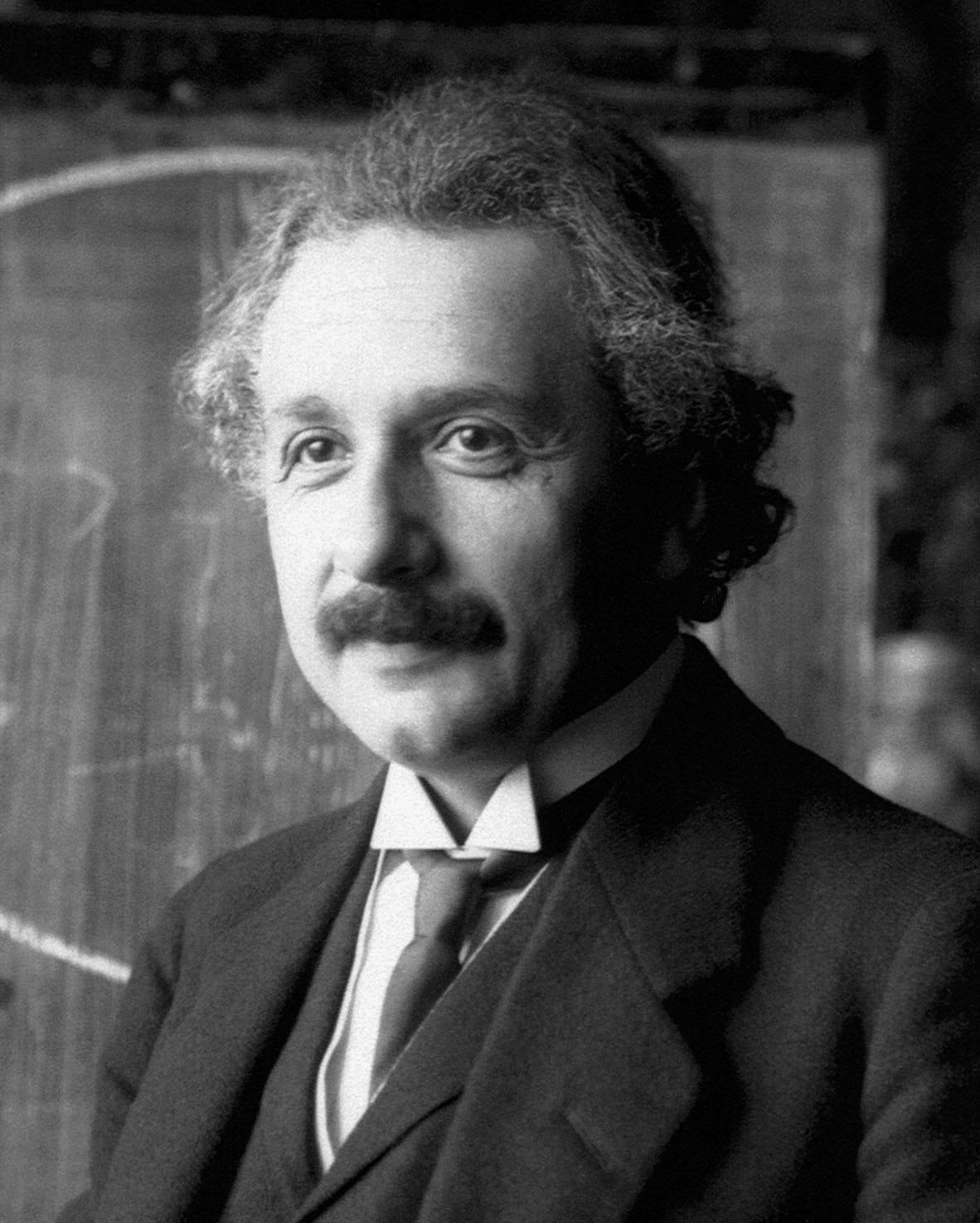

Albert Einstein (1879–1955) was a German-born theoretical physicist whose work transformed modern physics. In 1905 he published landmark papers on the light quantum, Brownian motion, and special relativity, and in 1916 completed the general theory of relativity, confirmed by the 1919 eclipse expeditions. He received the Nobel Prize in Physics for 1921 — awarded for the law of the photoelectric effect — and spent his final decades at the Institute for Advanced Study in Princeton.
Early life and education
Albert Einstein was born at Ulm, in Württemberg, Germany, on March 14, 1879.1 Six weeks later the family moved to Munich, where he began his schooling at the Luitpold Gymnasium.1 His father founded an electrical engineering company in the city.2 Britannica records that Hermann Einstein had first worked as a featherbed salesman and later ran an electrochemical factory, that his mother, born Pauline Koch, managed the household, and that his sister Maria — known as Maja — was born two years after Albert.3
The family later moved to Italy, and Albert continued his education at Aarau, Switzerland.1 He was generally a good pupil and outstanding in mathematics, but he detested the academic high school in Munich, where success depended on memorization and obedience to arbitrary authority.4 What is documented is that in the entrance examination for the Zurich polytechnic his marks showed that he excelled in mathematics and physics, while he failed at French, chemistry, and biology.3
In 1896 Einstein entered the Swiss Federal Polytechnic School in Zurich to be trained as a teacher in physics and mathematics.1 He completed his studies with a diploma in July 1900.5 The result placed him outside the usual academic ladder: apart from him, all four of his fellow graduates obtained assistant posts at the Polytechnic Institute.5
The patent office and the miracle year
In 1901, the year he gained his diploma, Einstein acquired Swiss citizenship; the ETH Zurich archives date the naturalization to 21 February 1901.16 While the other graduates from his year took up posts at the Polytechnic Institute, he tried unsuccessfully to gain an assistant lectureship at universities in Switzerland, Germany, the Netherlands and Italy.6 Unable to find a teaching post, he accepted a position as technical assistant in the Swiss Patent Office.1 A post at the Federal Office for Intellectual Property had been announced in the “Bundesblatt” on 11 December 1901, and on 19 June 1902 he was appointed Technical Expert, III Class.6
During his stay at the Patent Office, and in his spare time, he produced much of his remarkable work.1 In 1905 he obtained his doctor's degree.1 The chronology of his collected papers fixes the sequence: on 30 April 1905 he submitted his University of Zurich doctoral dissertation, “A New Determination of Molecular Dimensions”, published in 1906, and on 27 July the doctorate was approved unanimously by the University of Zurich Philosophy II faculty.7
His 1905 papers carry precise archival dates: on 17 March he sent the Annalen der Physik his photoelectricity paper, “On a Heuristic Point of View concerning the Production and Transformation of Light”, received 18 March and published 9 June.7 The Brownian Motion paper, “On the Movement of Small Particles Suspended in Stationary Liquids Required by the Molecular-Kinetic Theory of Heat”, was received on 11 May and published on 18 July.7 “On the Electrodynamics of Moving Bodies” was received on 30 June and published on 26 September.7 The mass-energy paper, “Does the Inertia of a Body Depend upon Its Energy Content?”, was received on 27 September and published on 21 November, and contains the concept later written E=mc².7
The brilliant concept of special relativity occurred to Einstein in May 1905 in a discussion with Michele Besso in Berne; during the following six weeks he wrote his essay, which appeared three months later in the “Annalen der Physik” under the title “Zur Elektrodynamik bewegter Körper”.6 Mid-May is the date the chronology gives for the conception, with Einstein recalling that he sent the paper in for publication five or six weeks after the idea came to him.7
In one of several epoch-making studies beginning in 1905, Einstein explained that light consists of quanta — packets with fixed energies corresponding to certain frequencies — and that one such light quantum, a photon, must have a certain minimum frequency before it can liberate an electron.2 The Library of Congress notes that he put forth the idea that light consists of “discrete packets”, against the widely accepted wave theory, a step that later advanced wave-particle duality in quantum mechanics.8 His work led to an explanation of the Brownian movement of molecules, and the Library of Congress records that this paper helped to move the theory of atoms into reality by offering a way to count and observe their behaviour in experiments.18 The fourth paper produced what the Library of Congress calls arguably the most famous equation in history, E=mc²: the energy of a body at rest equals its mass times the speed of light squared, and the speed of light, c, is 299,792,458 meters per second.8 The Nobel site counts four landmark papers for 1905 and notes that 2005 was named the “World Year of Physics” in recognition of their centenary.9
Academic career
From the patent office Einstein moved back into academic life: in 1908 he was appointed Privatdozent in Berne, and in 1909 he became Professor Extraordinary at Zurich.1 In 1911 he became Professor of Theoretical Physics at Prague, and in 1912 he returned to Zurich to fill a similar post.1 The Nobel records summarise the sequence as employment at universities in Bern, Zurich and Prague, and from 1914 in Berlin.2
In Zurich he was predominantly concerned with the problem of gravitation, which he attempted to solve together with the mathematician Marcel Grossmann; he made a break-through while still in Zurich, although the ultimate formulation of general relativity would follow only a few years later.10 In 1914 he was appointed Director of the Kaiser Wilhelm Physical Institute and Professor in the University of Berlin, and he became a German citizen, remaining in Berlin until 1933.1 In 1916 he published “Die Grundlage der allgemeinen Relativitätstheorie”, the book laying out the general theory of relativity, and became president of the German Physical Society.11
General relativity and the 1919 eclipse
In his early days in Berlin, Einstein postulated that the correct interpretation of the special theory of relativity must also furnish a theory of gravitation, and in 1916 he published his paper on the general theory of relativity.1 In 1915 he had published “Feldgleichungen der Gravitation” — the general relativity equations — and the Nobel site describes the general relativity theory as published in 1915, complementing the special theory of 1905.119
Einstein's theory had already explained a small discrepancy in Mercury's orbit around the Sun, but his prediction of the gravitational redshift of absorption lines in the Sun had not been confirmed.12 In 1917, in response to the publication of the theory, Frank Dyson, the Astronomer Royal and director of the Royal Observatory Greenwich, predicted that the total eclipse in 1919 would provide a much better chance to test it, as the Sun would be situated in the richer star field of the Hyades.12
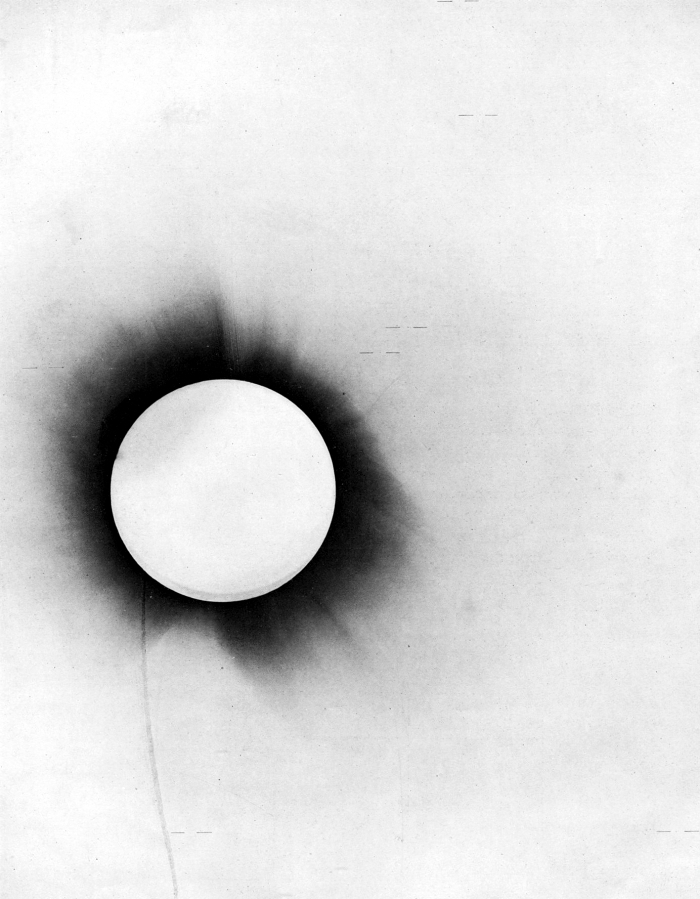

A British expedition was organised under the direction of Dyson, sending two groups of two observers: Andrew Crommelin and Charles Davidson of the Royal Observatory Greenwich to Sobral in Brazil, and Arthur Eddington and Edwin Cottingham of Cambridge to the island of Principe off the West African coast.12 The two expeditions were sent to observe the solar eclipse of May 29, 1919.3 They were supported and partially funded by the joint standing eclipse committee of the Royal Society and Royal Astronomical Society.12
Seven out of the eight images taken with the 4-inch Cortie lens at Sobral showed star images and, measured back at Greenwich, provided excellent confirmation of Einstein's prediction as well as its expected variation with distance.12 At Principe on 29 May the day of the eclipse started with a very heavy thunderstorm; the sky cleared just before totality, and only two plates were of sufficient quality — but they were consistent with Einstein's prediction.12 The American Institute of Physics records that the starlight had been deflected just as Einstein had predicted.13 On 6 November 1919 the results were announced in London at a joint meeting of the Royal Society and the Royal Astronomical Society, and Einstein became world famous on 7 November 1919, following press publication of that meeting.312 In 1979, Harvey reported the re-measurement of five of the original seven 4-inch plates and all 16 original astrographic plates from Sobral, using modern measuring machines; he obtained essentially the same result, with much improved accuracy for the astrographic camera plates.12
In his own words
Einstein's Nobel Lecture, “Fundamental ideas and problems of the theory of relativity”, was delivered to the Nordic Assembly of Naturalists at Gothenburg on July 11, 1923.14 The Nobel Foundation notes that the lecture was not delivered on the occasion of the prize award and did not concern the discovery of the photoelectric effect.14
The special relativity theory resulted in appreciable advances. It reconciled mechanics and electrodynamics.14
Albert Einstein, Nobel Lecture, Gothenburg, 11 July 1923
It united the momentum and energy principle, and demonstrated the like nature of mass and energy.14
Albert Einstein, Nobel Lecture, Gothenburg, 11 July 1923
A theory which from the outset prefers no state of motion should appear more satisfactory.14
Albert Einstein, Nobel Lecture, Gothenburg, 11 July 1923
The relativity principle in connection with the Maxwell equations demands that the mass is a direct measure for the energy contained in bodies; light transfers mass...15
Albert Einstein, letter quoted by the American Institute of Physics, Center for History of Physics
[T]he theory produces a good deal but hardly brings us closer to the secret of the Old One. I am at all events convinced that He does not play dice.3
Albert Einstein to Max Born, December 1926, as quoted by Encyclopaedia Britannica
There is probably no physicist living today whose name has become so widely known as that of Albert Einstein.16
Svante Arrhenius, Nobel presentation speech, 10 December 1922
The Nobel Prize
The Nobel Prize in Physics 1921 was awarded to Albert Einstein for his services to theoretical physics, and especially for his discovery of the law of the photoelectric effect.17 At the time of the award his affiliation was the Kaiser-Wilhelm-Institut (now Max-Planck-Institut) für Physik, Berlin, and his prize share was 1/1.2
The award came late and by an unusual route: during the selection process in 1921 the Nobel Committee for Physics decided that none of the year's nominations met the criteria as outlined in the will of Alfred Nobel; under the Foundation's statutes the prize could be reserved until the following year, and that statute was applied.17 Einstein therefore received his Nobel Prize for 1921 one year later, in 1922.17 The prize was announced on 9 November 1922, and being too remote from Sweden he could not attend the ceremony in Stockholm on 10 December.9
The nomination record shows how long the recognition had been building: Einstein's earliest nomination for the physics prize came in 1910, from Wilhelm Ostwald, and his 1921 nominators included Arthur Eddington.18 In the presentation speech, the Chairman of the Nobel Committee for Physics noted that the studies for which Einstein in particular received the prize fall within the domain of the quantum theory founded by Planck in 1900.16
The quantum debates
In 1916 Einstein devised an improved fundamental statistical theory of heat, embracing the quantum of energy; it predicted that light passing through a substance could stimulate the emission of more light — the effect at the heart of the modern laser.19 At the fifth Solvay Congress in 1927 he began his long dialogue on the interpretation of quantum theory with Niels Bohr.11
His doubts about the new quantum mechanics were already on record: in December 1926 he wrote to Max Born that the theory produced a good deal but hardly brought them closer to the secret of the “Old One”, and that he remained convinced that He does not play dice.3 He also kept looking for a wider theory of his own: at the Institute for Advanced Study he pursued the goal of a unified field theory at a time when the goal of unifying the four fundamental forces of nature had been set aside by the majority of working physicists.20
Later years and legacy
In 1933 Einstein renounced his citizenship for political reasons and emigrated to America to take the position of Professor of Theoretical Physics at Princeton, where he was formally associated with the Institute for Advanced Study.1 He had come to the United States to take up the appointment at the invitation of Abraham Flexner, the Institute's founding Director.20 After the Nazis seized power in Germany, he immigrated to the US, where he worked at the Institute for Advanced Study in Princeton, New Jersey.2 ETH Zurich records that he did not return to Germany: his assets were confiscated and a price was put on his head.21 The Institute remembers him as one of its first Faculty members, serving from 1933 until his death in 1955, and as a significant figure in its early development.20
In 1939 nuclear physicists came to Einstein, not for scientific but for political help: the fission of the uranium nucleus had recently been discovered, and a long-time friend, Leo Szilard, and other physicists realized that uranium might be used for enormously devastating bombs.22 A letter informing the President about the dangers of a nuclear chain reaction bomb was drafted for Einstein's signature.23 Dated 2 August 1939, it was delivered to President Roosevelt on 11 October 1939 by Alexander Sachs, a longtime economic adviser to FDR.23 The letter held that recent research on fission chain reactions utilizing uranium made it probable that large amounts of power could be produced, and that by harnessing this power the construction of extremely powerful bombs was conceivable; Einstein believed the German government was actively supporting research in this area.24 After learning its contents, Roosevelt told his military adviser General Edwin M. Watson that the matter required action — action that would evolve into the Manhattan Project.23
Einstein played no other role in the nuclear bomb project: as a German who had supported left-wing causes he was denied security clearance for such sensitive work, though during the war he served as a consultant for the United States Navy's Bureau of Ordnance.22 In 1952 he was offered the presidency of Israel, and declined.11
He became a United States citizen in 1940 and retired from his post in 1945.1 His awards included honorary doctorates in science, medicine and philosophy from many European and American universities and fellowships or memberships of the leading scientific academies, as well as the Copley Medal of the Royal Society of London in 1925 and the Franklin Medal of the Franklin Institute in 1935.1 He had married Mileva Maric in 1903; they had a daughter and two sons, and the marriage was dissolved in 1919, the same year he married his cousin Elsa Löwenthal, who died in 1936.1 Nobel records give the children as Lieserl (born 1902), Hans Albert (born 1904) and Eduard (born 1910).9 For relaxation, music played an important part in his life.1 Einstein died on April 18, 1955 at Princeton, New Jersey.1 Britannica records that he was 76, having suffered an abdominal aortic aneurysm rupture several days before.3
Timeline
Born in Ulm
Albert Einstein was born at Ulm, in Württemberg, Germany; six weeks later the family moved to Munich.1
Enters the Swiss Federal Polytechnic School
Einstein entered the Swiss Federal Polytechnic School in Zurich to be trained as a teacher in physics and mathematics.1
Diploma and Swiss citizenship
In the year he gained his diploma, Einstein acquired Swiss citizenship and, unable to find a teaching post, accepted a position at the Swiss Patent Office.1
Doctorate and epoch-making studies
Einstein obtained his doctor's degree and began a series of epoch-making studies, including the explanation of light as quanta.12 The year's landmark papers were received at the Annalen der Physik on 18 March (light quanta), 11 May (Brownian motion), 30 June (special relativity) and 27 September (mass–energy equivalence).7
Professor at the ETH Zurich; gravitation in Zurich
Einstein was appointed professor for theoretical physics at the ETH in Zurich, and in 1912 he worked predominantly on the problem of gravitation together with the mathematician Marcel Grossmann, making a break-through while still in Zurich.10
Director in Berlin
Appointed Director of the Kaiser Wilhelm Physical Institute and Professor in the University of Berlin; he became a German citizen.1
General theory of relativity
Einstein published his paper on the general theory of relativity.1
The eclipse confirms the theory
Expeditions to Sobral and Principe reported measurements consistent with the general theory; Einstein became world famous on 7 November 1919.12 On 6 November 1919 the results were announced in London at a joint meeting of the Royal Society and the Royal Astronomical Society.3
Nobel Prize in Physics
Awarded "for his services to Theoretical Physics, and especially for his discovery of the law of the photoelectric effect"; received in 1922 after the 1921 prize was reserved.17
Emigration to America
Einstein renounced his citizenship for political reasons and emigrated to America, taking the position of Professor of Theoretical Physics at Princeton.1
Letter to President Roosevelt
A letter warning of the dangers of a nuclear chain reaction bomb was drafted for Einstein's signature; dated 2 August 1939, it was delivered to President Roosevelt on 11 October 1939 by Alexander Sachs.23
United States citizen
Einstein became a United States citizen; he retired from his post in 1945.1
Declines the presidency of Israel
Einstein was offered the presidency of Israel, and declined.11
Death in Princeton
Albert Einstein died at Princeton, New Jersey, aged 76.1
Frequently asked questions
Where and when was Albert Einstein born?
Albert Einstein was born at Ulm, in Württemberg, Germany, on March 14, 1879.1 Six weeks later the family moved to Munich, where he began his schooling at the Luitpold Gymnasium.1
What did Einstein publish in 1905, and when were the papers received?
In 1905 Einstein published four landmark papers in physics — on the photoelectric effect, Brownian motion, the special theory of relativity and equivalence of matter and energy (E=mc²).9 The papers were received at the Annalen der Physik on 18 March, 11 May, 30 June and 27 September, and published on 9 June, 18 July, 26 September and 21 November respectively.7
Was Einstein a poor student?
Although he got generally good grades and was outstanding in mathematics, Einstein hated the academic high school he was sent to in Munich.4 In the entrance examination for the Zurich polytechnic his marks showed that he excelled in mathematics and physics, but he failed at French, chemistry, and biology.3
Why did Einstein receive the 1921 Nobel Prize only in 1922?
During the 1921 selection process the Nobel Committee for Physics decided that none of the year's nominations met the criteria as outlined in the will of Alfred Nobel, so the prize was reserved and Einstein received it one year later, in 1922.17 The prize was announced on 9 November 1922, and being too remote from Sweden he could not attend the ceremony in Stockholm on 10 December.9
Did Einstein build the atomic bomb?
A letter informing the President about the dangers of a nuclear chain reaction bomb was drafted for Einstein's signature and, dated 2 August 1939, was delivered to Roosevelt on 11 October 1939 by Alexander Sachs.23 He played no other role in the nuclear bomb project: he was denied security clearance for such work, though he served as a consultant for the United States Navy's Bureau of Ordnance during the war.22
Did Einstein alone develop the theory of special relativity?
Britannica records that other scientists, especially Henri Poincaré and Hendrik Lorentz, had pieces of the theory, but Einstein was the first to assemble the whole theory together and to realize that it was a universal law of nature.3 The concept occurred to him in May 1905 in a discussion with Michele Besso in Berne.6 Britannica notes that one private letter in which Einstein spoke of “our” theory has led some to speculate that Mileva Marić was a cofounder of relativity theory, but records that she had abandoned physics after twice failing her graduate exams and that there is no record of her involvement.3
Why did Einstein leave Germany, and where did he go?
In 1933 he renounced his citizenship for political reasons and emigrated to America to take the position of Professor of Theoretical Physics at Princeton, where he was formally associated with the Institute for Advanced Study.1 He did not return to Germany; his assets were confiscated and a price was put on his head.21
What did Einstein work on at the Institute for Advanced Study?
The Institute records that he was one of its first Faculty members, serving from 1933 until his death in 1955.20 He pursued the goal of a unified field theory, and in 1946 he presented his first draft of the field equation for a general field theory.2025
Knowledge graph
Sources & citations
Every factual claim in this article is drawn from the sources below. Bracketed numbers in the text link to the corresponding source.
- 1
- 2
- 3
- 4
- 5
- 6
- 7
- 8
- 9
- 10
- 11
- 12
- 13
- 14
- 15
- 16
- 17
- 18
- 19
- 20
- 21
- 22
- 23
- 24
- 25