Laser
The story of the laser: Einstein's prediction of stimulated emission, the maser, Maiman's ruby laser of 1960, the many types of lasers built since, and the applications from surgery and telecommunications to fusion ignition and gravitational-wave detection.
The laser is a device that amplifies light by stimulated emission of radiation, a process Albert Einstein predicted in 1917. The first working laser was built by Theodore Maiman in 1960 from a ruby crystal pumped by a flash lamp, and by the end of that year three quite different types of laser had been demonstrated. Lasers now cut and weld, scan barcodes, carry telephone traffic through optical fibres, perform millions of eye operations each year, trap atoms and cells with optical tweezers, drive inertial confinement fusion and measure gravitational waves.
Overview
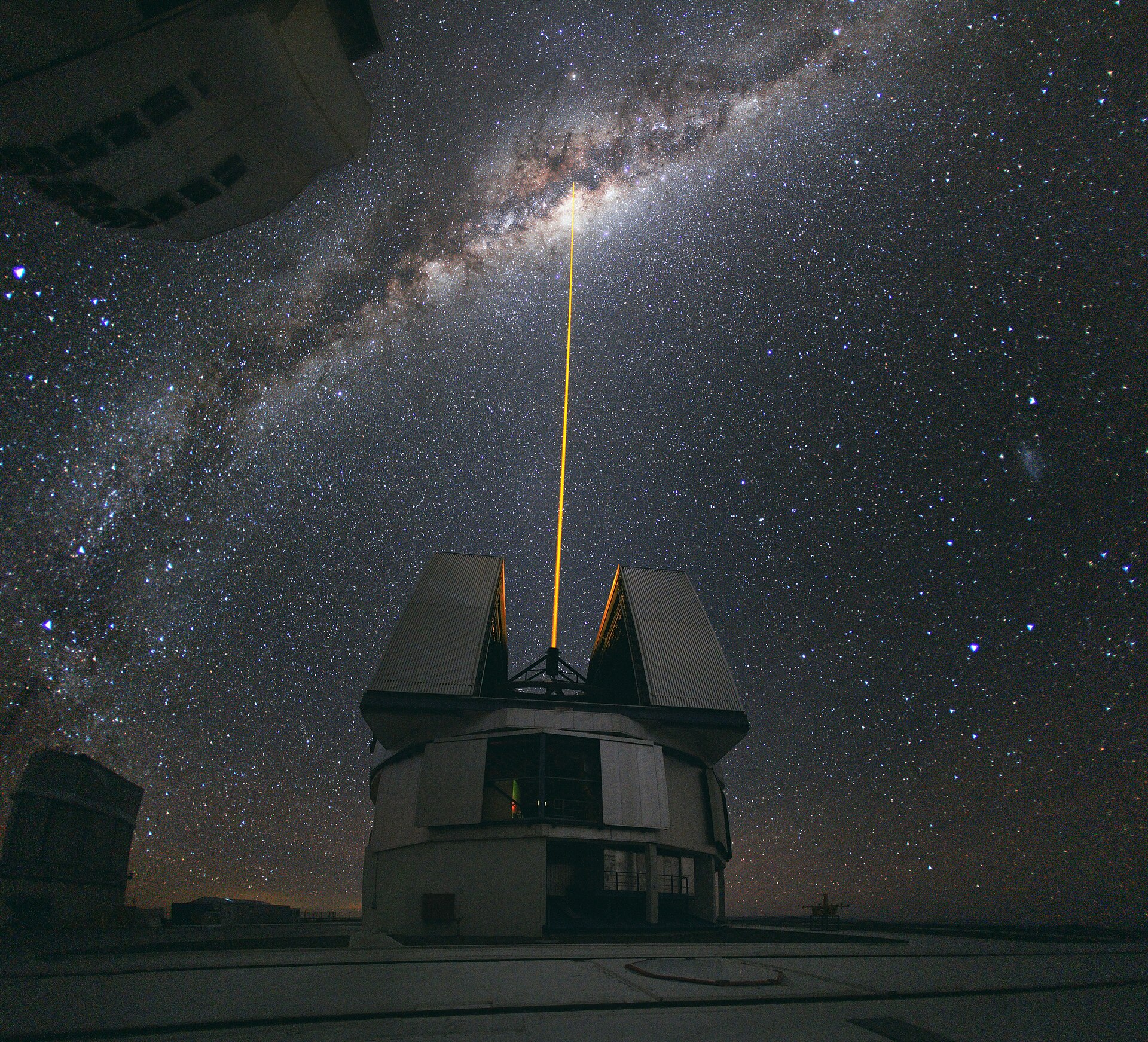
Laser is an acronym for light amplification by the stimulated emission of radiation. A laser is a device that stimulates atoms or molecules to emit light at particular wavelengths and amplifies that light, typically producing a very narrow beam of radiation. Many different types of lasers have been developed with highly varied characteristics.
1. Physical Principles
In 1917 Einstein postulated on thermodynamic grounds that the probability of spontaneous emission is related to the probability of stimulated emission, a relation known as the Einstein A and B coefficients. Stimulated emission is the quantum process that makes the laser possible: a ray passing through excited atoms can stimulate them to emit further rays of the same wavelength. Britannica describes the resulting device as one that produces monochromatic coherent light in which the rays are all of the same wavelength and phase.
A population inversion in atomic or molecular energy states is a precondition for laser action, and it cannot be achieved with just two levels. The obstacle is that absorption and stimulated emission are equally probable in a two-level scheme, so pumping atoms upward is matched by their prompt return. The lifetime of a typical excited state is about ten to the minus eight seconds, so electrons drop back down about as fast as they can be pumped up.
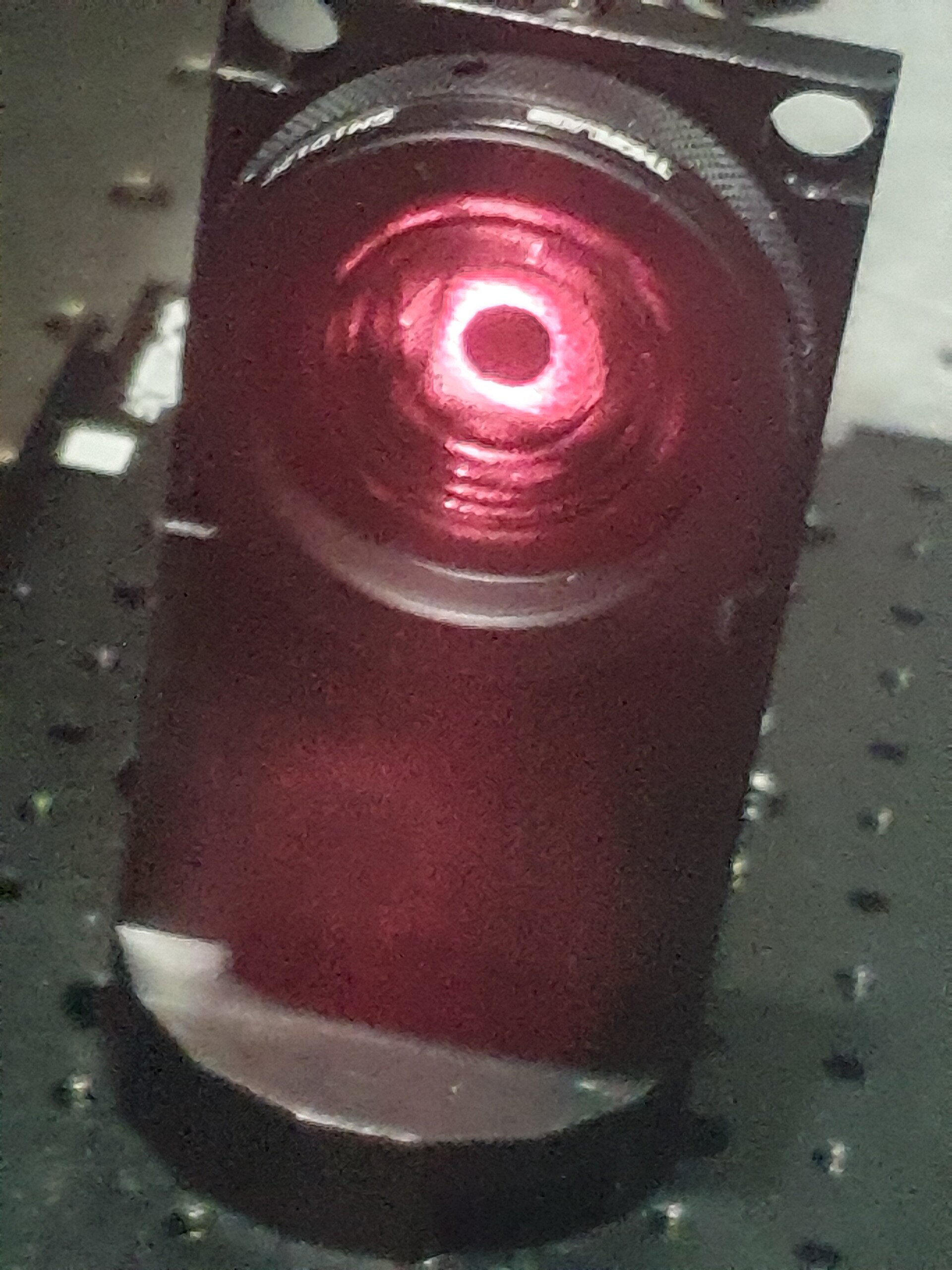
Laser action was first achieved in three-level systems, such as the helium-neon laser, where collisional transfer from helium overcomes the two-level limitation. In the helium-neon laser an excited level of helium lies close to a level in neon, so collisions transfer energy from the helium to the neon atoms. The helium-neon laser is usually constructed to operate in the red at 632.8 nm.
2. From Maser to Laser
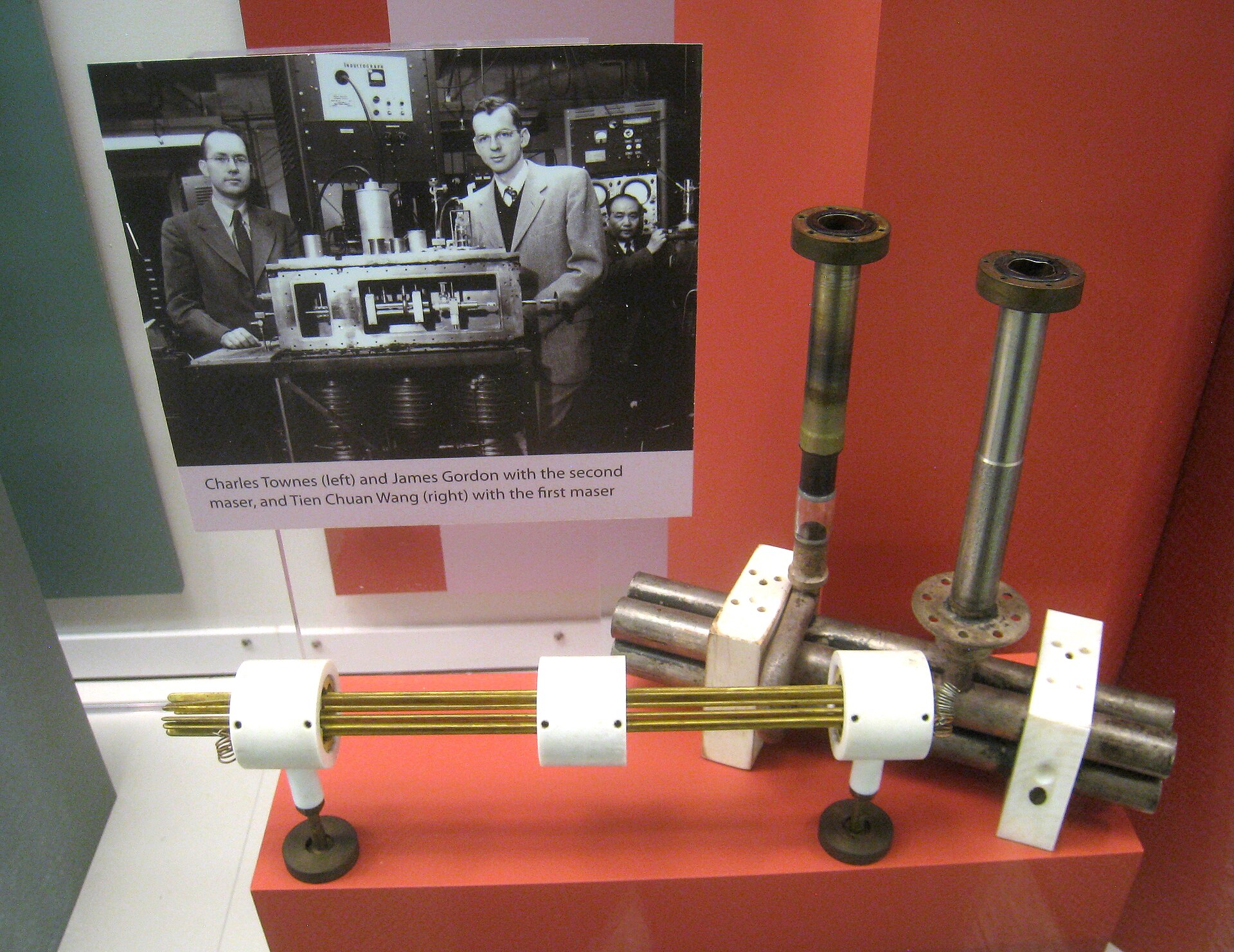
In 1951 Charles Townes found a solution: under the right conditions, inside a resonating cavity like the ones used to generate radar waves, the right kind of collection of molecules might generate radiation all on its own. The maser was first operated in 1954 through simultaneous independent work by Townes at Columbia and Basov and Prokhorov in Moscow. Townes predicted that the radiation from the maser would be at a single frequency, as pure as a note from a tuning fork. In Moscow, Prokhorov and Basov were thinking in the same direction and in 1955 they built a maser. The first papers about the maser had been published a decade earlier by the Columbia and Lebedev groups.
While studying the equations for amplifying radiation in 1957 Townes realized that it would be easier to make it happen with very short waves than with far-infrared waves, and he talked the idea over with his colleague and brother-in-law Arthur Schawlow. The laser dates from 1958 when the possibilities of applying the maser principle in the optical region were analysed by Schawlow and Townes as well as at the Lebedev Institute, and two years later the first laser was operating. Maiman opened his letter by noting that Schawlow and Townes had proposed a technique for generating very monochromatic radiation in the infra-red optical region using an alkali vapour as the active medium. Nature's editorial summary noted that after the maser principle was demonstrated in 1954 systems were sought in which the effect occurred in the infrared and visible spectrum, a goal reached in 1960 when Maiman achieved optical laser action in ruby.
Gould wrote down his ideas for the record and in April 1959 filed patent applications with his employer TRG, nine months after Schawlow and Townes had applied for a patent on behalf of Bell Laboratories. An entry on Gould's initial ideas for the laser was dated and notarized in November of 1957 and he fought for decades; he was finally granted patent rights, receiving his fourth and final patent on lasers in 1988 after long litigation. When the Bell patent was granted Gould sued claiming he was first to conceive the device, and the legal battles raged for the next thirty years, until in 1987 Gould and his backers began to win settlements.
3. First Laser
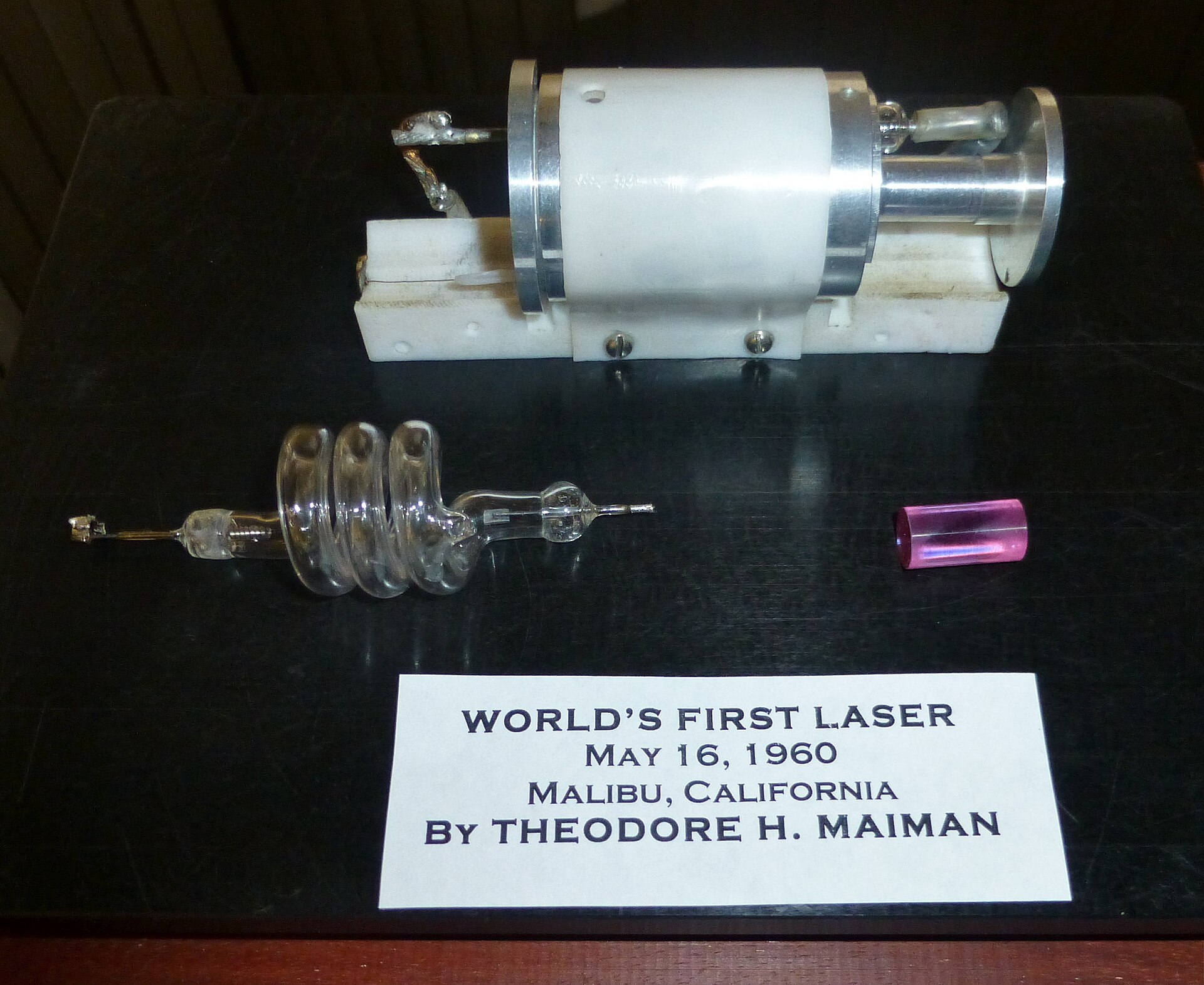
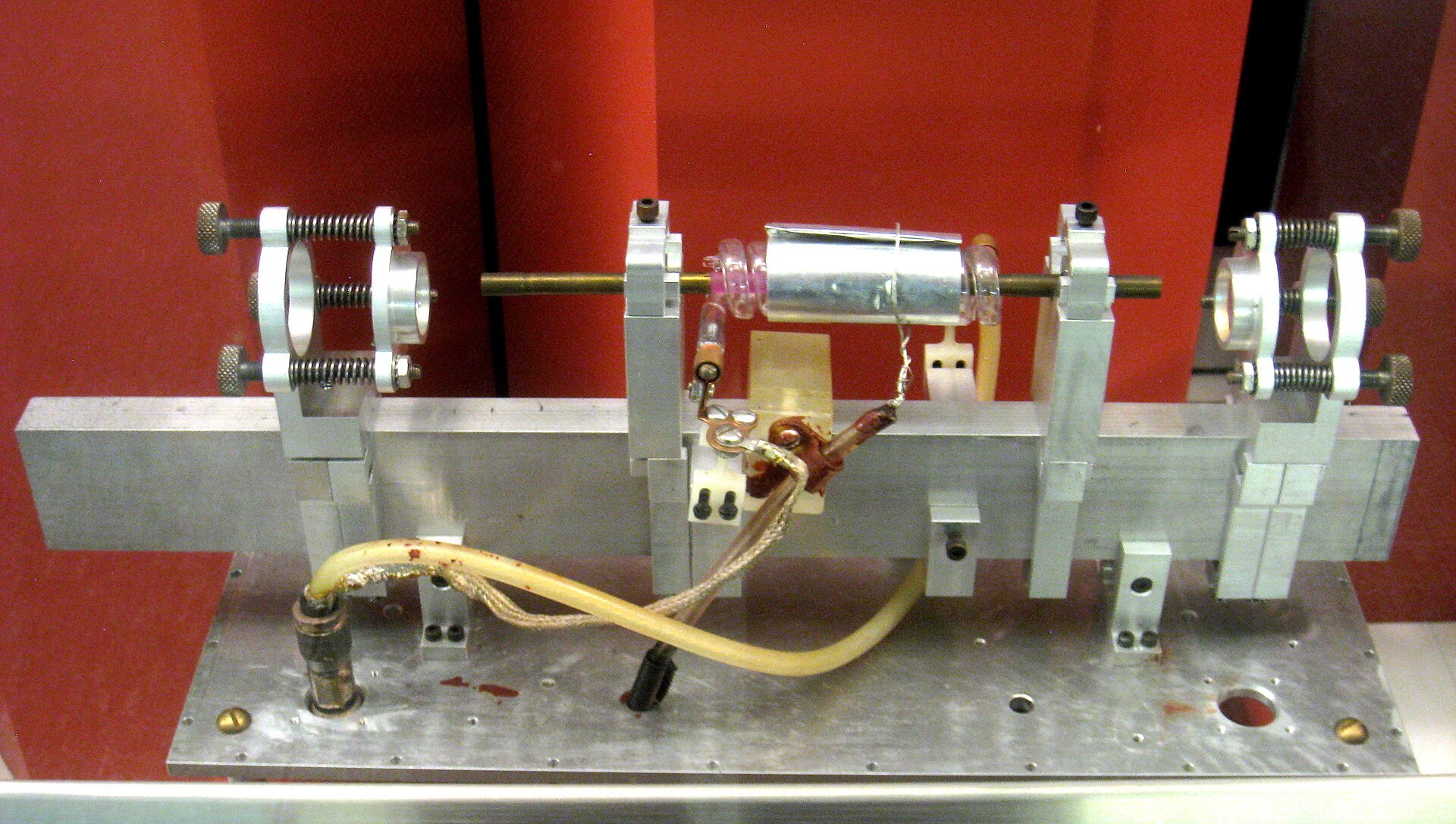
The first working laser was built by Theodore H. Maiman at Hughes Research Laboratories in Malibu, California. Maiman realized the light source did not have to shine continuously and a flash lamp would do. With an assistant, Irnee d'Haenens, he assembled the components, and on 16 May 1960 they observed pulses of red light. The device was pumped by a xenon flash lamp.
The Smithsonian holds a ruby crystal from Maiman's experiments of May 1960 mounted in a small holder that also contained a spiral flashlamp of the kind photographers used. No one knows with certainty which crystal actually generated the first laser light, although when this one was donated to the Smithsonian in 1967 officials at Hughes reported that it was the first. The Science Museum Group holds a case cut away to reveal a ruby laser made at the Services Electronics Research Laboratories in Baldock in 1961 and it is the second such device to operate in the United Kingdom.
Maiman's letter also cited proposals by Javan and by Sanders that involved electron-excited gaseous systems. Maiman was born 11 July 1927 in Los Angeles and died 5 May 2007 in Vancouver, aged 79.
4. Early Laser Development
In December of 1960 Javan with Herriott and Bennett produced a continuous beam of infrared rays, the first gas laser, so that by the end of 1960 three quite different types of laser had been demonstrated. The carbon dioxide laser, pumped by an electric discharge with nitrogen as a pumping gas, is the most efficient laser, capable of operating at more than 30 percent efficiency, and is widely used for welding and cutting.
Only a few years after the first laser demonstration, bright coherent beams had exposed new forms of light-matter interaction and given birth to the field of nonlinear optics, and the parallel growth of electronics gave rise to electro-optics.
5. Nobel Recognition
The Nobel Prize in Physics 1964 was divided, one half to Charles Hard Townes, and the other half jointly to Nicolay Basov and Aleksandr Prokhorov for fundamental work in quantum electronics which led to the maser-laser principle. The presentation speech emphasized that using a laser beam for destructive purposes over large distances is wholly unrealistic, and that the death ray is and remains a myth.
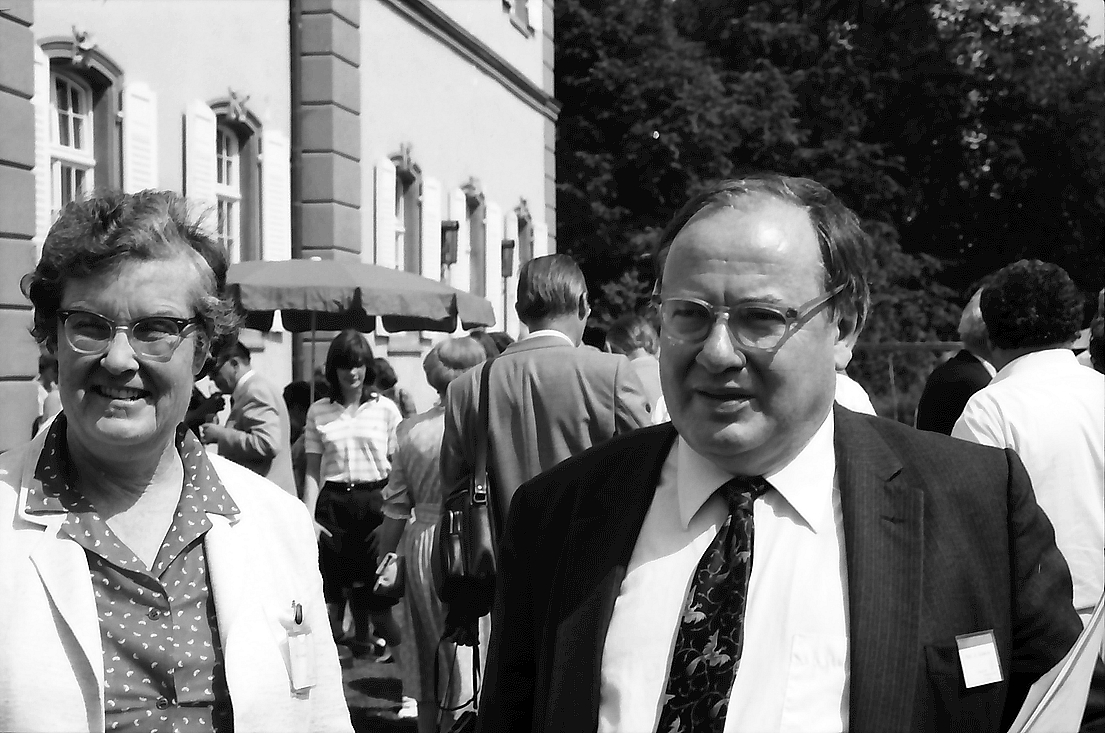
The Nobel Prize in Physics 2018 was awarded for groundbreaking inventions in the field of laser physics, with one half to Arthur Ashkin for the optical tweezers and their application to biological systems.
6. Optical Tweezers
Arthur Ashkin's optical tweezers grab particles, atoms and molecules with laser beam fingers. The radiation pressure of light, an old dream of science fiction, was put to work when Ashkin got laser light to push small particles towards the centre of the beam and to hold them there.
When bacteria close to the laser beam were caught in the light trap, Ashkin found that his green laser beam killed them, so a weaker beam was necessary; in invisible infrared light the bacteria stayed unharmed and were able to reproduce in the trap. The tweezers are now widely used to investigate the machinery of life.
7. Chirped Pulse Amplification
Before chirped pulse amplification, the peak power attainable in a laser was constrained by damage to the amplifying material. The revolutionary article by Mourou and Strickland, the foundation of Strickland's doctoral thesis, was published in 1985 and described the creation of ultrashort high-intensity laser pulses that did not destroy the amplifying material.
Chirped pulse amplification soon became the standard for subsequent high-intensity lasers, and its uses include the millions of corrective eye surgeries conducted every year with the sharpest of laser beams. Mourou initiated and led the early development of the Extreme Light Infrastructure, with three sites in the Czech Republic, Hungary and Romania planned for a peak power of 10 petawatts.
8. Large-Scale Laser Facilities
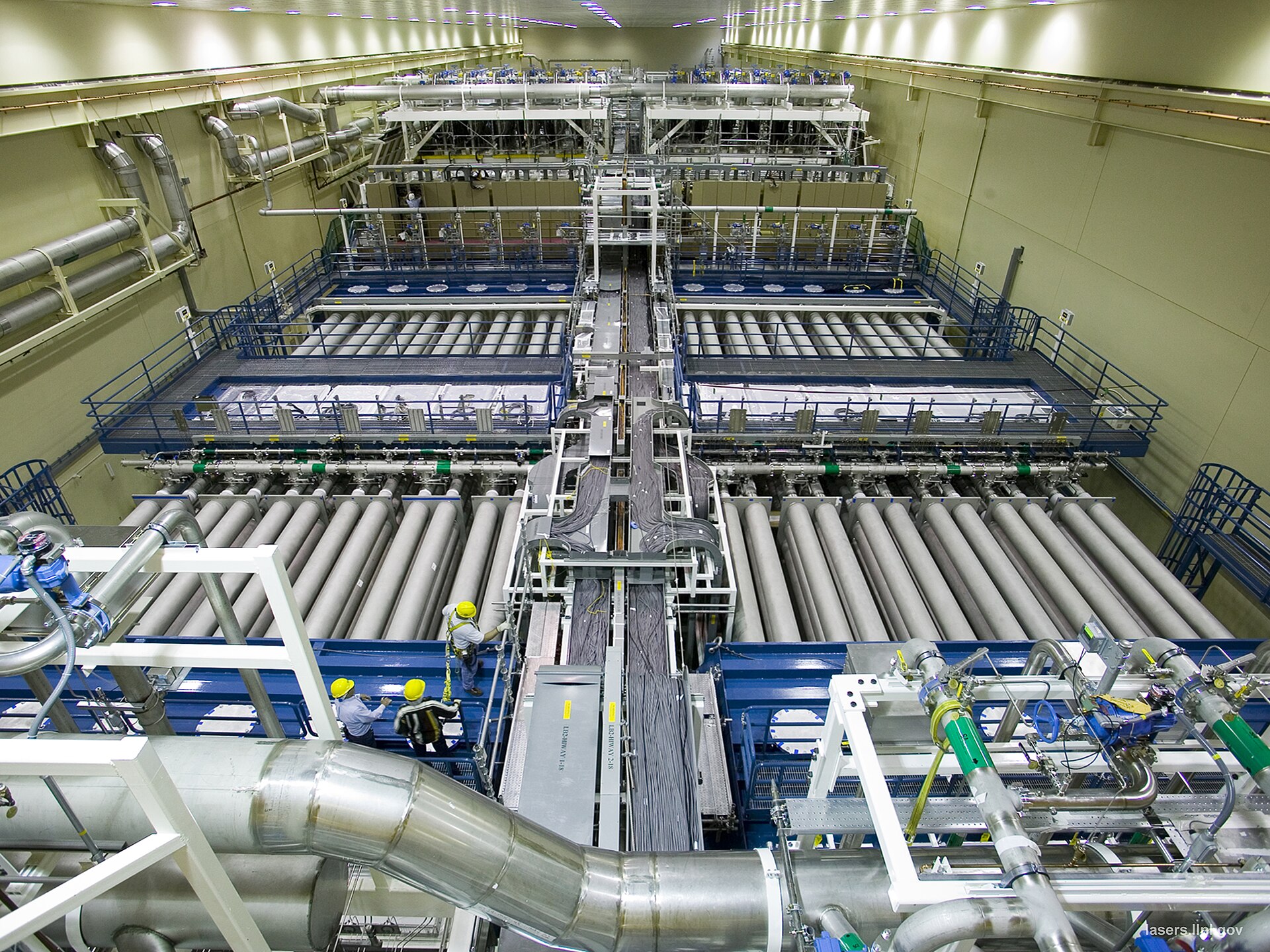
The National Ignition Facility became operational in 2009 and its optics team has hardened the optics to withstand ever-increasing laser energy as the facility routinely exceeded its design specification of 1.8 megajoules.
LIGO detects gravitational waves by splitting a laser beam in half and sending each half down an arm of the interferometer, where it bounces between test masses about 300 times before the beams are recombined. In LIGO the laser acts as a ruler: when the arms change length the recombined beams no longer cancel out and instead generate a flicker of light at the photodetector.
9. Safety
A laser beam can focus to an almost microscopic dot on the retina, so direct viewing can cause almost instant eye damage, while the same focusing power underlies medical and industrial uses 4Quantum Properties of Light: Coherence, Population Inversion and Laser Characteristics · HyperPhysics, Georgia State University ↗. An unfocused helium-neon laser of one milliwatt has a brightness equal to sunshine on a clear day and is just as dangerous to stare at directly 5Helium-Neon Laser; Carbon Dioxide Laser; Argon Laser · HyperPhysics, Georgia State University ↗. Until 1985 the peak power of laser pulses had been limited by the damage the pulses caused to the material used to amplify them, when Mourou and Strickland demonstrated a table-top terawatt laser 19Rochester breakthrough in laser science earns Nobel Prize · University of Rochester News Center ↗.
10. Timeline
-
1959Maiman's ruby experimentsAfter attending a conference in September of 1959 Maiman ran experiments on whether a ruby crystal could emit laser light.10Ruby Crystal from Maiman Laser · National Museum of American History, Smithsonian Institution ↗
-
16 May 1960First operating laserMaiman and his assistant Irnee D'Haenes demonstrated the first operating laser, which worked in pulses rather than as a continuous beam.10
11. Key Figures
| Name | Lifespan | Role |
|---|---|---|
| Theodore H. Maiman | born 11 July 1927 in Los Angeles, died 5 May 2007 in Vancouver aged 79 | American physicist who constructed the first laser, later founded the Korad Corporation |
| Charles H. Townes | born 28 July 1915 in Greenville, South Carolina, died 27 January 2015 in Berkeley, California | 1964 Nobel co-recipient |
| Donna Strickland | born 27 May 1959 in Guelph, Canada | PhD from the University of Rochester in 1989 |
Donna Strickland shared the 2018 Nobel Prize in Physics; she was affiliated with the University of Waterloo at the time of the award 20Donna Strickland · NobelPrize.org, Nobel Prize Outreach ↗. Strickland is only the third woman to receive the Nobel Prize in physics, joining Marie Curie and Maria Goeppert-Mayer, and the first woman laureate in Rochester's history 19.
12. Timeline: from Einstein's prediction to fusion ignition
- 1917Einstein predicts stimulated emissionEinstein postulated on thermodynamic grounds that the probability of spontaneous emission was related to the probability of stimulated emission, introducing the relations now called the Einstein A and B coefficients.
- 1951Townes conceives the maserCharles Townes found a solution: under the right conditions, inside a resonating cavity like the ones used to generate radar waves, the right kind of collection of molecules might generate radiation all on its own.
- 1954The first maser operatesBy 1954 Townes and his students had the device working, and he called it a MASER, for microwave amplification by stimulated emission of radiation.
- 1955Maser built in MoscowIn Moscow, Prokhorov and Basov were thinking in the same direction as Townes, and in 1955 they built a maser.
- November 1957Gould's laser notebook entryAn entry on Gordon Gould's initial ideas for the laser was dated and notarized in November, and he would fight for decades for patent rights based on them.
- December 1958Schawlow and Townes publish the optical maser paperThe optical maser, that is, the laser, dates from 1958: in that year the possibilities of applying the maser principle in the optical region were analysed by Schawlow and Townes as well as in the Lebedev Institute.
- 16 May 1960First laser operatesAt Hughes Research Laboratories, Theodore Maiman assembled the components with an assistant, Irnee d'Haenens, and they observed pulses of red light.
- 6 August 1960Maiman's letter appears in NatureThe letter Stimulated Optical Radiation in Ruby, by T. H. Maiman, was published in Nature, describing stimulated optical emission at a wave-length of 6943 angstroms from chromium in corundum.
- December 1960The first gas laserBack at Bell Labs, Ali Javan with Donald Herriott and William Bennett produced a continuous beam of infrared rays, the first gas laser, so that by the end of 1960 three quite different types of laser had been demonstrated.
- 1961Second laser in the United KingdomA ruby laser made at the Services Electronics Research Laboratories in Baldock was the second laser to operate in the United Kingdom.
- 1962Korad Corporation foundedTwo years after operating the first successful laser, Maiman established the Korad Corporation for research, development and manufacture of lasers.
- 1964Nobel Prize honours the maser and the laserThe Nobel Prize in Physics was divided, one half to Charles Hard Townes, and the other half jointly to Nicolay Basov and Aleksandr Prokhorov for fundamental work in quantum electronics.
- 1985Chirped pulse amplification demonstratedMourou and Strickland demonstrated a table-top terawatt laser, an advance that overcame the damage limiting the peak power of laser pulses in the amplifying material.
- 1987Optical tweezers capture living bacteriaAt Bell Labs, Ashkin used optical tweezers to capture living bacteria without harming them, opening the study of biological systems with laser traps.
- 2018Nobel Prize for inventions in laser physicsThe prize was awarded for groundbreaking inventions in the field of laser physics: one half to Arthur Ashkin for optical tweezers, and the other half jointly to Gerard Mourou and Donna Strickland.
- 5 December 2022Fusion ignition at the National Ignition FacilityOn 5 December 2022 Lawrence Livermore National Laboratory made history, demonstrating fusion ignition for the first time in a laboratory setting, an achievement six decades in the making.
References (22)
- 1Laser — Encyclopaedia Britannica ArchiveView source
- 2Einstein A and B Coefficients — HyperPhysics, Georgia State University WebView source
- 3Theodore H. Maiman — Encyclopaedia Britannica ArchiveView source
- 4Quantum Properties of Light: Coherence, Population Inversion and Laser Characteristics — HyperPhysics, Georgia State University Web↩View source
- 5Helium-Neon Laser; Carbon Dioxide Laser; Argon Laser — HyperPhysics, Georgia State University Web↩View source
- 6Bright Idea: The First Lasers — American Institute of Physics, Center for History of Physics WebView source
- 7Award Ceremony Speech, Nobel Prize in Physics 1964 (Professor B. Edlen) — NobelPrize.org, Nobel Prize Outreach 1964 WebView source
- 8Stimulated Optical Radiation in Ruby (T. H. Maiman, Nature 187, 493-494, 1960) — Nature 1960 JournalView source
- 9This Month in Physics History: December 1958: Invention of the Laser — APS News, American Physical Society 1958 WebView source
- 10Ruby Crystal from Maiman Laser — National Museum of American History, Smithsonian Institution Archive↩View source
- 11Ruby laser, the second to operate in the United Kingdom — Science Museum Group Collection WebView source
- 122020: 60 Years of Lasers — Optica (formerly the Optical Society) 2020 WebView source
- 13The Nobel Prize in Physics 1964 — NobelPrize.org, Nobel Prize Outreach 1964 WebView source
- 14The Nobel Prize in Physics 2018 — NobelPrize.org, Nobel Prize Outreach 2018 WebView source
- 15Popular Information: Tools made of light, Nobel Prize in Physics 2018 — NobelPrize.org, Nobel Prize Outreach 2018 WebView source
- 16Press Release: The Nobel Prize in Physics 2018 — NobelPrize.org, Nobel Prize Outreach 2018 WebView source
- 17Celebrating the Milestone of Ignition — Lawrence Livermore National Laboratory WebView source
- 18LIGO Technology — LIGO Laboratory, Caltech and MIT WebView source
- 19Rochester breakthrough in laser science earns Nobel Prize — University of Rochester News Center Web↩View source
- 20Donna Strickland — NobelPrize.org, Nobel Prize Outreach 2018 Web↩View source
- 21Arthur Ashkin — NobelPrize.org, Nobel Prize Outreach 2018 WebView source
- 22Charles H. Townes — NobelPrize.org, Nobel Prize Outreach 1964 WebView source