Rainbow
The geometric optics of the rainbow: how sunlight is refracted, reflected and dispersed inside raindrops to produce the 42 degree primary bow, the 51 degree secondary bow, Alexander's band and the supernumerary arcs that defeated ray optics.
A rainbow is an optical phenomenon produced when sunlight enters spherical raindrops, is refracted, reflected once inside and refracted out again. Because the refractive index of water varies with wavelength, colours leave each drop at slightly different angles, and the concentration of rays near the angle of minimum deviation builds the bright primary bow about 42 degrees from the antisolar point, with red on the outside. Two internal reflections produce the fainter secondary bow near 51 degrees, with the colour order reversed, and the sky between the two bows is darkened as Alexander's band. Rays alone cannot explain the supernumerary arcs that appear just inside the primary bow; those fringes required Airy's wave theory of 1838 and the later interference treatments of the rainbow. The bow is a circle centred on the observer's shadow, so it is always opposite the Sun and its visible extent depends on the Sun's altitude. Aristotle explained the bow as reflection from a cloud, Theodoric of Freiberg traced rays through a water globe in the fourteenth century, Descartes derived the angles geometrically in Les Meteores in 1637, and Newton divided the spectrum into seven colours in Opticks. Moonbows, fogbows and the tertiary and quaternary bows extend the same physics into fainter and stranger displays.
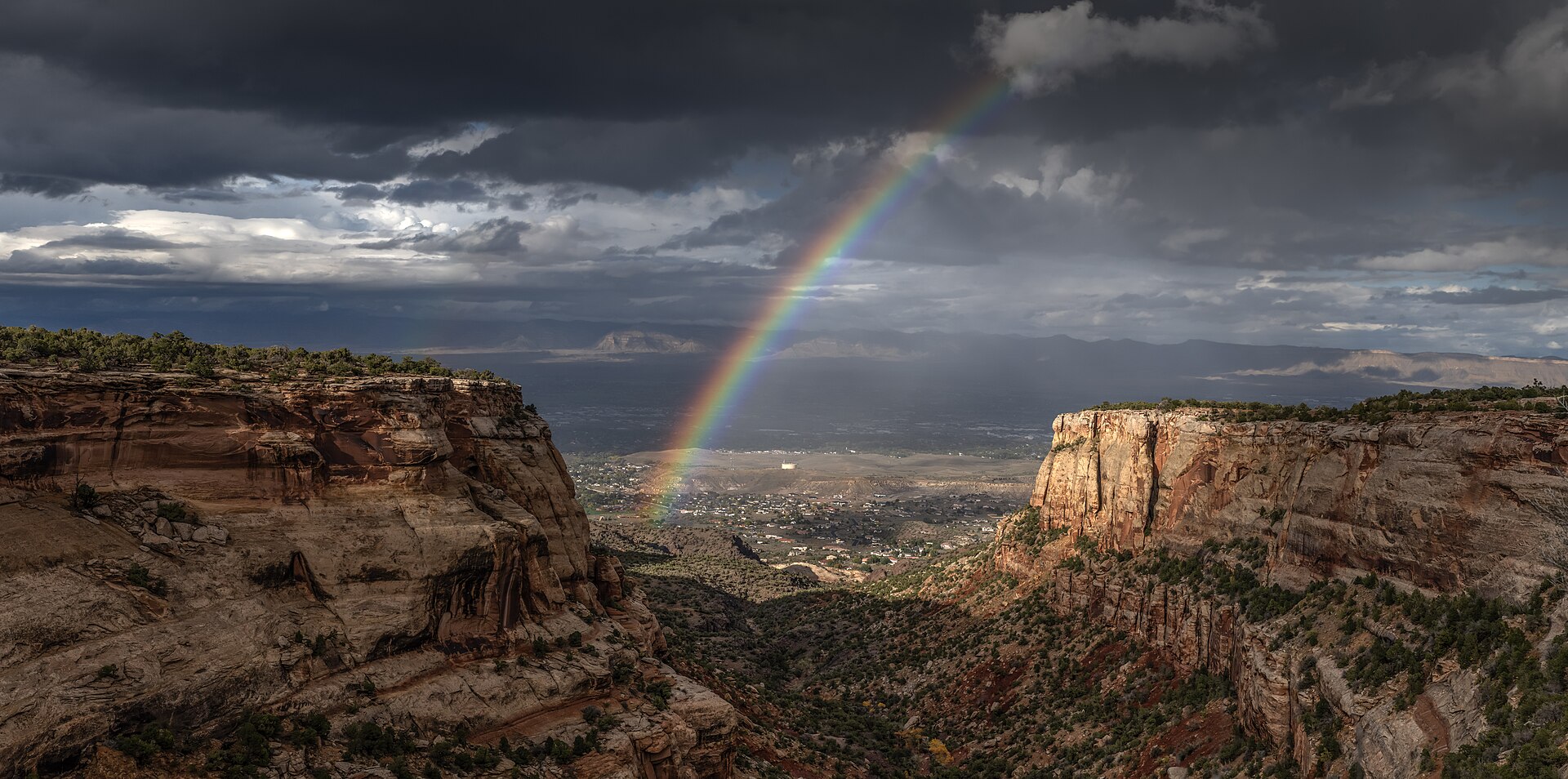
In this article
- 1Overview
- 2Geometry and the observer
- 3Formation in a water droplet
- 4The primary bow
- 5The secondary bow and Alexander's band
- 6Supernumerary arcs and higher-order bows
- 7Colour, spectrum and the number seven
- 8History of explanation
- 9Newton's measurements
- 10Variants: moonbows and fogbows
- 11Related phenomena and terminology
- 12Cultural and religious significance
- 13Timeline: from Aristotle's Meteorologica to the first photographs of higher-order bows
- 14Knowledge graph
Overview
A rainbow is an arc-shaped spectrum of light created by refraction and reflection.
A rainbow demonstrates the dispersion of light and is evidence that visible light is composed of a spectrum of wavelengths.
1. Geometry and the observer
A rainbow is not an object in a particular place but an optical phenomenon that depends on the viewer's position. The Sun must be behind the observer and water droplets in front. To view a rainbow the observer's back must be to the sun while looking about 40 degrees above the ground into droplets or mist.
Rainbows are always opposite the Sun and their centres lie below the horizon at the antisolar point, so the lower the Sun the higher the bow. The apparent centre of a rainbow is the shadow of the observer's head, so each person sees a slightly different bow.
Rainbows are not seen at midday because the whole 42 degree circle lies below the horizon at most latitudes.
From an airplane the entire circle of a rainbow can be seen because droplets may be falling both above and below the observer.
2. Formation in a water droplet
A ray of sunlight entering a raindrop is bent toward the normal as it crosses the surface, turned back by an internal reflection, and bent again as it leaves, this time away from the normal. Each droplet thus behaves as a minute prism that separates light into its constituent colours and returns it toward the observer.
The separation arises because refraction depends on wavelength: blue and violet light of shorter wavelength refract slightly more than longer-wavelength red light. Within a droplet violet, the shortest visible wavelength, bends the most, while red, the longest, bends the least.
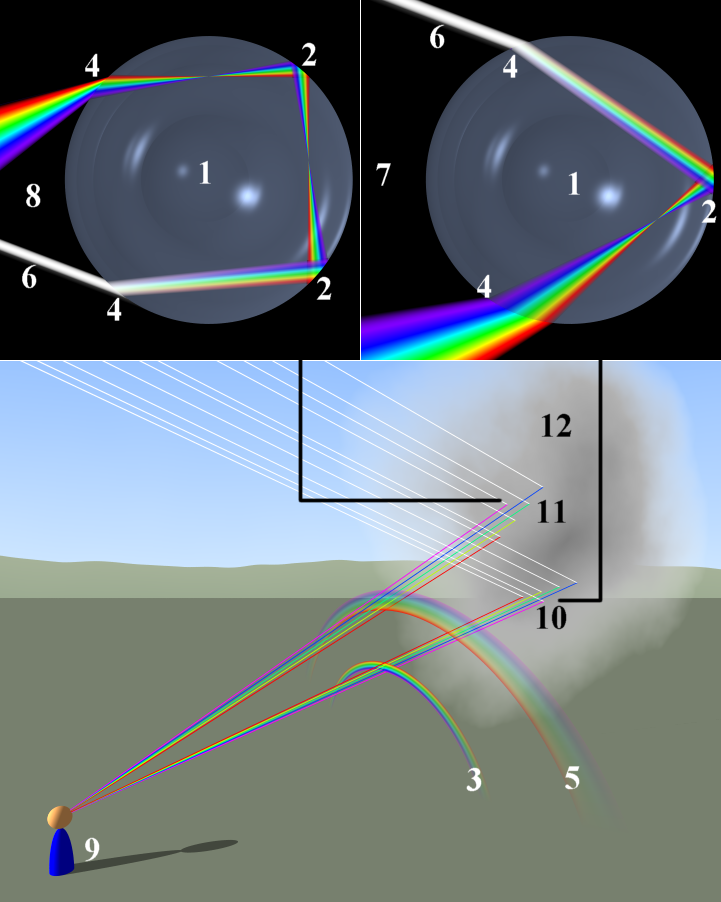
The outgoing rays are most densely gathered at angles of deviation between 40 and 42 degrees. The reflection at the back of the drop contributes no dispersion of its own, since the law of reflection does not depend on wavelength.
Because the droplets need only hang in the air, waterfalls and garden sprinklers can produce rainbows as readily as falling rain.
For a given medium the index of refraction increases as wavelength decreases and is greatest for violet light; in water it rises from 1.331 for red light at 660 nanometres to 1.342 for violet light at 410 nanometres.
Red light leaves the drop at a deviation of about 42 degrees and violet at about 40, which places red on the outside of the primary bow.
3. The primary bow
The primary bow is the brighter of the two arcs Newton describes, formed by a single internal reflection within the raindrops. Its colours run from red on the outside of the arc to violet on the inside.
The band is not evenly bounded: its inner edge is diffuse while its outer edge is sharp. Newton popularised seven distinct colours, yet a rainbow actually contains a continuous range of hues.
A rainbow is not just a set of coloured rings: the sky inside is bright because raindrops direct light there too, making the primary a disk that brightens toward its rim.
4. The secondary bow and Alexander's band
The secondary bow is fainter because light is lost at each internal reflection, about twice as wide as the primary, and appears at a radius of about 51 degrees, roughly 9 degrees outside the primary.
The colour order of the secondary bow is reversed because sunlight is reflected twice inside the drop, with red on the bottom and violet on the top, so that the reds of the two bows face one another.
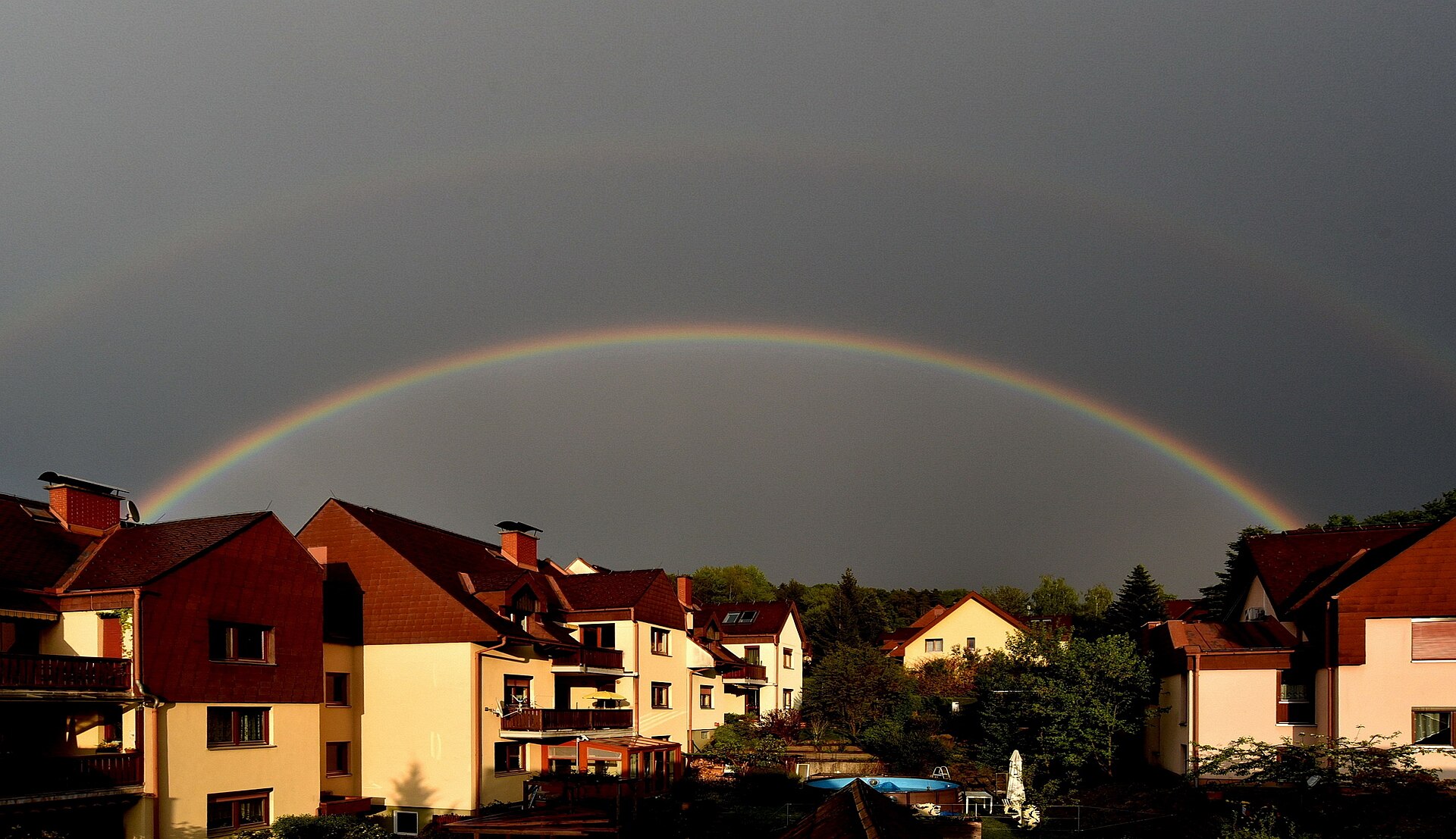
Alexander's band is the darker sky between the two bows, where no reflected light reaches the eye; it is named after Alexander of Aphrodisias, who described it some 1800 years ago.
Its outer edge is diffuse while its inner edge is sharp, the reverse of the primary bow.
5. Supernumerary arcs and higher-order bows
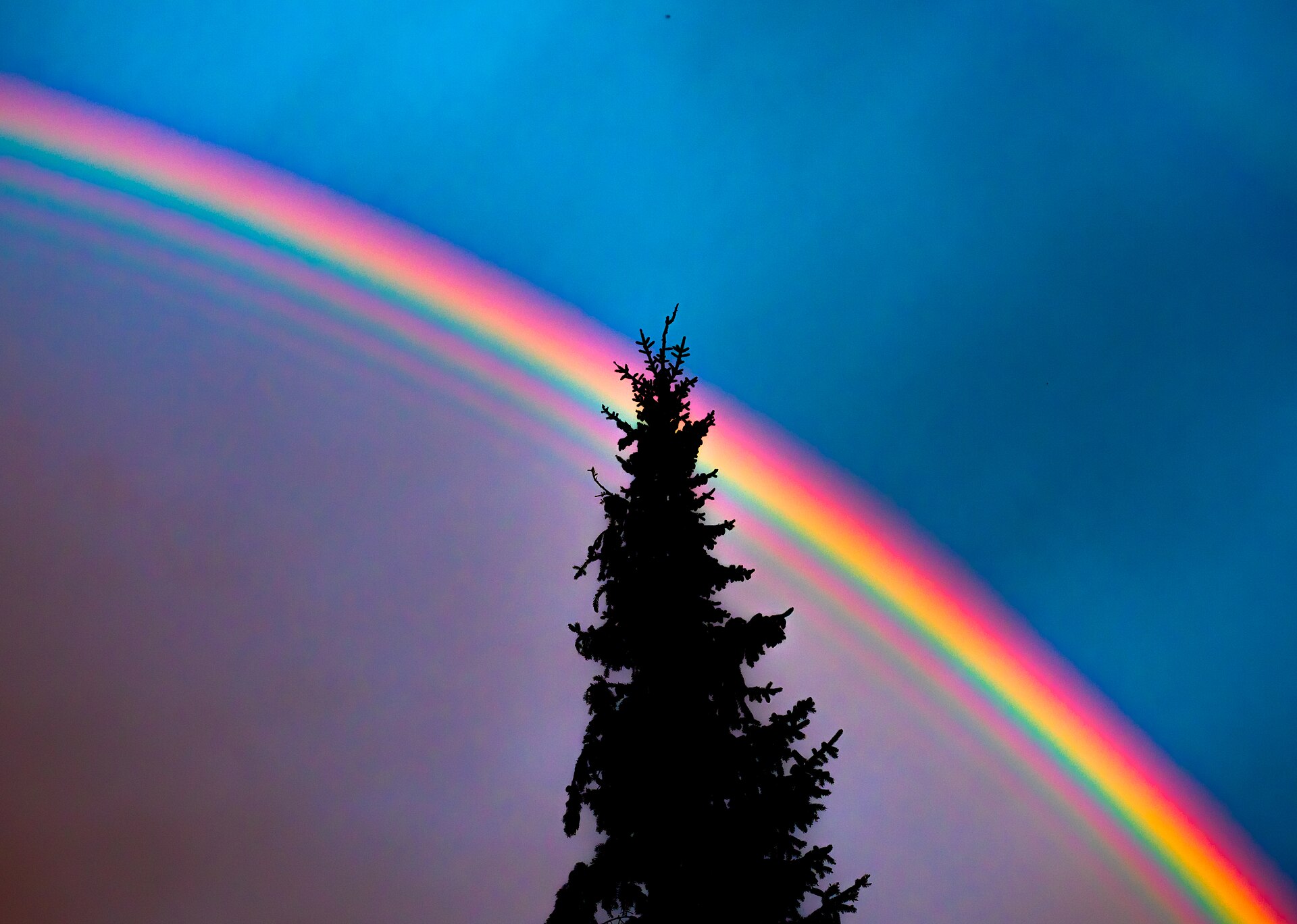
Supernumerary arcs appear as interference fringes along the inner edge of the primary bow, closely spaced greenish and purple arcs lying on the inner, blue side.
Classical ray theory predicts extra brightness where two rays of equal deviation meet, but the waves can arrive out of phase and cancel instead. As the deviation angle changes the paired waves alternately reinforce and cancel, producing light and dark fringes whose bright fringes are supernumerary bows.
The tertiary bow is centred on the Sun and appears sunwards, so the observer must look back toward the Sun to see it. Its radius is given as 40 degrees 20 minutes around the Sun in one treatment and as a nominal 42.5 degrees in another, with the latter also assigning it about 24 percent of the primary's brightness.
The first photograph of a natural third-order bow was taken on 15 May 2011 by Michael Grossmann in south-west Germany. In the laboratory, orders up to thirteen have been produced with a laser and water droplets.
6. Colour, spectrum and the number seven
White light passing through a triangular prism separates into red, orange, yellow, green, blue and violet. The separation begins at the first face of the prism and increases at the second face. The angle of deviation varies with wavelength because the indices of refraction differ.
About six colours are seen in a rainbow, red, orange, yellow, green, blue and violet, with indigo sometimes added. The colour sequence follows the same order as the colours plotted against wavelength.
A rectangular prism reverses the refraction at exit, leaving only thin red and violet fringes rather than a spread spectrum.
7. History of explanation
Kamal al-Din al-Farisi worked in Persia from 1267 to 1319 and built an enormous water drop to study how droplets split white light.His experiments belong to a tradition of optical inquiry in which Theodoric of Freiberg performed similar optical experiments, and both he and al-Farisi relied on the work of Ibn al-Haytham.
Descartes gave a rough explanation of rainbows but did not account for supernumerary arcs, which need the wave theory that Airy applied with reasonable accuracy in about 1838 to explain them.
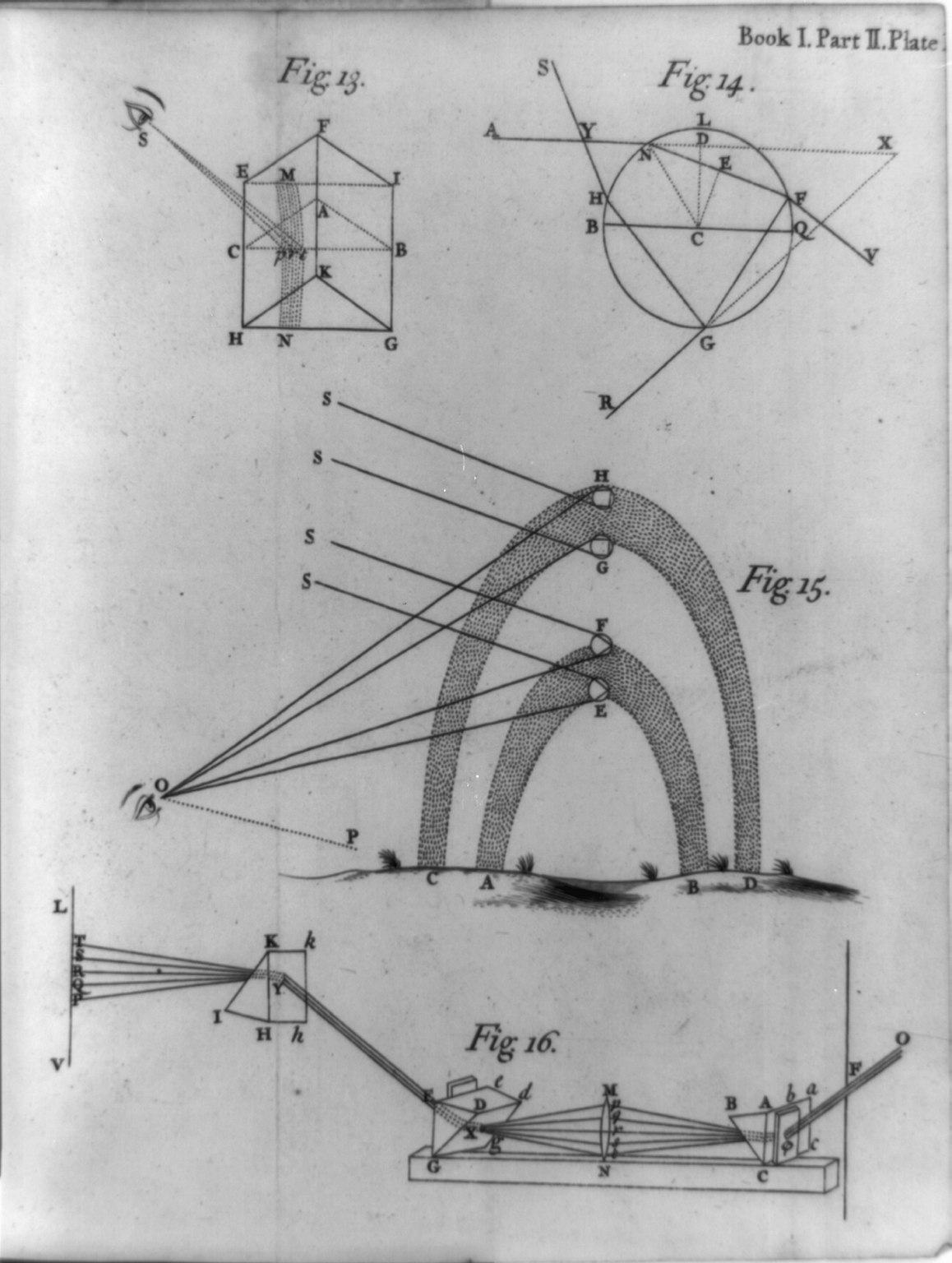
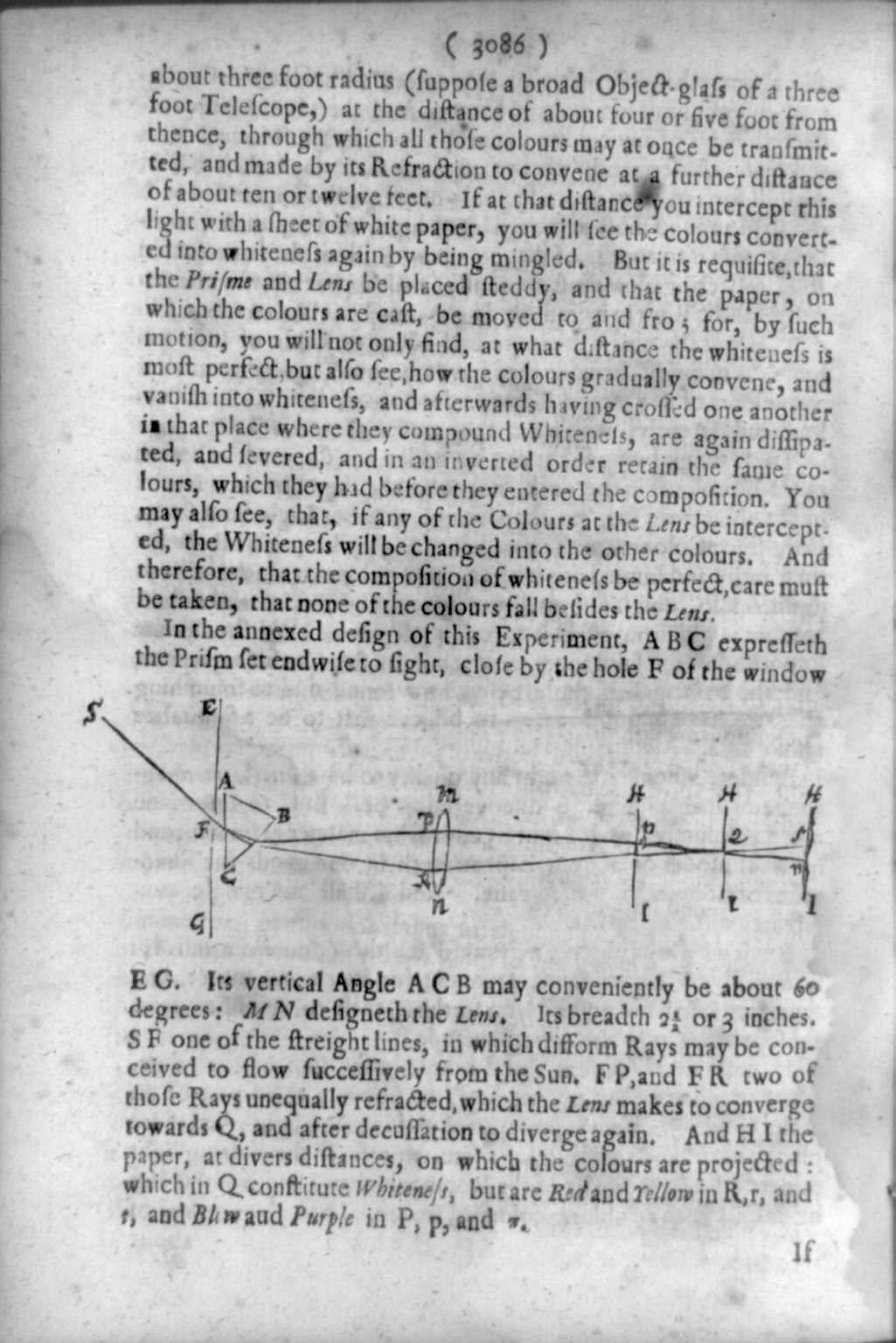
Newton passed a thin beam of sunlight through a glass prism and argued that white light is a mixture of rays refracted at slightly different angles.
Aristotle held that the rainbow came from sunlight reflected by the surface of a cloud, its colours a mixture of light and darkness.
8. Newton's measurements
Newton computed the red-ray angles of both bows and measured their angular widths, fixing the geometry that later measurements have largely confirmed.8Opticks, or a Treatise of the Reflections, Refractions, Inflections and Colours of Light · Isaac Newton, Project Gutenberg edition of the 1730 fourth edition ↗
| Quantity | Primary bow | Secondary bow |
|---|---|---|
| Newton's computed bow angles | 42 degrees 2 minutes | 50 degrees 57 minutes |
| Measured bow widths | 1 degree 45 minutes | 3 degrees 10 minutes |
9. Variants: moonbows and fogbows
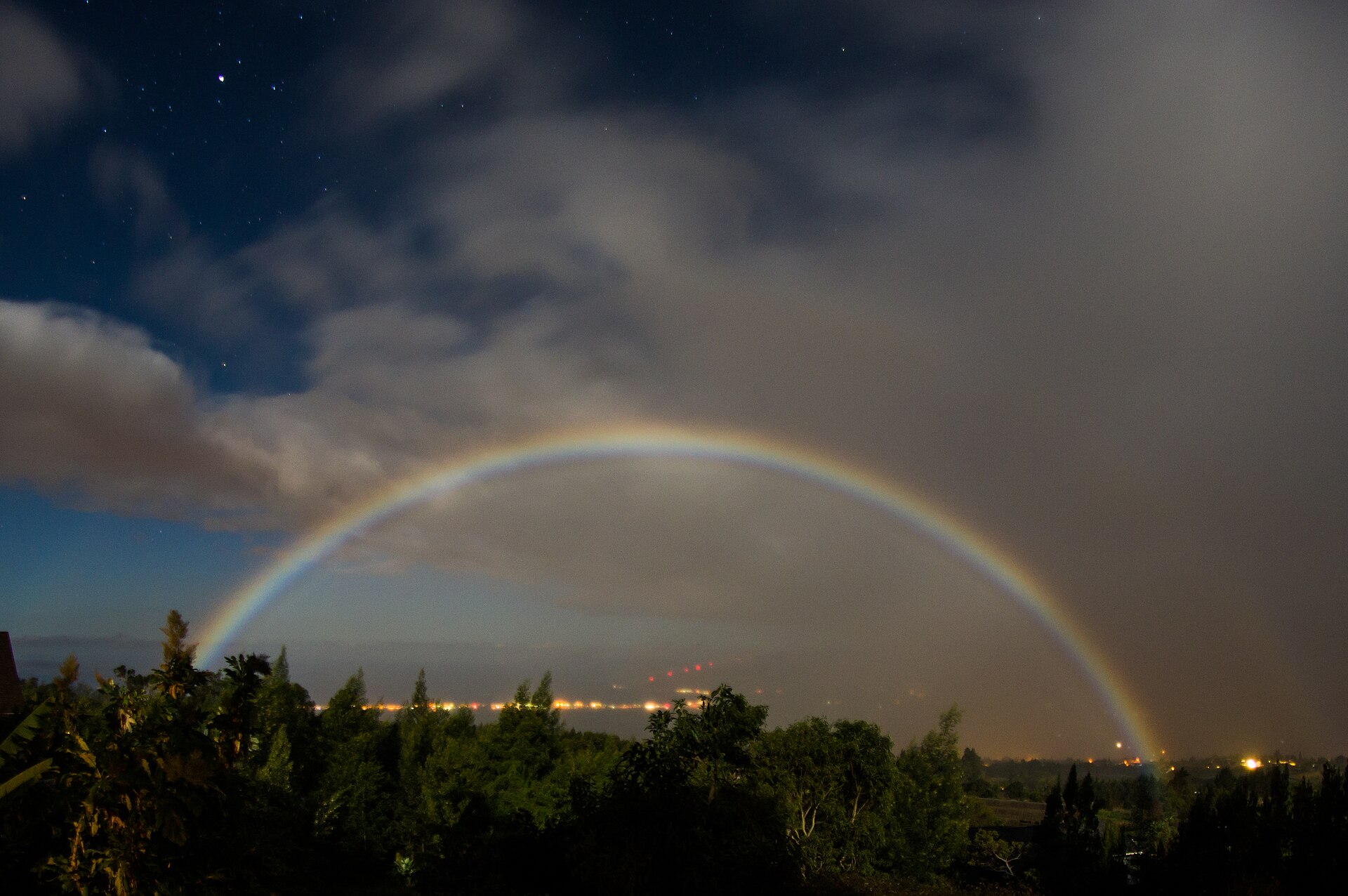
A moonbow requires a nearly full low Moon, a dark sky and rain opposite the Moon. To the unaided eye a moonbow usually appears without colour because its light is too faint to activate the cone receptors.
Fogbows form in fog, mist or cloud, where droplets much smaller than raindrops diffract the light and smear out the colours, so a bow in droplets below 0.05 mm turns white.
10. Related phenomena and terminology
A rainbow belongs to a family of large coloured circular arcs produced when light falls on a population of water drops. Within this family the supernumeraries appear inside the primary bow, and reflection bows complete the group.
The term rainbow is not applied to the corona and glory seen around the Sun and the antisolar point, nor to halos formed by ice crystals.
11. Cultural and religious significance
Iris was the goddess of the rainbow and the messenger of the Olympian gods. Servius held that the rainbow is only the road on which Iris travels, appearing when the goddess wants it and vanishing when it is no longer needed.
In Genesis the bow set in the cloud serves as the sign of a covenant between the deity and the earth.
12. Timeline: from Aristotle's Meteorologica to the first photographs of higher-order bows
- fourth century BCEAristotle explains the bow as reflection from a cloudAristotle's Meteorologica offered the most sophisticated ancient account of the rainbow, treating it as sunlight reflected from the surface of a cloud, with colour arising from a mixture of light and darkness.
- about 200 ADAlexander of Aphrodisias describes the dark bandAlexander of Aphrodisias recorded that the sky between the primary and secondary bows is darker than the surrounding sky, an observation that still carries his name.
- thirteenth centuryAlbertus Magnus points to individual dropsAlbertus Magnus became the first to suggest that refraction by individual drops played a role in forming the rainbow, a step away from Aristotle's reflecting cloud.
- around 1300Kamal al-Din al-Farisi reaches the correct qualitative accountWorking in Persia with a large water-filled vessel, al-Farisi produced a correct qualitative description of the primary and secondary bows independently of Theodoric and possibly before him.
- 1304 to 1311Theodoric of Freiberg traces rays through a water globeIn De Iride Theodoric treated a globe of water as a magnified raindrop and showed that the primary bow comes from two refractions and one internal reflection, while the secondary comes from two reflections.
- 1514Trutfetter publishes Theodoric's theoryJodocus Trutfetter printed an account of Theodoric's rainbow theory with diagrams, keeping the fourteenth-century explanation in circulation before Descartes took it up.
- 1611Antonius de Dominis explains both bowsDe Dominis described the interior bow as two refractions and one reflection and the exterior as two refractions and two reflections, supporting the account with experiments using a water-filled phial and glass globes.
- 1637Descartes publishes Les MeteoresDescartes issued the Discourse on Method at Leiden with three appendices, including Les Meteores, the meteorological treatise that set out the first sustained attempt to put the study of weather on a scientific basis.
- 1672Newton's first paper on light and colourNewton published his first scientific paper on light and colour in the Philosophical Transactions of the Royal Society, arguing that white light is a mixture of rays refracted at different angles.
- 1704Newton's Opticks appearsOpticks set out Newton's theory of light and colour, including the proposition that explains the colours of the rainbow from the refrangibility of rays and computes the angles of both bows.
- around 1838Airy applies wave theory to the bowGeorge Biddell Airy gave the first reasonably accurate wave-theory account of the rainbow, explaining the supernumerary arcs that geometrical optics could not produce.
- late nineteenth centuryMascart reports a fifth-order bowA sighting of the fifth-order bow is attributed to the nineteenth-century scientist Eleuthere Mascart, an order that would fall between the primary and secondary bows.
- July 1977Laboratory observation of higher-order bowsJearl Walker described experiments for observing higher-order bows in the Amateur Scientist section of Scientific American, and orders up to thirteen have since been produced with lasers.
- 15 May 2011First photograph of a natural third-order bowMichael Grossmann photographed a faint sunward arc at Kaempfelbach in south-west Germany, and careful analysis confirmed it as the first known image of a natural tertiary rainbow.
- June 2011Fourth-order bow photographedOnly a month after Grossmann's success, Michael Theusner photographed a natural fourth-order bow, which lies close to the third order but with its colours reversed.
References (21)
- 1Rainbows: optical wonders — Met Office WebView source
- 2Rainbow Formation — The Physics Classroom WebView source
- 3What Causes a Rainbow? — NOAA NESDIS WebView source
- 4Primary Bow — Atmospheric Optics, Les Cowley WebView source
- 5Rainbow — American Meteorological Society Glossary of Meteorology WebView source
- 6Primary and Secondary Rainbows — HyperPhysics, Georgia State University WebView source
- 7College Physics 2e, 25.5 Dispersion: The Rainbow and Prisms — OpenStax, Rice University WebView source
- 8Opticks, or a Treatise of the Reflections, Refractions, Inflections and Colours of Light — Isaac Newton, Project Gutenberg edition of the 1730 fourth edition Web↩View source
- 9Rainbows, from the lecture notes on Geometric Optics — Richard Fitzpatrick, University of Texas at Austin WebView source
- 10Secondary Bow — Atmospheric Optics, Les Cowley WebView source
- 11Alexander's Dark Band — Atmospheric Optics, Les Cowley WebView source
- 12Supernumerary Bow Formation — Atmospheric Optics, Les Cowley WebView source
- 133rd and 4th Order Rainbows — Atmospheric Optics, Les Cowley WebView source
- 14Dispersion of Light by Prisms — The Physics Classroom WebView source
- 15The Mathematics of the Rainbow, Part II — Bill Casselman, American Mathematical Society Feature Column 2015 WebView source
- 16Isaac Newton, biography — MacTutor History of Mathematics Archive, University of St Andrews WebView source
- 17Theodoric of Freiberg and Kamal al-Din al-Farisi Independently Formulate the Correct Qualitative Description of the Rainbow — Encyclopedia.com, from Science and Its Times WebView source
- 18Moonbow — Atmospheric Optics, Les Cowley WebView source
- 19Iris, goddess of the rainbow — Theoi Project WebView source
- 20Genesis 9:13, parallel translations — Bible Hub WebView source
- 21Rene Descartes, biography — MacTutor History of Mathematics Archive, University of St Andrews WebView source
 United Kingdom
 Gravity
 Halley's Comet