Charles Darwin
The English naturalist who spent five years aboard HMS Beagle, then twenty more in patient study, before publishing On the Origin of Species — the book that made evolution by natural selection the foundation of modern biology.
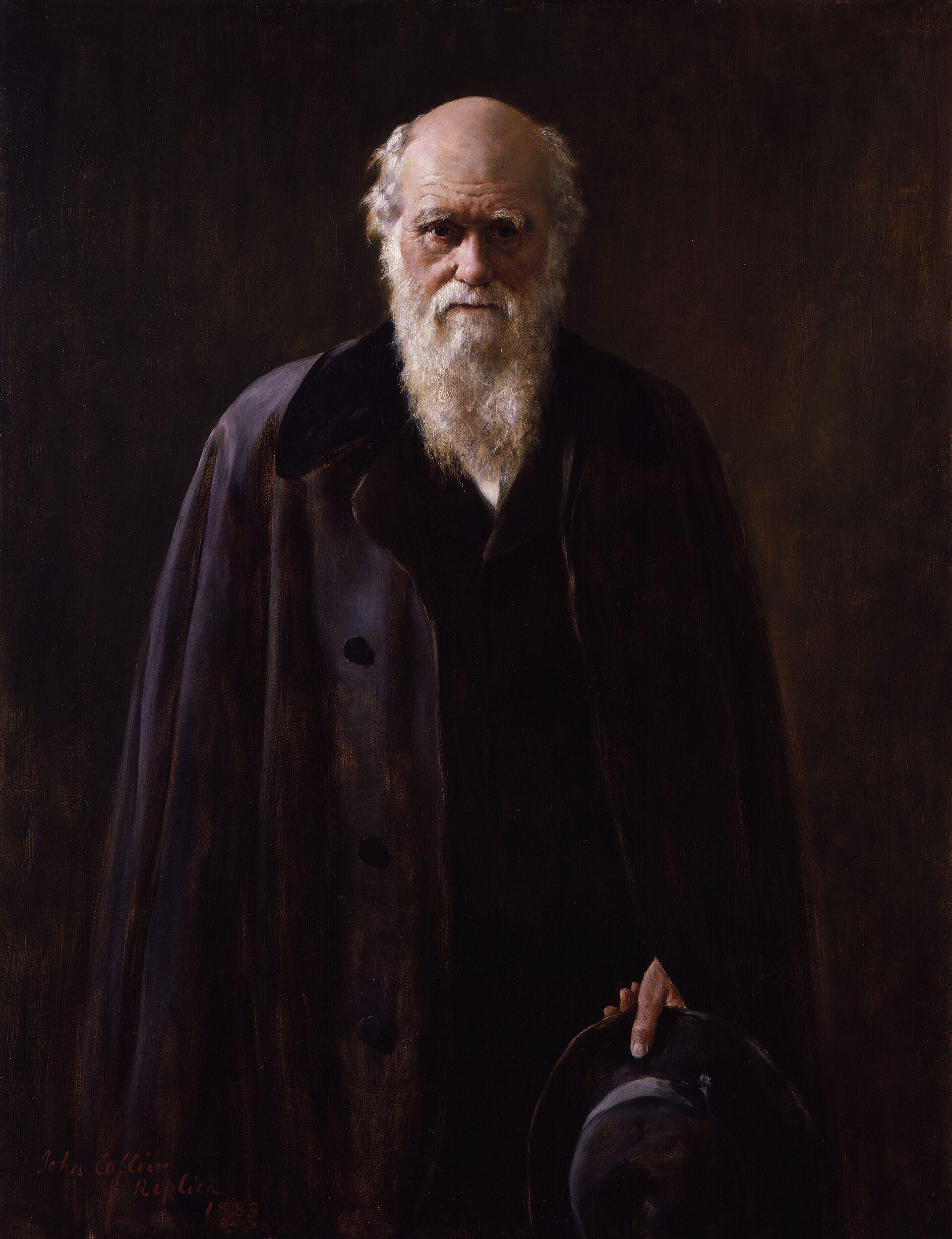

Charles Robert Darwin (1809–1882) was an English naturalist whose theory of evolution by natural selection became the foundation of modern evolutionary studies. Born in Shrewsbury, he studied medicine at Edinburgh and graduated from Christ's College, Cambridge, before joining HMS Beagle in 1831 as a self-financed gentleman companion to Captain Robert FitzRoy. Five years of surveying and collecting — South America, the Galápagos, the Pacific — made him famous as a geologist and collector; privately, from July 1837, he filled notebooks with 'transmutation' of species, finding his mechanism after reading Malthus in September 1838. Married to his cousin Emma Wedgwood from 1839, he settled at Down House in Kent in 1842, published his Beagle journal and worked for eight years on barnacles, then began the 'big book' on Natural Selection. The shock of Alfred Russel Wallace's 1858 essay forced a joint announcement at the Linnean Society, followed in November 1859 by On the Origin of Species — 1,250 copies, sold out on the day, and an argument that split Victorian opinion. The Descent of Man (1871), plant books, and a final study of earthworms followed. He died at Down on 19 April 1882 and was buried in Westminster Abbey, near Newton. Fellow of the Royal Society (1839), Royal Medal (1853) and Copley Medal (1864).
Early life in Shrewsbury
Charles Darwin was born on 12 February 1809 at The Mount in Shrewsbury.1 He was the fifth child of the physician Robert Waring Darwin and Susannah Wedgwood.2 On his mother's side, the Wedgwoods were pioneers of the pottery industry.3 His paternal grandfather was the renowned physician, poet and natural philosopher Erasmus Darwin.3 That grandfather, a freethinking physician and poet, had published his own ideas on evolution in Zoonomia; or the Laws of Organic Life.1 He grew up in Shrewsbury with three older sisters, Marianne, Caroline and Susan, an older brother, Erasmus Alvey, and a younger sister, Catherine.3 His mother died when he was eight, and he was cared for by his three elder sisters.1 The household was led by their father, an outsize character who prospered both in his medical practice and in business.3
He hated the rote learning of Classics at the traditional Anglican Shrewsbury School, where he studied between 1818 and 1825.1 He described the school as 'narrow and classical'.2 Science was then considered dehumanizing in English public schools, and his dabbling in chemistry earned him a headmaster's condemnation and the nickname 'Gas' among his schoolmates.1 His father took him away from the school early, on 17 June 1825.4
Edinburgh and Cambridge
His father, considering the 16-year-old a wastrel interested only in game shooting, sent him to study medicine at Edinburgh University in 1825.1 On 22 October 1825 Darwin matriculated with his brother Erasmus at the University of Edinburgh and registered for medical courses; his first lecture came on 26 October.4 He loathed anatomy and was sickened by pre-chloroform surgery.1 At the Edinburgh Museum he was taught to stuff birds by John Edmonstone, a freed South American slave.1 Robert Edmond Grant, a radical evolutionist and disciple of Lamarck, became his mentor.1 In the winter of 1826 he met the naturalist and Lamarckian Robert Grant and examined marine animals with him, and on 10 November he was elected to the Plinian Society.4 On 27 March 1827 he read papers on marine animals to the Plinian Society, and left Edinburgh in April.4 In May 1827 he visited Paris with his Wedgwood cousins, his only time in France.4 At both universities natural history interested him more than his regular studies.5
His freethinking father, judging the church a better calling for an aimless naturalist, switched him to Christ's College, Cambridge.1 On 15 October 1827 he was admitted to Christ's College, though he did not move there until January 1828, reading for an ordinary degree, the usual preliminary for theological training, which he never undertook.4 He took his horse, indulged his drinking, shooting and beetle-collecting passions with other squires' sons.1 He sat his BA exam in January 1831 and was astonished to be ranked 10th out of 178 candidates.2 Adam Sedgwick took him to Wales in 1831 on a geologic field trip.1 Returning to Shrewsbury from Wales in August 1831, he found a letter from Henslow inviting him to join the Beagle voyage.4
The voyage of HMS Beagle
In August 1831 Darwin was invited to join HMS Beagle on a surveying voyage to South America.5 His father objected, but his uncle, Josiah Wedgwood II, persuaded him otherwise.4 Darwin sailed as a self-financed gentleman companion to the 26-year-old captain, Robert FitzRoy, rather than as a lowly surgeon-naturalist.1 FitzRoy's was to be an imperial-evangelical voyage: he planned to survey coastal Patagonia to facilitate British trade and return three Christianized Fuegians to Tierra del Fuego.1 Darwin equipped himself with weapons and books, including the first volume of Charles Lyell's Principles of Geology, which FitzRoy gave him, and advice on preserving carcasses from London Zoo's experts.1 The Beagle sailed from England on 27 December 1831.1
It became a five-year voyage around the world.6 Darwin made his first landing on a tropical shore at St Jago, Cape Verde Islands, on 16 January 1832, and began filling his field notebooks.4 From February 1832 to May 1834 the Beagle surveyed the east coast of South America, and in December 1832 the ship arrived in Tierra del Fuego.4 In March 1833 Darwin encountered slavery in Brazil, and he later met the native people of Tierra del Fuego.5 That December Henslow printed extracts from his letters.4 The Beagle visited the Cape of Good Hope from 31 May to 18 June 1836, and after calls at St Helena, Ascension, Brazil and the Azores dropped anchor at Falmouth on 2 October 1836; Darwin returned home to Shrewsbury on 4 October.4 Five years of surveying and collecting had made him a geologist and collector.4
| Stop | Dates | The voyage record |
|---|---|---|
| St Jago, Cape Verde Islands | 16 January 18324 | Darwin makes his first landing on a tropical shore, and his field notebooks begin to be used.4 |
| Brazil and the River Plate | 1832–334 | In March 1833 Darwin encounters slavery in Brazil.5 |
| Tierra del Fuego | December 18324 | The ship arrives in Tierra del Fuego in December 1832.4 |
| Falkland Islands | 1833–344 | — |
| Chile and the Andes | 1834–354 | Darwin spends February 1835 in Valdivia and early March in Concepcion, and makes a long excursion northwards, calling at Copiapo, Iquique and Callao.4 |
| Galapagos Archipelago | 16 September – 20 October 18354 | The Beagle departs Lima on 7 September for the archipelago, where Darwin spends six weeks exploring, from 16 September to 20 October.4 |
| Tahiti and New Zealand | November – December 18354 | The ship is in Tahiti from 15 to 26 November and in New Zealand from 21 to 30 December.4 |
| Australia, Cocos, the Cape, St Helena | 18364 | Calls at Sydney in January, Hobart in February, the Cocos and Keeling Islands in April, the Cape of Good Hope from 31 May to 18 June, and St Helena and Ascension in July.4 |
| Falmouth, England | 2 October 18364 | The Beagle drops anchor at Falmouth on 2 October 1836, and Darwin returns home to Shrewsbury on 4 October.4 |
The Galápagos and the problem of species
The Beagle departed Lima on 7 September 1835 for the Galapagos Archipelago, where Darwin spent 16 September to 20 October exploring.4 Walking on Chatham Island, Darwin met two large tortoises, each of at least two hundred pounds, and they seemed to him like antediluvian creatures.7 Looking at the gradation and diversity of structure in one small, intimately related group of the archipelago's birds, he reflected that one species might have been taken and modified for different ends.7
His first book after the journal of the voyage was on the structure and distribution of coral reefs.4 The theory itself was not handed to him on the islands: the bird specimens were identified in London by the naturalist John Gould.4 He formulated his theory in private in 1837–39, after returning from the voyage, and gave it full public expression only two decades later, in On the Origin of Species.1
London, notebooks, and the private years
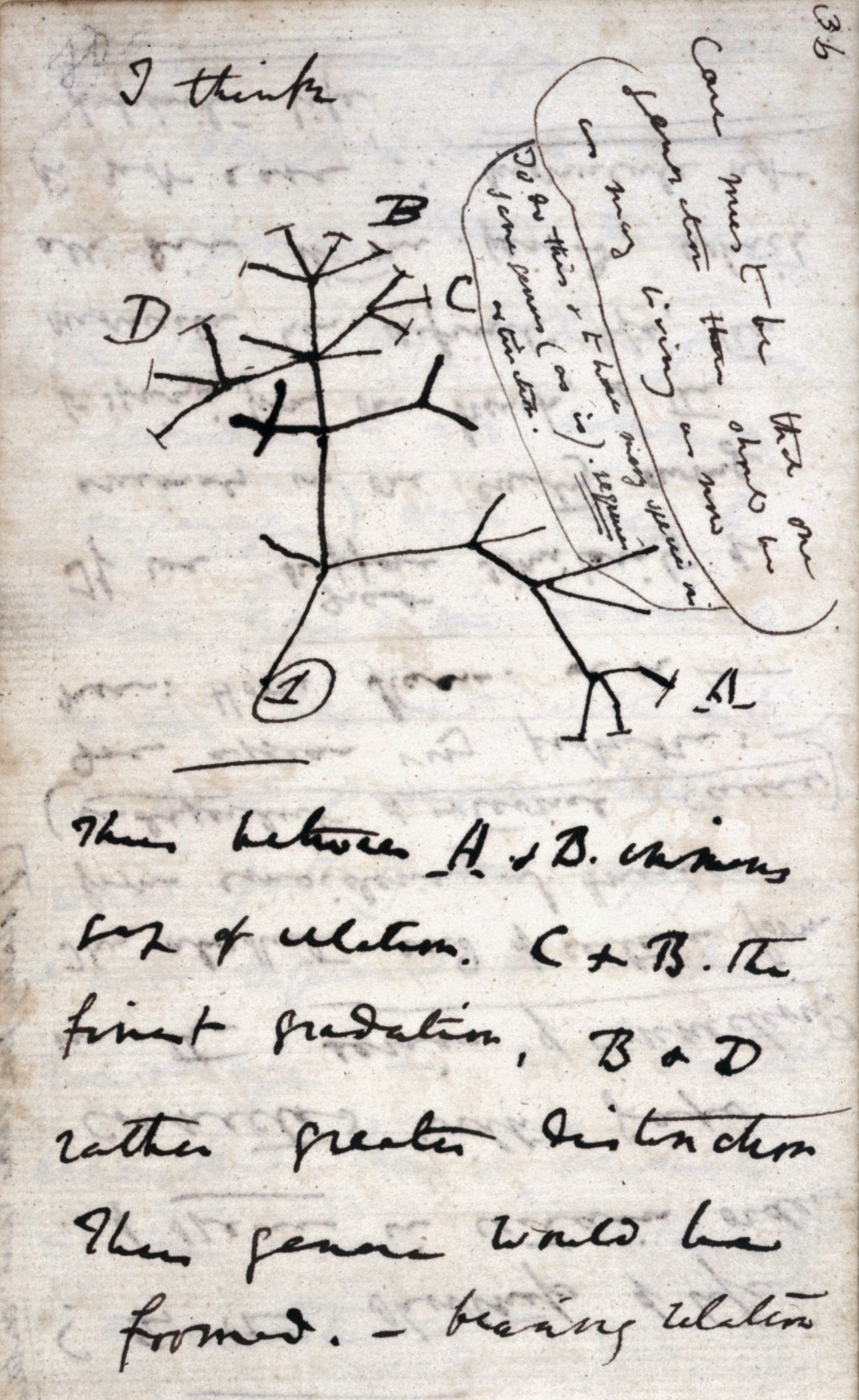
In March 1837 Darwin took lodgings in Great Marlborough Street, London.4 He arranged for his Beagle specimens to be identified, began publication of The Zoology of the Voyage of the Beagle (1838–43), and became friendly with the geologist Charles Lyell.4 He gave papers at the Geological Society of London.4 In July 1837 Darwin opened his first notebook on the transmutation of species.4 Its most famous page carries the branching tree-of-life sketch headed with the words 'I think'.4 On 28 September 1838 he read Malthus's Essay on the Principle of Population.4 He finished a paper on the geology of Glen Roy in Scotland, and in the last weeks of the year moved to a house in Gower Street, London.4 On 11 November 1838 he proposed marriage to his cousin Emma Wedgwood.4
Darwin married Emma Wedgwood on 29 January 1839.4 That same year he published his Journal of Researches, later known as Voyage of the Beagle, and was elected a Fellow of the Royal Society.4 He and Emma eventually had ten children, seven of whom reached adulthood.4 Emma and the children assisted him in research, writing and correspondence, and even occasionally served as research subjects.3 In the summer of 1842, with Emma six months pregnant with their third child, the Darwins moved into Down House in the village of Downe, Kent, on 24 September.8 The remodelled house and its extensive gardens became his open-air laboratory, where he developed his theory of evolution by natural selection and wrote the Origin.8 In the spring of 1843 he began improving the property, commissioning the architect Edward Cresy to add a full-height bay window with views across the garden.8 On a visit to Maer in 1842 he made a brief pencil sketch of his theory of 'descent with modification'; by 1844 he had expanded it into a longer Essay, with a memorandum asking Emma to publish it if he should die unexpectedly.4 In October 1846 he began his eight-year study of barnacles.4 In March 1851 the eldest daughter, Annie, was taken to Malvern, where she died of fever on 23 March, aged ten.4 Three of the ten children died young: Mary within weeks of the move to Down in 1842, Annie in 1851, and Charles Waring of scarlet fever in 1858.8

Wallace and the Linnean Society, 1858
In June 1858 a letter arrived from Alfred Russel Wallace, who was collecting specimens in Indonesia, enclosing an essay on species and varieties that mirrored Darwin's own theory of natural selection.4 Darwin wrote that he had never seen a more striking coincidence.4 Extracts from the two men's writings were presented by Charles Lyell and Joseph Hooker at the Linnean Society of London on 1 July; neither Darwin nor Wallace attended.4 The work was later published as 'On the Tendency of Species to form Varieties' in the Journal of the Proceedings of the Linnean Society, Zoology, volume 3, pages 45–62.9 Events moved so fast that Wallace was not notified of the joint presentation until afterwards, but he responded courteously.2
The rush had a longer history: in April 1856 Darwin had invited Huxley and other naturalists to a weekend party to discuss his ideas on the origin of species.2 Lyell, fearing he might be pre-empted, urged him to write for publication, and the 'abstract' took shape on the Isle of Wight.2 As he told readers in the Origin, he had been induced to publish partly because Wallace, studying the natural history of the Malay archipelago, had arrived at very nearly the same conclusions about the origin of species.10
On the Origin of Species (1859)
On the Origin of Species was published in London on 24 November 1859 by John Murray; on publication day Darwin was taking the water cure in Ilkley, Yorkshire.4 The 1,250-copy print run was oversubscribed, and Darwin started corrections for a second edition.2 It was immediately a best-seller, but opinion on its argument for evolution was divided.5 The volume is framed as a single long argument, and its conclusion is stated plainly: species are not immutable.10 Its central term, the struggle for existence, was used in a broad and figurative sense, including the dependence of one being on another and success in leaving progeny.10 By the sixth and last edition, rewritten to answer arguments by St George Mivart, the book used the word 'evolution' for the first time.2 Six editions followed, the last of them in 1872.2
It was a book written for the reading public, stripped of academic references.2 The book's cause was championed by Huxley, who was confrontational and somewhat polarised the debate, while Darwin backed him and excused himself from combat because of illness.2 He was elected a Fellow of the Royal Society in 1839 and awarded its Royal Medal in 1853.11 In 1864 he received the Copley Medal after being nominated three years running; the Origin of Species was omitted from the award.2 The book has deeply influenced modern Western society and thought.1
The later books: from Descent of Man to worms
Darwin did not stop with the Origin.4 Over the next two decades he published a sequence of books that carried the argument into orchids, domesticated animals and plants, the descent of man, the emotions, insectivorous plants, flowers, and finally earthworms.4 His last book, on the formation of vegetable mould through the actions of worms, was published on 1 May 1881.5
| Work | Year | Note |
|---|---|---|
| Journal of Researches (Voyage of the Beagle) | 18394 | His account of the voyage, published the year he married.4 |
| Coral Reefs | 18424 | The structure and distribution of coral reefs, published as the family settled at Down House.4 |
| Volcanic Islands | 18444 | Geological observations on the volcanic islands visited during the voyage of HMS Beagle.4 |
| Geological Observations on South America | 18464 | His last book describing the Beagle voyages; that October he began work on barnacles.4 |
| Barnacle monographs | 1851–544 | The first of two volumes on barnacles was published in 1851, part of the eight-year study begun in 1846.4 |
| On the Origin of Species | 18594 | Published in London on 24 November by John Murray.4 |
| Orchids | 18624 | On the various contrivances by which British and foreign orchids are fertilised by insects; that year he also met Alfred Russel Wallace on his return from Indonesia.4 |
| Variation of Animals and Plants under Domestication | 18684 | — |
| The Descent of Man | 18714 | The second of his books on evolutionary theory, focused on human evolution and sexual selection.5 |
| The Expression of the Emotions in Man and Animals | 18725 | Research for it included testing the ability to recognise facial expressions on his friends and family.5 |
| Insectivorous Plants | 18755 | Published sixteen years after his first observations on the organisms.5 |
| The Different Forms of Flowers on Plants of the Same Species | 18774 | Its basis was his discovery of 'heterostylous' species, a significant step in his investigations into plant evolution.8 |
| The Formation of Vegetable Mould through the Action of Worms | 18814 | His last book; he had exchanged letters about worms since the 1830s.5 |
In his own words
The Origin is a book of argument, and some of its sentences have outlived their century.10 A few of the most quoted lines, from the book and from a letter written years before, are given here as Darwin wrote them.10
When on board H.M.S. ‘Beagle,’ as naturalist, I was much struck with certain facts in the distribution of the inhabitants of South America, and in the geological relations of the present to the past inhabitants of that continent. These facts seemed to me to throw some light on the origin of species—that mystery of mysteries, as it has been called by one of our greatest philosophers.
Charles Darwin, On the Origin of Species, Introduction (1859)
There is grandeur in this view of life, with its several powers, having been originally breathed into a few forms or into one; and that, whilst this planet has gone cycling on according to the fixed law of gravity, from so simple a beginning endless forms most beautiful and most wonderful have been, and are being, evolved.
Charles Darwin, On the Origin of Species, closing paragraph (1859)
I am fully convinced that species are not immutable; but that those belonging to what are called the same genera are lineal descendants of some other and generally extinct species, in the same manner as the acknowledged varieties of any one species are the descendants of that species.
Charles Darwin, On the Origin of Species (1859)
As this whole volume is one long argument, it may be convenient to the reader to have the leading facts and inferences briefly recapitulated.
Charles Darwin, On the Origin of Species, Recapitulation (1859)
Here, then, I had at last got a theory by which to work
Charles Darwin, Autobiography, recalling 28 September 1838
I never saw a more striking coincidence.
Charles Darwin, June 1858, on receiving Wallace's essay
I am quite conscious that my speculations run quite beyond the bounds of true science.
Letter to Asa Gray, 18 June [1857]
Darwin and religion — and the things he never wrote
Darwin was himself an agnostic, and he was accorded the ultimate British accolade of burial in Westminster Abbey.1 The telegram that settled the burial asked the Dean of Westminster whether it would be acceptable to a very large number of his fellow-countrymen that Darwin should be buried in the Abbey; the Dean recalled that he did not hesitate and telegraphed that his assent would be cheerfully given.12 In his funeral sermon the Bishop of Carlisle remarked that there is no necessary conflict between knowledge of nature and belief in God.12
Illness, last years, and legacy
His health was often poor, but he went on working.12 In the late 1850s, while writing the Origin, he had taken over a corner of the kitchen garden for 'experimental beds'; in the early 1860s a hothouse was built adjoining the greenhouse, and the results of his investigations went into an 'Experiment Book' begun in 1855 and kept until 1867.8 In 1862 he began to grow a beard after an episode of ill health.4 In 1877 Cambridge awarded him an honorary LLD.4 In 1881 his brother Erasmus died, and that year Darwin published his last book, on worms, arranged a civil list pension for Wallace, and gave money to Kew Gardens for the publication of Index Kewensis.4
He died on 19 April 1882, aged seventy-three.4 At the funeral on the morning of 26 April 1882 the coffin was borne through the Abbey cloisters, followed by Darwin's five sons; among the pall-bearers were Sir Joseph Hooker, Alfred Russel Wallace, the US ambassador James Russell Lowell and the Royal Society President William Spottiswoode.12 He was buried in the north aisle of the nave, next to the astronomer Sir John Herschel and a few feet from Newton.12 In 1888 a bronze memorial roundel with a life-sized relief bust, the work of the sculptor Boehm and funded by a Darwin Memorial Fund, was erected in the north choir aisle near the grave; its inscription says simply DARWIN.12 Christ's College calls him most famous as the father of evolutionary biology and originator of the theory of natural selection.6 His theory of evolution by natural selection became the foundation of modern evolutionary studies.1 Writing in Nature, Mark Pagel judged that the theory of evolution by natural selection had prospered across its first 150 years, providing a consistent account of species as highly adapted and rare survivors in the struggle for existence.14 In 2009 Christ's College marked the bicentenary of his birth by opening his student rooms to the public.6 His writings and manuscripts are published as a free scholarly edition in The Complete Work of Charles Darwin Online, edited by John van Wyhe.15 His letters live on in the standard edition of The Correspondence of Charles Darwin, published by Cambridge University Press.16
Timeline
Birth at The Mount, Shrewsbury
Charles Darwin is born at The Mount, Shrewsbury, the fifth child of Robert Waring Darwin, physician, and Susannah Wedgwood.
Matriculates at the University of Edinburgh
Taken away early from Shrewsbury School by his father on 17 June 1825, Darwin matriculates with his brother Erasmus at the University of Edinburgh on 22 October and registers for medical courses; his first lecture is on 26 October.
Admitted to Christ's College, Cambridge
On 15 October Darwin is admitted to Christ's College, Cambridge, though he does not move there until January 1828; he reads for an ordinary degree, the usual preliminary for the theological training he never undertook.
Passes his BA examinations
Darwin passes his BA examinations on 22 January without honours and remains at Cambridge for a further two terms to fulfil the residence requirement; that August he accompanies Adam Sedgwick's geological field trip to Wales.
Sails from Plymouth on HMS Beagle
Back from Wales in August, Darwin finds Henslow's letter inviting him to join the Beagle voyage; his father objects, but his uncle Josiah Wedgwood II persuades him otherwise. After meeting Captain Robert FitzRoy and making preparations — and after two false starts — the ship leaves Plymouth on 27 December 1831.
Six weeks exploring the Galápagos
The Beagle departs Lima on 7 September 1835 for the Galapagos Archipelago, where Darwin spends 16 September to 20 October exploring the islands — the archipelago whose mockingbirds, finches and tortoises would loom large in his thinking about species.
Returns to England
After calls at Sydney, Hobart, the Cocos (Keeling) Islands, Mauritius, the Cape of Good Hope, St Helena, Ascension, Brazil and the Azores, the Beagle drops anchor at Falmouth on 2 October 1836; Darwin reaches home in Shrewsbury on 4 October.
Opens his first 'transmutation' notebook
In March Darwin takes lodgings in Great Marlborough Street, London, arranging for his Beagle specimens to be identified and beginning The Zoology of the Voyage of the Beagle; in July he opens his first notebook on the transmutation of species.
Malthus and 'a theory by which to work'
On 28 September Darwin reads Malthus's Essay on the Principle of Population 'for amusement' and later recalls in his Autobiography, 'Here, then, I had at last got a theory by which to work'; on 11 November he proposes marriage to his cousin Emma Wedgwood.
Marries Emma Wedgwood
Darwin marries Emma Wedgwood on 29 January 1839; the same year he publishes his Journal of Researches — later known as Voyage of the Beagle — and is elected a Fellow of the Royal Society, and their first child, William, is born.
Moves to Down House
With Emma six months pregnant with their third child, the Darwins move into Down House in the village of Downe, Kent, on 24 September 1842 — the home and 'open-air laboratory' where Darwin will spend the rest of his life.
The Darwin–Wallace reading at the Linnean Society
In June Darwin receives Alfred Russel Wallace's essay from Indonesia — 'I never saw a more striking coincidence', he writes — and on 1 July, extracts of the two men's writings are presented to the Linnean Society by Charles Lyell and Joseph Hooker. Neither author attends.
On the Origin of Species is published
Darwin publishes On the Origin of Species by Means of Natural Selection, or the Preservation of Favoured Races in the Struggle for Life on 24 November 1859. It is immediately a best-seller, but opinion on its argument for evolution is divided.
Awarded the Copley Medal
In November 1864 Darwin is awarded the Copley Medal of the Royal Society of London, its highest scientific honour.
The Descent of Man is published
Darwin's second book on evolutionary theory, The Descent of Man and Selection in Relation to Sex, focuses on human evolution and sexual selection; its inclusion of human beings in the natural order leads to Darwin being widely satirised as an ape or monkey in the media.
Death and burial in Westminster Abbey
Darwin dies at Down House on 19 April 1882, aged seventy-three; following petitions from friends and colleagues it is agreed that he should receive a ceremonial funeral and be buried in Westminster Abbey, on 26 April.
Frequently asked questions
Where and when was Charles Darwin born?
Charles Darwin was born on 12 February 1809 at The Mount in Shrewsbury.1
What was Darwin's role on HMS Beagle?
He sailed as a self-financed gentleman companion to the 26-year-old captain, Robert FitzRoy, rather than as a lowly surgeon-naturalist.1
How long did the Beagle voyage last, and when did it end?
It was a five-year voyage around the world.6 The Beagle dropped anchor at Falmouth on 2 October 1836, and Darwin returned home to Shrewsbury on 4 October.4
How did Darwin arrive at the theory of natural selection?
On 28 September 1838 he read Malthus's Essay on the Principle of Population, after opening his first notebook on the transmutation of species in July 1837.4
Who was Alfred Russel Wallace, and what is the 1858 Linnean Society story?
Wallace sent Darwin, in June 1858, an essay from Indonesia that mirrored his own theory of natural selection.4 Extracts from their writings were presented by Charles Lyell and Joseph Hooker at the Linnean Society of London on 1 July 1858, and the work was later published in the Journal of the Proceedings of the Linnean Society, Zoology, volume 3, pages 45–62.9
When was On the Origin of Species published, and how did it sell?
It was published in London on 24 November 1859 by John Murray.4 The 1,250-copy print run was oversubscribed, and Darwin started corrections for a second edition.2 It was immediately a best-seller, but opinion on its argument for evolution was divided.5
What did Darwin argue in The Descent of Man?
The Descent of Man argued that humans and apes shared a common ancestor, a revolutionary theory for its time; its inclusion of human beings in the natural order led to Darwin being widely satirised as an ape or monkey in the media.6
Where is Darwin buried?
He was buried in the north aisle of the nave of Westminster Abbey, not far from Sir Isaac Newton.12
Knowledge graph
Sources & citations
Every factual claim in this article is drawn from the sources below. Bracketed numbers in the text link to the corresponding source.
- 1
- 2
- 3
- 4
- 5
- 6
- 7
- 8
- 9
- 10
- 11
- 12
- 13
- 14
- 15
- 16
- 17
- 18