Steve Jobs
Apple co-founder and Pixar chairman — from a California garage in 1976 to the iPhone, told through official documents, his own words, and the obituaries.
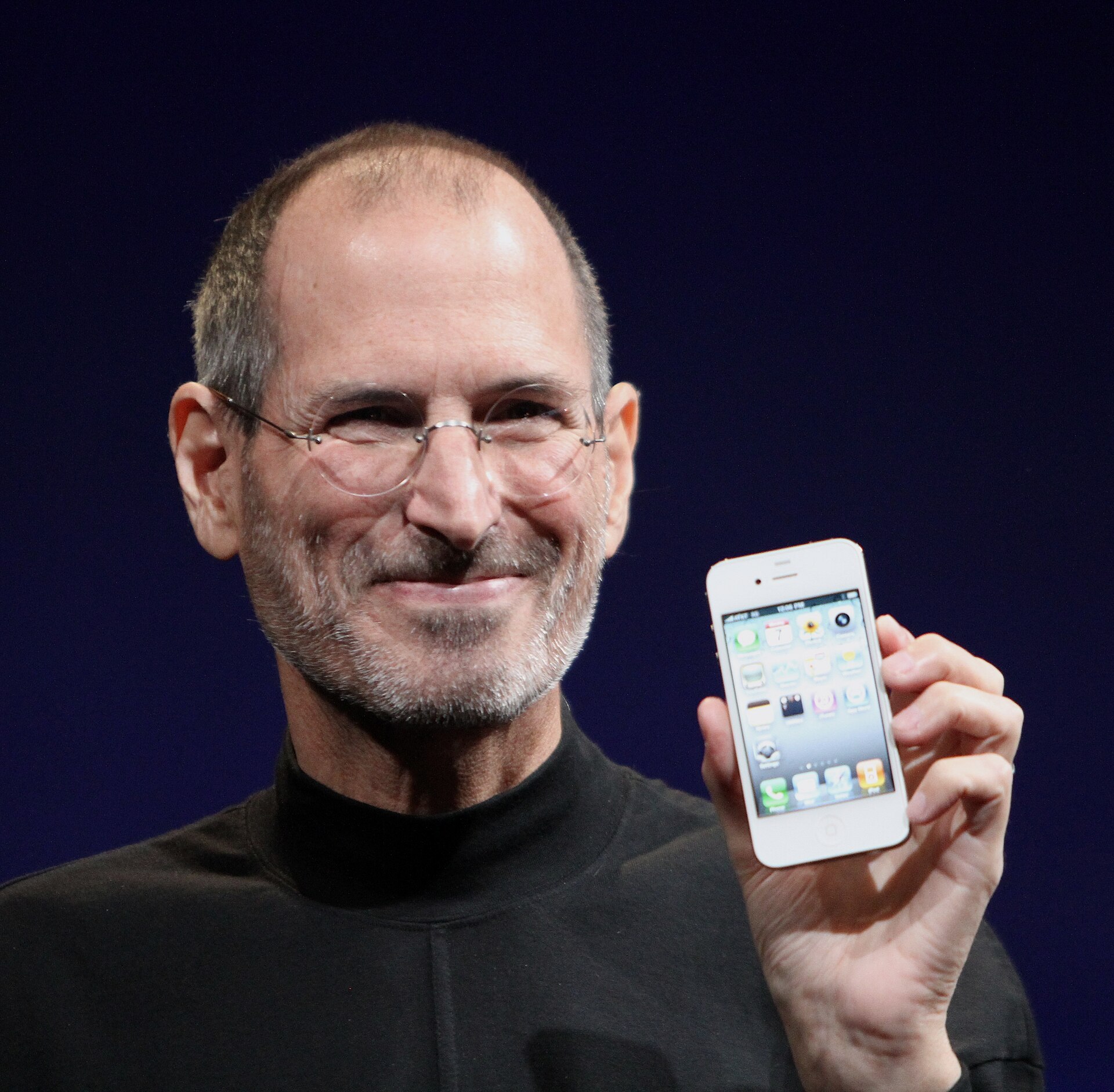
Steve Jobs (1955–2011) co-founded Apple Computer with Steve Wozniak in 1976 and led the Macintosh, iPod, iPhone and iPad. Driven out in 1985, he founded NeXT and bought Pixar from Lucasfilm before returning to Apple in 1996–97 and reshaping the music, phone and tablet industries. He resigned as CEO in August 2011 and died of pancreatic cancer on 5 October 2011, aged 56.
Early life and education
Steve Jobs was born in San Francisco, California, on 24 February 19551. In a 1995 oral history interview he introduced himself by birthplace and date: San Francisco, California, on 24 February 19552. His biological mother, a young, unwed college graduate student, decided to put him up for adoption3. He was adopted in infancy and grew up in Cupertino, California1.
When he was about five or six, his father sectioned off part of his garage workbench for him, gave him some of his smaller tools and showed him how to use a hammer and saw and how to build things2. He dropped out of Reed College after the first six months but stayed around as a drop-in for about another eighteen months3. Because he did not have to take the normal classes, he took a calligraphy class — the course that later shaped computer typography3. After college he went to work for Atari, designing video games1.
After dropping out of college he made a long pilgrimage through India seeking enlightenment4. It was mainly the Japanese path of Zen Buddhism, however, that stirred his sensibilities4. His love of simplicity in design was honed when he became a practitioner of Buddhism4.
Founding Apple in the garage
Jobs and Wozniak met in 1971, creating and selling Blue Boxes — devices for making free long-distance calls5. After stints at Hewlett Packard and Atari they reunited, formed Apple, and demonstrated the Apple I to the hobbyists of the Homebrew Computer Club5. He and Woz, as he told Stanford much later, started Apple in his parents' garage when he was twenty3. Steve Wozniak and Steve Jobs founded Apple Computer in 1976, with the Jobs family garage as corporate headquarters5.
They funded the venture from what they owned: Jobs sold his Volkswagen bus and Wozniak his HP-65 calculator, and with personal loans and vendor credit they could afford parts for their first order from Palo Alto's Byte Shop — 50 Apple-1 computers at $500 each5. Their co-founder Ronald Wayne, briefly a 10% owner of Apple, drew its short-lived logo featuring Isaac Newton5. The first Apple computer, created when Jobs was only 21, changed the public's idea of a computer from a huge machine for scientific use to a home appliance that could be used by anyone1.
It was the more fully developed Apple II that established Apple: Wozniak designed it in 1977 as a self-contained unit with a TV serving as the display5. Going on sale in June 1977, it became Apple's first big seller and is best known as one of the first machines to run a spreadsheet6. A floppy disk drive in 1978 and the spreadsheet program VisiCalc in 1979 made it a blockbuster5. The company had been incorporated in 19771.
The Macintosh and the ouster
In 1980 Apple became a public corporation, and Jobs became the company's chairman1. The intermediate machine was the Apple Lisa: released in 1983, it was a very expensive machine that did not succeed in the marketplace, but it pioneered many of the ideas that were later made cost effective in the Macintosh6.
In 1984 the Macintosh introduced the graphical user interface to the world, allowing users to open files and programs by clicking icons or menu choices with a mouse6. Its original selling price was $2,4956. The graphical interface and mouse technology it brought became the standard for application interfaces1.
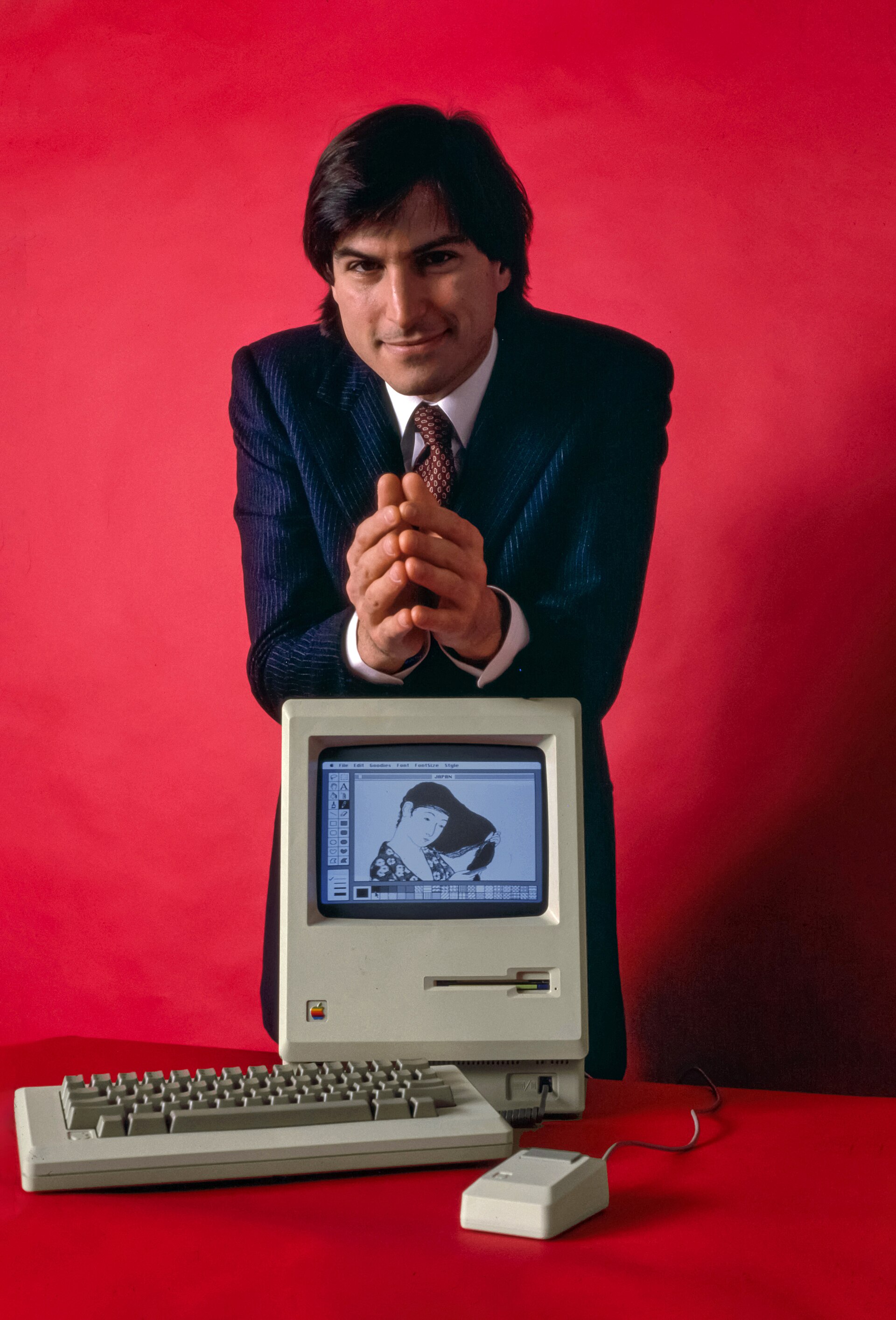

Within ten years Apple had grown from the two of them in a garage into a $2 billion company with over 4,000 employees3. The Macintosh had been released a year earlier, and he had just turned thirty — and then he got fired3.
After his vision for the future diverged from that of the executive he had hired to help run Apple, the board of directors sided with the executive3. Smithsonian magazine records the outcome plainly: after battling with CEO John Sculley for control of the company in 1985, Jobs left Apple, returning again only in 19976. His own verdict on the episode, delivered years later at Stanford, was that getting fired from Apple was the best thing that could have ever happened to him — the heaviness of being successful replaced by the lightness of being a beginner again3.
NeXT, Pixar, and the wilderness years
Management conflicts led him to leave Apple in 1985 and to form NeXT Computer1. He bought the computer graphics group from George Lucas and incorporated it as Pixar, setting about revolutionizing high-end computer graphics2. At Stanford he compressed those years into a sentence: he had started a company named NeXT, another named Pixar, and fallen in love with an amazing woman who would become his wife3.
During his absence, in 1993, Apple launched the Newton, its first handheld device, which retailed for $7006. In the 1995 oral history he remembered being at Xerox in 1979 as one of those apocalyptic moments2. Within ten minutes of seeing the graphical user interface stuff, he knew that every computer would work that way some day2.
He had seen the pattern before: the Macintosh was made by a core group of fewer than a hundred people, and yet Apple shipped over ten million of them2. Pixar went on to create the world's first computer-animated feature film, Toy Story, and became the most successful animation studio in the world, he said at Stanford3. Starting with Toy Story in 1995, Pixar produced a string of hit movies, won several Academy Awards for artistic and technological excellence, and made the full-length computer-animated film a mainstream art form7.
Return to Apple and the second act
Apple announced on 20 December 1996 its intention to purchase NeXT in a friendly acquisition for approximately $400 million8. The acquisition completed on 7 February 1997 after all necessary regulatory approvals, and Apple said NeXT technology would form the basis for its next-generation operating system, Rhapsody8. Jobs, chairman and CEO of NeXT Software at the time, was to serve as an advisor to Apple's chairman and CEO Gilbert Amelio8. Apple's fiscal 1997 Form 10-K reported that cash used to acquire NeXT totaled $384 million9.
Britannica records that he returned to Apple in 1996 and became its CEO in 19971. At Macworld Boston on 6 August 1997, Jobs and Microsoft chairman Bill Gates announced a broad product and technology development agreement between Apple and Microsoft10. Under it, Microsoft agreed to invest $150 million in non-voting Apple stock, and Apple agreed to bundle Microsoft's Internet Explorer browser with the Mac OS as the default browser in future releases10.
The striking new iMac of 1998 revived the company's flagging fortunes1. The technology developed at NeXT stood at the heart of Apple's renaissance3. The New York Times framed the whole second act as a 12-year separation from the company, prompted by a bitter falling-out with his chief executive John Sculley, ending with his return in 1997 to oversee the creation of one innovative digital device after another — the iPod, the iPhone and the iPad7.
Apple’s defining products
The product line runs from the garage-built Apple I — first sold as an order of 50 computers at $500 each — to the iPad announced in January 2010511. Between them stand the Apple II, Apple's first big seller from June 19776; the Macintosh of 1984 at an original selling price of $2,4956; the iMac of 1998, which revived Apple's flagging fortunes1; the iPod of October 2001, up to 1,000 songs for $39912; the iTunes Music Store of April 2003, songs at 99 cents each13; and the iPhone announced on 9 January 200714. The table below keeps each product's introduction date and its documented details, every figure traceable to the record that carries it11.
| Product | Introduced | Key documented details |
|---|---|---|
| Apple I | 19765 | First order from Palo Alto's Byte Shop: 50 computers at $500 each, funded by the sale of Jobs's Volkswagen bus and Wozniak's HP-65 calculator5 |
| Apple II | June 19776 | Apple's first big seller, best known as one of the first machines to run a spreadsheet; the floppy disk drive (1978) and VisiCalc (1979) made it a blockbuster65 |
| Macintosh | 19846 | Introduced the graphical user interface to the world and was originally sold for $2,4956 |
| iMac | 19981 | The striking new machine that revived the company's flagging fortunes1 |
| iPod | 23 October 200112 | Packed up to 1,000 CD-quality songs into a 6.5-ounce design; on sale from 10 November 2001 at $39912 |
| iTunes Music Store | 28 April 200313 | Songs at 99 cents each without subscription fees; over 200,000 songs available at launch13 |
| iPhone | Announced 9 January 200714 | Combined a mobile phone, a widescreen iPod with touch controls and an internet communications device; on sale in the United States in June 2007, a 4GB model for $499 and an 8GB model for $59914 |
| iPad | 27 January 201011 | 0.5 inches thick and weighing 1.5 pounds, thinner and lighter than any laptop or netbook; from $49911 |
Illness and final years
In 2003 Jobs was diagnosed with pancreatic cancer, and he subsequently took several medical leaves of absence1. He underwent surgery in 2004 and received a liver transplant in 20097. On 12 June 2005, while serving as CEO of both Apple Computer and Pixar Animation Studios, he delivered a commencement address at Stanford University in which he told the graduates that death is very likely the single best invention of Life, and that time is limited3.
In his resignation letter of 24 August 2011, he wrote that he had always said that if there ever came a day when he could no longer meet his duties and expectations as Apple's CEO, he would be the first to let the board know15. That day, the letter said, had unfortunately come15. He asked to serve as chairman of the board, director and Apple employee if the board saw fit, and strongly recommended naming Tim Cook as CEO of Apple15.
Apple's Form 8-K records that on 24 August 2011 Jobs resigned as Chief Executive Officer but would continue to serve as an employee of Apple16. The board appointed him Chairman of the Board and promoted Chief Operating Officer Tim Cook to Chief Executive Officer16.
He died on 5 October 2011 in Palo Alto, California, at age 56, weeks after stepping down as chief executive of Apple17. A friend of the family said he died of complications from pancreatic cancer, with which he had waged a long and public struggle while remaining the face of the company even during treatment7. Apple's board of directors issued a statement that day saying it was deeply saddened to announce that he had passed away18.
Management style and design philosophy
The New York Times observed that he was neither a hardware engineer nor a software programmer, and did not think of himself as a manager: he considered himself a technology leader, choosing the best people possible, encouraging and prodding them, and making the final call on product design7. The same account records that over the course of a year he tossed out two iPhone prototypes before approving the third, and began shipping it in June 20077. In his early years his meddling in tiny details maddened colleagues, and his criticism could be caustic and even humiliating — but he grew to elicit extraordinary loyalty7.
The aesthetic was deliberate from early on: the headline of Apple's first marketing brochure, in 1977, proclaimed that simplicity is the ultimate sophistication4. He said it takes a lot of hard work to make something simple, to truly understand the underlying challenges and come up with elegant solutions4. His partnerships with Hartmut Esslinger in the 1980s and Jony Ive starting in 1997 created an engineering and design aesthetic that set Apple apart from other technology companies and ultimately helped make it the most valuable company in the world4.
After 1997 the guiding tenet, in Isaacson's account, was simplicity — not the shallow simplicity of an uncluttered look and feel, but the deep simplicity that comes from knowing the essence of every product, the complexities of its engineering and the function of every component4. The division of labor went back to the beginning: they built the company with Jobs focusing on promotion and creating a distinct Apple identity, and Wozniak as the designer5.
In his own words
You can’t connect the dots looking forward; you can only connect them looking backward
Steve Jobs, Stanford University commencement address, 12 June 2005 (Stanford News)
Getting fired from Apple was the best thing that could have ever happened to me. The heaviness of being successful was replaced by the lightness of being a beginner again
Steve Jobs, Stanford University commencement address, 12 June 2005 (Stanford News)
The only way to be truly satisfied is to do what you believe is great work. And the only way to do great work is to love what you do
Steve Jobs, Stanford University commencement address, 12 June 2005 (Stanford News)
Death is very likely the single best invention of Life. It is Life’s change agent
Steve Jobs, Stanford University commencement address, 12 June 2005 (Stanford News)
Your time is limited, so don’t waste it living someone else’s life
Steve Jobs, Stanford University commencement address, 12 June 2005 (Stanford News)
Stay Hungry. Stay Foolish.
Steve Jobs, closing words of the Stanford University commencement address, 12 June 2005 (Stanford News)
Unfortunately, that day has come
Steve Jobs, letter to Apple's board resigning as CEO, 24 August 2011 (Apple statement)
The Stanford quotations come from the commencement address delivered on 12 June 2005, when he was CEO of both Apple Computer and Pixar Animation Studios3. The closing line comes from the letter of 24 August 2011 in which he resigned as Apple's CEO15. Both are primary documents: a published commencement text, and a letter preserved in Apple's public statements and its regulatory record16.
Legacy
For Reuters he was the heart and soul of a company that rivals Exxon Mobil as the most valuable in America, and was counted among the greatest American CEOs of his generation19. The Associated Press credited him with inventing and master-marketing ever-sleeker gadgets that transformed everyday technology17. David Allison, a curator at the Smithsonian, called him one of the iconic innovators of our lifetime, whose success lay in mixing business savvy with design sensibility6.
By the time of his death he had become a very rich man, worth an estimated $8.3 billion7. The death was announced by Apple, the company he and his high school friend Stephen Wozniak had started in 1976 in a suburban California garage7. Reuters called him the Silicon Valley icon who gave the world the iPod and the iPhone19.
On 24 January 2006 Disney announced that it had agreed to acquire Pixar, the computer animation house, in an all-stock transaction expected to close that summer20. The terms issued 2.3 Disney shares for each Pixar share, putting the transaction value at $7.4 billion20. Pixar chairman and CEO Steve Jobs was to be appointed to Disney's board of directors as a non-independent member20.
Timeline
Born in San Francisco
Steve Jobs was born in San Francisco, California on 24 February 1955, was adopted in infancy and grew up in Cupertino.1
Founding Apple in the family garage
Steve Wozniak and Steve Jobs founded Apple Computer in 1976, with the Jobs family garage as corporate headquarters; the Apple I was demonstrated at the Homebrew Computer Club.5
Macintosh introduced
The Macintosh came to market in 1984 billed as the computer for the rest of us; it introduced the graphical user interface to the world and originally sold for $2,495.6
Leaves Apple; founds NeXT
Management conflicts led him to leave Apple in 1985 and form NeXT Computer Inc.1
Pixar releases Toy Story
Starting with Toy Story in 1995, Pixar produced a string of hit movies and won several Academy Awards, making the computer-animated feature a mainstream art form.7
Apple announces the NeXT acquisition
Apple announced on 20 December 1996 its intention to purchase NeXT in a friendly acquisition for approximately $400 million.8
Returns to Apple and becomes CEO
Jobs returned to Apple in 1996 and became its CEO in 1997, closing the sale of NeXT earlier that year.1
iMac revives Apple
The striking new iMac computer of 1998 revived the company’s flagging fortunes.1
iPod introduced
Apple introduced iPod on 23 October 2001 — a player that packs up to 1,000 CD-quality songs into a design that fits in your pocket.12
iTunes Music Store launched
Apple launched the iTunes Music Store on 28 April 2003, selling songs for 99 cents each with over 200,000 songs available at launch.13
iPhone introduced
At Macworld San Francisco on 9 January 2007 Apple introduced iPhone, combining three products into one handheld device.14
iPad announced
Apple announced the iPad on 27 January 2010 — 0.5 inches thick, 1.5 pounds, with prices starting at $499.11
Resigns as CEO; Tim Cook named CEO
On 24 August 2011 Steve Jobs resigned as Chief Executive Officer of Apple; the board appointed him Chairman of the Board and promoted Timothy D. Cook to CEO.16
Dies at 56 in Palo Alto
Steve Jobs died on 5 October 2011 in Palo Alto, California at age 56, after a years-long public battle with cancer and other health issues.19
Frequently asked questions
Where and when was Steve Jobs born?
Steve Jobs was born in San Francisco, California, on 24 February 1955 and was adopted in infancy1. He grew up in Cupertino, California1. In a 1995 oral history interview he introduced himself by that same birthplace and date2.
When and where did Apple get started?
Steve Wozniak and Steve Jobs founded Apple Computer in 1976, with the Jobs family garage as corporate headquarters5. They demonstrated the Apple I to the hobbyists of the Homebrew Computer Club, and their first order from Palo Alto's Byte Shop was for 50 Apple-1 computers at $500 each5. The money came from selling Jobs's Volkswagen bus, Wozniak's HP-65 calculator, and from personal loans and vendor credit5.
Which Apple products did Jobs launch after his return?
The iMac of 1998 revived the company's flagging fortunes1. Apple then introduced the iPod on 23 October 2001 and the iTunes Music Store on 28 April 2003, and announced the iPhone on 9 January 2007 and the iPad on 27 January 201012131411.
Why did Steve Jobs leave Apple in 1985?
Management conflicts led him to leave Apple in 1985 and form NeXT Computer Inc1. In his own account, once his vision for the future diverged from the executive he had hired to help run Apple, the board of directors sided with the executive3. Smithsonian magazine records that he had battled with CEO John Sculley for control of the company, and that he returned again only in 19976.
What did Jobs do at NeXT and Pixar?
He founded NeXT Computer after leaving Apple1, and bought the computer graphics group from George Lucas, incorporating it as Pixar and setting about revolutionizing high-end computer graphics2. Pixar went on to create the world's first computer-animated feature film, Toy Story, and became the most successful animation studio in the world3. Starting with Toy Story in 1995, it produced a string of hit movies and won several Academy Awards7.
How did Jobs return to Apple?
Apple announced on 20 December 1996 that it intended to purchase NeXT in a friendly acquisition for approximately $400 million, and the deal closed on 7 February 19978. He returned to Apple in 1996 and became its CEO in 19971. In August 1997 he and Bill Gates announced a broad Apple-Microsoft development agreement under which Microsoft would invest $150 million in non-voting Apple stock10.
When did Steve Jobs resign as CEO, and who succeeded him?
He resigned as CEO on 24 August 2011 but stayed on as an Apple employee, and the board appointed him chairman of the board16. The board promoted chief operating officer Tim Cook to chief executive officer16. In his resignation letter he had strongly recommended naming Tim Cook as CEO of Apple15.
How and when did Steve Jobs die?
Steve Jobs died on 5 October 2011 in Palo Alto, California, at age 56, weeks after stepping down as chief executive of Apple6. He had been diagnosed with pancreatic cancer in 2003, and he subsequently took several medical leaves of absence1. A friend of the family said he died of complications from pancreatic cancer, with which he had waged a long and public struggle while remaining the face of the company even during treatment7.
Knowledge graph
Sources & citations
Every factual claim in this article is drawn from the sources below. Bracketed numbers in the text link to the corresponding source.
- 1
- 2
- 3
- 4
- 5
- 6
- 7
- 8
- 9
- 10
- 11
- 12
- 13
- 14
- 15
- 16
- 17
- 18
- 19
- 20