Pelé
Brazil's three-time world champion and football's first global superstar — from a childhood in Bauru and Santos's 25 titles to a thousand goals, the New York Cosmos and the records the sources still dispute.
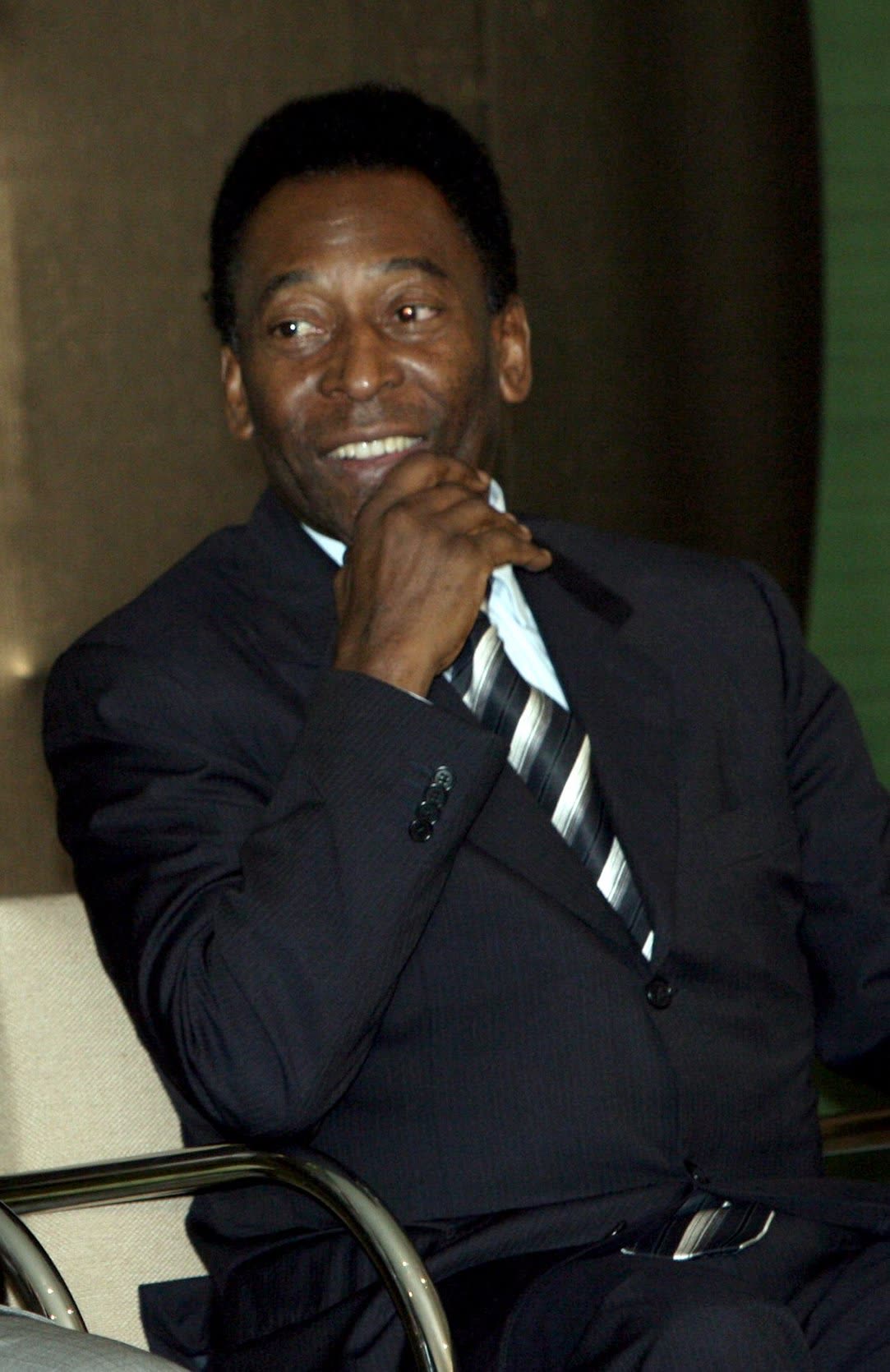
Pelé (Edson Arantes do Nascimento, 23 October 1940 – 29 December 2022) was a Brazilian footballer widely regarded as one of the greatest of all time and the game's first global icon. With Brazil he won the World Cup three times (1958, 1962 and 1970) — the only player to do so — and scored 77 goals in 92 appearances. At Santos he won 25 major titles, including two Copa Libertadores and two Intercontinental Cups, before ending his club career with the New York Cosmos in 1977. After football he served as Brazil's minister of sport (1995–1998), operated as an ambassador for UNESCO and the United Nations, and was named athlete of the century by the IOC in 1999 and, jointly with Diego Maradona, FIFA player of the century in 2000.

In this article
- 1From Três Corações to Santos (1940–1956)
- 2A boy wonder at Santos and the Seleção (1956–1958)
- 3Sweden 1958: a 17-year-old world champion
- 4Chile 1962 and the Santásticos
- 5Mexico 1970: the Beautiful Team and the third star
- 6A thousand goals and a disputed record
- 7New York Cosmos: winning a country (1975–1977)
- 8Minister, ambassador, global icon (1995–2022)
- 9Farewell: 29 December 2022 and the legacy
- 10In his own words
- 11Timeline: Pelé, 1940-2022
- 12Frequently asked questions
- 13Knowledge graph
From Três Corações to Santos (1940–1956)
Edson Arantes do Nascimento was born on 23 October 1940 in Três Corações, in the interior of Minas Gerais state, Brazil. He grew up shining shoes to buy his modest soccer gear. His father Dondinho, a gifted footballer whose career was ended by a knee injury, moved the family to Bauru, a railway town in São Paulo state, where they slipped into poverty. As a child he also sold tea to help support his family.

He was named Edson after the inventor Thomas Edison. The family called him 'Dico', and he became 'Pelé' at school through his mispronunciation of the goalkeeper Bile's name. The nickname reportedly originated in childhood and had no known meaning in Portuguese.
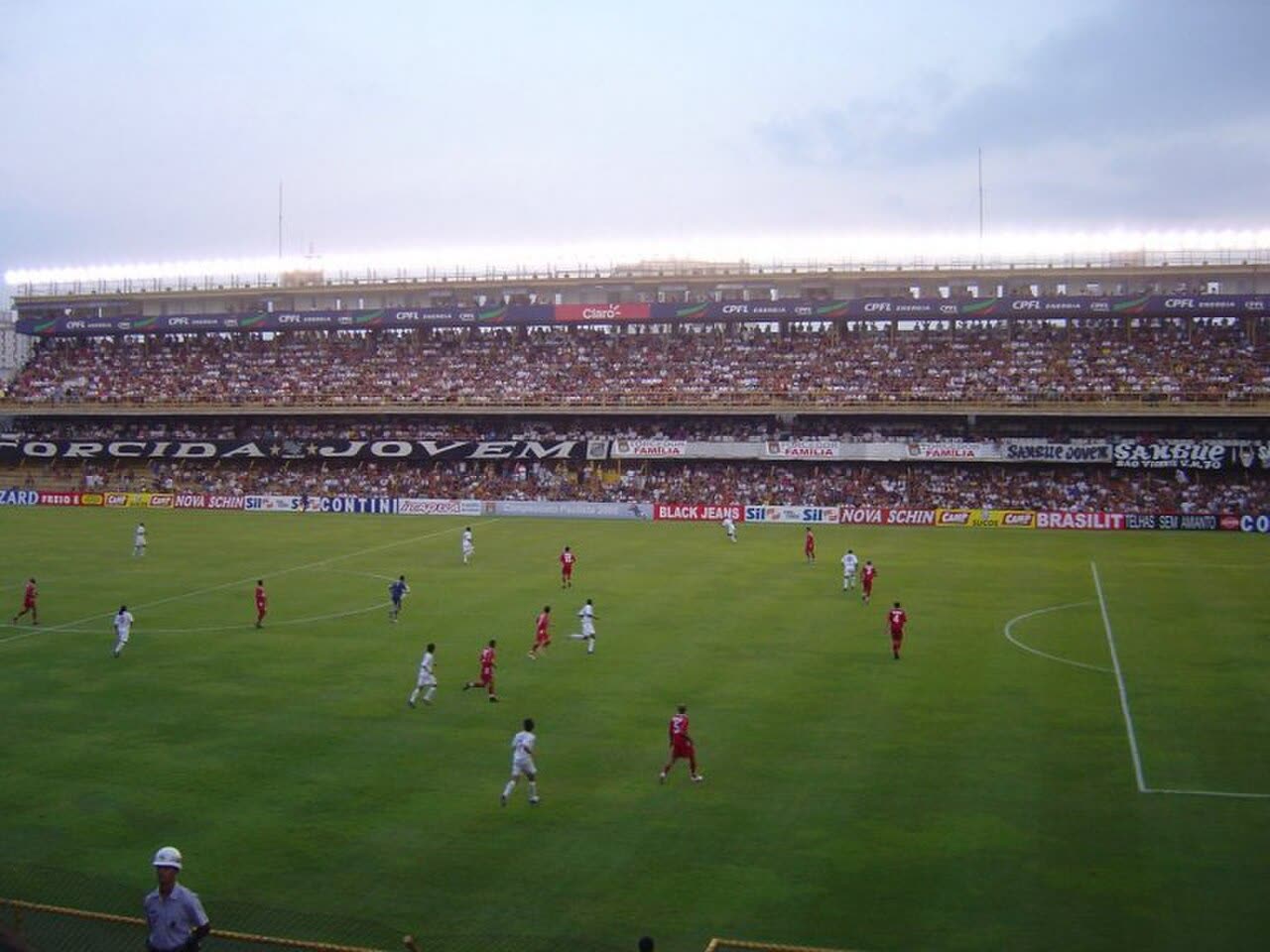
He was scouted by Waldemar de Brito, who proclaimed he would become the best player in the world. Pelé joined the Santos Football Club at 15 and quickly emerged as one of Brazil's brightest young stars. He made his debut for Santos at the age of 15 and scored in a 7-1 win over Corinthians de Santo André.
1. A boy wonder at Santos and the Seleção (1956–1958)
Pelé first wore the Brazil shirt on 9 July 1957, facing Argentina at the Maracanã at the age of sixteen years and nine months, and scored the first of the 77 goals he would register in 92 appearances for his country. That same year, his first full professional season, he finished as the top scorer of the São Paulo state championship. His senior club career had begun when he joined the Santos Football Club at fifteen, where he quickly emerged as one of Brazil's brightest young stars. Brazil's official record credits him with 77 goals in 92 official appearances between 1957 and 1971.
The following year he scored 58 times as Santos won the state title, the club finding the net 143 times across 38 games. On 29 June 1958, aged seventeen, he celebrated his first World Cup title with Brazil in Sweden, a feat that leaves him the youngest world champion of all time. Santos, nicknamed the Santásticos, would go on to win eight more state championships, six Brazilian championships, two Copas Libertadores and two Intercontinental Cups.
After the 1958 World Cup he was declared a national treasure by the Brazilian government, a measure intended to discourage large offers from European clubs and keep him in Brazil. Inter Milan, Juventus, Manchester United and Real Madrid all tried to sign him, prompting the Brazilian government under president Jânio Quadros to declare him an official national treasure. When wealthy European clubs tried to sign him, the Brazilian government intervened with the same declaration. Called 'Pérola Negra' (Black Pearl) and 'O Rei' (The King), he became a Brazilian national hero.
2. Sweden 1958: a 17-year-old world champion
Pelé arrived at the 1958 tournament in Sweden as a reserve, and in his only first-round appearance he provided an assist before scoring the only goal in the quarter-final against Wales. That goal made him the youngest player ever to score at a men's World Cup, netting against Wales at 17 years and 239 days old. He was also the youngest to score a World Cup hat-trick.
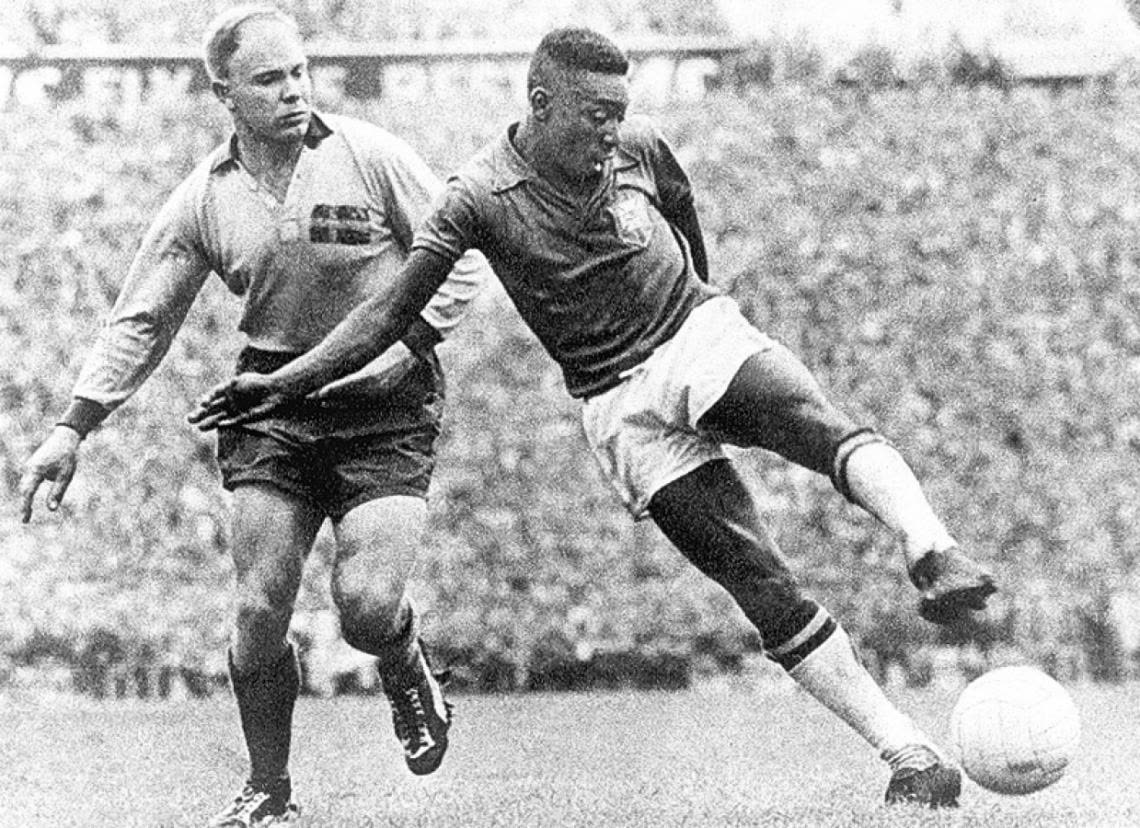

He scored a hat-trick against France in the semi-final and two in the 5-2 final win over the hosts. With that brace against Sweden he became the youngest player ever to score in a World Cup final. He also recorded an unprecedented three assists in World Cup deciders, one of them against Sweden in 1958.
Aged 17 he celebrated his first World Cup title with Brazil in Sweden on 29 June 1958 and remains the youngest world champion of all time. FIFA lists him as the youngest scorer, youngest hat-trick scorer and youngest finalist in World Cup history. He holds the record as the youngest player to score in a World Cup Final.
3. Chile 1962 and the Santásticos
At the 1962 World Cup in Chile, Pelé scored a brilliant individual goal as a 21-year-old in a 2-0 win over Mexico, but was injured in the next match and watched from the sidelines as Brazil defended their title. By the time he appeared at his second World Cup he had played 426 games and scored 488 goals for club and country. The tournament added a second winner's medal to a record that would eventually stand at three World Cups, in 1958, 1962 and 1970, the only player with three winner's medals.
In 1962 and 1963 Santos won both the Libertadores Cup and the Intercontinental Club Cup, establishing itself as one of the most dominant clubs of the era. The side, nicknamed the Santásticos, also won eight more state championships and six Brazilian championships. Scouted by Waldemar de Brito, who proclaimed he would become the best player in the world, Pelé propelled Santos to 25 major titles over 18 years, among them two Copa Libertadores and two Intercontinental Cup crowns.
The club's dominance was built on an unrelenting schedule of matches at home and abroad. FIFA credits him with an extraordinary 127 goals for Santos in the single calendar year 1959 alone. At the 1966 World Cup in England, Bulgarian and Portuguese defenders repeatedly hacked him down at the knees; he limped out of the tournament and, angered at the lack of protection from referees, vowed that he had played his last World Cup. He played five more games for Brazil and stayed with Santos another four years but declined to come out of international retirement for the 1974 World Cup.
4. Mexico 1970: the Beautiful Team and the third star
At the 1970 World Cup in Mexico, Pelé scored the opening goal in Brazil's 4-1 victory over Italy in the final at the Aztec Stadium. In that same match he set up Carlos Alberto with a nonchalant pass for the last goal of the 4-1 win. He also scored the opening goal and provided two assists in the final, helping Brazil claim a third title. Earlier, in the semi-final against Uruguay, he let the ball roll past goalkeeper Ladislao Mazurkiewicz, circled around him without touching it and sent the shot narrowly wide.
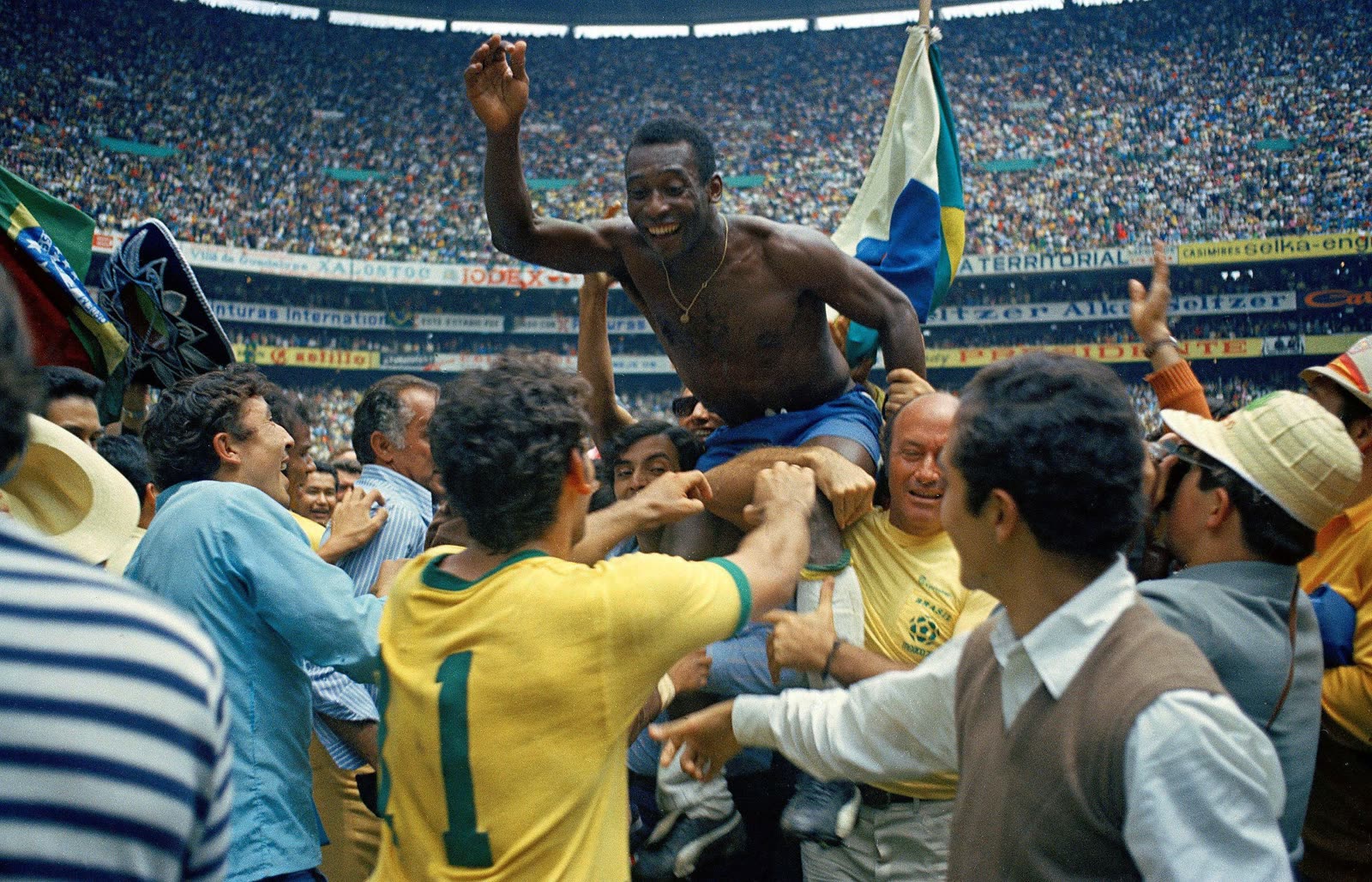

He won the Golden Ball in Mexico, scoring four goals, the pick of them the opener in the 4-1 final win over Italy. His six assists at Mexico 1970 were a record for a single World Cup. He also recorded an unprecedented three assists in World Cup deciders: one against Sweden in 1958 and two against Italy in 1970. He is the only player to have won the World Cup three times.
The third title brought Brazil permanent ownership of the Jules Rimet Trophy. In his own words, Brazil had the best team of all time without a doubt, and the 1970 World Cup marked the Brazilian people.
5. A thousand goals and a disputed record
The thousandth goal arrived on 19 November 1969, struck from the penalty spot for Santos at the Maracanã in what was his 909th first-class match 9Pele's goal record: Numbers that justify why Brazilian legend is 'King' · Olympics.com (International Olympic Committee) ↗. The Brazilian sports ministry likewise records that his thousandth goal came on that date 11Edson Arantes do Nascimento, o Pelé · Ministério da Cidadania, Governo do Brasil (gov.br) ↗. The milestone became known as the Milesimo, and it fixed in the public imagination a figure that the record books themselves could never quite settle 9.
The uncertainty is structural rather than merely clerical: the exact career goal tally is highly debated because of unstructured and decentralised record-keeping in the 1950s and 1970s, which is why more than one figure circulates 9. Guinness World Records counts 1,279 goals for Pelé between 7 September 1956 and 1 October 1977, across 1,363 games 9. The Brazilian Football Confederation and Santos count 1,283 goals in 1,367 matches, while FIFA claims 1,281 in 1,366 games 5Pele: Brazil football legend dies aged 82 · BBC Sport ↗. Against those totals stands a narrower and more strictly defined measure: 643 goals for Santos in official competitions 5.
| Record | Figure | Counted by |
|---|---|---|
| Career goals | 1,279 in 1,363 games | Guinness World Records 9 |
| Career goals | 1,281 in 1,366 games | FIFA 5 |
| Career goals | 1,283 in 1,367 matches | Brazilian Football Confederation and Santos 5 |
| Goals for Santos | 643 in official competitions | BBC 5 |
Whatever total is preferred, the Santos figure carries its own weight in the game's history: his 643 goals for the club stood as the record for a player at a single club for almost half a century before Lionel Messi broke it 9. The scale of his scoring for Brazil is less contested, with 77 goals in 92 official appearances between 1957 and 1971 4Pelé – a life in his own words · FIFA Museum ↗. On the game's largest stage he scored 12 goals in 14 World Cup matches 16Pelé | FIFA World Cup, Brazil, Biography, Father, GOAT · Encyclopaedia Britannica ↗.
6. New York Cosmos: winning a country (1975–1977)
Pelé joined the New York Cosmos in 1975, at a point when he was 34 and past his prime. His decision to move to the United States was shaped by two personal aims: the chance to study sports marketing, and the wish for his children to speak English. The club he joined was the last of his career, following Santos, where he had played from 1956 to 1974.
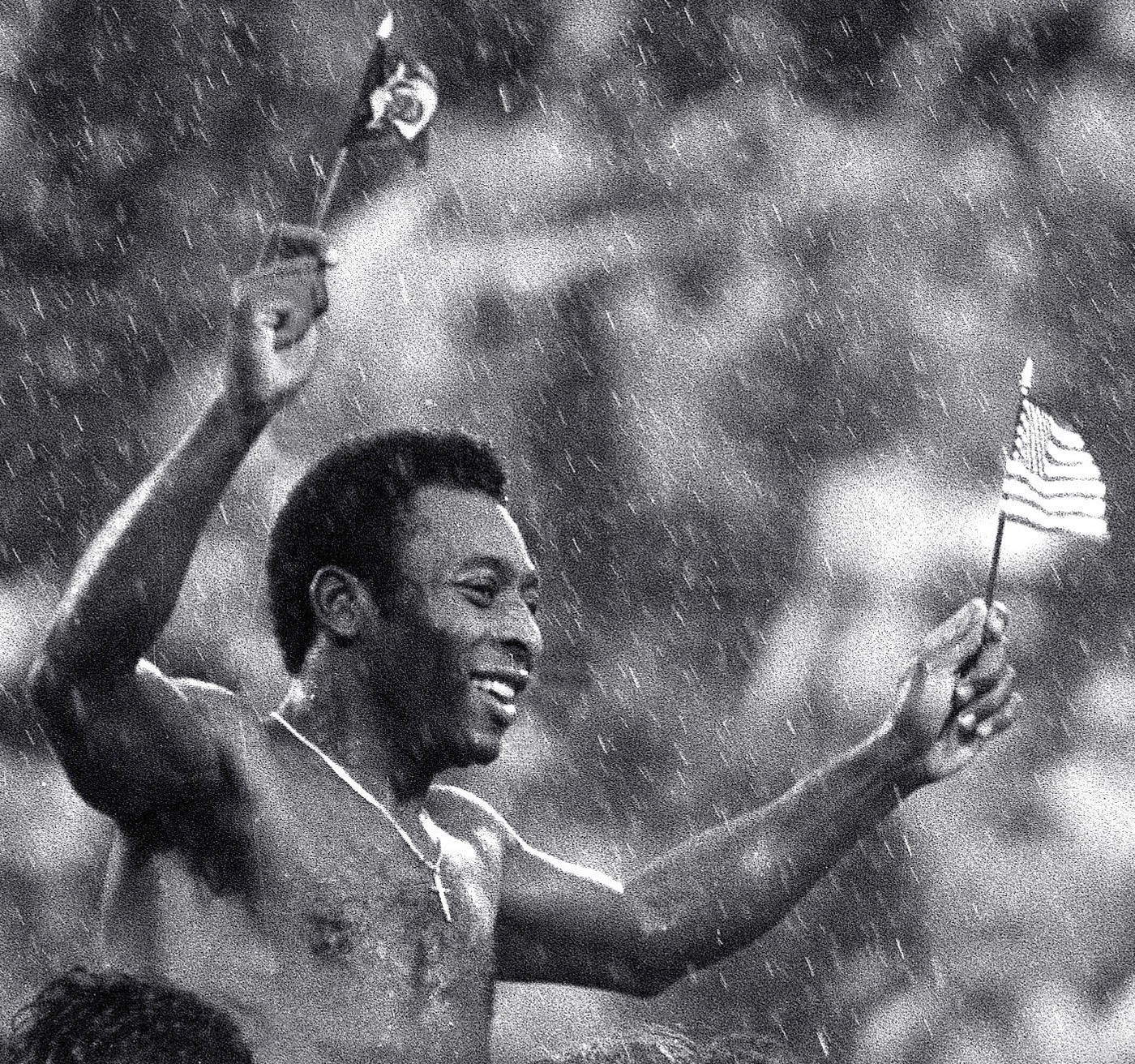

His scoring record with the Cosmos is counted at 64 goals across three seasons. A separate tally records 65 goals in 111 games over the same three seasons. In 1977 he led the club to the American championship. His presence with the Cosmos also helped draw stars such as Franz Beckenbauer, Carlos Alberto and Giorgio Chinaglia to the club.
He ended his career on 1 October 1977 in an exhibition between the Cosmos and Santos before some 77,000 spectators in New Jersey, playing half the game for each club. That date also closes the span in which Guinness World Records counts his 1,279 goals, in 1,363 games. A former Cosmos executive said soccer in the United States was a small immigrant sport before Pelé arrived, and only then grabbed the hearts and minds of Americans.
7. Minister, ambassador, global icon (1995–2022)
Between 1995 and 1998 Pelé served as Brazil's minister of sport, the first person to hold the post in the country. His tenure coincided with the enactment of the Lei Pelé, legislation regulating sport and the relationship between clubs and players. After football his life took many forms: he was Brazil's extraordinary minister for sport, a businessman, and an ambassador for UNESCO and the United Nations.
In 1999 the International Olympic Committee named him athlete of the century, even though he had never appeared at an Olympic Games. He was named FIFA's Player of the Century in the year 2000. In 1967 factions in Nigeria's civil war agreed a brief cease-fire so he could play an exhibition match, and in 1997 he was knighted by Queen Elizabeth II.
The Pelé Museum opened in Santos in 2014 and preserves memorabilia from his life and career. He was widely regarded as the greatest player ever, and is the only player to have won the World Cup three times. He died on 29 December 2022 in São Paulo, Brazil, at the age of 82.
8. Farewell: 29 December 2022 and the legacy
Pelé died on 29 December 2022 in São Paulo, Brazil, at the age of 82. The cause was multiple organ failure following colon cancer. The state of São Paulo declared seven days of official mourning over his death.
He was buried privately in Santos after an eight-mile funeral procession. Santos unveiled a 'Sala do Trono' (Throne Room) at its Memorial das Conquistas, inaugurated in the presence of Edinho, Pelé's son, and former teammates including Pepe, Lima and Mengálvio. The club marked 23 October 2023 as the first birthday without Pelé, a date it says will always be remembered by its fans.
The tally of his goals remains a matter of record-keeping rather than dispute over his stature. Guinness World Records counts 1,279 goals for Pelé between 7 September 1956 and 1 October 1977 in 1,363 games. The Brazilian Football Confederation and Santos count 1,283 goals in 1,367 matches, while FIFA claims 1,281 in 1,366 games. For Santos alone, in official competitions, he scored 643 goals over 19 years.
9. In his own words
Pelé's own account of his career returns repeatedly to the Brazil side that won the 1970 World Cup in Mexico, a team he described as the best of all time without a doubt, and one whose triumph, in his words, marked the Brazilian people 4. He scored in that final and set up Carlos Alberto with a nonchalant pass for the last goal in the 4-1 victory over Italy 10As 'The King,' Pelé enchanted fans and dazzled opponents · Associated Press ↗, and he also scored the opening goal of the same match at Mexico's Aztec Stadium 6Pele: Goalscorer, World Cup winner, hero, icon and legend · BBC Sport ↗. On the pass that everyone asks about, he explained that it was not that he passed without looking — the Brazilian team simply knew each other so well 4.
The 1970 final was not his only decisive contribution on such a stage: he recorded an unprecedented three assists in World Cup deciders, one against Sweden in 1958 and two against Italy in 1970 7Football and the world mourns Pelé · FIFA (Inside FIFA) ↗. In the Italy match he both scored the opening goal and provided two assists, helping Brazil claim a third title and permanent ownership of the Jules Rimet Trophy 16. His World Cup record stands at 12 goals in 14 matches 16.
Do not worry, I will win a World Cup for you.
Pelé, aged ten, to his father after Brazil lost 2-1 to Uruguay 4
Brazil had the best team of all time without a doubt, and the 1970 World Cup marked the Brazilian people.
Pelé, in his own words 4
It was not that he passed without looking — the Brazilian team simply knew each other so well.
Pelé, on the pass to Carlos Alberto 4
10. Timeline: Pelé, 1940-2022
- 23 October 1940Birth in Três CoraçõesEdson Arantes do Nascimento is born in the interior of Minas Gerais state and grows up shining shoes to buy his first football gear.
- 1950The promise to his fatherTen-year-old Pelé sees his father cry when Brazil lose 2-1 to Uruguay and tells him: 'Do not worry, I will win a World Cup for you.'
- 1956Debut for Santos at 15Pelé makes his debut for Santos at the age of 15, scoring in a 7-1 win over Corinthians de Santo André.
- 9 July 1957First cap for BrazilAged 16 years and nine months he first wears the Brazil shirt against Argentina at the Maracanã, scoring the first of his 77 international goals in a 2-1 defeat.
- 29 June 1958World champion at 17Pelé celebrates his first FIFA World Cup title with Brazil in Sweden, still the youngest world champion of all time.
- 1961Declared a 'non-exportable national treasure'After Italian clubs try to lure him away, Brazil's president Jânio Quadros declares Pelé a 'non-exportable national treasure', keeping him at Santos for almost two decades.
- 1962A second star, from the sidelinesHe scores a brilliant individual goal in the 2-0 win over Mexico at the World Cup, then is injured in the next match and watches as Brazil defend their title.
- 19 November 1969The Milesimo: 1,000th goalHis 1,000th goal — the 'Milesimo' — comes from a penalty for Santos at the Maracanã, in his 909th first-class match.
- 21 June 1970A third World CupPelé leads Brazil to a third World Cup triumph — the only player ever to have won three — celebrated at the Azteca Stadium in Mexico.
- 1975New York CosmosPast his prime at 34, he joins the New York Cosmos of the North American Soccer League, raises soccer's profile in North America and leads the club to the 1977 league title.
- 1 October 1977Final matchHe ends his career in an exhibition between the Cosmos and Santos before some 77,000 spectators in New Jersey, playing half the game for each club.
- 1995Minister of sportEdson Arantes do Nascimento is appointed Brazil's minister of sport, the first to hold the post; the Lei Pelé regulating sport is enacted during his term.
- 2000FIFA Player of the CenturyHaving won the World Cup three times, lifting the trophy in 1958, 1962 and 1970, Pelé is named FIFA's Player of the Century.
- 29 December 2022Death in São PauloPelé dies at the age of 82; the hospital confirms the failure of multiple organs resulting from the progression of colon cancer, and Santos announces a public wake at the club's Estadio Urbano Caldeira, with his coffin to be placed in the centre of the pitch.
11. Frequently asked questions
Who was Pelé, and what was his full name?
Which clubs did Pelé play for?
He played for Santos from 1956 to 1974 and for the New York Cosmos from 1975 to 1977 4. With Santos he won 25 major titles, including two Copa Libertadores and two Intercontinental Cups 3A tribute to Pele | Brazil and FIFA World Cup legend · FIFA (Fédération Internationale de Football Association) ↗.
How many goals did Pelé score in his career?
How many World Cups did Pelé win?
What did Pelé do after retiring from football?
References (16)
- 1Pelé, Brazil's mighty king of 'beautiful game,' has died — Associated Press BookView source
- 2Pelé obituary — The Guardian 2022 Web↩View source
- 3A tribute to Pele | Brazil and FIFA World Cup legend — FIFA (Fédération Internationale de Football Association) Web↩View source
- 4Pelé – a life in his own words — FIFA Museum Web↩View source
- 5Pele: Brazil football legend dies aged 82 — BBC Sport Web↩View source
- 6Pele: Goalscorer, World Cup winner, hero, icon and legend — BBC Sport Web↩View source
- 7Football and the world mourns Pelé — FIFA (Inside FIFA) Web↩View source
- 8Pelé: Most Wins of the FIFA World Cup by a player — Guinness World Records Web↩View source
- 9Pele's goal record: Numbers that justify why Brazilian legend is 'King' — Olympics.com (International Olympic Committee) Web↩View source
- 10As 'The King,' Pelé enchanted fans and dazzled opponents — Associated Press Book↩View source
- 11Edson Arantes do Nascimento, o Pelé — Ministério da Cidadania, Governo do Brasil (gov.br) Web↩View source
- 12Pele praised for hugely impactful move to the USA — FIFA (Fédération Internationale de Football Association) WebView source
- 13Rei do futebol, Pelé morre aos 82 anos — Agência Brasil (EBC) 2022 WebView source
- 14Em homenagem ao Rei Pelé, Sala do Trono é inaugurada no Memorial das Conquistas — Santos Futebol Clube WebView source
- 15Em homenagem ao Rei Pelé, Memorial das Conquistas realiza visitas especiais com os Ídolos Eternos e trono no centro do gramado — Santos Futebol Clube WebView source
- 16Pelé | FIFA World Cup, Brazil, Biography, Father, GOAT — Encyclopaedia Britannica Web↩View source