Al-Khwarizmi
The ninth-century Baghdad scholar whose book on al-jabr founded algebra, whose arithmetic carried Hindu-Arabic numerals westward, and whose Latinised name gave the world the word algorithm.
Al-Khwarizmi (c. 780 – c. 850) was a mathematician, astronomer and geographer who worked at the House of Wisdom in Baghdad under the Abbasid caliph al-Ma'mun. His Compendious Book on Calculation by Completion and Balancing (al-Kitab al-mukhtasar fi hisab al-jabr wa'l-muqabala) set out systematic methods for solving linear and quadratic equations and gave algebra its name, while a second treatise carried the Hindu-Arabic numeral system to the Latin West in translations whose title, Algoritmi de numero Indorum, gave rise to the word algorithm. He also compiled astronomical tables (the Zij al-Sindhind) and a geography, Kitab Surat al-Ard, based on the work of Ptolemy.
Overview
Muhammad ibn Musa al-Khwarizmi was a Muslim mathematician, astronomer and geographer who lived during the Islamic Golden Age.
1. Life and Historical Context
Muhammad ibn Musa al-Khwarizmi was born around 780 and died around 850 during the Islamic Golden Age. He was a Muslim mathematician and astronomer, and he spent most, if not all, of his scholarly life in Baghdad in close connection with the Abbasid court, particularly during the caliphate of al-Ma'mun, who reigned from 813 to 833 CE. The era was one of remarkable scientific progress in the Islamic Empire, and al-Ma'mun encouraged learning even more strongly than his father al-Rashid.
Al-Ma'mun set up the House of Wisdom in Baghdad, which became the centre for both the work of translating and of research. Al-Khwarizmi and his colleagues the Banu Musa were scholars at the House of Wisdom, translating Greek scientific manuscripts and studying and writing on algebra, geometry and astronomy. Among the famous mathematicians employed there was al-Khwarizmi, who composed the oldest work on arithmetic and the oldest work on algebra. The House of Wisdom also drew al-Kindi and the translator Hunayn ibn Ishaq.
There is some confusion about his origins: the 10th-century bibliographer Ibn al-Nadim claimed that Muhammad ibn Musa was from Khwarizm in Central Asia, whereas the historian Tabari reported that he was also known as al-Qutrabbuli, associating him with a town not far from Baghdad. Toomer suggests that the name al-Khwarizmi may indicate that he came from Khwarizm south of the Aral Sea in central Asia. Tabari added that he was also called al-Majusi, a designation that indicates that Khwarizmi was a Zoroastrian rather than a Muslim.
2. Algebra: Al-Kitab al-mukhtasar fi hisab al-jabr wa'l-muqabala
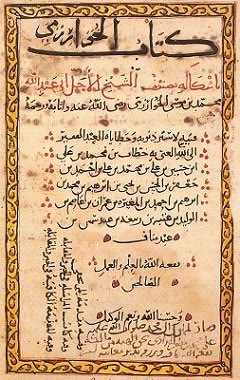
Al-Khwarizmi's most important work is Al-Kitab al-mukhtasar fi hisab al-jabr wa'l-muqabala, known in English as The Compendious Book on Calculation by Completion and Balancing, written around 830 with the encouragement of the Abbasid caliph al-Ma'mun, to whom the Algebra was dedicated. The treatise is a compilation of rules, together with demonstrations, for finding solutions of linear and quadratic equations based on intuitive geometric arguments rather than the abstract notation now associated with the subject, and its systematic approach distinguishes it from earlier treatments. It is the first book on algebra known in Arabic.
The reduction of equations is carried out using the two operations of al-jabr and al-muqabala, of which al-jabr means completion and is the process of removing negative terms from an equation. The science as taught by Mohammed ben Musa in the treatise does not extend beyond quadratic equations, including problems with an affected square. For the type in which a square and ten roots are equal to 39 units, al-Khwarizmi takes one-half of the roots, multiplies it by itself, adds the result to 39 and then takes the square root and subtracts half the roots, leaving three as the root. He observed that the numbers required in calculating by completion and reduction are of three kinds: roots, squares and simple numbers relative to neither root nor square.
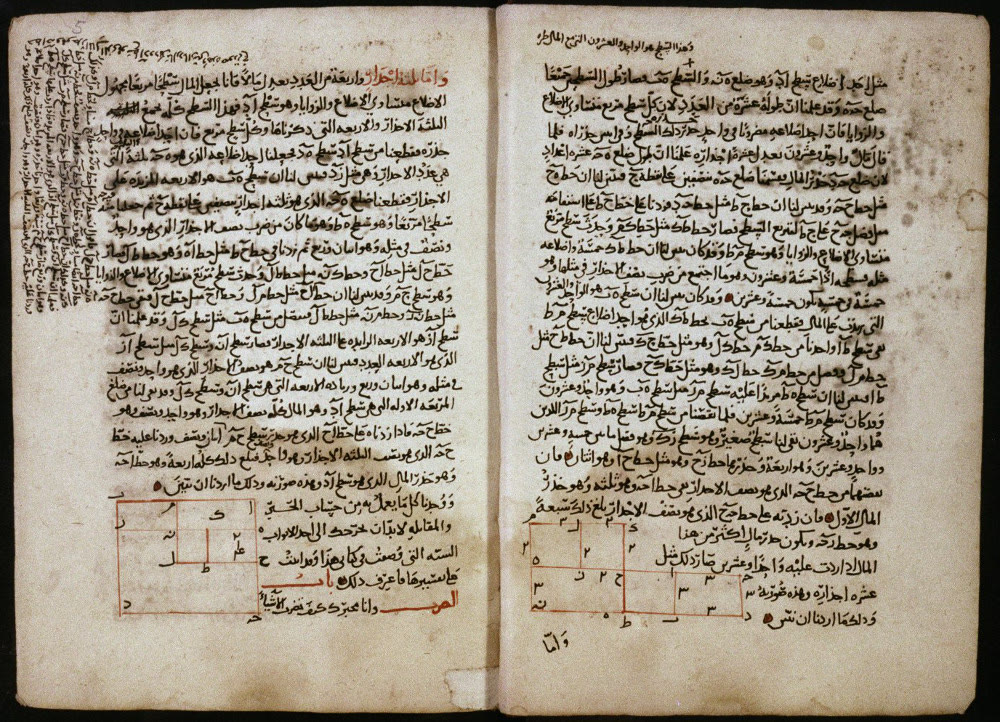
The work consists of three parts: on linear and quadratic equations, on practical geometry, and on inheritance problems. Its second chapter is concerned with mensuration, outlining rules for computing areas and volumes, and the last and largest chapter is concerned mainly with legacies. Al-Khwarizmi intended his book to teach what is easiest and most useful in arithmetic, such as what men constantly require in cases of inheritance, legacies, partition, lawsuits and trade, and its worked examples were meant for everyday applications in trade, legal inheritance and surveying.
The treatise is preserved in the Bodleian Library of Oxford University as manuscript Hunt. It was translated into Latin in the 12th century. Written in the 9th century, the treatise is recognized as the foundational source of modern algebra, and it was through this work that the term al-jabr entered the world of science.
3. Arithmetic and the Hindu-Arabic Numerals
Al-Khwarizmi composed a treatise on calculation with Hindu numerals (about 825), a work that has not survived in its Arabic original but is known through its Latin translation. That translation, Algoritmi de numero Indorum, preserves the substance of his arithmetic and stands as the principal witness to it. The treatise set out the Hindu place-value system of numerals, built on nine digits together with zero.
The first use of zero as a place holder in positional base notation was probably due to al-Khwarizmi. The oldest Latin adaptations from the 12th century remain the only evidence documenting the genesis and first spreading of a decimal arithmetic that uses nine figures and zero, known in the Middle Ages as algorismus. The title Algoritmi de numero Indorum is itself an imaginary title, a free translation from the Arabic that is sometimes accepted by authors.
Cambridge University Library MS Ii.6.5 is the manuscript witness: its current Quire 14 contains the first half of al-Khwarizmi's Arithmetic in Latin, with catchwords suggesting that the text once continued onto a subsequent quire, now lost. In 1857 Baldassare Boncompagni published the Latin translation of al-Khwarizmi's arithmetic that had been found in Cambridge.
4. Astronomy and Geographical Work
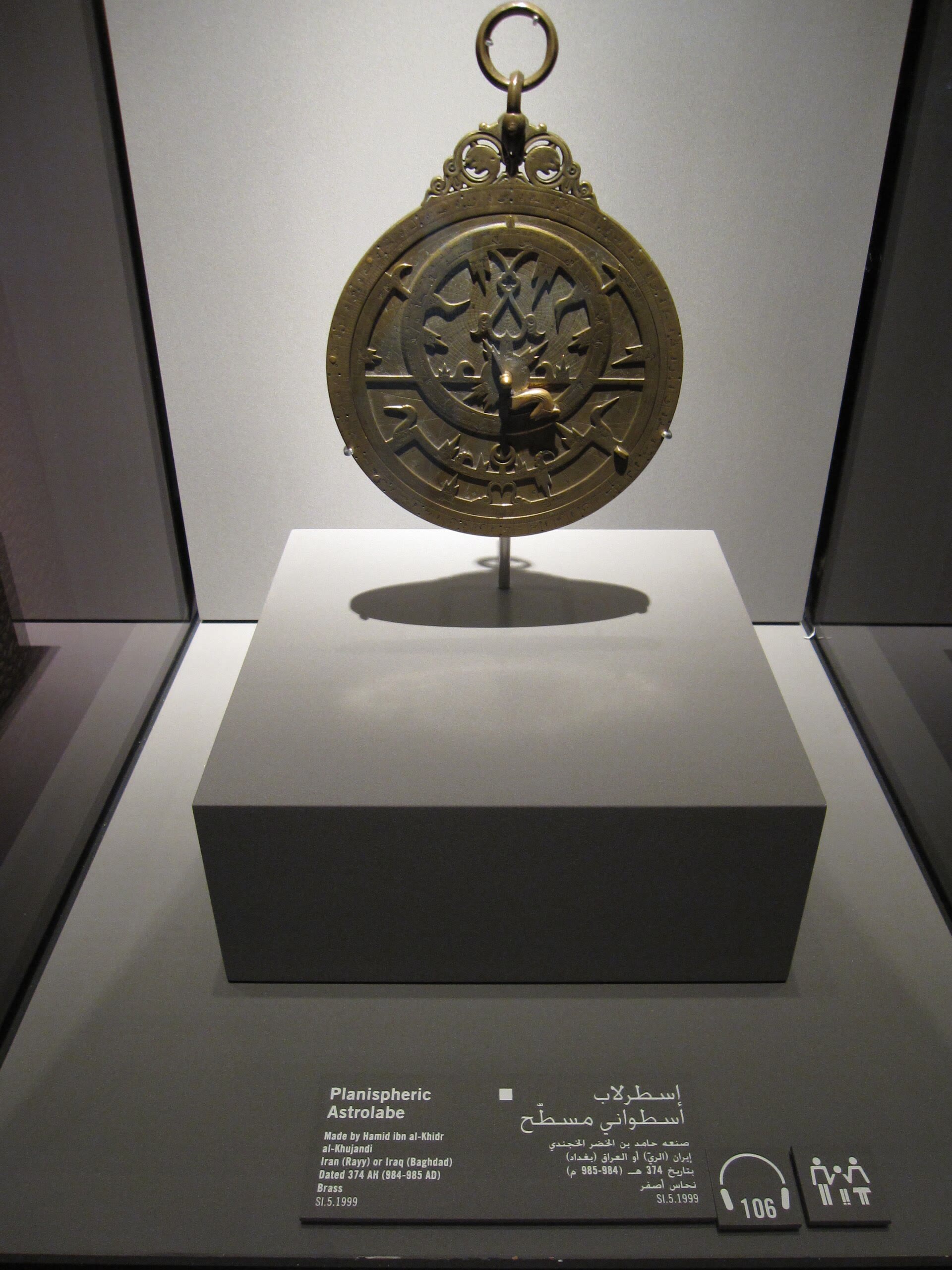
Among al-Khwarizmi's astronomical writings was the Zij al-Sindhind, a handbook that no longer survives in its Arabic original and is known instead through a revision by Maslama al-Majriti and through Latin translations. Ibn al-Nadim lists four astronomical works by him: the Zij al-Sindhind, a treatise on the sundial, and two works on the astrolabe. The first of these is no longer extant in Arabic but is available in Latin translation, while the second seems to be extant along with fragments of a work on the astrolabe.
A third major book was his Kitab Surat al-Ard, The Image of the Earth, which presented the coordinates of localities in the known world on the basis of Ptolemy's Geography but with improved values for the length of the Mediterranean Sea and the location of cities in Asia and Africa. The work was extracted by Abu Ja'far Muhammad al-Khwarizmi from the Geography composed by Claudius Ptolemaeus. It gave latitudes and longitudes for 2402 localities as a basis for a world map, listing cities, mountains, seas, islands, geographical regions and rivers. The book combines substantial parts of Ptolemy's Geography with many non-Ptolemaic coordinates and place names. Al-Khwarizmi's world map has been reconstructed in detail in 1967 by Radiya Jafri of the Aligarh Muslim University.
Al-Khwarizmi also assisted in the construction of a world map for al-Ma'mun and participated in a project to determine the circumference of the Earth by measuring the length of a degree of a meridian through the plain of Sinjar in Iraq.
5. Legacy and Influence
Al-Khwarizmi is considered the father of algebra and, for some, the grandfather of computer science. His algebra represented a revolutionary move away from the Greek concept of mathematics, which was essentially geometry. It offered a unifying theory that allowed rational numbers, irrational numbers and geometrical magnitudes to be treated alike as algebraic objects, and it provided a vehicle for the future development of mathematics. The word algorithm entered its current definition and usage in the early 20th century. More than 1,000 years before the internet and smartphone apps, al-Khwarizmi invented the concept of algorithms.
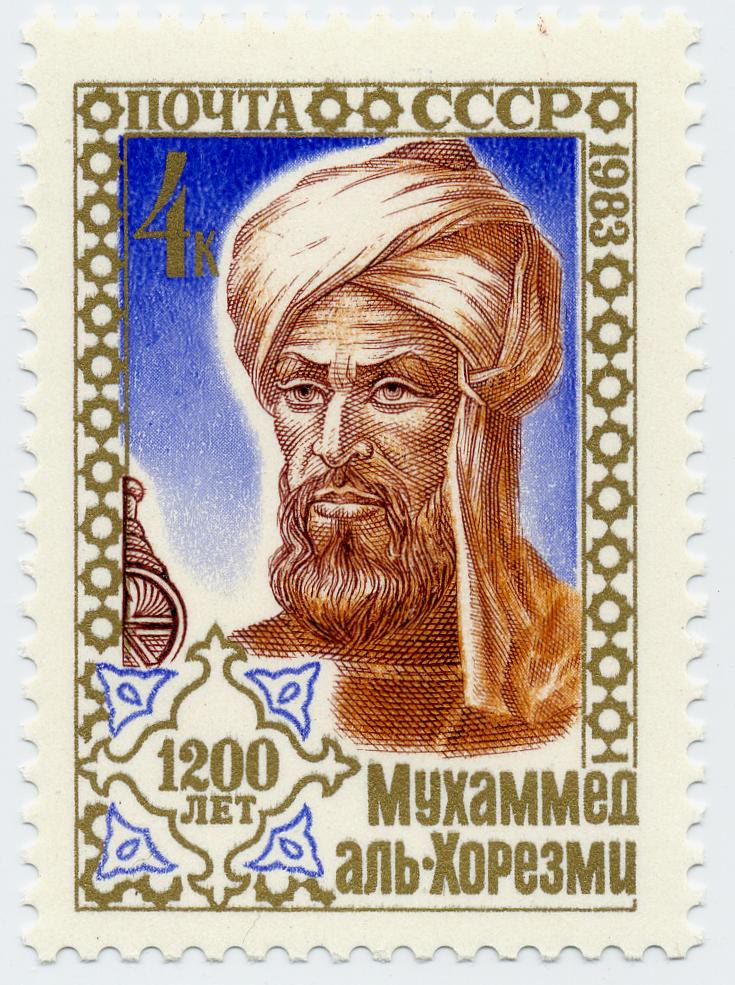
Commemoration has taken both terrestrial and lunar forms. The Soviet Union issued a stamp in 1983 for his 1,200th birthday. A crater on the Moon bears the name Al-Khwarizmi. No authentic portraits of him survive; all portraits on the internet are modern artist's impressions.
6. Timeline: from 773 to 1983
- 773The Sindhind reaches BaghdadAn Indian astronomer visits the court of al-Mansur, and the astronomical tables he brought, known as the Sindhind, are translated into Arabic; they later inform al-Khwarizmi's own astronomical work.
- c. 780Birth of al-KhwarizmiAl-Khwarizmi is born; the traditional date given for his birth is about 780.
- 14 September 786Harun al-Rashid becomes caliphHarun al-Rashid becomes the fifth Abbasid caliph about the time al-Khwarizmi was born; he rules from Baghdad and encourages scholarship.
- 813Al-Ma'mun becomes caliphAfter defeating his brother al-Amin, al-Ma'mun becomes caliph and continues the patronage of learning, setting up the House of Wisdom in Baghdad.
- 823/824Treatise on the Jewish calendarAl-Khwarizmi's description of the Jewish calendar is written not before 823/824, because one of its examples is carried out for that year.
- c. 825The Arithmetic on Indian numbersAl-Khwarizmi writes his arithmetic of the Hindu decimal reckoning; the Arabic text is lost and the work survives through Latin adaptations.
- c. 830The Compendious Book on Calculation by Completion and BalancingAround 830 al-Khwarizmi writes his algebra treatise with the encouragement of Caliph al-Maamoun.
- c. 850Death of al-KhwarizmiAl-Khwarizmi dies about 850.
- 12th centuryLatin translations reach EuropeLatin translations of his works circulate in Europe, introducing algebra and the Hindu-Arabic numerals to Western mathematicians.
- 1831Rosen's edition and translationThe Algebra of Mohammad ben Musa, edited and translated by Frederic Rosen, is published in London.
- 1857The Cambridge manuscript is publishedThe Latin translation of al-Khwarizmi's arithmetic, found in Cambridge, is published by Baldassare Boncompagni.
- 1967Reconstruction of the world mapRadiya Jafri of the Aligarh Muslim University reconstructs al-Khwarizmi's world map in detail.
- 1983A stamp for the 1,200th birthdayThe Soviet Union issues a stamp in honour of his 1,200th birthday.
References (14)
- 1The Compendious Book on Calculation by Completion and Balancing — Library of Congress (World Digital Library) WebView source
- 2al-Khwārizmī | Muslim mathematician — Encyclopaedia Britannica WebView source
- 3Khwārizmī: Muḥammad ibn Mūsā al-Khwārizmī (Biographical Encyclopedia of Astronomers) — Islamic Scientific Manuscripts Initiative (MPIWG Berlin) / Springer WebView source
- 4Why are algorithms called algorithms? A brief history of the Persian polymath you've likely never heard of — The Conversation (Debbie Passey, University of Melbourne) WebView source
- 5Arabic mathematics: forgotten brilliance? — MacTutor History of Mathematics Archive, University of St Andrews WebView source
- 6Al-Khwarizmi — MacTutor History of Mathematics Archive, University of St Andrews WebView source
- 7Culture — Islamic Mathematics (course project) — University of Illinois WebView source
- 8The Algebra of Mohammed ben Musa, edited and translated by Frederic Rosen (1831) — Internet Archive (Oriental Translation Fund, London) 1831 ArchiveView source
- 9Muhammad ibn Musa (Al-)Khwarizmi (or Kharazmi) (ca. 780-850 CE) — Utrecht University (Jan P. Hogendijk) WebView source
- 10Algebra — Islamic Mathematics (course project) — University of Illinois WebView source
- 11Oxford's hidden secret: for the first time, Al-Khwarizmi's work will be exhibited at the Center of Islamic Civilization — Center for Islamic Civilization (Uzbekistan) WebView source
- 12The Arabic Origins and Development of Latin Algorisms in the Twelfth Century (Arabic Sciences and Philosophy, Vol. 1, Issue 2) — Cambridge University Press BookView source
- 13Constantinus Africanus, al-Khwarizmi, Hermannus Contractus, and other texts (MS Ii.6.5) — Cambridge University Library, Western Medieval Manuscripts BookView source
- 14The Hindu-Arabic Numerals (David Eugene Smith & Louis Charles Karpinski, 1911) — Project Gutenberg 1911 WebView source
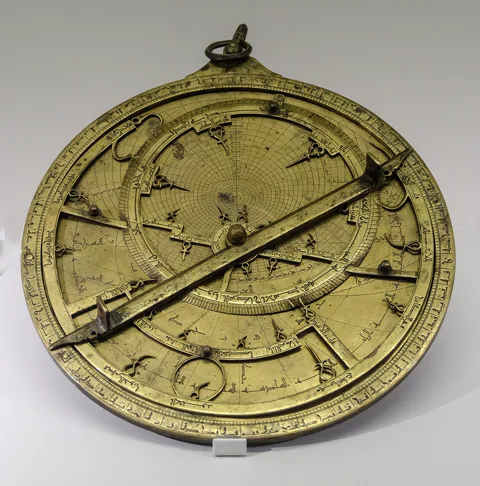 Islamic Golden Age
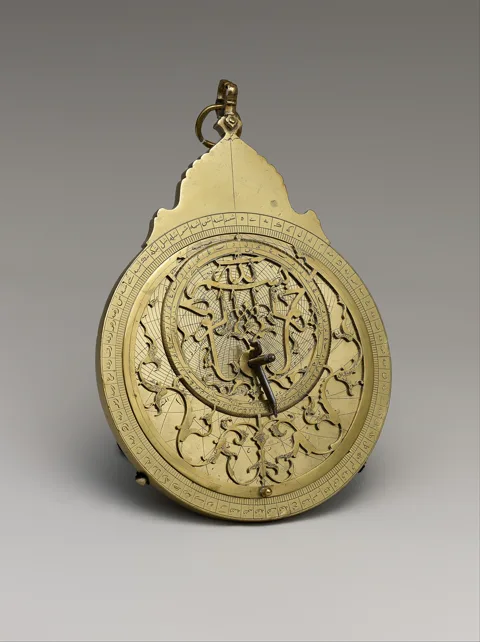 Astrolabe
 Paper