Astrolabe
The ancient astronomical instrument that modelled the sky in two dimensions — from Hellenistic Alexandria and the Islamic workshops to Chaucer's manual and the mariner's astrolabe.
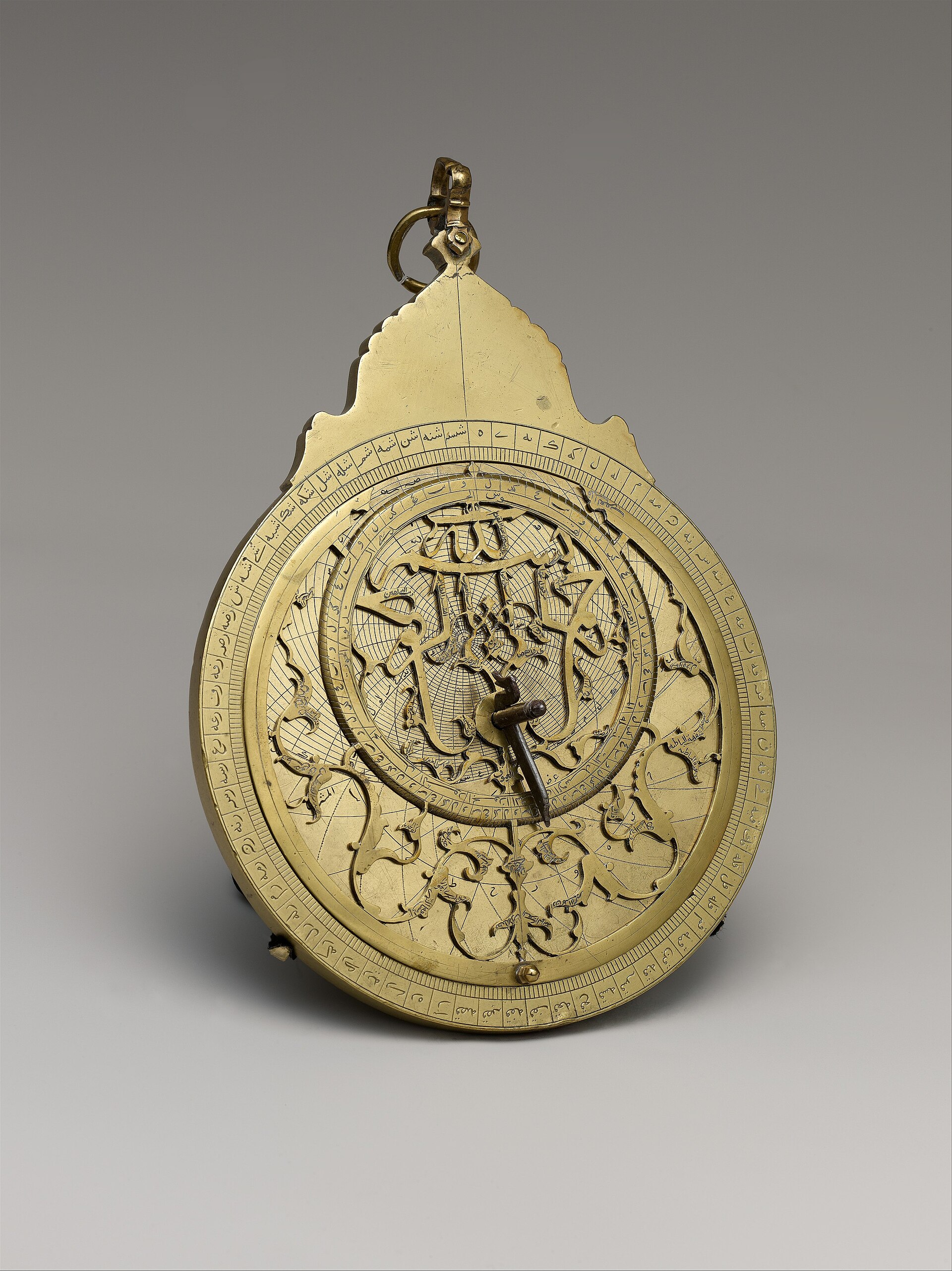
The astrolabe is a portable astronomical instrument that projects the celestial sphere onto a flat plate by stereographic projection, letting its user tell the time, measure the altitudes of sun and stars, find latitudes and directions, and solve problems of astronomy and astrology. Traced to 6th-century use and probably devised in the Hellenistic world, it was refined in the Islamic world from the 9th century, where makers added latitude plates, qibla scales and the spider-like rete, and where al-Zarqali built the universal azafea. It reached medieval Europe through Spain and Arabic translations, was described for English readers by Chaucer around 1391, and was adapted at sea as the open-ringed mariner's astrolabe before the sextant replaced it in the 18th century.
In this article
- 1Overview
- 2Etymology and Origins
- 3Construction and Principal Parts
- 4Function and Use
- 5Historical Development and Transmission
- 6Universal Astrolabes
- 7Mariner's Astrolabe
- 8Notable Surviving Astrolabes
- 9Chaucer's Treatise on the Astrolabe
- 10Cultural and Scientific Significance
- 11Timeline
- 12Timeline: from Hipparchus to the sextant
- 13Frequently asked questions
- 14Knowledge graph
Overview
The astrolabe is classed among the early scientific instruments used for reckoning time and for observational purposes. Its name means either star-taker or the one that catches the heavenly bodies. The instrument is traced to the 6th century and was in wide use from the early Middle Ages.
1. Etymology and Origins
The name of the instrument derives from the Greek astrolabos, a compound that joins the word for star to that for taking, so that the device is named for its office of seizing the positions of the stars. The astrolabe is an object probably invented by the Greeks in the 2nd century BC, and knowledge of it was transmitted to the Muslims through the translation of Hellenistic and Byzantine texts into Arabic. The device may have been invented by Hipparchus of Nicea in the 2nd century BCE.
The principle on which the instrument rests is stereographic projection, by which the celestial sphere is mapped on the plate of an astrolabe, allowing the 3-dimensional sphere to be represented on a flat plate; because each latitude needs its own projection, most astrolabes come with several plates.
2. Construction and Principal Parts
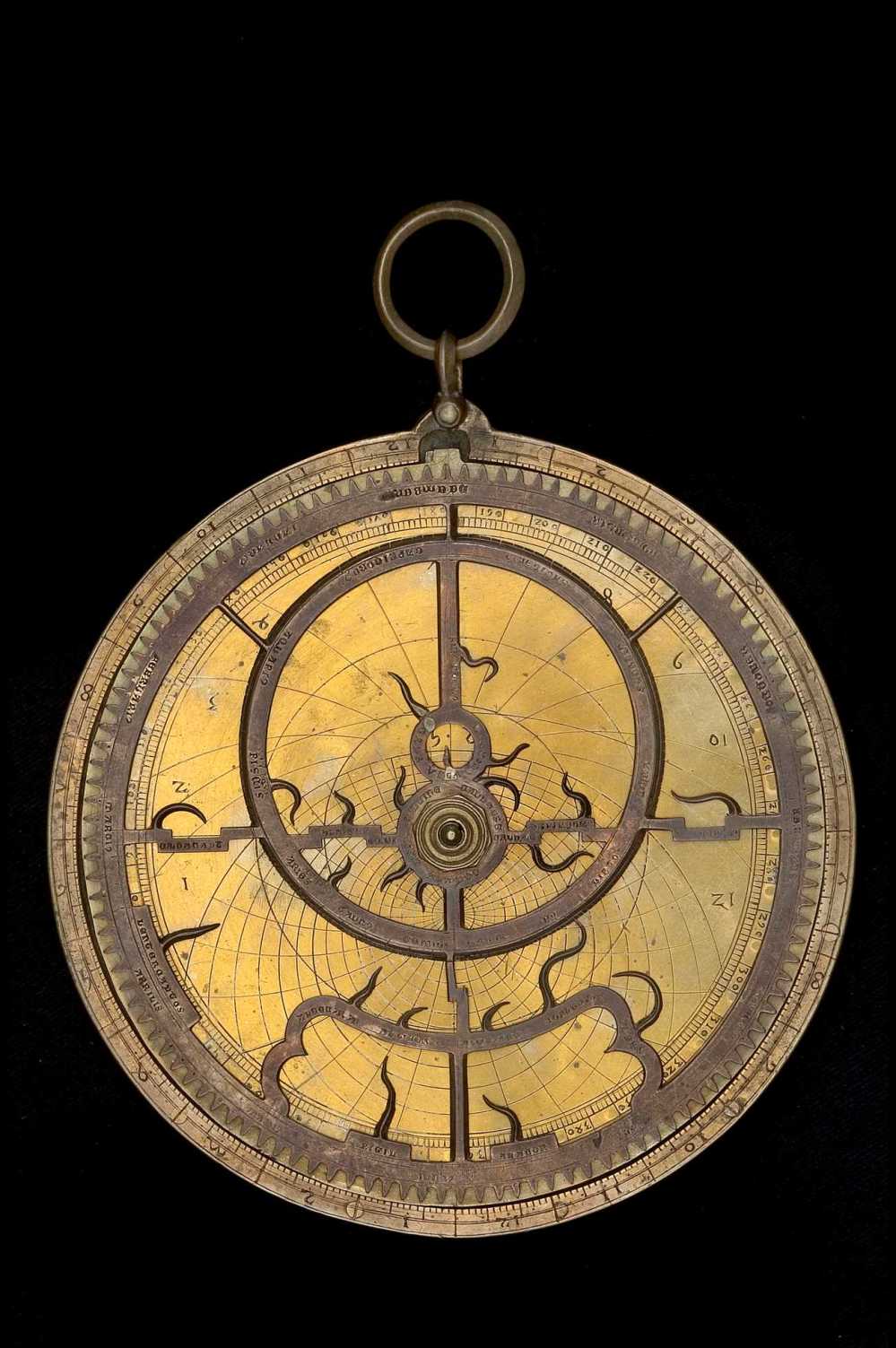
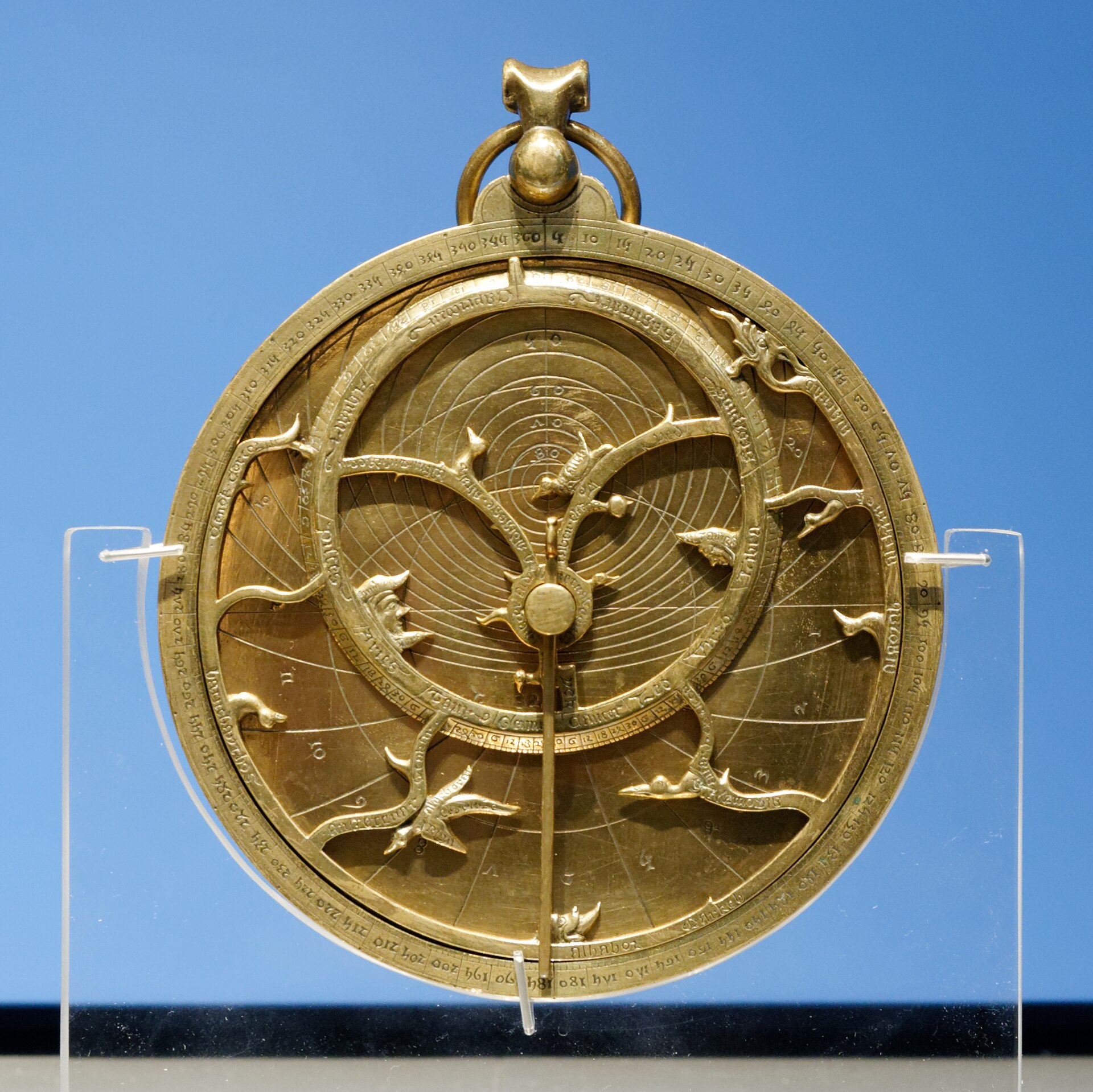
The instrument consists of a solid body, the mater, into which fit a series of plates and a revolving web-like star map called the rete in Europe and the ankabut, or spider, in the Islamic world. The mater, Latin for mother, is the main body of the astrolabe; its edge is called the limb, and the hollowed-out part is called the womb and contains the latitude plates. In Chaucer's own description the moder of the astrolabe is the thickest plate, pierced with a large hole, receiving in its womb the thin plates compounded for diverse climates and the rete shaped like a net. The standard planispheric astrolabe includes a set of thin brass plates, one for each terrestrial latitude, ruled with the horizon coordinate net for its latitude, under the rete. The rete, sometimes called the star-net, is a cut-out plate that carries the star pointers and ecliptic ring and can be rotated over the latitude plates underneath.
The alidade is a rotating bar on the back of an astrolabe, fitted with vanes with pin-holes that serve as sights; altitude is measured by lining up a star in the two holes and reading the degrees on the scale around the edge. At night the Pole Star was sighted through pinholes in the two vanes on the pivoting alidade; by day the astrolabe was held below the waist so that a beam of sunlight passed from the top pinhole onto the bottom one. The rule is a bar rotating across the front of the astrolabe that locates positions on the plate or rete and relates them to the scale of hours on the limb. A pin through the centre holds the alidade to the back and the rete to the front, secured by a wedge called a horse.
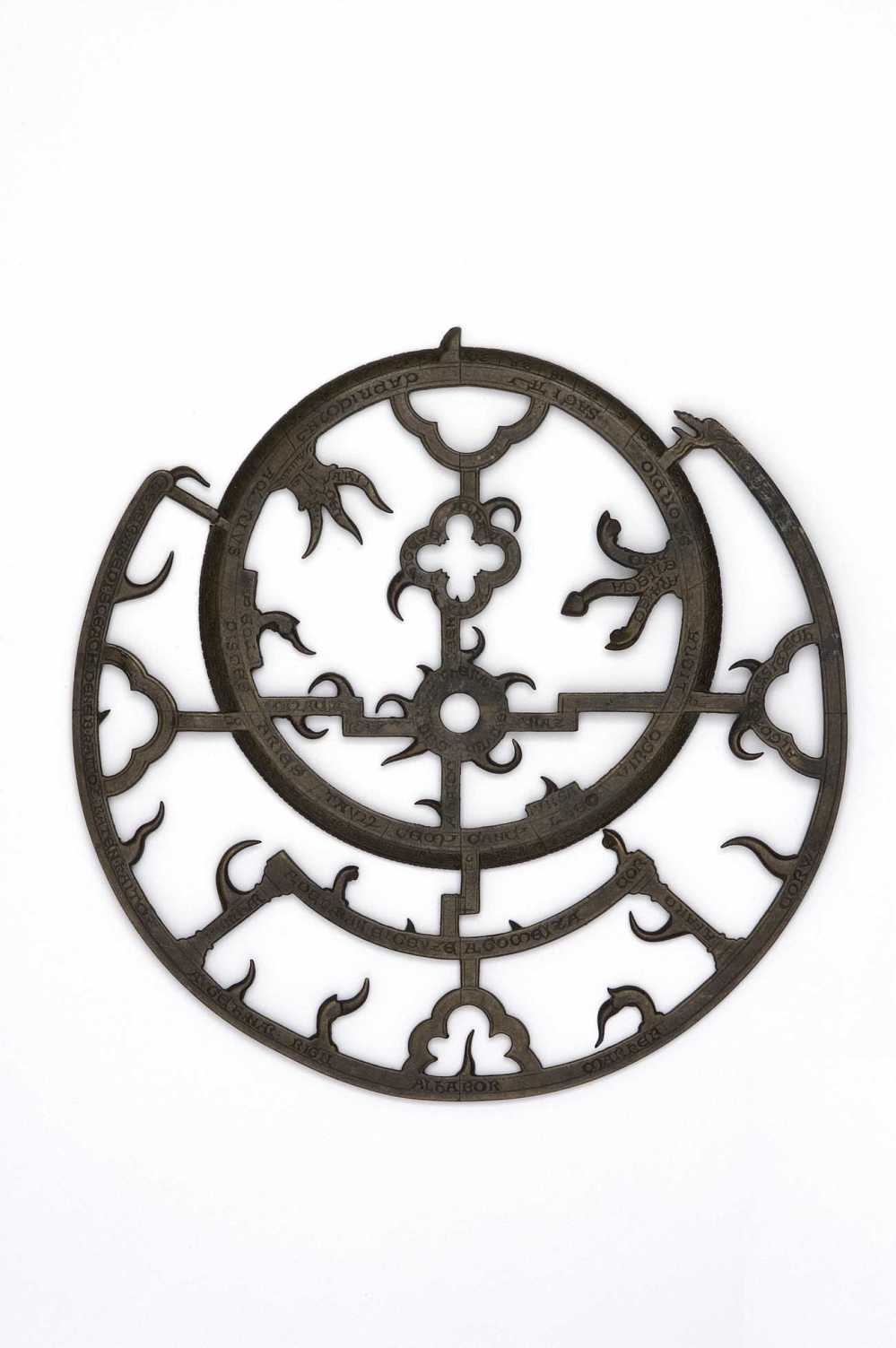
Most of the 41 star pointers on the Whipple rete are labelled with the names of stars, many of them in Arabic, reflecting the Arab influences on medieval European astronomy. The back of the Shah Abbas astrolabe contains 10 scales, among them altitude, cotangent, declination, azimuth of qibla, sine and cosine, and shadow square.
Brass is the most common material, and surviving examples also appear in copper or iron, with gold or silver inlay on finer pieces. The British Museum holds a brass astrolabe dated 1241/2 AH inlaid with silver and copper, carrying the maker's mark Abd al-Karim al-Asturlabi, the Astrolabist.
3. Function and Use
The planispheric astrolabe allowed an astronomer to compute the positions of the Sun and the prominent stars with respect to the horizon and the meridian, functioning as a rudimentary analog computer. It served to tell the time and to measure the heights of stars and buildings. The face of the instrument could be used as a clock: by moving the position of the Sun, or a pointer to a star, to the circle of its observed altitude, the hour could be read off. The back carried concentric circles for calendar calculations, including saints' days and feast days. The alidade was used to measure altitude by lining up a star in its two holes and reading the degrees. The astrologer worked with three tools: the astrolabe, the ephemeris table, and the dust board.
4. Historical Development and Transmission
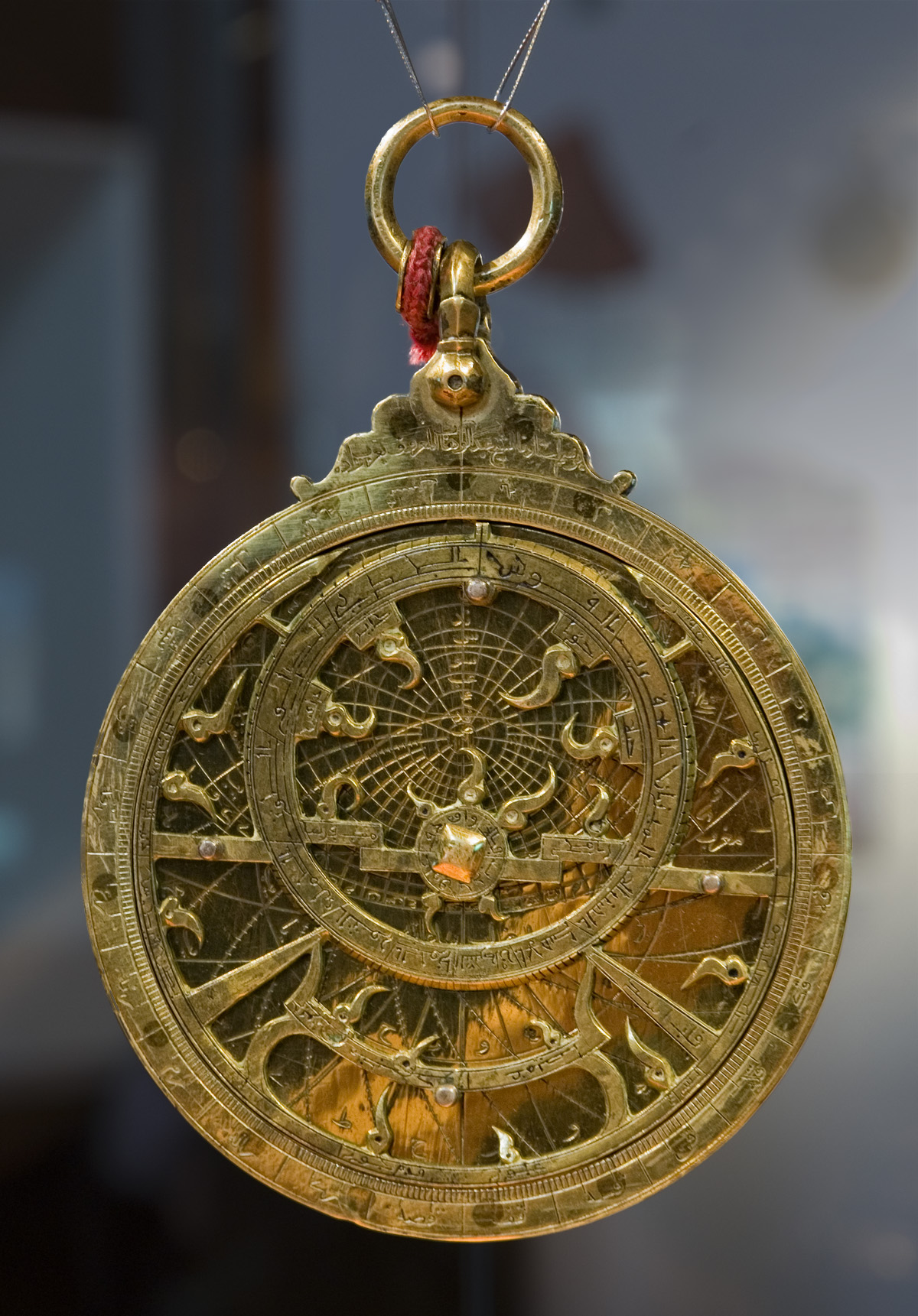
The earliest extant treatise on the astrolabe, covering both its construction and its use, was written by al-Khwarizmi. The earliest surviving astrolabes and astrolabe treatises belong to the 9th century. This development unfolded alongside the translation of scientific texts in Baghdad during the early Abbasid era, when the city became a major center of study under al-Mansur and al-Ma'mun, while local rulers in Cairo, Rayy and Isfahan likewise supported research. The specific requirements of Islam drove the refinement of such instruments: the astrolabe served as a two-dimensional map of the heavens by which the direction of Mecca and the times of prayer could be found. By the later 9th century it was in use throughout the Islamic world from Spain to India, and it later reached Christian Europe, with knowledge passing through Islamic Spain from around 1000 CE. In the Middle Ages the instrument became widespread in the Arab world, the Byzantine Empire, India and Europe.
Al-Biruni produced treatises on constructing an astrolabe and on using its different kinds, an epistle on the instrument, a treatise on time-keeping and the mechanical calendar, and the al-Qanun al-Masudi. Al-Battani was skilled in making instruments, and the final chapter of his astronomical work discusses instrument construction. Al-Sufi's Book of the Images of the Fixed Stars describes the forty-eight constellations on the basis of observations at Isfahan. The linear astrolabe was invented by Mozaffar ibn Muhammad Tusi.
5. Universal Astrolabes
Al-Zarqali's azafea, known in Europe as the Saphea Arzachelis, rests on stereographic mapping, but its centre of projection is one of the equinoctial points rather than the North Pole. Because of this choice of projection, the instrument is universal: it requires no special latitude plates.
Al-Zarqali led the Toledan school of astronomers and produced the Toledan Tables, containing observations of the sun, moon and planets. Those tables were widely used in Europe until the Alphonsine Tables appeared around 1270 in Castile. His patron Qadi ibn Said gave him books to study, and after two years he had mastered mathematics and astronomy and joined the Toledo group of astronomers in 1062 as its head.
6. Mariner's Astrolabe
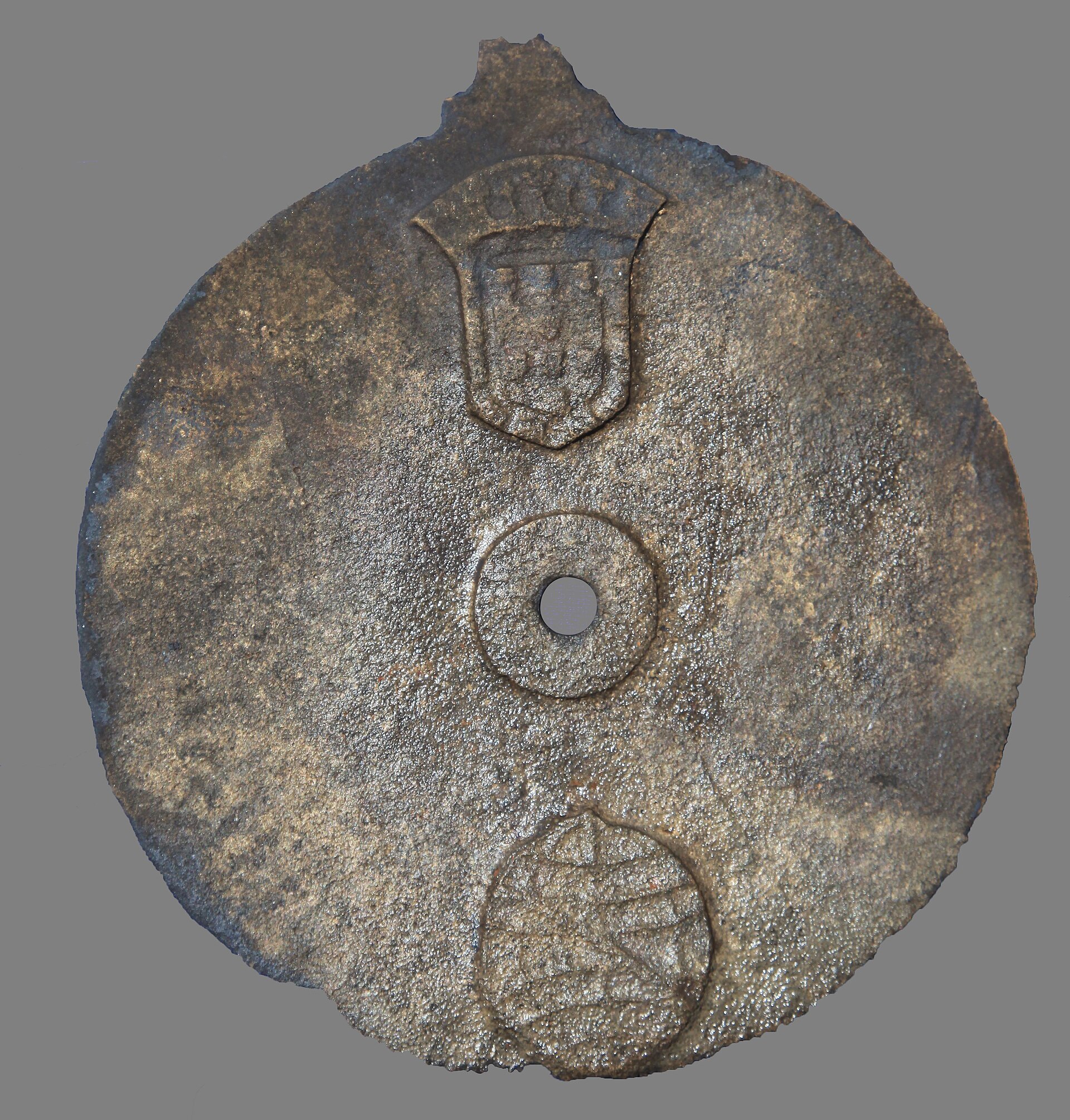
The mariner's astrolabe was a simplified instrument built for use at sea: it was heavier than its predecessors and had parts of the disc cut away to reduce wind resistance, and it served to determine the ship's latitude from the height of the Pole Star or of the sun.
A mariner's astrolabe recovered from Mounts Bay in Cornwall was found in 1982 and purchased in 1989. It is missing its alidade and suspension ring, and its cast brass frame has a mater made from a single casting with a wedge-shaped bottom ballast. The instrument measures 207 mm in diameter, its ballast is 14 mm thick at the top and 28 mm at the bottom, and it weighs 3288 grams. A Spanish escudo of about 1520 found at the same site suggests that the Mounts Bay astrolabe may have been made in Spain, though an illustration in William Bourne's A Regiment for Sea of 1574 is similar.
7. Notable Surviving Astrolabes
The Khalili Collection holds a ninth-century North African astrolabe of cast brass, whose star pointers are inscribed with Babylonian-Hellenistic star lists alongside individual stars bearing pre-Islamic Beduin names 5Planispheric Astrolabe (SCI 430) · Khalili Collections ↗. The Museum of the History of Science catalogue records an astrolabe dated 1647/8 (A.H. 1057), made by Muhammad Muqim al-Yazdi in Persia and presented by Lewis Evans in 1924 as part of the Museum collection 11Astrolabe by Muḥammad Muqīm al-Yazdī (catalogue entry 45747) · Museum of the History of Science, Oxford ↗.
| Instrument | Maker or origin | Date | Material | Dimensions | Distinguishing features | Collection |
|---|---|---|---|---|---|---|
| Oldest surviving Persian astrolabe | Hamed ibn Khezr Khojandi | 374/984-85 | ||||
| North African astrolabe | North Africa | 9th century | Brass, cast | Fretwork rete; star pointers with Babylonian-Hellenistic star lists and individual stars with pre-Islamic Beduin names | Khalili Collection | |
| Astrolabe | Abd al-Karim al-Asturlabi | 1241/2 (AH 638) | Brass inlaid with silver and copper | Maker's mark | British Museum | |
| Rasulid astrolabe | Umar ibn Yusuf ibn Umar ibn Ali ibn Rasul al-Muzaffari | 690 AH / 1291 CE | Brass inlaid with silver | Metropolitan Museum | ||
| Astrolabe | Mahmud ibn Shawka al-Baghdadi | AH 694 (about 1294-95 AD) | Small brass | Rete cut for 23 dagger- and sickle-shaped star pointers; three plates covering latitudes 30 and 40 degrees, 33 and 36 degrees, and 38 degrees | Greenwich | |
| Shah Jahan astrolabe | Lahore | 1648-1658 | Diameter 52.6 cm; height 60.2 cm | Rete inlaid with silver; branching stem with pointed leaves as star pointers labelled in Sanskrit and Arabic; six plates; longest day given in ghati 13A monumental planispheric astrolabe made for Shah Jahan (SCI 53) · Khalili Collections ↗ | ||
| Shah Abbas II astrolabe | Muhammad Muqim al-Yazdi, Persia | 1647/8 (A.H. 1057) | Back with 10 scales including altitude, cotangent, declination, azimuth of qibla, sine and cosine, and shadow square; presented by Lewis Evans in 1924 | Museum of the History of Science | ||
| Large brass astrolabe | Probably 14th century | Brass | Engraved for latitude of London at 52 degrees; 41 star pointers, many labelled in Arabic | Whipple Museum | ||
| Eastern astrolabe | Attributed to Jehan Moreau and Philippe Danfrie, Paris | About 1584-1622 | Adler Planetarium | |||
| Paper astrolabe | 16th century | Paper | Prepared in September 2018 for loan to Duke University's Nasher Museum of Art | Adler Planetarium |
8. Chaucer's Treatise on the Astrolabe
Chaucer's Treatise on the Astrolabe is divided into five parts and written in plain English under full light rules and naked words, because the boy knew but little Latin. The treatise instructs the reader to put the ring of the astrolabe upon the right thumb, turn the left side against the sunlight, and move the rule until the sunbeams shine through both holes.
9. Cultural and Scientific Significance
The astrolabe was a key astronomical instrument during the Middle Ages, and it is classed among the early scientific instruments. Iranica describes it as an instrument used in astronomy for demonstration and solution of problems in spherics, measuring altitudes, and telling time. It also served as a cultural resource shared between Islam and the West.
The Oxford exhibition covers a thousand years of astrolabes, from the ninth century to the nineteenth. The Museum of the History of Science in Oxford houses the world's largest and most important collection of astrolabes, ranging from India and the Middle East to Europe and spanning two thousand years of history.
10. Timeline
-
374/984-85Oldest surviving Persian astrolabeA Persian astrolabe made by Hamed ibn Khezr Khojandi is dated to this year in the Islamic era.9Asṭorlāb · Encyclopaedia Iranica ↗
-
around 1000 CETransmission to EuropeKnowledge of the astrolabe reached Europe through Islamic Spain.2Astrolabe · World History Encyclopedia ↗
-
around 1270Alphonsine TablesThe Alphonsine Tables appeared in Castile, superseding the Toledan Tables in European use.7Al-Zarqali · MacTutor History of Mathematics Archive, University of St Andrews ↗
11. Timeline: from Hipparchus to the sextant
- 2nd century BCEHipparchus and the plane astrolabeThe device may have been invented by Hipparchus of Nicea in the 2nd century BCE, and the Oxford Classical Dictionary considers it probable that he devised the plane astrolabe to tell the time at night from the stars.
- 2nd century CEPtolemy describes the principlePtolemy describes stereographic projection and a three-dimensional astrolabe made of rings akin to the armillary sphere in his 2nd-century work Planisphaerium.
- 6th century CEAstrolabes in wide useAstrolabes were widely used from the 6th century CE onwards and became widespread in the Middle Ages across the Arab world, the Byzantine Empire, India and Europe.
- early 9th centuryEarliest Islamic astrolabes and treatisesThe translation of scientific texts in Baghdad in the early Abbasid era preceded the earliest astrolabes and astrolabe treatises, which date to the 9th century; the earliest extant treatise is that of al-Khwarizmi.
- 374/984-85Oldest surviving Persian astrolabeThe oldest surviving Persian astrolabe appears to be one made by Hamed ibn Khezr Khojandi.
- 11th centuryAl-Zarqali's universal astrolabeAl-Zarqali invented the azafea, a type of universal astrolabe requiring no special latitude plates, which became known in medieval Europe as the Saphea Arzachelis.
- 1241/2 (AH 638)Ayyubid brass astrolabeThe British Museum's astrolabe of brass inlaid with silver and copper, dated 1241/2, carries the maker's mark Abd al-Karim al-Asturlabi.
- 690 AH / 1291 CERasulid astrolabe at the MetAn astrolabe made for the Rasulid court, dated 690 AH / 1291 CE and inlaid with silver, is held in the Metropolitan Museum of Art.
- 1294-95Greenwich astrolabe signedMahmud ibn Shawka al-Baghdadi signed the small brass astrolabe now at Greenwich in the year AH 694, approximating to 1294-95 AD.
- 1391Chaucer's Treatise on the AstrolabeChaucer wrote his Treatise on the Astrolabe around 1391, the oldest known technical manual in the English language, based on Messahala's Latin treatise.
- about 1470The mariner's astrolabe at seaThe mariner's astrolabe came into use in navigation by about 1470 as a simplified, heavier version of the instrument, cut away to reduce wind resistance.
- 1510Stoeffler's ElucidatioJohannes Stoeffler's Elucidatio fabricae ususque astrolabii was published in 1510 and is most often taken as the reference work on the astrolabe.
- 1588Armada wreck astrolabeA mariner's astrolabe found on Valentia Island lies close to the point where three ships of the Spanish Armada were wrecked in 1588.
- 1647/8 (A.H. 1057)Astrolabe for Shah Abbas IIAn astrolabe dated 1647/8 by Muhammad Muqim al-Yazdi was made for the Safavid ruler Shah Abbas II and later presented to the Oxford Museum by Lewis Evans.
- between 1648 and 1658Monumental astrolabe for Shah JahanA monumental planispheric astrolabe with six plates was made in Lahore for the Mughal emperor Shah Jahan between 1648 and 1658.
- 1750sSextant ends the portable astrolabeThe invention of the octant and then the sextant by John Bird in the 1750s saw the gradual demise of the portable astrolabe.
12. Frequently asked questions
How large were medieval planispheric astrolabes?
The typical planispheric astrolabe employed by medieval astronomers measured from 8 to 46 cm (3 to 18 inches) and was made of metal, usually brass or iron 1Astrolabe | Definition, History, & Facts · Encyclopaedia Britannica ↗.
What is the rete called in the Islamic world?
The openwork star map is known as the rete in Europe and as the ankabut, or spider, in the Islamic world 5.
When did the mariner's astrolabe enter navigational use, and what replaced it?
What are the circles of altitude on an astrolabe projection called?
The circles of altitude on the projection are called almacantars, and the number of degrees between them characterises the astrolabe by name 9.
Who wrote the earliest extant treatise on the astrolabe, and what does it cover?
The earliest extant treatise on the astrolabe is that by Abu Abdallah Muhammad ibn Musa al-Khwarizmi, whose first part covers the construction of the instrument and the second its use 9.
What did al-Biruni compose before the year 1000?
Before the year 1000 al-Biruni composed a treatise on all the possible methods of constructing an astrolabe, describing northern, southern, mixed, melon-shaped and 'perfect' projections 9.
References (18)
- 1Astrolabe | Definition, History, & Facts — Encyclopaedia Britannica Web↩View source
- 2Astrolabe — World History Encyclopedia Web↩View source
- 3Astrolabe (Museum number 1855,0709.1) — The British Museum (Islamic Gallery) 1855 WebView source
- 4The Parts of an Astrolabe — Whipple Museum of the History of Science, University of Cambridge BookView source
- 5Planispheric Astrolabe (SCI 430) — Khalili Collections Web↩View source
- 6Chaucer's Works, Volume 3 (The Treatise on the Astrolabe) — Project Gutenberg WebView source
- 7Al-Zarqali — MacTutor History of Mathematics Archive, University of St Andrews Web↩View source
- 8Greenwich (Valentia) Astrolabe (NAV0022) — Royal Museums Greenwich, National Maritime Museum Web↩View source
- 9Asṭorlāb — Encyclopaedia Iranica Web↩View source
- 10A Medieval Astrolabe — Whipple Museum of the History of Science, University of Cambridge BookView source
- 11Astrolabe by Muḥammad Muqīm al-Yazdī (catalogue entry 45747) — Museum of the History of Science, Oxford Book↩View source
- 12Mariner's Astrolabe (NAV0030) — Royal Museums Greenwich, National Maritime Museum WebView source
- 13A monumental planispheric astrolabe made for Shah Jahan (SCI 53) — Khalili Collections Web↩View source
- 14Geoffrey Chaucer: A Treatise on the Astrolabe — Internet Medieval Sourcebook, Fordham University WebView source
- 15Exhibition: The Astrolabe, East and West — Museum of the History of Science, Oxford BookView source
- 16The Astrolabe: an Online Resource — Museum of the History of Science, Oxford BookView source
- 17Astrolabe by Mahmud ibn Shawka al-Baghdadi (AST0546) — Royal Museums Greenwich, National Maritime Museum WebView source
- 18Astronomy and Astrology in the Medieval Islamic World — The Metropolitan Museum of Art (Heilbrunn Timeline of Art History) WebView source