Baghdad
The Abbasid Round City on the Tigris — from al-Mansur's foundation of 762 and the House of Wisdom to the Mongol sack of 1258 and the modern capital of Iraq.
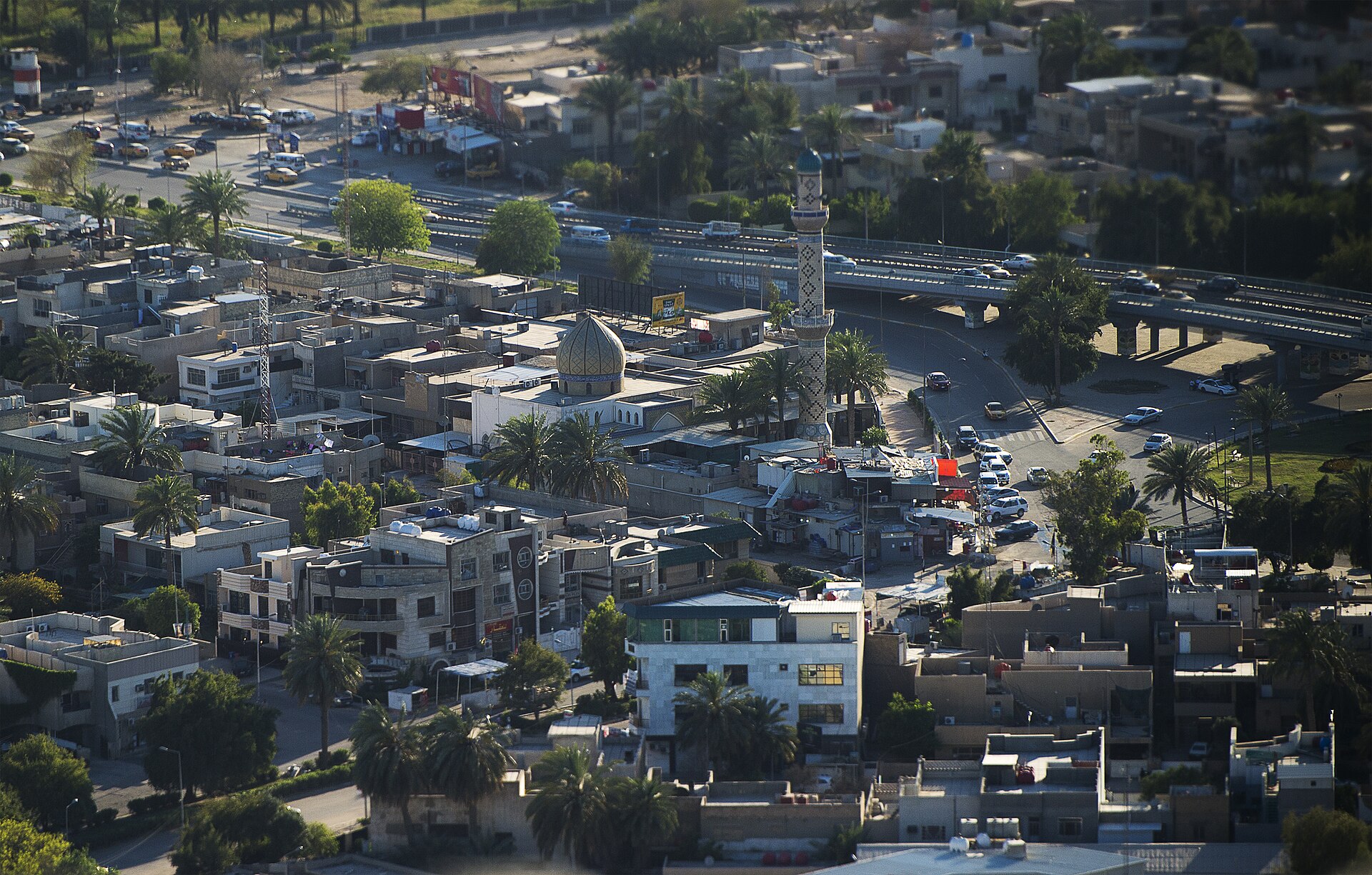
Baghdad was founded in 762 by the Abbasid caliph al-Mansur as his empire's new capital, the circular City of Peace on the Tigris that grew into one of the greatest cities of the medieval world and the seat of the caliphate for five centuries. Sacked by the Mongols under Hulegu in 1258, it later served as a provincial Ottoman capital before becoming the capital of modern Iraq in 1920. Today it is Iraq's largest city, marked by the wars of 1991 and 2003-2011 but still the country's political, commercial and cultural centre.
In this article
- 1Overview
- 2Site and Setting
- 3Foundation and the Round City
- 4Architecture of the Round City
- 5Abbasid Capital and Golden Age
- 6The House of Wisdom
- 7The Mongol Conquest
- 8Late Abbasid Revival and the Mustansiriyya
- 9The Kazimiyyah Shrine
- 10Ottoman and Modern City
- 11War, Looting and Rebuilding
- 12Cultural Standing
- 13Key Dates
- 14Timeline: from the Abbasid revolution to modern Baghdad
- 15Frequently asked questions
- 16Knowledge graph
Overview
Baghdad is the capital of Iraq and of Baghdad governorate in central Iraq, the country's largest city and one of the most populous urban agglomerations of the Middle East.It was founded in 762 as the capital of the Abbasid dynasty of caliphs, and for the next 500 years it stood as the most significant cultural centre of Arab and Islamic civilization and one of the greatest cities of the world. That pre-eminence ended when the city was conquered by the Mongol leader Hülegü in 1258, after which its importance waned.
1. Site and Setting
Baghdad lies on the Tigris roughly 330 miles (530 km) from the headwaters of the Persian Gulf, at the point where the river comes closest to the Euphrates, about 25 miles (40 km) to the west. The city occupies a flat alluvial plain some 112 feet (34 metres) above sea level. The periodic Tigris floods that had historically inundated the city came to an end in 1956, when a dam at Samarra was completed.
The climate is marked by hot, dry summers and cool, damp winters. Average daily maxima reach the low 100s F (low 40s C) between May and September, while winter temperatures occasionally drop below freezing. Annual rainfall is slight, amounting to only about 6 inches (150 mm).
2. Foundation and the Round City
The Abbasid caliphate was the second of Islam's two great caliphate dynasties, rising to power in 750 CE by overthrowing the Umayyads and drawing its name from al-Abbas, an uncle of the Prophet Muhammad. One thing the Abbasids had been lacking was a capital of their own, and al-Mansur commissioned the creation of a new capital near the Tigris River, Baghdad, a bustling metropolis that humbled all European cities of the time by every standard.
Workers traced the plans of the round city on the ground in lines of cinders, a perfect circle inspired by the geometric teachings of Euclid, and cotton balls soaked in naphtha were set alight to mark the position of the double outer walls. On 30 July 762 al-Mansur offered up a prayer, laid the ceremonial first brick and ordered the assembled workers to begin, the date having been declared the most auspicious by his royal astrologers.
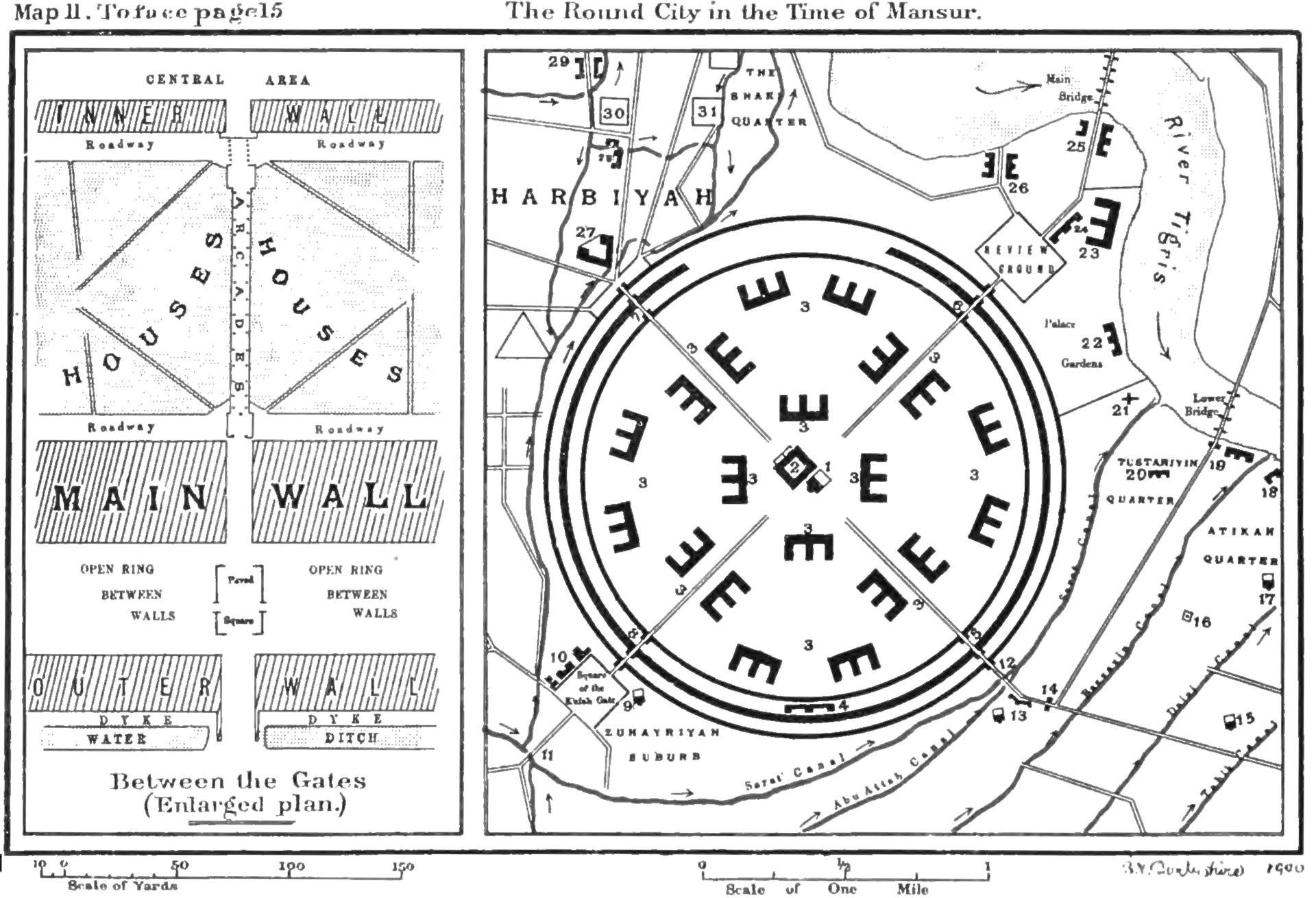

Builders from across the region came to work on the new capital by the thousands, and the result was a grand model of urban design notable for its circular plan.By 766 al-Mansur's Round City was complete, and the general verdict was that it was a triumph.
3. Architecture of the Round City
The Round City was enclosed by massive brick walls with a circumference of four miles. Each course of the first third of the wall's height used 162,000 bricks, and the outer wall stood 80 feet high, crowned with battlements and ringed by a deep moat. The walls were built of mud brick with reed supports, while baked brick was used for the domes and vaults, with an outer wall and a main wall fortifying the whole. Each gateway included a vaulted chamber with a domed second storey built into the main enclosure, supported by approximately 28 towers between one gate and the next.
Four main gates stood equidistant from each other: the Kufa Gate to the southwest, the Basra Gate to the southeast, the Khurasan Gate to the northeast, and the Damascus Gate to the northwest. Straight roads led from the gates to the centre. The Kufa and Basra gates both opened on to the Sarat canal, a key part of the network of waterways that drained the Euphrates into the Tigris. Between the central headquarters and the fortifications lay a residential area with houses and stores partitioned into quadrants.
At the heart of the city was an immense central enclosure of perhaps 6,500 feet in diameter, with the royal precinct containing the two finest buildings in the city, the Great Mosque and the caliph's Golden Gate Palace. The central governing area also contained residences for the princes, government offices and a kitchen. Mansur's palace covered 360,000 square feet, and its most striking feature was a 130-foot-high Green Dome above the main audience chamber, surmounted by the figure of a horseman with a lance.
The last traces of al-Mansur's Round City were demolished in the early 1870s, when Midhat Pasha, the reformist Ottoman governor, tore down the city walls in a fit of modernising zeal.
4. Abbasid Capital and Golden Age
Founded in 762 by al-Mansur, the second Abbasid caliph, Baghdad quickly grew to become one of the largest cities in the world, possibly reaching as many as 500,000 inhabitants by the year 800 and serving as a commercial hub that received ships from China, India and East Africa.
Ali ibn Buya was the founder of the Iranian-based Shia Buyid dynasty, which captured the Abbasid capital of Baghdad in 945 CE; for the Abbasids the only change was the party pulling their strings, while their realm broke apart as different local rulers declared independence.
5. The House of Wisdom
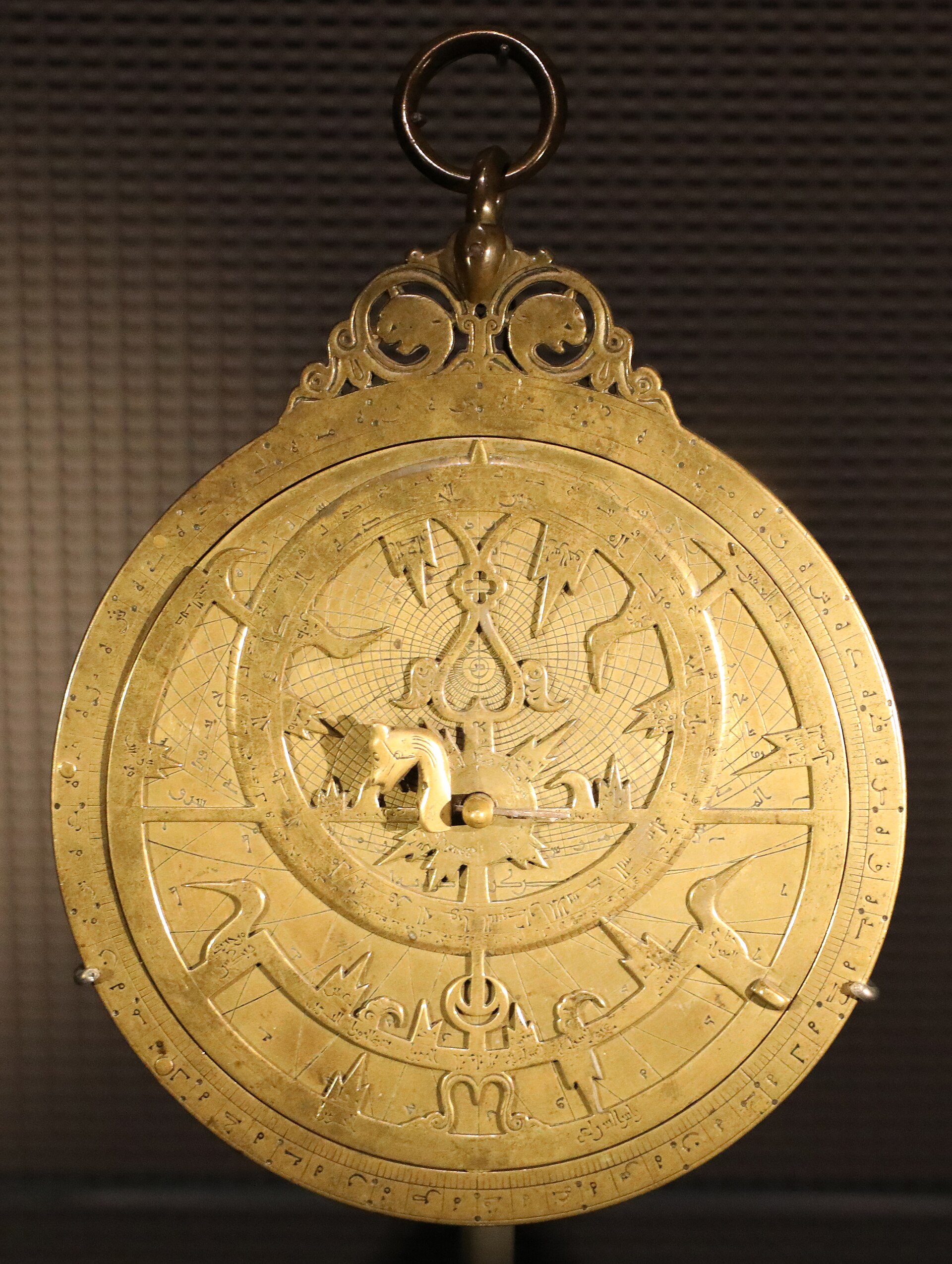
One account describes the House of Wisdom as founded in Baghdad in 830 CE by al-Ma'mun, the seventh Abbasid caliph, to translate, study and improve upon Hellenistic works of science and philosophy, though Britannica notes there is little evidence that it was a centre of scholarship and collaboration. Among those affiliated with the Bayt al-Hikmah under al-Ma'mun was Muhammad ibn Musa al-Khwarizmi, a mathematician and astronomer often credited as the father of algebra, as well as the astronomer Yahya ibn Abi Mansur al-Munajjim and the Banu Musa brothers, who made strides in mechanics.
In modern times the library became a symbol of the scientific enterprise and imperial glory of the early Islamic period.
6. The Mongol Conquest
The Mongol invasions of the Islamic world began in 1221 with the conquest of eastern Iran, and a more devastating wave under Genghis Khan's grandson Hülegü subjugated all of Iran and took Baghdad by 1258 and brought the Abbasid caliphate to an end.
The surviving Abbasids fled to Mamluk Egypt, where their caliphs would have only nominal influence. The Mongol advance into the heartland of Islam was crushed by the Mamluk Sultanate at the Battle of Ain Jalut in 1260 CE, and the Mamluks then raised a lineage of Abbasids as shadow caliphs in Cairo, until in 1517 CE Sultan Selim I of the Ottoman Sultanate conquered the Mamluk lands and passed the caliphal title to his lineage.
Hülegü took the title of Il-Khan, meaning lesser Khan subordinate to the Great Khan in China, and the branch of the Mongol dynasty known as the Ilkhanids centred its power in northwest Iran. Although the conquests initially brought devastation, the control of most of Asia by the Mongols, the so-called Pax Mongolica, created an environment of tremendous cultural exchange, and after Il-Khan Mahmud Ghazan converted to Islam in 1295 Islamic art flourished once again.
7. Late Abbasid Revival and the Mustansiriyya
A brief Abbasid revival under caliphs al-Nasir and al-Mustansir saw Baghdad again become the greatest centre for the arts of the book in the Islamic world.
The Mustansiriyya Madrasa, the first college for the four canonical schools of Sunni law, was built between 1228 and 1233 CE.
The main entrance is a monumental portal with a relatively small arched doorway set within a pointed-arch recession, topped by a 10-line foundation inscription of Mustansir and framed by three concentric moldings with geometric star-and-polygon patterns. The river-facing southwestern façade is adorned with a geometric pattern of interlocking zigzags formed by square brick plugs, below which runs a monumental inscription band describing a restoration commissioned in 1865 under Ottoman Sultan Abd al-Aziz.
8. The Kazimiyyah Shrine
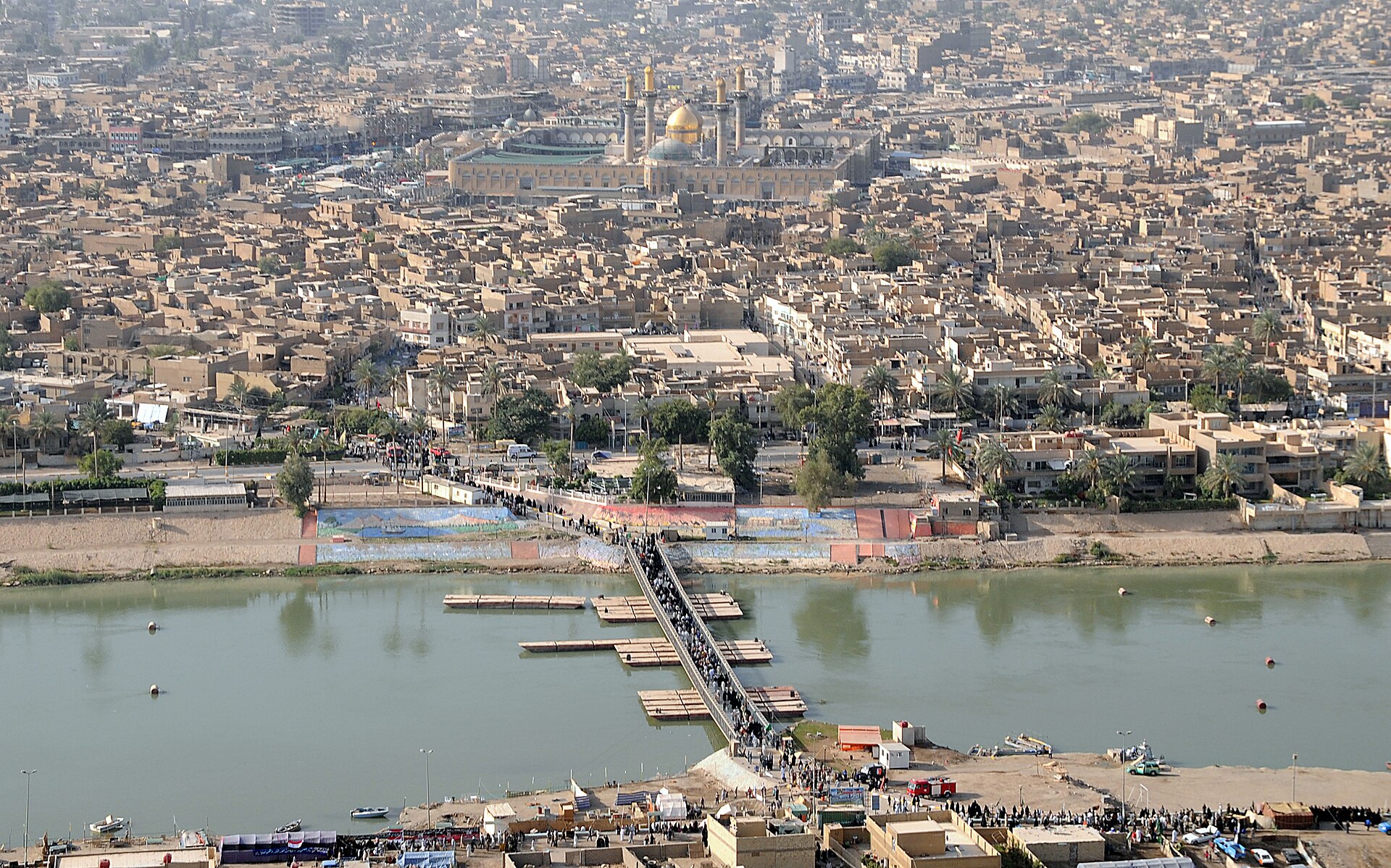
Before Baghdad was founded, the ground on which the Kazimiyyah shrine now stands served as the Shunayziyyah cemetery, which al-Mansur used as a burial place for the caliph's family. In 799 Imam Musa, the seventh imam, died and was buried there, and the site became a pilgrimage destination for the Shi'ite community. That standing was reinforced by the burial in 835 of the ninth Imam.
The building as it stands today comprises an enclosure housing the mausoleum of the two imams and a mosque, its northern and southern sides measuring 131.2 meters and its eastern and western sides spanning 124 meters. The mausoleum is framed on three sides by tall tarimahs, an Iranian design composing a portico with thin wooden columns. The western Tarimah Quraysh is 37 meters long, the eastern tarimah measures 49 meters by 5.2 meters, and the southern tarimah measures 47.2 meters by 6 meters.

9. Ottoman and Modern City
The older core of the city is a rectangle about 2 miles (3 km) long and 1 mile (1.6 km) wide on the east bank, extending between the former Al-Mu'azzam Gate in the north and Al-Sharqi Gate in the south, with Rashid Street as its heart and the city's financial district and copper, textile and gold bazaars. Beyond the Army Canal at the eastern edge of the city lies a sprawling low-income district of some two million rural Shi'i migrants, known alternately as Al-Thawrah, or Revolution, quarter and as Saddam City in the Ba'athist era.
Baghdad was heavily damaged by aerial bombardment during the Persian Gulf War of 1990-91 and again by air and ground operations during the Iraq War of 2003-11, while UN economic sanctions had already left its services and infrastructure deteriorating.
10. War, Looting and Rebuilding
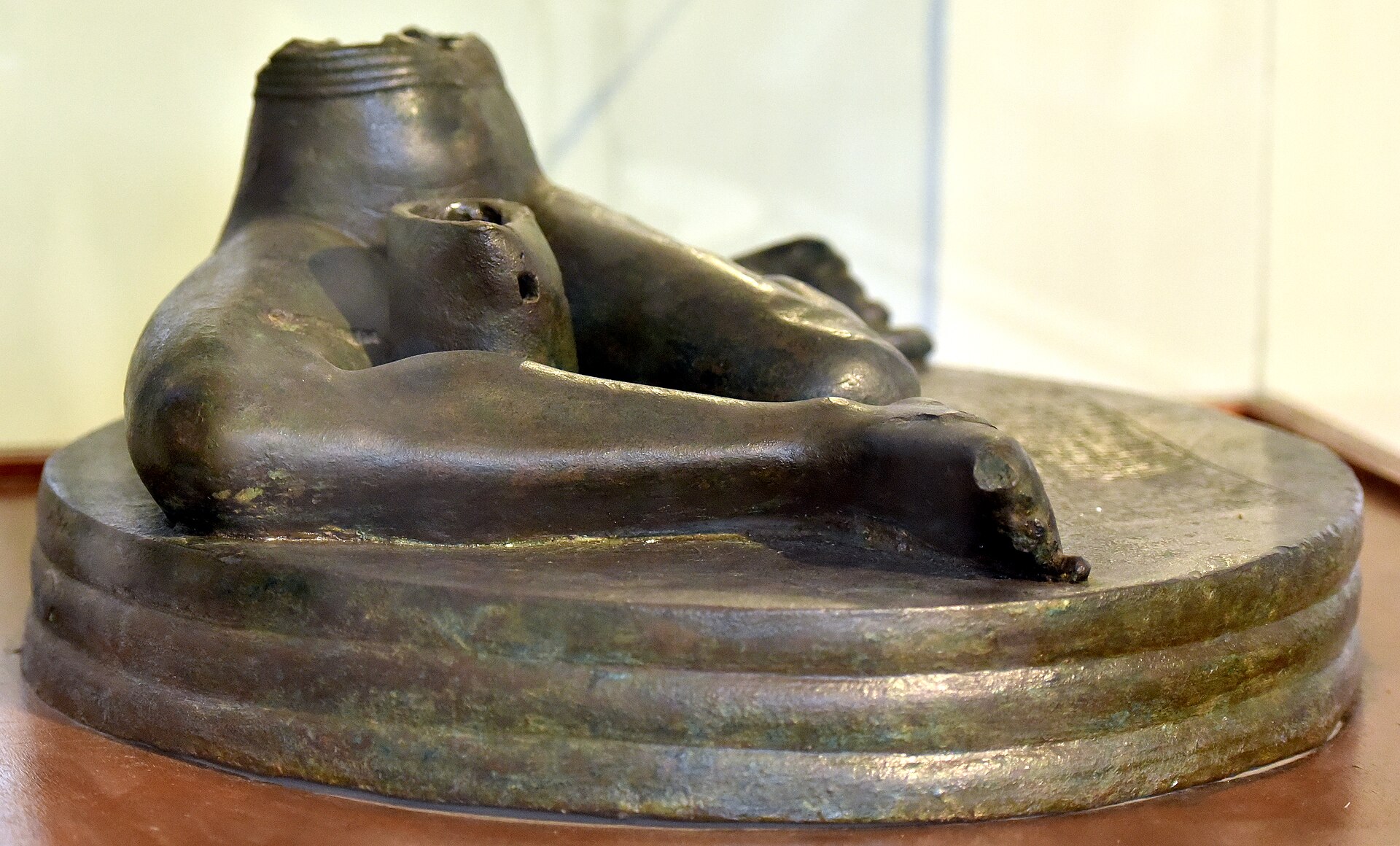
All the looting at Baghdad's Iraq Museum had taken place by the time U.S. troops arrived to protect it on 16 April 2003; between 8 April, when the museum was vacated, and 12 April, thieves plundered an estimated 15,000 items, including more than 5,000 cylinder seals. Leading archaeologists had warned before the war that the Iraq Museum was vulnerable, but neither Iraqi officials nor invading troops were prepared for such aggressive plunder, and no equivalent of the Second World War monuments task force existed.
The investigation found that hundreds of the most valuable items missing from the museum, including a cache of gold jewelry from Nimrud, had not been stolen at all but stashed since the Gulf War of 1990-91 for safekeeping in Iraq's Central Bank.
11. Cultural Standing
The Guardian's story of cities series describes the foundation of Baghdad 1,250 years ago as a glorious milestone in the history of urban design and a landmark for civilisation, the birth of a city that would quickly become the cultural lodestar of the world.
Bradt Travel Guides published what was probably the first postwar guidebook for Baghdad, describing Iraqis as a justifiably proud people whose city was the capital of the world when London was an overgrown village.
12. Key Dates
-
750Abbasid successionThe Abbasids succeed the Umayyads and shift the centre of Islamic political and cultural life eastward from Syria to Iraq. 7The Art of the Abbasid Period (750-1258) · The Metropolitan Museum of Art (Heilbrunn Timeline of Art History) ↗
-
762Foundation of BaghdadThe circular City of Peace (madinat al-salam) is founded as the new Abbasid capital. 7
-
799Burial of the seventh imamImam Musa dies and is buried at the site of the Kazimiyyah shrine, formerly the Shunayziyyah cemetery used by al-Mansur as a burial ground for the caliph's family. 9Mashhad al-Kazimiyya · Archnet (Aga Khan Documentation Center, MIT Libraries) ↗
-
835Burial of the ninth imamThe burial of the ninth Imam reinforces the Kazimiyyah site's standing as a pilgrimage site for the Shi'ite community. 9
-
1945Restoration campaignThe Iraqi Directorate of Antiquities initiates a campaign to restore the madrasa and clears the surrounding area of shops and structures. 8Madrasa al-Mustansiriyya · Archnet (Aga Khan Documentation Center, MIT Libraries) ↗
-
1960Museum of Islamic ArtThe restored building becomes the Museum of Islamic Art in Baghdad. 8
13. Timeline: from the Abbasid revolution to modern Baghdad
- 747 CEAbbasid revolution beginsThe Abbasid movement rose in open revolt in Khorasan under Abu Muslim, beginning the revolution that would topple the Umayyads.
- 750 CEUmayyads overthrownMarwan II, the last Umayyad caliph, was defeated at the Battle of the Great Zab River, and Abu al-Abbas al-Saffah was proclaimed the first Abbasid caliph at Kufah.
- 754 CEAl-Mansur becomes caliphAl-Mansur succeeded his brother as-Saffah and took up the rule of the Abbasid caliphate.
- 30 July 762 CEFoundation of BaghdadAfter his astrologers declared the day most auspicious, al-Mansur laid the ceremonial first brick of the Round City, the new capital on the Tigris.
- 766 CEThe Round City completedAl-Mansur's circular city was complete by 766, with its double walls, four gates and central palace crowned by the Green Dome.
- 799 CEBurial of the seventh imam at KazimiyyahImam Musa died and was buried at the spot that became the Kazimiyyah shrine, a pilgrimage site beside Baghdad.
- 836 CECapital moved to SamarraThe Abbasids established Samarra north of Baghdad, which replaced the capital for a brief period.
- 892 CEThe capital returns to BaghdadThe brief Samarra interlude ended and Baghdad again served as the seat of the Abbasid caliphate.
- 945 CEBuyids take BaghdadThe Shia Buyid dynasty captured the caliph's capital, beginning a century in which much of the empire was ruled by local dynasties.
- 1055 CESeljuks enter BaghdadTughril Beg's Seljuk Turks took Baghdad and ousted the Buyids, ruling behind a caliph who retained mostly nominal authority.
- 1227 CEMustansiriyya madrasa commissionedCaliph al-Mustansir Billah commissioned al-Madrasa al-Mustansiriyya, which opened in 1234 as the earliest universal madrasa.
- 10 February 1258Mongol sack of BaghdadHulegu's army ended the Abbasid caliphate: the city was looted and its population slaughtered, and caliph al-Musta'sim was killed.
- 1534 CEOttoman period beginsSuleiman the Magnificent entered Baghdad and Ottoman rule over the city began; work on the Kazimiyyah shrine continued under his patronage.
- 1920 CECapital of modern IraqBaghdad became the capital of the new state of Iraq and grew over the following half century into a modern metropolis.
- 1991 CEGulf War bombardmentBaghdad was heavily damaged by aerial bombardment during the Persian Gulf War of 1990-91.
- 9 April 2003Fall of Saddam HusseinAmerican troops took Baghdad and toppled Saddam Hussein's statue in Firdos Square, beginning the US-led occupation of Iraq.
14. Frequently asked questions
What was Baghdad originally called?
The city was founded under the name Madinat al-Salam, meaning 'City of Peace'.1Baghdad | History, Population, Map, & Facts · Encyclopaedia Britannica ↗
Who founded Baghdad, and when did he become caliph?
How large was the Round City, and how many workers built it?
At its completion in 766-7 the Round City was estimated to measure about 2000 meters in diameter.12 The ninth-century geographer al-Yaqubi reckoned that 100,000 workers were involved, by far the greatest construction project in the Islamic world.4Story of cities #3: the birth of Baghdad was a landmark for world civilisation · The Guardian ↗
What was the House of Wisdom, and when did it end?
The Bayt al-Hikmah was a royal library of the Abbasid caliphs, established as Baghdad rose to become the capital of the Islamic world and Persian culture was incorporated into the Abbasid court.5Bayt al-Hikmah (House of Wisdom) · Encyclopaedia Britannica ↗ Its significance declined after 833, and whatever remained of it was destroyed in the Mongol sack of 1258.5
Did Baghdad always remain the seat of the caliphate?
References (14)
- 1Baghdad | History, Population, Map, & Facts — Encyclopaedia Britannica Web↩View source
- 2Abbasid caliphate | Achievements, Capital, & Facts — Encyclopaedia Britannica WebView source
- 3Abbasid Dynasty — World History Encyclopedia WebView source
- 4Story of cities #3: the birth of Baghdad was a landmark for world civilisation — The Guardian 2016 Web↩View source
- 5Bayt al-Hikmah (House of Wisdom) — Encyclopaedia Britannica Web↩View source
- 6The Art of the Ilkhanid Period (1256-1353) — The Metropolitan Museum of Art (Heilbrunn Timeline of Art History) WebView source
- 7The Art of the Abbasid Period (750-1258) — The Metropolitan Museum of Art (Heilbrunn Timeline of Art History) Web↩View source
- 8Madrasa al-Mustansiriyya — Archnet (Aga Khan Documentation Center, MIT Libraries) Web↩View source
- 9Mashhad al-Kazimiyya — Archnet (Aga Khan Documentation Center, MIT Libraries) Web↩View source
- 10Looting Iraq — Smithsonian Magazine WebView source
- 11A slow rebirth for Baghdad the beautiful — The Guardian 2005 WebView source
- 12Madina al-Mansur al-Mudawwara (the Round City) — Archnet (Aga Khan Documentation Center, MIT Libraries) Web↩View source
- 13Baghdad Sacked by the Mongols — History Today Web↩View source
- 14Astronaut Photo STS078-740-87: Baghdad, Iraq — NASA Johnson Space Center, Earth Science and Remote Sensing Unit WebView source