Damascus
The Syrian capital on the Barada — one of the oldest continuously inhabited cities in the world, capital of the Umayyad caliphate and home of the Great Mosque and the walled Old City.
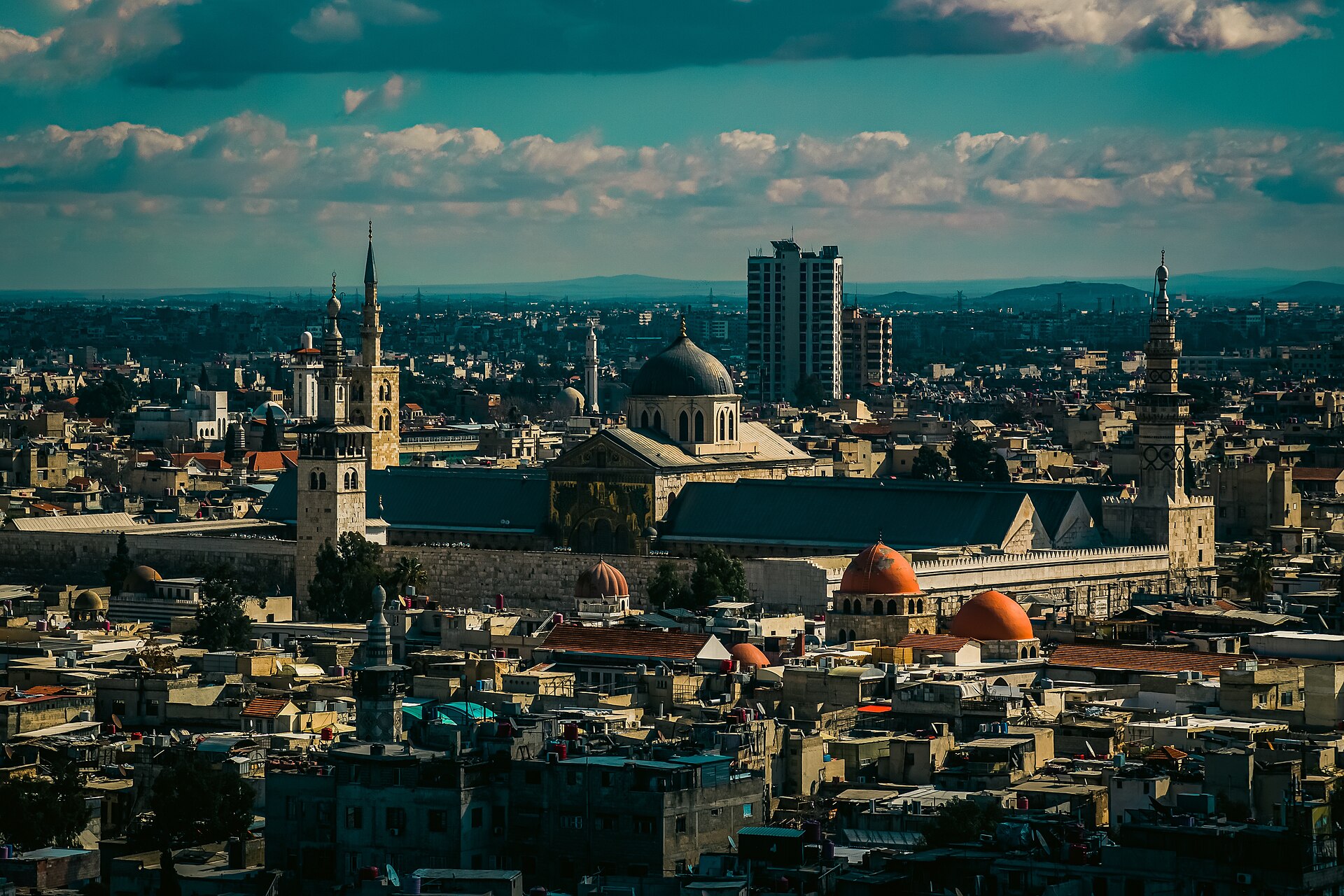
Damascus, called Dimashq in Arabic, is the capital of Syria and one of the oldest continuously inhabited cities in the world, with settlement evidence in its oasis going back thousands of years. It was the capital of the Umayyad caliphate from 661, when the Great Mosque of the Umayyads was built over the site of a Roman temple and a Christian basilica, and it served later as a provincial capital under the Ayyubids, Mamluks and Ottomans. Its walled Old City, inscribed by UNESCO in 1979, preserves the Umayyad Mosque, the Citadel, the Azem Palace, khans, madrasas, hammams and courtyard houses, and it has been on the List of World Heritage in Danger since 2013.
In this article
- 1Overview
- 2Names and Identity
- 3Geography and Climate
- 4Origins and Antiquity
- 5Aramaean, Assyrian and Classical Damascus
- 6Islamic Conquest and the Umayyad Capital
- 7The Umayyad Mosque
- 8Medieval Damascus: Crusades, Saladin and the Mamluks
- 9Ottoman Damascus
- 10Mandate, Revolt and Modern History
- 11The Old City and Its Monuments
- 12World Heritage Status and Conservation
- 13Timeline: from Tell Ramad to the List of World Heritage in Danger
- 14Knowledge graph
Overview
Damascus is the national capital of Syria and the largest city in the country. Its metropolitan population was estimated at 2,799,960 in 2024. The city is known by the names Dimashq, al-Fayha' (the Fragrant), and al-Sham, and is also called the Pearl of the East.
1. Names and Identity
Damascus is mentioned for the first time in the fifteenth century BCE in an Egyptian text from the reign of Thuthmose III, and the city was known by a name that is almost certainly pre-Semitic. Successive colonisers from the second millennium BCE onward developed an intricate irrigation system fed by branches of the Barada, and since the coming of Islam the city has been the starting point of the northern pilgrimage road to Mecca and Medina.
Because of associations of Damascus with Aram, the biblical capital of the Aramaeans, some Arabic sources link the city with the Iram dhat al-imad mentioned in the Quran, an identification that has long been disputed.
The Damascus Straight Street, also known as the Via Recta, was the east-west main street of Roman Damascus and extended for over 1,500 metres; today it consists of the street of Bab Sharqi and the covered Souk Medhat Pasha.
2. Geography and Climate
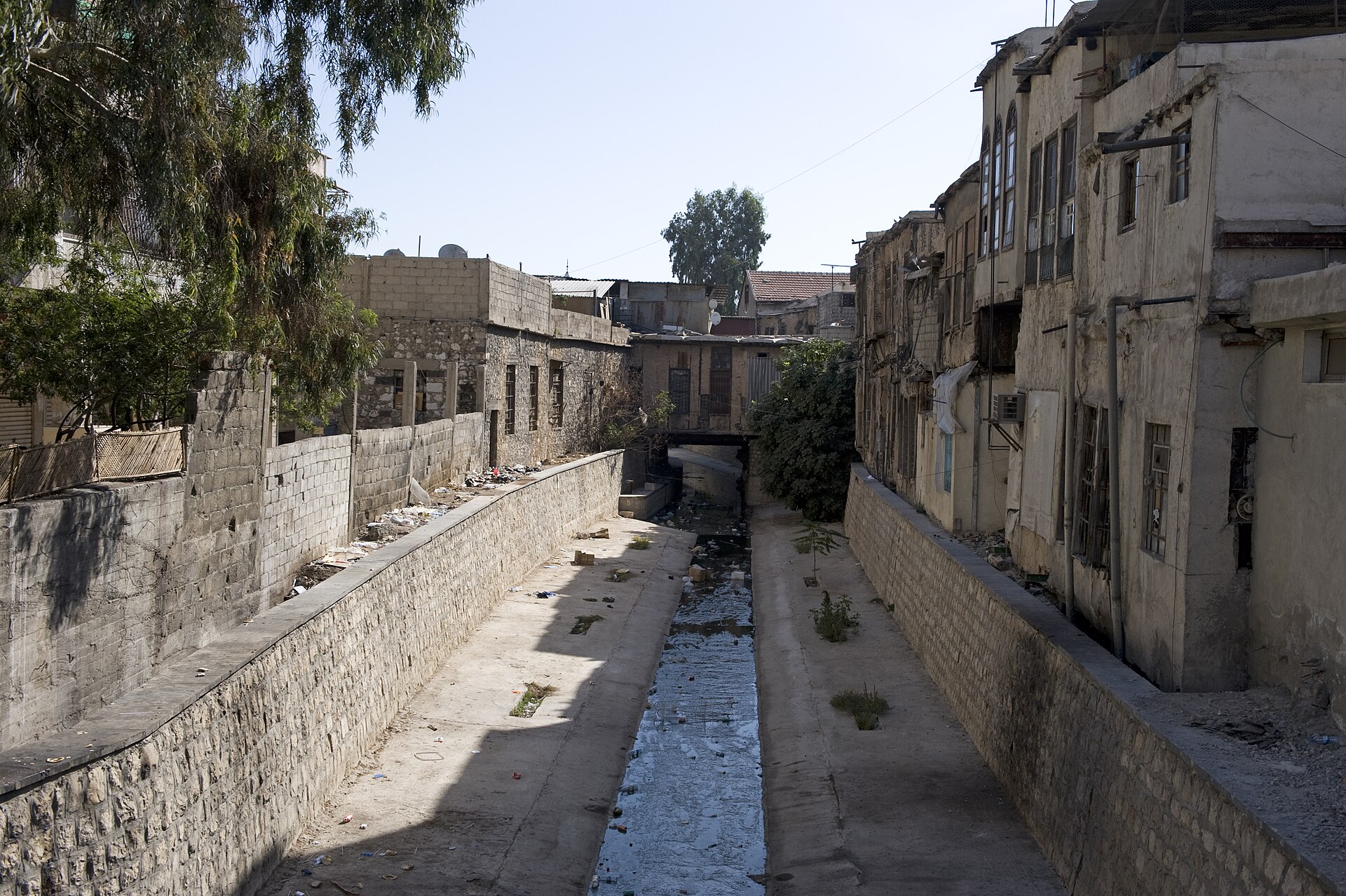
Damascus grew on a terrace about 2,250 feet (690 metres) above sea level, south of Mount Qasioun and overlooking the Barada River. The Barada rises in the Anti-Lebanon Mountains and waters the Ghouta oasis.
The city lies some 50 miles (80 km) from the sea yet is separated from it by two mountain ranges. Damascus receives only about 7 inches (178 mm) of precipitation annually, most of it from November through February. The city covers 17 square miles (43 square km). It lies among the eastern foothills of the Anti-Lebanon mountain range on a plateau 680 metres above sea level, and experiences an arid climate because of the rain-shadow effect. Its municipality population was estimated at 1,669,000 in 2007.
3. Origins and Antiquity
The old city of Damascus is considered to be among the oldest continually inhabited cities in the world, and excavations at Tell Ramad on its outskirts have demonstrated that the area was inhabited as early as 8,000 to 10,000 BC. Carbon-14 dating at Tell Ramad on the outskirts of Damascus suggests the site may have been occupied since the second half of the seventh millennium BC, possibly around 6300 BC, while evidence of settlement in the wider Barada basin dates to 9000 BC.
Damascus is first documented as an important city with the arrival of the Aramaeans, a Semitic people, in the 11th century BC, and one of their states, Aram-Damascus, was centred on the city as its capital. Ezron, a claimant to the throne of Aram-Zobah, fled the Beqaa and captured Damascus by force in 965 BC, overthrowing its tribal governor and founding the independent kingdom of Aram-Damascus.
4. Aramaean, Assyrian and Classical Damascus
In 853 BC King Hadadezer of Damascus led a Levantine coalition that included troops supplied by King Ahab of Israel in the Battle of Qarqar against the Neo-Assyrian army, and the coalition's victory temporarily halted Assyrian expansion into Syria. According to the Kurkh Stela, the coalition that faced Shalmaneser III at Qarqar included 1,200 chariots, 1,200 cavalry and 20,000 troops of Hadad-Ezer of Damascus, along with forces from Hamath, Israel, Byblos and other states. Whatever the nature of Assyria's victories, the fact that the Assyrian king needed to return proves that Qarqar had been a strategic victory for the coalition, which was able to expand its power to Carchemish and Arpad.
In 841 the Assyrians met the isolated king Hazael of Damascus, defeated him in battle, pillaged the land and received tribute from Sidon, Tyre and Israel, breaking the coalition and establishing Assyrian power in Syria for two centuries. By the 8th century BC Damascus was practically engulfed by the Assyrians, and after Tiglath-Pileser III campaigned across Syria the city became subjugated by Assyrian rule. In the last quarter of the ninth century Damascus became part of the Assyrian Empire, a revolt in 727 BCE was suppressed, and Assyria was replaced by Babylonia and then by Achaemenid Persia.
In 64 BCE Pompey the Great conquered the Seleucid Empire and Damascus became part of the Roman province of Syria and of the Decapolis, and the apostle Paul later visited the city where he met Ananias and was baptized. The earliest visible physical evidence in Damascus dates to the Roman period, including the remains of the Temple of Jupiter and sections of the Roman city walls and gates, while most of the surviving built heritage dates from after the Ottoman conquest of the early 16th century.
5. Islamic Conquest and the Umayyad Capital
In the time of the caliph Umar the city of Damascus was conquered by the Arab Muslim general Khalid ibn al-Walid in August and September of 634 CE. After Ali's death in 661 Muawiya was chosen as caliph and established Damascus as the capital of the Umayyad Caliphate, an empire stretching from the Iberian Peninsula to Central Asia and the Indus River. Muawiya's twenty-year reign from his capital at Damascus was the most stable that the Arabs had seen since the death of Umar, and his administrative reforms included a police network, personal bodyguards and diwans for local administration. As capital of the Umayyad caliphate, the first Islamic caliphate, Damascus with its Great Mosque at the heart of a Graeco-Roman grid provided the exemplary model for the Arab Muslim world.
Although the Umayyad empire was at its largest size during their reign, internal divisions and civil wars weakened their hold over it, and in 750 CE they were overthrown by the Abbasids, a rival Arab faction who claimed descent from the Prophet's uncle Abbas.
6. The Umayyad Mosque
The Great Mosque was built between 705 and 715 CE by the caliph al-Walid I. The new mosque structure was built over nine years by thousands of labourers and artisans from across the Islamic and Byzantine empires, and it was noted for its marble panelling and extensive gold mosaics of vegetal motifs covering some 4,000 square metres.
The site was first a temple dedicated to the god Hadad founded between the 10th and 9th century BCE, then a Greek temple dedicated to Jupiter, Romanised in the 1st century and Christianised in the 4th century. The Umayyad Mosque's religious significance was reinforced by its medieval manuscripts and its ranking as one of the wonders of the world, and the site has housed sacred buildings for thousands of years.
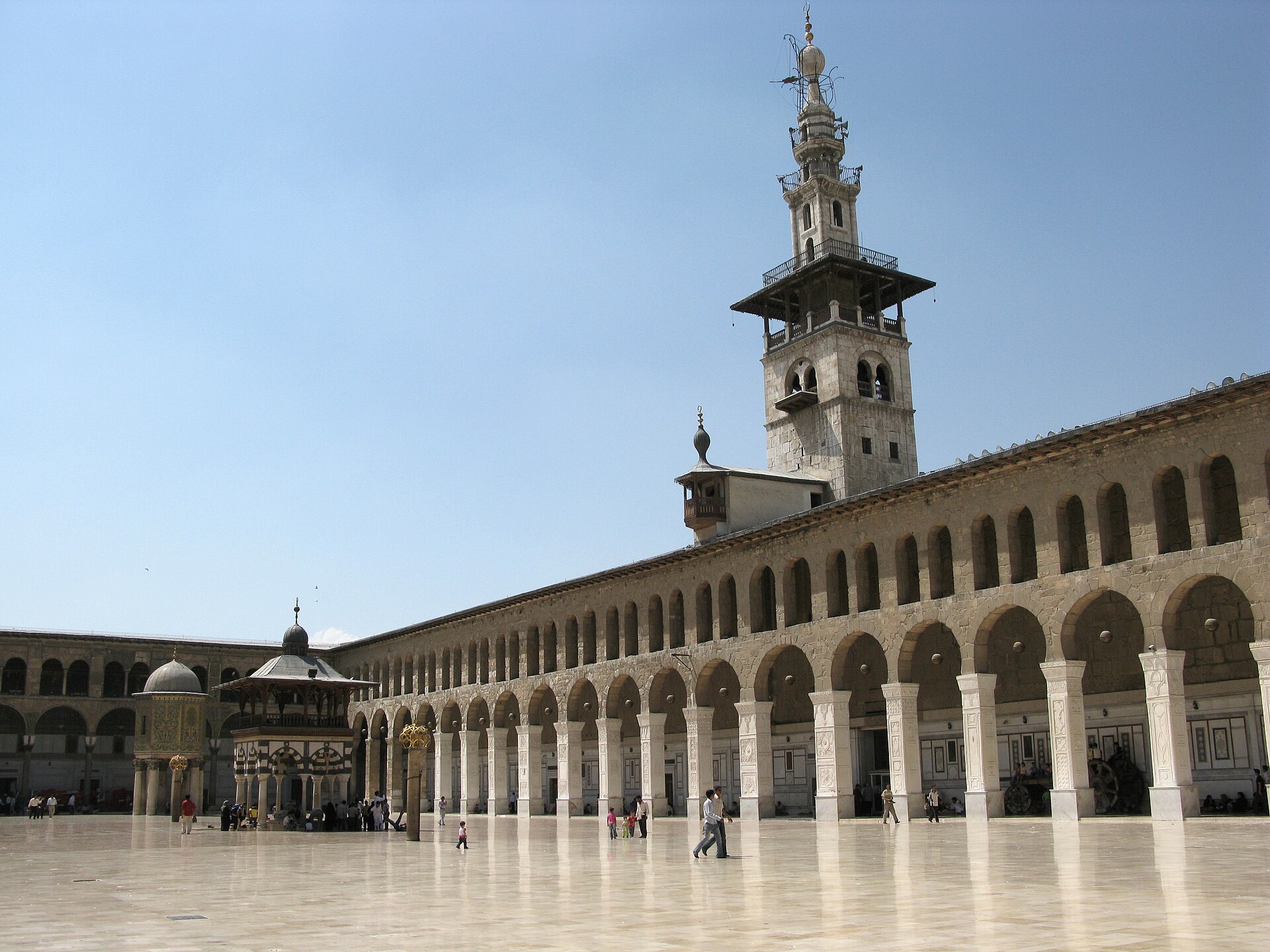
The hypostyle plan of the mosque borrows from Byzantine basilicas adapted to Muslim worship, rotated a quarter turn so that worshippers kneel in long rows parallel to the qiblah wall, and three minarets were positioned along the outer wall for the call to prayer.
The plan of the Umayyad Mosque is formed by a rectangle measuring 97 by 156 metres with the sahn on the northern side, and because the haram occupies the southern part of the rectangle the exterior wall has three gates connecting to the city.
The geographer al-Dimashqi, writing in the 13th and 14th centuries, described the mosaics of the great mosque as coloured glass with gold, silver and mother-of-pearl, showing several trees along with cities, fortresses and seas.
The largest surviving series of mosaics runs under the western portico and is known as the Barada panel, because it was thought by some to depict the banks of the river that flows through Damascus, while many of the mosaics were probably destroyed in the city's fires and earthquakes.
The Umayyad Mosque was hit by a severe earthquake in 748 AD that tore the roof along its length, and another earthquake in 847 AD led to the fall of the mosque's minaret. In 1069 large sections of the mosque, particularly the northern wall, were destroyed in a fire during an uprising by the city's residents against the Fatimids' Berber garrison.
The relics of St John the Baptist are integrated into the Umayyad Mosque and housed in a small marble aedicule, and the building's location also asserts the arrival of a new authority, the Umayyad dynasty. The caliph al-Walid negotiated with Christian leaders to take over the site, promising in return that all the other churches around the city would be safe, with a new church dedicated to the Virgin granted to the Christians as compensation.
The Umayyad Mosque is Islam's earliest great mosque and ranks in holiness below those of Mecca and Medina.
7. Medieval Damascus: Crusades, Saladin and the Mamluks
The siege of Damascus lasted a mere four days, from 24 to 28 July in 1148; the combined western European army failed to take the city, so the Second Crusade petered out. The Mongol invasion of Syria ended Ayyubid rule in the city, when the Mongols led by Kitbuqa entered Damascus on 1 March 1260. Muslim defenders were forced back through difficult terrain of orchards and low-walled copses that stretched some 8 kilometres out from the city walls, reaching the safety of the city's defences.
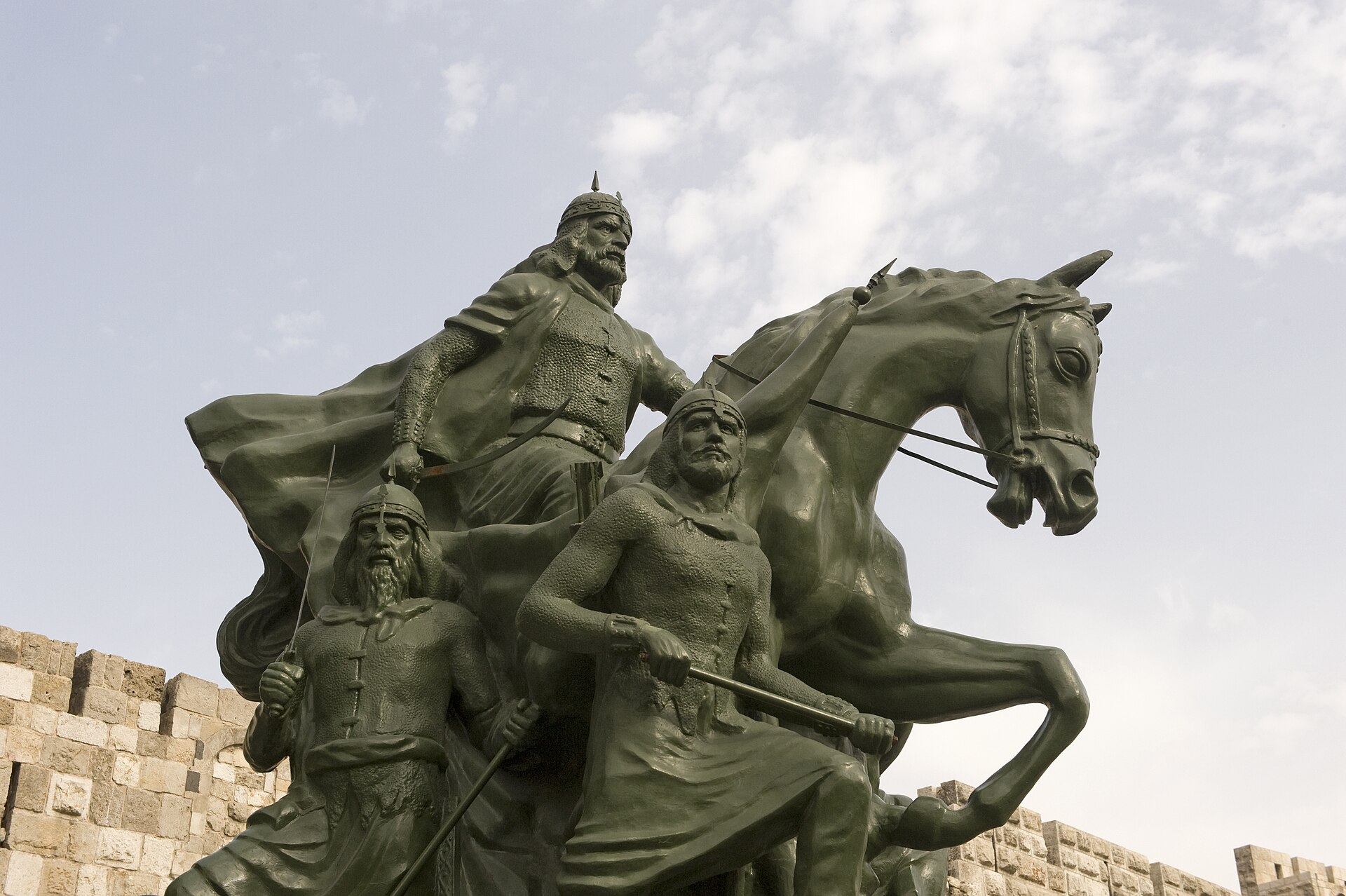
Saladin, already Sultan of Egypt, captured Damascus in 1174 and repeated in Syria the feat of Nur ad-Din. His skills in warfare and politics, together with his personal qualities of generosity and chivalry, led Christian and Muslim writers alike to eulogise him. He was unable to profit from the Crusaders' departure because he died soon after in Damascus on 4 March 1193. He was buried beside the Umayyad Mosque in Damascus in 1193. He was only 55 or 56 years of age and most likely died from the physical toll of decades of campaigning.
In the medieval period Damascus was the centre of a flourishing craft industry, with different quarters specialising in particular trades. The city's street grid is still based on a Roman plan oriented north-south and east-west.
8. Ottoman Damascus
In early 1516 the Ottoman Empire began a campaign of conquest against the Mamluk sultanate, and on 2 October of that year the khutba in the Umayyad Mosque was pronounced in the name of Selim I.
The Metropolitan Museum's Damascus Room is a period room that re-creates a residential reception chamber of the late Ottoman period in Damascus, Syria. At the time the room's woodwork was decorated (in 1707) Damascus was nearing its second century of Ottoman rule and, with a population of 80,000 to 90,000 inhabitants, it served as the provincial capital of the administrative region of southern Syria. For centuries the city functioned as an international nexus to which people travelled to study in its famous madrasas and worship in its renowned sanctuaries, and it was one of the main gathering places for the hajj caravans to Mecca, with an estimated 20,000 pilgrims congregating there annually.
In Damascus, local construction consisted of a first story of masonry surmounted by upper stories of timber and sun-baked brick coated with plaster and white-wash, unlike many other towns in the region where the primary construction material was stone, and from the street even the most elegant residences looked unassuming.
Al-Hamidiyah Souq, built between 1780 and 1884 during the reign of Sultan Abdul Hamid I, is the largest and central souk in Syria, about 600 metres long and 15 metres wide and covered by a metal arch 10 metres tall. Souq al-Hamidiyya occupies an ancient street that was converted into a lively covered market during the late-19th-century Ottoman era, one of the old city's many souqs where sellers peddle spices, sweets and rugs.
Several thousand Christians were killed in June 1860 when fighting between Druze and Maronites in Mount Lebanon spilled into Damascus, and many more were saved by the Algerian exile Abd al-Qadir and his soldiers.
9. Mandate, Revolt and Modern History
In 1920 a French army crossed the Anti-Lebanon Mountains, defeated a Syrian force at the Battle of Maysalun and entered Damascus, which the French then made the capital of their League of Nations mandate for Syria. The modern city began with the Ottoman Tanzimat in the late 19th century, and later development followed a plan devised by the French during the mandate period of 1920 to 1946 and revised thereafter. Damascus is the main centre of education in Syria and is home to Damascus University, the oldest and largest university in the country.
When the Great Syrian Revolt spread to Damascus in 1925, the French suppressed it with heavy weaponry, and the area between Al-Hamidiyah Souq and Medhat Pasha Souq was burned to the ground, having since been known as al-Hariqa, meaning the fire. On 17 October 1925 the population of Damascus, assisted by insurgents, attacked French troops, and between 18 and 21 October the city came under heavy fire from French airplanes and tanks, with whole neighbourhoods destroyed and hundreds of inhabitants killed. Reports of villages burned to the ground, the parading of rebel corpses and the bombing of a beautiful and ancient city, including the destruction of the Azm Palace, turned the assumption of a civilising mission on its head.
10. The Old City and Its Monuments
The heart of the Old City is Hellenistic in origin, with significant Roman additions, forming a rough oblong about 1,500 metres long and 1,000 metres wide whose long axis runs between the Roman Jupiter Gate and the Roman Sun Gate. It was enclosed within a historic wall of 4.5 kilometres in circuit that was mainly built by the Romans and later fortified by the Ayyubids and Mamluks, and the old part of the city is pierced by seven historical gates, with an eighth gate added later by Muslims.
The line of the walls of the old city forms the boundary of the World Heritage property. Its key attributes include the dense urban fabric, the city walls and gates, and 125 protected monuments such as the Umayyad Mosque, madrasas, khans, the Citadel and private houses.
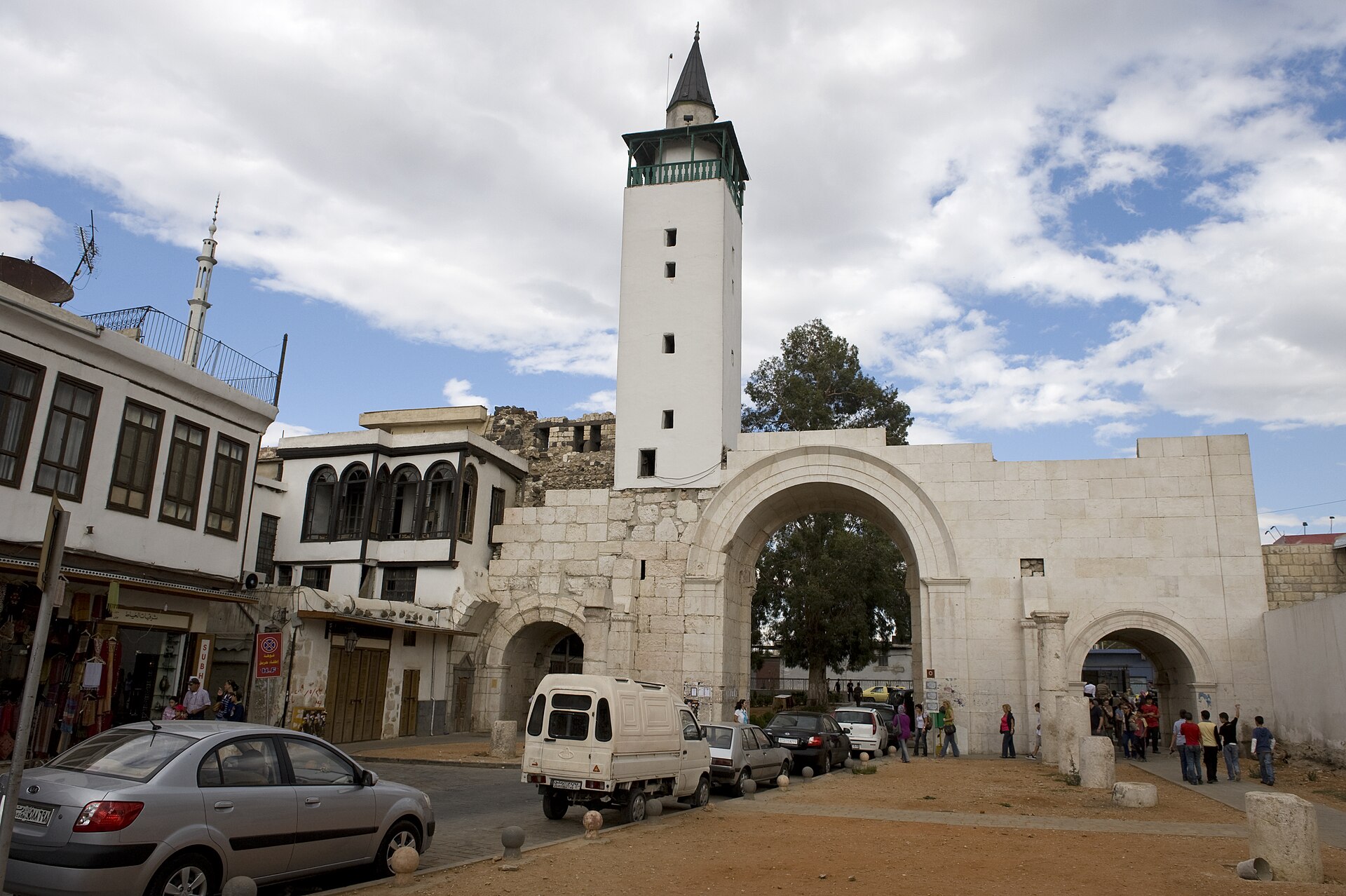
Since inscription, the morphological layout and spatial pattern of the historic fabric have remained basically unchanged. Commercial and semi-industrial activities, however, are spreading into residential areas and eroding the value of the urban fabric.
11. World Heritage Status and Conservation
The Ancient City of Damascus was inscribed on the World Heritage List in 1979 under cultural criteria (i), (ii), (iii), (iv) and (vi), with a property area of 86.12 hectares (212.8 acres) and a buffer zone of 42.6013 hectares.
In 2013 the Ancient City of Damascus was inscribed on the List of World Heritage in Danger because of destruction and threats resulting from the armed conflict in Syria that began in March 2011 and continued for more than a decade.
Between 2013 and 2021 minor damage from shelling related to the armed conflict affected some of the key monuments of Damascus, including the Great Mosque and the Citadel. Beyond direct conflict damage, the state of conservation of the Ancient City of Damascus has been affected by illegal restoration and construction works and building violations. On 23 April 2016 the Directorate General of Antiquities and Museums reported a significant fire in the Al-Assroniyah market near the Damascus Citadel in the old city.
The World Heritage Centre and ICOMOS sent a joint Reactive Monitoring mission to the Ancient City of Damascus in October 2025; the team visited the property and met the Syrian authorities.
12. Timeline: from Tell Ramad to the List of World Heritage in Danger
- c. 6300 BCEFirst settlement at Tell RamadCarbon-14 dating at Tell Ramad on the outskirts of Damascus suggests occupation since the second half of the seventh millennium BCE, while evidence of settlement in the wider Barada basin reaches back to 9000 BCE.
- c. 965 BCEEzron founds Aram-DamascusEzron, a claimant to the throne of Aram-Zobah, fled the Beqaa and captured Damascus by force, overthrowing its tribal governor and founding the independent kingdom of Aram-Damascus.
- 853 BCEBattle of QarqarKing Hadadezer of Damascus led a Levantine coalition that included troops of King Ahab of Israel against the Neo-Assyrian army of Shalmaneser III, and the coalition's victory temporarily prevented the Assyrians from encroaching into Syria.
- 64 BCEDamascus enters the Roman province of SyriaPompey the Great conquered the Seleucid Empire and Damascus became part of the Roman province of Syria, attached to the league of cities known as the Decapolis.
- c. 34 CEPaul in DamascusThe apostle Paul visited Damascus, where he met Ananias and was baptized, the episode known as the conversion on the road to Damascus.
- 634 CEMuslim conquest of DamascusThe city was conquered by the Arab Muslim general Khalid ibn al-Walid in August and September of 634 CE, during the caliphate of Umar.
- 661 CEDamascus becomes the Umayyad capitalAfter Ali's death in 661 Muawiya was chosen as caliph and established Damascus as the capital of the Umayyad Caliphate, an empire that stretched from the Iberian Peninsula to the Indus River.
- 705 to 715 CEConstruction of the Great MosqueAl-Walid I ordered the building of a large monumental mosque on the site of the former temple and cathedral; the prayer hall abuts the south wall of the ancient enclosure and the relics of St John the Baptist were incorporated into the plan.
- 24 to 28 July 1148The Second Crusade fails before DamascusThe siege of Damascus lasted a mere four days, from 24 to 28 July in 1148; the combined western European army failed to take the city and the leaders decided to withdraw.
- 1174Saladin captures DamascusSaladin, already Sultan of Egypt, captured Damascus in 1174 and repeated in Syria the feat of Nur ad-Din, making the city a base of his Ayyubid state.
- 4 March 1193Death of Saladin in DamascusSaladin died in his favourite gardens of Damascus on 4 March 1193 at only 55 or 56 years of age, and was buried beside the Umayyad Mosque.
- 1 March 1260Mongols enter DamascusThe Mongol invasion of Syria ended Ayyubid rule in the city, when the Mongols led by Kitbuqa entered Damascus on 1 March 1260.
- 2 October 1516Ottoman conquestThe Ottoman Empire began a campaign of conquest against the Mamluk sultanate in early 1516, and on 2 October the khutba in the Umayyad Mosque was pronounced in the name of Selim I.
- 18 to 21 October 1925French bombardment of DamascusDuring the Great Syrian Revolt the city was under heavy fire from French airplanes and tanks between 18 and 21 October 1925; whole neighbourhoods were destroyed and hundreds of inhabitants killed.
- 1979World Heritage inscriptionThe Ancient City of Damascus was inscribed on the UNESCO World Heritage List in 1979 under cultural criteria (i), (ii), (iii), (iv) and (vi).
- 2013Placed on the List of World Heritage in DangerIn 2013 the property was inscribed on the List of World Heritage in Danger because of destruction and threats resulting from the armed conflict in Syria that began in March 2011.
References (21)
- 1Damascus | History, Map, Population, & Facts — Encyclopaedia Britannica WebView source
- 2Damascus — Wikipedia WebView source
- 3Damascus — Livius.org (Jona Lendering) WebView source
- 4Old city of Damascus — Wikipedia WebView source
- 5Ancient City of Damascus — UNESCO World Heritage Centre WebView source
- 6Qarqar (853 BCE) — Livius.org (Jona Lendering) WebView source
- 7Umayyad Dynasty — World History Encyclopedia WebView source
- 8The Mosque of al-Walid I — French Ministry of Culture (Archeologie.culture.fr) WebView source
- 9Umayyad Mosque — Wikipedia WebView source
- 10The Umayyad mosque in Damascus — French Ministry of Culture (Archeologie.culture.fr) WebView source
- 11Jami' al-Umawi al-Kabir (Damascus) — Archnet (MIT / Aga Khan Trust for Culture) WebView source
- 12The building's forms and functions — French Ministry of Culture (Archeologie.culture.fr) WebView source
- 13The mosaic decoration: trees and architecture — French Ministry of Culture (Archeologie.culture.fr) WebView source
- 14Great Mosque of Damascus, Umayyad Mosque — IRCICA Islamic Architectural Heritage Database WebView source
- 15Ancient City of Damascus — National Geographic WebView source
- 16The Siege of Damascus, 1148 CE — World History Encyclopedia WebView source
- 17Saladin — World History Encyclopedia WebView source
- 18The Damascus Room — The Metropolitan Museum of Art WebView source
- 19Damascus, 1925: The Bombing of the City, Humanitarian Relief and Petitioning for Syrian Independence to the League of Nations — Online Atlas on the History of Humanitarianism and Human Rights (Leibniz Institute of European History) 1925 WebView source
- 20Report of the joint World Heritage Centre/ICOMOS Reactive Monitoring mission to the Ancient City of Damascus (Syria) — UNESCO World Heritage Centre WebView source
- 21Damage to Syria's heritage - 7 May 2016 — Heritage for Peace 2016 WebView source