Jupiter
The fifth planet from the Sun and the largest in the solar system — a hydrogen-helium gas giant with the Great Red Spot, four Galilean moons, 115 recognized satellites, and the most powerful magnetic field of any planet.
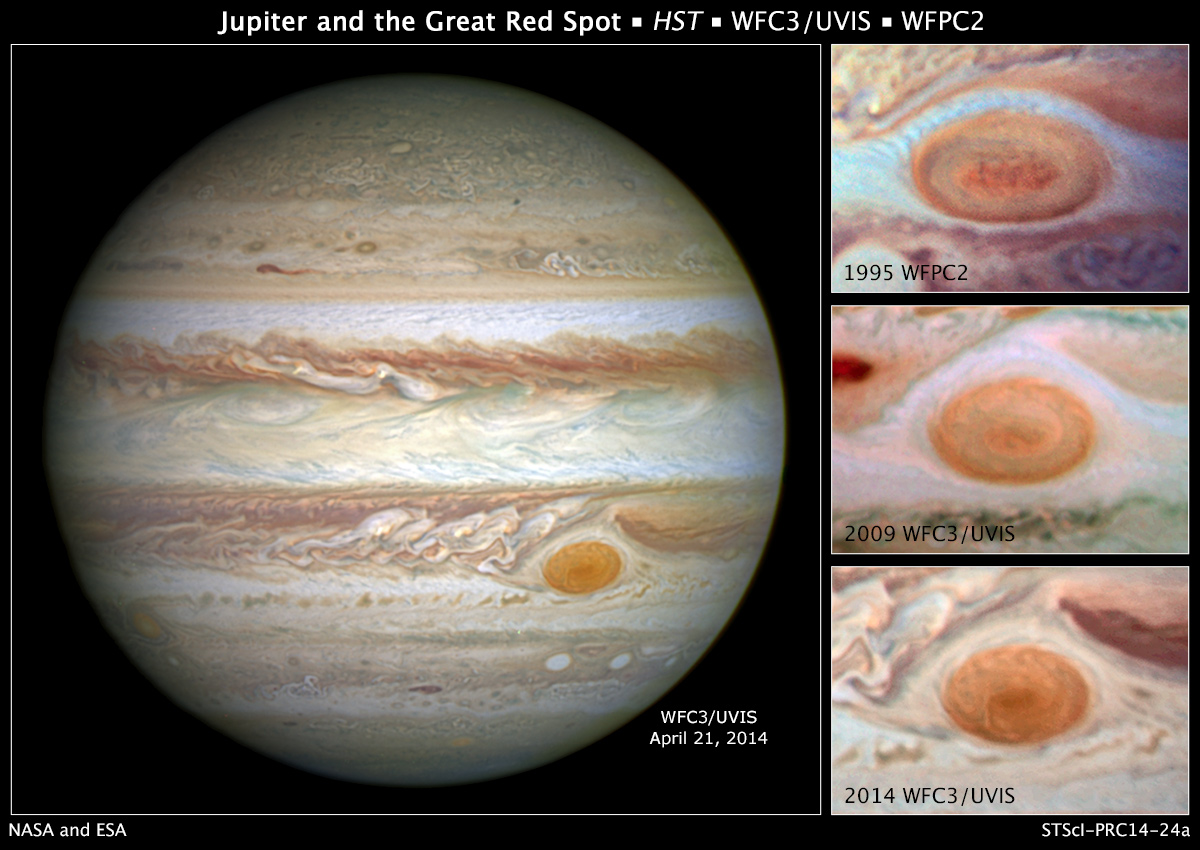
Jupiter is the fifth planet from the Sun, the largest and oldest planet in the solar system, and more than twice as massive as all the other planets combined. Its hydrogen-helium atmosphere is banded by jet streams thousands of kilometres deep, its Great Red Spot has been observed for centuries, and its magnetosphere is the largest structure in the solar system. Juno has been orbiting Jupiter since 2016, ESA's Juice is on its way for a 2031 arrival, and NASA's Europa Clipper will reach the Jovian system in 2030 to study the icy moon Europa.
Overview
Jupiter is the fifth planet from the Sun and by far the largest in the solar system.1 It is more than twice as massive as all the other planets combined, and it is the oldest planet in the solar system.1 If Jupiter were a hollow shell, 1,000 Earths could fit inside.1 A day on Jupiter lasts only 9.9 hours — the shortest in the solar system.2 A Jovian year takes about 12 Earth years, or 4,333 Earth days.2
Its signature appearance is a tapestry of stripes and swirls — cold, windy clouds of ammonia and water floating in an atmosphere of hydrogen and helium.2 The dark orange stripes are called belts, while the lighter bands are called zones, and they flow east and west in opposite directions.2 At the heart of the planet sits the Great Red Spot — a giant storm bigger than Earth that has raged for hundreds of years.2
Jupiter takes its name from the king of the ancient Roman gods.2 Most of its moons are named for mythological characters associated with Jupiter or with Zeus.2 The planet itself is an unlikely home for life, but its moons may not be — Europa is one of the likeliest places to find life elsewhere in the solar system.2
The king of planets: size, mass and orbit
Jupiter has a radius of 69,911 kilometres, making it 11 times wider than Earth.2 If Earth were the size of a grape, Jupiter would be about as big as a basketball.2 At its equator the planet measures about 143,000 kilometres across.3
Jupiter orbits the Sun at an average distance of about 778 million kilometres, or 5.2 astronomical units.2 Sunlight takes 43 minutes to reach the planet.2 Its equator is tilted by just 3 degrees to its orbital path, so Jupiter spins nearly upright and does not have seasons as extreme as other planets do.2
Jupiter took shape along with the rest of the solar system about 4.6 billion years ago.2 Gravity pulled swirling gas and dust together, and Jupiter captured most of the mass left over after the formation of the Sun, ending up with more than twice the combined material of the other bodies in the solar system.2 It has the same ingredients as a star, but it did not grow massive enough to ignite.2
A gas giant from the inside out
Jupiter has no true surface: the planet is mostly swirling gases and liquids, and a spacecraft could neither land on it nor fly through it unscathed.2 Deep in the atmosphere, pressure and temperature increase until hydrogen gas is compressed into a liquid, giving the planet the largest ocean in the solar system — an ocean of hydrogen rather than water.2 At still greater depths — perhaps halfway to the planet's centre — the pressure squeezes electrons off the hydrogen atoms, making the liquid electrically conducting like a metal.2
Juno's measurements of Jupiter's gravity and magnetic field suggest the core is much larger than expected.2 It is not solid either: it is partially dissolved, with no clear separation from the metallic hydrogen around it, leading researchers to describe it as dilute, or 'fuzzy'.2 Juno's discoveries also revealed a deep interior with a dilute heavy-element core.4
Weather on a giant: belts, zones and storms
The gas planet has three distinct cloud layers that together span about 71 kilometres: an upper deck of ammonia ice, a middle layer of ammonium hydrosulfide crystals, and an inner layer of water ice and vapour.2 Stormy Jupiter is swept by more than a dozen prevailing winds, some reaching up to 539 kilometres per hour at the equator.2 The dark belts and lighter zones flow in opposite directions around the planet.2
Juno found that the belts and zones extend about 3,000 kilometres deep.7 The spacecraft also discovered polygonal arrangements of giant cyclonic storms at both poles — eight in an octagonal pattern in the north and five in a pentagonal pattern in the south — which prove remarkably resilient, remaining in place over time.2 Juno also showed that lightning storms, which on Earth are more common near the equator, are a polar phenomenon on Jupiter, dropping softball-sized hailstones of ammonia and water.7
Storms run far taller than expected — some about 100 kilometres deep.7 With no solid surface to slow them down, they persist for years rather than dissipating.2 Juno's very first data-collection pass, on 27 August 2016, revealed Jupiter as a complex, gigantic, turbulent world — even more so than scientists had predicted.7
The Great Red Spot
The Great Red Spot is the largest and longest-lived vortex known on any planet of the solar system — a gigantic anticyclone wider than Earth.8 The Great Red Spot has been observed on Jupiter for more than 300 years.2 Giovanni Domenico Cassini discovered in 1665 a dark oval at the same latitude — the 'Permanent Spot', observed until 1713 — but historical analysis shows it is unlikely to correspond to the current Great Red Spot.8 The Great Red Spot as it is known today was first observed in 1831.8
The storm appears to be slowly shrinking — from twice Earth's size in 1979 to about 1.3 times Earth's width now.7 Juno showed that the Great Red Spot's roots run 200 miles (320 kilometres) deep — 50 to 100 times as deep as Earth's oceans.7 Gravity data constrained the Great Red Spot to a depth of about 500 kilometres below the cloud tops.2
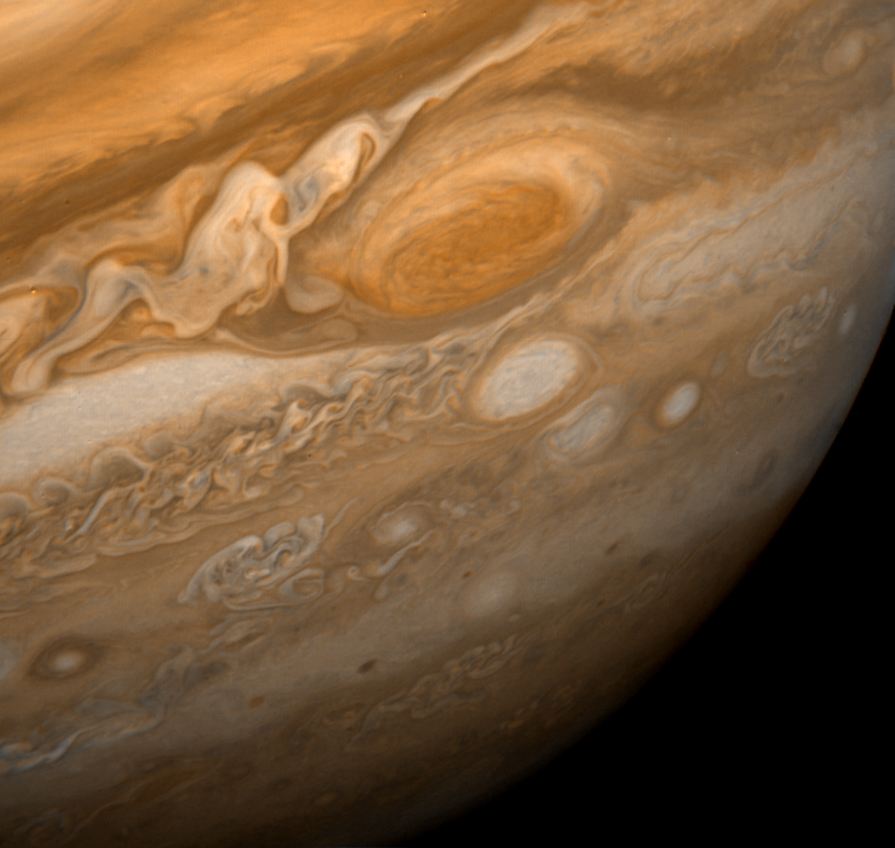
Numerical simulations rule out that the Great Red Spot formed by the merging of vortices or by a superstorm.8 The Great Red Spot most likely formed from a flow disturbance between the two opposed Jovian zonal jets north and south of it.8 An episode of apparent flaking in 2019 was explained as ordinary fluid dynamics.8
The magnetosphere and auroras
Jupiter's enormous magnetic field is 16 to 54 times as powerful as Earth's.2 It rotates with the planet, traps swarms of charged particles and accelerates them to very high energies, creating intense radiation that bombards the innermost moons and can damage spacecraft.2 The Jovian magnetosphere is the largest structure in the solar system.2 This magnetosphere balloons 1 to 3 million kilometres toward the Sun and tapers into a tadpole-shaped tail extending more than a billion kilometres behind the planet, as far as Saturn's orbit.2
Juno's first nine polar orbits allowed scientists to build the 'Juno Reference Model through Perijove 9'.9 The magnetic field is represented with a degree-20 spherical harmonic model of the planetary field plus a model of the magnetodisc, with coefficients well determined through degree and order 10.9 Eight of those orbits provided the first truly global coverage of Jupiter's magnetic field — and the first detailed view of a planetary dynamo beyond Earth.9 Juno has also spent years tracking the Great Blue Spot — an invisible, intense magnetic field on Jupiter's equator.7
The Great Blue Spot appears to be drifting eastward, pushed by winds measured at the surface; at its current course and speed, the spot could circumnavigate the planet in 350 years.7 Auroras — the Jovian northern lights — undulate at both poles, and Juno showed they seem to form by different processes than Earth's.7 Their energies reach hundreds of thousands of electron volts, making them the most powerful auroras in the solar system.7 Auroral emissions also mark the footprints of the Galilean moons.7
The moons of Jupiter
As of August 2026, Jupiter has 115 moons officially recognized by the International Astronomical Union.10 With its rings and asteroids, the Jovian system is a kind of miniature solar system.10 Satellites in the Jovian system are named for Zeus's and Jupiter's lovers and descendants: outer moons on prograde orbits generally take names ending in 'a', retrograde moons in 'e'.11 Moon-hunting has become so sensitive that the International Astronomical Union has decided the smallest new moons will no longer be given mythological names unless they are of significant scientific interest.10
| Moon | Discovered | Size | Mean distance from Jupiter | Orbital period | Key fact |
|---|---|---|---|---|---|
| Io | 1610, by Galileo Galilei10 | Third largest of Jupiter's moons12 | About 422,000 kilometres12 | — | The most volcanically active world in the solar system, with hundreds of volcanoes12 |
| Europa | 1610, by Galileo Galilei10 | Fourth largest of Jupiter's moons; sixth-closest to the planet13 | — | — | Holds a saltwater ocean beneath its icy shell with twice as much water as Earth's global ocean13 |
| Ganymede | 1610, by Galileo Galilei10 | The largest moon in the solar system, bigger than Mercury14 | — | — | The only moon known to have its own magnetic field14; Juno flew within 652 miles of it on 7 June 20217 |
| Callisto | 1610, by Galileo Galilei10 | Second largest Jovian moon and third largest in the solar system, almost as big as Mercury15 | — | — | Its rocky, icy surface is the oldest and most heavily cratered in the solar system, about 4 billion years old15 |
| Amalthea | 9 September 1892, by Edward Emerson Barnard11 | — | — | — | Jupiter's innermost moon, the first discovered after Galileo's four; Voyager later showed it sits inside the planet's ring system11 |
Jupiter's four largest moons — Io, Europa, Ganymede and Callisto — were the first moons discovered beyond Earth.10 Galileo Galilei is credited with their discovery in 1610, using an early version of the telescope.10 The German astronomer Simon Marius observed them around the same time, but published his findings after Galileo, and the names he proposed were not adopted until the mid-1800s.10
Ocean worlds: Europa, Ganymede and Callisto
Europa is the fourth largest of Jupiter's moons and the sixth-closest to the planet.13 Scientists believe a saltwater ocean lies beneath its icy shell, holding twice as much water as Earth's global ocean.13 The moon may also have the chemical elements that are key ingredients for life.13 NASA launched Europa Clipper on 14 October 2024 to determine whether there are places below Europa's surface that could support life.13
Ganymede is Jupiter's largest moon and the largest in the solar system — bigger than the planet Mercury and the dwarf planet Pluto.14 The Hubble Space Telescope found the best evidence yet for an underground saltwater ocean there, with more water than all of Earth's surface.14 That ocean is estimated to be about 100 kilometres thick — ten times deeper than Earth's ocean — buried under a crust of ice about 150 kilometres thick.14 Ganymede is the only moon known to have its own magnetic field, discovered by NASA's Galileo spacecraft in 1996.14 Juno observed mineral salts and organic compounds on Ganymede's surface during a flyby on 7 June 2021.14
Callisto is Jupiter's second largest moon and the third largest in the solar system, almost as big as Mercury.15 Its rocky, icy surface is the oldest and most heavily cratered in the solar system, about 4 billion years old, with no active volcanoes or tectonic shifting to erode the craters.15 Data from the Galileo spacecraft indicate Callisto may have a salty ocean interacting with a layer of rocks about 250 kilometres beneath the surface — key conditions for creating life.15 Io, for its part, is the most volcanically active world in the solar system, with hundreds of volcanoes, some erupting lava fountains dozens of kilometres high, driven by a tug-of-war between Jupiter's gravity and pulls from Europa and Ganymede.12
Four centuries of exploration
The first detailed observations of Jupiter were made by Galileo Galilei in 1610 with a small, homemade telescope.1 Pioneer 10, NASA's first spacecraft to the outer planets, was launched in March 1972 on a 21-month mission to Jupiter.16 It made its closest approach to Jupiter on 4 December 1973.16 Pioneer 11 flew even closer in 1974, passing by on its way to Saturn.16 Flying past the planet in March 1979, Voyager 1 discovered a thin ring, two new moons and active volcanoes on the moon Io.16
The Galileo mission was an orbiter plus an atmospheric probe, launched on 18 October 1989 from Space Shuttle Atlantis.16 The orbiter circled Jupiter for almost eight years and made close passes by all the planet's major moons.16 The probe that entered in 1995 found its entry site strangely dry, with one-tenth the expected water; Juno later showed water is much more abundant nearer the equator.7 On 21 September 2003 the main spacecraft was deliberately destroyed in Jupiter's atmosphere, to protect one of its key discoveries — a possible ocean beneath the icy crust of Europa.16
Cassini spent about six months — from October 2000 to March 2001 — exploring the Jupiter system on its way to Saturn.16 It came within about 9.7 million kilometres of the cloud tops and captured some 26,000 images.16 In July 1994, the planet had been the stage for the first planetary collision ever watched by spacecraft — comet Shoemaker-Levy 9.17 Juno launched on 5 August 2011 from Cape Canaveral aboard an Atlas V rocket, and after a voyage of nearly five years and 1.7 billion miles it reached Jupiter and went into orbit on 4 July 2016.7 Juno approaches the giant from the north, diving between the radiation belts and at times descending to 2,200 miles (3,500 kilometres) above the cloud tops.7
Missions today and tomorrow: Juno, Juice and Europa Clipper
Juno completed its primary mission by mid-2021, delivering revelations about Jupiter's interior structure, atmosphere and magnetosphere, and then pivoted to an extended mission as an explorer of the full Jovian system.7 In 2021 NASA scheduled 42 additional orbits and extended the mission to 2025, permitting encounters with three of the Galilean moons — Ganymede, Europa and Io.7 Moon flybys reshaped its orbit: Ganymede's gravity cut the period from 53 to 43 days, Europa shortened it to 38, and the Io encounters left Juno circling Jupiter every 33 days.7 As of 2026, JPL records the extended mission as continuing through September 2025 or end of life.4 Originally slated for 2016 to 2017, the mission was extended by NASA and is now scheduled to end in September 2025, when the spacecraft will burn up in Jupiter's atmosphere.7
ESA's Jupiter Icy Moons Explorer, Juice, will make detailed observations of the giant planet and its three large ocean-bearing moons — Ganymede, Callisto and Europa — characterising them as planetary objects and possible habitats, and studying the wider Jovian system as an archetype for gas giants.18 Juice launched on 14 April 2023 and will fly by the Moon and Earth, Venus, and Earth again before arriving at Jupiter in July 2031, carrying 10 instruments and 85 square metres of solar wings.18 Its tour will include 35 flybys of Jovian moons before ending in orbit around Ganymede.18 Europa Clipper is the first mission designed to conduct a detailed study of Jupiter's moon Europa.19 Europa Clipper will travel 1.8 billion miles (2.9 billion kilometres) to reach Jupiter in April 2030, then orbit the planet and conduct 49 close flybys of the moon.19
Collisions and catastrophes: Shoemaker-Levy 9
Comet Shoemaker-Levy 9 was discovered by Carolyn and Gene Shoemaker and David Levy in a photograph taken on 18 March 1993 with the 0.4-metre Schmidt telescope at Mount Palomar.17 By the time of its discovery it had already been torn into more than 20 pieces travelling around Jupiter in a two-year orbit.17 Further observations revealed that the comet — believed to be a single body at the time — had made a close approach to Jupiter in July 1992 and been torn apart by tidal forces resulting from the planet's powerful gravity.17 The fragments were going to smash into Jupiter, and for the first time in history NASA had spacecraft in position to watch a collision between two bodies in the solar system.17
NASA's Galileo orbiter, then still en route to Jupiter, captured unprecedented direct views as the string of fragments labelled A through W smashed into the planet's cloud tops.17 The impacts started on 16 July 1994 and ended on 22 July 1994 — the first planetary collision ever watched by spacecraft.17 The 'freight train' of fragments struck Jupiter with the force of 300 million atomic bombs.17 They created plumes 2,000 to 3,000 kilometres high and heated the atmosphere to 30,000 to 40,000 degrees Celsius.17 Shoemaker-Levy 9 left dark, ringed scars that were eventually erased by Jupiter's winds.17
Outlook: what remains to be discovered
Juno is preparing the way for ESA's Juice and NASA's Europa Clipper.7 The questions that remain are large — the depth of the dynamo, the true abundance of water in the deep atmosphere, the fate of the Great Red Spot, and whether Europa or Ganymede might be habitable.7 Scott Bolton, the mission's principal investigator, has described the attraction of Jupiter this way:7
Jupiter is the Rosetta Stone of our solar system. Juno is going there as our emissary – to interpret what Jupiter has to say.
Scott Bolton, Juno principal investigator, Southwest Research Institute in San Antonio
Every 53 days we go screaming by Jupiter, get doused by a fire hose of Jovian science, and there is always something new.
Scott Bolton, Juno principal investigator, Southwest Research Institute in San Antonio
Milestones in the exploration of Jupiter
Galileo discovers Jupiter's four largest moons
Galileo Galilei observes four points of light that stay close to Jupiter, the first moons ever discovered beyond Earth — today called the Galilean satellites: Io, Europa, Ganymede and Callisto.
Cassini records the 'Permanent Spot'
Giovanni Domenico Cassini observes a dark oval at the Great Red Spot's latitude, later called the Permanent Spot; it was tracked until 1713, though modern analysis suggests it was probably not the same storm as today's Great Red Spot.
First sighting of the modern Great Red Spot
Historical records indicate the Great Red Spot as we know it was first observed in 1831, making the current storm at most about 195 years old — younger than the 'Permanent Spot' some historians conflate it with.
Barnard discovers Amalthea
Edward Emerson Barnard finds Amalthea from Mt. Hamilton — the first moon of Jupiter discovered since Galileo's four, and later shown by Voyager to sit inside the planet's ring system.
Pioneer 10 makes the first close pass
NASA's Pioneer 10 flies past Jupiter, the first spacecraft to visit the outer planets, returning the first close-up images of the planet before heading out of the solar system.
Voyager 1 finds rings and volcanoes
During its Jupiter flyby, Voyager 1 discovers a thin ring around the planet, two new moons, and active volcanoes on Io — the first known volcanism beyond Earth.
Galileo launches from Space Shuttle Atlantis
NASA's Galileo mission — an orbiter and an atmospheric probe — departs aboard Space Shuttle Atlantis (STS-34) on a six-year journey to become the first spacecraft to orbit an outer planet.
Shoemaker-Levy 9 hits Jupiter
More than 20 fragments of comet Shoemaker-Levy 9 smash into Jupiter's atmosphere in the first planetary collision ever watched by spacecraft, with Galileo, Hubble, Ulysses and Voyager 2 observing.
Galileo arrives and drops a probe into Jupiter
Galileo enters orbit around Jupiter and releases its atmospheric probe, the first to descend into an outer planet's atmosphere, transmitting for about an hour before being crushed.
Cassini's closest approach to Jupiter
On its way to Saturn, Cassini passes about 9.7 million km from Jupiter's cloud tops, capturing some 26,000 images over six months — the most detailed global portrait of Jupiter to that date.
Galileo is deliberately destroyed in Jupiter
After 14 years and 34 orbits of Jupiter, Galileo is steered into the planet's atmosphere and destroyed, to protect its own discovery — the possible ocean beneath Europa's ice — from contamination.
Juno launches toward Jupiter
Juno lifts off from Cape Canaveral aboard an Atlas V, beginning a five-year, 1.7-billion-mile journey that will end with the most distant solar-powered spacecraft ever flown at Jupiter.
Juno enters orbit around Jupiter
After a flawless 35-minute main-engine burn, Juno is captured into a 53-day polar orbit and begins sampling Jupiter from its clouds to the edge of its magnetosphere.
Juno's historic Ganymede flyby
Juno passes within 652 miles (1,038 km) of Ganymede — the closest any spacecraft has come to Jupiter's largest moon in more than two decades — reshaping its orbit for the extended mission.
ESA launches Juice to Jupiter's icy moons
Juice lifts off from Europe's Spaceport in French Guiana on an Ariane 5, beginning an eight-year cruise to Jupiter with gravity assists at the Moon and Earth, Venus, and Earth again.
Europa Clipper launches to Europa
NASA's Europa Clipper lifts off on a SpaceX Falcon Heavy on a 1.8-billion-mile journey to Jupiter, where it will conduct 49 close flybys of Europa to assess whether the moon could support life.
Jupiter: quick answers
How large is Jupiter compared with Earth?
Jupiter has a radius of 69,911 kilometres, making it 11 times wider than Earth.2 If it were a hollow shell, 1,000 Earths could fit inside.1 It is also more than twice as massive as all the other planets in the solar system combined.1
How long is a day and a year on Jupiter?
A day on Jupiter lasts only 9.9 hours, the shortest in the solar system.2 A Jovian year takes about 12 Earth years, or 4,333 Earth days.2 Its equator is tilted by just 3 degrees, so it does not have seasons as extreme as other planets do.2
Why does Jupiter look striped?
The stripes are cold, windy clouds of ammonia and water floating in an atmosphere of hydrogen and helium.2 The dark orange stripes are called belts, while the lighter bands are called zones, and they flow east and west in opposite directions.2 Jupiter has three distinct cloud layers that span about 71 kilometres.2
What is the Great Red Spot, and is it shrinking?
The Great Red Spot is a giant storm bigger than Earth that has raged for hundreds of years.2 It appears to be slowly shrinking — from twice Earth's size in 1979 to about 1.3 times Earth's width now.7 Juno showed that its roots run 200 miles (320 kilometres) deep.7
How many moons does Jupiter have?
As of August 2026, Jupiter has 115 moons officially recognized by the International Astronomical Union.10 The four largest — Io, Europa, Ganymede and Callisto — were the first moons discovered beyond Earth, observed by Galileo Galilei in 1610.10
Could Europa or Ganymede support life?
Europa is one of the likeliest places to find life elsewhere in the solar system, with evidence of a vast ocean just beneath its icy crust.2 Scientists believe that ocean holds twice as much water as Earth's global ocean.13 Ganymede has an underground saltwater ocean estimated to be about 100 kilometres thick, buried under a crust of mostly ice.14
Which spacecraft are at Jupiter or on their way?
Juno is in orbit, and as of 2026 its extended mission is continuing.4 ESA's Juice, launched in April 2023, is due at Jupiter in July 2031.7 NASA's Europa Clipper, launched in October 2024, will arrive in April 2030.7
What happened when comet Shoemaker-Levy 9 hit Jupiter?
The comet had been torn into more than 20 pieces during a close approach to Jupiter in July 1992.17 The fragments smashed into the planet's cloud tops between 16 and 22 July 1994, with the force of 300 million atomic bombs and plumes 2,000 to 3,000 kilometres high.17 It was the first planetary collision ever watched by spacecraft.17
Jupiter in numbers
Sources & citations
Every factual claim in this article is drawn from the sources below. Bracketed numbers in the text link to the corresponding source.
- 1
- 2
- 3
- 4
- 5
- 6
- 7
- 8
- 9
- 10
- 11
- 12
- 13
- 14
- 15
- 16
- 17
- 18
- 19
- 20