Saturn
The sixth planet from the Sun and the second largest in the solar system — a hydrogen-helium gas giant girdled by the most spectacular ring system known, orbited by 293 confirmed moons, and explored for thirteen years by the Cassini-Huygens mission.
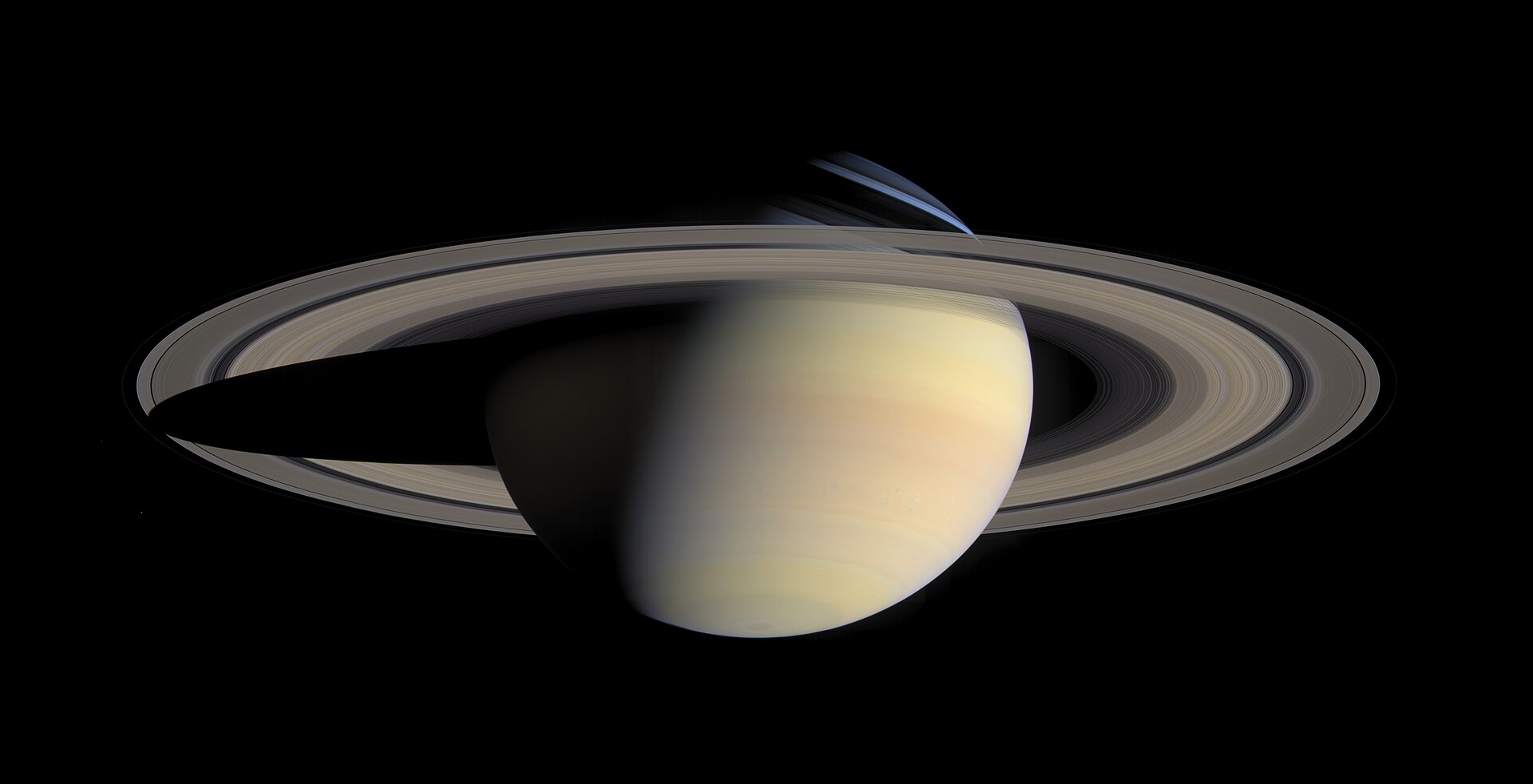
Saturn is the sixth planet from the Sun and the second largest in the solar system, a gas giant made mostly of hydrogen and helium with the lowest mean density of any planet — 0.69 grams per cubic centimetre, less than that of water. Its rings, almost entirely water ice, extend up to 282,000 kilometres from the planet yet stand only about 10 metres thick in the main rings, and its family of 293 confirmed moons as of August 2026 ranges from planet-sized Titan, with its thick nitrogen atmosphere and methane lakes, to Enceladus, whose geysers spray a subsurface ocean into space and supply the E ring. NASA's Cassini spacecraft orbited Saturn from 2004 to 2017 — the first spacecraft ever to do so — and its ESA-built Huygens probe made the first landing in the outer solar system, on Titan, in January 2005.
Overview
Saturn is the sixth planet from the Sun and the second-largest planet in the solar system.1 It is a massive ball made mostly of hydrogen and helium.1 Saturn is not the only planet to have rings, but none are as spectacular or as complex as Saturn's, and it also has dozens of moons.1 Saturn has 293 confirmed moons as of August 2026, far more than any other planet in the solar system.2
Its signature sight is a system of rings that extends up to 282,000 kilometers from the planet yet stands only about 10 meters thick in the main rings.1 Faint stripes, jet streams and storms shade the planet in yellow, brown and gray.1 Around it circles a family of moons that runs from Titan, larger than the planet Mercury, down to small bodies as compact as a sports arena.2
Saturn is named for the Roman god of agriculture and wealth, the father of Jupiter.3 It is the farthest planet visible to the unaided eye, and the slowest-moving of the planets known to ancient observers.3
Saturn in the night sky
To the unaided eye it appears as a steady, non-twinkling point of light.3
Galileo was the first to observe Saturn with a telescope in 1610.3 He saw a strangeness in the planet's appearance, but the low resolution of his instrument did not reveal the true nature of the rings.3
From Earth the rings present a slow cycle: over Saturn's 29.5-year orbit they open from edge-on to nearly 30 degrees.3 Ground observers see the sunlit north face for about 15 years, then the south face for 15.3 When Earth crosses the ring plane, the rings become almost invisible.3
Size, mass and orbit
Saturn's equatorial diameter is 120,536 kilometers, against a polar diameter of 108,728 kilometers — about 10 percent smaller, making it the most oblate of the planets.3 The planet is about 9 times wider than Earth.3 If Earth were the size of a nickel, Saturn would be about as big as a volleyball.3
Saturn packs 95 times Earth's mass into a volume 766 times greater, giving it a mean density of 0.69 grams per cubic centimeter — the lowest of any planet, about 70 percent that of water.3 It is the only planet in the solar system with an average density less than that of water, and it could float in a bathtub if such a colossal thing existed.1
Saturn's mean distance from the Sun is 1,427,000,000 kilometers, or 9.5 astronomical units.3 Sunlight takes 80 minutes to travel from the Sun to Saturn.1 A day at the cloud tops lasts 10.7 hours — the second-shortest of any planet — and a year runs about 29.4 Earth years, or 10,756 Earth days.1
Inside a gas giant
Saturn has no true surface: the planet is mostly swirling gases and liquids deeper down.1 The extreme pressures and temperatures inside would crush, melt and vaporize any spacecraft trying to fly in.1 At the center is a dense core of metals like iron and nickel surrounded by rocky material, enveloped by liquid metallic hydrogen inside a layer of liquid hydrogen.1 The structure is similar to Jupiter's, but considerably smaller.1
The deep interior lies hidden from view, so its rotation had to be measured indirectly.3 Waves in the rings, related to the planet's gravity field during Cassini's final orbits, yielded a deep-interior rotation period of 10 hours 33 minutes 38 seconds.3 During those same final orbits, between the planet and its rings, Cassini measured the gravitational pull acting on the spacecraft.4 That measurement allowed scientists to separate the contributions of the planet and the rings, and to determine Saturn's interior structure along with the mass of its rings.4
Saturn's escape velocity at the equatorial one-bar level is about 35.5 kilometers per second — high enough that there has been no significant loss of atmosphere since the planet formed.1 Saturn took shape about 4.5 billion years ago, along with the rest of the solar system, and settled into its present orbit about 4 billion years ago.1
Weather, the hexagon and the poles
Winds in the upper atmosphere reach 500 meters per second in the equatorial region — far beyond Earth's strongest hurricane winds of about 110 meters per second.1
The north pole is crowned by a six-sided jet stream — a hexagon-shaped pattern first noticed in Voyager images in the early 1980s and studied more closely by Cassini.1 Spanning about 30,000 kilometers, the hexagon blows at 200 miles per hour — about 322 kilometers per hour — and holds a massive rotating storm at its center.1
For decades, the north-pole hexagon had no counterpart at the south pole.1 Recent observations with the Hubble Space Telescope revealed a giant, evolving, 10-sided — or decagonal — atmospheric wave encircling Saturn's south pole, according to a research study published in September 2026.1 Gleaned from observations dating back to 2023, the discovery marked the first time a large, regular-sided jet pattern had been observed in the planet's southern hemisphere.1
The rings
Named alphabetically in the order they were discovered, Saturn's rings run outward from the planet as D, C, B, the Cassini Division, A, F, G and E.1 Much farther out lies the very faint Phoebe ring, in the orbit of the moon Phoebe.1 The gap called the Cassini Division, 4,700 kilometers wide, separates Rings A and B.1
The rings are made of billions of small chunks of ice and rock coated with dust.1 These particles range from dust-sized icy grains to chunks as big as a house, with a few as large as mountains.1 They are thought to be pieces of comets, asteroids or shattered moons that broke up before reaching the planet, torn apart by Saturn's powerful gravity.1 Cassini's gravity measurements show the rings are substantially younger than the planet itself, which constrains models of their origin.4
Cassini was the first mission to study the size, temperature, composition and distribution of Saturn's rings from orbit.5 It studied features called spokes — finger-like radial structures, made of tiny icy particles lifted by an electrostatic charge, that can be longer than the diameter of Earth.5 The spacecraft also found propeller-shaped wakes, sometimes several thousand kilometers long, produced by the gravitational influence of moonlets about 1 kilometer in diameter; its instruments first observed these formations in 2006.5
On 11 August 2009, with sunlight striking the rings edge-on, Cassini became the only spacecraft ever to give scientists an up-close view of the rings during the planet's equinox.5 The rings proved far less smooth than scientists had thought: countless icy clumps cast great shadows, and some of the clumps and bumps were as tall as the Rocky Mountains.5 The A ring cooled to minus 230 degrees Celsius — the lowest ring temperature ever recorded at Saturn.5
Saturn's moons: a system of 293 worlds
The Saturnian system holds 293 confirmed moons as of August 2026 — far more than any other planet in the solar system.2 They range in size from Titan, which is larger than the planet Mercury, down to bodies as small as a sports arena.2 The small moon Enceladus has a global ocean under a thick, icy shell, and scientists have identified both Enceladus and Titan as high-priority science destinations for future deep-space missions.2
The moons carry the names of Titans and Titanesses.6 The names used today for the classical satellites were applied in the early 19th century by John Herschel.6 Later discoveries extended the naming scheme: retrograde outer satellites are named for Norse giants — except Phoebe, which was discovered long ago and is the largest — prograde moons with an inclination around 36 degrees are named for Gallic giants, and those near 48 degrees for Inuit giants and spirits.6
Seven moons were discovered between 1655 and 1789 — Mimas, Enceladus, Tethys, Dione, Rhea, Titan and Iapetus — followed by Hyperion in 1848 and Phoebe in 1898.2 Rhea, a Titaness and the mother of Zeus by Kronos, was discovered by Giovanni Cassini on 23 December 1672 in Paris.6 Phoebe, a distant retrograde satellite, was the first moon ever found by photography.6
The catalog keeps growing: 293 is a running count, and new outer satellites continue to be confirmed and named by the International Astronomical Union.2 Cassini alone discovered six named moons during its thirteen years at Saturn.7
The major moons at a glance
Nine of the most significant moons, from the innermost major moon Mimas to distant, retrograde Phoebe: their discovery dates span more than three centuries, and their sizes span a factor of seventeen.2
| Moon | Discovered | Size | Distance from Saturn | Key feature |
|---|---|---|---|---|
| Mimas | 1789, by William Herschel8 | Measures about 394 kilometers across8 | About 186,000 kilometers8 | Herschel Crater stretches a third of the way across the moon and is 130 kilometers wide8 |
| Enceladus | 1789, by William Herschel9 | About 500 kilometers across9 | 238,000 kilometers9 | The most reflective body in the solar system; its geysers feed Saturn's E ring9 |
| Tethys | 1684, by Giovanni Cassini2 | — | — | A classical icy moon whose modern name was applied by John Herschel6 |
| Dione | 1684, by Giovanni Cassini2 | — | — | Larger than Enceladus; it orbits Saturn once for every two orbits of Enceladus, driving tidal heating9 |
| Rhea | 1672, by Giovanni Cassini6 | Mean radius of 764 kilometers10 | 527,000 kilometers10 | Saturn's second largest moon, more heavily cratered than Dione and Tethys10 |
| Titan | 1655, by Christiaan Huygens11 | Radius of about 2,575 kilometers, nearly 50 percent wider than Earth's moon11 | 1,221,850 kilometers11 | The only moon with a dense atmosphere; methane lakes and seas dot its surface11 |
| Hyperion | 1848, by the Bond brothers and Lassell6 | — | — | Named by Lassell for one of the Titans6 |
| Iapetus | 1671, by Giovanni Cassini12 | Mean radius of 736 kilometers12 | 3,561,000 kilometers12 | Two-tone: a coal-dark leading hemisphere and a bright trailing one, with a 10-kilometer-high equatorial ridge12 |
| Phoebe | 1898, by Pickering6 | — | — | A distant retrograde moon — the first satellite ever found by photography6 |
Beyond the table, the list keeps growing — the count of 293 confirmed moons as of August 2026 is a running tally rather than a final figure.2
Titan and Enceladus: the ocean-bearing moons
Titan, Saturn's largest moon, is an icy world whose surface is completely obscured by a golden hazy atmosphere.11 Dutch astronomer Christiaan Huygens discovered Titan on 25 March 1655 and called it 'Luna Saturni'.11 Titan has a radius of about 2,575 kilometers, nearly 50 percent wider than Earth's moon.11 It is the only moon in the solar system with a dense atmosphere.11
Titan's atmosphere is mostly nitrogen, about 95 percent, with about 5 percent methane.11 Small amounts of other carbon-rich compounds are also present, and their chemistry produces a thick orange haze of smog that makes the moon's surface difficult to view from space.11 At the surface, the atmospheric pressure is about 60 percent greater than on Earth — roughly the pressure a person would feel 15 meters underwater.11 Because Titan is less massive than Earth, its atmosphere extends to an altitude 10 times higher than Earth's — nearly 600 kilometers into space.11
Titan is the only world besides Earth that has standing bodies of liquid — rivers, lakes and seas — on its surface.11 It is the sole other place in the solar system known to have an earthlike cycle of liquids raining from clouds, flowing across the surface, filling lakes and seas, and evaporating back into the sky.11 It is so cold there — minus 179 degrees Celsius — that water ice plays the role of rock.11 Flowing methane and ethane carve river channels and fill great lakes with liquid natural gas, and vast regions of dark hydrocarbon dunes stretch across the equatorial landscape.11 Surprisingly like Earth, the brighter highland regions show complex systems draining into flat, dark lowlands.13
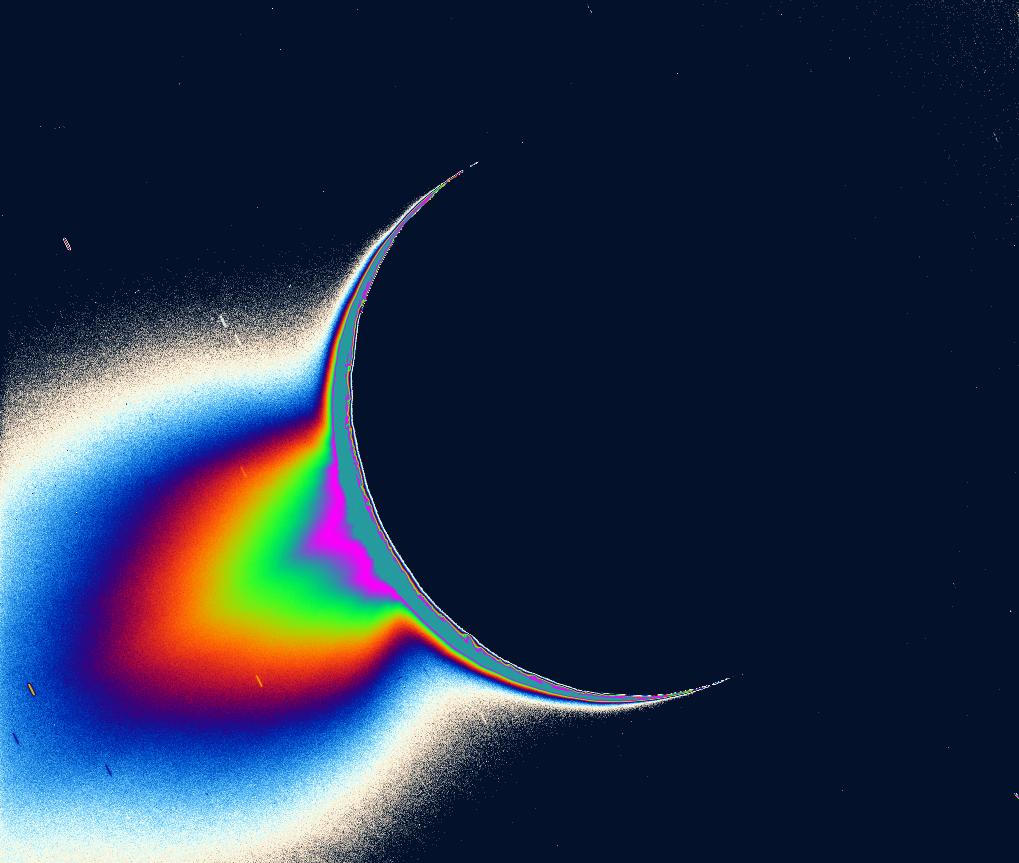
Cassini's gravity measurements revealed that Titan hides an underground ocean of liquid water, likely mixed with salts and ammonia.11 Huygens radio signals during its 2005 descent strongly suggested an ocean 55 to 80 kilometers below the icy ground.11 Enceladus, by contrast, is only about 500 kilometers across and about as wide as Arizona, and it is the most reflective body in the solar system.9 In 2005, NASA's Cassini spacecraft discovered that icy water particles and gas gush from the moon's surface at approximately 400 meters per second.9
The eruptions come from relatively warm fractures informally called the 'tiger stripes', and they appear to be continuous; most of the material falls back like snow, helping keep the moon bright white.9 From samples of the plume, scientists have determined that Enceladus has most of the chemical ingredients needed for life, and it likely has hydrothermal vents releasing hot, mineral-rich water into its ocean.9 Cassini passed within 168.2 kilometers of Enceladus's surface on 14 July 2005 during its closest approach to the moon.14 The E ring is mostly ice droplets, but among them are peculiar nanograins of silica that can only be generated where liquid water and rock interact above about 90 degrees Celsius — evidence pointing to hydrothermal vents deep beneath the icy shell.9 The inferred rate of water vapor injection into Saturn's magnetosphere is about 200 kilograms per second.15
Cassini-Huygens: thirteen years at Saturn
Cassini-Huygens was a partnership of NASA, the European Space Agency and the Italian Space Agency, and it was one of the largest and most complex interplanetary spacecraft ever built.16 It weighed 5.6 tonnes and measured 6.7 meters high and more than 4 meters wide; Cassini carried 12 scientific instruments and the Huygens probe carried six.16 Cassini-Huygens launched from Cape Canaveral Air Force Station in Florida aboard a Titan IVB/Centaur on 15 October 1997.7
Cassini arrived at Saturn on 1 July 2004 and became the first spacecraft ever to orbit the planet.7 During its mission Cassini completed 294 orbits of Saturn, executed 162 targeted moon flybys — 127 at Titan and 23 at Enceladus — and took 453,048 images.7 The mission is named for two scientists.16 Christiaan Huygens was a Dutch scientist who discovered Saturn's rings and, in 1655, its largest moon, Titan.16 The Italian Jean-Dominique Cassini discovered the moons Iapetus, Rhea, Tethys and Dione and, in 1675, the gap now known as the Cassini Division.16
The Huygens probe was about 2.7 meters wide and weighed 318 kilograms, and its hard shell protected it during a descent through Titan's atmosphere that lasted two hours and 27 minutes.17 It landed at about 11:30 UTC on 14 January 2005 and survived another 72 minutes on the surface.17 It was the first, and so far the only, landing in the outer solar system, and it holds the record as the most distant landing from Earth.17
For more than a decade, Cassini took scientists to worlds where methane rivers run to a methane sea and where jets of ice and gas blast from a liquid water ocean that might harbor the ingredients for life.18 Its discoveries included the geysers and global ocean of Enceladus, the lakes and seas of Titan, propeller wakes in the rings, and the young-ring result from its gravity measurements.7 The Grand Finale began with the closest flyby of Titan on 22 April 2017 and the first ringplane crossing on 26 April 2017.19 With its propellant nearly exhausted, operators deliberately plunged Cassini into the planet on 15 September 2017 to ensure the moons — in particular the ice-covered, ocean-bearing Enceladus, but also Titan — remain pristine for future exploration.18
What comes next at Saturn
Dragonfly, the first-of-its-kind rotorcraft to explore another world, will fly to various locations on Saturn's moon Titan and investigate the moon's habitability.20 Launch is scheduled for no earlier than July 2028, with arrival in late 2034.20 Instead of being limited to the region around its landing site, Dragonfly's rotors will carry it for miles across Titan during a planned 3.3-year mission, stopping at sites including dunes and Selk Crater.20 It is expected to make one flight every 1-2 Titan days — a Tsol of about 16 Earth days.20
Many questions about the Saturn system remain open.4 How old the rings are, and how long they will last, is one of them.4 Why Mimas is frozen while Enceladus is active is the paradox behind the 'Mimas Test': any theory that explains the partially thawed water of Enceladus must also explain the entirely frozen water of Mimas.8 Where Titan's methane comes from is a mystery — sunlight continuously breaks it down, so some source must be replenishing it, and researchers suspect cryovolcanism but are not certain.11
The legacy of Cassini continues to shape exploration.18 In revealing that Enceladus has essentially all the ingredients needed for life, the mission energized a pivot to the exploration of 'ocean worlds'.18 NASA's Europa Clipper uses an orbital tour design derived from the way Cassini explored Saturn.18 Future ice-giant missions may follow the same path.18
Timeline: from Galileo's telescope to the Grand Finale
Galileo turns a telescope on Saturn
The Italian astronomer Galileo becomes the first to observe Saturn with a telescope; he sees a strangeness in its appearance, but the low resolution of his instrument does not reveal the true nature of the rings.
Christiaan Huygens discovers Titan
The Dutch astronomer Christiaan Huygens discovers Saturn's largest moon and calls it 'Luna Saturni'; Titan turns out to be the second largest moon in the solar system, bigger than the planet Mercury.
Giovanni Cassini discovers Iapetus
Cassini finds Iapetus and notices that he can only see it on the west side of Saturn, correctly concluding that one hemisphere is much darker than the other and that the moon is tidally locked.
Cassini identifies the great division in the rings
Jean-Dominique Cassini discovers what is known today as the Cassini Division, the narrow gap separating Saturn's rings between the A and B rings.
Cassini discovers Tethys and Dione
Giovanni Domenico Cassini adds two more moons to the Saturnian system: Tethys and Dione, both discovered from Paris and recorded in the modern catalogue with the years 1684.
William Herschel discovers Enceladus
The British astronomer William Herschel spots Enceladus orbiting Saturn; the small, brilliant moon will prove to be the most reflective body in the solar system.
William Herschel discovers Mimas
Working with his 40-foot reflector telescope, Herschel finds Mimas, the smallest and innermost of Saturn's major moons — the moon whose giant Herschel Crater makes it resemble the 'Death Star'.
Pioneer 11 makes the first visit
Pioneer 11 becomes the first spacecraft to visit the Saturnian system, a short-term flyby followed by Voyagers 1 and 2 in the two years that followed.
Cassini-Huygens launches from Cape Canaveral
The Cassini orbiter and ESA's Huygens probe lift off aboard a Titan IVB/Centaur rocket, beginning a mission that will last two decades from launch to the Grand Finale.
Cassini enters orbit at Saturn
Cassini arrives at Saturn and becomes the first spacecraft ever to orbit the planet; in December 2004 it releases the Huygens probe on a 22-day cruise to Titan.
Huygens lands on Titan
After a descent of two hours and 27 minutes, ESA's Huygens probe lands on Titan at about 11:30 UTC and survives 72 minutes on the surface — the first, and so far only, landing in the outer solar system and the most distant landing from Earth.
Cassini discovers the geysers of Enceladus
Cassini finds icy water particles and gas gushing from Enceladus's south polar region at about 400 metres per second; the continuous eruptions supply Saturn's E ring and make the little moon a prime target in the search for habitable environments.
Propellers appear in the rings
Cassini's instruments first observe propeller-shaped features in the rings, wake-like structures raised by moonlets about one kilometre across orbiting within the ring plane.
Cassini watches the rings at equinox
Cassini becomes the only spacecraft ever to give an up-close view of Saturn's rings during the planet's equinox; the edge-on sunlight reveals clumps as tall as the Rocky Mountains and cools the A ring to minus 230 degrees Celsius — the lowest ring temperature recorded at Saturn.
The Day Earth Smiled
Cassini slips into Saturn's shadow and images the planet, seven of its moons, its inner rings and the Earth in the background, in an event celebrated the world over as 'The Day Earth Smiled'.
Cassini's Grand Finale ends at Saturn
With its propellant nearly exhausted, Cassini makes its final entry into Saturn's atmosphere, ending a 20-year mission; the deliberate plunge ensures that the moons — especially the ocean-bearing Enceladus — remain pristine for future exploration.
Frequently asked questions
How many moons does Saturn have today?
Saturn has 293 confirmed moons as of August 2026, far more than any other planet in the solar system.2 They range in size from Titan, larger than the planet Mercury, to bodies as small as a sports arena.2
Why could Saturn float in water?
Saturn has an average density of 0.69 grams per cubic centimeter — the lowest of any planet, about 70 percent that of water.3 It is the only planet in the solar system with an average density less than that of water, and it could float in a bathtub if such a colossal thing existed.1
How big is Saturn compared with Earth?
Saturn's equatorial diameter is 120,536 kilometers, and its polar diameter is 108,728 kilometers — about 10 percent smaller.3 It packs 95 times Earth's mass into a volume 766 times greater, and it is about 9 times wider than Earth.3
What are days and years like on Saturn?
A day at the cloud tops lasts 10.7 hours — the second-shortest of any planet.1 A year runs about 29.4 Earth years, or 10,756 Earth days, and a 26.73-degree tilt gives each season more than seven years.1
What are Saturn's rings made of, and how big are they?
The rings are made of billions of small chunks of ice and rock coated with dust.1 They extend up to 282,000 kilometers from the planet, yet the main rings stand only about 10 meters thick vertically.1
What is the hexagon on Saturn's north pole?
It is a six-sided jet stream about 30,000 kilometers across, with 200-mile-per-hour winds and a massive rotating storm at its center.1 It was first noticed in Voyager images in the early 1980s and studied closely by Cassini.1 At the south pole, Hubble observations from 2023 revealed a 10-sided decagonal wave — the first regular-sided jet pattern seen in the southern hemisphere.1
Has anything ever landed on Titan?
ESA's Huygens probe landed on Titan at about 11:30 UTC on 14 January 2005, after a descent of two hours and 27 minutes, and survived another 72 minutes on the surface.17 It was the first, and so far the only, landing in the outer solar system, and it holds the record as the most distant landing from Earth.17
Saturn by the numbers
Sources & citations
Every factual claim in this article is drawn from the sources below. Bracketed numbers in the text link to the corresponding source.
- 1
- 2
- 3
- 4
- 5
- 6
- 7
- 8
- 9
- 10
- 11
- 12
- 13
- 14
- 15
- 16
- 17
- 18
- 19
- 20