The Solar System
The Sun and everything bound to it — eight planets, hundreds of moons, dwarf planets, and the icy debris of the Kuiper Belt and Oort Cloud.
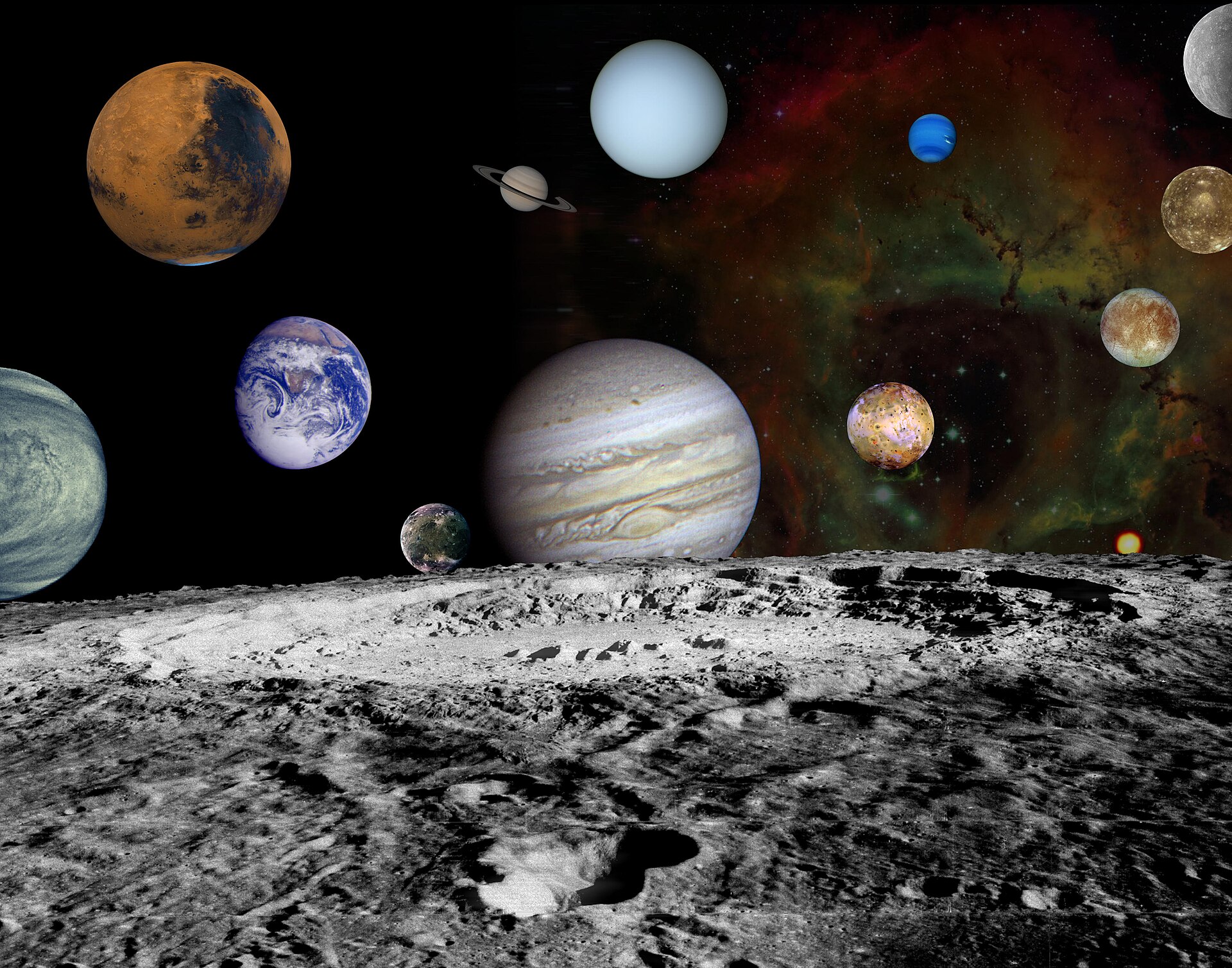
The solar system is the Sun and everything held by its gravity: eight planets, five officially named dwarf planets, hundreds of moons, and millions of asteroids and comets. It formed about 4.6 billion years ago when a cloud of interstellar gas and dust collapsed into a spinning disk, and the Sun gathered more than 99% of the matter. Nearest the Sun are the rocky terrestrial planets — Mercury, Venus, Earth and Mars — followed by the giants Jupiter, Saturn, Uranus and Neptune. Beyond Neptune lie the Kuiper Belt and the vast Oort Cloud. In 2006 the International Astronomical Union defined what a planet is, reducing the census from nine to eight and reclassifying Pluto as a dwarf planet; NASA's New Horizons has since shown Pluto as a complex world.
The solar system in brief
The solar system includes the Sun, eight planets, five officially named dwarf planets, hundreds of moons, and thousands of asteroids and comets.1 It has eight planets — Mercury, Venus, Earth, Mars, Jupiter, Saturn, Uranus and Neptune — and five officially recognised dwarf planets: Ceres, Pluto, Haumea, Makemake and Eris.2 It is called the solar system because we use the word 'solar' to describe things related to our star, after the Latin word for Sun, 'solis'.1
One astronomical unit — the Sun–Earth distance — is about 93 million miles (150 million kilometres).1 Neptune, the most distant planet, orbits the Sun at a mean distance of 30.06992276 astronomical units.3 About 1.4 million asteroids and about 4,000 comets are found in the solar system.4
The solar system occupies one of the Milky Way galaxy's spiral arms, called the Orion Spur.4 It is a small, partial arm between the Sagittarius and Perseus arms.1 The system orbits the centre of the galaxy at about 515,000 mph (828,000 kph).1 One full orbit of the galactic centre takes about 230 million years.4
How the solar system formed
The solar system formed about 4.6 billion years ago from a dense cloud of interstellar gas and dust.1 That cloud collapsed, possibly due to the shockwave of a nearby exploding star, called a supernova.1 It fell into a spinning disk, and at its centre the young Sun was born.1
The Sun eventually amassed more than 99% of the available matter.1 Some clumps grew big enough for their gravity to shape them into spheres, becoming planets, dwarf planets and large moons.1 In other cases planets did not form: the asteroid belt is made of bits and pieces of the early solar system that could never quite come together into a planet.1
Nearest the Sun, only rocky material could withstand the heat when the solar system was young.1 For this reason the first four planets — Mercury, Venus, Earth and Mars — are terrestrial planets, all small with solid, rocky surfaces.1 Farther out, materials we are used to seeing as ice, liquid or gas settled in the outer regions, and gravity pulled them together into the gas giants Jupiter and Saturn and the ice giants Uranus and Neptune.1
Geochemical and astronomical evidence indicates that planet formation occurred in two spatially and temporally separated reservoirs.5 Numerical simulations suggest that the compositional fractionation and isotopic dichotomy of the solar system were initiated by the interplay of disk dynamics, heterogeneous accretion and the internal evolution of forming protoplanets.5
The Sun: the star at the centre
The Sun is the star at the heart of the solar system.6 Its gravity holds the solar system together, keeping everything — from the biggest planets to the smallest bits of debris — in orbit.6 The connection and interactions between the Sun and Earth drive the seasons, ocean currents, weather, climate, radiation belts and auroras.6
The Sun accounts for more than 99% of the mass of the solar system.1 The Sun has many names in many cultures.6 The Latin word for Sun is 'sol', the main adjective for all things Sun-related: solar.6
ESA's Solar Orbiter is the most complex scientific laboratory ever sent to the Sun.7 It takes images of the Sun from closer than any spacecraft before and is the first to look at its polar regions.7 It launched in February 2020, returned its first images in July 2020 and began routine science operations in November 2021.7 The spacecraft carries ten instruments, has a launch mass of 1,720 kg and approaches the Sun as close as 42 million kilometres.7
The eight planets
| Planet | Mean distance from the Sun (AU) | Equatorial radius (km) | Sidereal rotation period (days) |
|---|---|---|---|
| Mercury | 0.387099273 | 2,440.538 | 58.64628 |
| Venus | 0.723335663 | 6,051.88 | −243.018 (retrograde)8 |
| Earth | 1.00000261 (Earth–Moon barycentre)3 | 6,378.13668 | 0.997269688 |
| Mars | 1.523710343 | 3,396.198 | 1.025956768 |
| Jupiter | 5.202887003 | 71,4928 | 0.413548 |
| Saturn | 9.536675943 | 60,2688 | 0.444018 |
| Uranus | 19.189164643 | 25,5598 | −0.71833 (retrograde)8 |
| Neptune | 30.069922763 | 24,7648 | 0.671258 |
The first four planets from the Sun are Mercury, Venus, Earth and Mars.2 These inner planets are known as terrestrial planets because they have solid surfaces.2 The giants have no hard surfaces — just swirling gases above a core: Jupiter and Saturn are gas giants, while Uranus and Neptune are ice giants.2
The hottest planet in the solar system is Venus, even though Mercury is closer to the Sun.1 Jupiter is the largest planet, with an equatorial radius of 71,492 km, and the fastest rotator, with a sidereal rotation period of 0.41354 days.8 Venus also turns slowest: its sidereal rotation period is −243.018 days, retrograde, which makes its day longer than its year.8 Mercury is the smallest planet, with an equatorial radius of 2,440.53 km.8 Mercury also has the shortest planetary year, 0.2408467 years, while Neptune's orbit of 164.79132 years is the longest.8
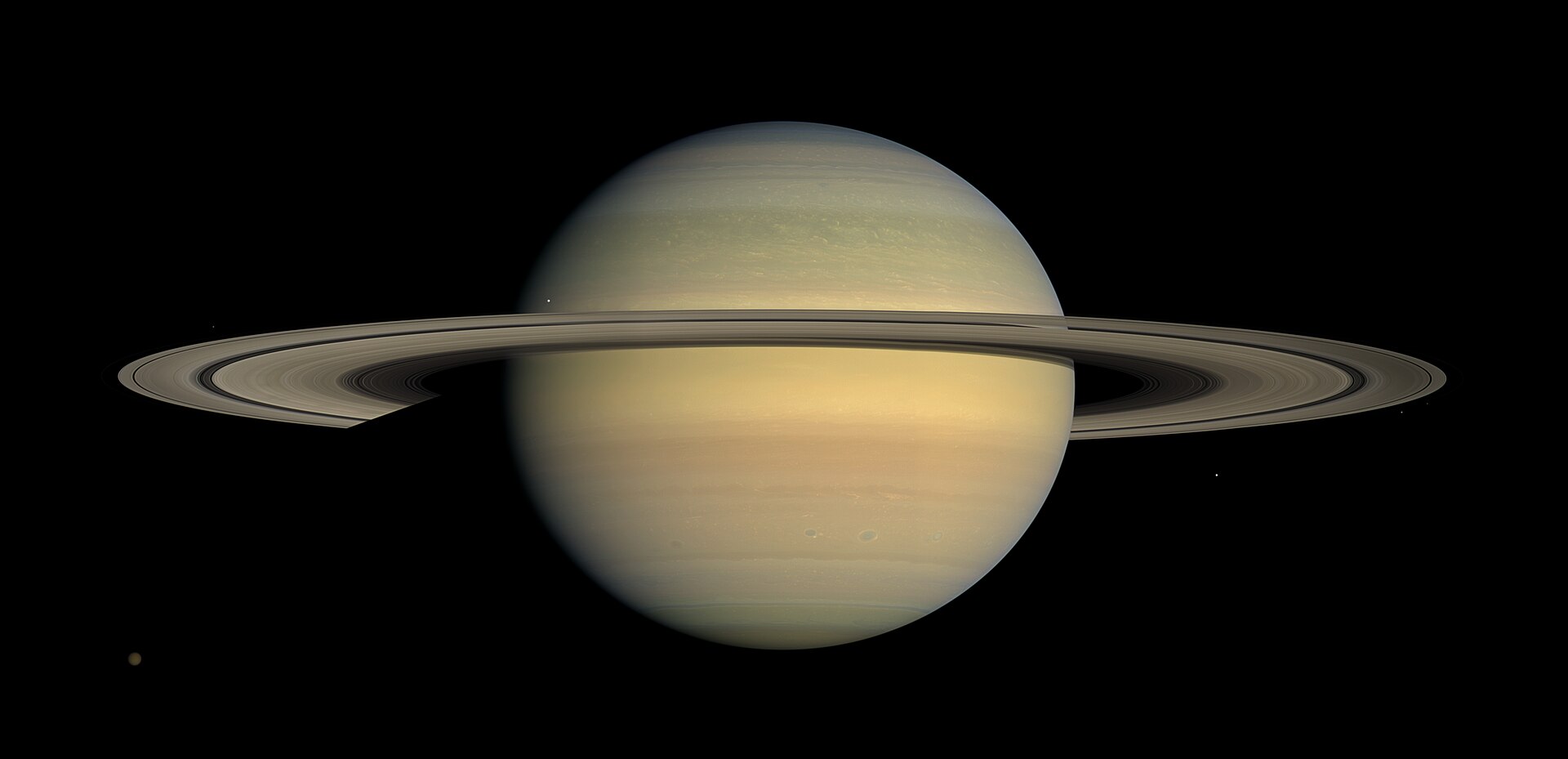
Rings are a trait of the giant planets rather than of Saturn alone: all four giants have them, and so does at least one asteroid.4 The pattern follows temperature and distance: small rocky worlds near the Sun, vast gaseous and icy worlds far beyond.1 The figures in the table are drawn from JPL's planetary physical parameters and Keplerian elements.83
Moons of the solar system
Naturally formed bodies that orbit planets are called moons, or planetary satellites.9 Moons come in many shapes, sizes and types.9 Hundreds of moons orbit planets, dwarf planets, asteroids and trans-Neptunian objects — the icy bodies beyond Neptune.9 Of the eight planets, Mercury and Venus are the only ones with no moons, although Venus does have a quasi-satellite that has officially been named Zoozve.1 Saturn has more moons than any other planet.9
The Moon makes Earth more livable by moderating its wobble.9 Its appearance shifts through the month — at times the entire face glows, at others only a thin crescent of light shows, and sometimes it seems to disappear — and these shifts are called moon phases.9 From lighting up our skies to maintaining a geological record of the solar system's history, the Moon plays a pivotal role in the study of our planet and the solar system.9
JPL's missions have brought dramatic and diverse discoveries, including volcanoes, canyons, geysers, colossal storms and evidence of liquid oceans on other worlds.10 So far, Earth is the only place in the solar system where life has been found.4
Dwarf planets and the reclassification of Pluto
Five dwarf planets are officially named; the first members were Ceres, Pluto and Eris.11 Pluto was long considered our ninth planet, but the International Astronomical Union reclassified it as a dwarf planet in 2006.12 The trigger lay at the edge of the solar system: a 2003 discovery, provisionally designated 2003 UB313, proved to be more massive than Pluto and to have a satellite of its own.11
(1) A "planet" [1] is a celestial body that (a) is in orbit around the Sun, (b) has sufficient mass for its self-gravity to overcome rigid body forces so that it assumes a hydrostatic equilibrium (nearly round) shape, and (c) has cleared the neighbourhood around its orbit.
IAU Resolution 5A, IAU General Assembly, Prague, 24 August 2006
(2) A "dwarf planet" is a celestial body that (a) is in orbit around the Sun, (b) has sufficient mass for its self-gravity to overcome rigid body forces so that it assumes a hydrostatic equilibrium (nearly round) shape [2] , (c) has not cleared the neighbourhood around its orbit
IAU Resolution 5A, IAU General Assembly, Prague, 24 August 2006
Pluto is a "dwarf planet" by the above definition and is recognized as the prototype of a new category of trans-Neptunian objects.
IAU Resolution 6A, IAU General Assembly, Prague, 24 August 2006
In a series of votes on 24 August 2006 at the IAU General Assembly in Prague, astronomers accepted a definition of 'planet' that excludes Pluto and relegates it, with at least two other objects, to 'dwarf planet' status.13 The vote on Resolution 6A, 'Definition of Pluto-class objects', passed with 237 votes in favour, 157 against and 17 abstentions.14 A rival Resolution 5B, 'Definition of Classical Planet', had 91 votes in favour but many more against, so no count was taken.14
The change reduced the solar system census from nine planets to eight.2 On 14 July 2015 NASA's New Horizons flew past Pluto, sending back imaging and spectroscopic data that dramatically changed knowledge of Pluto and its five-moon system.11 Its largest moon, Charon, is about half Pluto's size — the largest known moon relative to its parent planet — and the other moons are Styx, Nix, Kerberos and Hydra.12
Asteroids and comets: the small bodies
Asteroids, sometimes called minor planets, are rocky, airless remnants left over from the early formation of the solar system about 4.6 billion years ago.15 Most asteroids orbit the Sun between Mars and Jupiter, within the main asteroid belt.15 They range in size from Vesta — the largest, at about 329 miles (530 kilometres) in diameter — to bodies less than 33 feet (10 metres) across.15 The total mass of all the asteroids combined is less than that of Earth's Moon.15 NASA has sent several robotic spacecraft to study asteroids up close, while many others have been observed with telescopes here on Earth.15
Comets are cosmic snowballs of frozen gases, rock and dust that orbit the Sun; when frozen, they are the size of a small town.16 When a comet's orbit brings it close to the Sun, it heats up and spews dust and gases into a giant glowing head larger than most planets, and the dust and gases form a tail that stretches away from the Sun for millions of miles.16 There are likely billions of comets orbiting the Sun in the Kuiper Belt and the even more distant Oort Cloud.16
The first known interstellar object — 'Oumuamua — was discovered in 2017.16 The second was 2I/Borisov, discovered in 2019.16 Comet 3I/ATLAS — the third confirmed interstellar visitor — was discovered on 1 July 2025 by the NASA-funded ATLAS survey telescope in Chile.16
Beyond Neptune: the Kuiper Belt and the Oort Cloud
The Kuiper Belt is a doughnut-shaped region of icy objects beyond the orbit of Neptune.17 It is home to Pluto and most of the known dwarf planets, and to some comets.17 There may be millions of other icy worlds in the Kuiper Belt that were left over from the formation of the solar system.17 Only one spacecraft has visited it: NASA's New Horizons flew past Pluto in July 2015 and by Arrokoth on 1 January 2019.17
Scientists think the Oort Cloud is a giant spherical shell surrounding the Sun, the planets and the Kuiper Belt objects.18 It is like a big, thick bubble around the solar system, made of icy, comet-like objects.18 Its icy pieces — some bigger than mountains — orbit the Sun as far as 1.6 light-years away, and the shell extends from 5,000 to 100,000 astronomical units.1
Because it is so far away, NASA has no direct images of the Oort Cloud.18 The boundary where the solar wind is abruptly slowed by pressure from interstellar gases is called the termination shock, and it lies between 80 and 100 astronomical units from the Sun.1 Two NASA spacecraft launched in 1977 have crossed the termination shock: Voyager 1 in 2004 and Voyager 2 in 2007.1
Exploring the solar system
Spacecraft managed by JPL for NASA have visited every planet in our solar system.10 The run began when the JPL-built Mariner 2 spacecraft flew past Venus in 1962.10 More than 300 robotic spacecraft have left Earth's orbit, and 24 astronauts have travelled to the Moon.4
Built at JPL and launched in 1977, the twin Voyager spacecraft between them flew by and imaged Jupiter, Saturn, Uranus and Neptune.10 Voyager 1 went interstellar in 2012 and Voyager 2 joined it in 2018.1 They are the only spacecraft ever to operate outside the heliosphere, the Sun's protective bubble.1
From wandering stars to a system: how the picture changed
The word 'planet' originally described 'wanderers' that were known only as moving lights in the sky.14 In 1772 a German astronomer named Bode, of Berlin, drew attention to curious numerical relations between the distances of the planets — a 'law' that bears his name although Titius of Wittemberg discovered it first.19 The gap between Mars and Jupiter sent astronomers hunting for a missing planet, and on 1 January 1801 Piazzi, director of the Observatory at Palermo, noted an object in Taurus that moved from night to night — Ceres.19 Uranus was found in March 1781, when William Herschel noticed an object in Gemini whose apparent size grew under higher magnification — not a star, but a planet.19 Neptune followed, found by calculation in September 1846: Encke at Berlin directed his assistants D'Arrest and Galle to search for the predicted planet.19 Already in 1895, Chambers could report that the question of a planet farther off than Neptune had often been mooted, and that there did seem some evidence of it.19
By the term “Solar System” it is to be understood that an Astronomer, speaking from the standpoint of an inhabitant of the Earth, wishes to refer to that object, the Sun, which is to him the material and visible centre of life and heat and control, and also to those bodies dependent on the Sun which circulate round it at various distances, deriving their light and heat from the Sun, and known as planets and comets.
George Chambers, The Story of the Solar System, 1895
The following is an enumeration of the major planets in the order of their distances, reckoning from the Sun outwards:— 1. Mercury. 2. Venus. 3. The Earth. 4. Mars. 5. Jupiter. 6. Saturn. 7. Uranus. 8. Neptune.
George Chambers, The Story of the Solar System, 1895
Mapping and naming the worlds
The USGS Astrogeology Science Center is a national resource for the integration of planetary geoscience, cartography and remote sensing.20 Its mission is to serve the nation, the international planetary science community and the public in pursuit of new knowledge of the solar system.20 It released the first-ever comprehensive geologic map of the Moon.20
The naming side belongs to the International Astronomical Union — the group of astronomers that names objects in our solar system.2 Its vocabulary runs from planets and dwarf planets to the catch-all term for everything else orbiting the Sun that is not a satellite: 'Small Solar-System Bodies'.14 The Mars 2020 mission was guided by USGS Astrogeology maps.20
Timeline
Bode and Titius: a numerical 'law' of planetary distances
The Berlin astronomer Johann Elert Bode highlighted curious numerical relations between the distances of the planets — a pattern really discovered first by J. D. Titius of Wittemberg. The large gap it implied between Mars and Jupiter set astronomers hunting for a missing planet.
Herschel finds Uranus
On a certain evening in March 1781, William Herschel noticed an object in the constellation Gemini whose apparent size grew under higher magnification, proving it was not a star. Announced at first as a comet, the body was eventually recognised as a new planet — Uranus.
Piazzi discovers Ceres
Giuseppe Piazzi, director of the Observatory at Palermo, noted an 8th-magnitude object in Taurus that moved from night to night — the first asteroid, later named Ceres, found in the gap predicted by Bode's law.
Neptune found by calculation
Following the predictions of Urbain Le Verrier (and, independently, John Couch Adams), Encke at Berlin directed his assistants D'Arrest and Galle to search the sky; the following night showed the suspected object was moving — the trans-Uranian planet Neptune.
Chambers publishes The Story of the Solar System
George F. Chambers's popular survey described the Solar System as the Sun — 'the material and visible centre of life and heat and control' — with the bodies that circulate round it, and enumerated eight major planets from Mercury to Neptune.
Tombaugh discovers Pluto
At around 4pm on 18 February 1930 Clyde Tombaugh, an observing assistant at Lowell Observatory, compared two photographic plates of Gemini taken in January; a small object that flitted between them proved to be the long-sought Planet X — Pluto.
Mariner 2 flies past Venus
The JPL-built Mariner 2 flew past Venus, beginning a run in which spacecraft managed by JPL for NASA would visit every planet in the solar system.
The Voyagers launch
The twin Voyager spacecraft, built at JPL, were launched in 1977; between them they flew by and imaged Jupiter, Saturn, Uranus and Neptune, and they now rank among the most productive explorers ever flown.
The first object beyond Neptune is found after Pluto
David Jewitt and Jane Luu of the University of Hawaii discovered the first of what are now more than a thousand known objects orbiting beyond Neptune — the beginning of the trans-Neptunian landscape that would force astronomers to ask what a planet really is.
The IAU defines 'planet' and reclassifies Pluto
At the IAU General Assembly in Prague, members passed Resolution 5A, defining a planet as a body that orbits the Sun, is nearly round under its own gravity and has cleared its orbital neighbourhood. Resolution 6A made Pluto the prototype of the dwarf planets, and the planetary census fell from nine to eight.
Voyager 1 enters interstellar space
Voyager 1 crossed into interstellar space in 2012, six years before Voyager 2 followed in 2018 — the only spacecraft ever to operate outside the heliosphere, the Sun's protective bubble.
New Horizons flies past Pluto
NASA's New Horizons flew past Pluto, sending back imaging and spectroscopic data that dramatically changed knowledge of the dwarf planet and its system of five moons.
'Oumuamua: the first known interstellar visitor
The first known interstellar object, 'Oumuamua, was discovered in 2017; the second, comet 2I/Borisov, followed in 2019.
New Horizons flies by Arrokoth
New Horizons flew by the Kuiper Belt object later named Arrokoth — the second world, after Pluto, visited in the solar system's 'third zone'.
Solar Orbiter begins its mission
ESA's Solar Orbiter launched in February 2020 to study the Sun from closer than any spacecraft before; it returned its first images in July 2020 and later became the first mission to image the Sun's polar regions.
Comet 3I/ATLAS: a third interstellar visitor
The NASA-funded ATLAS survey telescope in Chile discovered comet 3I/ATLAS, the third confirmed interstellar object ever seen — it poses no threat to Earth and passed no closer than about the orbit of Mars.
Frequently Asked Questions
How many planets and dwarf planets does the solar system have?
It has eight planets: Mercury, Venus, Earth, Mars, Jupiter, Saturn, Uranus and Neptune.2 Five dwarf planets are officially recognised: Ceres, Pluto, Haumea, Makemake and Eris.2
How old is the solar system, and how did it form?
It formed about 4.6 billion years ago from a dense cloud of interstellar gas and dust.1 The cloud collapsed, possibly due to the shockwave of a nearby exploding star, and the Sun eventually amassed more than 99% of the available matter.1
How far from the Sun does the solar system reach?
One astronomical unit — the Sun–Earth distance — is about 93 million miles (150 million kilometres).1 The outermost known structure, the Oort Cloud, extends from 5,000 to 100,000 astronomical units, as far as 1.6 light-years from the Sun.1
Why was Pluto reclassified as a dwarf planet?
In 2006 the International Astronomical Union adopted a definition of 'planet' under which a planet must orbit the Sun, be nearly round under its own gravity and have cleared the neighbourhood around its orbit.14 Pluto has not cleared its orbital neighbourhood, so it was classified as a dwarf planet and recognised as the prototype of a new category of trans-Neptunian objects.14 The reclassification reduced the solar system census from nine planets to eight.2
Which planet is hottest, and which has the longest day?
Venus is the hottest planet, even though Mercury is closer to the Sun.1 Venus also has the longest planetary day, a retrograde sidereal rotation of −243.018 days that makes its day longer than its year; its orbit takes 0.61519726 years.8
What is the Kuiper Belt?
It is a doughnut-shaped region of icy objects beyond the orbit of Neptune, home to Pluto and most of the known dwarf planets and some comets.17 Only one spacecraft has visited it: NASA's New Horizons flew past Pluto in July 2015 and by Arrokoth on 1 January 2019.17
Where are the asteroids, and how big are they?
Most orbit the Sun between Mars and Jupiter, within the main asteroid belt.15 They range from Vesta, the largest at about 530 kilometres (329 miles) in diameter, down to bodies less than 10 metres (33 feet) across, and their combined mass is less than that of Earth's Moon.15
What have the Voyager spacecraft achieved?
Built at JPL and launched in 1977, the twin spacecraft between them flew by and imaged Jupiter, Saturn, Uranus and Neptune.10 Voyager 1 entered interstellar space in 2012 and Voyager 2 in 2018, making them the only spacecraft ever to operate outside the heliosphere.1
Knowledge Graph
Sources & citations
Every factual claim in this article is drawn from the sources below. Bracketed numbers in the text link to the corresponding source.
- 1
- 2
- 3
- 4
- 5
- 6
- 7
- 8
- 9
- 10
- 11
- 12
- 13
- 14
- 15
- 16
- 17
- 18
- 19
- 20