Pluto
The dwarf planet of the Kuiper Belt: its prediction and discovery, its icy surface and five moons, the 2006 reclassification, and the New Horizons flyby that revealed it.
Pluto is a dwarf planet in the Kuiper Belt, discovered by Clyde Tombaugh in 1930 at Lowell Observatory after Percival Lowell's search for a ninth planet, and reclassified by the International Astronomical Union in 2006. NASA's New Horizons flew through the Pluto system on 14 July 2015, revealing mountains, glaciers, haze and a complex world with five moons led by Charon, its near-equal binary partner. Pluto is the prototype of the dwarf planets and the best-known resident of the Kuiper Belt.
Overview
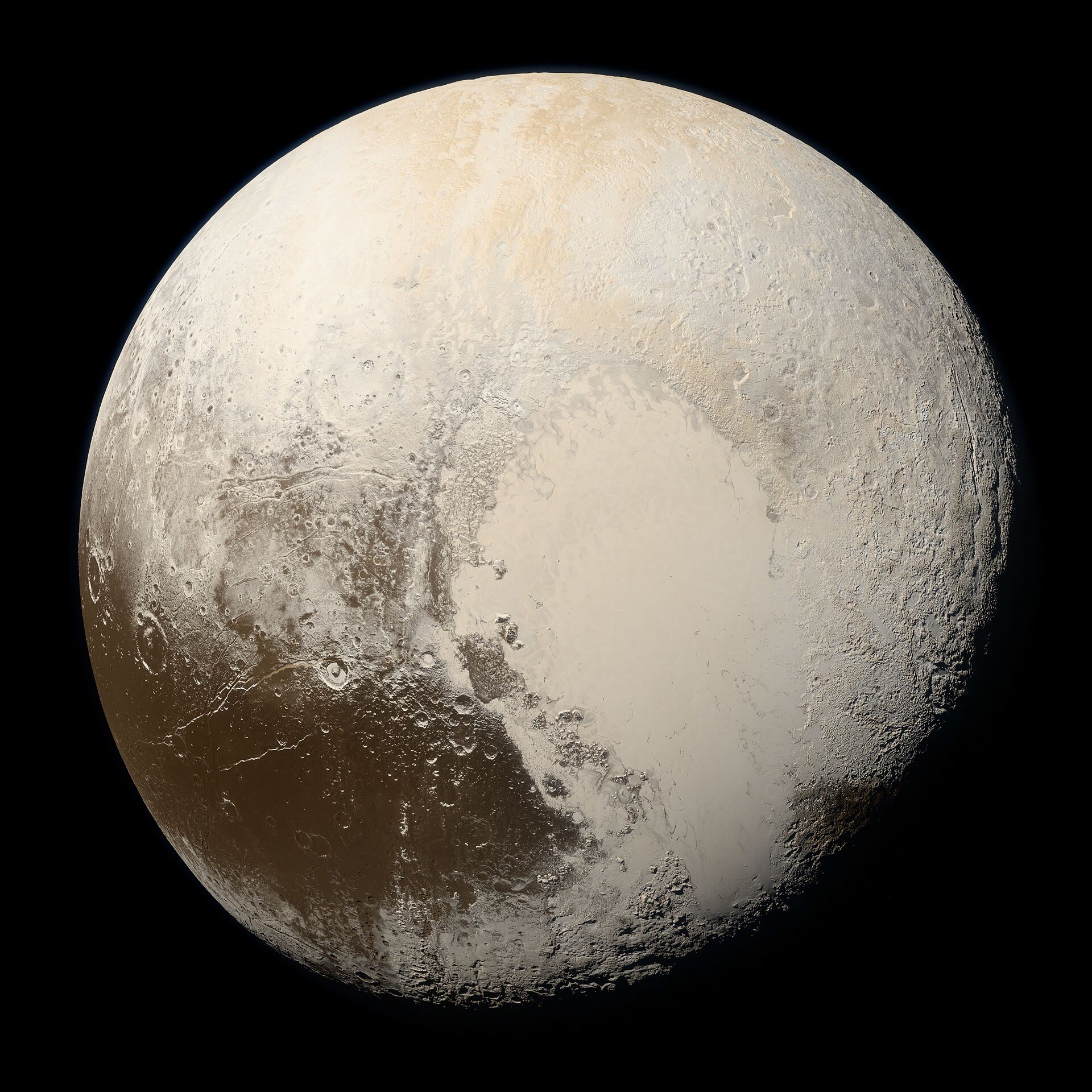
Pluto is a dwarf planet located in a distant region of the solar system beyond Neptune known as the Kuiper Belt. Pluto is about 5.5 times smaller than Earth.
Pluto is a complex and mysterious world with mountains, valleys, plains, craters, and glaciers.
1. Discovery and Naming
Pluto was discovered on 18 February 1930 by Clyde W. Tombaugh at Lowell Observatory in Flagstaff, Arizona. The search for Planet X had resumed in 1929 when the work was handed to Tombaugh, then twenty-three years old, who used a blink comparator to spot a moving object on photographic plates taken on January 23 and January 29 in 1930 from the Lowell Observatory. The discovery plates were taken only six days apart, and the object Tombaugh found had moved about 3 mm on the plates between the two exposures, indicating an orbital distance of about 40-43 AU, at about the right place to be the predicted planet. He captured wide-field images using 14 x 17 inch glass photographic plates that revealed Pluto's location among distant stars, and on February 18 in 1930 he found a tiny spot of light moving slowly against the fixed pattern of stars in the constellation Gemini. Tombaugh told Vesto Slipher he had found Planet X, and the Observatory announced the finding on March 13 in 1930; the announcement date matched the anniversary of Herschel's discovery of Uranus and Percival Lowell's birthday.
The new world was christened Pluto in 1930 on a name suggested by eleven-year-old Venetia Burney of Oxford, England, favored partly because its first two letters were the initials of Percival Lowell. The name was announced on May 1 in 1930 and she received five pounds as a reward.
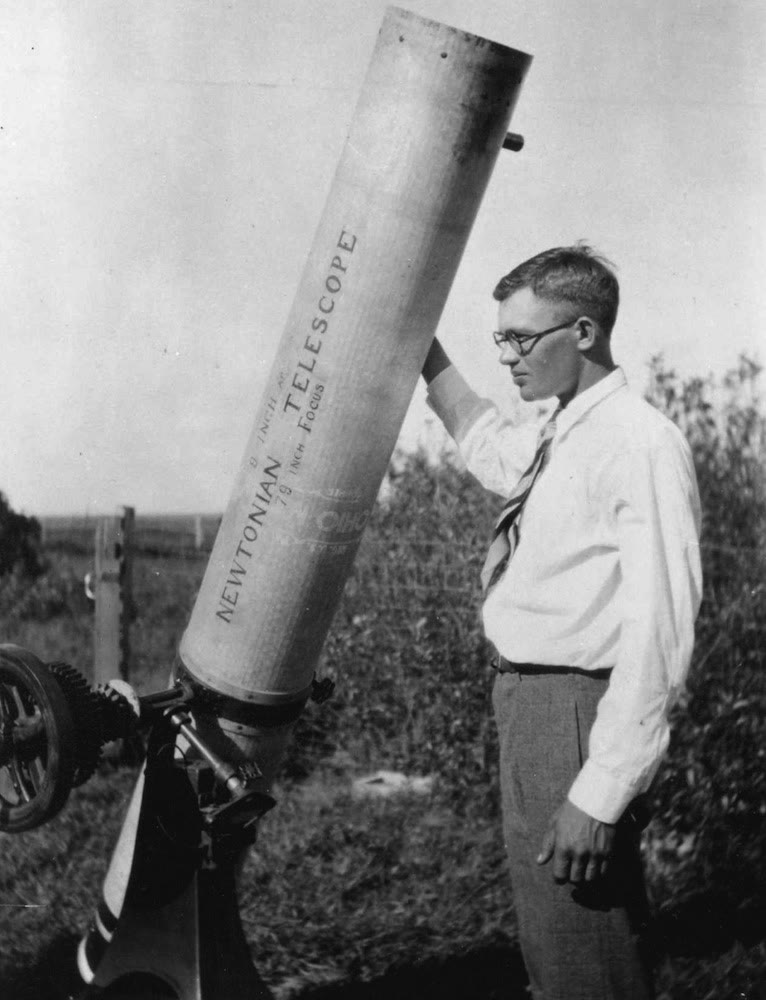
Sixteen pre-discovery photographs of Pluto are known, the oldest taken by Yerkes Observatory on 20 August 1909.
After the discovery Tombaugh received a scholarship to study astronomy at the University of Kansas; he began as a freshman in 1932 and worked in astronomy for many years.
2. Physical Characteristics
Pluto's diameter is about 1,477 miles (2,377 kilometers), making it roughly two-thirds the diameter of Earth's Moon. Its mass is about one-sixth that of Earth's Moon. The body probably has a rocky core surrounded by a mantle of water ice.
Surface temperatures on Pluto range from -375 to -400 degrees Fahrenheit (-226 to -240 degrees Celsius). The dwarf planet is very bright, with an average reflectivity of 0.5 compared with only about 10% for Earth's Moon.
Pluto's tallest mountains stand 6,500 to 9,800 feet (2 to 3 kilometers) high and are big blocks of water ice, sometimes coated with frozen gases such as methane. The most prominent plains appear to be made of frozen nitrogen and show no craters, with structures suggesting convection of material. Sputnik Planitia is a vast frozen nitrogen glacier larger than the U.S. states of Texas and Oklahoma combined. An analysis of New Horizons imagery from the 2015 encounter found evidence that liquid nitrogen is rising to Pluto's surface through cracks at the northern edge of Sputnik Planitia, the first evidence of recently flowing liquid on Pluto.
3. Orbit and Rotation
Pluto travels the Sun on an orbit that is both elliptical and tilted, completing one circuit in 248 years. Its mean distance from the Sun is about 3.7 billion miles (5.9 billion kilometers), or 39 AU, but the oval-shaped path carries it as far out as 49.3 astronomical units and as close in as 30 AU. The orbit is inclined by 17.14 degrees with respect to the ecliptic, the highest inclination of any planet in the solar system. Pluto and Neptune never come very close to each other because their orbits are held in an exact resonance: Pluto orbits the Sun twice for every three orbits of Neptune.
From 1979 to 1999 Pluto was near perihelion and was actually closer to the Sun than Neptune. One day on Pluto takes about 153 hours, and its axis is tilted 57 degrees with respect to the plane of its orbit, so it spins almost on its side, with a retrograde rotation from east to west.
4. Moons
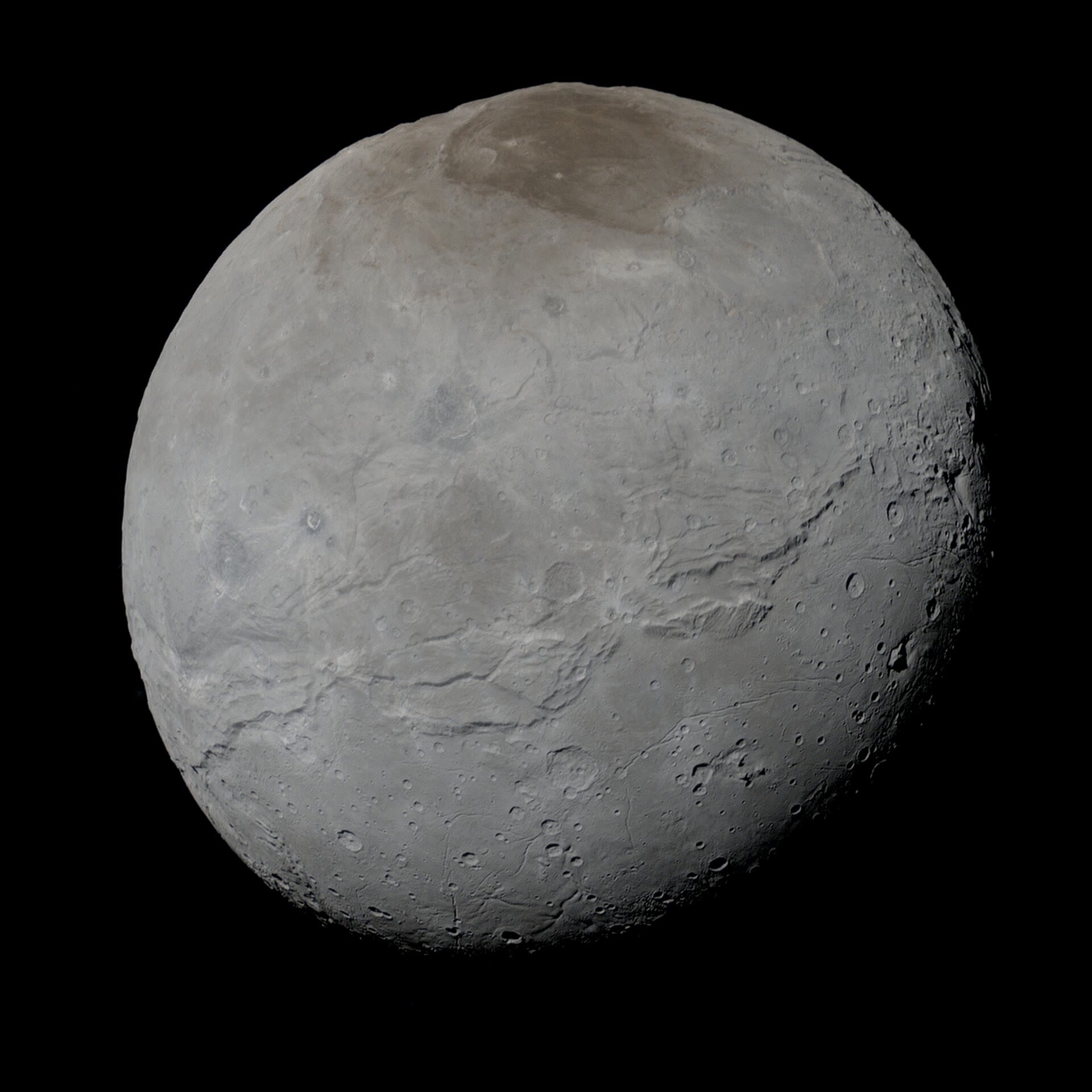
Pluto has five moons: Charon, Nix, Hydra, Kerberos and Styx. Charon is the largest of them, measuring 754 miles (1,214 kilometers) across. At about half the size of Pluto, it is the largest known satellite relative to its parent body in the solar system, and the two are often called a double planet. The same surfaces of Charon and Pluto always face each other in mutual tidal locking, and Charon orbits Pluto every 6.4 Earth days.
Charon was discovered in June 1978 by James Christy and Robert Harrington at the U.S. Naval Observatory in Flagstaff, Arizona, about six miles from where Pluto was discovered. Christy noticed that images of Pluto were strangely elongated, with the direction of elongation cycling back and forth over 6.39 days, Pluto's rotation period. He proposed the name Charon for the mythological ferryman of the underworld, also choosing it because its first four letters matched the name of his wife, Charlene.
Nix and Hydra were discovered in June 2005 by a large team led by New Horizons science team members Hal Weaver and Alan Stern using the Hubble Space Telescope. Kerberos was discovered on June 28 in 2011 by a large team led by Mark Showalter, while astronomers searched for rings around Pluto with the Hubble Space Telescope. Styx, Pluto's fifth moon, was uncovered on June 26 in 2012 by a Showalter-led Hubble team searching for potential hazards for the New Horizons flyby. The IAU approved the names Kerberos and Styx in 2013 following an unprecedented internet vote held in February 2012 that received almost 500,000 votes, including 30,000 write-in suggestions.
5. Atmosphere
Pluto's atmosphere is thin and tenuous, composed mainly of molecular nitrogen, with methane and carbon monoxide also present. It behaves in a manner resembling a comet's, expanding as the dwarf planet draws closer to the Sun and collapsing as it moves farther away. Its density is roughly 100,000 times smaller than that of Earth's atmosphere, and it could freeze out onto the surface as Pluto recedes from the Sun.
Looking back at Pluto on departure, New Horizons discovered multiple haze layers wrapping completely around the planet and extending over several hundred kilometers in height.
6. Exploration
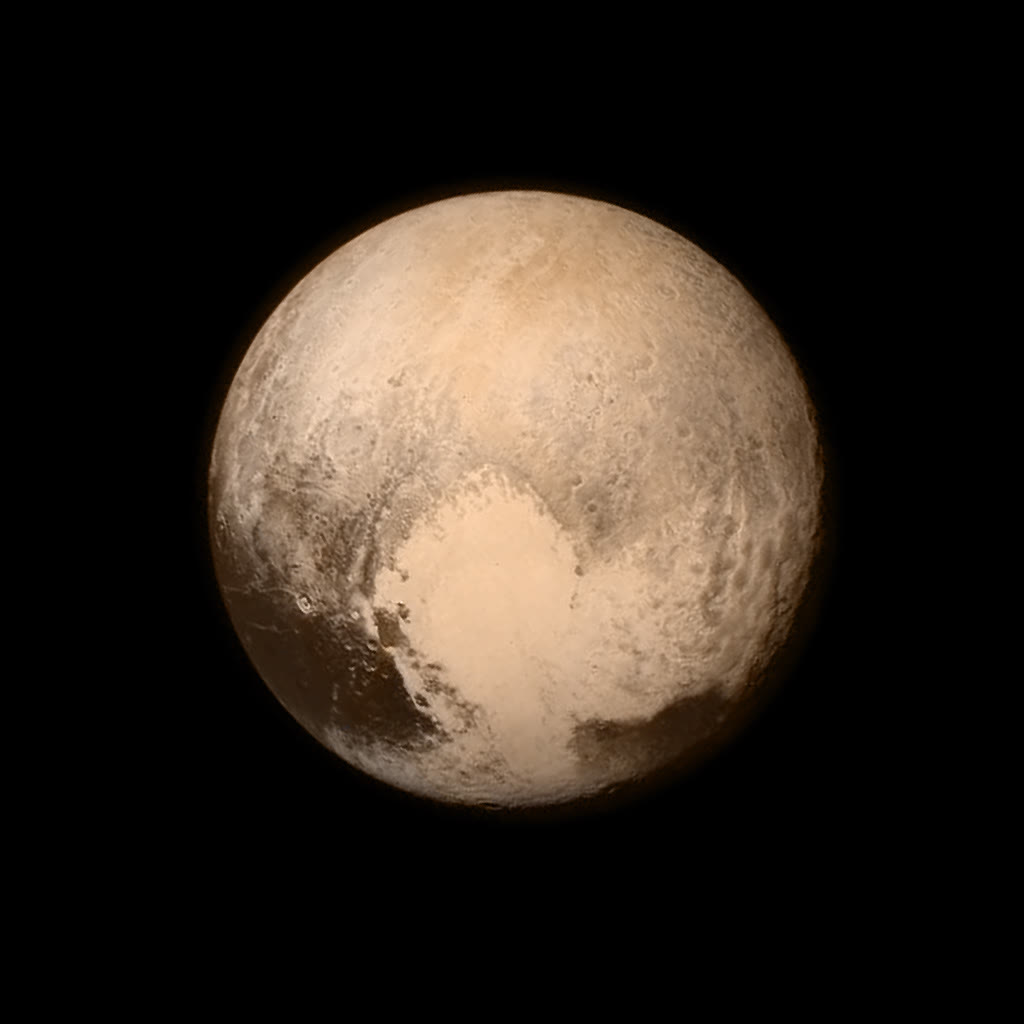
NASA's New Horizons was the first spacecraft to explore Pluto up close, flying by the dwarf planet and its moons on 14 July 2015. It was the first and so far the only mission to Pluto, and the first to explore the Kuiper Belt, the solar system's third zone. The spacecraft launched in January 2006 and received a gravity assist from Jupiter in February 2007. That Jupiter encounter increased the spacecraft's velocity by about 9,000 miles per hour (14,000 kilometers per hour), shortening its trip to Pluto by three years.
At closest approach New Horizons came about 7,750 miles (12,500 kilometers) from Pluto and about 17,900 miles (28,800 kilometers) from Charon. In early 2019 the mission flew past Arrokoth, the most distant object ever explored up close. Pluto and Charon form a binary planet, and although binary planets are thought to be common in the galaxy, no spacecraft had explored one until New Horizons visited the Pluto-Charon system during its 2015 flyby.
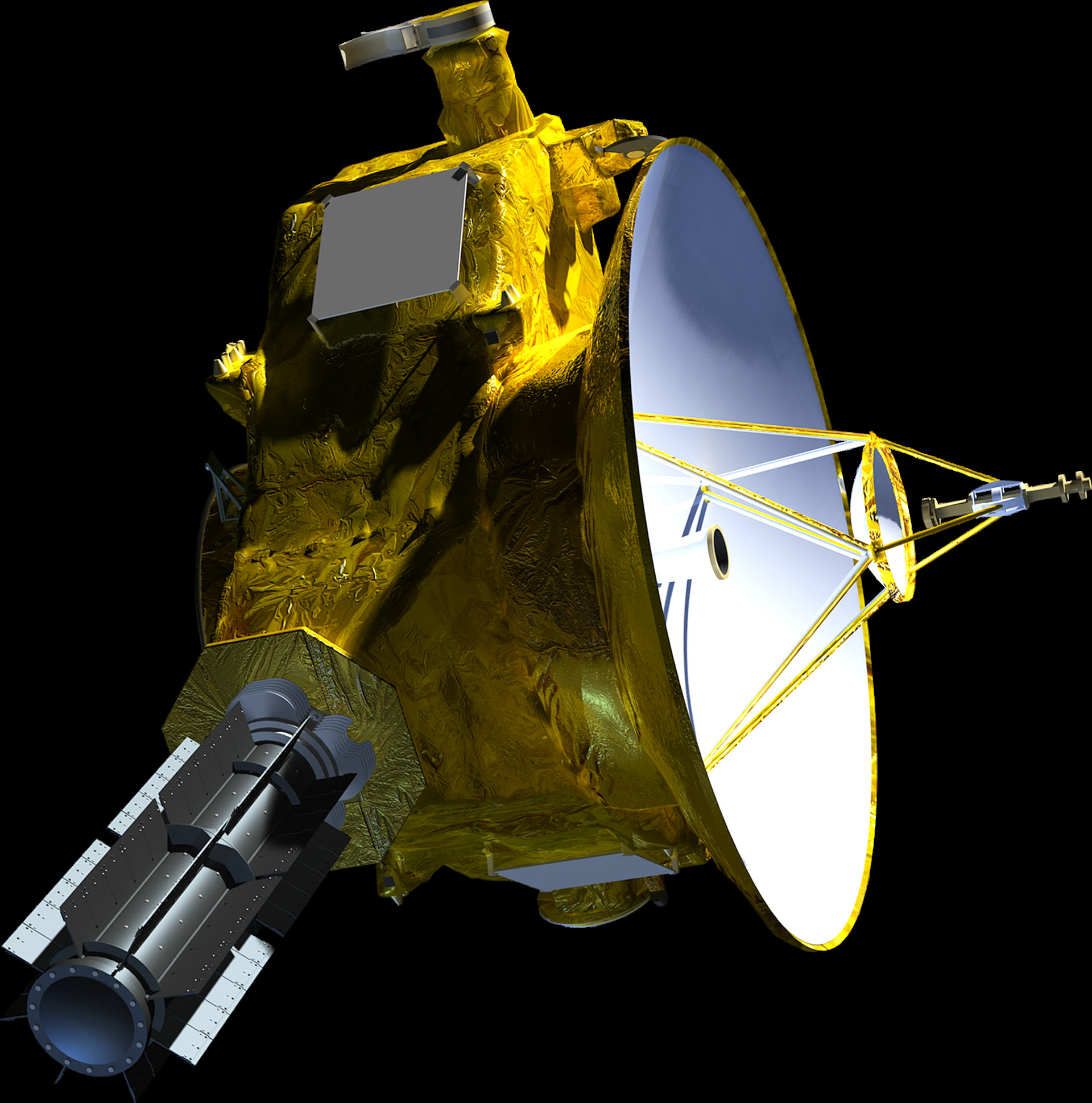
New Horizons revealed Pluto to be a geologically and meteorologically active world, and it remains the physically largest world in the Kuiper Belt. Charon's surface is dominated by water ice and has no atmosphere, and New Horizons also confirmed ammonia ice across much of the surface.
7. Classification
The International Astronomical Union defines a dwarf planet as a celestial body orbiting the Sun with enough mass for hydrostatic equilibrium that has not cleared its orbital neighbourhood and is not a satellite. Pluto was long considered the ninth planet, but in 2006 the IAU reclassified it as a dwarf planet. It failed one of the three criteria for a full-sized planet, having not cleared its neighbouring region of other objects, and it was reclassified because it lies in the Trans-Neptunian region where other objects might cross its orbital path. The IAU explains that after a vigorous debate the first draft of the planet definition was presented at the XXV General Assembly in Prague, and Pluto was found not to meet the criteria, so it is a dwarf planet. In August 2006 the downgrade left the rocky inner worlds and the giant planets as the only planets, so the Solar System has eight planets instead of nine. Resolution 6A was passed with 237 votes in favour, 157 against and 17 abstentions, while Resolution 6B on the name of the category had 183 votes in favour and 186 against.
An IAU draft resolution in 2006 would have kept Pluto a planet and enlarged the Solar System to 12 planets, adding Ceres, Charon and 2003 UB313 while keeping Pluto the prototype of a new category of plutons. A Planet Definition Committee of seven astronomers, writers and historians formed by the IAU Executive Committee reached unanimous consensus in July 2006 on a proposed new definition of planet. Resolution 6A declares Pluto a dwarf planet by the IAU definition and recognizes it as the prototype of a new category of trans-Neptunian objects. The first members of the dwarf planet category were Ceres, Pluto and the object 2003 UB313 that was later named Eris.
8. Cultural and Historical Context
The discovery of Pluto in early 1930 was made by a farm boy from Kansas with no formal training in astronomy, and the announcement that March excited both scientists and the public.
He died in 1997 without seeing Pluto demoted to dwarf planet status. Tombaugh lived to within three weeks of his 91st birthday and died on January 17 in 1997 in Las Cruces, New Mexico.
9. Timeline
-
20 August 1909Earliest known pre-discovery photographThe oldest of sixteen known pre-discovery photographs of Pluto was taken by Yerkes Observatory.5Why is Pluto no longer a planet? · Library of Congress ↗
-
18 February 1930Discovery
-
1 May 1930Name announcedThe name Pluto was announced.5
-
June 1978Charon discovered
-
1979–1999Near perihelionPluto was near perihelion and was actually closer to the Sun than Neptune.3Pluto: Facts · NASA Science ↗
-
June 2005Nix and Hydra discoveredA large team led by New Horizons science team members Hal Weaver and Alan Stern discovered Nix and Hydra using the Hubble Space Telescope.2The Pluto System · Johns Hopkins University Applied Physics Laboratory (New Horizons) ↗
-
January 2006New Horizons launchedNew Horizons blasted off from Cape Canaveral.19The Year of Pluto · Lowell Observatory ↗
-
2006ReclassificationThe IAU reclassified Pluto from planet to dwarf planet.1Pluto · NASA Science ↗
-
February 2007Jupiter gravity assistNew Horizons received a gravity assist from Jupiter.13New Horizons · NASA Science ↗
-
28 June 2011Kerberos discoveredA large team led by Mark Showalter discovered Kerberos while astronomers searched for rings around Pluto with the Hubble Space Telescope.2
-
26 June 2012Styx discoveredA Showalter-led Hubble team searching for potential hazards for the New Horizons flyby uncovered Styx, Pluto's fifth moon.2
-
2013Moon names approvedThe IAU approved the names Kerberos and Styx following an unprecedented internet vote held in February 2012 that received almost 500,000 votes, including 30,000 write-in suggestions.2
-
14 July 2015New Horizons flyby
-
Early 2019Arrokoth flybyNew Horizons flew past Arrokoth, the most distant object ever explored up close.13
10. Timeline: from the search for Planet X to New Horizons
- February 4, 1906Clyde Tombaugh is bornClyde W. Tombaugh is born in Illinois and grows up on a Kansas farm, where he becomes an amateur astronomer and telescope builder.
- 1916Percival Lowell dies without finding Planet XLowell, who had searched for a ninth planet beyond Neptune since 1906 and funded searches at his Flagstaff observatory, dies with the planet undiscovered; years later the search is resumed.
- January 29, 1929Tombaugh arrives at Lowell ObservatoryHired by director V. M. Slipher on the strength of his planetary sketches, Tombaugh arrives in Flagstaff to carry out the photographic search for Planet X with the new 13-inch telescope.
- February 18, 1930Tombaugh discovers PlutoWhile examining photographic plates with a blink comparator, Tombaugh spots a tiny moving speck in Gemini; the discovery plates were taken on January 23 and 29.
- March 13, 1930The discovery is announcedLowell Observatory announces the discovery, timing the announcement to the anniversary of Herschel's discovery of Uranus and Percival Lowell's birthday.
- June 1978Charon is discoveredJames Christy and Robert Harrington discover Charon at the U.S. Naval Observatory in Flagstaff after noticing that Pluto's image appeared repeatedly elongated.
- 1992The first Kuiper Belt object beyond Pluto is foundDave Jewitt and Jane Luu discover 1992QB1 about 40 AU from the Sun; more than 3,100 further objects with orbits beyond Neptune have since been found.
- June 2005Nix and Hydra are discoveredA team led by Hal Weaver and Alan Stern finds the moons Nix and Hydra with the Hubble Space Telescope.
- January 19, 2006New Horizons launchesNASA's New Horizons spacecraft lifts off from Cape Canaveral on a journey of more than nine years and over three billion miles to Pluto.
- August 24, 2006The IAU reclassifies PlutoAt the General Assembly in Prague, IAU members pass Resolution 6A declaring Pluto a dwarf planet and the prototype of a new category of trans-Neptunian objects.
- June 28, 2011Kerberos is discoveredAstronomers using the Hubble Space Telescope spot Kerberos, Pluto's fourth moon, while searching for rings around the dwarf planet.
- June 26, 2012Styx is discoveredA Showalter-led Hubble team uncovers Styx, Pluto's fifth moon, while checking for hazards for the coming New Horizons flyby.
- July 14, 2015New Horizons flies through the Pluto systemNew Horizons comes about 7,750 miles (12,500 kilometers) from Pluto and about 17,900 miles (28,800 kilometers) from Charon, returning the first close-up images of the system.
- January 1, 2019New Horizons visits ArrokothThe spacecraft flies past the Kuiper Belt object Arrokoth (2014 MU69), the most distant object ever explored up close.
References (19)
- 1Pluto — NASA Science Web↩View source
- 2The Pluto System — Johns Hopkins University Applied Physics Laboratory (New Horizons) Web↩View source
- 3Pluto: Facts — NASA Science Web↩View source
- 4About Clyde Tombaugh — Johns Hopkins University Applied Physics Laboratory (New Horizons) WebView source
- 5Why is Pluto no longer a planet? — Library of Congress Web↩View source
- 6March 13, 1930: Clyde Tombaugh's discovery of Pluto announced — American Physical Society (APS News) 1930 WebView source
- 7Pluto Discovery Telescope — Lowell Observatory WebView source
- 8About the Kuiper Belt — Johns Hopkins University Applied Physics Laboratory (New Horizons) WebView source
- 9NASA's New Horizons Finds Evidence of Recent Liquid on Pluto's Surface — NASA Science 2026 WebView source
- 10Pluto Moons: Facts — NASA Science WebView source
- 11Charon — NASA Science WebView source
- 12The Path to Pluto and Arrokoth — Johns Hopkins University Applied Physics Laboratory (New Horizons) Web↩View source
- 13New Horizons — NASA Science Web↩View source
- 14Pluto: Exploration — NASA Science WebView source
- 15Why Pluto? — Johns Hopkins University Applied Physics Laboratory (New Horizons) WebView source
- 16IAU 2006 General Assembly: Result of the IAU Resolution votes — International Astronomical Union 2006 WebView source
- 17Frequently Asked Questions (FAQs) — International Astronomical Union WebView source
- 18The IAU draft definition of "planet" and "plutons" — International Astronomical Union WebView source
- 19The Year of Pluto — Lowell Observatory Web↩View source