Uranus
The seventh planet from the Sun — the sideways ice giant discovered by William Herschel in 1781, visited once by Voyager 2, and ringed by 13 faint rings and a system of literary moons.
Uranus is the seventh planet from the Sun and one of the solar system's two ice giants. Discovered by William Herschel in 1781 — the first planet found with a telescope — it orbits tipped on its side at a tilt of about 98 degrees, giving it the most extreme seasons of any planet. Voyager 2 remains the only spacecraft to have visited it, during a six-hour flyby in 1986 that revealed 13 rings, new moons and a strangely tilted magnetic field.
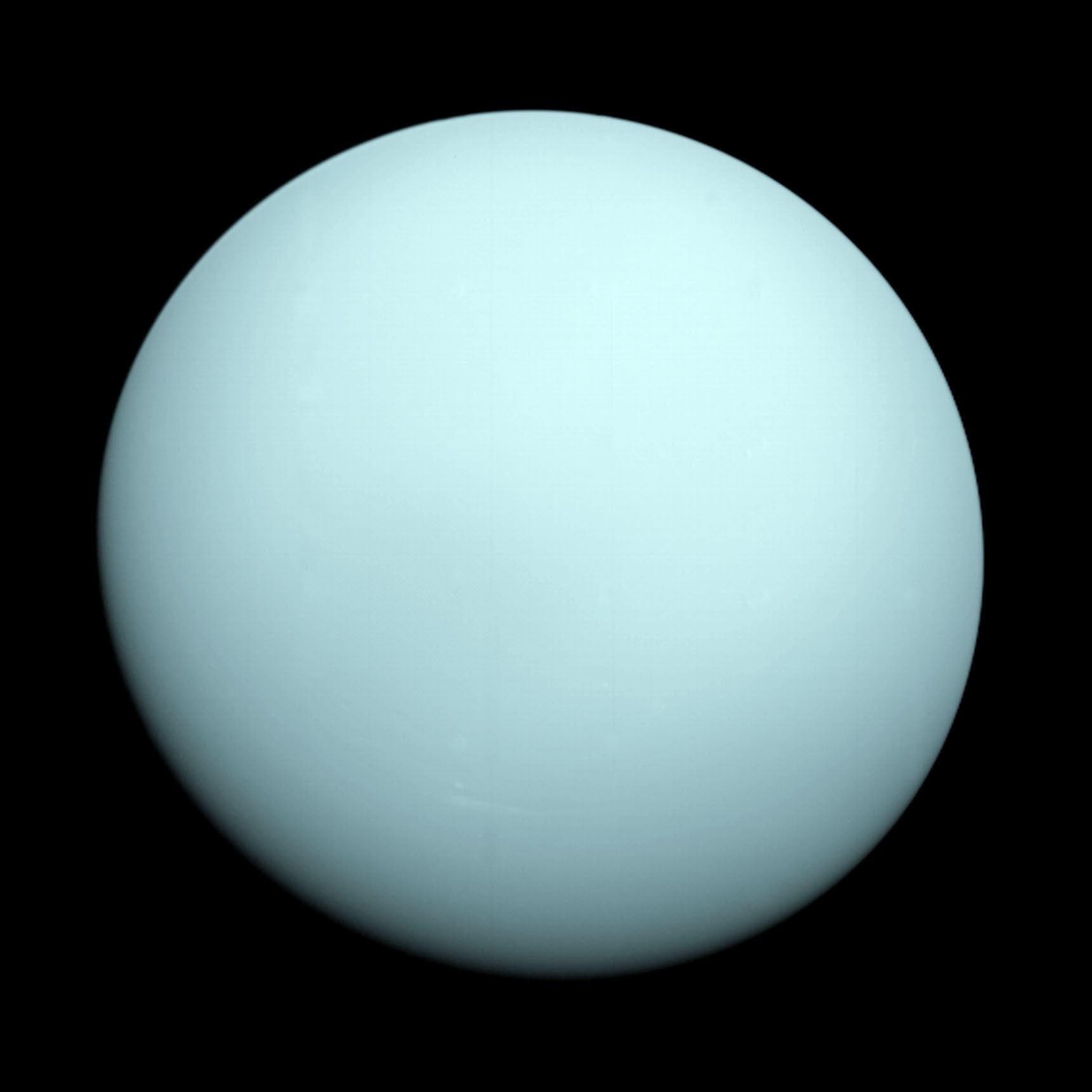
Overview
Uranus is the seventh planet from the Sun and the third largest planet in our solar system, about four times wider than Earth. It is one of the two ice giants of the outer solar system, the other being Neptune. At its brightest it is just visible to the unaided eye as a blue-green point of light.
1. Discovery and Naming
Until 1781 the known solar system consisted of six planets, and on March 13 of that year the astronomer William Herschel observed a faint object in the constellation Gemini and noted that it moved slowly relative to the background stars. Slightly before midnight on 13 March 1781, in his back garden in Bath, the German-born musician and astronomer saw a strange object in the eyepiece of his homemade telescope. It took the resolving power of his newly built 6.2 inch reflecting telescope to see the object as a disc rather than a point-like star after it had wandered into Gemini. Uranus was thus the first planet found with the aid of a telescope, discovered in 1781 by Herschel, who originally thought it was either a comet or a star.
Herschel first thought the object was a comet, but he later correctly identified it as a distant planet and wanted to name it after the monarch of his adopted United Kingdom. As discoverer he held the naming rights, and in honour of King George III he called the new planet Georgium sidus, Latin for George's Star. The Royal Society archive holds his paper of a comet seen on 13 March 1781, in which he misidentifies the object as a comet throughout despite noting similarities with the characteristics of a planet. He notified the Astronomer Royal, Nevil Maskelyne, of his discovery and received a flummoxed reply on 23 April 1781 asking what to call it and noting that no coma or tail had yet been seen.
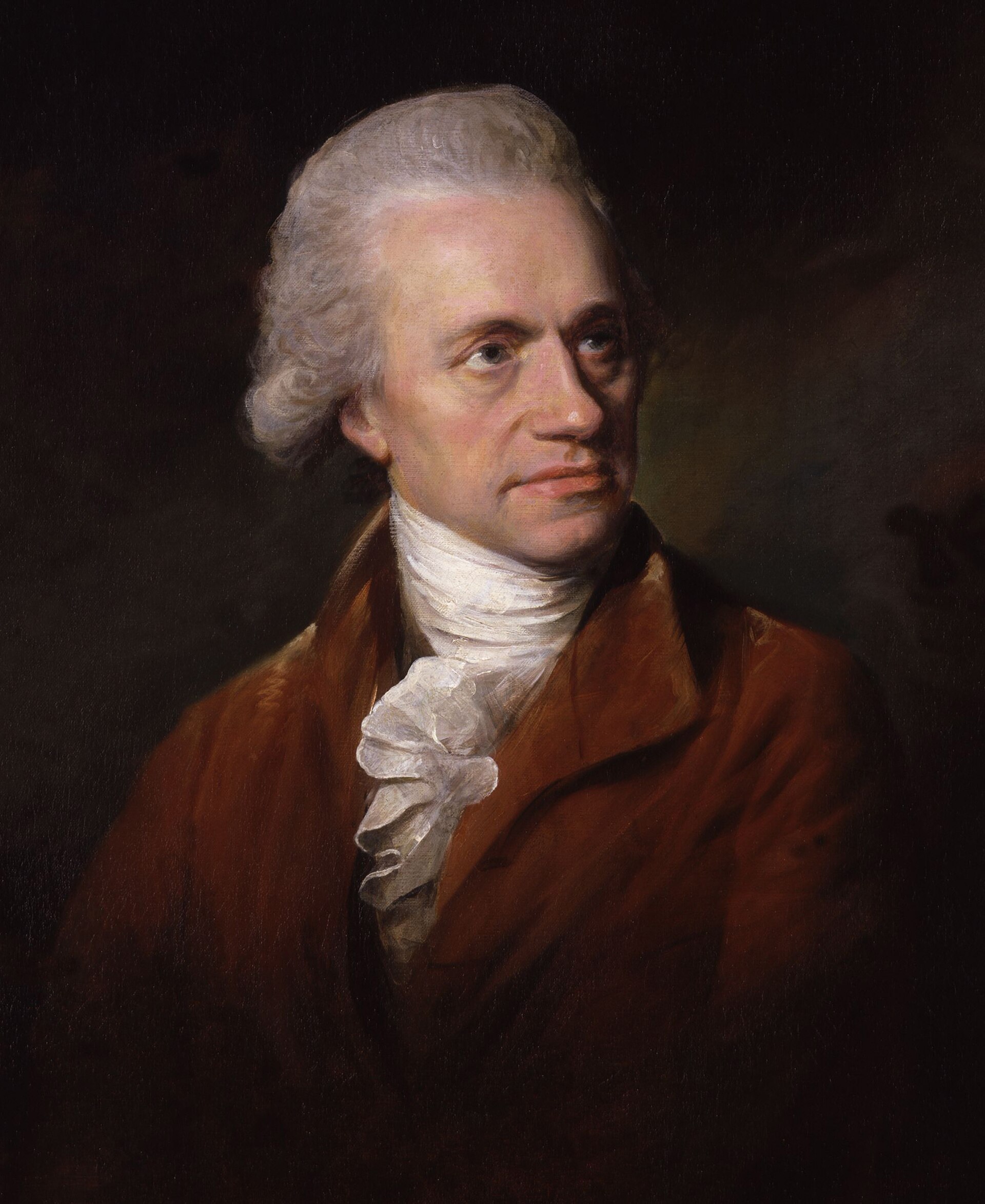
Astronomers in other countries disliked a planet named after the British monarch and instead suggested Uranus, the Greek god of the sky, who in Greek mythology is the father of Cronus and the grandfather of Zeus. The name Uranus was suggested by Johann Bode in 1782; he argued that Georgium did not follow the pattern of the other planet names and that Uranus, the Greek god of the sky, was more appropriate. The Astronomer Royal Nevil Maskelyne first proposed that the object was a planet, and astronomers across Europe confirmed it; the account was read to the Royal Society on 26 April 1781 in London.
The object was universally accepted as a new planet two years later, in part because of observations by the astronomer Johann Elert Bode. Bode described Herschel's discovery as a moving star that could be deemed a hitherto unknown planet-like object circulating beyond the orbit of Saturn, and concluded that its near-circular orbit was more like a planet's than a comet's. Consensus on the name of the planet was not reached until almost 70 years after its discovery.
Uranus is named for the personification of heaven and the son and husband of Gaea in Greek mythology.
2. Pre-discovery Observations
Long before Uranus was recognised as a planet, it had already entered the record as an ordinary star. By 1690 John Flamsteed's growing catalogue of fixed stars included a faint object he called 34 Tauri, observed again by Flamsteed in later years and by his successor James Bradley between 1748 and 1753 without anyone noticing that it had moved across the sky. Uranus is the first planet discovered that had not been recognised in prehistoric times, though it had been seen through telescopes several times over the previous century and dismissed as another star.
3. Physical Characteristics
Most of the mass of Uranus — 80 percent or more — is a hot dense fluid of icy materials above a small rocky core, where temperatures near the core reach about 9,000 degrees Fahrenheit (4,982 degrees Celsius) 2Uranus: Facts · NASA Science ↗. The planet also has very low internal heat compared to other giant planets 7Uranus · Wikipedia ↗.
| Property | Value | Source |
|---|---|---|
| Equatorial diameter | 31,763 miles (51,118 km); about four times wider than Earth | nasa-uranus-facts |
| Mass | 8.681 × 10^25 kg; the least massive of the four giant planets | britannica-uranus |
| Escape velocity | 21.3 km/sec | britannica-uranus |
| Rotation period | 17 hr 14 min (retrograde) | britannica-uranus |
| Orbital period | 84 Earth years (30,687 Earth days) | nasa-uranus-facts |
| Mean distance from Sun | 1.8 billion miles (2.9 billion km), about 19 astronomical units | nasa-uranus-facts |
| Minimum temperature | 49 K (−224.2 °C), colder than Neptune in some places | nasa-uranus-facts |
| Wind speeds | Up to 560 miles per hour (900 km/h) | nasa-uranus-facts |
4. Orbit, Rotation, and Seasons
Uranus rotates at a nearly 90-degree angle from the plane of its orbit, and this unique tilt makes the planet appear to spin sideways, orbiting the Sun like a rolling ball. The planet's axial tilt is 97.77° to its orbit.
The extreme tilt may be the result of a collision with an Earth-sized object long ago.
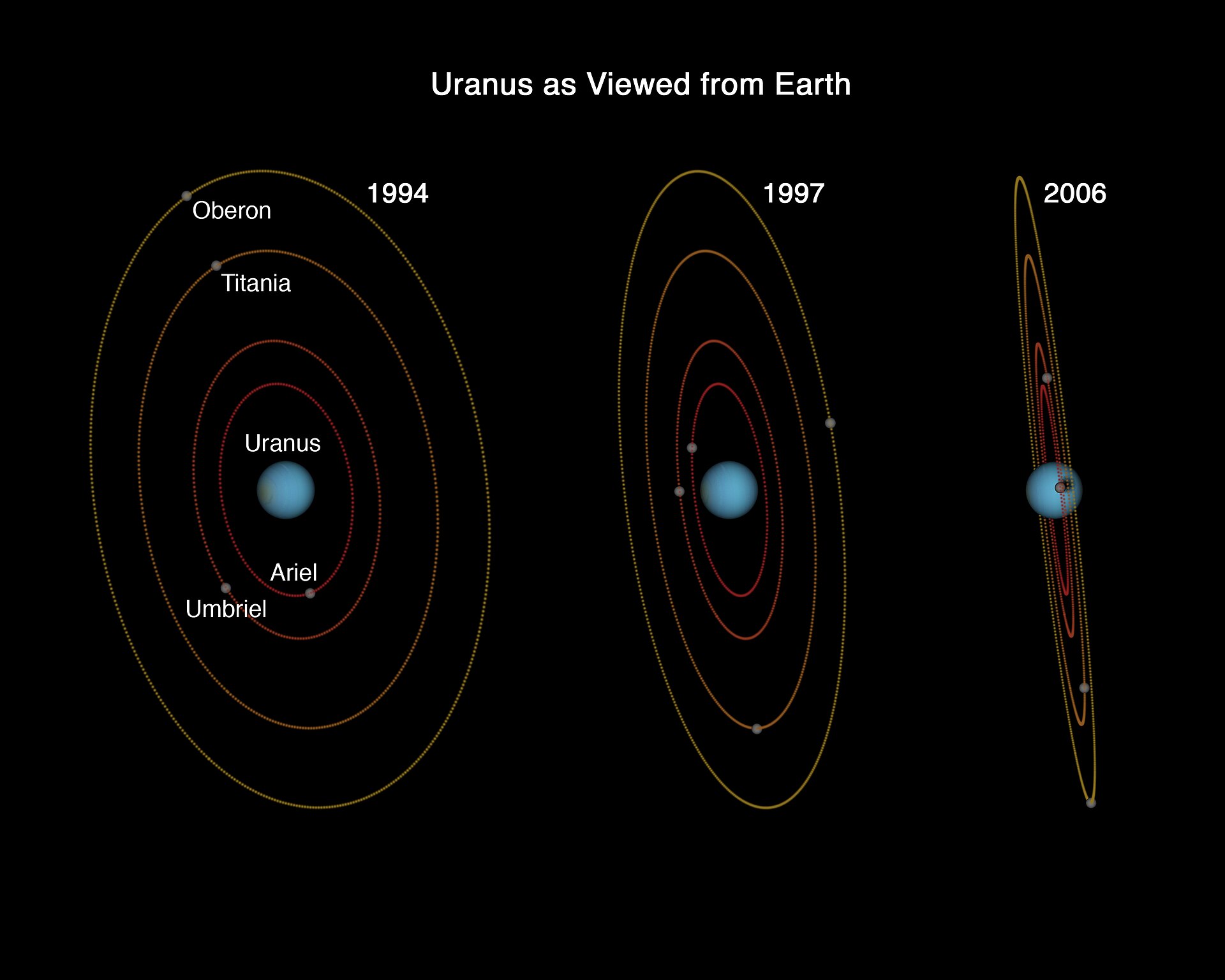
Uranus has an 84-year orbital period, so its poles alternate between 42 years of sunlight and 42 years of darkness, providing the largest fractional seasonal forcing of any planet in our solar system.
Uranus reached equinox in December 2007: the planet is fully illuminated as the Sun passes over its equator; the equinox also brings a ring-plane crossing, in which the rings appear edge-on from Earth and then widen again.
5. Atmosphere and Interior
Uranus' atmosphere is mostly hydrogen and helium, with a small amount of methane and traces of water and ammonia. Scientists determined that the atmosphere is 85 percent hydrogen and 15 percent helium. The planet's blue-green color comes from methane gas in the atmosphere, which absorbs the red portion of sunlight.
Evidence has been found of a boiling ocean about 500 miles (800 kilometers) below the cloud tops.
Uranus' atmosphere is the coldest known in our solar system, even colder than Neptune in some places, and is so cold even though it is not the farthest from the Sun because it has no internal heat source.
Winds are retrograde at the equator, blowing in the reverse direction of the planet's rotation, but closer to the poles they shift to a prograde direction, flowing with the rotation. The atmospheric circulation is characterized by one prograde jet in each hemisphere, with maximum speeds of about 250 m/s, and a retrograde jet at the equator.
A Hubble study spanning two decades observed Uranus four times and found that methane is not uniformly distributed, being strongly depleted near the poles. The same study found that the aerosol and haze structure of Uranus changed dramatically, with the northern polar region brightening significantly as the planet heads toward a 2030 summer solstice. A polar cap seems to appear when the pole enters direct sunlight in the summer and vanishes in the fall, and Webb revealed a surprising subtle enhanced brightening at the center of the cap.
The first definitive images of a dark spot on Uranus were taken with NASA's Hubble Space Telescope by a team led by Lawrence Sromovsky; the elongated feature measures 1,100 miles by 1,900 miles (1,700 kilometers by 3,000 kilometers).
6. Formation and Evolution
Uranus took shape about 4.5 billion years ago, when gravity drew swirling gas and dust together into a single body. Like its neighbour Neptune, it likely formed closer to the Sun and only later moved outward to the outer solar system, a migration that occurred about 4 billion years ago.
The cause of the planet's extreme tilt is not known with certainty. One possibility is that a large world crashed into Uranus long ago; another is that a larger, earlier ring system set the planet wobbling until it tipped over.
7. Magnetic Field and Magnetosphere
Uranus possesses an unusual, irregularly shaped magnetosphere: its magnetic field is defined by an axis tilted 58.6° from the rotation axis and offset 0.31 of the planet's radius. This configuration is unlike any previously observed planetary magnetic field. The magnetosphere tail behind Uranus extends into space for millions of miles, its magnetic field lines twisted by the planet's sideways rotation into a long corkscrew shape.
Uranus has auroras, but they are not in line with the poles as on Earth, Jupiter, and Saturn, because of the planet's lopsided magnetic field.
About 11 hours before closest approach, Voyager 2 entered the planet's magnetosphere. The spacecraft found a magnetic field stronger than that of Saturn. In March 2020, scientists at NASA's Goddard Space Flight Center published a reanalysis of the Voyager 2 data, finding that a giant magnetic bubble known as a plasmoid may have been slowly whisking the planet's atmosphere out to space.
8. Ring System
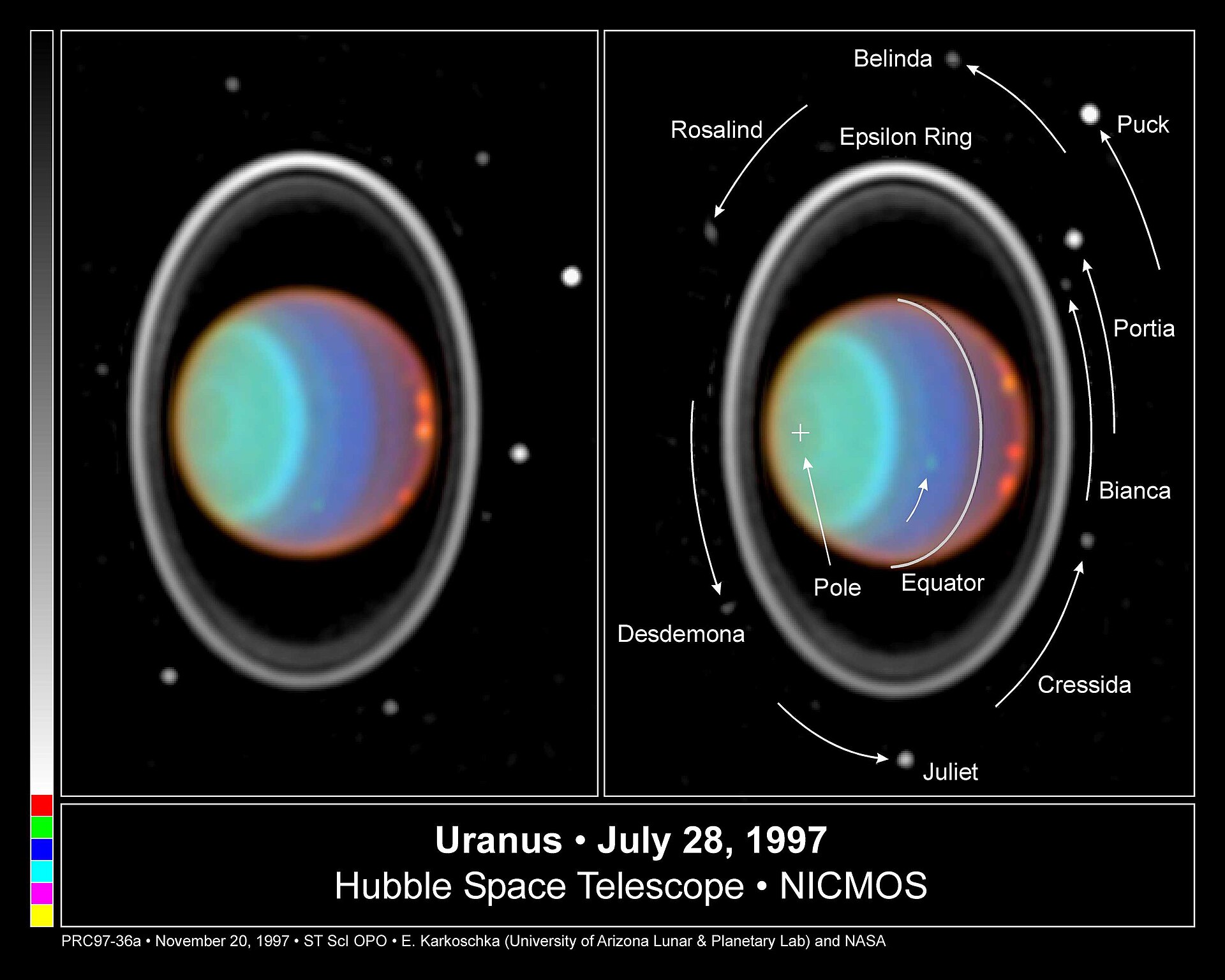
Uranus has two sets of rings: an inner system of nine narrow, dark grey rings, and two outer rings of which the innermost is reddish and the outer ring is blue like Saturn's E ring. Thirteen distinct rings are presently known around Uranus, the brightest being the epsilon ring; most are extremely narrow, usually a few kilometres wide, and the rings are probably quite young. The epsilon ring is the brightest and densest part of the Uranian ring system and is responsible for about two-thirds of the light reflected by the rings, and it is the most eccentric of the rings.
The epsilon ring is known to have interior and exterior shepherd moons, Cordelia and Ophelia respectively, which keep it confined. The first mention of a Uranian ring system comes from William Herschel's notes of the 18th century, which record a suspected ring on 22 February 1789 that was a little inclined to the red. Uranus' first nine rings were discovered in 1977 during stellar occultation observations of the planet's atmosphere, and during the Voyager encounters two other inner rings and ten moons were discovered.
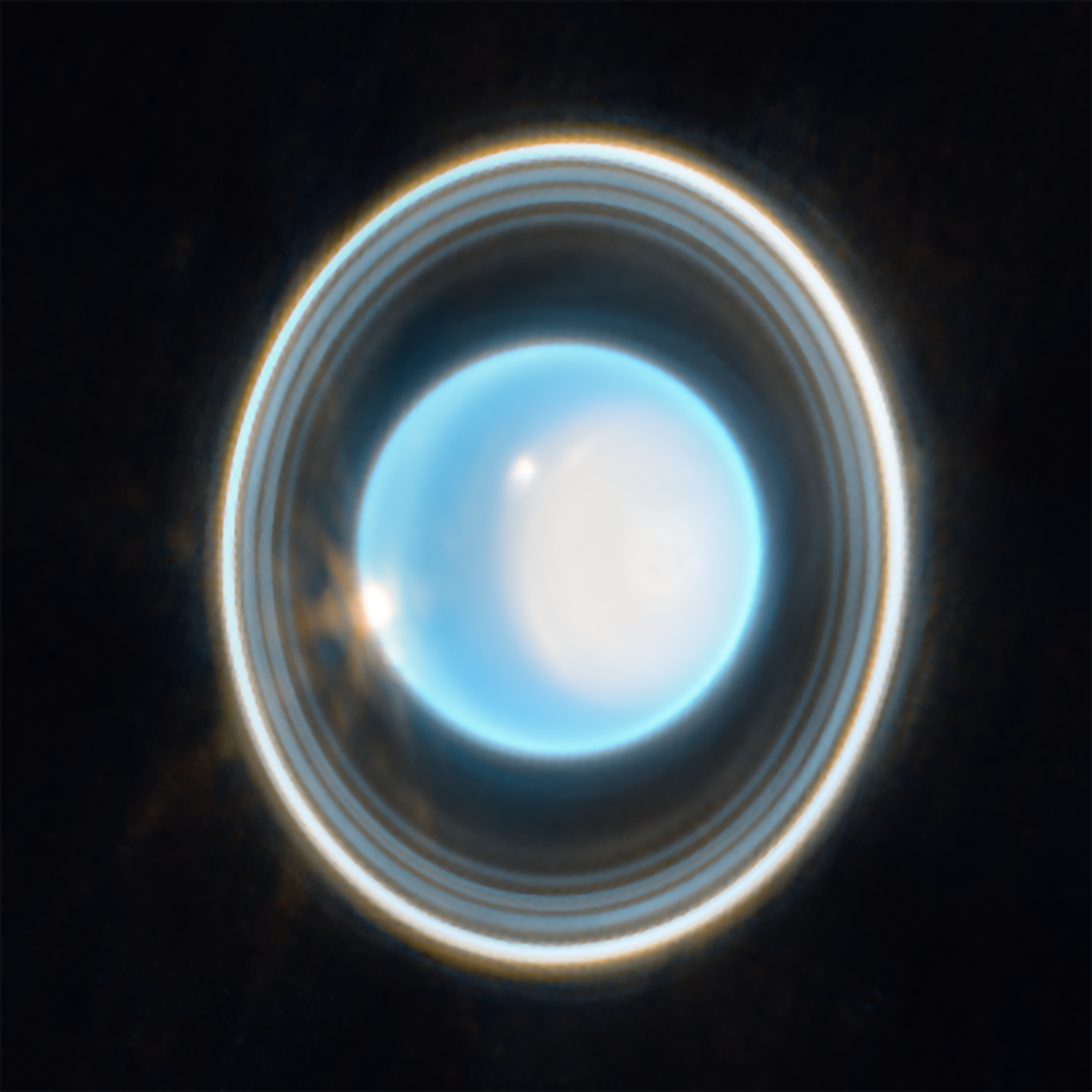
The outermost new ring is replenished by a 12-mile-wide companion satellite, named Mab, which was first seen using Hubble; meteoroid impacts blast dust off Mab and the dust spreads out into a ring around Uranus. Observations made at the Keck Observatory and by the Hubble Space Telescope show that Uranus' outer ring is colored blue while the newer inner ring is reddish.
The extremely dark ring system reflects only about 2% of the incoming light.
9. Moons
Uranus has 29 officially recognized moons as of August 2026, a count that includes five major moons: Miranda, Ariel, Umbriel, Titania, and Oberon. These bodies are divided into three groups — 14 inner moons, five major moons, and ten irregular moons — and the inner and major moons all have prograde orbits.
The 27 named moons are named after characters that appear in, or are mentioned in, Shakespeare's plays and Pope's poem The Rape of the Lock. Because of this convention they are sometimes called the literary moons. Several carry English-literature names: the fairies Oberon and Titania from A Midsummer Night's Dream and the sylph Ariel and gnome Umbriel from Pope's The Rape of the Lock.
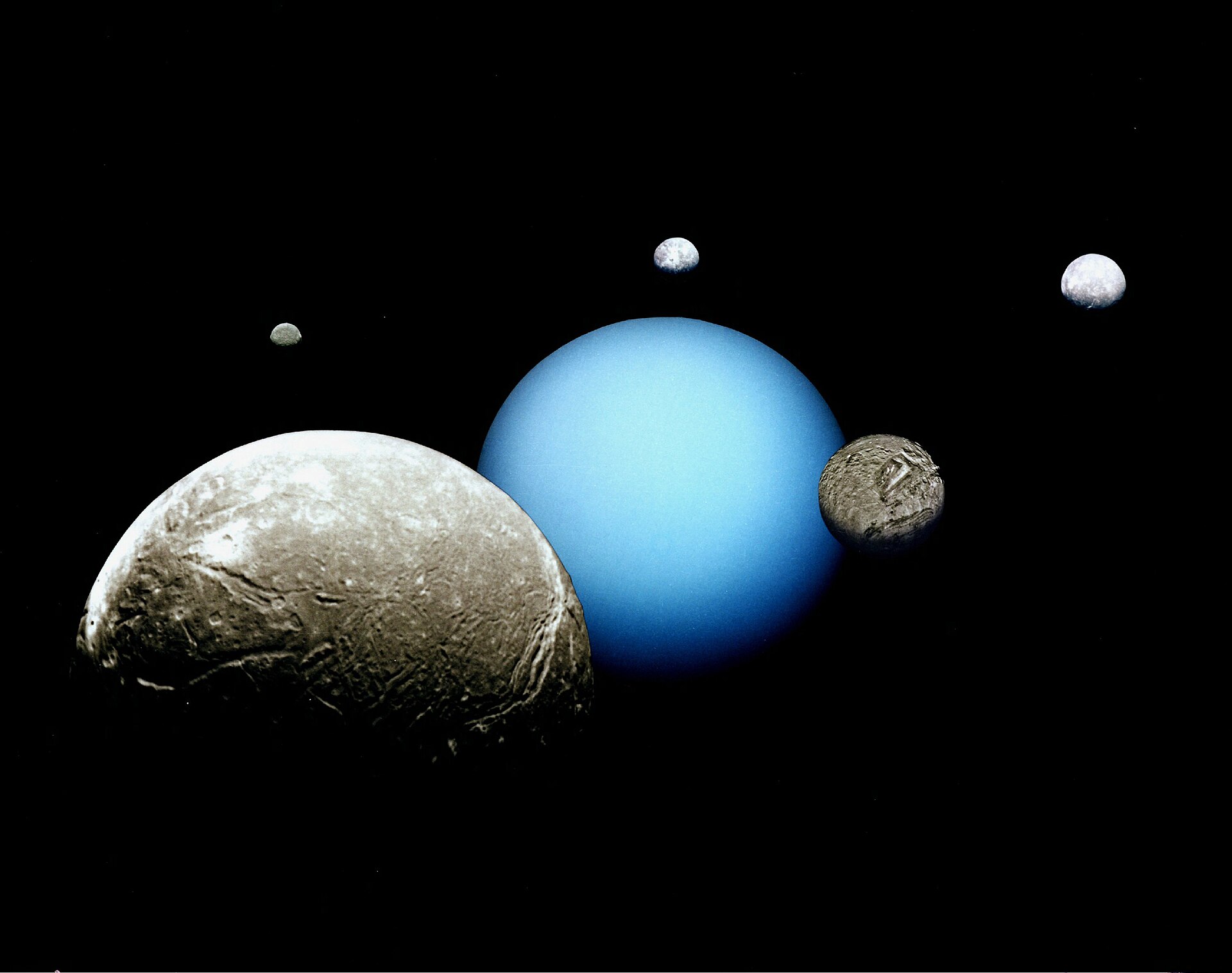
William Herschel discovered Titania and Oberon in 1787, while William Lassell found Ariel and Umbriel in 1851 and Gerard Kuiper discovered Miranda in 1948 as the fifth major moon.
Uranus was the last giant planet without any known irregular moons until 1997, when astronomers using ground-based telescopes discovered Sycorax and Caliban; searches from 1999 to 2003 added seven more irregular moons. These irregular moons range in size from 120 to 200 km for Sycorax down to under 10 km for S/2023 U1, the smallest of the known Uranian moons. Provisionally named S/2023 U1 and only about 8 kilometers across, the new moon takes 680 days to orbit Uranus and will eventually be named after a character from a Shakespeare play. Carnegie astronomer Scott Sheppard said the newly discovered moons are the faintest ever found around the two ice giant planets using ground-based telescopes, requiring special image processing to reveal them.
Miranda, only about 300 miles (500 kilometers) in diameter, boasts giant canyons that could be up to 12 times as deep as the Grand Canyon and three unique features called coronae, lightly cratered collections of ridges and valleys; scientists think the moon could have been shattered and then reassembled.
10. Exploration
Voyager 2 is the only spacecraft to visit Uranus and Neptune; the probe is now in interstellar space, outside the heliopause. It launched in the summer of 1977, and its itinerary took it to Jupiter, Saturn, and then Uranus, with its next encounter coming at Neptune in August 1989 before it later entered interstellar space.
At its closest, Voyager 2 came within 81,500 kilometers (50,600 miles) of Uranus's cloudtops on 24 January 1986 and radioed thousands of images and voluminous scientific data on the planet, its moons, rings, atmosphere, interior and magnetic environment. The spacecraft discovered 10 new moons and two new rings. Because the moons' orbits sat sideways compared to its trajectory, the spacecraft only got a close look at Miranda.
After travelling more than 1.8 billion miles (3 billion kilometers) in nine years, NASA's Voyager 2 gathered much of its critical information about Uranus, including its rings and moons, in just six hours. Its images of the five largest moons around Uranus revealed complex surfaces indicative of varying geologic pasts. Voyager 2 passed just 18,000 miles from Miranda, the closest encounter it had made with any celestial body to that point, and the images returned showed each moon to be unique and more geologically active than expected. Because of Uranus' great distance, engineers changed Voyager's imaging techniques to accommodate light levels only 25% of what they were during the Saturn encounter, programming image motion compensation for the required 15-second exposure times.
NASA announced on 22 December 2005 the discovery of a new pair of rings around Uranus and two new small moons, Mab and Cupid, from photographs taken by the Hubble Space Telescope. The Webb data demonstrates the observatory's unprecedented sensitivity for the faintest dusty rings, which had only ever been imaged by two other facilities: the Voyager 2 spacecraft in 1986 and the Keck Observatory with advanced adaptive optics. The new Webb image of Uranus features dramatic rings as well as bright features in the planet's atmosphere, and it was captured by the Near-Infrared Camera on 6 February 2023 and made by combining data from two filters at 1.4 and 3.0 microns.
The Uranus Orbiter and Probe should be the highest priority large mission, according to the decadal report, and the mission would conduct a multiyear orbital tour to transform knowledge of ice giants generally and the Uranian system in particular through flybys and the delivery of an atmospheric probe. The report states that a launch of the Uranus Orbiter and Probe within the 2023-2032 decade is viable on currently available launch vehicles.
11. Timeline
- 1690A wandering star is cataloguedJohn Flamsteed's catalogue of fixed stars lists a faint object in Taurus as 34 Tauri; he and later James Bradley observe it repeatedly without realising it is a planet moving across the sky.
- March 13, 1781Herschel discovers UranusWilliam Herschel spots a faint object in Gemini that moves against the background stars, first takes it for a comet and later identifies it as a distant planet — the first planet discovered since antiquity and the first found with a telescope.
- November 1781Royal Society honours HerschelHerschel's discovery earns him membership in the Royal Society and its Copley Medal in November 1781.
- 1782Bode proposes the name UranusJohann Bode argues that Georgium Sidus does not follow the pattern of planetary names and suggests Uranus, the Greek god of the sky; consensus on the name still took decades.
- 1787Titania and Oberon discoveredWilliam Herschel discovers Uranus's two largest moons, Titania and Oberon.
- 1851Ariel and Umbriel discoveredWilliam Lassell discovers the moons Ariel and Umbriel.
- 1948Miranda discoveredGerard Kuiper discovers Miranda, the fifth and innermost of the major moons.
- March 10, 1977The rings of Uranus foundWhile Uranus passes in front of the star SAO 158687, observers aboard NASA's Kuiper Airborne Observatory and at the Perth Observatory record brief dimmings before and after the planet: Uranus, like Saturn, is encircled by rings.
- August 20, 1977Voyager 2 launchesVoyager 2 lifts off on Aug. 20, 1977 — 16 days before its twin Voyager 1 — beginning the mission that would carry it past all four giant planets.
- January 24, 1986Voyager 2 flies past UranusVoyager 2 makes the first and so far only visit to Uranus, coming within 50,600 miles (81,500 kilometres) of the cloud tops and discovering new moons and two new rings.
- December 22, 2005Hubble finds new rings and moonsNASA announces that Hubble has photographed a new pair of rings around Uranus and two small moons, Mab and Cupid, revealing a densely packed and rapidly changing system.
- December 2007Uranus reaches equinoxThe planet is fully illuminated as the Sun crosses its equator, bringing a ring-plane crossing in which the rings appear edge-on from Earth before widening again.
- April 19, 2022A flagship Uranus mission becomes top priorityThe Planetary Science and Astrobiology Decadal Survey 2023–2032 names a Uranus Orbiter and Probe among its highest priority objectives.
- April 6, 2023Webb images the Uranian ringsThe NASA/ESA/CSA James Webb Space Telescope releases a near-infrared image of Uranus, captured on Feb. 6, 2023, showing the planet's dramatic rings and a bright polar cap.
- February 23, 2024A new moon announcedCarnegie Science announces S/2023 U1, the first new moon of Uranus discovered in more than 20 years and probably the smallest, spotted with ground-based telescopes.
- April 3, 2025Two decades of Hubble observationsA Hubble study spanning 20 years of observations of Uranus reports methane strongly depleted near the poles and a polar region brightening as the planet approaches its 2030 summer solstice.
References (24)
- 1Uranus — NASA Science WebView source
- 2Uranus: Facts — NASA Science Web↩View source
- 3Uranus | Facts, Moons, & Rings — Encyclopaedia Britannica WebView source
- 4240 Years Ago: Astronomer William Herschel Identifies Uranus as the Seventh Planet — NASA WebView source
- 5The Discovery of Uranus — Royal Museums Greenwich WebView source
- 6Paper, 'Of a comet [Uranus] seen on 13 March' by William Herschel — The Royal Society WebView source
- 7Uranus — Wikipedia Web↩View source
- 8Uranus — University of Wisconsin–Madison Space Science and Engineering Center WebView source
- 9Uranus: Exploration — NASA Science WebView source
- 10Voyager Mission Celebrates 30 Years Since Uranus — NASA Jet Propulsion Laboratory WebView source
- 1120 years of Uranus observations — European Space Agency 2025 WebView source
- 12Webb scores another ringed world with new image of Uranus — European Space Agency WebView source
- 13Uranus, the sideways planet — The Planetary Society WebView source
- 1435 Years Ago: Voyager 2 Explores Uranus — NASA WebView source
- 15Rings of Uranus — Wikipedia WebView source
- 16NASA's Hubble Discovers New Rings and Moons Around Uranus — NASA / Space Telescope Science Institute 2005 WebView source
- 17Uranus Moons — NASA Science WebView source
- 18Moons of Uranus — Wikipedia WebView source
- 19New moons of Uranus and Neptune announced — Carnegie Science WebView source
- 20Voyager 2: First To Visit All Four Giants — NASA Science WebView source
- 21Planetary Voyage — NASA Science WebView source
- 22NASA's Webb Scores Another Ringed World with New Image of Uranus — NASA Science WebView source
- 23Report Identifies Priority Planetary Science Missions, Planetary Defense Efforts, and Strategic Investments for the Next Decade — National Academies of Sciences, Engineering, and Medicine WebView source
- 24Planetary Physical Parameters — NASA Jet Propulsion Laboratory, Solar System Dynamics WebView source
 Neptune
 Telescope
 Ada Lovelace


