Venus
The second planet from the Sun — Earth's scorching twin: a runaway greenhouse of carbon dioxide beneath sulfuric-acid clouds, a retrograde 243-day rotation, and a history of exploration from Mariner 2 and the Venera landers to the coming DAVINCI, VERITAS and Envision missions.
Venus is the second planet from the Sun and the hottest in the solar system, its surface at about 464 °C beneath an atmosphere 92 times Earth's surface pressure. Closest to Earth in size and mass and sometimes called Earth's twin, it rotates retrograde once every 243 Earth days — longer than its own year. Explored since 1962 by Mariner 2, the Soviet Venera landers, NASA's Magellan radar mapper, ESA's Venus Express and JAXA's Akatsuki, it remains the target of NASA's DAVINCI and VERITAS and ESA's Envision missions.
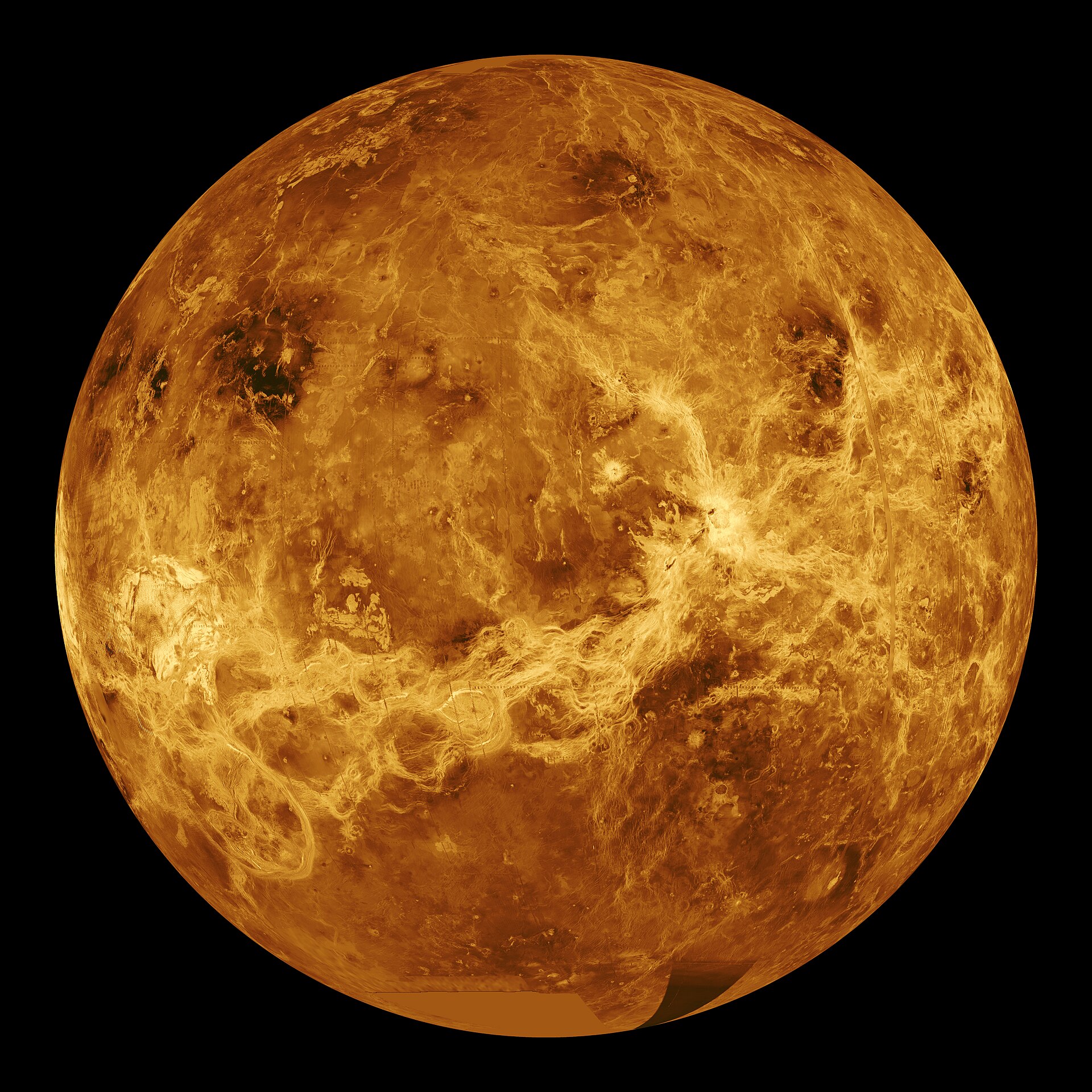
Overview
Venus is the second planet from the Sun and Earth's closest planetary neighbor. Yet it has evolved in a radically different manner, with a surface temperature hotter than a kitchen oven and a choking mixture of noxious gases for an atmosphere.
Venus is named for the ancient Roman goddess of love and beauty, known to the Greeks as Aphrodite; it is the only planet named after a female deity, and most of its surface features are named for women. In ancient Greece the planet was known by two different names — Phosphorus as a morning star and Hesperus as an evening star — while its modern name comes from the Roman goddess of love and beauty.
Venus is a cloud-swaddled planet and our nearest planetary neighbor, and its surface is hot enough to melt lead. It is the third brightest object in the sky after the Sun and Moon, and it spins slowly in the opposite direction from most planets. Its bright sulfurous clouds make Venus by far the brightest planet seen from Earth.
1. Physical Characteristics
Venus is close to Earth in size and mass, a resemblance that has earned it the description of Earth's twin 1Venus: Facts - NASA Science · NASA Science ↗. Its equatorial diameter is 12,104 kilometers, against 12,756 kilometers for Earth 6Planetary Fact Sheet - Metric · NASA NSSDC (Goddard Space Flight Center) ↗. The planet's mass is 4.8673 × 10^24 kg, or 0.815 of Earth's 7Venus Fact Sheet · NASA NSSDC (Goddard Space Flight Center) ↗, and its mean density is 5,243 kg/m³, which is 0.951 of Earth's 7.
Surface gravity on Venus averages 8.87 m/s², about 90.3 percent of Earth's, and the escape velocity is 10.36 km/s 7. The mean surface temperature is 737 K (464 °C; 867 °F), and the diurnal temperature range is nearly zero 7.
| Property | Value | Comparison to Earth |
|---|---|---|
| Equatorial diameter | 12,104 km | Earth: 12,756 km 6 |
| Mass | 4.8673 × 10^24 kg | 0.815 of Earth's 7 |
| Mean density | 5,243 kg/m³ | 0.951 of Earth's 7 |
| Surface gravity | 8.87 m/s² | 0.903 of Earth's 7 |
| Escape velocity | 10.36 km/s | — 7 |
| Mean radius | 6,051.8 km | — 7 |
| Volume | about 85.7 percent of Earth's | — 7 |
2. Orbit and Rotation
Venus orbits the Sun at a mean distance of 108.210 million km, or 0.723 astronomical units, and sunlight takes about six minutes to reach it. Its sidereal orbital period is 224.701 Earth days. The orbit is inclined 3.395 degrees to the ecliptic and has an eccentricity of only 0.0068 — the least eccentric orbit of all the planets. In keeping with that figure, Venus deviates from a perfect circle by only about 1 part in 150, the smallest deviation of any planet.
Venus rotates on its axis in the retrograde direction, opposite to the other planets. Its sidereal rotation period is 243.69 Earth days, retrograde, while the length of a solar day is 2,802 hours, or 116.75 Earth days. The planet's obliquity to its orbit is 177.36 degrees, so it rotates essentially upside down. Because of this extremely slow rotation, a day on Venus lasts longer than its year, and an observer on the surface would see the Sun rise in the west and set in the east.
At its nearest, Venus comes about 24 million miles (38 million kilometers) from Earth, while the maximum separation is about 162 million miles (261 million kilometers).
3. Atmosphere and Climate
By volume, the atmosphere near the surface of Venus is 96.5% carbon dioxide and 3.5% nitrogen, with sulfur dioxide, argon, water, carbon monoxide, helium and neon as minor components. The planet's dense clouds are composed of sulfuric acid. Surface pressure measures 92 bars, about 93 times Earth's at sea level, and the atmosphere's scale height is 15.9 km, with a total mass of about 4.8 × 10^20 kg.
Surface wind speeds are 0. The concentration of carbon dioxide in the extremely dense atmosphere is responsible for a runaway greenhouse effect and the very high annual average surface temperature of 464 °C (867 °F), and the pressure is like being more than 3,000 feet underwater on Earth.
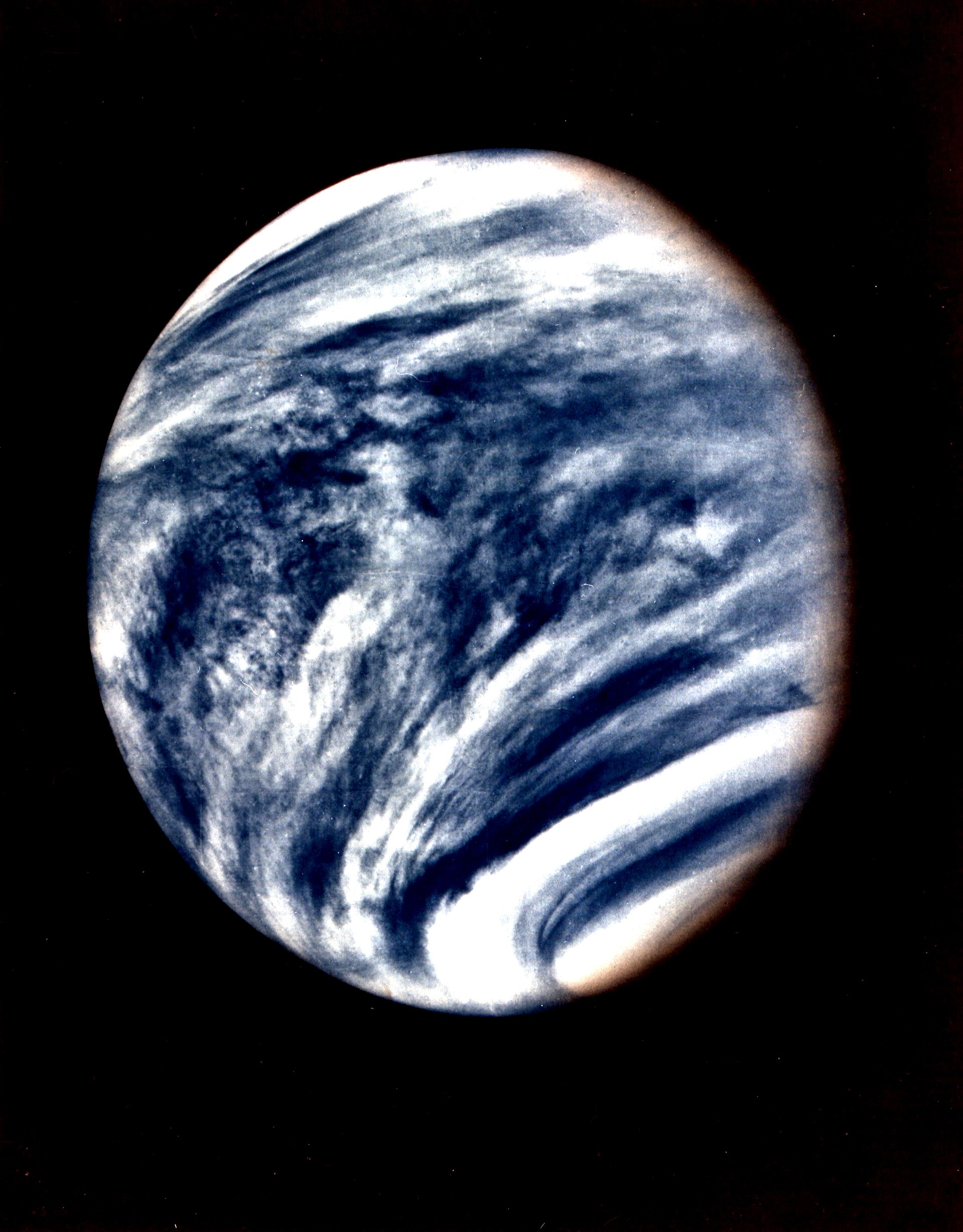
About 50 kilometers above the surface, temperatures range from 86 to 158 °F, a range that could accommodate Earthly extremophile microbes.
4. Surface and Geology
Venus carries valleys and high mountains dotted with thousands of volcanoes, among them Ishtar Terra near the north pole and the larger Aphrodite Terra region stretching across the equator. One mountain on the planet reaches 36,000 feet (11 kilometers), higher than Mount Everest. The planet is dominated by rolling volcanic plains, interrupted by two elevated plateaus — Aphrodite Terra and Ishtar Terra.
Except for Earth, Venus has by far the fewest impact craters of any rocky planet. The average age of its surface features could be as young as 150 million years, with some older surfaces mixed in. Tesserae account for about 8% of the surface and are highland regions resembling rugged mountains. Alpha Regio is one such tessera and may be among the oldest surfaces on Venus, offering access to rocks that are billions of years old.
5. Magnetic Field and Satellites
Venus possesses no intrinsically generated global magnetic field; what it has instead is a weak induced magnetic field, produced as the Sun's field interacts with the planet's outer atmosphere. This induced field envelops the planet and takes the form of an extended teardrop, or the tail of a comet, as the solar wind streams past. The absence of a global field distinguishes Venus from Mercury and Earth.
Venus has no natural satellites and no ring system. It is one of only two planets in the solar system that does not have a moon. It does, however, have a quasi-satellite officially named Zoozve.
6. Historical Observation
Early telescopic observations of Venus revealed a perpetual veil of clouds, leading to popular speculation that Venus was a warm, wet world perhaps similar to Earth. Galileo's telescopic observation of the phases of Venus provided the key scientific proof for the Copernican heliocentric nature of the solar system.
Transits of Venus across the disk of the Sun are among the rarest of planetary alignments, and they are much rarer than transits of Mercury. Only six were observed between the invention of the telescope and the modern era, the last pair occurring in 1874 and 1882 after a gap of over a century. The recurrence pattern of these transits runs at intervals of 8 and 121.5 years alternating with 8 and 105.5 years.
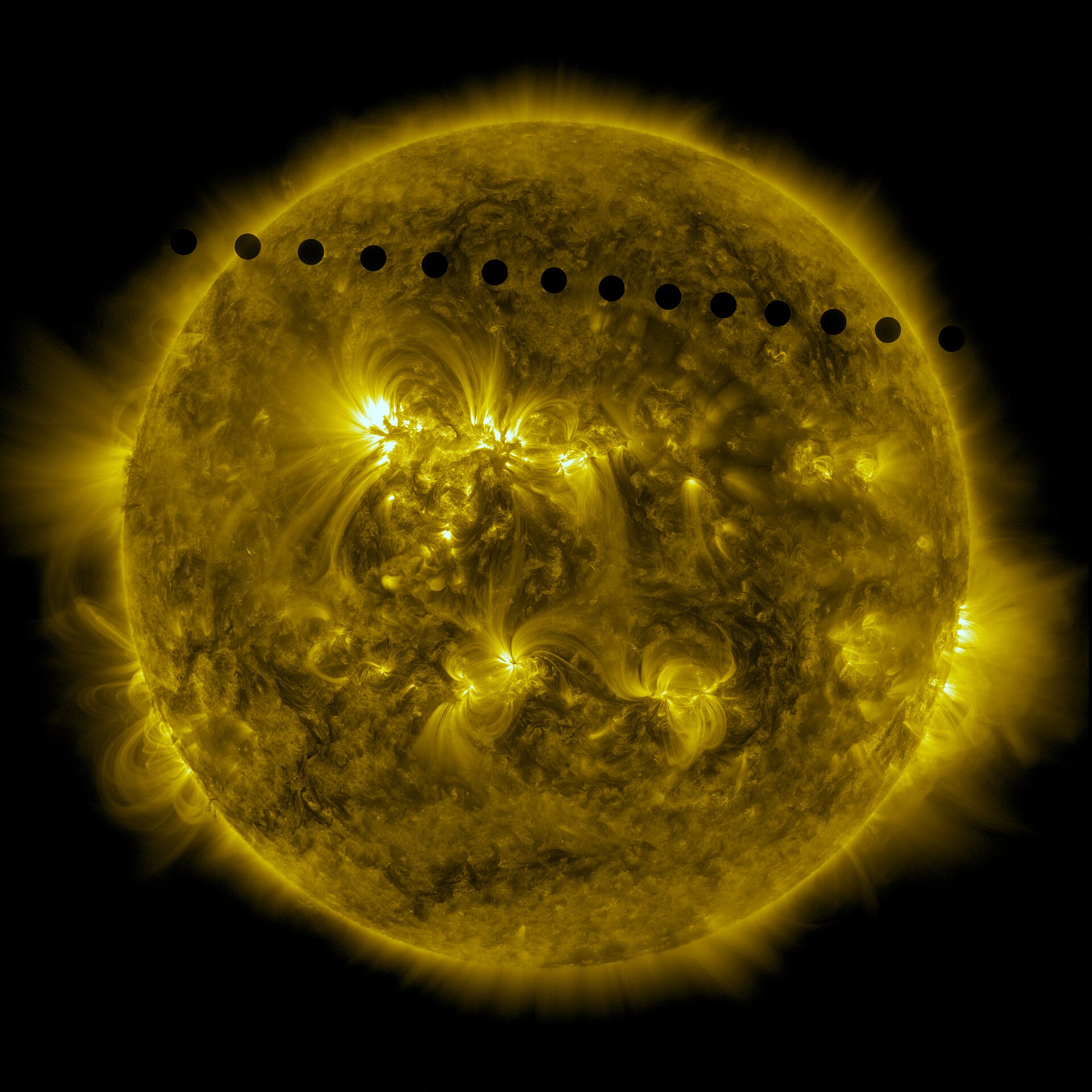
In 1639 Jeremiah Horrocks and William Crabtree became the first to witness a transit of Venus. In 1716 Edmond Halley published a paper describing exactly how transits could be used to measure the Sun's distance, establishing the absolute scale of the solar system from Kepler's third law. A major observing campaign was mounted by many nations for the Venus transits of 1874 and 1882, but the black drop limited the precision of observations and the determination of the Sun's distance.
7. Exploration
More than 40 missions have been launched to explore Venus, though not all of them succeeded. Dozens of spacecraft have set out for the planet, and in December 1962 NASA's Mariner 2 became the first spacecraft to visit any planet beyond Earth. Mariner 2 launched on Aug. 27 in 1962, after Mariner 1 was destroyed in the first few minutes of flight on July 22; the fault was traced partly to a missing overbar in communications software.
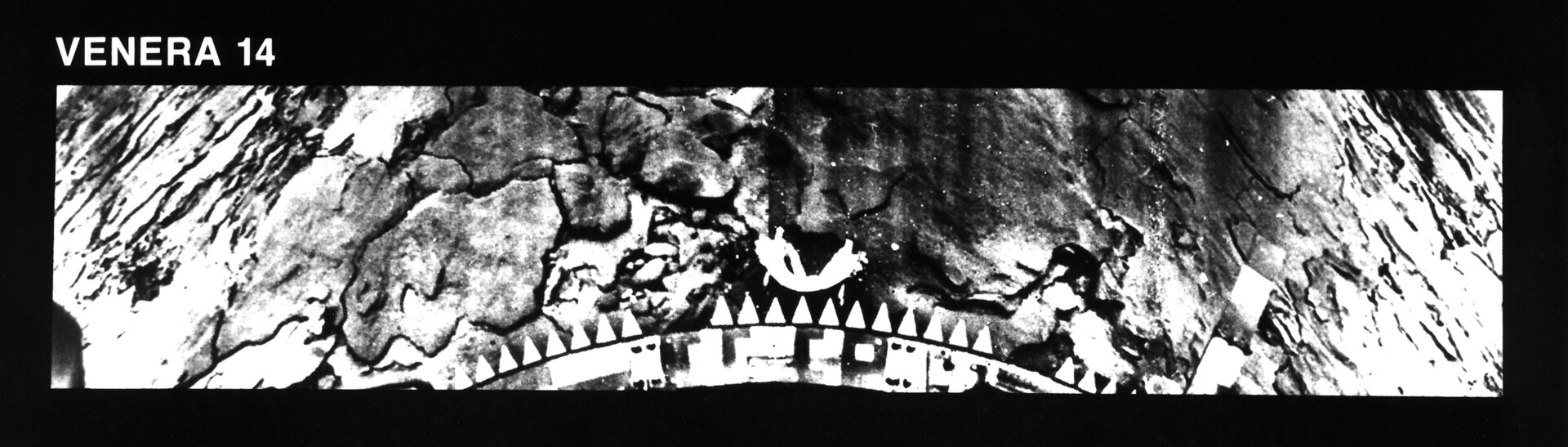
The Soviet Union sent a series of Venera probes to Venus between 1961 and 1984; ten made it to the surface, and the longest survivor operated for two hours. The Venera 9 lander touched down on 22 October 1975 and operated for 53 minutes, returning a single image showing angular and partly weathered rocks about 30 to 40 cm across.
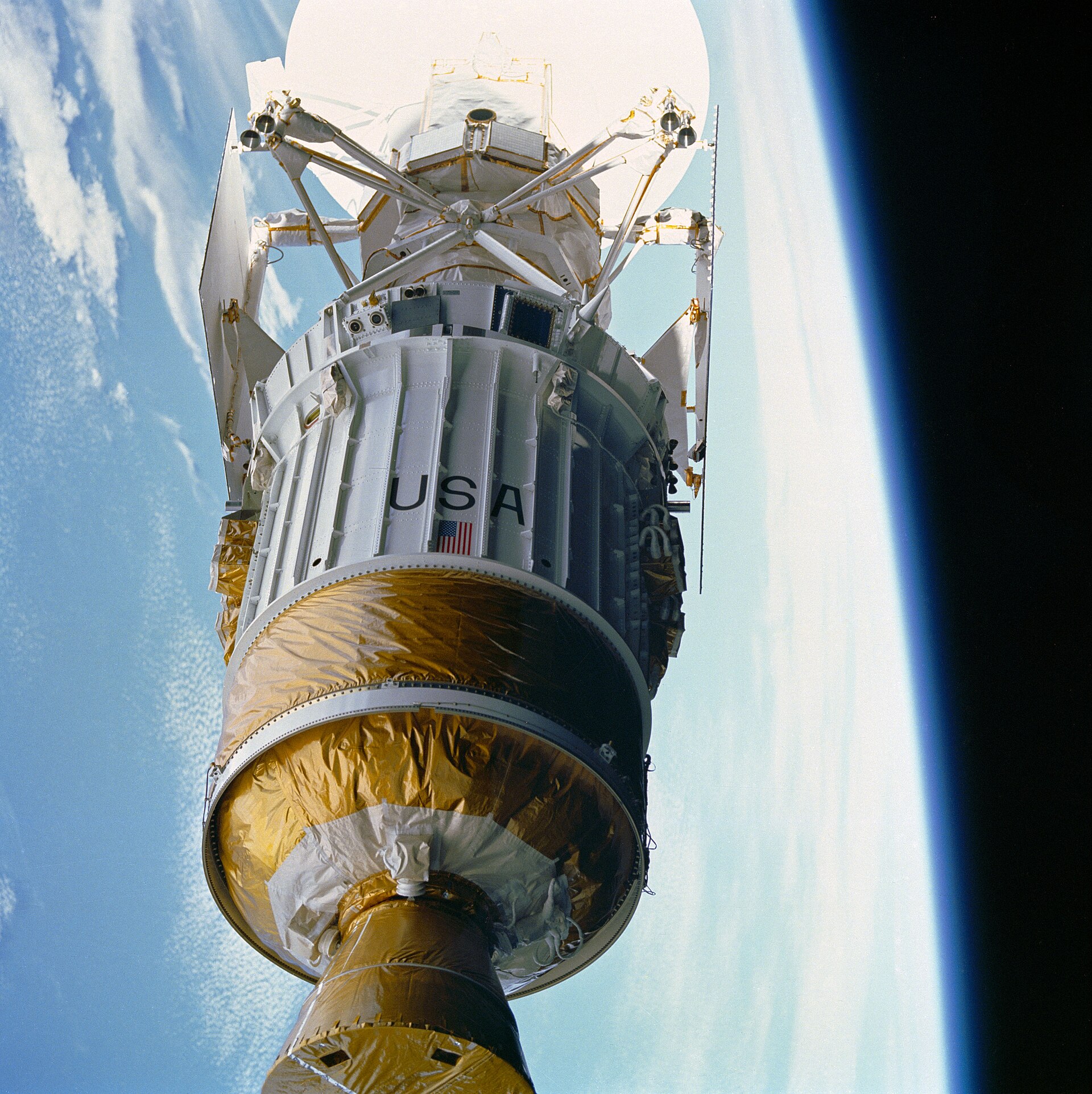
Pioneer Venus 1 launched on May 20 in 1978 and was the first U.S. spacecraft to orbit Venus. Magellan launched on May 4 in 1989 from the cargo bay of Space Shuttle Atlantis and imaged the entire surface of Venus. It was the first planetary spacecraft launched from a space shuttle and the first spacecraft to image the entire surface of Venus, burning up about 10 hours after being commanded to plunge into the Venusian atmosphere. Its bus was assembled from spare parts left over from prior missions including Voyager, Galileo, Ulysses and Mariner 9 spacecraft.
Venus Express launched on Nov. 9 in 2005 and was the first European spacecraft to orbit Venus. It arrived at Venus on 11 April 2006, operated for 8 years, and the mission ended in December 2014 after its propellant ran out. The spacecraft was an adapted copy of Mars Express, a honeycombed aluminium box about a metre and a half wide that measured about eight metres across with its solar arrays extended. It was placed in a near-polar orbit locked in space with respect to the background stars while the planet rotated beneath it, allowing the instruments to observe almost the entire planet over a full Venusian day of 243 Earth days.
In May 2010 JAXA launched Akatsuki to solve the mysteries of Venus' atmosphere, with five cameras photographing it in infrared, visible light and ultraviolet rays. After the original orbit insertion failed, JAXA successfully inserted the Akatsuki orbiter into Venus orbit on 7 December 2015 by firing the attitude control engine.
8. Current and Planned Missions
NASA is planning two new missions to Venus: VERITAS and DAVINCI. Together they will be the first NASA spacecraft to explore Venus since the 1990s. VERITAS will discover the secrets of a lost habitable world, gathering data to reveal how the paths of Venus and Earth diverged.
DAVINCI is scheduled to launch in the early 2030s and will explore Venus with both a spacecraft and a descent probe; the probe will be the first in the 21st century to descend through Venus' atmosphere to the surface. The mission will release a spherical probe about 3 feet wide that will plunge through the thick atmosphere and capture high-resolution images of the Venusian surface below the clouds. It will be the first mission to closely explore Alpha Regio. DAVINCI studies Venus from above its clouds down to its surface, investigating how the planet and its thick, crushing atmosphere formed and evolved over the past 4.5 billion years.
ESA's Envision will be the first mission to provide a complete view of Venus from its inner core to its upper atmosphere, to determine how and why Venus and Earth evolved so differently. Envision has a planned launch in November 2031 with a 15-month cruise plus 11 months of aerobraking to reach its final science orbit and a science operation phase of 4 Earth years.
9. Habitability and the Phosphine Debate
Computer modeling of Venus' ancient climate by NASA's Goddard Institute for Space Studies found that the planet may have had a shallow liquid-water ocean and habitable surface temperatures for up to 2 billion years of its early history. In that reconstruction, Venus' early ocean evaporated, water-vapor molecules were broken apart by ultraviolet radiation, and hydrogen escaped to space, so carbon dioxide built up in the atmosphere and drove a runaway greenhouse effect that created present conditions. The GISS study factored in an ancient Sun up to 30 percent dimmer than today; even so, ancient Venus still received about 40 percent more sunlight than Earth does today. In the simulation, Venus' slow spin exposes its dayside to the Sun for almost two months at a time, warming the surface and producing rain that creates a thick layer of clouds acting like an umbrella to shield the surface from solar heating.
A modeling study submitted to JGR Planets concluded that Venus could have had habitable conditions for nearly 3 billion years, with surface liquid water required for any habitable scenario. Its authors speculate that large igneous provinces and the global resurfacing hundreds of millions of years ago played key roles in ending the clement period in Venus' history. Cloud feedbacks from a slowly rotating world with surface liquid water reservoirs were the keys to keeping the planet clement. The authors propose placing Venus-like exoplanets with clement conditions akin to modern Earth in what they term the 'optimistic Venus zone'.
An announcement that phosphine (the molecule PH3) had been discovered above Venus' clouds made headlines in 2020 because of its potential as an indicator of life; on Earth phosphine is associated with biology. The detection of phosphine in the atmosphere of Venus was reported on the basis of millimetre-wave radio observations and their reanalyses.
In a Matters Arising article in Nature Astronomy, an independent reanalysis identified several issues in the interpretation of the spectroscopic data and determined sensitive upper limits for PH3 above the cloud decks that are discrepant with the original findings. The paper titled 'No evidence of phosphine in the atmosphere of Venus from independent analyses' was published on 16 July 2021 in Nature Astronomy. SOFIA observations found no sign of phosphine in Venus' atmosphere; if any is present at all it is at most about 0.8 parts per billion, much smaller than the initial estimate reported in 2020 by the original study. Along with complementary data from other observatories, the SOFIA results help build the body of evidence against phosphine above 75 km altitude in Venus' atmosphere, from its equator to its poles.
A 2024 review states that the phosphine detection has survived all challenges and has acquired independent support from archival data from the Pioneer Venus probes. The presence of phosphine in Venus' oxidising environment is perplexing, and comprehensive studies rule out all known abiotic sources. Detections of phosphine appear as the observed atmosphere moves from night into day while upper limits or weak detections appear from day into night, suggesting phosphine is destroyed by solar photolysis during daylight. More data is needed to understand the origin of phosphine on Venus, leading to JCMT-Venus, a long-term atmospheric monitoring programme that can find how phosphine varies in relation to other species.
10. Timeline
- 1610Galileo observes the phases of VenusGalileo's discovery of the phases of Venus was one of the most important in the history of astronomy, supporting the heliocentric model of the solar system.
- December 1639First transit of Venus witnessedJeremiah Horrocks and William Crabtree became the first to witness a transit of Venus across the Sun.
- 1716Halley's method for measuring the solar systemEdmond Halley published a paper describing exactly how transits of Venus could be used to measure the Sun's distance and establish the absolute scale of the solar system.
- 14 December 1962Mariner 2 flies past VenusMariner 2 completed the first successful close-up observations of another planet when it flew by Venus, having confirmed the existence of the solar wind en route.
- 1967Venera 4 and Mariner 5 reach VenusThe Soviet Venera 4 probe entered the planet's atmosphere and NASA's Mariner 5 made a flyby, both in 1967.
- 22 October 1975Venera 9 returns an image from the surfaceThe Venera 9 lander touched down at 5:13 UT and operated for 53 minutes, allowing return of a single image of the rocky surface.
- 20 May 1978Pioneer Venus 1 launchedPioneer Venus 1 launched and became the first U.S. spacecraft to orbit Venus.
- 4 May 1989Magellan launched aboard Space Shuttle AtlantisMagellan launched from the cargo bay of Space Shuttle Atlantis on its way to image the entire surface of Venus with synthetic aperture radar.
- 13 October 1994Magellan mission ends at VenusContact was lost after Magellan was commanded to plunge into the atmosphere of Venus; the spacecraft burned up about 10 hours later.
- 8 June 2004Transit of Venus observed worldwideThe first transit of the 2004/2012 pair occurred on 8 June 2004, the first such event since 1882.
- 9 November 2005Venus Express launchedEurope's first mission to Venus launched from Baikonur on a Soyuz-Fregat and arrived at the planet on 11 April 2006.
- May 2010Akatsuki launchedJapan's Venus Climate Orbiter Akatsuki launched in May 2010 with five cameras to study the Venusian atmosphere.
- 6 June 2012The 2012 transit of VenusThe second transit of the 2004/2012 pair occurred on 6 June 2012, after which no further transits occur until 2117.
- 7 December 2015Akatsuki enters Venus orbitAfter the original orbit insertion failed in 2010, JAXA successfully inserted Akatsuki into Venus orbit by emitting thrust from the attitude control engine.
- 2020Phosphine announcement makes headlinesAn announcement that phosphine had been discovered above Venus' clouds made headlines because of its potential as an indicator of life.
- November 2031 (planned)Envision planned launchESA's Envision mission is planned to launch in November 2031 to provide a complete view of Venus from its inner core to its upper atmosphere.
References (26)
- 1Venus: Facts - NASA Science — NASA Science Web↩View source
- 2Venus Express overview — European Space Agency WebView source
- 3Venus: Facts, Color, Rotation, Temperature, Size, & Surface — Encyclopaedia Britannica WebView source
- 4Venus - NASA Science — NASA Science WebView source
- 5Solar System Tour - Venus — NASA Goddard Space Flight Center WebView source
- 6Planetary Fact Sheet - Metric — NASA NSSDC (Goddard Space Flight Center) Web↩View source
- 7Venus Fact Sheet — NASA NSSDC (Goddard Space Flight Center) Web↩View source
- 8Comparing Planetary Gases — UCAR Center for Science Education WebView source
- 9NASA DAVINCI Mission's Many 'Firsts' to Unlock Venus' Hidden Secrets — NASA Science WebView source
- 102004 and 2012 Transits of Venus — NASA Goddard Space Flight Center 2004 WebView source
- 11Planetary Transits Across the Sun — NASA Goddard Space Flight Center WebView source
- 12The 2012 Transit of Venus — NASA Goddard Space Flight Center 2012 WebView source
- 13Venus Exploration - NASA Science — NASA Science WebView source
- 1460 Years Ago: Mariner 2 First to Explore Venus — NASA History (Johnson Space Center) WebView source
- 15Magellan - NASA Science — NASA Science WebView source
- 16Venus Express — European Space Agency WebView source
- 17Venus Express: mission overview — ESA Science & Technology WebView source
- 18Venus Climate Orbiter AKATSUKI (PLANET-C) — Japan Aerospace Exploration Agency (JAXA) WebView source
- 19VERITAS - NASA Science — NASA Science WebView source
- 20NASA's DAVINCI Mission - NASA Science — NASA Science WebView source
- 21Envision — European Space Agency WebView source
- 22NASA Climate Modeling Suggests Venus May Have Been Habitable — NASA Goddard Institute for Space Studies WebView source
- 23Venusian Habitable Climate Scenarios: Modeling Venus through time and applications to slowly rotating Venus-Like Exoplanets — NASA NTRS / JGR Planets (Way et al.) WebView source
- 24No Phosphine on Venus, According to SOFIA (VEXAG Science Nugget) — Lunar and Planetary Institute (USRA) WebView source
- 25No evidence of phosphine in the atmosphere of Venus from independent analyses — Nature Astronomy JournalView source
- 26Venus Phosphine: Updates and lessons learned — arXiv (Clements, Imperial College London) JournalView source
 Jupiter