Mount Everest
The highest point on Earth: 8,848.86 metres above sea level, astride the Nepal–China border, shaped by plate tectonics and two centuries of survey and climbing.
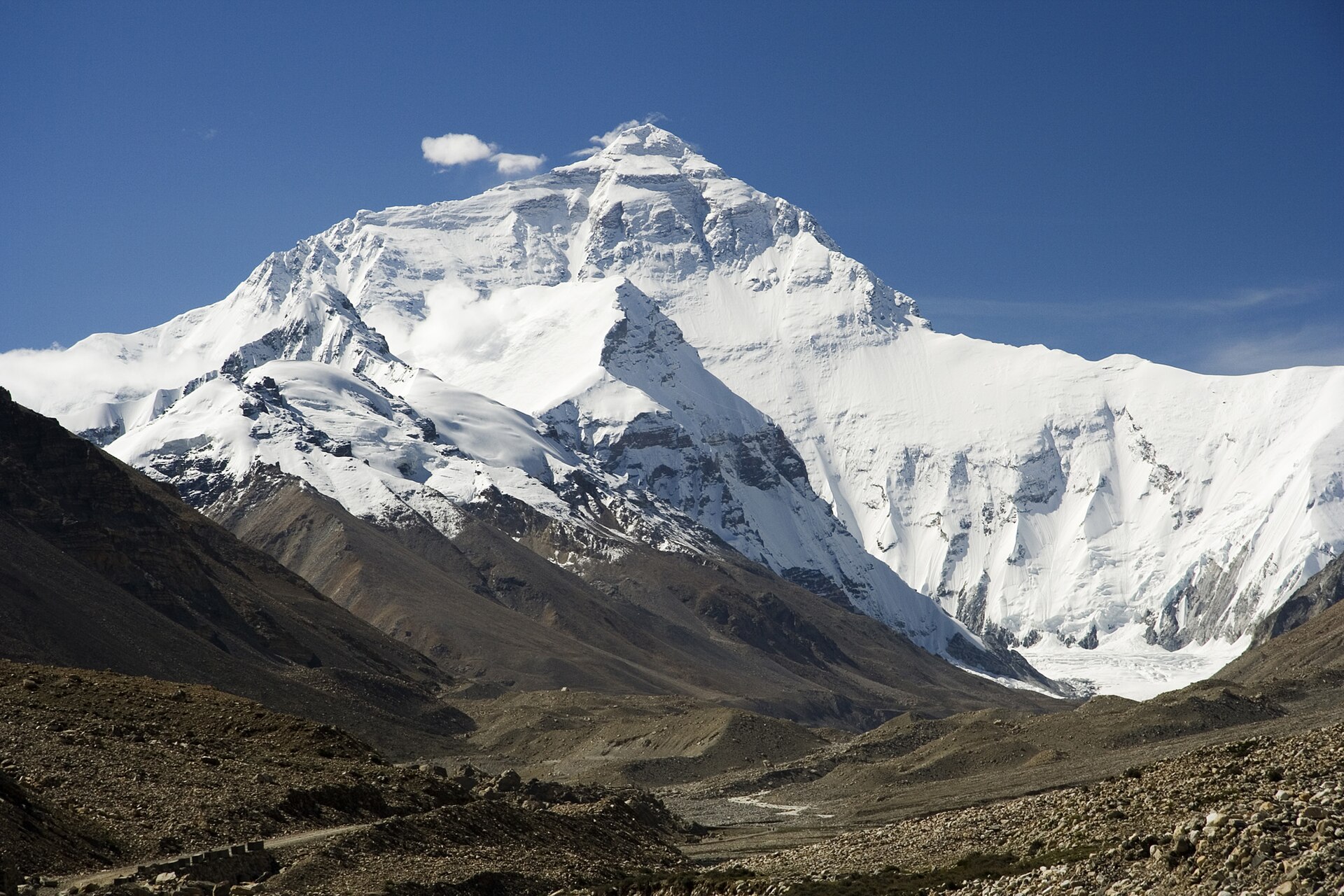
Mount Everest is the highest mountain in the world, standing 8,848.86 metres (29,031.69 feet) above sea level according to the joint China–Nepal announcement of December 2020. It sits on the crest of the Great Himalayas, on the border between Nepal and the Tibet Autonomous Region of China, and is known as Sagarmatha in Nepali and Chomolungma in Tibetan. Built by the collision of the Indian and Eurasian plates 40–50 million years ago, the mountain is still rising, and its summit — with only one-third of sea-level oxygen — sits in the “death zone.” First climbed by Edmund Hillary and Tenzing Norgay in 1953, Everest has since been summited more than 11,000 times, while more than 320 climbers have died on its slopes.
Overview
Mount Everest is the highest mountain in the world.1 Since December 2020 its jointly agreed official height has stood at 8,848.86 metres, following the announcement by Nepal and China.2 The mountain rises on the crest of the Great Himalayas of southern Asia, on the border between Nepal and the Tibet Autonomous Region of China, at 27°59′ N 86°56′ E.1 In Nepali it is called Sagarmatha, meaning literally “Peak of Heaven,” and in Tibetan Chomolungma, meaning “Goddess Mother of the World” or “Goddess of the Valley.”1 Previously referred to as Peak XV, it was renamed in 1865 for Sir George Everest, British surveyor general of India from 1830 to 1843.1
Everest's identity as the highest point on the Earth's surface was not recognized until 1852, when the governmental Survey of India established that fact.1 The first confirmed ascent was made in 1953 by Tenzing Norgay and Edmund Hillary.1 By May 2023 the mountain had been climbed more than 11,000 times from both the Nepali and Tibetan sides since 1953, and more than 320 people had died on it.3 In the spring of 2019 a record 381 climbing permits were issued by the Nepalese government, and on 23 May more than 250 climbers were on the mountain in one day.4 Overcrowding on the mountain that season was highlighted by a viral photo of one long queue to the summit.5
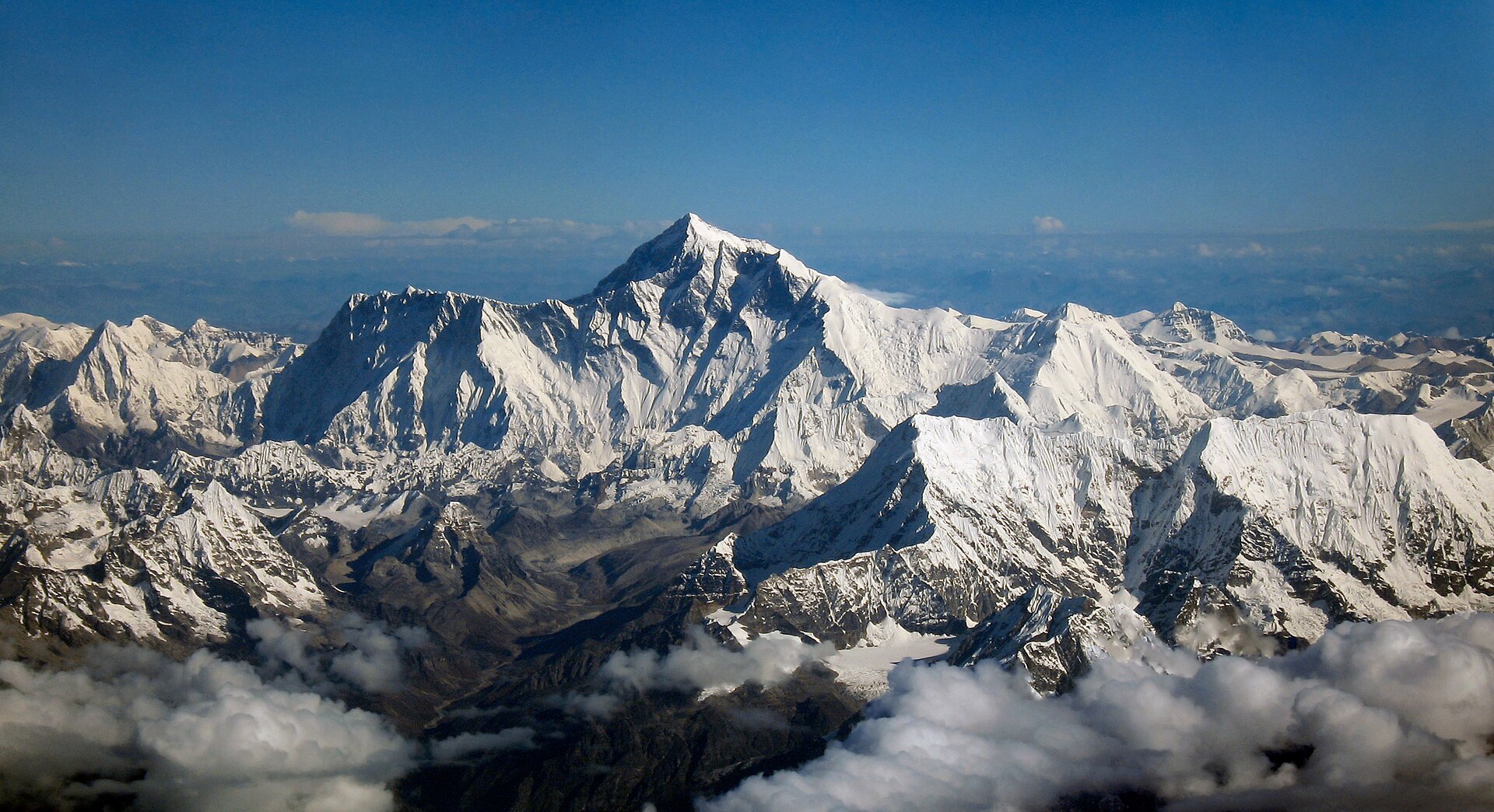
Today, climbing Everest is a regulated industry: from September 2025, a peak-season permit costs $15,000.6 Permit income is a key source of revenue for Nepal.6 K2, the world's second highest mountain, is 237 metres lower than Everest's 2020 height.7 Since 2019 the Nepalese army's annual clean-up has collected 119 tonnes of rubbish and 14 human corpses, and an estimated 200 bodies remain on the mountain.6
How tall is Everest?
In December 2020 China and Nepal jointly declared that the height of Everest was 29,031.69 feet (8,848.86 metres), a measurement derived from data from surveys performed by Nepal in 2019 and China in 2020.8 The new figure was accepted by various specialists in the fields of geodesy and cartography, including the National Geographic Society.8 Encyclopaedia Britannica records the mountain's elevation as 29,032 feet (8,849 metres).1 The new height is 0.86 m higher than had been previously officially calculated, Nepal and China jointly announced on 8 December 2020.2 Until then the two countries had differed over whether to add the snow cap on top: China's previous official measurement of 8,844.43 m had put the mountain nearly four metres lower than Nepal's figure.2
The figure 29,028 feet (8,848 metres) was established by the Survey of India between 1952 and 1954 and remained in wide use until 1999.8 In 1856 the Survey of India estimated Everest at 29,002 feet, and an Indian survey reestablished the number at 29,029 feet in 1955.9 A Chinese survey in 1975 obtained 8,848.11 metres, and Italian surveys obtained 8,872 metres in 1987 and 8,846 metres in 1992, though questions were raised about their methods.8 In 1999 an American survey sponsored by the National Geographic Society measured Everest at 29,035 feet (8,850 metres), plus or minus 6.5 feet (2 metres), using GPS.8 A 2005 Chinese survey estimated the rock height at 29,017 feet (8,844.43 m).9
The 8,848 m height Nepal had been using was determined by the Survey of India in 1954, and the 2020 remeasurement was the first time Nepal measured the summit itself.2 Nepal built a network of line-of-sight survey stations stretching nearly 250 km to the point where Everest first becomes visible, creating a chain of points it could measure and add together.2 Nepalese officials used 12 different lower peaks looking up at the Everest summit for their trigonometry calculations, and used the Bay of Bengal as the sea-level base.2 This time the Chinese surveyors used China's BeiDou navigation satellite system; China had previously measured Everest in 1975 and 2005.2 The Chinese surveyors went up in May 2020, becoming the only team to reach the top that year, after Nepal suspended all expeditions during the coronavirus pandemic and China banned foreign travellers.2
Geology: how the mountain was built
Pressure from the collision of the Indian and the Eurasian plates 40–50 million years ago formed the Himalayas, and plate tectonics remains the major reason for their continued rise.10 The Himalayan ranges were thrust upward as the Indian-Australian Plate was subducted under the Eurasian Plate after the two collided between about 40 and 50 million years ago, and the Himalayas themselves started rising about 25 to 30 million years ago.1 Rock on the lower elevations of the mountain consists of metamorphic schists and gneisses topped by igneous granites; higher up are found sedimentary rocks of marine origin, remnants of the ancient floor of the Tethys Sea that closed after the collision of the two plates.1 Notable is the Yellow Band, a limestone formation prominently visible just below the summit pyramid.1 The Great Himalayas began to take their present form during the Pleistocene Epoch, about 2,600,000 to 11,700 years ago.1
Everest is shaped like a three-sided pyramid, with three faces and three main ridges, and a short distance from the summit is the South Summit, a minor bump on the Southeast Ridge with an elevation of 28,700 feet (8,748 metres).1 The summit itself is covered by rock-hard snow surmounted by a layer of softer snow that fluctuates annually by 1.5–6 metres; the snow level is highest in September, after the monsoon, and lowest in May.1 Glaciers cover the slopes of Everest to its base: the Khumbu Glacier to the west and south, the Rongbuk glaciers to the north, and the Kangshung Glacier to the east.1 GPS data show a disconnect between the short-term rock uplift rate of Chomolungma of about 2 mm per year and its long-term rock uplift rate recorded by thermochronology of about 1 mm per year.11
Climate and the death zone
The climate of Everest is always hostile to living things.1 The risk of frostbite to climbers on Everest is extremely high.1 The warmest average daytime summit temperature, in July, is only about −19 °C; in January, the coldest month, the summit averages −36 °C and can drop as low as −60 °C.1 The peak is so high that it reaches the lower limit of the jet stream and can be buffeted by sustained winds of more than 100 miles (160 km) per hour.1
The summit and upper slopes sit so high in the Earth's atmosphere that the amount of breathable oxygen there is one-third what it is at sea level; lack of oxygen, powerful winds, and extremely cold temperatures preclude the development of any plant or animal life there.1 This is why the area above 8,000 metres on Everest is called the “death zone”: climbers who spend long periods in this region can develop altitude sickness and even brain swelling.12 In 1978 Reinhold Messner and Peter Habeler made the first ascent of Everest without supplemental oxygen, leaving the South Col at 5:30 am on 8 May and reaching the summit at 1:15 pm.13
The people of Everest
The valleys below the mountain are inhabited by Tibetan-speaking peoples; notable among these are the Sherpas, who live in villages at elevations up to about 4,270 metres in the Khumbu valley of Nepal.8 The Sherpas traditionally treated the Himalayas as sacred, building Buddhist monasteries at their base, placing prayer flags on the slopes, and establishing sanctuaries for the wildlife of the valleys.8 For these reasons, the Sherpas traditionally did not climb the mountains.8 The word “Sherpa” actually refers to an ethnic group rather than a mountain guide, and most climbs of Everest would be impossible without the Sherpas' logistical help and knowledge.12
On the Nepalese side of the international boundary, the mountain and its surrounding valleys lie within Sagarmatha National Park, a 1,243-square-km zone established in 1976; in 1979 the park was designated a UNESCO World Heritage site.8 Mountain climbing and trekking contribute more than 4% to Nepal's economy.6 Mountaineering experts often criticise Nepal's government for allowing too many climbers on Everest, with about 300 permits to the mountain issued per year.6 Nepal is home to eight of the world's 14 highest mountains, including Everest.6
The first ascent of 1953
The 1953 expedition was sponsored by the Royal Geographical Society and the Alpine Club and led by Colonel John Hunt.14 Earlier attempts had come close: in 1924 Norton reached 28,100 feet (8,565 metres), a documented height unsurpassed until 1953, and Mallory and Irvine were last seen high on the mountain on 8 June.15 On the morning of 29 May 1953, Hillary and Tenzing set out early, reaching the South Summit by 9:00 am, and stood on the summit of Everest at 11:30 am.14 The final obstacle, about halfway between the South Summit and the summit of Everest, was a steep spur of rock and ice — now called the Hillary Step — only about 55 feet (17 metres) high but difficult to climb because of its extreme pitch.14 They spent about 15 minutes on the summit; Tenzing, a Buddhist, made an offering of food for the mountain, and Hillary left a crucifix Hunt had given him.14
Well, George, we knocked the bastard off.
Attributed to Edmund Hillary, speaking to George Lowe after the descent from the summit, 1953
All this, and Everest too!
Headline in a London paper, 2 June 1953 — the day Elizabeth II was crowned
News of the ascent reached London in time to appear in the 2 June 1953 edition.14 A headline from another London paper published later that day referred to the fact that Elizabeth II was being crowned on the same day on which the news broke about the success on Everest.14 Both Hillary and Hunt were knighted in July 1953, and Tenzing was awarded the George Medal.14
Firsts and records
The first woman to summit Everest was the Japanese climber Junko Tabei, who reached the top from the South Col on 16 May 1975, climbing with the first all-women expedition to Everest.13 Reinhold Messner and Peter Habeler made the first ascent without supplemental oxygen on 8 May 1978.13 Messner also completed the first solo ascent of Mount Everest in 1980.1 Speed records from Base Camp have fallen repeatedly: Babu Chiri Sherpa climbed the southern route from Base Camp to summit in 16 hours 56 minutes in 1999, Lakpa Gelu summited in 10 hours 56 minutes in 2003, and Pemba Dorje reached the top in 8 hours 10 minutes in 2004.16 Kami Rita Sherpa had climbed Everest 30 times as of 22 May 2024 — the record for most ascents.17
| Achievement | Climber(s) | Year |
|---|---|---|
| First woman to summit | Junko Tabei (Japan), with the first all-women expedition | 16 May 197513 |
| First ascent without supplemental oxygen | Reinhold Messner and Peter Habeler | 8 May 197813 |
| First winter ascent | Leszek Cichy and Krzysztof Wielicki; expedition led by Andrzej Zawada | 17 February 198018 |
| First solo ascent | Reinhold Messner, from the East Rongbuk Glacier | 18 August 198018 |
| Youngest to summit | Jordan Romero, age 13, from the north side | 22 May 201016 |
| Oldest to summit | Yūichirō Miura, age 80 | 23 May 201316 |
| Fastest ascent from Base Camp | Pemba Dorje, in 8 hours 10 minutes | 200416 |
| Most ascents | Kami Rita Sherpa, 30 ascents | As of 22 May 202417 |
Danger and death on the mountain
As of 2017, more than 7,600 people had reached the top of the mountain, and nearly 300 had perished in the attempt.1 Records suggest there had been just over 280 deaths on the mountain as of March 2019, and since 2010 there had been 72 deaths on Everest and 7,954 climbs above base camp.19 While the number of deaths has been increasing, the death rate — the proportion of those who climb above base camp who die — has fallen below 1%.19 Over the past two decades, the average annual death rate of climbers on Mount Everest has remained at about six.4 By May 2023, more than 320 people had died on the mountain.3
In the spring of 2019, overcrowding on the mountain was highlighted by a viral photo of one long queue to the summit, and 11 lives were lost that season.5 In the spring of 2023 there were 12 confirmed fatalities on Everest and five climbers missing.5 Avalanches have accounted for roughly 40% of Everest fatalities in recent years, according to the Himalayan Database.5
Climbing Everest today
From September 2025 those seeking to summit the world's tallest mountain during peak season will have to pay $15,000, a 36% rise on the longstanding fee of $11,000; outside peak season the fee will be $7,500 from September to November and $3,750 from December to February.6 Nepal issued a record 478 permits for people to climb Everest in 2023, compared with the previous record of 408 in 2021.3 As of 2023, Nepal's government was criticised for allowing anyone who could pay the $11,000 fee for a permit to climb Everest.5 Every expedition is logged in the Himalayan Database, a compilation of records for all expeditions that have climbed in the Nepal Himalaya, based on the archives of longtime Kathmandu journalist Elizabeth Hawley.21
Scientists noted that due to climate change, temperatures on the Tibetan Plateau, where Everest is located, have increased by around 2 °C over 40 years from 1979.5 Melting glaciers could also destabilise the base camp that houses about 1,000 climbers and logistics team during the peak season.5 Some geologists have suggested the 2015 earthquake may have changed Everest's height or shrunk its snow cap, and Nepali officials said the earthquake was a major reason for re-measuring the mountain.2 Since 2019 the Nepalese army's annual clean-up of Everest has collected 119 tonnes of rubbish.6
Timeline
Survey of India recognises the highest peak
The governmental Survey of India established that Everest is the highest point on the Earth's surface.1
Peak XV is renamed for George Everest
The mountain, previously referred to as Peak XV, was renamed for Sir George Everest, British surveyor general of India from 1830 to 1843.1
Mallory and Irvine disappear
George Mallory and Andrew Irvine were last seen high on the mountain; Norton had reached 8,565 m without oxygen, a height unsurpassed until 1953. Mallory's body was found in 1999.15
Hillary and Tenzing make the first ascent
Edmund Hillary and Tenzing Norgay reached the summit at 11:30 am via the South Col and the Hillary Step; the news reached London on 2 June, the coronation day of Elizabeth II.14
Junko Tabei becomes the first woman on top
Japanese climber Tabei Junko reached the top from the South Col with the first all-women expedition to Everest.13
First ascent without supplemental oxygen
Reinhold Messner and Peter Habeler reached the summit at 1:15 pm, proving humans could climb Everest without supplemental oxygen.13
First winter ascent
Polish climbers Leszek Cichy and Krzysztof Wielicki, on an expedition led by Andrzej Zawada, reached the summit on 17 February — the first winter ascent of Everest.18
Messner climbs solo
Reinhold Messner completed the first solo ascent of Everest, setting off alone from the East Rongbuk Glacier on 18 August and climbing the north side.18
The Gorkha earthquake
A magnitude-7.8 earthquake killed nearly 9,000 people in Nepal; an avalanche it triggered buried parts of Everest base camp, killing at least 18 climbers.2
China and Nepal agree on a new height
China and Nepal jointly announced the new official height: 8,848.86 m (29,031.69 ft), based on surveys by Nepal in 2019 and China in 2020 using GPS and BeiDou.2
Permit fees rise 36%
Nepal's peak-season Everest permit fee for foreign climbers rose from $11,000 to $15,000, the first increase in nearly a decade.6
Frequently asked questions
How tall is Mount Everest?
In December 2020 China and Nepal jointly declared that the height of Everest was 29,031.69 feet (8,848.86 metres).8 The new height is 0.86 m higher than had been previously officially calculated.2
Where is Mount Everest?
Everest lies on the crest of the Great Himalayas of southern Asia, on the border between Nepal and the Tibet Autonomous Region of China, at 27°59′ N 86°56′ E.1
Why have Everest's height figures changed over time?
Until 2020 China and Nepal differed over whether to add the snow cap on top; China's previous official measurement of 8,844.43 m had put the mountain nearly four metres lower than Nepal's figure.2 A 1975 Chinese survey obtained 8,848.11 metres, Italian surveys obtained 8,872 metres in 1987 and 8,846 metres in 1992, and a 1999 American survey measured 8,850 metres.8
Who first climbed Mount Everest?
Edmund Hillary and Tenzing Norgay made the first confirmed ascent, standing on the summit of Everest at 11:30 am on 29 May 1953.14 Their expedition was sponsored by the Royal Geographical Society and the Alpine Club and led by Colonel John Hunt.14
What is the death zone?
The area above 8,000 metres on Everest is called the death zone; climbers who spend long periods in this region can develop altitude sickness and even brain swelling.12 The amount of breathable oxygen at the summit is one-third what it is at sea level.1
How many people have died on Everest?
More than 320 people had died on the mountain by May 2023.3 Over the past two decades, the average annual death rate of climbers has remained at about six.4 The death rate — the proportion of those who climb above base camp who die — has fallen below 1%.19
How much does it cost to climb Everest?
From September 2025 those seeking to summit during peak season will have to pay $15,000, a 36% rise on the longstanding fee of $11,000; outside peak season the fee will be $7,500 from September to November and $3,750 from December to February.6
Knowledge graph
Sources & citations
Every factual claim in this article is drawn from the sources below. Bracketed numbers in the text link to the corresponding source.
- 1
- 2
- 3
- 4
- 5
- 6
- 7
- 8
- 9
- 10
- 11
- 12
- 13
- 14
- 15
- 16
- 17
- 18
- 19
- 20
- 21