Dubai
From a pearl-diving creek town to the record-breaking metropolis of the Gulf — the emirate and city that turned trade, oil and aviation into a global hub.
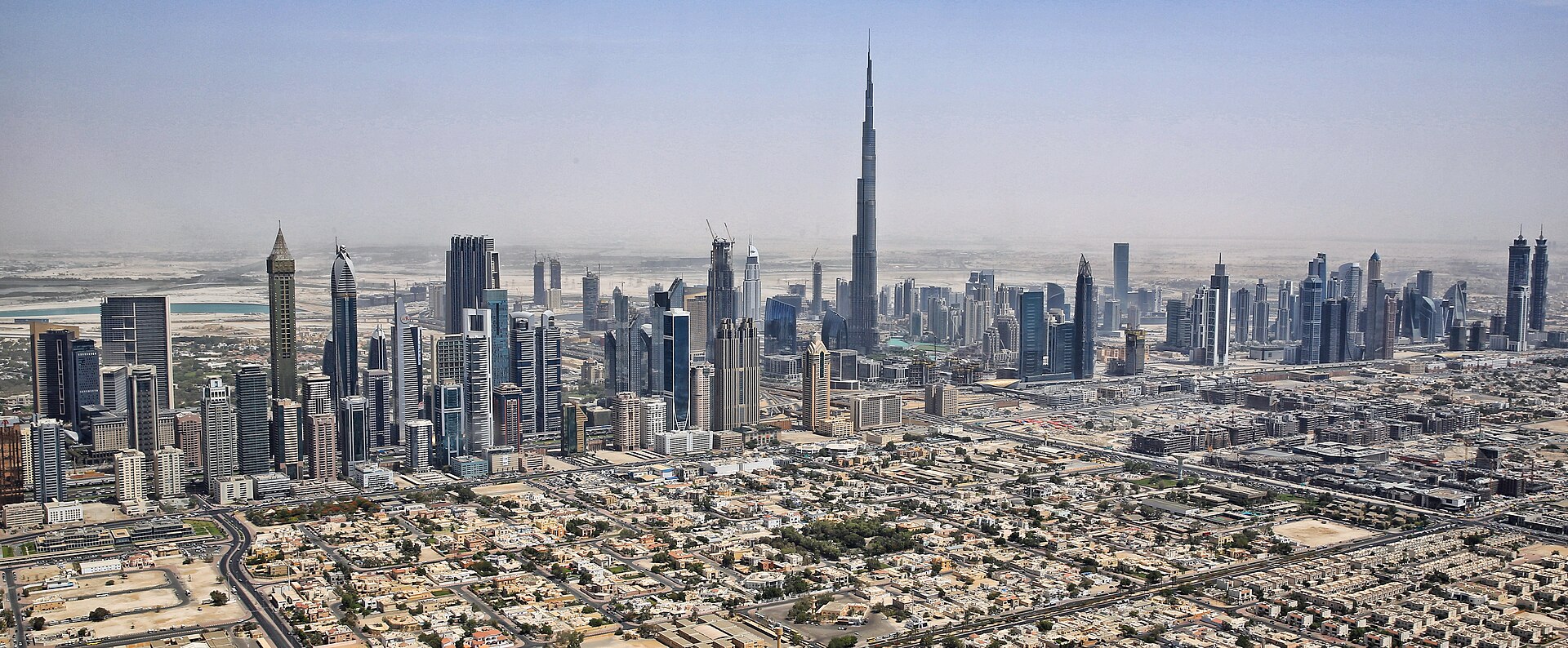
Dubai is the second largest of the seven emirates of the United Arab Emirates and the name of its capital city, a port city on the southern shore of the Persian Gulf whose natural creek made it a centre of fishing, pearling and trade long before oil. First recorded in 1799, Dubai was taken over in 1833 by some 800 Bani Yas tribesmen of the Al Bu Falasah, led by the Maktoum family, who have ruled it since. After the 1966 discovery of the offshore Fateh field and the first oil exports of 1969, the emirate turned deliberately toward trade, ports, aviation, finance and tourism, building Port Rashid (1972), the Jebel Ali free zone (early 1980s) and Emirates airline (mid-1980s). Its record-breaking skyline includes the 828 m Burj Khalifa (2010) and the 150.23 m Dubai Frame (2018), while Dubai International has been the world's number one airport for international passengers since 2014, handling 95.2 million guests in 2025. A city where expatriates vastly outnumber Emiratis, Dubai joined UNESCO's Creative Cities Network as a City of Design in 2017 and hosted the first World Expo in the MEASA region (2020, held 2021-22), drawing 24,102,967 visits.
Setting: creek, coast and desert
The city of Dubai straddles a natural inlet called Dubai Creek, on the southern shores of the Persian Gulf.1 The port city sits at the base of the mountainous Musandam Peninsula.2 It is the capital of the emirate of Dubai and one of the region's most vital commercial and financial centres, housing hundreds of multinational corporations in a forest of skyscrapers.2
The emirate is the second most populous and second largest of the seven emirates that constitute the United Arab Emirates.3 It has an area of about 3,900 square kilometres and a frontage of about 72 km on the Persian Gulf.3 The government portal gives the emirate an area of 4,114 km², which is about 5 per cent of the UAE without the islands.4 It lies on the eastern coast of the Arabian Peninsula, in the south-west corner of the Arabian Gulf.4 It borders Abu Dhabi to the south, Sharjah to the north-east and the Sultanate of Oman to the south-east.4
The climate is hot year-round, like much of the Persian Gulf coastline, with January lows of about 15 °C and July highs of more than 40 °C.1 Beyond the creek and the coast, the wadis of Hatta are counted among the emirate's major attractions.4 The most famous of Dubai's man-made islands is Palm Jumeirah, which has the shape of a palm tree.1 Others include the 'World' islands, a cluster of small islands positioned to resemble a world map when viewed from above.1
Early Dubai: pearls, trade and the Al Maktoum era
The origin of the name Dubai is uncertain.1 One theory associates it with the daba, a type of locust that infests the area, while another holds that it refers to a market that existed near the city.1 The settlement of Dubai town is known from 1799.3 The sheikh of the emirate, then a minor, signed the British-sponsored General Treaty of Peace in 1820, but the area was seemingly dependent on Abu Dhabi until 1833.3
The town's modern history effectively begins in 1833, when a group of Al Bu Falasah clansmen of the Bani Yas confederation, chiefly pearl fishers, left Abu Dhabi in a rivalry dispute.3 They took over Dubai town without resistance.3 Dubai was established in 1833, when some 800 members of the Bani Yas tribe, led by the Maktoum family, settled by Dubai Creek.4 Since then, the Al Maktoum family have ruled Dubai.4
The creek was the town's fortune: a natural harbour that helped Dubai become a centre of fishing, pearling and sea trade.4 By the beginning of the 20th century the town had developed into a successful port city.4 The Maktoum sheikhs, unlike most of their neighbours, long fostered trade and commerce.3 Dubai was an important port by the beginning of the 20th century.3
In foreign affairs the emirate moved within Britain's orbit: together with the rest of the original Trucial States, Dubai signed a maritime truce with Britain in 1835 and the Perpetual Maritime Truce in 1853.3 Its foreign relations were placed under British control by the Exclusive Agreement of 1892.3 When Britain finally left the Persian Gulf in 1971, Dubai was a prominent founding member of the United Arab Emirates.3
Oil money and the trading state
The oil era began offshore: in 1966 the Fateh field was discovered in the Persian Gulf about 120 km due east of Dubai, in waters where the state had granted an oil concession.3 By the 1970s three 20-story submarine tanks, each holding 500,000 barrels, were installed on the seabed at the site.3 Shaped like inverted champagne glasses, they are popularly called the 'Three Pyramids of Dubai.'3 Dubai's first oil exports in 1969 were followed by a period of rapid development that laid the foundations for today's modern society.4
Money reshaped the currency as well as the skyline: after the devaluation of the Gulf rupee in 1966, Dubai joined Qatar in setting up a new monetary unit, the riyal.3 In 1973 Dubai joined the other emirates in the adoption of a national currency, the dirham.3 Sheikh Rashid bin Saeed Al Maktoum, the eighth ruler from the Al Maktoum family, ruled Dubai from 1958 to 1990.4
The state invested its income in trade infrastructure.3 Port Rashid, a deepwater harbour named for the former emir, was opened in 1972, and a supertanker dry dock was completed in 1979.3 In an effort to boost industrial investment, the Jebel Ali port and industrial centre was declared a free-trade zone in the early 1980s, and numerous international companies responded favourably by opening facilities there.3 Emirates airline, the national carrier of the United Arab Emirates, was established by the Dubai government in the mid-1980s.3
The oil endowment itself was modest beside Abu Dhabi's.3 Dubai's estimated oil reserves are less than one-twentieth those of its neighbour, but oil income combined with trading wealth has made the emirate a very prosperous state.3 Investment in the Burj Khalifa and numerous other extravagant projects entailed heavy borrowing.3 With the escalation of the global financial crisis, the emirate's economy was troubled by massive debt and substantial quantities of real estate that lacked prospective buyers.3 Abu Dhabi had recently provided its financially troubled neighbour with a bailout of some $10 billion, and new reliance upon it explains to some extent the decision to rename the Burj Dubai in honour of Abu Dhabi's emir upon its opening.3
The skyline era and the record book
Construction of the Burj Khalifa began on 21 September 2004, and the exterior of the structure was completed on 1 October 2009.5 The tower was to form part of Downtown Dubai, a new 2 km² (490-acre) flagship development at the 'First Interchange', near Dubai's main business district.5 It was developed by Emaar Properties with the architects Skidmore, Owings & Merrill LLP, headed up by the renowned American architect Adrian Smith.5
The monumental edifice officially opened on 4 January 2010 and was certified as the tallest building on the planet.5 Reaching 828 m (2,716 ft 6 in) into the sky, the skyscraper would soon be described as a 'vertical city' and become an icon of the modern world.5 It took the crown of tallest building from Taipei 101 when it officially opened, concluding a construction period that lasted more than seven years.6
The records extend beyond height: the tower has the tallest elevator in a building, at 504 m, the most floors in a building, at 163, and the highest restaurant from ground level, at 441.3 m.5 Its 555.7 m observation deck was formerly the highest in the world until China's Shanghai Tower opened one at 561.3 m in 2015.5 More than 12,000 people from all over the world worked on its construction, and almost 26,000 hand-cut glass panels were used in the exterior cladding.5
The tower was named after the president of the United Arab Emirates and emir of Abu Dhabi, Khalifa ibn Zayed Al Nahyan.1 Close to Sheikh Zayed Road stand the Dubai International Financial Centre, housed in a futuristic arch-shaped building, and the Burj Khalifa itself.1 The emirate's second signature record belongs to the Dubai Frame, measuring 150.23 m (492 ft 10 in) tall and 95.53 m (313 ft 5 in) wide.7 Guinness World Records verified it on 9 May 2019 as the largest building in the shape of a picture frame, achieved by Dubai Municipality.7
Reaching a breath-taking 828 m (2,716 ft 6 in) into the sky, this new skyscraper would soon be described as a 'vertical city' and become an icon of the modern world.
Guinness World Records — “Burj Khalifa: The tallest building in the world” (Hall of Fame)
The largest building in a shape of a picture frame is The Dubai Frame measuring 150.23 m (492 ft 10 in) tall and 95.53 m (313 ft 5 in) wide, and was achieved by Dubai Municipality (UAE) in Dubai, UAE, verified on 9 May 2019.
Guinness World Records — “Largest building in the shape of a picture frame”
Landmarks and key dates
Port Rashid, Dubai's deepwater harbour, opened in 1972.3 The first portion of the driverless metro went into operation in September 2009, the first metro in the Gulf region.3 The Burj Khalifa officially opened on 4 January 2010.5
| Landmark | Opened / dated | Note |
|---|---|---|
| Port Rashid | 1972 3 | A deepwater harbour named for the former emir. 3 |
| Supertanker dry dock | 1979 3 | A supertanker dry dock was completed at Dubai's deepwater port. 3 |
| Jebel Ali free-trade zone | Early 1980s 3 | The Jebel Ali port and industrial centre was declared a free-trade zone to boost industrial investment; numerous international companies opened facilities there. 3 |
| Burj al-Arab | 1999 8 | Designed by architect Tom Wright: a 321 m sail-shaped hotel on an artificial island about 280 m offshore, one of the tallest hotels in the world. 8 |
| Dubai Metro | September 2009 3 | The first portion of a driverless rapid-transit metro line, the first in the Gulf region. 3 The 52.1 km Red Line holds the Guinness record for the longest driverless metro line. 9 |
| Burj Khalifa | 4 January 2010 5 | At 828 m (2,716 ft 6 in) it opened as the tallest building on the planet, taking the crown from Taipei 101. 6 |
| Dubai Frame | 1 January 2018 7 | 150.23 m tall and 95.53 m wide; verified by Guinness World Records on 9 May 2019 as the largest building in the shape of a picture frame, achieved by Dubai Municipality. 7 |
| Al Maktoum International (DWC) | 27 October 2013 10 | Dubai's second airport opened its doors to passengers, with Wizz Air as the launch airline. 10 |
| Expo 2020 Dubai | 1 October 2021 – 31 March 2022 11 | The first World Expo in the Middle East, Africa and South Asia region: 182 days, more than 200 participants and 24,102,967 visits. 11 |
People: a city of expatriates
Expatriates in the city vastly outnumber native Emiratis.1 Although Arabic is the official language, English is, in practice, the lingua franca.1 Because of its large expatriate population, the city feels like a Middle Eastern melting pot, and the atmosphere is generally tolerant.1
The numbers trace the growth: Britannica put the city's population at 2,919,178 in a 2017 estimate.1 A 2020 estimate for the emirate stood at 3,411,200.3 The UAE government portal now gives the emirate's population as 3,759,864.4
In the later 20th century the city's construction boom led to a huge increase in the number of South Asian labourers and an influx of skilled expatriates from all over the world.1 They play an important role in Dubai's multi-sector economy.1 At the national scale, World Bank data put the total population of the United Arab Emirates at 11,513,149 in 2025, with annual population growth of 4.7 per cent.12 Net migration to the UAE reached 158,634 in 2025.12
Construction on the Burj Dubai tower, as the Burj Khalifa was then known, was interrupted by strikes held by the city's large population of expatriate labourers.3 Sheikh Mohammed bin Rashid Al Maktoum became the Ruler of Dubai on 4 January 2006, following the death of his brother and the then Ruler, Sheikh Maktoum bin Rashid Al Maktoum.4 He is the Vice-President and Prime Minister of the UAE.4
Economy: diversification beyond oil
Dubai's economy is now more diversified, relying heavily on trade, services and finance sectors.4 Dubai's GDP reached around AED 115 billion during the first quarter of 2024.4 At the national level, the World Bank reports GDP of about US$552.32 billion for 2024 and GDP per capita of US$50,273.5.12
The value of the UAE's non-oil foreign trade in 2022 amounted to nearly AED 2.233 trillion, reflecting a 17 per cent growth compared with the value of trade in 2021.13 In 2023, non-oil GDP was AED 1.43 trillion at current prices, achieving a growth rate of 9.9 per cent since 2022.13 Dubai's economic geography supports the pattern: it has a large number of small 'free economic zones', academic institutions for developing a knowledge economy, and smart and/or sustainable urban neighbourhoods.14
From the three cities studied, the authors conclude that Dubai currently leads, having largely completed its industrial transition with vast economic diversification and urban expansion.14 Across the board, however, this has had little effect on its ecological footprint.14 Oil income combined with trading wealth has made the emirate a very prosperous state, even though its estimated reserves are less than one-twentieth those of neighbouring Abu Dhabi.3
Aviation, ports and the transport web
Dubai Airports was established as a commercial entity in April 2007, following organisational restructuring of the erstwhile Dubai Department of Civil Aviation.10 It manages the operation of both of Dubai's airports.10 Dubai International (DXB) is the world's number one airport for international guests since 2014, and Dubai World Central – Al Maktoum International (DWC) is presented as the world's future aviation hub.10 Dubai's second airport opened its doors to passengers on 27 October 2013, with Wizz Air as the launch airline.10
DXB recorded its highest-ever annual traffic with 95.2 million guests in 2025, up 3.1 per cent year on year, marking the highest annual international passenger traffic ever recorded by any airport.10 The airport has a total of 526 check-in counters, and its baggage handling system is 175 km long.10 An average bag spends 29 minutes in the system.10
On 28 April 2024 Sheikh Mohammed bin Rashid Al Maktoum, Vice President and Prime Minister of the UAE and Ruler of Dubai, approved a US$35 billion Phase 2 expansion of DWC.10 The project aims to build a 150 million capacity facility over the next 10 years.10 The ultimate capacity of the airport will be 260 million passengers per year and 12 million tonnes of cargo.10
In September 2009 the first portion of a driverless rapid-transit metro line went into operation in Dubai: the first metro in the Gulf region.3 Its Red Line, 52.1 km long, holds the Guinness record for the longest driverless metro line as of 23 May 2011.9 The city's ports complete the web: Port Rashid, the deepwater harbour, dates to 1972, and the Jebel Ali free-trade zone to the early 1980s.3
Culture, design and global soft power
UNESCO describes Dubai, located on the south-east coast of the Persian Gulf, as a cosmopolite city and the business hub of the Middle East.15 The city has long asserted its role as the country's economic driver and technological hub.15 In transiting from an oil-based industry, it aims to reinvent itself by harnessing creativity and innovation to develop a strong creativity-led economy.15
Dubai joined the UNESCO Creative Cities Network in the Design category, with membership dated 2017.15 Committed to placing design and creativity at the heart of its policies, the Dubai Government completed the Dubai Design District (D3).15 The project aims to meet the needs amongst design practitioners, creative professionals and artists of the region, and to formalise dedicated infrastructures supporting design and the cultural ecosystem as a whole.15
Its global showcase was Expo 2020 Dubai, an International Registered exhibition that ran from 1 October 2021 to 31 March 2022 under the theme 'Connecting Minds, Creating the Future', on a site of 438 hectares.11 It was the first World Expo held in the Middle East, Africa and South Asia region.11 Across 182 days, more than 200 participants — including nations, multilateral organisations, businesses and educational institutions — created what the BIE calls the largest and most diverse World Expo ever.11
The fair recorded 24,102,967 visits from 200 participants.11 Built with a meaningful and measurable long-term legacy in mind, the Expo site is transforming into Expo City Dubai.11 The new district is described as a model global community that will rethink the cities of the future.11
Growth, debt and criticism
A satellite-based study found that Dubai grew rapidly between 1972 and 2011, with the rate of urban growth and associated sprawl dependent on local and global drivers.16 Urbanisation in this hyper-arid environment resulted in an increase in vegetation cover and inland water bodies.16 The emirate's offshore islands demonstrate that development has not been constrained by physical barriers or land ownership.16
Britannica notes that criticism of Dubai's authoritarian government and ruling elite is not tolerated, and that there persists an atmosphere of discreet corruption.1 In the construction years, work on the Burj Dubai tower, as the Burj Khalifa was then known, was interrupted by strikes held by the city's large population of expatriate labourers.3 Landscape metrics, meanwhile, reveal rapidly oscillating phases of urban diffusion and coalescence, a sequence the researchers find unique to the Dubai landscape.16
Scholars also question the sustainability record.14 A 2019 study found that Gulf cities have been very active in branding their sustainable urbanisation policies, but that the branding is substantially more impressive than implementation.14 The same study observes that the economic rise has led the emirates to attain the world's highest per capita carbon footprint.14 The World Bank recorded CO2 emissions of 18.3 tonnes per capita for the UAE in 2024.12
Historians of the city look beneath the spectacle.17 Yasser Elsheshtawy's book 'Dubai: Behind an Urban Spectacle' explores Dubai's history from its beginnings as a small fishing village to its place on the world stage today.17 With the help of case studies and surveys, it explores the economic and political forces driving Dubai's urban growth, its changing urbanity and its place within the global city network.17 Looking beyond the glamour of the mega-projects, it provides an in-depth exploration of a select set of spaces which reveal the city's 'inner life'.17
Dubai in numbers
The emirate covers an area of 4,114 km², about 5 per cent of the UAE without the islands.4 The government portal puts the emirate's population at 3,759,864.4 For the country as a whole, World Bank data put the population at 11,513,149 and, for 2024, GDP at about US$552.32 billion and GDP per capita at US$50,273.5.12
| Figure | Value |
|---|---|
| Area of the emirate | 4,114 km² — about 5 per cent of the UAE without the islands 4 |
| Population of the emirate (government estimate, as of 2024) | 3,759,864 4 |
| Population of the city (2017 estimate) | 2,919,178 1 |
| Population of the emirate (2020 estimate) | 3,411,200 3 |
| Population of the UAE (World Bank, 2025) | 11,513,149 12 |
| Burj Khalifa height (as of 2010) | 828 m 5 |
| DXB international guests (2025) | 95.2 million 10 |
| Expo 2020 Dubai visits (as of 2022) | 24,102,967 11 |
| Oil share of Dubai's GDP (as of 2019) | about 6 per cent 14 |
| Climate | January lows about 15 °C; July highs above 40 °C 1 |
Timeline: dates that built Dubai
First record of Dubai town
The settlement of Dubai town is known from 1799, when the area fell under the loose orbit of Abu Dhabi's rulers.
The Al Bu Falasah take Dubai
A group of Al Bu Falasah clansmen of the Bani Yas, chiefly pearl fishers, left Abu Dhabi after a rivalry dispute and took over Dubai town without resistance; some 800 settlers of the Bani Yas led by the Maktoum family settled by the creek.
British control of foreign relations
After a maritime truce in 1835 and the Perpetual Maritime Truce of 1853, Dubai's foreign relations were placed under British control by the Exclusive Agreement of 1892.
Fateh oil field discovered
The offshore Fateh oil field was discovered about 120 km due east of Dubai, in waters where the state had granted an oil concession.
First oil exports
Dubai's first oil exports were followed by a period of rapid development that laid the foundations for today's modern society.
United Arab Emirates founded
When Britain left the Persian Gulf in 1971, Dubai was a prominent founding member of the United Arab Emirates.
Port Rashid opens
Port Rashid, a deepwater harbour named for the former emir, opened in 1972; a supertanker dry dock followed in 1979.
Jebel Ali free-trade zone
Jebel Ali port and industrial centre was declared a free-trade zone; numerous international companies opened facilities there, and Emirates airline had been established by the Dubai government in the mid-1980s.
Burj al-Arab completed
The Burj al-Arab, designed by architect Tom Wright, was completed in 1999: a sail-shaped tower 321 m tall on an artificial island about 280 m offshore, one of the tallest hotels in the world.
Construction of the Burj Khalifa begins
Construction began on what would become the Burj Khalifa, part of the new 2 km2 Downtown Dubai development; its exterior was completed on 1 October 2009.
Sheikh Mohammed becomes Ruler of Dubai
Sheikh Mohammed bin Rashid Al Maktoum became the Ruler of Dubai on 4 January 2006, following the death of his brother Sheikh Maktoum bin Rashid Al Maktoum; he is also Vice-President and Prime Minister of the UAE.
Dubai Metro opens
The first portion of a driverless rapid-transit metro line — the first metro in the Gulf region — went into operation; its Red Line, 52.1 km long, became the Guinness record holder for the longest driverless metro line.
Burj Khalifa opens as the world's tallest building
The 828 m Burj Khalifa officially opened and was certified as the tallest building on the planet; it took the crown from Taipei 101 and also holds records for the most floors (163) and tallest elevator (504 m).
Dubai Frame inaugurated
The Dubai Frame, 150.23 m tall and 95.53 m wide, was inaugurated; Guinness verified it on 9 May 2019 as the largest building in the shape of a picture frame, achieved by Dubai Municipality.
Expo 2020 Dubai opens
Expo 2020 Dubai, the first World Expo in the Middle East, Africa and South Asia region, opened under the theme 'Connecting Minds, Creating the Future'; over 182 days it drew 24,102,967 visits from 200 participants before closing on 31 March 2022.
Frequently asked questions
Where is Dubai?
Dubai is a port city on the southern shores of the Persian Gulf, straddling a natural inlet called Dubai Creek.1 The emirate lies on the eastern coast of the Arabian Peninsula, bordering Abu Dhabi to the south, Sharjah to the north-east and the Sultanate of Oman to the south-east.4
How did Dubai get its name?
There are several theories about the origin of the name Dubai. One associates it with the daba, a type of locust that infests the area, while another holds that it refers to a market that existed near the city.1
When does Dubai's recorded history begin?
The settlement of Dubai town is known from 1799.3 The emirate as it is known today was established in 1833, when some 800 members of the Bani Yas tribe, led by the Maktoum family, settled by Dubai Creek.4
How did oil change Dubai?
The offshore Fateh field was discovered in 1966 about 120 km due east of Dubai.3 Dubai's first oil exports in 1969 were followed by a period of rapid development that laid the foundations for today's modern society.4 Dubai's estimated oil reserves are less than one-twentieth those of Abu Dhabi, but oil income combined with trading wealth has made the emirate a very prosperous state.3
What is Dubai's tallest building?
The Burj Khalifa, which rises 828 m (2,716 ft 6 in) and officially opened on 4 January 2010, when it was certified as the tallest building on the planet.5 It also holds records for the most floors in a building, 163, and the tallest elevator in a building, 504 m.5
How busy is Dubai International (DXB)?
DXB has been the world's number one airport for international guests since 2014, and in 2025 it recorded 95.2 million guests, up 3.1 per cent year on year.10 It has 526 check-in counters and a baggage handling system that is 175 km long.10
Why does Dubai have so many expatriates?
The city's construction boom led to a huge increase in the number of South Asian labourers and an influx of skilled expatriates from all over the world.1 Expatriates in the city vastly outnumber native Emiratis, and although Arabic is the official language, English is, in practice, the lingua franca.1
What was Expo 2020 Dubai?
It was the first World Expo held in the Middle East, Africa and South Asia region, running from 1 October 2021 to 31 March 2022 under the theme 'Connecting Minds, Creating the Future'.11 Over 182 days it recorded 24,102,967 visits from 200 participants, and its site is transforming into Expo City Dubai.11
Dubai at a glance
Sources & citations
Every factual claim in this article is drawn from the sources below. Bracketed numbers in the text link to the corresponding source.
- 1
- 2
- 3
- 4
- 5
- 6
- 7
- 8
- 9
- 10
- 11
- 12
- 13
- 14
- 15
- 16
- 17