Iceland
The North Atlantic island on the Mid-Atlantic Ridge — the Viking settlement of 874, the world's oldest parliament at Þingvellir, glaciers and volcanoes, and a modern economy rebuilt after the 2008 crash.
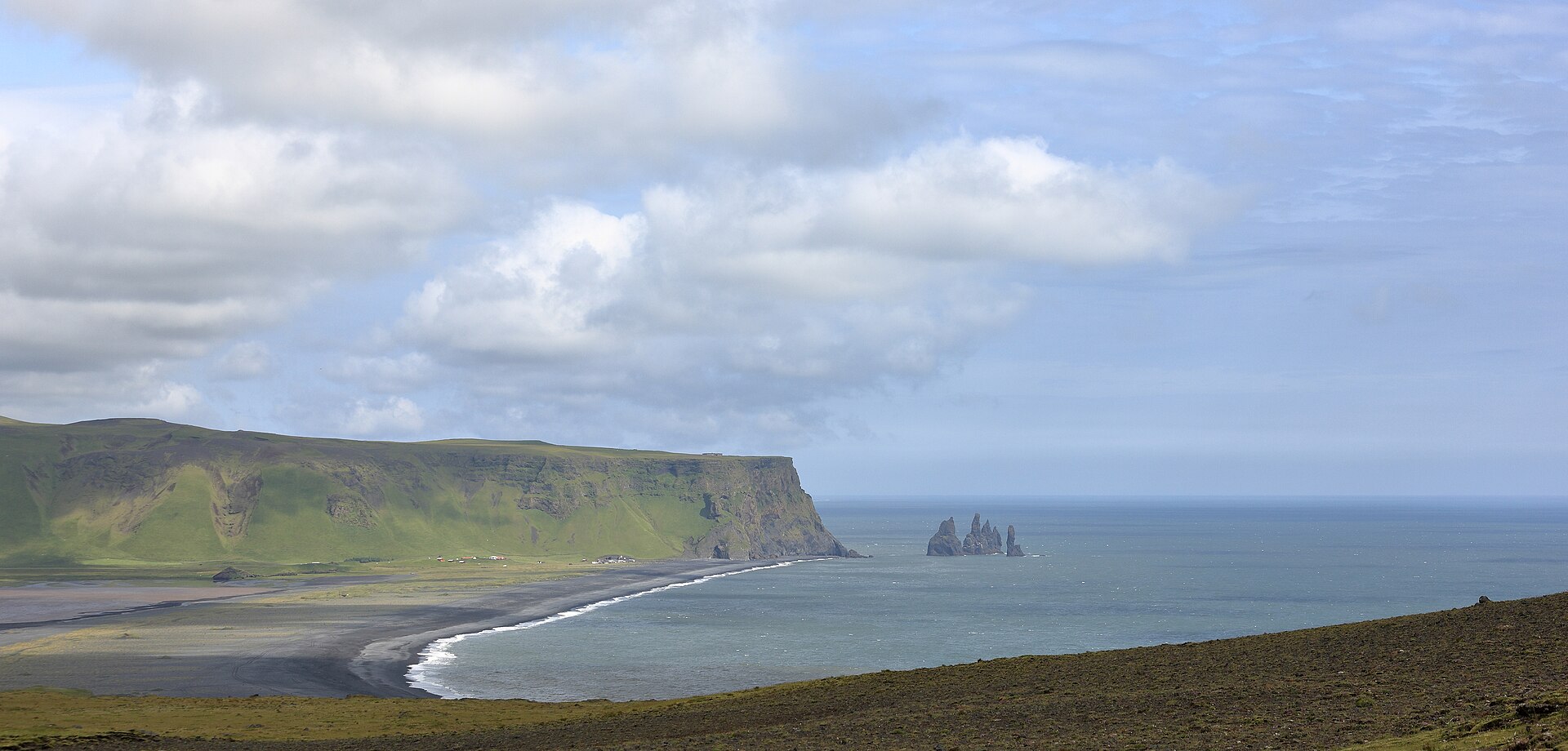
Iceland is a Nordic island country in the North Atlantic, lying on the Mid-Atlantic Ridge about 800 km from Scotland. Norse settlers arrived in the Viking Age — the first permanent settler, Ingólfr Arnarson, is dated to 874 — and by 930 a general assembly, the Althing, was meeting at Þingvellir, a site now inscribed on the UNESCO World Heritage List. The island's volcanic geology shapes everything from its glaciers and geysers to its geothermal economy: it sits atop a plate boundary, contains about 200 volcanoes, and has been shaped by eruptions from Hekla to Eyjafjallajökull in 2010 and the Reykjanes peninsula eruptions of the 2020s. Under Norwegian and then Danish rule for centuries, Iceland won home rule in 1874 and full independence with the founding of the republic at Þingvellir on 17 June 1944. Today its economy — fishing, aluminium smelting, geothermal energy and tourism — has been rebuilt since the 2008 banking collapse; provisional national accounts put GDP at 4,956 billion ISK in 2025, when the economy grew 1.3 percent, while the population reached 396,500 by the middle of 2026.
Overview
Iceland is a Nordic island country in the North Atlantic, lying on the Mid-Atlantic Ridge about 800 kilometres from Scotland.1 It has a total area of about 103,000 square kilometres, and its capital is Reykjavík.1 It is a unitary multiparty republic with one legislative house, the Althingi, with 63 members, regarded as the world's oldest parliament.1
The population was 396,500 at the end of the second quarter of 2026, an increase of 1,450 from the previous quarter.2 Glacier ice and cooled lava each cover approximately one-tenth of the country's total area.1 Iceland contains about 200 volcanoes of various types.1
According to Landnámabók, the first permanent settler, Ingólfr Arnarson, came from Norway and settled in the year 874 at a site he named Reykjavík.3 The Althing was established at Þingvellir in 930 and continued to meet there until 1798.4 The republic was founded at Þingvellir on 17 June 1944, with Sveinn Björnsson as its first president.5 Its modern economy — fisheries, aluminium smelting, geothermal energy and tourism — was rebuilt after the banking collapse of 2008.6 Provisional accounts put nominal GDP at 4,956 billion ISK in 2025, when the economy grew 1.3 percent.7
Geography and landscape
Iceland's coastline of more than 3,000 miles (4,800 kilometres) meets the Greenland Sea on the north and the Norwegian Sea on the east.1 The Atlantic Ocean washes its south and west coasts.1 The Denmark Strait — which separates the island from Greenland by about 200 miles (320 kilometres) — lies to the northwest.1
Much of the island is underlain by basalt, a dark igneous rock, and the oldest rocks were formed about 16 million years ago.1 Its average elevation is 500 metres above sea level, although one-fourth of the country lies below 198 metres.1 The highest point is 2,119 metres, at Hvannadals Peak, the top of Öræfajökull in Vatnajökull.1 The glaciers are a reminder of Iceland's proximity to the Arctic Circle, which nearly touches its northernmost peninsula.1
Vatnajökull, the country's largest glacier, covers an area equal to the combined total of all the glaciers on the continent of Europe.1 Fjords cut into the coastline, and lava fields spread across the interior.1 A new volcano erupting on the sea floor between November 1963 and June 1967 created the island of Surtsey, off the southwestern coast.1
Geology, volcanoes and the Mid-Atlantic Ridge
Iceland sits on top of the Mid-Atlantic Ridge.1 Geologists describe the island's volcanism through volcanic systems: a central volcano and the fissure swarms that extend out from it, as a rule named after the central volcano.8 A seismic refraction experiment along 225 kilometres of the Kolbeinsey Ridge and the Tjörnes Fracture Zone quantified the influence of the Iceland hot spot on melt flux north of Iceland.9
It is estimated that since the year 1500 about one-third of the Earth's total lava flow has poured from Iceland's volcanoes.1 In 1973 a volcano on Heimaey spilled lava into the town of Vestmannaeyjar; more than 5,000 residents were evacuated and about one-third of the town was destroyed.1 Hekla, the country's best-known volcano, erupted four times in the 20th century — in 1947, 1970, 1980 and 1991 — and also had a series of small eruptions in 2000.1 Eyjafjallajökull erupted in March 2010 for the first time since 1821 and again from 14 April, sending wandering ash plumes that disrupted air traffic for days across northern and central Europe.1
The volcanic eruption that began on 16 July on the Sundhnúkur crater row — the ninth eruption there — is now officially over, and a new hazard map has been issued.10 Despite the end of the eruption, life-threatening conditions remain in the area due to unstable lava and the potential for gas pollution.10 Uplift has resumed, and model calculations indicate that around 27.5 million cubic metres of magma have accumulated beneath Svartsengi since about mid-July last year.10 The strain on nearby Grindavík has been severe: the town lost 427 residents, a decrease of 34.3 percent between years.11
Iceland has more hot springs and solfataras — volcanic vents that emit hot gases and vapours — than any other country.1 Alkaline hot springs are found in some 250 areas, and the largest, Deildartunguhver, emits nearly 190 litres of boiling water per second.1 Geothermal heat serves the capital region and its greenhouses.1
Settlement and the Commonwealth (874–1262)
The settlement story rests on two medieval texts: Íslendingabók and Landnámabók, the Book of Settlements.3 According to Landnámabók, the first permanent settler, Ingólfr Arnarson, settled at Reykjavík in the year 874.3 The Book of Settlements enumerates more than 400 settlers who sailed with their families, servants and slaves to Iceland to stake claims to land.3 A layer of tephra — volcanic ash — found in Greenland ice and dated to about 870 coincides in places with the earliest remains of human habitation in Iceland.3 According to the early Icelandic sources, some Irish monks were living in Iceland when the Nordic settlers arrived, but they soon left, unwilling to share the country with heathens.3
By the end of the settlement period, a general assembly called the Althing had been established, held at midsummer on a site that came to be called Þingvellir.3 Heathen worship was organized around a class of chieftains called godar, about 40 in number, who formed the ruling class in the absence of royal power.3 The assembly consisted of a law council, the lögrétta, in which the godar made and amended the laws, and courts of justice in which householders nominated by the godar acted on the panels of judges.3 No one was vested with executive power over the country as a whole, and democratic practice reached no farther down the social scale than the heads of farming households; women and workers, free or enslaved, had no role in the political system.3
In 999 or 1000 the Althing made a peaceful decision that all Icelanders should become Christians.3 Two bishoprics were established, one at Skálholt in 1056 and the other at Hólar in 1106.3 Codification of the law was begun in the years 1117–18, and the Icelanders later began to write sagas, which reached their pinnacle of literary achievement in the next century.3 Early Icelandic society prospered: sheep and cattle were raised for meat and milk, homespun cloth became the chief export, and grain was always imported.3
Þingvellir and the Althing: a World Heritage site
Þingvellir is the national park where the Althing was established in 930 and continued to meet until 1798.4 Over two weeks a year, the assembly set laws — seen as a covenant between free men — and settled disputes.4 The World Heritage property includes the remains of the Althing itself: fragments of around 50 booths built from turf and stone, with tenth-century remains thought to be buried underground.4
The national park preserves the assembly ground at the Law Rock, within the Almannagjá rift.4 The floor of the valley has subsided by some 3–4 metres since the Alþing was founded there and will continue to do so in an active seismic zone.4 The park preserves landscape evidence of settlement extending back to the time of the assembly's establishment.4
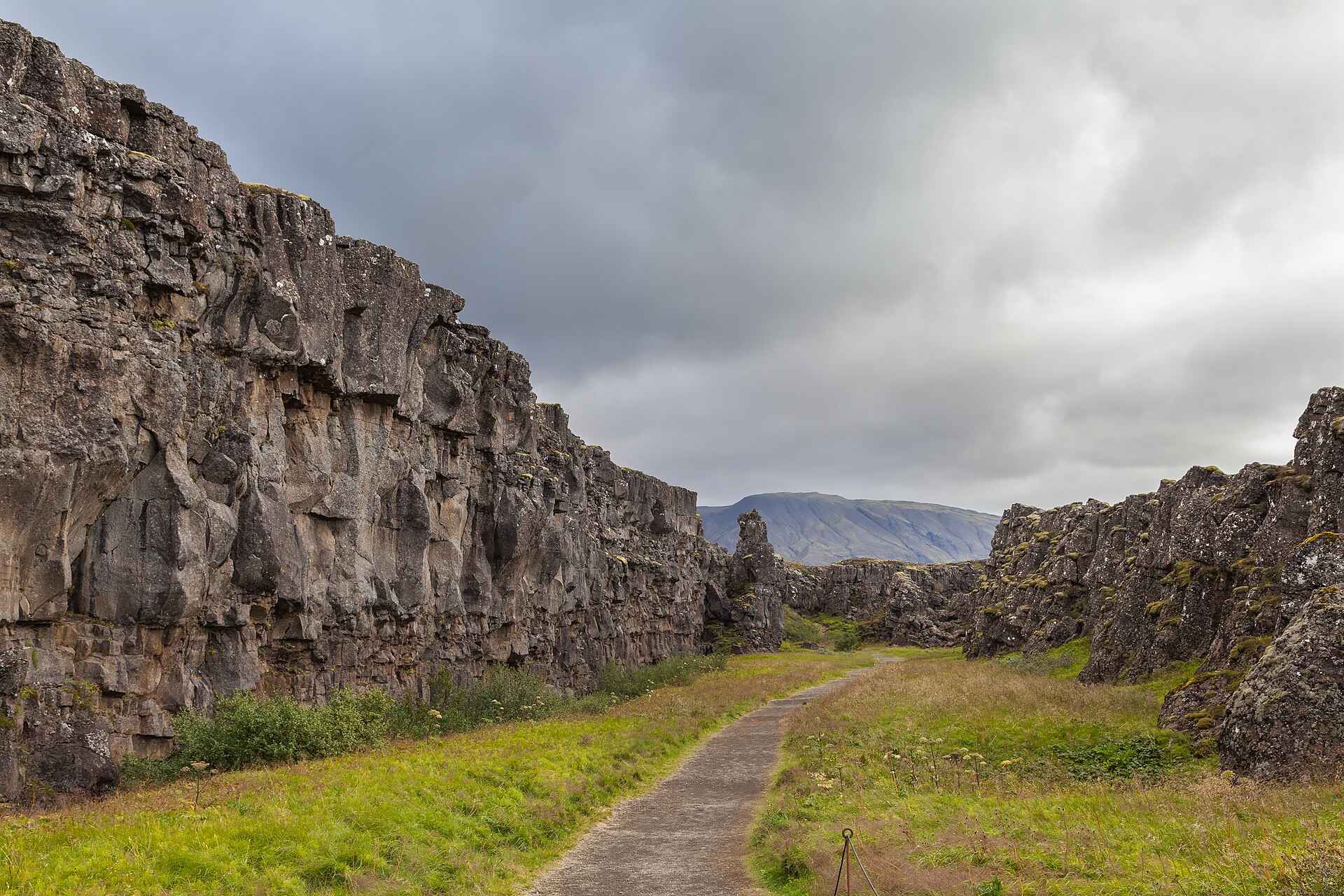
Þingvellir National Park was inscribed on the UNESCO World Heritage List in 2004 under criteria (iii) and (vi).4 Criterion (iii) finds in the Alþing and its hinterland a unique reflection of medieval Norse/Germanic culture, persisting in essence from its foundation in 930 until the 18th century.4 Criterion (vi) notes that the Alþing, known through the 12th-century Icelandic sagas and reinforced during the independence struggle, has given the site iconic status as a shrine of national Icelandic identity.4
Foreign rule and the road to independence (1262–1944)
In 1262–64 all Icelandic chieftains and representatives of the farmers were persuaded to swear allegiance to the king of Norway, partly in the hope that he would bring peace to the country.3 In 1380 the Norwegian monarchy entered into a union with the Danish crown, but Iceland's status within the realm as a personal skattland of the crown was unaffected.14 The Lutheran Reformation met greater resistance in Iceland than anywhere else in the realm: in 1541 the bishop of Skálholt was captured and Lutheranism introduced in his diocese, while Bishop Jón Arason of Hólar held out until 1550, before being captured and beheaded.14
In 1602 all foreign trade in Iceland was monopolized by a royal decree and handed over to Danish merchants.14 The arrangement lasted nearly two centuries, and in 1787 the monopoly was abolished.14 In 1800 the Althing was abolished, and an appeals court was set up in Reykjavík to succeed it.14 In 1845 a restored Althing met for the first time — not at Thingvellir, as originally intended, but in Reykjavík.5 In 1874 the king presented Iceland with a constitution whereby the Althing was vested with legislative power in internal affairs.5
Home rule followed in 1904, and on 1 December 1918 Iceland became a separate state under the Danish crown, with only foreign affairs remaining under Danish control.5 The German occupation of Denmark in April 1940 effectively dissolved the union, and a month later British forces occupied Iceland.5 In 1941 the United States took over the defense of Iceland and stationed a force of 60,000 in the country.5 On 17 June 1944, now celebrated as National Day, the Icelandic republic was founded at Thingvellir, with Sveinn Björnsson as its first president.5
The republic and the 2008 financial crisis
After the Second World War, Iceland developed into a modern welfare state.5 A rapid restoration of the trawler fleet prevented the return of prewar unemployment, and fish freezing became the mainstay of the country's exports.5 After the war Iceland gradually extended its exclusive fishing zone from 3 nautical miles in 1950 to 200 miles in 1975.15 The struggle with Britain, commonly known as the Cod Wars, ended in 1976 when Britain recognized the 200-mile limit.15
The tide of capital reversed abruptly in 2008, when foreign investors fled Iceland's bond market.6 The value of the króna plunged more than 70 percent before all currency trading was suspended, and the domestic stock market shed 90 percent of its value.6 The central government took control of the three largest private banks, which held a combined liability equal to roughly 10 times the country's pre-crisis GDP.6 A series of austerity measures was implemented to secure a $2 billion loan from the International Monetary Fund.6 In the wake of the financial crisis, GDP dropped by 6.5 percent in 2009 and by 4 percent in 2010, while unemployment hovered between 9 and 10 percent.6
In July 2009 the legislature narrowly approved a proposal to seek EU membership, and a week later the country submitted its formal application.15 Demonstrators harangued officials and banged kitchenware outside the Althing, igniting the Pots and Pans Revolution.6 The Althing then decided that a new constitution should be drafted: in 2010 a national assembly of 950 members drawn randomly from the population determined its principles, and a committee of 25 wrote the text, soliciting feedback across 12 versions.6 In October 2012 a final draft was endorsed by some two-thirds of those who voted in a nonbinding referendum, but its adoption stalled in the Althing.6 In April 2016 the prime minister was forced to resign after a leak of more than 11 million documents from a Panamanian law firm revealed that he had links to offshore companies in tax havens.6
Economy: fisheries, aluminium and tourism
Fishing has shaped the economy since the postwar years.5 The economy also rests on aluminium smelting, powered by the country's geothermal and hydroelectric energy, and on tourism.1 In 2025, an average of 235,900 people aged 16 to 74 were active in the Icelandic labour market, an activity rate of 81.4 percent.16
Preliminary results for 2025 indicate that GDP increased by 1.3 percent in volume terms, with the nominal level estimated at 4,956 billion ISK.7 The main driver of growth was private consumption, which grew by 4.3 percent, while gross domestic final expenditure increased by 3.9 percent in volume.7 GDP is estimated to have contracted by 0.6 percent in real terms in the fourth quarter of 2025 compared with a year earlier.7 The Consumer Price Index in August 2026 was 694.6 points, 0.20 percent higher than in the previous month.17 The CPI is 5.6 percent higher in August 2026 than a year earlier, while the CPI less housing cost is 5.2 percent higher.17
Revised national accounts put economic growth in 2024 at -1.3 percent, following 5.0 percent in 2023 and 8.9 percent in 2022.7 An average of 225,700 people aged 16 to 74 were employed in 2025, an employment rate of 77.8 percent, down from 79.5 percent in the year before.16 On average 10,300 people were unemployed in 2025, corresponding to 4.3 percent of the labour force, up from 3.3 percent a year earlier.16
Iceland in figures
Iceland's population was 394,324 on 1 January 2026, an increase of 4,880, or 1.3 percent, from a year earlier.11 At the end of the second quarter of 2026 it stood at 396,500, an increase of 1,450 from the previous quarter.2
| Figure | Value | As of |
|---|---|---|
| Population | 394,32411 | 1 January 202611 |
| Population, end of Q2 2026 | 396,5002 | Q2 20262 |
| Nominal GDP | 4,956 billion ISK7 | 20257 |
| GDP growth, volume | 1.3 percent7 | 20257 |
| GDP, current US dollars | 33.2 billion US$18 | 202418 |
| GDP per capita | US$85,86318 | 202418 |
| Inflation, 12-month | 5.6 percent17 | August 202617 |
| Unemployment, average | 4.3 percent16 | 202516 |
| Immigrants, share of population | 19.6 percent19 | 1 January 202619 |
| Currency | Icelandic króna (ISK)1 | — |
Society and the people
On 1 January 2026 the population stood at 394,324.11 The number of males increased by 1.3 percent from the previous year, females by 1.2 percent and non-binary/other by 8.5 percent.11 There were 62 municipalities in Iceland on 1 January 2026; Reykjavík was the most populous, with 139,804 inhabitants.11 In the second quarter of 2026 the Capital region counted 253,230 inhabitants, while 143,270 people lived in other regions.2 Reykjavík — 'Bay of Smokes' — is the site of the island's first farmstead and a thriving city.1
Immigrants numbered 77,226 on 1 January 2026, or 19.6 percent of the total population.19 People born in Poland were the largest group, 23,055 people or 29.9 percent of the immigrant population, followed by people born in Ukraine at 6.1 percent and in Lithuania at 4.9 percent.19 Foreign citizens numbered 71,130 by the end of the second quarter of 2026, or 17.9 percent of the population.2 About 64.8 percent of first- and second-generation immigrants lived in the Capital region.19
Over the last ten years the share of people aged 0–19 among the working-age population fell from 45.9 to 40.3 percent, while the share of the elderly aged 65 and over rose from 23.9 to 27.0 percent and has never been higher.11 In 2025 the fertility rate in Iceland was 1.56, matching the record low of 2024 and the lowest level since measurements began in 1853.19 In the second quarter of 2026, 1,130 children were born, 590 persons died and net migration was 930 persons.2
Britannica describes Iceland as the world's oldest democracy, and so ethnically homogeneous that genetic researchers have used its inhabitants to study hereditary disorders.1 The head of state is President Halla Tómasdóttir.1 The country's political record includes gender milestones such as Vigdís Finnbogadóttir.15 In 2009 Jóhanna Sigurðardóttir became Iceland's first female prime minister and the world's first openly gay head of government.15 In the 2016 election, 30 women were elected to the Althing, increasing the proportion of female members to more than 47 percent.15
Iceland and the world: Nordic and European cooperation
Iceland is a member of the Nordic Council, formed in 1952 as the official body for formal inter-parliamentary co-operation.20 The council today has 87 members from Denmark, Finland, Iceland, Norway, Sweden, the Faroe Islands, Greenland and Åland.20 Iceland became a member of the World Bank in 1945 and has worked with it ever since.18
Iceland is not a member of the European Union.15 It entered the European Free Trade Association in 1970, during the period of the Independence and Social Democratic coalition.15 It also participates in European cooperation through the EEA.15
Iceland's medieval literature is inseparable from its history: the sagas were handed down by word of mouth, told from Althing to Althing.12 Dasent's translation dates from 1861.12 The most celebrated of the sagas is Njáls saga, praised by its translator for truthfulness and beauty.12
Of all the Sagas relating to Iceland, this tragic story bears away the palm for truthfulness and beauty
Sir George Webbe Dasent on Njáls saga — The Story of Burnt Njal, Project Gutenberg edition
Timeline of Iceland
The first permanent settler: Ingólfr Arnarson
According to Landnámabók the first permanent settler, Ingólfr Arnarson, came from Norway and settled at a site he named Reykjavík.3
The Althing is established at Þingvellir
The Althing, an open-air assembly representing the whole of Iceland, was established at Þingvellir and continued to meet until 1798.4
Christianity adopted by a decision of the Althing
In 999 or 1000 the Althing made a peaceful decision that all Icelanders should become Christians.3
Allegiance sworn to the king of Norway
All Icelandic chieftains and representatives of the farmers were persuaded to swear allegiance to the king of Norway, partly in the hope that he would bring peace.3
Union with the Danish crown
The Norwegian monarchy entered into a union with the Danish crown; Iceland remained a personal skattland of the crown.14
The Reformation is completed
Bishop Jón Arason of Hólar was captured and beheaded, and all resistance to the Reformation ended; his death is traditionally understood to mark the end of the Middle Ages in Iceland.14
The Althing is abolished
The Althing was abolished and an appeals court was set up in Reykjavík to succeed it.14
A restored Althing meets
A restored Althing met for the first time — not at Thingvellir, as originally intended, but in Reykjavík.5
A constitution is granted
The king presented Iceland with a constitution whereby the Althing was vested with legislative power in internal affairs.5
Iceland becomes a separate state under the Danish crown
On 1 December 1918 Iceland became a separate state under the Danish crown, with only foreign affairs remaining under Danish control.5
Occupation and the Second World War
The German occupation of Denmark dissolved the union, British forces occupied Iceland a month later, and in 1941 the United States took over the island's defense.5
The republic is founded at Þingvellir
On 17 June 1944, now celebrated as National Day, the Icelandic republic was founded at Thingvellir, with Sveinn Björnsson as its first president.5
The banking system collapses
The króna plunged more than 70 percent before currency trading was suspended, the stock market shed 90 percent of its value, and the government took control of the three largest private banks.6
Eyjafjallajökull disrupts European air traffic
Eyjafjallajökull erupted in March 2010 for the first time since 1821 and again from 14 April, sending ash plumes that disrupted air traffic across northern and central Europe for days.1
Ninth eruption on the Sundhnúkur crater row ends
The volcanic eruption that began on 16 July on the Sundhnúkur crater row is now officially over, though magma continues to accumulate beneath Svartsengi near Grindavík.10
Population reaches 396,500
Iceland's population at the end of the second quarter of 2026 was 396,500, an increase of 1,450 from the previous quarter.2
Frequently asked questions
Where is Iceland, and what is its capital?
Iceland is a Nordic island country in the North Atlantic, lying on the Mid-Atlantic Ridge about 800 kilometres from Scotland.1 Its capital is Reykjavík.1
How large is Iceland, and what is its highest point?
It has a total area of about 103,000 square kilometres.1 Its highest point is 2,119 metres, at Hvannadals Peak, the top of Öræfajökull in Vatnajökull.1
What is the population of Iceland?
The population was 394,324 on 1 January 2026.11 At the end of the second quarter of 2026 it had reached 396,500, an increase of 1,450 from the previous quarter.2
Who were the first settlers of Iceland?
According to Landnámabók, the first permanent settler was Ingólfr Arnarson, who came from Norway and settled in the year 874 at a site he named Reykjavík.3 The Book of Settlements enumerates more than 400 settlers who sailed to Iceland to stake claims to land.3
What is the Althing, and when was it established?
The Althing is an open-air assembly representing the whole of Iceland that was established at Þingvellir in 930 and continued to meet until 1798.4 The site was inscribed on the UNESCO World Heritage List in 2004.4
Why does Iceland have so many volcanoes and eruptions?
Iceland sits on top of the Mid-Atlantic Ridge, and it is estimated that since the year 1500 about one-third of the Earth's total lava flow has poured from its volcanoes.1 The island contains about 200 volcanoes of various types.1
What happened to Iceland's economy in 2008?
The value of the króna plunged more than 70 percent before all currency trading was suspended, and the domestic stock market shed 90 percent of its value, while the government took control of the three largest private banks.6 GDP dropped by 6.5 percent in 2009 and by 4 percent in 2010.6
Is Iceland in the European Union?
Iceland is not a member of the European Union; it entered the European Free Trade Association in 1970 and participates in European cooperation through the EEA.15 In July 2009 the legislature narrowly approved a proposal to seek EU membership, and the country submitted its formal application a week later.15
Knowledge graph
Sources & citations
Every factual claim in this article is drawn from the sources below. Bracketed numbers in the text link to the corresponding source.
- 1
- 2
- 3
- 4
- 5
- 6
- 7
- 8
- 9
- 10
- 11
- 12
- 13
- 14
- 15
- 16
- 17
- 18
- 19
- 20