World War II
The 1939–1945 conflict that killed tens of millions, destroyed the Third Reich, and built the institutions of the postwar world
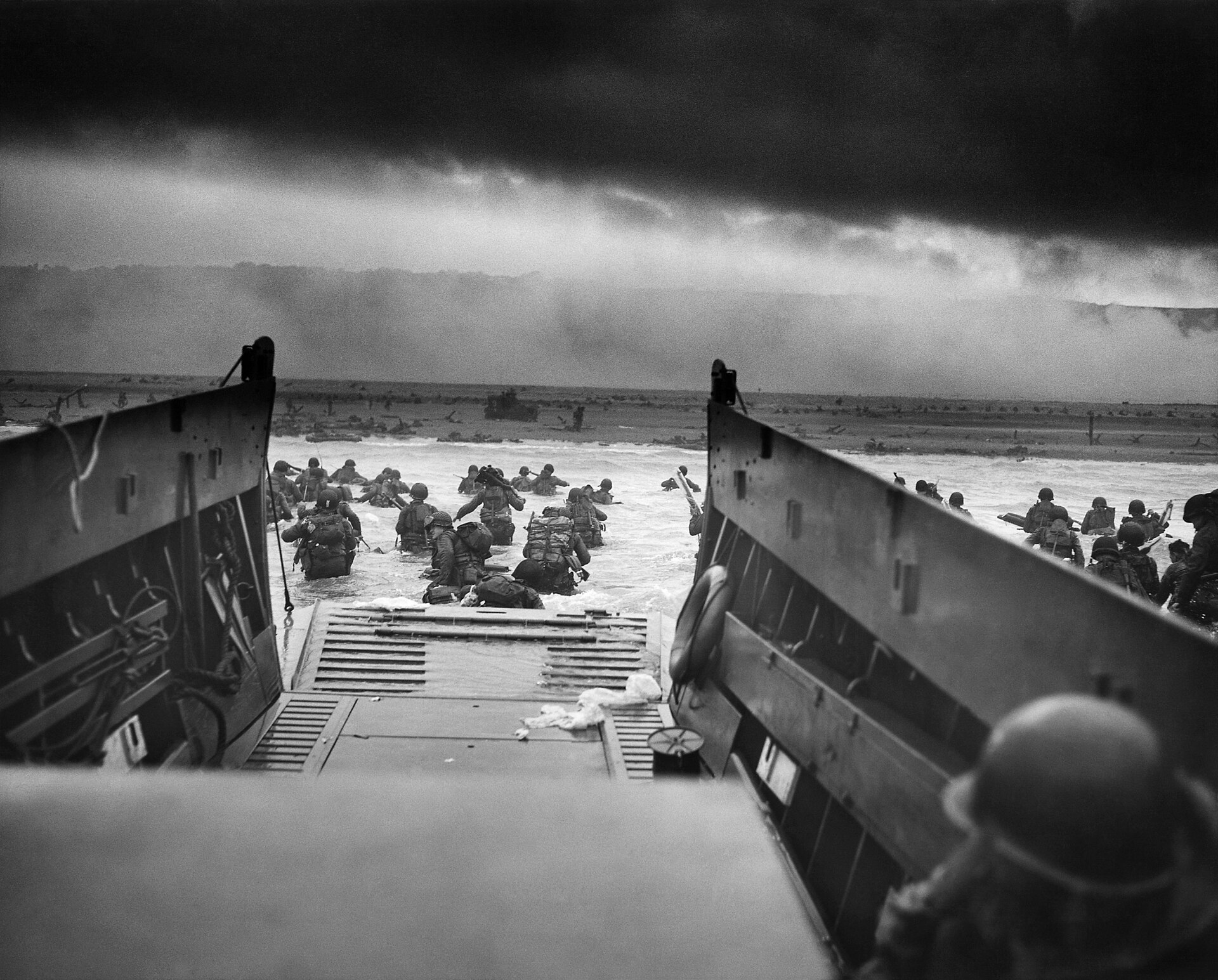

World War II (1939–1945) was the largest and deadliest war in history. It began in Europe on 1 September 1939, when Germany invaded Poland, and became global in 1941 with Operation Barbarossa and the attack on Pearl Harbor. The Axis powers — Germany, Italy and Japan — were defeated by the Allies — France, Great Britain, the United States, the Soviet Union and China — after the turning points of Midway, El Alamein and Stalingrad and the Normandy landings of 6 June 1944. Germany surrendered in May 1945; Japan in September 1945, after the atomic bombings of Hiroshima and Nagasaki. Estimates of the dead vary widely — Britannica gives 35,000,000–60,000,000, other tabulations differ — because wartime statistics are inexact. The Holocaust, documented by the United States Holocaust Memorial Museum, murdered six million European Jews and millions of others. The war produced the United Nations, accelerated decolonisation, and inaugurated the Cold War.
The largest war in history
World War II began in Europe on 1 September 1939, when Germany invaded Poland.1 Great Britain and France declared war on Germany on 3 September 1939, at 11:00 am and 5:00 pm respectively.1 The main combatants were the Axis powers — Germany, Italy and Japan — and the Allies — France, Great Britain, the United States, the Soviet Union and, to a lesser extent, China.1 The Allied wartime leaders were Winston Churchill, Joseph Stalin, Charles de Gaulle, Franklin D. Roosevelt and Harry S. Truman; the Axis leaders were Adolf Hitler, Benito Mussolini and Hideki Tojo.1
Estimates of the total number of people killed during World War II have ranged from 35,000,000 to 60,000,000 — a significant span, because statistics about the war's casualties are inexact.1 The 40,000,000–50,000,000 deaths in Britannica's overview make it the bloodiest conflict, as well as the largest war, in history.1 A National WWII Museum tabulation counts approximately 15,000,000 battle deaths, 25,000,000 battle wounded and 45,000,000 civilian deaths worldwide.2 Casualty estimates vary widely between sources; civilian deaths in China alone might well exceed 50,000,000.2
Figures differ for a reason: wartime statistics are inexact, and tabulations rest on different definitions of military and civilian losses.1 Every figure in this article therefore keeps its source, definition and date, with ranges preserved as published.2 Britannica's own numbers show the spread — 35,000,000–60,000,000 in one estimate, 40,000,000–50,000,000 in the other.1
Causes: the interwar breakdown
World War II followed years of international tension and aggressive expansion by Fascist Italy and Nazi Germany, and it grew from disputes left unsettled by World War I.3 Economic crises and the collapse of collective security left the democracies unable to hold the line.3 The pressures culminated in the German invasion of Poland on 1 September 1939; Britain and France declared war on Germany two days later.3
Racial ideology was a foundation of the regime.1 When Hitler came to power legally on 30 January 1933, the assault against the Jews began on 1 April with a boycott of Jewish businesses.4 The Nürnberg Laws, promulgated at the annual Nazi Party rally in Nürnberg on 15 September 1935, became the centerpiece of anti-Jewish legislation and a precedent for defining and categorizing Jews in all German-controlled lands.4 In 1941 the Nazi regime unleashed a war of extermination against Jews, Slavs and other people deemed inferior by Hitler's ideology.1
By 1939 Hitler was determined to invade Poland, and the German-Soviet Nonaggression Pact — signed on 23–24 August 1939, with a secret protocol dividing Poland — cleared the diplomatic ground for the attack.1 German forces began the invasion at 4:45 a.m. on 1 September 1939, the attack Hitler had ordered, and World War II had begun in Europe.1
1939–1941: from a European war to a world war
The war in Europe had begun with the invasion of Poland on 1 September 1939.1 Great Britain and France declared war on Germany on 3 September, at 11:00 am and 5:00 pm respectively.1 The first winter passed in the lull that became known as the ‘Phoney War’.1
In May–June 1940 German forces invaded Denmark, Norway, the Low Countries and France.3 The German invasion of France pushed the British Expeditionary Force, with French and Belgian troops, back to Dunkirk, and a rescue operation was mounted from across the Channel.3 From 10 July to 31 October 1940 the Battle of Britain, a major air campaign, was fought over the skies of southern England.3 From September 1940, Hitler instructed the Luftwaffe to begin bombing British cities; over the next nine months, over 43,500 civilians were killed in the Blitz.3
In 1941 the war became global.1 The war between the Soviet Union and Germany began on 22 June 1941 with Operation Barbarossa, the German invasion of the Soviet Union.1 On 7 December 1941, Japan launched a surprise air attack on the US naval base at Pearl Harbor in Hawaii, and Japanese forces overran Allied possessions in south-east Asia and the Philippines.3 On 15 February 1942, at Singapore, Lt General Arthur Percival signed the largest surrender in British history: his force of 85,000 men had been defeated by just 35,000 Japanese troops.3
The two theatres at a glance
World War II was fought across two principal theatres and their margins: Europe, with the Atlantic and North Africa, and the Pacific, with East Asia.1 The two differed in geography, forces and turning points: land armies, air power, U-boats and strategic bombing dominated one theatre, while carrier fleets and island fighting defined the other.5 Each had its own opening, turning point and ending, as the table below sets out.1
| Aspect | Europe & North Africa | Pacific & East Asia |
|---|---|---|
| Opening | 1 September 1939 — Germany invades Poland1 | 7/8 December 1941 — Japan attacks Pearl Harbor and other American, Dutch and British installations throughout Asia1 |
| Character | Land armies, air power, U-boats and strategic bombing3 | Carrier fleets and island fighting; a naval war fought almost entirely with aircraft5 |
| Turning point | El Alamein, October 1942, and Stalingrad, February 19436 | Midway, June 19425 |
| End | Germany surrenders 8 May 19457 | Japan signs surrender 2 September 19457 |
The Pacific war and Midway
The Pacific war opened on 7 December 1941, when Japan launched a surprise air attack on the US naval base at Pearl Harbor in Hawaii.3 Britannica dates the war's start to 7/8 December 1941, when Japan also attacked other American, Dutch and British military installations throughout Asia.1 Japanese forces overran Allied possessions in south-east Asia and the Philippines, and by mid-1942 Japan's conquests encompassed a vast area of south-east Asia and the western Pacific.1
The war in the Pacific turned against Japan during the Battle of Midway, 3–6 June 1942.1 Fought almost entirely with aircraft, some 1,100 miles west of Hawaii, it was an American victory that destroyed Japan's first-line carrier strength and most of its best trained naval pilots.5 Japan suffered catastrophic losses—four carriers and over 320 aircraft—marking its most significant naval defeat since 1592.5 The United States lost one carrier.5
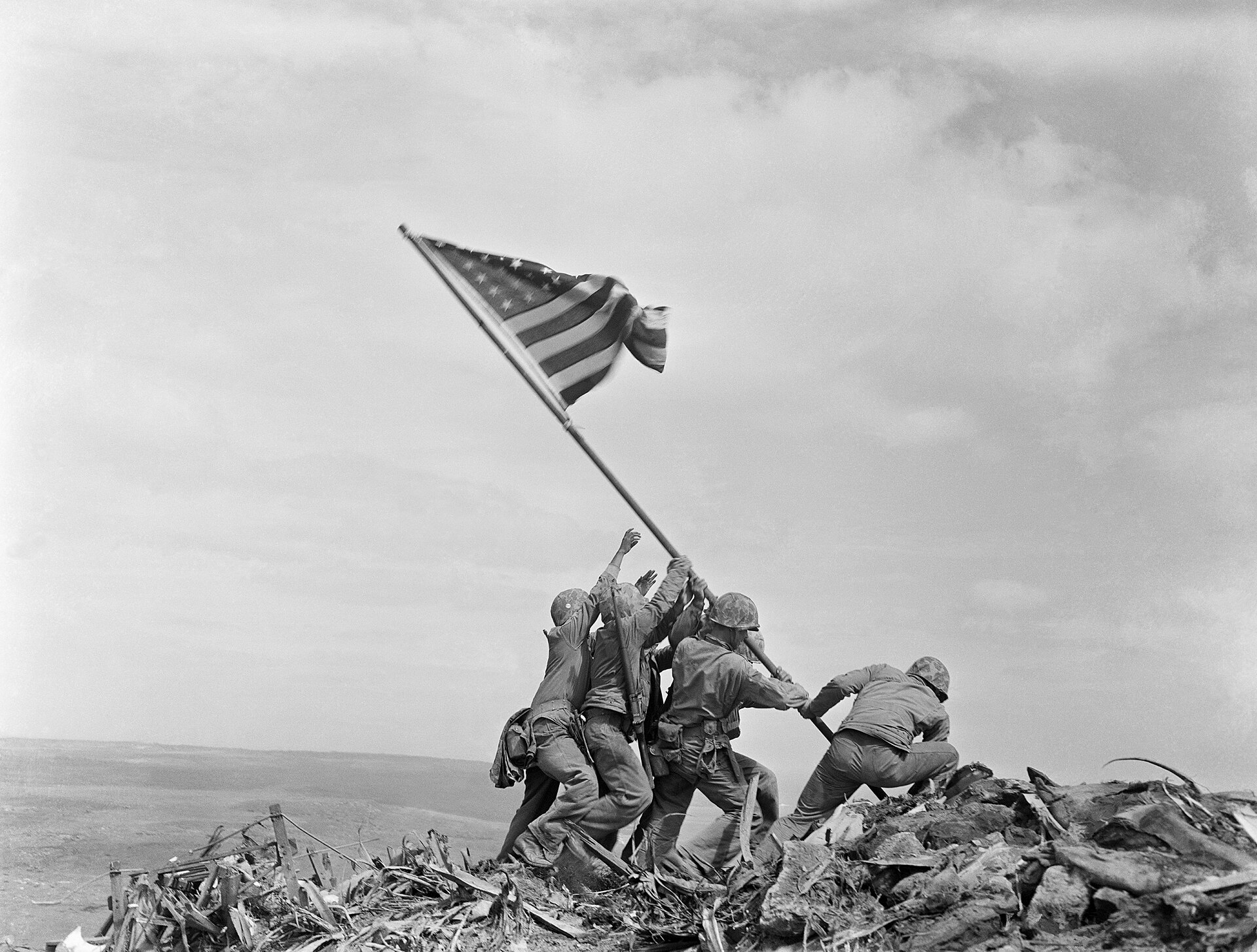

The battle brought the naval forces of Japan and the United States to approximate parity, signifying a turning point in the Pacific conflict.5 Together with the Battle of Guadalcanal, it ended the threat of further Japanese invasion in the Pacific.5 It also ended Japan's ability to prosecute an offensive war.1 As the Allies pushed the Japanese back across the Pacific, hundreds of thousands were killed in firebombings of Japanese cities.1
North Africa and El Alamein
In the summer of 1942, the British 8th Army was in a crisis.8 After being defeated at the Battle of Gazala, Erwin Rommel's Panzer Army Africa had the 8th Army on the run.8 If the rout could not be stopped soon, then the Suez Canal could be under threat.8
The Second Battle of El Alamein began at 9:40 pm on Friday 23 October 1942, with a four-hour ground and air bombardment launched by Britain and its allies.8 As it subsided, the troops began their advance.8 What followed was a minefield slog — and it would prove that the tide of the war had truly turned in the Allies' favour.8
The Eastern Front and Stalingrad
In 1942 Hitler's offensive in the east drove towards Stalingrad and the Caucasus.6 The city stretched for some 30 miles along the Volga, and the fighting there was conducted building by building.6 Joseph Stalin's Order No. 227 — ‘Not One Step Back’ — demanded that the city be held.6
The turning point of the battle came in November 1942, when a Soviet counteroffensive named Operation Uranus (19–23 November) targeted the weak Axis forces defending the flanks of the German armies trying to take the city.6 The Soviets surrounded the German Sixth Army, which surrendered — against the orders of Adolf Hitler — on 31 January 1943.6 On 31 January Paulus disobeyed Hitler and agreed to give himself up; twenty-two generals surrendered with him, and on 2 February the last of 91,000 frozen, starving men surrendered to the Soviets.6
Axis casualties during the Battle of Stalingrad are estimated at around 800,000, including those missing or captured.6 Soviet forces are estimated to have suffered 1,100,000 casualties, and approximately 40,000 civilians died.6 The battle marked a turning point in the war and significantly weakened Germany's military forces; it stopped the German advance into the Soviet Union and marked the turning of the tide of war in favour of the Allies.6 The destruction of two entire German armies marked the beginning of the end of the Third Reich.1
D-Day and the liberation of Europe
On 6 June 1944, Allied forces launched Operation Overlord — D-Day — and began the fight to liberate north-west Europe from German occupation.3 It was the largest amphibious invasion in the history of warfare: the Allies used over 5,000 ships and landing craft to land more than 150,000 troops on five beaches in Normandy.9 Approximately 160,000 Allied troops were to land across five beaches — Sword, Juno, Gold, Omaha and Utah — with British and American airborne forces landing inland.10 Poor weather had delayed the invasion from 5 June, but Eisenhower decided to go on 6 June; shortly after midnight, over 18,000 Allied paratroopers were dropped into the invasion area.9 Allied air forces flew over 14,000 sorties in support of the landings.9
American forces faced severe resistance at Omaha and Utah beaches; despite mislandings and fierce opposition, the Allies established a critical beachhead in Normandy.10 The campaign ground forward through the summer: Cherbourg fell on 27 June, Caen on 20 July, and Operation Cobra began on 24–25 July.10 By the end of August 1944 the German Army was in full retreat from France.9
The Germans regrouped and launched a failed counter-offensive in the Ardennes in December 1944, a defeat that sapped German manpower and resources and allowed the Allies to resume their advance.9 With Berlin surrounded, Adolf Hitler committed suicide on 30 April 1945.7 On 7 May, at his headquarters in Reims, France, Supreme Allied Commander General Eisenhower accepted the unconditional surrender of all German forces, and on 8 May 1945 — VE Day, Victory in Europe Day — the war in Europe ended.7
The Holocaust
The Holocaust era began in January 1933, when Hitler and the Nazi Party came to power in Germany, and it ended in May 1945, when the Allied Powers defeated Nazi Germany in World War II.11 The Nazis and their allies established more than 1,300 ghettos, most of them located in German-occupied Poland, the German-occupied Baltic states and the occupied Soviet Union.11 This radicalisation culminated in a plan Nazi leaders called the ‘Final Solution’ — the organized and systematic mass murder of European Jews, implemented between 1941 and 1945.11 The genocide affected nearly all of Europe's Jewish population, which in 1933 numbered 9 million people.11
Jews were murdered by two main methods — poison gas and mass shootings — and also in other acts of violence and by the deliberate denial of food and medical care.12 As many as 2 million Jews were murdered in mass shootings or gas vans in territories seized from Soviet forces.11 In the museum's documentation, about 2 million were murdered in mass shooting operations and related massacres, carried out in more than 1,500 cities, towns and villages across occupied eastern Europe.12 Nazi Germany operated five killing centers — Chelmno, Belzec, Sobibor, Treblinka and Auschwitz-Birkenau — where approximately 2.7 million Jews were murdered.12 Between 800,000 and 1,000,000 Jews were murdered in ghettos, labor camps and concentration camps through deliberate privation, disease, brutal treatment and arbitrary acts of violence.12 Among non-Jewish victims, the museum documents around 3,300,000 Soviet prisoners of war and around 1,800,000 non-Jewish (ethnic) Poles; Roma victims number at least 250,000, possibly as high as 500,000, and people with disabilities are counted at 250,000–300,000.12
The most famous act of armed resistance in the ghettos was the Warsaw ghetto uprising in 1943.11 Liberation came with the Allied advance: Soviet troops reached Majdanek in July 1944, and in the war's final months surviving prisoners were forced onto death marches.11 The record rests on documentation: no single Nazi German document accounts for every death, but hundreds of thousands of pages of documents recorded this information.12
The atomic bombings and the end of the Pacific war
The atomic bombings of Hiroshima and Nagasaki were American bombing raids on the two Japanese cities, and they marked the first use of atomic weapons in war.13 The bombs were the product of the Manhattan Project, whose first test took place on 16 July 1945.13 The decision came against the background of Japan's refusal of unconditional surrender and of the firebombing campaign, in which hundreds of thousands had already been killed.1
The first atomic bomb, named Little Boy, was dropped on Hiroshima from the Enola Gay, a B-29 bomber, at 8:15 AM on 6 August 1945.13 Hiroshima had 343,000 inhabitants; some 70,000 people were killed instantly and, by the end of the year, the death toll had surpassed 100,000 — although exact numbers are unknown.13 The second bomb, named Fat Man, was dropped on Nagasaki from the Bockscar, also a B-29 bomber, at 11:02 AM on 9 August 1945.13 An estimated 40,000 people died instantly in Nagasaki, and at least 30,000 more succumbed to their injuries and radiation poisoning by the end of the year.13 It is estimated that more than 170,000 people died in the two bombings.13
The physical destruction was near-total: in Hiroshima over 60,000 of 90,000 buildings were destroyed or severely damaged — over 67% of the city's structures — and in Nagasaki 14,000 of 52,000 residences, or 27%, were completely destroyed, with only 12% left undamaged.14 The Hiroshima bomb had an explosive yield equivalent to 15,000 tons of TNT, while the Nagasaki bomb had the force of 21,000 tons of TNT.13 On 8 August 1945, two days after the Hiroshima bombing, the Soviet Union declared war against Japan; on 10 August, one day after the bombing of Nagasaki, the Japanese government issued a statement agreeing to accept the Allied surrender terms.13 Japan's leaders agreed to surrender on 14 August, and the act of surrender was signed on 2 September 1945.7
Aftermath: the United Nations, decolonisation and the Cold War
As World War II was about to end in 1945, nations were in ruins and the world wanted peace.15 Representatives of 50 countries gathered at the United Nations Conference on International Organization in San Francisco, California, from 25 April to 26 June 1945, and the Charter of the United Nations was signed there on 26 June 1945, establishing an organization to maintain international peace and security.16 The United Nations officially began on 24 October 1945, when its Charter had been ratified by China, France, the Soviet Union, the United Kingdom, the United States and a majority of other signatories.15 The Security Council is made up of fifteen member states: five permanent members with veto power — China, France, Russia, the United Kingdom and the United States — and ten non-permanent elected members.16
When the United Nations was founded in 1945, some 750 million people — nearly a third of the world's population — lived in territories dependent on colonial powers.17 Since the creation of the United Nations, 80 former colonies have gained their independence, including all 11 Trust Territories.17 Today, 17 Non-Self-Governing Territories remain, with fewer than 2 million people living in them.17
At the Yalta Conference, held in Crimea from 4 to 11 February 1945, President Franklin D. Roosevelt, Prime Minister Winston Churchill and Premier Joseph Stalin planned the final defeat and occupation of Nazi Germany.18 The Cold War was an ongoing political rivalry between the United States and the Soviet Union and their respective allies that developed after World War II.19 It began after the surrender of Nazi Germany in 1945; the Yalta agreements on Poland and Eastern Europe, which called for democratic governments and free elections, were not honoured by Stalin, who instead installed communist regimes.18 The Cold War reached its peak in 1948–53: the Soviets unsuccessfully blockaded the Western-held sectors of West Berlin in 1948–49, and in 1949 the United States and its European allies formed the North Atlantic Treaty Organization (NATO).19
Justice came through the Nuremberg trials, held in Nuremberg, Germany, in 1945 and 1946, in which former Nazi leaders were indicted and tried as war criminals by the International Military Tribunal.20 The indictment contained four counts, among them crimes against peace and crimes against humanity — exterminations, deportations and genocide.20 On 1 October 1946, verdicts on 22 of the original 24 defendants were handed down: three were acquitted, four received sentences of 10 to 20 years' imprisonment, three were sentenced to life imprisonment, and twelve to death by hanging.20 Ten of the condemned were hanged on 16 October 1946, and trials in Tokyo followed.20
Costs, legacy and the record
World War II was the most destructive conflict in history.3 Its cost is counted differently by different sources.1 Out of the war came the United Nations, decolonisation and the Cold War settlement.15 The table below sets out the casualty tabulations with the definitions and sources each one rests on, preserving every range as published.2
| Country or scope | Deaths | Definition and source |
|---|---|---|
| Soviet Union | 24,000,000 total2 | 8,800,000–10,700,000 military; total civilian and military deaths (National WWII Museum tabulation)2 |
| China | 20,000,000 total2 | 3–4,000,000 military; total civilian and military deaths (National WWII Museum tabulation)2 |
| Poland | 5,600,000 total2 | 240,000 military; total civilian and military deaths (National WWII Museum tabulation)2 |
| Germany | 6,600,000–8,800,000 total2 | 5,533,000 military; total deaths (National WWII Museum tabulation)2 |
| Japan | 2,600,000–3,100,000 total2 | Total deaths (National WWII Museum tabulation)2 |
| United States | 418,500 total2 | Total deaths (National WWII Museum tabulation)2 |
| Worldwide | 15,000,000 battle deaths; 25,000,000 battle wounded; 45,000,000 civilian deaths2 | National WWII Museum tabulation2; estimates vary widely between sources, and civilian deaths in China alone might well exceed 50,000,0002 |
| Worldwide (Britannica) | 35,000,000–60,000,000 summary estimate; 40,000,000–50,000,000 overview1 | Statistics about the war's casualties are inexact1; the deaths make it the bloodiest conflict, as well as the largest war, in history1 |
Timeline of World War II
Germany invades Poland
German forces began the invasion of Poland at 4:45 a.m., the attack Hitler had ordered; it began World War II in Europe.
Britain and France declare war
Great Britain and France declared war on Germany — at 11:00 am and 5:00 pm respectively — and World War II had begun.
The Dunkirk evacuation
After the German invasion of France pushed the British Expeditionary Force, with French and Belgian troops, back to Dunkirk, a rescue operation was mounted from across the Channel.
Battle of Britain
A major air campaign fought over the skies of southern England from 10 July to 31 October 1940.
Operation Barbarossa
The war between the Soviet Union and Germany began with Operation Barbarossa, the German invasion of the Soviet Union.
Attack on Pearl Harbor
Japan attacked the American naval base at Pearl Harbor and other American, Dutch, and British military installations throughout Asia; the war in the Pacific had begun.
Battle of Midway
Fought almost entirely with aircraft, the battle destroyed Japan’s first-line carrier strength and most of its best trained naval pilots; with Guadalcanal it ended the threat of further Japanese invasion in the Pacific.
Second Battle of El Alamein begins
At 9:40pm the battle began with a four-hour ground and air bombardment launched by Britain and its allies; it would prove the tide of the war had truly turned in the Allies’ favour.
Battle of Stalingrad
The German drive on the city was encircled by the Soviet counteroffensive Operation Uranus; the Sixth Army surrendered on 31 January–2 February 1943, and the battle marked the turning of the tide of war in favour of the Allies.
D-Day: the Normandy landings
The largest amphibious invasion in the history of warfare — over 5,000 ships and landing craft put more than 150,000 troops ashore on five beaches in Normandy, opening the second front in Europe.
German offensive in the Ardennes
The Germans launched a massive attack on Allied forces around the Ardennes forest in Belgium and Luxembourg, achieving complete surprise and pushing westwards through the middle of the American line, creating the “bulge” that gave the battle its name.
Yalta Conference
Roosevelt, Churchill and Stalin met in Crimea to plan the final defeat and occupation of Nazi Germany, agreeing to divide Germany into occupation zones and to prosecute major war criminals.
Hitler’s death and VE Day
With Berlin surrounded, Adolf Hitler committed suicide on 30 April; 8 May 1945 — VE Day, Victory in Europe Day — marked the end of the war in Europe.
Atomic bombings of Hiroshima and Nagasaki
American bombing raids dropped atomic bombs on Hiroshima and Nagasaki — the first use of atomic weapons in war; on 10 August the Japanese government issued a statement agreeing to accept the Allied surrender terms.
Japan surrenders
Japan’s leaders agreed to surrender on 14 August, and the act of surrender was signed on 2 September.
Charter of the United Nations
Representatives of 50 countries in San Francisco signed the UN Charter on 26 June 1945; the United Nations officially began on 24 October 1945 after its Charter had been ratified.
Frequently asked questions
When did World War II begin and end?
In Europe, the war began on 1 September 1939, when Germany invaded Poland, and it ended there on 8 May 1945.1 In the Pacific, the war began with the Japanese attacks of 7/8 December 1941.1 The act of surrender was signed on 2 September 1945.7
Who fought in World War II?
The main combatants were the Axis powers — Germany, Italy and Japan — and the Allies — France, Great Britain, the United States, the Soviet Union and, to a lesser extent, China.1 After the war, these countries became the five permanent members of the United Nations Security Council.1
How many people died in World War II?
Estimates of the number killed range from 35,000,000 to 60,000,000, and Britannica's overview gives 40,000,000–50,000,000 deaths, making it the bloodiest conflict, as well as the largest war, in history.1 The National WWII Museum tabulates approximately 15,000,000 battle deaths, 25,000,000 battle wounded and 45,000,000 civilian deaths.2 Casualty estimates vary widely between sources; civilian deaths in China alone might well exceed 50,000,000.2
What was the Holocaust?
The Holocaust (1933–1945) was the systematic, state-sponsored persecution and murder of six million European Jews by the Nazi German regime and its allies and collaborators.11 The Nazis and their allies established more than 1,300 ghettos and operated five killing centers: Chelmno, Belzec, Sobibor, Treblinka and Auschwitz-Birkenau.11 In total, six million Jewish men, women and children were murdered.12
What was D-Day?
D-Day — 6 June 1944 — was the largest amphibious invasion in the history of warfare.9 The Allies used over 5,000 ships and landing craft to land more than 150,000 troops on five beaches in Normandy.9 The landings opened a second front in Europe.1
What happened at Hiroshima and Nagasaki?
The first atomic bomb, named Little Boy, was dropped on Hiroshima from the Enola Gay, a B-29 bomber, at 8:15 AM on 6 August 1945, and a second, named Fat Man, was dropped on Nagasaki from the Bockscar at 11:02 AM on 9 August 1945.13 While exact numbers are unknown, it is estimated that more than 170,000 people died: in Hiroshima, of 343,000 inhabitants, some 70,000 were killed instantly and the death toll surpassed 100,000 by the end of the year; in Nagasaki an estimated 40,000 died instantly and at least 30,000 more by the end of the year.13
How did World War II end in Europe?
With Berlin surrounded, Adolf Hitler committed suicide on 30 April 1945.7 On 7 May, at his headquarters in Reims, France, Supreme Allied Commander General Eisenhower accepted the unconditional surrender of all German forces.7 8 May 1945 — VE Day, Victory in Europe Day — marked the end of the war in Europe.7
What did World War II create?
As the war was about to end in 1945, nations were in ruins and the world wanted peace; the United Nations officially began on 24 October 1945, when its Charter had been ratified.15 The war's end also brought the Cold War — an ongoing political rivalry between the United States and the Soviet Union and their respective allies that developed after World War II.19
Knowledge graph
Sources & citations
Every factual claim in this article is drawn from the sources below. Bracketed numbers in the text link to the corresponding source.
- 1
- 2
- 3
- 4
- 5
- 6
- 7
- 8
- 9
- 10
- 11
- 12
- 13
- 14
- 15
- 16
- 17
- 18
- 19
- 20