Philippines
The archipelago republic of Southeast Asia — its islands and climate, its peoples, and its history from the first settlers through Spanish and American rule to the modern upper-middle-income state.
The Philippines is an archipelago of more than 7,000 islands in the western Pacific, with a population of 112,729,484 at the 2024 census and Manila as its capital. Ruled by Spain for 333 years and by the United States for a further 48, it proclaimed independence in 1898 and became a sovereign republic in 1946; its modern history runs from martial law under Ferdinand Marcos to the 1986 People Power revolution and the 1987 Constitution. It is an upper-middle-income economy with six UNESCO World Heritage sites and about twenty tropical cyclones crossing its area each year.
In this article
- 1Geography and Environment
- 2People and Demography
- 3Colonial Rule and Nationhood
- 4War, Dictatorship and Restoration of Democracy
- 5Government and Constitution
- 6Economy
- 7Cultural and Natural Heritage
- 8Foreign Relations and Sovereignty
- 9Timeline: from the first settlers to the 1987 Constitution
- 10Frequently asked questions
- 11Knowledge graph
Geography and Environment
The Philippine archipelago comprises approximately 7,641 islands, grouped into three main divisions: the Luzon group, the Visayas and Mindanao. For a long period the count was given as 7,107, until the National Mapping and Resource Information Authority announced in 2016 the discovery of more than 500 previously uncharted islands.
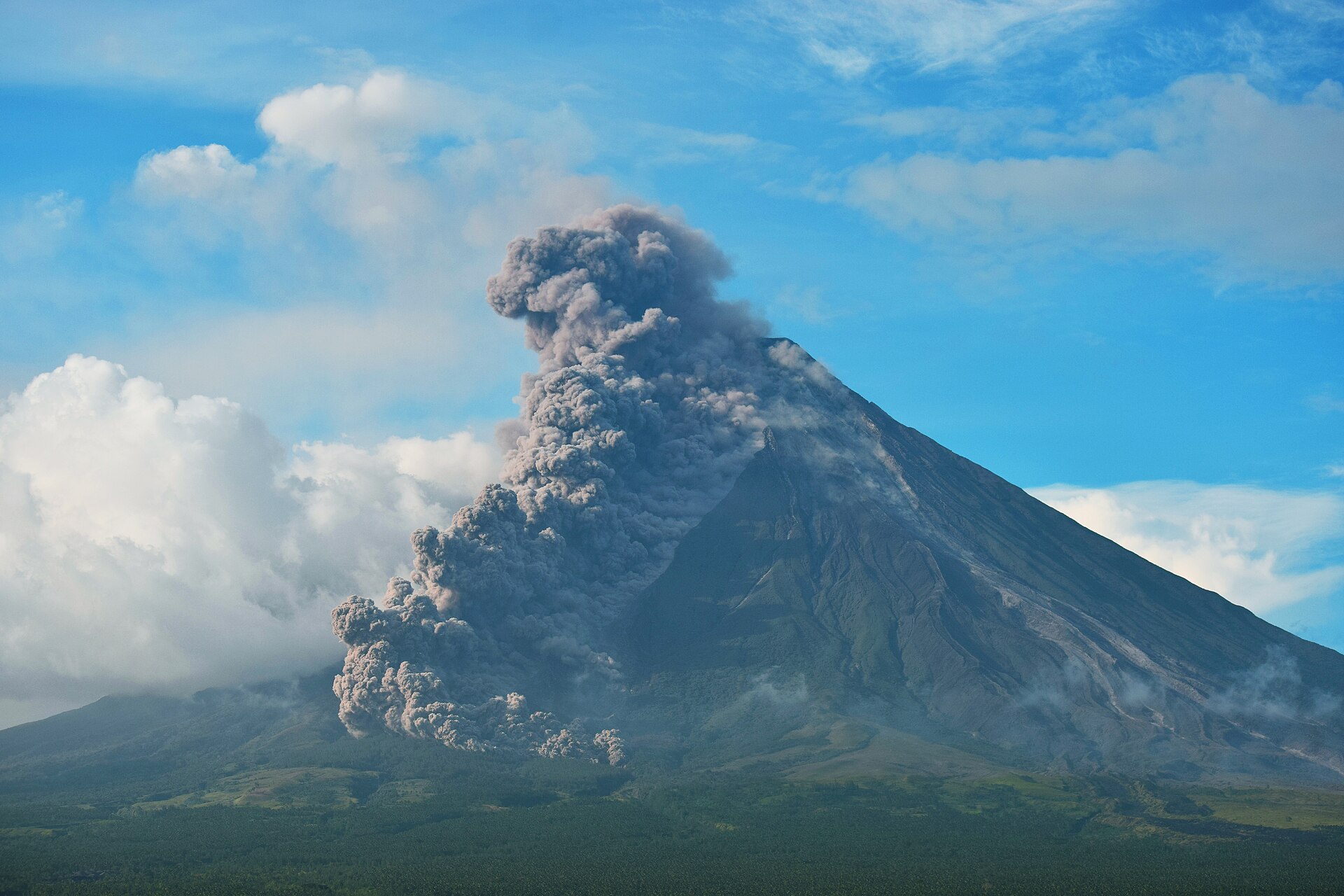
Mayon Volcano rises to 2,462 metres near Legazpi in Albay province, on the Bicol Peninsula of southeastern Luzon.
The climate is tropical and maritime, characterised by relatively high temperature, high humidity and abundant rainfall. Averaged over all weather stations except Baguio, the mean annual temperature is 26.6 degrees Celsius; the coolest months fall in January at 25.5 degrees and the warmest month is May at 28.3 degrees.
Mean annual rainfall varies from 965 to 4,064 millimetres. Baguio City, eastern Samar and eastern Surigao receive the most rain, while southern Cotabato receives the least.
An average of 20 tropical cyclones form and/or cross the Philippine Area of Responsibility each year, with no indication of an increase in frequency. Cyclones often strike from June to December, and in some years the number reaches 25 or more.
Over the last 60 years, maximum and minimum temperatures in the Philippines are seen to have increased by 0.36 degrees Celsius and 1.0 degree Celsius respectively.
Mount Apo, near the south-central coast of Mindanao, is the highest peak in the Philippines, reaching 2,954 metres. Manila is the capital, while nearby Quezon City is the country's most-populous city; both form the National Capital Region on Luzon, the largest island.
The Philippines has a total land area of 347,681 km² and a coastline of about 36,290 km.
The Philippine Institute of Volcanology and Seismology classifies volcanoes according to their eruptive history. Active volcanoes are those that erupted within historical times, in the last 600 years, including eruptions documented by man, and eruptions within the last 10,000 years identified from young volcanic deposits; twenty-four volcanoes appear on the PHIVOLCS active list.
1. People and Demography
The 2020 Census of Population and Housing recorded a total population of 109,035,343 as of 01 May 2020, a figure declared official for all purposes by the President.
Regional distribution has been uneven. Of the 17 administrative regions in 2020, CALABARZON had the biggest population with 16,195,042, followed by the National Capital Region with 13,484,462 and Central Luzon with 12,422,172 persons.
The aboriginal inhabitants of the islands were the Negritos, dark-skinned small-statured peoples such as the Aeta, Ita and Agta. Waves of people from Taiwan began to arrive in the northern Philippines around 3500 BCE.
The 2020 count was an increase of 8,053,906 over the 100,981,437 recorded in 2015, equivalent to an annual growth rate of 1.63 percent. By 2024 the population reached 112,729,484, up 3.69 million from 109.04 million in 2020, with growth slowing to 0.80 percent a year amid declining fertility and birth rates; BARMM remained the fastest-growing region at 3.43 percent, while Region V (Bicol) posted the lowest rate at -0.07 percent, the only region with negative growth.
The 2020 Census of Population and Housing recorded 17 administrative regions, whereas the 2024 Census of Population covered 18 administrative regions, the increase reflecting the creation of the Bangsamoro Autonomous Region in Muslim Mindanao.
2. Colonial Rule and Nationhood
The name of the country is taken from King Philip II of Spain; the islands were under Spanish rule for 333 years and under United States tutelage for a further 48 years.
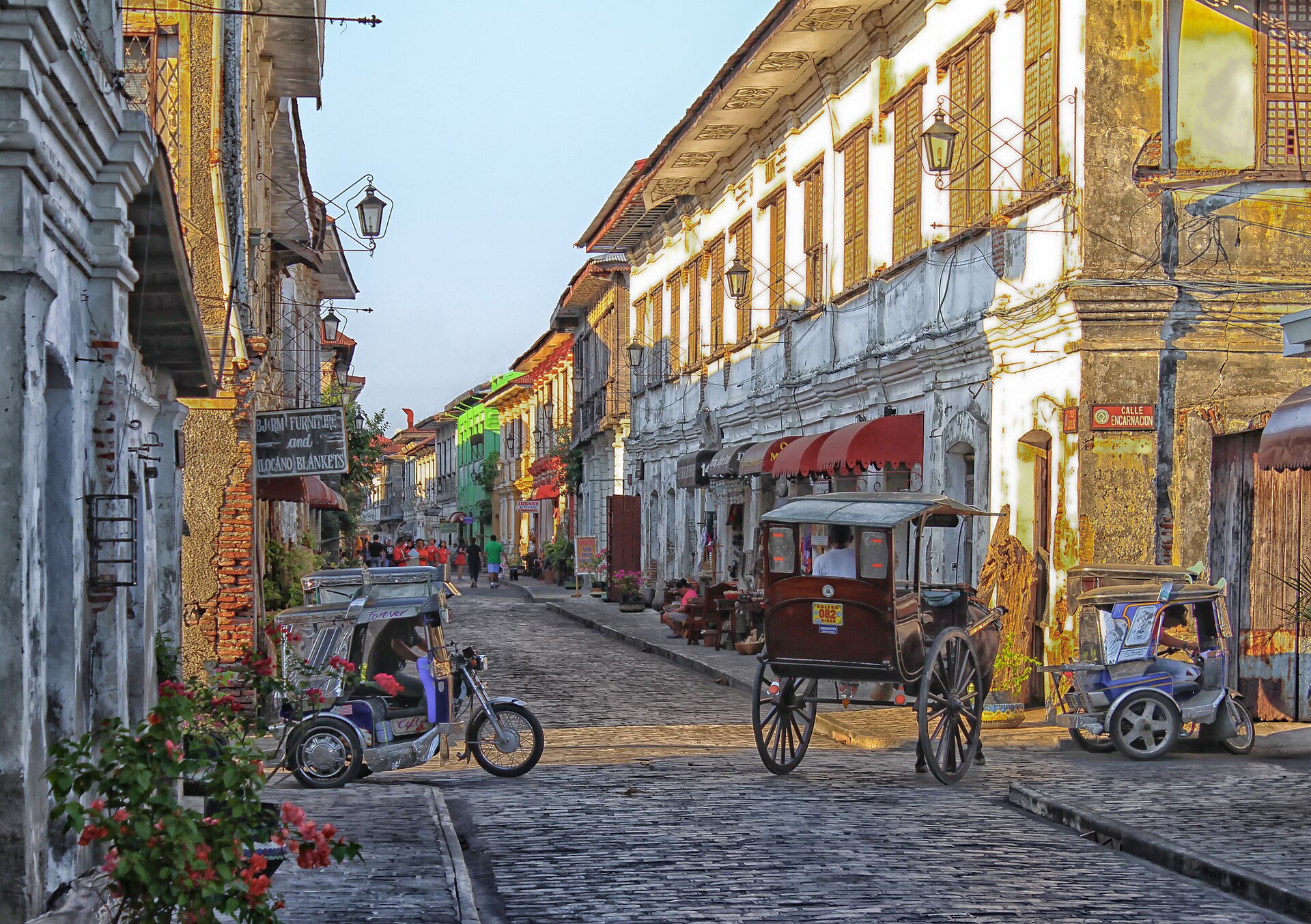
Ferdinand Magellan headed the first Spanish expedition to the Philippines, making landfall on Cebu in March 1521 and meeting his death soon afterwards on Mactan. Vigan, established in the 16th century, remains the best-preserved example of a planned Spanish colonial town in Asia, blending Philippine, Chinese and European elements.

The Jones Law of 1916 pledged independence once Filipinos proved capable of self-government, and the Tydings-McDuffie Act of 1934 put in place a ten-year transition under Commonwealth status.
The proclamation of Philippine Independence is celebrated on June 12, although before 1962 the observance fell on July 4, and that date is now observed as Republic Day.
Miguel López de Legazpi established the first permanent Spanish settlement at Cebu in 1565 for the Spanish crown, and the Spanish city of Manila was founded in 1571, so that by the end of the 16th century most coastal and lowland areas from Luzon to northern Mindanao were under Spanish control.
Activists shocked by Rizal's arrest in 1892 formed the Katipunan under Andres Bonifacio, a self-educated warehouseman, dedicated to expelling the Spanish; in August 1896 Spanish friars uncovered evidence of the Katipunan's plans and its leaders were forced into premature action.
In September 1972 Marcos declared martial law, claiming it was the last defence against violent student demonstrations, communist insurgency and the Moro separatist movement.
The cession of the Philippines from Spain to the United States was confirmed by the Treaty of Paris, signed on 10 December 1898 in Paris.
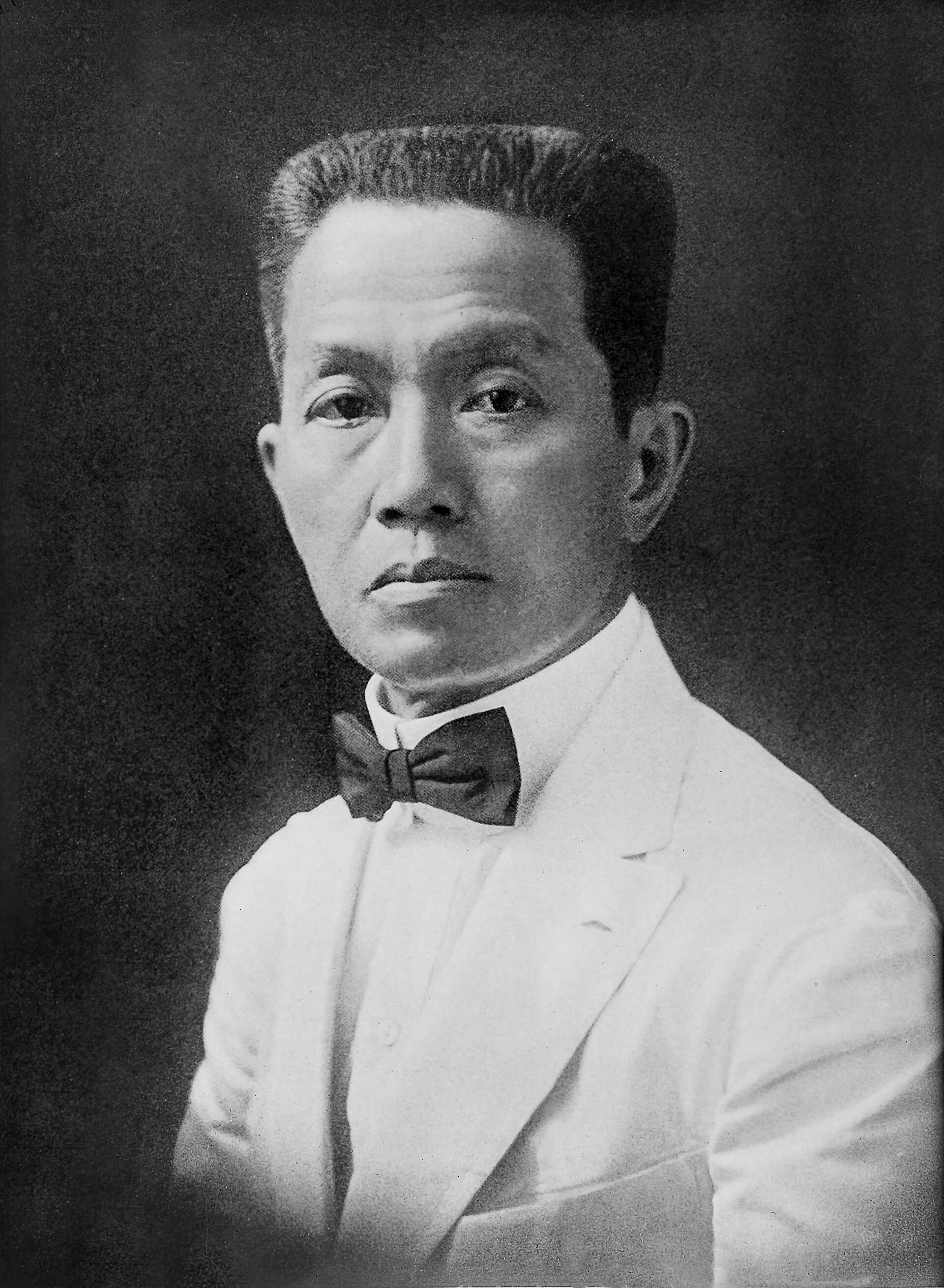
The Malolos Constitution was formally adopted by the congress on 20 January 1899 and promulgated by Emilio Aguinaldo on 21 January 1899 as the law of the First Republic, and Aguinaldo was inaugurated on 23 January 1899, when the First Republic of the Philippines was formally established with three branches of government, a constitution and an army. The Malolos Republic culminated the Philippine Revolution and led to the creation of the First Constitution and Republican Government of Asia.
The Third Republic of the Philippines was inaugurated on July 4, 1946, as the culmination of the peaceful campaign for independence.
The Tejeros Convention of 22 March 1897 sought to reconcile the Magdalo and Magdiwang factions of the Katipunan and elected Aguinaldo president while Bonifacio became director of the interior.
The Emilio Aguinaldo House in Kawit, Cavite, is the site of the proclamation of Philippine independence. In 1962 President Diosdado Macapagal issued Proclamation No. 28 of that year moving the date of independence from July 4 to June 12, and it has been celebrated in June ever since.
3. War, Dictatorship and Restoration of Democracy
Even before the fall of the Bataan Peninsula to the Japanese in April 1942, guerrilla units were forming throughout the Philippines.
The Plaza Miranda bombing, the growing communist insurgency and a staged ambush provided the pretext for the declaration on 23 September 1972 under Proclamation No. 1081 dated 21 September.
On 9 February 1986 thirty-five tabulators manning the COMELEC quick count computer terminals walked out during the snap elections.
On the first night of the 1986 uprising people came to EDSA by the thousands bringing provisions to those standing in the way of the troops.
In 1981 martial law was lifted throughout the country through Proclamation No. 2045 and the Fourth Republic began. A new constitution was ratified in February 1987 in a general referendum, and legislative elections in May 1987 and a new bicameral congress in July marked the return of the pre-1972 form of government.
The Japanese attacked the Philippines on 8 December 1941. Manila was declared an open city before Christmas, while Quezon and Osmeña were evacuated to Corregidor.
The official tally made Marcos the victor over Corazon Aquino by 1. 5 million votes, and the opposition rejected the result.
4. Government and Constitution
Under Article II of the 1987 Constitution, the Philippines is a democratic and republican State in which sovereignty resides in the people and all government authority emanates from them.
Legislative power is vested in a Congress consisting of a Senate and a House of Representatives. Executive power is vested in the President of the Philippines, who must be a natural-born citizen, a registered voter, able to read and write, at least forty years of age on election day and a resident of the Philippines. Judicial power is vested in one Supreme Court and in such lower courts as may be established by law.
The Constitution provides for autonomous regions in Muslim Mindanao and the Cordilleras and for territorial and political subdivisions that enjoy local autonomy.
The official name of the country is Republika ng Pilipinas in Filipino and Republic of the Philippines in English. The official languages are Filipino, which is based on Tagalog, and English; approximately 70 to 75 aboriginal languages of the Austronesian family are also spoken.
The Philippines is a unitary republic with two legislative houses: a Senate of 24 members and a House of Representatives of 317 members. The country is divided into 18 administrative regions.
5. Economy
In recent years the economy demonstrated strong performance, with real GDP growth averaging 5.8 percent annually between 2021 and 2025 according to the World Bank.
With the right policy responses, the World Bank projects growth returning to 5.2 percent in 2027, following a slowdown to 3.7 percent during 2026 caused by investment weakness and higher energy prices.
Overseas Filipino cash remittances rose from US$32.54 billion in 2022 to US$35.63 billion in 2025. Of that total, US$28.49 billion was land-based and US$7.14 billion sea-based. The currency is the Philippine peso (₱), with an exchange rate of about 62.92 pesos to the US dollar in 2026.
A scenario in which renewable energy reaches 35 percent of the energy mix by 2030 could reduce residential electricity prices by as much as 28 percent, create about 161,000 jobs and lift around 730,000 Filipinos out of poverty.
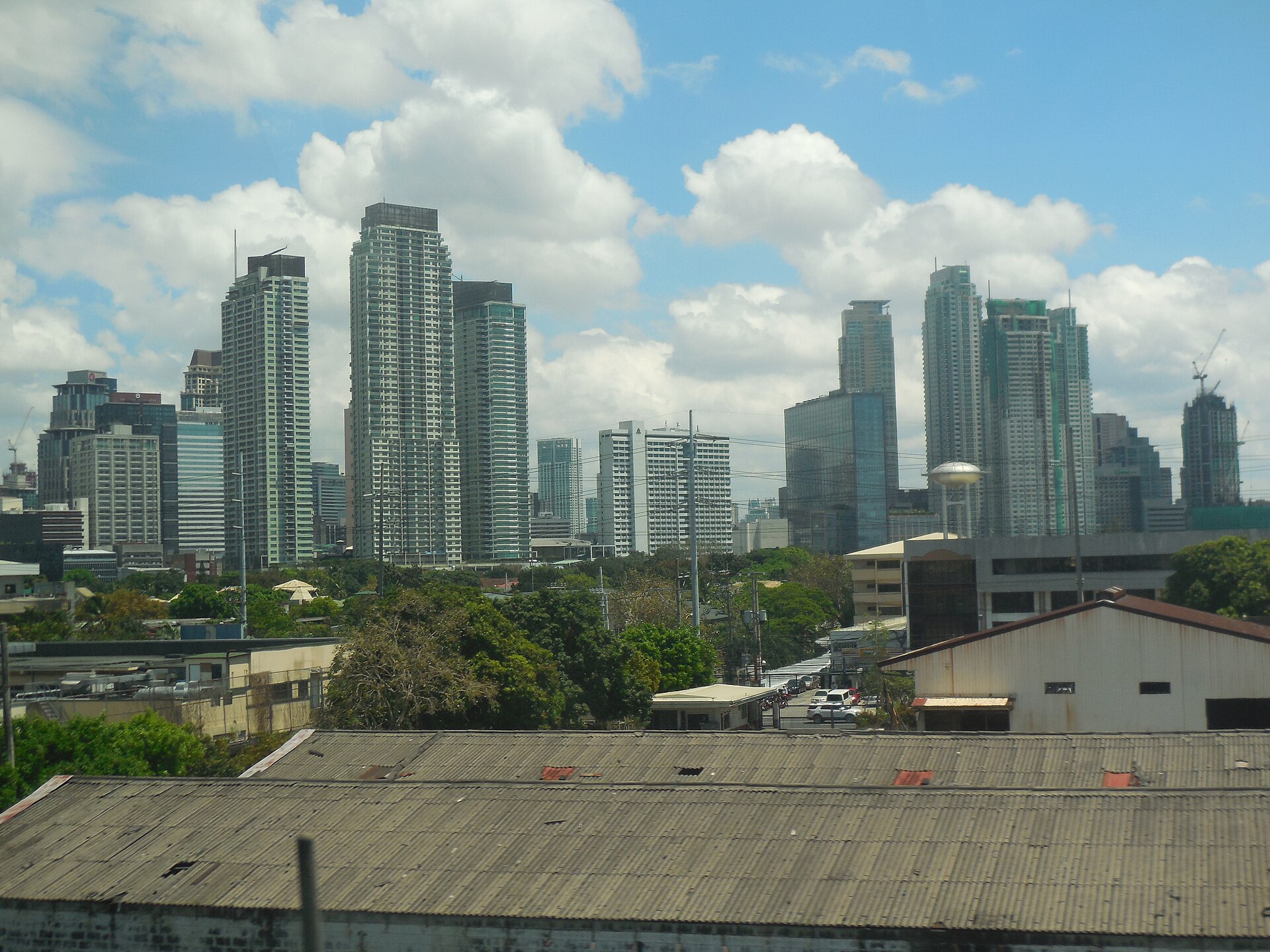
The country's economic transformation has been fuelled by rapid urbanization, a large and youthful population, strong consumer demand and remittances from overseas Filipino workers.
The Philippines' transition to upper-middle-income status in 2025 came when gross national income per capita reached US$4,850 for the first time. On 3 August 2026 the World Bank announced that the Philippines had reached upper-middle-income country status, capping two decades of sustained economic growth and rising living standards.
6. Cultural and Natural Heritage
The Philippines ratified the World Heritage Convention on 19 September 1985 and has 6 properties inscribed on the World Heritage List, comprising three cultural and three natural sites.
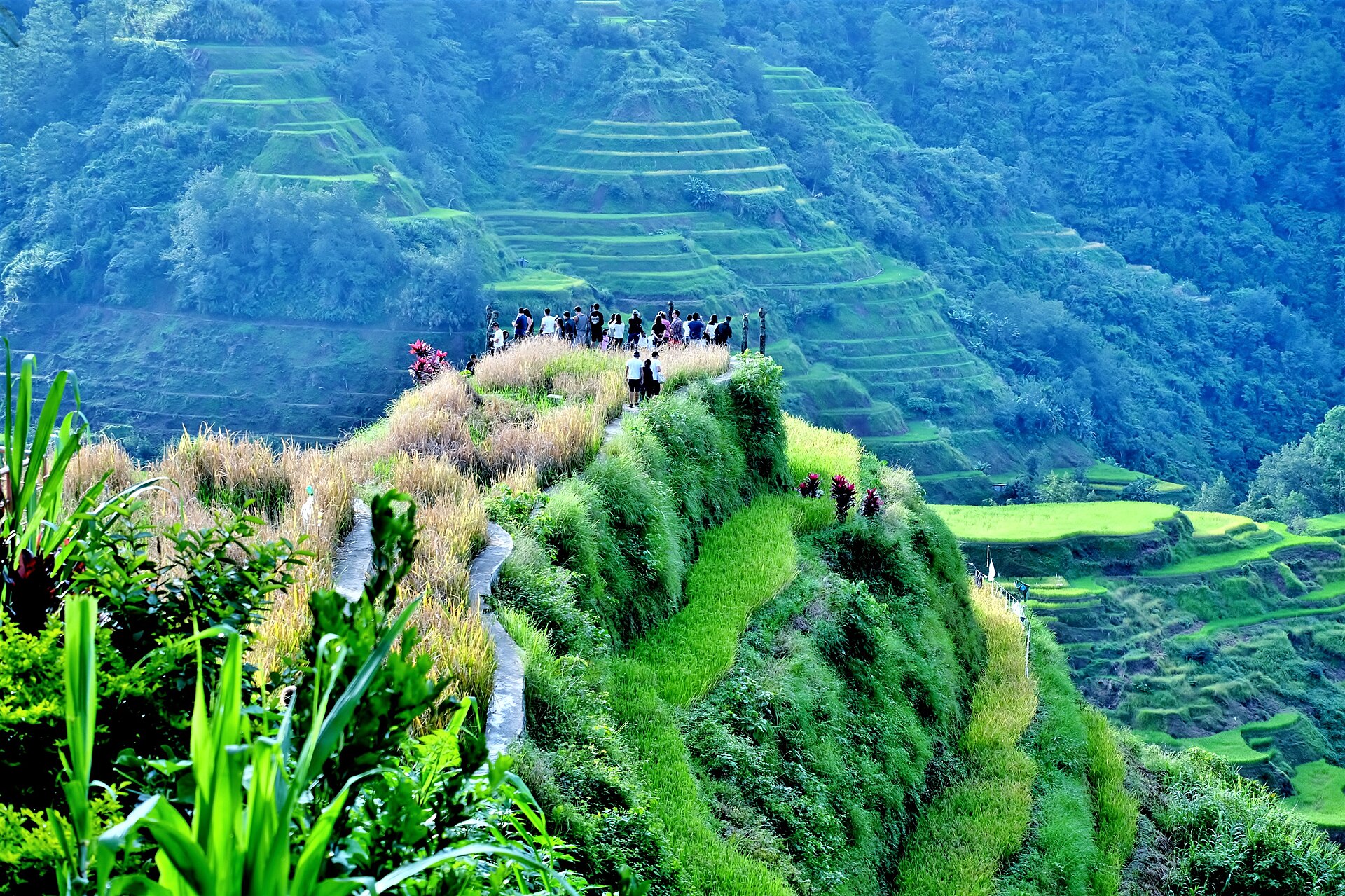
The cultural properties are the Baroque Churches of the Philippines, the Historic City of Vigan and the Rice Terraces of the Philippine Cordilleras. The Rice Terraces were inscribed in 1995 and spent 2001 to 2012 on the List of World Heritage in Danger. For 2,000 years the high rice fields of the Ifugao have followed the contours of the mountains, forming a landscape that expresses harmony between humankind and the environment.
The natural properties are Mount Hamiguitan Range Wildlife Sanctuary, the Puerto-Princesa Subterranean River National Park and the Tubbataha Reefs Natural Park. Tubbataha is described as an excellent example of a pristine coral reef with a spectacular 100-metre perpendicular wall, extensive lagoons and two coral islands. The Tubbataha Reef Marine Park covers 96,828 hectares including the North and South Atolls, and the North Islet serves as a nesting site for birds and marine turtles.
The Philippines ratified the UNESCO Convention for the Safeguarding of the Intangible Cultural Heritage on 18 August 2006 and has since inscribed seven elements, among them the Hudhud chants of the Ifugao and the Darangen epic of the Maranao both inscribed in 2008 and the practice of making Asin Tibuok, the artisanal sea salt of Bohol, added in 2025 as the seventh.
The Tabon Cave in Quezon, Palawan has yielded the earliest direct evidence of modern humans in the Philippines. The fossilized skull cap and tibia fragment found in Tabon Cave were declared National Cultural Treasures, as were the Manunggul burial jar, jade lingling-o ornaments and the Duyong shell adze. The National Museum of the Philippines is a government trust that acquires, preserves and exhibits works of art, specimens and cultural and historical artifacts representative of Filipino heritage.
7. Foreign Relations and Sovereignty
In July 2016 the Permanent Court of Arbitration concluded that there was no evidence of historical Chinese claim to the waters and ruled that China had violated the Philippines' sovereign rights.
8. Timeline: from the first settlers to the 1987 Constitution
- Around 3500 BCEFirst Austronesian arrivalsWaves of people from Taiwan began to arrive in the northern Philippines around 3500 BCE.
- March 1521Magellan reaches the islandsFerdinand Magellan made landfall on Cebu in March 1521 and met his death soon afterwards on Mactan.
- 1565First permanent Spanish settlementMiguel López de Legazpi established the first permanent Spanish settlement, in Cebu, in 1565.
- 1571Manila foundedThe Spanish city of Manila was founded in 1571; by the end of the 16th century most coastal and lowland areas were under Spanish control.
- August 1896Philippine Revolution breaks outSpanish friars uncovered the Katipunan's plans and its leaders were forced into premature action; fighting continued until the truce of December 1897.
- 12 June 1898Independence proclaimed at KawitPhilippine independence was formally proclaimed on June 12, 1898, when Aguinaldo waved the flag in Kawit, Cavite.
- 23 January 1899First Republic establishedAguinaldo was inaugurated on January 23, 1899, and the First Republic of the Philippines was formally established in Malolos.
- 24 March 1934Tydings-McDuffie ActThe Tydings-McDuffie Act provided for a 10-year commonwealth during which the United States would retain jurisdiction over defence and foreign affairs.
- December 1941 – 1945Japanese occupation and liberationThe Japanese attacked on December 8, 1941; guerrilla resistance grew after the fall of Bataan in April 1942, and Allied forces returned at Leyte in October 1944.
- 4 July 1946Republic of the Philippines proclaimedThe Third Republic was inaugurated on July 4, 1946, with Manuel Roxas as its first president.
- 12 May 1962Independence Day moved to June 12President Diosdado Macapagal issued Proclamation No. 28, s. 1962, moving the observance of independence from July 4 to June 12.
- 23 September 1972Martial law declaredMarcos declared martial law by virtue of Proclamation No. 1081, dated September 21 but put into effect on September 23, 1972.
- 22–25 February 1986People Power revolutionMass protests on EDSA followed the disputed snap election; Marcos was driven from power and Corazon Aquino took office.
- February 19871987 Constitution ratifiedA new constitution was drafted and ratified in February 1987 in a general referendum.
9. Frequently asked questions
What is the official name of the country, and what languages does it recognize?
The official name is Republika ng Pilipinas in Filipino and Republic of the Philippines in English.1Philippines | History, Map, Flag, Population, Capital, & Facts · Encyclopaedia Britannica ↗ The national language is Filipino, to be further developed and enriched on the basis of existing Philippine and other languages.141987 Constitution of the Republic of the Philippines · The LawPhil Project, Arellano Law Foundation ↗
How did Islam arrive in the southern Philippines?
Islam was introduced to Mindanao and the Sulu Archipelago in the 15th century through Brunei, and by the mid-16th century two sultanates had been established.6History of the Philippines | People, Spain, United States, Revolution, Map, & Facts · Encyclopaedia Britannica ↗
What did José Rizal write, and what followed his arrest?
How did the Marcos era end?
The assassination of Benigno Aquino on his return to Manila in August 1983 was generally thought to be the work of the military and became the focus of renewed opposition to Marcos.11History of the Philippines — World War II and the modern era · Encyclopaedia Britannica ↗ Under mounting pressure Marcos called a snap presidential election for February 1986 in which Corazon Aquino, the assassinated leader's widow, ran for the opposition; he was declared the official winner, but public outcry over the results precipitated a revolt that drove him from power by the end of the month.11
What does the 1987 Constitution say about Church and State and about foreign policy?
The 1987 Constitution declares the separation of Church and State inviolable and directs the State to pursue an independent foreign policy.14
What is the Malolos Constitution's view of government?
The Malolos Constitution declared that the government of the republic is popular, representative, alternative and responsible and exercises three distinct powers: legislative, executive and judicial.23The Malolos Constitution (1899) · The LawPhil Project, Arellano Law Foundation ↗
References (23)
- 1Philippines | History, Map, Flag, Population, Capital, & Facts — Encyclopaedia Britannica Web↩View source
- 2Climate of the Philippines — PAGASA, Department of Science and Technology WebView source
- 3Climate Change in the Philippines — PAGASA, Department of Science and Technology WebView source
- 4Volcanoes of the Philippines — PHIVOLCS, Department of Science and Technology WebView source
- 52020 Census of Population and Housing (2020 CPH) Population Counts Declared Official by the President — Philippine Statistics Authority 2020 WebView source
- 6History of the Philippines | People, Spain, United States, Revolution, Map, & Facts — Encyclopaedia Britannica Web↩View source
- 72024 Census of Population (POPCEN) Population Counts Declared Official by the President — Philippine Statistics Authority 2024 WebView source
- 8Historic City of Vigan — UNESCO World Heritage Centre WebView source
- 9Third Republic — Official Gazette of the Republic of the Philippines WebView source
- 10Araw ng Kalayaan (Independence Day) — Official Gazette of the Republic of the Philippines WebView source
- 11History of the Philippines — World War II and the modern era — Encyclopaedia Britannica Web↩View source
- 12Araw ng Republikang Filipino, 1899 — Official Gazette of the Republic of the Philippines 1899 WebView source
- 13The Fall of the Dictatorship — Official Gazette of the Republic of the Philippines WebView source
- 141987 Constitution of the Republic of the Philippines — The LawPhil Project, Arellano Law Foundation 1987 Web↩View source
- 15Philippines Overview — World Bank Group WebView source
- 16Philippines Reaches Upper-Middle-Income Status; Bolder Reforms Critical for More Inclusive Growth and Job Creation — World Bank Group 2026 WebView source
- 17Overseas Filipino Cash Remittances (Table 11) — Bangko Sentral ng Pilipinas WebView source
- 18Philippines — UNESCO World Heritage Convention (States Parties) — UNESCO World Heritage Centre WebView source
- 19Rice Terraces of the Philippine Cordilleras — UNESCO World Heritage Centre WebView source
- 20Tubbataha Reefs Natural Park — UNESCO World Heritage Centre WebView source
- 21Philippines — UNESCO Intangible Cultural Heritage — UNESCO Intangible Cultural Heritage WebView source
- 2260th Anniversary of the Tabon Caves Archaeological Research and Opening of the Stories of Origins Exhibit — National Museum of the Philippines 2022 WebView source
- 23The Malolos Constitution (1899) — The LawPhil Project, Arellano Law Foundation 1899 Web↩View source