Wikipedia
The free encyclopedia that anyone can edit — born in January 2001 as a wiki-based companion to Nupedia, written by volunteers, and today one of the most-visited sites on the internet.
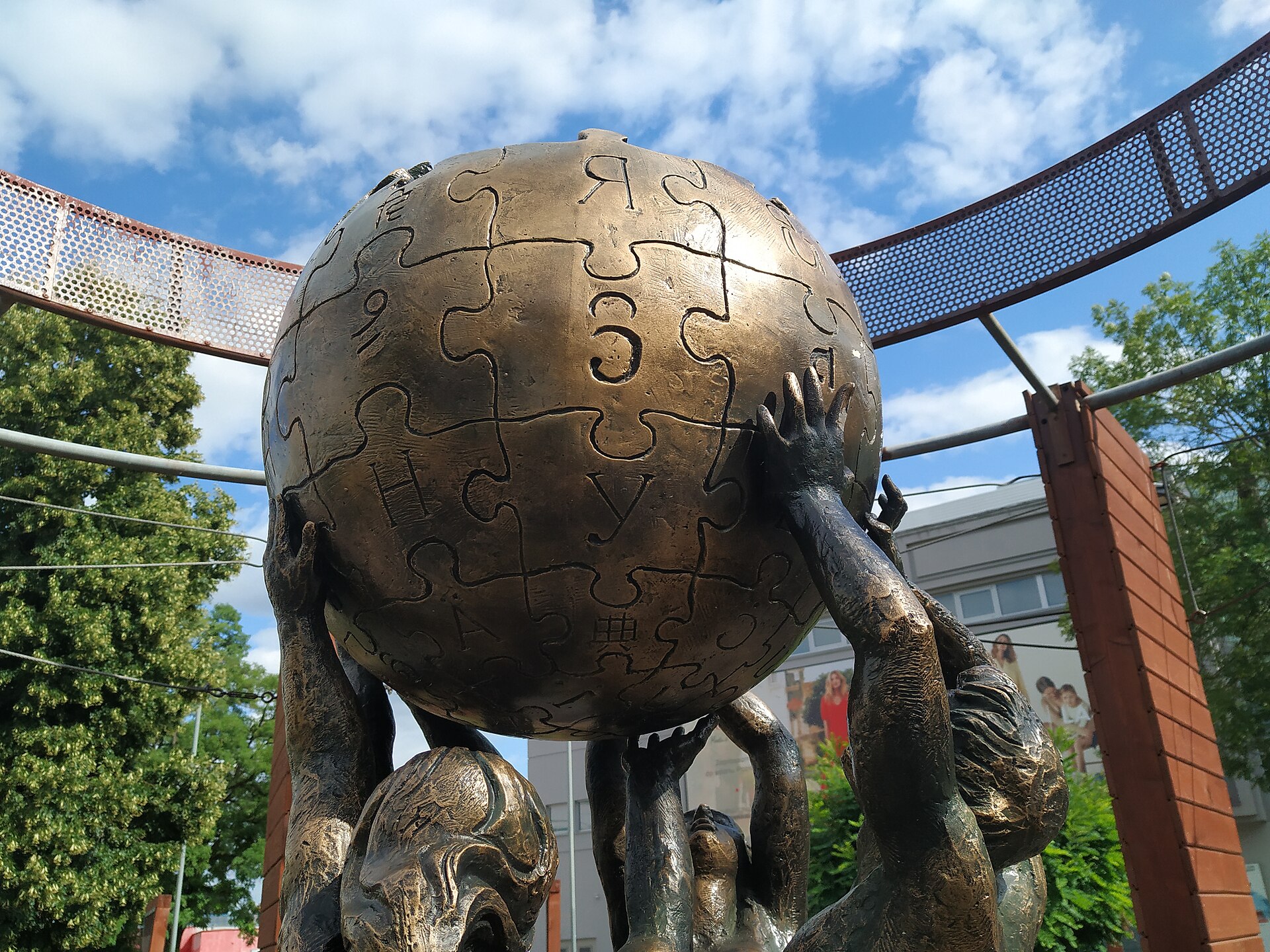
Wikipedia is a free, volunteer-written online encyclopedia operated by the nonprofit Wikimedia Foundation. It began with its first edit on 15 January 2001, grew out of the expert-reviewed Nupedia project, and became the world's largest reference website, with more than 68 million articles across more than 300 language editions and over a billion visitors each month. Its content is governed by five pillars and by policies such as a neutral point of view and verifiability, and it is licensed for reuse under Creative Commons BY-SA. Studies — from Nature's 2005 comparison with Encyclopædia Britannica to peer-reviewed research on coverage gaps — have both tested its accuracy and documented where it falls short; in the 2020s the Wikimedia Foundation reports declining human pageviews attributed to generative AI while describing Wikipedia's human-curated knowledge as more valuable than ever.
Overview
Wikipedia is a free online encyclopedia that anyone can edit, and millions of people already have1. It is written and maintained by human volunteers known as Wikipedians, who collaborate with almost no assistance from artificial intelligence1. The encyclopedia is hosted by the nonprofit Wikimedia Foundation, the organization responsible for hosting and protecting Wikipedia and its fellow Wikimedia projects2. Unlike most other high-traffic websites, it does not run advertisements and is free to access3. Its fundamental principles are summarized in five pillars1.
Since its creation on 15 January 2001, Wikipedia has grown into the world's largest reference website, attracting over a billion visitors each month1. As of September 2026 it comprises 364 language editions holding 68,348,064 articles in total, 77 of them with more than 100,000 articles4. The English Wikipedia alone contains 7,240,970 articles and 262,745 active contributors in the past month, on the project's 2026 figures1. It is among the top-ten most-visited global websites and the only one of them run by a nonprofit5.
The Wikimedia Foundation describes Wikipedia's human-created and curated knowledge as more valuable than ever in the AI era5, and the encyclopedia is one of the highest-quality datasets used in training large language models5. Pew Research Center records Wikipedia among the top sources mentioned in Google search results and notes that it helps train the large language models behind many artificial intelligence technologies3. On the Foundation's 2026 anniversary account, all of Wikipedia's knowledge is created and maintained by a global community of nearly 250,000 volunteer editors who write, edit and fact-check it to rigorous standards on neutrality and reliability5.
The 2001 founding: from Nupedia's failure to the wiki model
Wikipedia grew out of Nupedia, a more structured free encyclopedia conceived as a way to allow easier and faster drafting of articles and translations6. Nupedia was founded by Jimmy Wales, underwritten by Bomis and led by Larry Sanger as editor-in-chief; it operated from March 2000 until September 2003 and is best known today as the predecessor of Wikipedia7. Its articles were written by experts and passed through a seven-step approval process before posting, rather than live wiki-based updating7. Production was nevertheless extremely slow: despite a mailing list of over 2000 interested editors and Sanger serving full-time as editor-in-chief, only 12 articles were written during the first year6.
Wikis had already been used elsewhere on the web to organize knowledge, and the idea of a wiki-based companion to Nupedia was seeded by two conversations — one between Sanger and Ben Kovitz, another between Wales and Jeremy Rosenfeld6. Wales put a wiki online on 10 January 2001 under the nupedia.com domain, and it moved to a new wiki under the wikipedia.com domain on 15 January6. In 2001 the licence for Nupedia was changed to the GFDL, and Wales and Sanger launched Wikipedia as a complementary project, using an online wiki as a collaborative drafting tool6. The project formally opened on 15 January, the day known as Wikipedia Day, with the first international editions — German, Catalan, French, Swedish and Italian — created between March and May6.

Pew Research Center records that the earliest edit found on Wikipedia's homepage announced the new WikiPedia3. The contrast with Nupedia was striking: 21 articles in its first year against 200 articles in Wikipedia's first month and 18,000 in its first year7. The first subdomain for a non-English Wikipedia, deutsche.wikipedia.com, was created on 16 March 2001, followed within hours by Catalan6. By 2003 the English Wikipedia had passed 100,000 articles, while the next largest edition, the German Wikipedia, passed 10,0006. On 28 March 2008 the project exceeded 10 million articles across all 251 language editions6.
The wiki model and the five pillars
Wikipedia runs on openness: anyone can edit, and its fundamental principles are summarized in its five pillars1. Editors are human volunteers who collaborate with almost no assistance from artificial intelligence, and the quality of the content matters more than the expertise of whoever contributes it, provided it conforms with policies including verifiability by published reliable sources1. Content must also follow the neutral point of view policy, which requires representing fairly, proportionately and, as far as possible, without editorial bias all the significant views that reliable sources have published on a topic8.
| Pillar | What it says |
|---|---|
| 1. Wikipedia is an encyclopedia | It combines features of general and specialized encyclopedias, almanacs and gazetteers, and is not a soapbox, an advertising platform or a social network9. |
| 2. Neutral point of view | Articles strive for an impartial tone that documents and explains major points of view, giving due weight, and the community avoids advocacy9. |
| 3. Free content | All editors freely license their work to the public, and no editor owns an article — contributions can be edited and redistributed9. |
| 4. Respect and civility | Editors should treat one another with respect, avoid personal attacks and edit wars, and seek consensus9. |
| 5. No firm rules | Policies and guidelines are not carved in stone: their content and interpretation can evolve, and the principles and spirit matter more than literal wording9. |
Licensing: from the GFDL to Creative Commons
Wikipedia's content became licensed under a Creative Commons Attribution-ShareAlike licence in 20096. The change followed an invitation from the Wikimedia Foundation's Board of Trustees, which in 2009 asked the community to vote on licensing Wikimedia material under CC-BY-SA while retaining dual licensing with the GNU Free Documentation Licence (GFDL)10. The vote ran from 12 April to 3 May 2009 and was open to all users, excluding bots, who had made at least 25 edits to any Wikimedia project before 15 March 200910.
The motivation was practical: the GFDL includes potentially onerous provisions, such as the requirement to include the full licence text with each copy, and those requirements impede re-use of both text and multimedia10. Under the Terms of Use in force today, contributors license the text they submit under the Creative Commons Attribution-ShareAlike 4.0 International licence and the GFDL, and reusers may comply with either licence or both11. Dual licensing with the GFDL was retained, so Wikimedia material remains available under both licences10.
Governance: how a volunteer community is run
The Wikimedia Foundation is the nonprofit responsible for hosting and protecting Wikipedia and the other Wikimedia projects, and it is a United States 501(c)(3) tax-exempt organization2. It was founded on 20 June 2003, the same day the sister project Wikiquote was created6. Since 2003 it has supported the hundreds of thousands of volunteer editors who edit, expand and curate the Wikimedia projects2. Governance accordingly rests with the volunteer community: editors are expected to seek consensus, avoid personal attacks and edit wars, and work under principles summarized in the five pillars9.
For serious conduct disputes that the community cannot resolve, English Wikipedia relies on its Arbitration Committee, the panel of editors responsible for conducting its arbitration process, with the authority to impose binding solutions to disputes between editors12. Arbitrators are volunteer users — usually experienced editors and administrators — whom the community of editors at large elects to resolve the most complex or intractable disputes and to oversee the few areas where access to non-public information is a prerequisite12. Beyond dispute resolution, the Committee determines which editors have access to CheckUser and Oversight permissions, and it considers certain matters where exceptional factors such as privacy preclude a public hearing12. Formal elections for a board of the Foundation and for an Arbitration Committee on the English Wikipedia began in 20046.
Scale: how many articles, languages and readers
The table below sets out Wikipedia's scale as dated snapshots, reflecting the as-of dates of the underlying sources4. It combines September 2026 counts from Meta-Wiki, 2026 figures from the Wikimedia Foundation and the English Wikipedia project page, and 2024 editing statistics from Pew Research Center3. The English Wikipedia passed 500,000 articles in March 2005, one million in March 2006 and three million in August 2009, and by 9 March 2019 the project exceeded 50 million articles across all 309 language editions6. The German Wikipedia became the second edition to exceed one million articles, on 27 December 20096. The Arabic Wikipedia, launched on 9 July 2003, has 1,332,681 articles, 2,992,083 registered users and 56,632 files as of September 2026, ranking 15th among Wikipedias by article count and 4th by depth13.
| Metric | Value | As of |
|---|---|---|
| Articles across all editions | 68,348,064 | September 20264 |
| Language editions | 364 | September 20264 |
| English Wikipedia articles | 7,240,970 | 20261 |
| Active contributors (English) | 262,745 active in the past month | 20261 |
| Volunteer editors (global) | nearly 250,000 | 20265 |
| Monthly views | nearly 15 billion | 20265 |
| Editing rate | 5.7 edits per second; nearly 40% of edits by approved bots | 20243 |
| Active users (all Wikipedias) | more than 600,000 accounts with at least one edit in the last 30 days; 45% contribute to English Wikipedia | as cited by Pew Research Center3 |
Reliability debates, as documented
The first major Wikipedia scandal, the Seigenthaler incident, occurred in 2005, when a well-known figure was found to have a vandalized biography that had gone unnoticed for months6. In its wake, the project's first policy and system changes designed to counter that form of abuse were established: a Checkuser privilege policy update to assist sock-puppetry investigations, a new semi-protection feature, a stricter policy on biographies of living people, and the tagging of such articles for stricter review6.
In December 2005, Nature published an investigation finding that Wikipedia came close to Britannica in terms of the accuracy of its science entries14. Forty-two expert reviewers carried out the comparison, and after tallying their results Nature recorded errors — the great majority of them minor — at a rate of about three per online Britannica item and about four per Wikipedia item15.
Britannica's formal response, published in March 2006 under the title Fatally Flawed, disputed the study and demanded a retraction16. Britannica argued that the numbers buried deep in the article told the opposite story: Wikipedia in fact had a third more inaccuracies than Britannica16. Nature rejected the critique, stating that its comparison was unbiased and that it stood by the story15. The exchange became the defining early episode in the debate over Wikipedia's reliability16.
Gaps and criticism: what the research shows
Peer-reviewed research in EPJ Data Science notes that although everyone can participate, Wikipedia's editor community is known to have narrow diversity, with a majority of white male editors17. The same study found that women in Wikipedia are more notable than men, an outcome its authors interpret as a subtle glass ceiling effect17. It also documents linguistic bias, with abstract terms tending to describe positive aspects in the biographies of men and negative aspects in the biographies of women17.
Article counts can mislead: Lsjbot, an automated program built by linguist Sverker Johansson, creates articles in Cebuano and Swedish3. Cebuano — a language spoken in the southern Philippines — now has the second-most Wikipedia articles of any language, despite having relatively few active users3.
Editor retention offers another signal: the number of regularly active editors on the English Wikipedia peaked in 2007 at more than 51,000 and has been declining since6. Pew Research Center reports that Wikipedia's summary statistics page lists more than 600,000 active users — account holders who have made at least one edit in the last 30 days — with just under half of them, 45%, contributing to English Wikipedia3. Nearly 40% of the edits made in 2024 came from Wikipedia-approved bots that operate alongside human editors3.
Wikipedia in the age of AI
After revising its bot-detection systems, the Wikimedia Foundation reported in 2025 that human pageviews on Wikipedia had declined by roughly 8% compared with the same months in 202418. The Foundation attributes the decline to the impact of generative AI and social media on how people seek information, especially with search engines providing answers directly to searchers, often based on Wikipedia content18. It warns that with fewer visits to Wikipedia, fewer volunteers may grow and enrich the content, and fewer individual donors may support the work18.
The same technology depends heavily on the encyclopedia: Wikipedia is one of the highest-quality datasets used in training large language models5, and its knowledge powers generative AI chatbots, search engines and voice assistants5. Pew Research Center records Wikipedia as one of the top sources mentioned in Google search results and as a training source for the large language models behind many artificial intelligence technologies3. In the Foundation's account, Wikipedia and its human-created and curated knowledge have never been more valuable than in the AI era5.
Both the Foundation and the editors have responded to these pressures519. The Foundation's AI strategy directs future investments and developments in AI to support the human contributors at the core of Wikipedia5. Wikimedia Enterprise, its commercial product for large-scale reusers and distributors of content from Wikimedia projects, has gained new partners including Ecosia, Microsoft, Mistral AI, Perplexity, Pleias and ProRata, joining existing partners such as Amazon, Google and Meta5. Wikipedia's editors maintain an AI Cleanup project, which records that since 2022 large language models have become a convenient tool for creating text at scale but virtually always fail to properly source claims and often introduce errors19. Since March 2026, the Wikipedia guideline WP:LLM has prohibited the use of LLMs to generate or rewrite article content, with limited exceptions for translation and basic copyediting19.
a digital wonder of the world, unlike anything else
Maryana Iskander, CEO of the Wikimedia Foundation
Wikipedia started as a dream to share knowledge with everyone, everywhere.
Jimmy Wales, co-founder of Wikipedia
in the age of AI, knowledge is human
Wikimedia Foundation, on Wikipedia's 25th anniversary
How to read Wikipedia critically
Wikipedia's usefulness to a reader depends on its sourcing: the encyclopedia requires that content conform with its policies, including being verifiable by published reliable sources1. Its verifiability policy holds that even if an editor is sure something is true, it must have been published in a reliable source before it can be added20.
Timeline: from a one-edit side project to the world's encyclopedia
Nupedia: the expert-reviewed predecessor goes online
Jimmy Wales and Larry Sanger launch Nupedia, a free encyclopedia whose articles were written by experts and passed through a seven-step review — a process so slow it produced only a handful of approved articles in its first years. Nupedia would be remembered as the predecessor of Wikipedia.7
Wikipedia begins with a single edit
Wikipedia begins with its first edit on 15 January 2001, two days after the domain was registered; it is set up as a wiki-based companion to Nupedia where anyone could draft articles. The earliest edit found on its homepage announced: "This is the new WikiPedia!"63
The first non-English editions
The first subdomain for a non-English Wikipedia, deutsche.wikipedia.com (German), is created on 16 March 2001 at 01:38 UTC, followed within hours by Catalan; French, Swedish and Italian editions follow by May.6
The Wikimedia Foundation is founded
The nonprofit Wikimedia Foundation is founded — the same day the sister project Wikiquote is created — giving Wikipedia and its sibling projects an institutional home; formal elections for a board and for an Arbitration Committee follow in 2004.6
Nature compares Wikipedia with Britannica
Nature publishes an investigation finding that "Jimmy Wales' Wikipedia comes close to Britannica in terms of the accuracy of its science entries"; the finding is immediately disputed by Britannica.14
Britannica pushes back — and Nature answers
Encyclopaedia Britannica publishes "Fatally Flawed", disputing Nature's study and demanding a retraction; Nature replies that its comparison was unbiased and stands by the story. The exchange becomes the defining early episode in the debate over Wikipedia's reliability.1615
Relicensing: from the GFDL to Creative Commons
The Wikimedia community votes, between 12 April and 3 May 2009, to make Wikimedia content available under Creative Commons Attribution-ShareAlike while retaining dual licensing with the GFDL; the migration is executed in 2009.10
English Wikipedia reaches five million articles
The English Wikipedia reaches 5,000,000 articles with the creation of an article on Persoonia terminalis, a type of shrub; it has over 125,000 editors who have made one or more edits in the past 30 days.6
Arabic Wikipedia passes one million articles
The Arabic Wikipedia — launched on 9 July 2003 — becomes the first Semitic-language Wikipedia to exceed 1 million articles, having earlier been the first to pass 100,000 articles, on 25 May 2009.13
The AI era: human pageviews fall about 8%
After revising its traffic data, the Wikimedia Foundation reports declines in human pageviews of roughly 8% compared with the same months of 2024, attributing them to generative AI and social media changing how people seek information.18
Twenty-five years of Wikipedia
Wikipedia turns 25 as "the world's largest online information resource", with knowledge created by a global community of nearly 250,000 volunteer editors; the Foundation marks the anniversary under the message that, in the age of AI, knowledge is human.5
Frequently asked questions
What is Wikipedia?
Wikipedia is a free online encyclopedia that anyone can edit, and millions of people already have1. It is written and maintained by human volunteers known as Wikipedians, who collaborate with almost no assistance from artificial intelligence1.
When did Wikipedia launch, and who founded it?
Wikipedia began with its first edit on 15 January 2001, two days after the domain was registered6. Jimmy Wales and Larry Sanger launched it as a complementary project to Nupedia, using an online wiki as a collaborative drafting tool6.
Who runs Wikipedia, and how is it funded?
The Wikimedia Foundation — a United States 501(c)(3) tax-exempt nonprofit founded in 2003 — is the organization responsible for hosting and protecting Wikipedia and the other Wikimedia projects2. Unlike most other high-traffic websites, Wikipedia does not run advertisements and is free to access; it relies on donations from the public and on a community of largely volunteer editors3.
How many articles does Wikipedia have?
As of September 2026 there are 364 language editions of Wikipedia, which collectively contain 68,348,064 articles4. The English Wikipedia alone contains 7,240,970 articles, with 262,745 active contributors in the past month1.
Who writes Wikipedia?
All of Wikipedia's knowledge is created and maintained by a global community of nearly 250,000 volunteer editors, who write, edit and fact-check information according to rigorous standards on neutrality and reliability5. Edits also come from Wikipedia-approved bots, which operate alongside human editors3.
Can Wikipedia's content be reused, including commercially?
Yes — contributors license their text under CC BY-SA 4.0 and the GFDL, and reusers may comply with either licence or both11. The licences do allow commercial uses of contributions, as long as such uses comply with their terms11.
Is Wikipedia reliable? What did Nature's study find?
In December 2005 Nature published an investigation finding that Wikipedia came close to Britannica in terms of the accuracy of its science entries14. Forty-two expert reviewers recorded about three errors per online Britannica item and about four per Wikipedia item15. Britannica disputed the result, arguing Wikipedia had a third more inaccuracies, while Nature rejected the critique and stood by its comparison as unbiased1615.
Is AI-generated content allowed on Wikipedia?
Since March 2026, the Wikipedia guideline WP:LLM has prohibited the use of LLMs to generate or rewrite article content, with limited exceptions for translation and basic copyediting19. The volunteer-run AI Cleanup project notes that large language models virtually always fail to properly source claims and often introduce errors19.
Knowledge graph
Sources & citations
Every factual claim in this article is drawn from the sources below. Bracketed numbers in the text link to the corresponding source.
- 1
- 2
- 3
- 4
- 5
- 6
- 7
- 8
- 9
- 10
- 11
- 12
- 13
- 14
- 15
- 16
- 17
- 18
- 19
- 20