Mars
The fourth planet from the Sun: a cold desert world with a thin atmosphere, two small moons, and a long history of water.
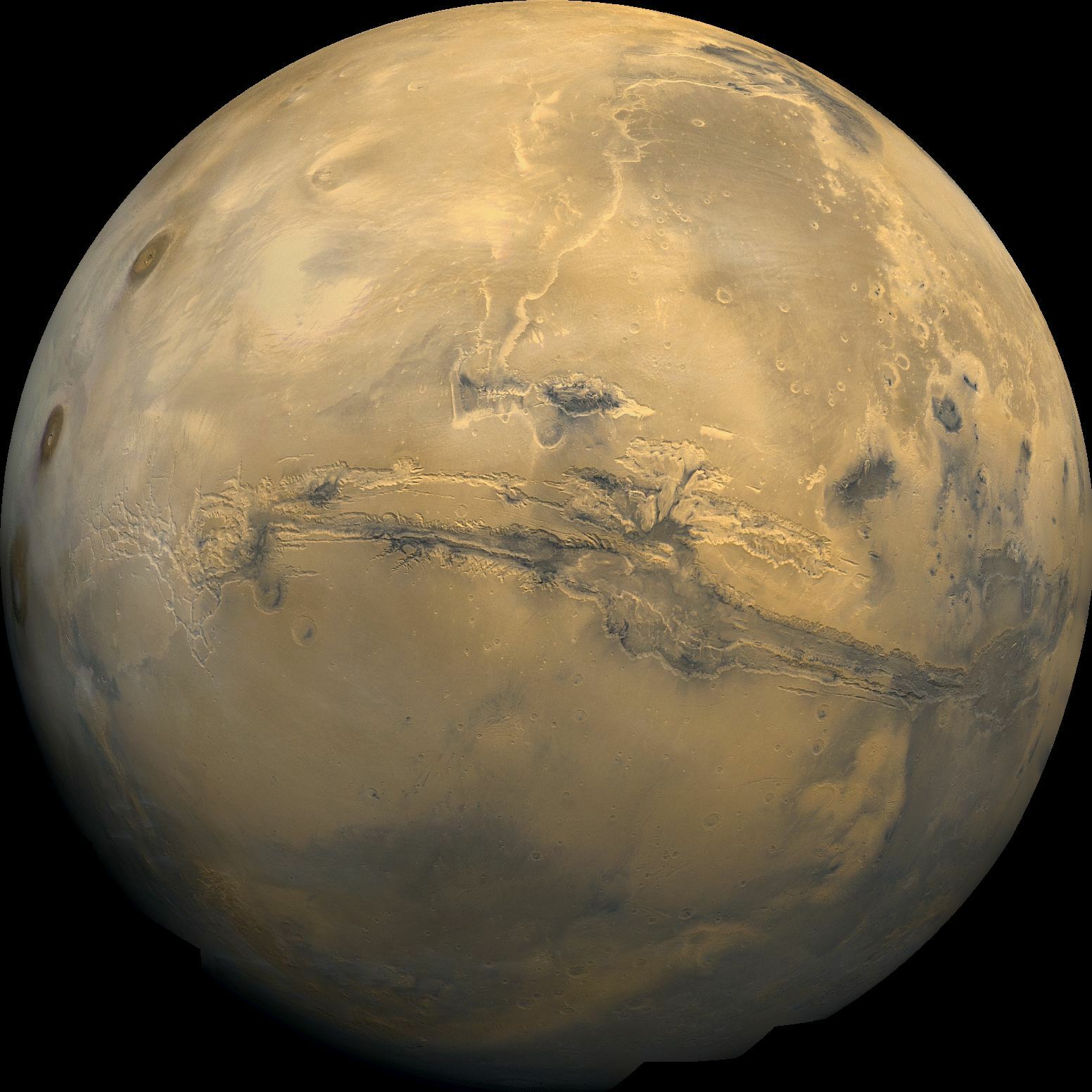

Mars is the fourth planet from the Sun and the most explored planet beyond Earth — the only world on which robotic rovers have driven across the surface. Its landscape is defined by rust-colored dust, extinct volcanoes, vast canyons, polar ice, and evidence that rivers and lakes once flowed there. Two small moons, Phobos and Deimos, orbit close to the planet, and an armada of spacecraft has studied Mars since the first flyby in 1965.
Overview
Mars is the fourth planet from the Sun.1 It is a dusty, cold, desert world with a very thin atmosphere.1 This dynamic planet has seasons, polar ice caps, extinct volcanoes, canyons, and weather.1 It is a terrestrial planet.1 Two small moons, Phobos and Deimos, circle it.1
Mars is one of the most explored bodies in the solar system.1 It is the only planet where rovers have been sent to roam the landscape.1 The ancient Romans named the planet for their god of war because its reddish color was reminiscent of blood.1 The Egyptians called it "Her Desher," meaning "the red one".1 Even today it is frequently called the "Red Planet" because iron minerals in the Martian dirt oxidize, or rust, causing the surface to look red.1
NASA missions have found evidence that Mars was much wetter and warmer, with a thicker atmosphere, billions of years ago.1 Scientists do not expect to find living things currently thriving on Mars.1 Instead, they are looking for signs of life that existed long ago, when Mars was warmer and covered with water.1 That search now runs through ancient rocks and minerals that could only have formed in liquid water.1
Size, orbit and rotation
With a radius of 3,390 kilometers (2,106 miles), Mars is about half the size of Earth.1 If Earth were the size of a nickel, Mars would be about as big as a raspberry.1 The planet orbits at an average distance of 228 million kilometers (142 million miles) from the Sun, or 1.5 astronomical units.1 ESA states the distance as 227,940,000 kilometers, or 1.52 times that of Earth.2 From this distance, it takes sunlight 13 minutes to travel from the Sun to Mars.1
As Mars orbits the Sun, it completes one rotation every 24.6 hours, which is very similar to one day on Earth.1 Martian days are called sols, short for "solar day".1 ESA gives the Martian day as 24 hours 37 minutes.2 A year on Mars lasts 669.6 sols, which is the same as 687 Earth days.1 ESA records the Martian year as 669 sols or 687 Earth days.2
Mars' axis of rotation is tilted 25 degrees with respect to the plane of its orbit around the Sun.1 Earth, by comparison, has an axial tilt of 23.4 degrees.1 Like Earth, Mars has distinct seasons, but they last longer than seasons on Earth.1 The seasons vary in length because Mars' orbit is elliptical.1 Spring in the northern hemisphere is the longest season at 194 sols, and autumn in the northern hemisphere is the shortest at 142 days.1
Structure and geology
When the solar system settled into its current layout about 4.5 billion years ago, Mars formed as the fourth planet from the Sun.1 Like its fellow terrestrial planets, it has a central core, a rocky mantle, and a solid crust.1 The core at its center is between 1,500 and 2,100 kilometers (930 and 1,300 miles) in radius, and it is made of iron, nickel, and sulfur.1 The rocky mantle is between 1,240 and 1,880 kilometers (770 and 1,170 miles) thick, and the crust is 10 to 50 kilometers (6 to 30 miles) deep.1
Mars looks reddish due to oxidization — rusting — of iron in the rocks, regolith, and dust.1 This rusting is why the planet is called the "Red Planet".1 While Mars is about half the diameter of Earth, its surface has nearly the same area as Earth's dry land.1
Mars is home to the largest volcano in the solar system, Olympus Mons.1 It stands more than 25 miles (40 kilometers) tall from base to summit, and its base covers an area as large as the state of Arizona.1 It dwarfs Earth's highest peak, Mount Everest, which rises 29,029 feet, or 8,848 meters, above the Earth's surface.1 The planet's Valles Marineris canyon — the largest in the solar system — extends about 3,870 kilometers (2,400 miles) in length, spans about 600 kilometers (370 miles) across at its widest, and descends about 9.3 kilometers (5.8 miles) at its deepest, more than 10 times longer and wider than Earth's Grand Canyon.1 Mars has no global magnetic field today, but areas of the southern-hemisphere crust are highly magnetized, indicating traces of a magnetic field from 4 billion years ago.1
Atmosphere and climate
Mars has a thin atmosphere made up mostly of carbon dioxide, nitrogen, and argon gases.1 ESA measures the air as 95.32% carbon dioxide, 2.7% nitrogen, 1.6% argon, and 0.13% oxygen.2 Atmospheric pressure at the surface is 6.35 mbar — less than one hundredth of Earth's atmospheric pressure.2
To our eyes, the Martian sky would be hazy and red because of suspended dust, instead of the familiar blue tint seen on Earth.1 The tint comes from dust suspended in the thin air.1 The sparse atmosphere does not offer much protection from impacts by meteorites, asteroids, and comets.1
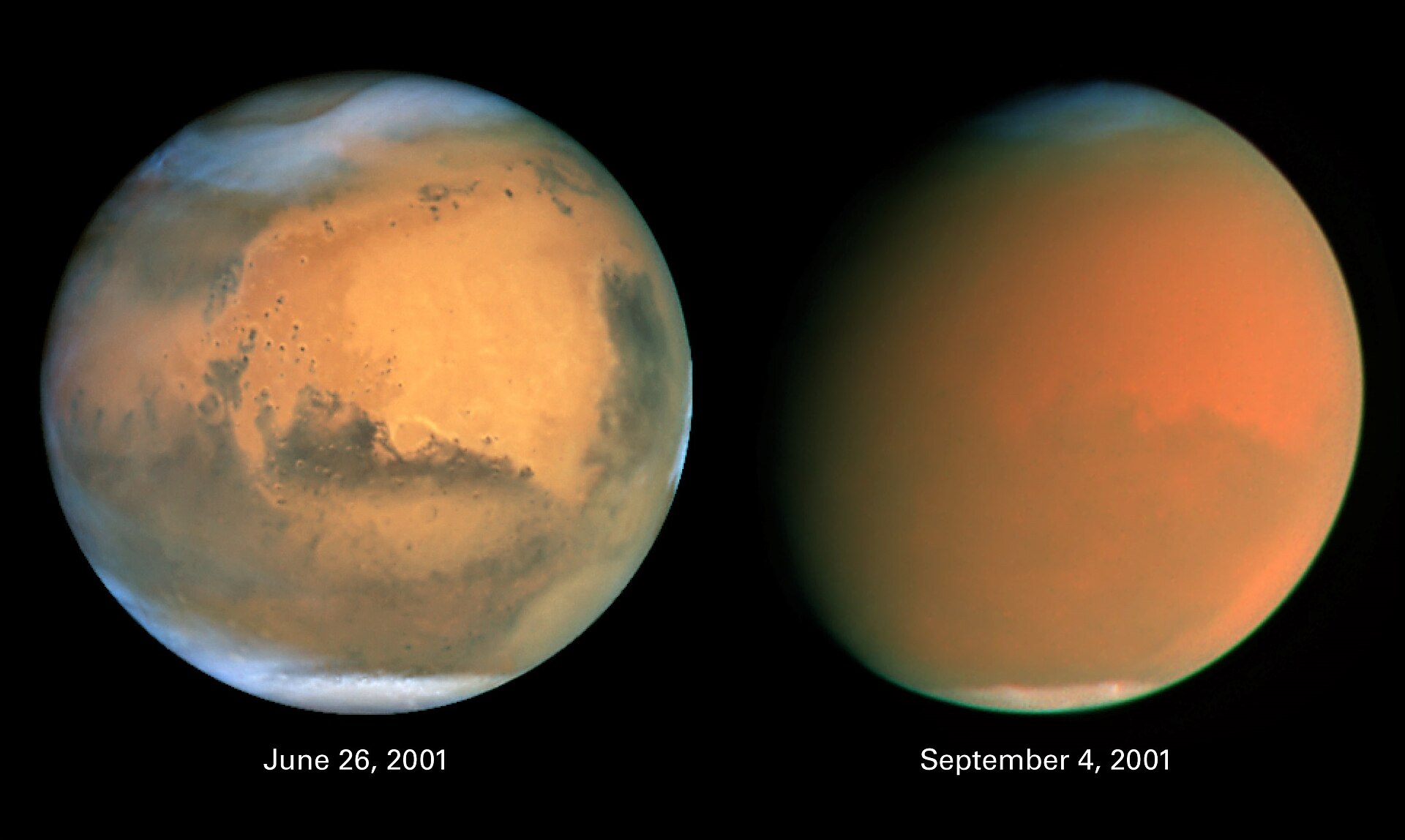

The temperature on Mars can be as high as 20 degrees Celsius (70 degrees Fahrenheit).1 It can be as low as about -153 degrees Celsius (-225 degrees Fahrenheit).1 ESA gives the average as -55 degrees Celsius, from -133 degrees Celsius at the winter pole to +27 degrees Celsius during summer.2 Standing on the equator at noon, it would feel like spring at your feet (24 degrees Celsius) and winter at your head (0 degrees Celsius).1
Occasionally, winds on Mars are strong enough to create dust storms that cover much of the planet.1 After such storms, it can be months before all of the dust settles.1 A planet-wide storm of this kind blanketed Opportunity's location in June 2018, and the rover never communicated with Earth again.3
Water on Mars
Mars appears to have had a watery past.1 The surface preserves ancient river valley networks, deltas, and lakebeds.1 Rocks and minerals on the surface could only have formed in liquid water.1 Some features suggest that Mars experienced huge floods about 3.5 billion years ago.1
There is water on Mars today, but the atmosphere is too thin for liquid water to exist for long on the surface.1 Water is found as water-ice just under the surface in the polar regions.1 It also exists as briny, salty water that seasonally flows down some hillsides and crater walls.1
Early in its mission, Curiosity's scientific tools found chemical and mineral evidence of past habitable environments on Mars.4 The rover also detected the largest organic molecules found on Mars to date — decane, undecane, and dodecane — in a drilled rock sample called "Cumberland".4 Perseverance explored the history of geology, water, and habitable environments in Jezero crater and on the crater rim.5 In September 2025, after a rigorous yearlong peer review, the journal Nature published validated results that Perseverance's "Sapphire Canyon" sample from the rock nicknamed "Cheyava Falls" contains potential biosignatures.5 These are clues that suggest past life may have been present, but they require more data or further study before any conclusions about the absence or presence of life.5
The moons of Mars
Mars has two small moons, Phobos and Deimos, that may be captured asteroids.1 They are potato-shaped because they have too little mass for gravity to make them spherical.1 Asaph Hall discovered Deimos on one August night in 1877, after his wife Angelina urged him on, and he found Phobos six nights later.6 Hall named the moons for the mythological sons of Ares, the Greek counterpart of the Roman god Mars: Phobos means fear and Deimos means dread.6 The moons are among the smallest in the solar system.6
Phobos, the innermost and larger moon, is heavily cratered with deep grooves on its surface.1 Phobos measures 27 x 22 x 18 kilometers and orbits about 6,000 kilometers above Mars.2 Deimos measures 15 x 12 x 11 kilometers and orbits about 20,000 kilometers above Mars.2 Deimos is about half as big as Phobos and orbits two and a half times farther away from Mars.1 Phobos whips around Mars three times a day, while the more distant Deimos takes 30 hours for each orbit.6
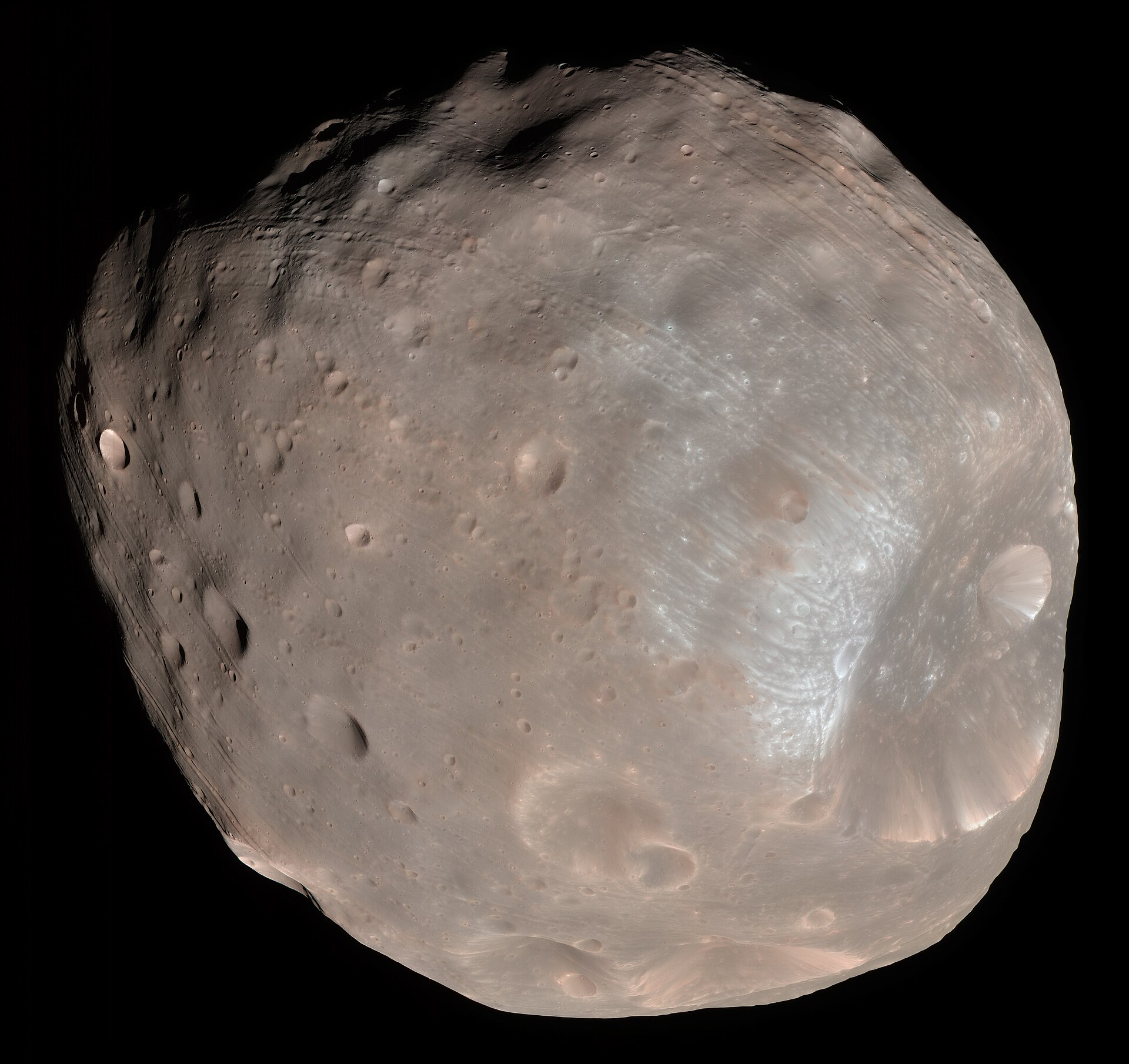

No known moon orbits closer to its planet than Phobos, which circles only 6,000 kilometers (3,700 miles) above the Martian surface.6 In 1971, NASA's Mariner 9 spacecraft got a much better look at the two moons from its orbit around Mars.6 The dominant feature on Phobos, it found, was a crater 10 kilometers (6 miles) wide — nearly half the width of the moon itself.6 It was given Angelina's maiden name: Stickney.6 Phobos is gradually spiraling inward, drawing about 1.8 meters (six feet) closer to the planet each century; within 50 million years it will either crash into Mars or break up and form a ring.6
Like Earth's Moon, Phobos and Deimos always present the same face to their planet.6 Both are lumpy, heavily cratered, and covered in dust and loose rocks.6 They are among the darker objects in the solar system.6 The moons appear to be made of carbon-rich rock mixed with ice.6 Phobos has only 1/1,000th as much gravitational pull as Earth, and a 150-pound (68 kilogram) person would weigh two ounces (68 grams) there.6
Exploration
NASA's Mariner 4 became the first spacecraft to fly by Mars and captured the first close-up views of another planet.7 Its closest approach came at 08:00:57 p.m. EDT on July 14, 1965 (01:00:57 UT July 15).7 The TV camera began taking the first of 21 images at a range of 9,846 kilometers (6,118 miles).7 In 1971, Mariner 9 became the first spacecraft to orbit another planet, mapping 85% of the Martian surface.8 That same year, the Soviet Mars 3 lander claimed a technical first with a survivable landing, but contact was lost seconds after it touched down.9
Viking 1 was the first of a pair of complex deep-space probes designed to collect evidence on the possibility of life on Mars.9 It made the first truly successful landing on Mars and returned the first images from the surface.9 The lander set down on July 20, 1976 at 22.483 degrees north latitude and 47.94 degrees west longitude.9 On July 28, 1976, its robot arm scooped up the first soil samples from the Martian surface.9
Mars Pathfinder landed on July 4, 1997 and delivered the first-ever robotic rover, Sojourner, to the Martian surface.10 It entered the atmosphere with the help of a parachute and cushioned the impact with a giant system of airbags — the first time this technique had been used.10 The twin Mars Exploration Rovers, Spirit and Opportunity, landed on January 3 and January 24, 2004, in search of answers about the history of water on Mars.3 Spirit concluded its mission in 2010, and Opportunity last communicated with Earth on June 10, 2018, as a planet-wide dust storm blanketed its location.3
Curiosity, the largest and most capable rover ever sent to Mars when it launched, was launched on November 26, 2011 and landed on August 6, 2012.4 The rover landed in Gale Crater and set out to answer whether Mars ever had the right environmental conditions to support microbes.4 Perseverance was launched on July 30, 2020 and landed on February 18, 2021 in Jezero Crater.5 As of October 2024, it had driven over 30 kilometers (18.65 miles) and collected 24 samples of rock and regolith, as well as one air sample.5 Strapped to its belly for the journey was the Mars Helicopter, Ingenuity, which completed 72 historic flights and became the first aircraft to achieve powered, controlled flight on another planet.5
Mars and Earth compared
Mars is about half the diameter of Earth, yet its surface has nearly the same area as Earth's dry land.1 The table below sets the two worlds side by side, using the figures stated in the cited sources.2 The moons row marks a clear difference: Mars has two small moons, Phobos and Deimos.1
| Property | Mars | Earth |
|---|---|---|
| Diameter | 6,794 km 2 | about twice Mars' diameter 1 |
| Day length | 24 hours 37 minutes 2 | 23.9 hours 1 |
| Year length | 669 sols (687 Earth days) 2 | — |
| Axial tilt | 25 degrees 1 | 23.4 degrees 1 |
| Surface gravity | 3.711 m/s² 2 | — |
| Average temperature | −55 °C 2 | — |
| Surface pressure | 6.35 mbar — less than one hundredth of Earth's 2 | — |
| Moons | 2 — Phobos and Deimos 1 | the Moon 6 |
Timeline of exploration
Phobos and Deimos discovered
Asaph Hall, urged on by his wife Angelina, discovered Deimos and then Phobos six nights later with the U.S. Naval Observatory's telescope.6
Mariner 4: first flyby
NASA's Mariner 4 became the first spacecraft to fly by Mars, capturing the first close-up views of another planet — 21 images from a range of about 9,846 kilometers.7
Mariner 9: first orbit of another planet
Mariner 9 became the first spacecraft to orbit another planet and mapped 85% of the Martian surface.8
Viking 1: first successful landing
Viking 1 made the first truly successful landing on Mars at 22.483°N, 47.94°W, and returned the first images from the surface; its robot arm scooped the first soil samples on 28 July.9
Pathfinder and Sojourner
Mars Pathfinder delivered the first robotic rover, Sojourner, using a parachute and airbags — the first use of that landing technique.10
Spirit and Opportunity land
Twin rovers landed on 3 and 24 January 2004 to search for the history of water on Mars. Spirit's mission concluded in 2010; Opportunity last communicated on 10 June 2018 during a planet-wide dust storm.3
Curiosity lands in Gale Crater
The largest rover sent to Mars at launch landed in Gale Crater and soon found chemical and mineral evidence of past habitable environments.4
Perseverance lands in Jezero Crater
Perseverance landed in Jezero Crater and carried the helicopter Ingenuity, which completed 72 flights — the first powered, controlled flight on another planet.5
Frequently asked questions
Why is Mars called the Red Planet?
The name goes back to the ancient Romans, who named the planet for their god of war because its reddish color was reminiscent of blood.1 Even today it is frequently called the "Red Planet" because iron minerals in the Martian dirt oxidize, or rust, causing the surface to look red.1 The Egyptians called it "Her Desher," meaning "the red one".1
How long is a day and a year on Mars?
Mars completes one rotation every 24.6 hours, and its days are called sols.1 A year lasts 669.6 sols, the same as 687 Earth days.1 ESA gives the day as 24 hours 37 minutes and the year as 669 sols.2
How big is Mars compared with Earth?
With a radius of 3,390 kilometers (2,106 miles), Mars is about half the size of Earth.1 Yet its surface has nearly the same area as Earth's dry land.1 If Earth were the size of a nickel, Mars would be about as big as a raspberry.1
Does Mars still have water?
There is water on Mars today, but the atmosphere is too thin for liquid water to exist for long on the surface.1 Water is found as ice just under the surface in the polar regions, and as briny, salty water that seasonally flows down some hillsides and crater walls.1 In the deep past the planet carried river valley networks, deltas, and lakebeds.1
Has life been found on Mars?
Scientists do not expect to find living things currently thriving on Mars; instead they look for signs of life that existed long ago, when the planet was warmer and covered with water.1 In September 2025 the journal Nature published validated results that Perseverance's "Sapphire Canyon" sample from the rock nicknamed "Cheyava Falls" contains potential biosignatures, but these require more data before any conclusions about the absence or presence of life.5
What are the moons of Mars?
Mars has two small moons, Phobos and Deimos, that may be captured asteroids.1 They are potato-shaped because they have too little mass for gravity to make them spherical.1 Phobos measures 27 x 22 x 18 km and orbits about 6,000 km above Mars, while Deimos measures 15 x 12 x 11 km and orbits about 20,000 km above.2
What were the firsts of Mars exploration?
Mariner 4 became the first spacecraft to fly by Mars in 1965, capturing the first close-up views of another planet.7 Mariner 9 became the first spacecraft to orbit another planet in 1971, mapping 85% of the Martian surface.8 Viking 1 made the first truly successful landing on Mars in 1976 and returned the first images from the surface.9
How cold does it get on Mars?
The temperature can be as high as 20 degrees Celsius or as low as about -153 degrees Celsius.1 The average is -55 degrees Celsius, from -133 degrees Celsius at the winter pole to +27 degrees Celsius during summer.2 Standing on the equator at noon, it would feel like spring at your feet and winter at your head.1
Knowledge graph
Sources & citations
Every factual claim in this article is drawn from the sources below. Bracketed numbers in the text link to the corresponding source.
- 1
- 2
- 3
- 4
- 5
- 6
- 7
- 8
- 9
- 10