The Big Bang
How the universe began — the evidence chain of an expanding cosmos, the microwave afterglow and the first elements, and the questions that still stand
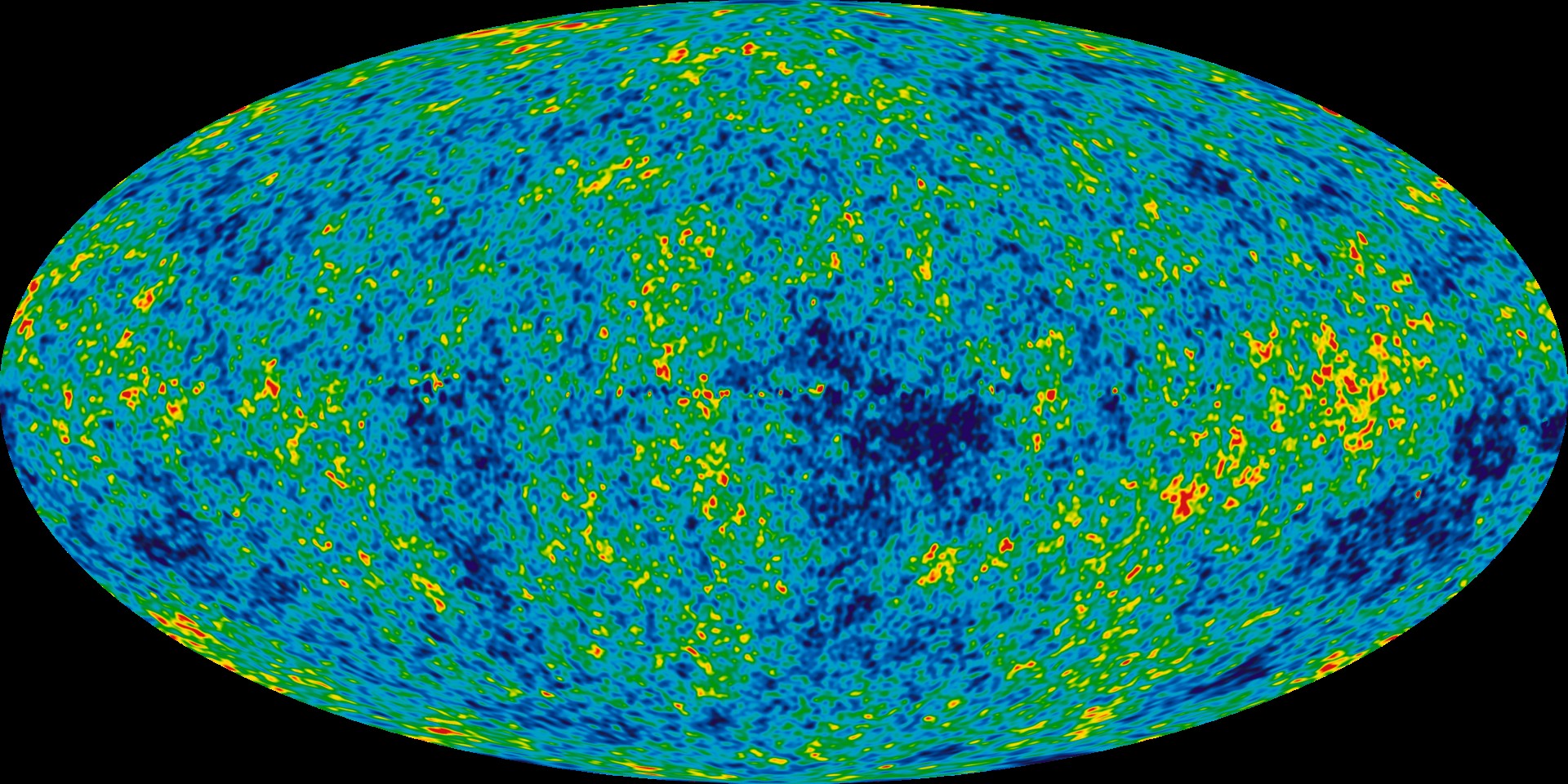
The Big Bang is the prevailing model of how the universe began: about 13.8 billion years ago the cosmos expanded from an extremely hot and dense state and has been cooling and expanding ever since. Three independent lines of evidence converge on it — the expansion of the universe described by Hubble's law, the cosmic microwave background at 2.725 K released about 380,000 years after the beginning, and the predicted abundances of hydrogen, helium and lithium forged in the first minutes. This article follows that evidence chain from Hubble's 1929 observations to the Planck and DESI results, and explains what the theory does — and does not — claim.
Overview
The Big Bang is the prevailing account of how the universe began: the cosmos emerged from a state of extremely high temperature and density about 13.8 billion years ago.1 The model rests on two assumptions — that general relativity correctly describes gravity, and the cosmological principle, which holds that an observer's view of the universe depends neither on the direction in which he looks nor on his location.1 Those two assumptions make it possible to calculate the history of the cosmos after an epoch called the Planck time; scientists have yet to determine what prevailed before it.1
It was not an explosion inside pre-existing space; it was the expansion of space itself.2 The cosmological principle applies to the large-scale universe, and it implies that the universe has no edge: the big-bang origin occurred not at a particular point in space but throughout space at the same time.1 We know the universe has no center because galaxies rush away from each other rather than from a central point, and because the heat left over from early times uniformly fills the cosmos.2 The Big Bang, on this reading, was a process happening in time, not a point in time.2
In 1929 the American astronomer Edwin Hubble discovered that the distances to far-away galaxies were proportional to their redshifts.3 COBE, WMAP and Planck all saw further back than JWST, mapping the heat that dates from roughly 380,000 years after the beginning.2 What follows traces that evidence chain, then the cosmic timeline and the numbers, and closes with the questions that remain open.
The expanding universe: Hubble's law
The first pillar of the case is expansion: in 1929 the American astronomer Edwin Hubble discovered that the distances to far-away galaxies were proportional to their redshifts.3 The farther a galaxy, the faster it recedes.4 The relationship is known today as the Hubble–Lemaître law.4 Hubble's discovery was the first observational support for Georges Lemaître's Big Bang theory of the universe, proposed in 1927.3
The groundwork had been laid over the preceding decade: in 1922 the Russian scientist and mathematician Alexander Friedmann published a paper detailing multiple possibilities for the history of the universe, including the possibility that the universe is expanding.5 In 1927 the Belgian astronomer Georges Lemaître showed that the equations of Einstein's theory support the idea that the universe is not static but is actually expanding.5 Behind both stood earlier work — Slipher's galaxy redshifts and Leavitt's period–luminosity relation for Cepheids, the rungs of the cosmic distance ladder.3
Expansion also explains what redshift means: as space stretches, the light travelling through it is stretched with it — the same effect that has carried the early universe's glow down to a cold 2.7 degrees above absolute zero.6 The expansion rate is expressed as the Hubble constant, in kilometres per second per megaparsec: 67.4 from the CMB and 73.5 from local measurements.7 The local figure carries an uncertainty of only two percent, the CMB figure less than a percent — which is precisely why their disagreement matters.7
Evidence table: the four pillars
| Pillar | Key observation | Central numbers | Anchor sources |
|---|---|---|---|
| Cosmic expansion | Distant galaxies recede with redshifts proportional to their distance — the Hubble–Lemaître law3 | H₀ = 67.4–73.5 km/s/Mpc7 | Hubble (1929)4; CERN3 |
| Cosmic microwave background | Light released when the universe was about 380,000 years old, now a 2.725 K blackbody; discovered in 1965, mapped by COBE, WMAP and Planck8 | 380,000 years9; 2.725 K8 | Penzias & Wilson (1965)10; ESA Planck6 |
| Big Bang nucleosynthesis | Protons and neutrons forged hydrogen, helium and traces of lithium and beryllium in the first minutes9 | Helium at roughly one quarter of the mass of the universe11 | NASA9 |
| Large-scale structure | The ripples in the CMB are the seeds that grew into galaxies2 | Space flat to within 0.4%8 | WMAP8; Planck6 |
The cosmic microwave background: the oldest light
About 380,000 years after the Big Bang, the universe had cooled enough that atomic nuclei could capture electrons — a period astronomers call the epoch of recombination.9 The universe became transparent, and light could travel freely over great distances for the first time.9 That glow, still detectable today, is the cosmic microwave background: the oldest light we can observe in the universe.9 It originated when the universe was dense, hot and opaque, and the expansion of space has since stretched it to a cold 2.7 K.12 At recombination the temperature of the universe was around 2,700 degrees Celsius.6
The detection was an accident: Penzias and Wilson spent 1964–1965 fighting an unexplained hiss in their Holmdel antenna — a hunt that famously involved even the New Jersey pigeons — before concluding that it was microwave radiation present throughout the universe at about three degrees above absolute zero.10 The result matched a Princeton prediction that just such a relic glow should exist.13 The noise became known as cosmic microwave background radiation — the missing evidence that could back up the Big Bang theory and led to its acceptance as the standard model of cosmology.13 Penzias and Wilson shared half of the 1978 Nobel Prize in Physics for their discovery of cosmic microwave background radiation.14
Satellites then turned the afterglow into precision data. In 1989 NASA's COBE satellite was launched under John Mather's leadership to study the radiation from orbit.15 COBE confirmed that the diffuse radiation displayed precisely the expected frequency–wavelength relationships — the perfect blackbody spectrum predicted to result from first light in the universe.15 In 1992, detectors under George Smoot's direction measured minute variations, or anisotropies, in the background radiation — traces left behind by developing clusters in the expanding universe.15 Later came WMAP, which fixed the universe's age at 13.77 billion years and the curvature of space to within 0.4% of flat Euclidean geometry8, and Planck, which released the most detailed map ever created of the CMB and found ordinary matter at 4.9% and dark matter at 26.8%.6
Big Bang nucleosynthesis: the first elements
One second after the Big Bang, the universe consisted of an extremely hot primordial soup of light and particles at 18 billion degrees Fahrenheit, or 10 billion degrees Celsius.9 In the following minutes, an era called nucleosynthesis, protons and neutrons collided and produced the earliest elements: hydrogen, helium, and traces of lithium and beryllium.9 Protons and neutrons formed the nuclei of hydrogen and helium, the basic building blocks of stars.11
After five minutes, most of today's helium had formed, and the universe had expanded and cooled enough that further element formation stopped.9 Helium nuclei created in the Big Bang contain two protons and two neutrons each, and helium is the second most abundant element.11 It comprises roughly one quarter of the mass of the universe, a proportion set in the first minutes.11
The heavier elements came later: the chemical elements of life were first produced in the first generation of stars after the Big Bang.2 By the time the universe was 1 billion years old, stars and galaxies had transformed nearly all this primordial gas, making the universe transparent to light as we see it today.9
What 'Big Bang' does — and does not — claim
The name is a relic of a scientific quarrel: the idea that the universe began in an explosive burst was sarcastically dubbed the 'Big Bang' theory by Fred Hoyle, a critic of the theory, in 1949 — and the nickname stuck.15 It is, as the Nobel laureate John Mather puts it, a really misleading name for the expanding universe that we see.2
Cosmic history: from inflation to the first stars
Cosmic history begins with inflation: around 13.8 billion years ago the universe expanded faster than the speed of light for a fraction of a second.9 When cosmic inflation stopped, the energy driving it transferred to matter and light — the big bang.9 In the standard model of cosmology, the fluctuations we see in the CMB arose immediately after the Big Bang and were stretched to cosmologically large scales during that brief period of accelerated expansion.6 Cosmologists think inflation explains many aspects of the universe we observe today, such as its flatness, or lack of curvature, on the largest scales.9 What came before inflation, and what powered it, scientists are not sure.9
After nucleosynthesis the universe entered a long dark age: for the next 200 million years it remained dark, with no stars to shine.9 Present observations suggest that the first stars formed from clouds of gas around 150–200 million years after the Big Bang.3 They were 30 to 300 times more massive than the Sun and millions of times brighter.9 By the time the universe was 1 billion years old, stars and galaxies had transformed nearly all this gas, making the universe transparent to light as we see it today.9
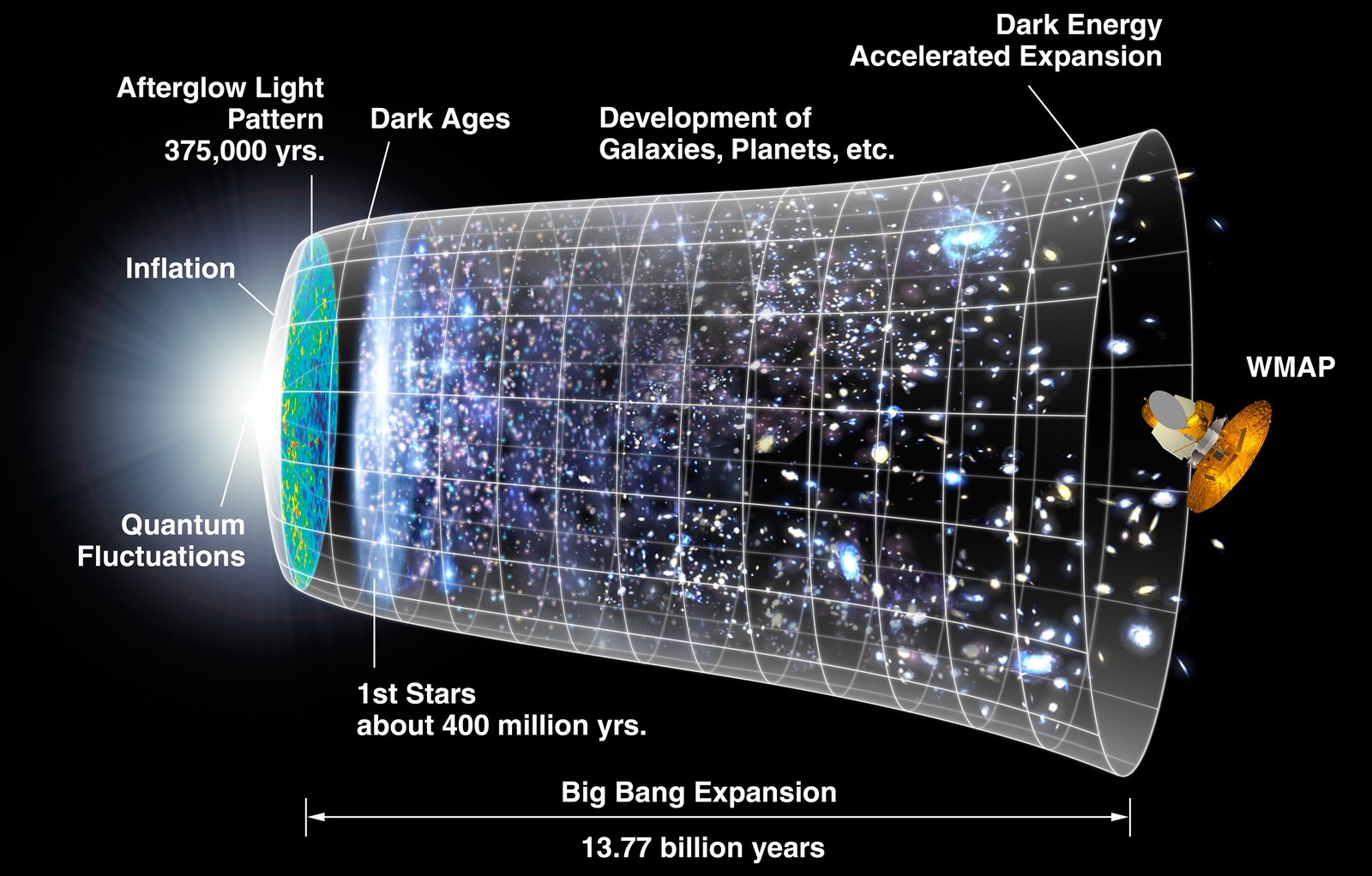
A single NASA/WMAP illustration — the timeline graphic included with this article — traces the full 13.8-billion-year journey from inflation through the first stars and galaxies to the present.8 The story has not stopped: more recently, the expansion has begun to speed up again as the repulsive effects of dark energy have come to dominate it.11 Cosmologists suggest it is likely that the universe will continue to expand forever.9
The universe by numbers
| Quantity | Value | Where it comes from |
|---|---|---|
| Age of the universe | 13.8 billion years | NASA9 |
| Age implied by Planck | 13.82 billion years | Planck6 |
| Hubble constant from the CMB | 67.4 km/s/Mpc (under 1% uncertainty) | Planck7 |
| Hubble constant from local measurements | 73.5 km/s/Mpc (2% uncertainty) | Hubble and Gaia7 |
| CMB temperature today | 2.725 K | WMAP8 |
| CMB released | 380,000 years after the Big Bang | NASA9 |
| Temperature at recombination | around 2,700 °C | Planck6 |
| Ordinary matter | 4.9% of mass and energy density | Planck6 |
| Dark matter | 26.8% | Planck6 |
| Dark energy | about 68.3–70% | NASA5 |
| First stars | 150–200 million years after the Big Bang | CERN3 |
| Geometry of space | flat to within 0.4% | WMAP8 |
Dark energy and the accelerating universe
In 1998, astronomers found that certain supernovae — bright stellar explosions — were fainter than expected, evidence that cosmic expansion is speeding up.9 Two teams working independently at Berkeley observed that supernovae were moving away from Earth at an accelerating rate.3 Nine billion years after the universe began, its expansion started to speed up, driven by an unknown force that scientists have named dark energy.5
Dark energy is the name for that unknown force, and it accounts for about 70% of the mass-energy content of the universe.3 In 1984 James Peebles contributed to reviving Einstein's cosmological constant, the energy of empty space; named dark energy, it fills 69 per cent of the cosmos.16 The standard model of cosmology includes cold dark matter, which unlike ordinary matter does not interact with light, and dark energy, which drives the currently accelerated expansion.7
Candidate explanations remain speculative: vacuum energy, whose discrepancy with observation is the cosmological constant problem, along with quintessence fields, cosmic defects, or a modification of general relativity; Euclid, Roman, Rubin and DESI are among the next tests.5 That discrepancy between the observed and the theoretically predicted vacuum energy has yet to be solved.5 DESI Data Release 2, based on three years of operation, presents baryon acoustic oscillation measurements from more than 14 million galaxies and quasars.17
The Hubble tension and open questions
The most-quoted discrepancy in modern cosmology is the Hubble tension. The value astronomers derive from local observations, including the Hubble Space Telescope and Gaia, is 73.5 km/s/Mpc, with an uncertainty of only two percent.7 The value predicted from the Planck CMB data is 67.4 km/s/Mpc, with a tiny uncertainty of less than a percent.7
No one has been able to come up with a satisfactory explanation for the differences between the two measurements, and the question remains to be resolved.7 The tension sharpened in 2016, when astronomers using NASA's Hubble Space Telescope discovered that the universe is expanding 5 percent to 9 percent faster than expected.18 Candidate resolutions — new physics, early dark energy, or a local under-density — are all under discussion.7
Inflation remains unexplained in physical detail: the process behind it is unknown, and it lies at energies and densities beyond standard particle physics and beyond terrestrial particle accelerators.12 One of the most surprising Planck findings is that the fluctuations in the CMB temperatures at large angular scales do not match those predicted by the standard model.6 And dark energy may not be constant: DESI DR2's mild tension with the CMB at 2.3σ is alleviated by a time-evolving dark energy, preferred over the standard picture at up to 4.2σ when supernovae are included.17
Some things, though, are settled: the big-bang model is the widely held theory of the evolution of the universe.1 Known matter comprises just five per cent of all the matter and energy contained in the universe; the remaining 95 per cent is hidden from us.16 Yet that small share of known matter has proved enough to trace the history of the cosmos from the first minutes to the present day.16
From ridicule to precision cosmology
The theory won its place the hard way. A nickname coined in mockery in 1949 became the standard model once the microwave background supplied the missing evidence.13 The Nobel Prizes mark the milestones: 1978 for the discovery of the cosmic microwave background14, 2006 for COBE's blackbody spectrum and its anisotropies15, and 2019 for James Peebles and the theoretical framework that is the foundation of our modern understanding of the universe's history, from the Big Bang to the present day.16
Precision cosmology grew out of that framework. WMAP determined the universe to be 13.77 billion years old to within a half percent, nailed down the curvature of space to within 0.4% of flat Euclidean geometry, and reduced the allowed volume of cosmological parameters by a factor in excess of 68,000.8 Planck's data set a new value for the Hubble constant — 67.15 kilometres per second per megaparsec, significantly less than the standard value in astronomy at the time.6 The mission's first all-sky picture of the oldest light was based on the initial 15.5 months of data, imprinted on the sky when the universe was just 380,000 years old.6 In 2018 the final Planck release confirmed the 'almost perfect Universe' while quantifying the most important tension: 73.5 versus 67.4 km/s/Mpc.7
So far the standard model of cosmology has survived all the tests it has faced, with Planck supplying the measurements that show it.7 At the same time, known matter comprises just five per cent of all the matter and energy in the universe, and the remaining 95 per cent is hidden from us.16 The dark matter is detected so far only indirectly, through its gravitational influence.6 The blueprint, in other words, is far from complete.
In their words
“The Big Bang is a really misleading name for the expanding universe that we see.”2
John Mather, Nobel laureate and senior project scientist for the James Webb Space Telescope
“The universe doesn't have a center. The Big Bang happened everywhere at once and was a process happening in time, not a point in time.”2
John Mather, on why the theory is not an explosion at a point
“So far the standard model of cosmology has survived all the tests, and Planck has made the measurements that show it.”7
Jan Tauber, ESA's Planck project scientist
“They are real and we have to look for a credible explanation.”6
Paolo Natoli, on the anomalies in the Planck data
“You start at two ends, and you expect to meet in the middle if all of your drawings are right and your measurements are right. But now the ends are not quite meeting in the middle and we want to know why.”18
Adam Riess, on the Hubble tension
Milestones in the story of the Big Bang
Einstein's general theory of relativity
Albert Einstein's general theory of relativity appears; it is now the basis of all large-scale calculations about the universe, and astronomers would later find that observations of receding galaxies had been predicted by it.
Friedmann publishes expanding-universe solutions
The Russian scientist and mathematician Alexander Friedmann publishes a paper detailing multiple possibilities for the history of the universe, including the possibility that the universe is expanding.
Lemaître proposes the expanding universe
The Belgian astronomer Georges Lemaître proposes that the universe expanded explosively from an extremely dense and hot state and continues to expand today — the idea later known as the Big Bang.
Hubble confirms that the universe is expanding
Edwin Hubble reports that the distances to far-away galaxies are proportional to their redshifts: the farther a galaxy, the faster it recedes. It is the first observational support for the expanding-universe models — today called the Hubble–Lemaître law.
Fred Hoyle coins the phrase 'Big Bang'
The explosive-beginning idea is sarcastically dubbed the 'Big Bang' theory by Fred Hoyle, a critic of the theory. The nickname sticks.
Penzias and Wilson detect the cosmic microwave background
Radio astronomers Arno Penzias and Robert Wilson, unable to remove a persistent background hiss in their Holmdel antenna, conclude that it is microwave radiation present throughout the universe at about three degrees above absolute zero. The result, published in 1965, becomes the missing evidence for the Big Bang.
Nobel Prize honours the CMB discovery
The Nobel Prize in Physics 1978 is awarded with one half to Pyotr Kapitsa for low-temperature physics and the other half jointly to Arno Penzias and Robert Woodrow Wilson 'for their discovery of cosmic microwave background radiation'.
COBE is launched
NASA's Cosmic Background Explorer is launched under John Mather's leadership to study the cosmic microwave background radiation from orbit, free of the interference of Earth's atmosphere.
COBE maps the ripples in the early universe
Principal investigators of the COBE satellite present an image of the first rays of light in the universe: tiny temperature variations in the background radiation that are the seeds of all later structure. Mather and Smoot share the 2006 Nobel Prize for the work.
Accelerating expansion discovered
Two independent teams studying distant supernovae find that the expansion of the universe is not slowing down under gravity but speeding up — evidence for what becomes known as dark energy. The discovery earns the 2011 Nobel Prize in Physics.
WMAP launches to map the microwave sky
The Wilkinson Microwave Anisotropy Probe is launched to the Sun–Earth L2 point. Its nine-year data set would fix the age of the universe at 13.77 billion years, the flatness of space to within 0.4%, and the cosmic recipe of atoms, dark matter and dark energy.
Nobel Prize for the blackbody CMB and its anisotropies
The Nobel Prize in Physics 2006 is awarded to John Mather and George Smoot for recording faint echoes of the birth of the universe — the COBE measurements of the perfect blackbody spectrum and of the tiny anisotropies in the cosmic microwave background.
Planck reveals an 'almost perfect Universe'
ESA's Planck space telescope releases the most detailed map ever created of the cosmic microwave background. The data confirm the standard model of cosmology to unprecedented accuracy and give the cosmic recipe: 4.9% ordinary matter, 26.8% dark matter, a universe 13.82 billion years old — with a few anomalies to explain.
Planck's final legacy data release
The Planck consortium makes its final data release, confirming the 'almost perfect Universe' and quantifying the most important tension in cosmology: the local Hubble constant of 73.5 km/s/Mpc versus 67.4 km/s/Mpc inferred from the CMB. No one has a satisfactory explanation for the difference.
Nobel Prize for the theoretical framework of cosmology
James Peebles receives one half of the Nobel Prize in Physics 2019 'for theoretical discoveries in physical cosmology' — the framework, developed from the mid-1960s, that underlies the modern picture from the Big Bang to the present day, including dark matter and dark energy.
DESI DR2 challenges the standard dark-energy picture
The Dark Energy Spectroscopic Instrument releases BAO measurements from more than 14 million galaxies and quasars. The results are in mild tension with the CMB at 2.3σ, and a time-evolving dark energy provides a better fit — preferred over ΛCDM at up to 4.2σ when supernovae are included.
The Big Bang: quick answers
How old is the universe?
About 13.8 billion years: the cosmos emerged from a state of extremely high temperature and density 13.8 billion years ago.1 Planck's data imply an age of 13.82 billion years.6
What is the cosmic microwave background?
It is the oldest light we can observe, released about 380,000 years after the big bang, when the universe became transparent and light could travel freely.9 Stretched by expansion, it reaches us today as microwaves at a cold 2.7 K.12
Did the Big Bang happen at a single point in space?
No: the universe has no center, because galaxies rush away from each other rather than from a central point and because the leftover heat fills the universe uniformly.2 The origin occurred not at a particular point but throughout space at the same time.1
What is the Hubble tension?
Local measurements give a Hubble constant of 73.5 km/s/Mpc while the Planck CMB data give 67.4 km/s/Mpc, and no one has yet found a satisfactory explanation for the difference.7 In 2016 astronomers using Hubble found the universe expanding 5 to 9 percent faster than expected.18
Can the theory describe the very beginning of the universe?
It cannot describe the conditions at the very beginning, but it can describe the earliest moments after the start of the expansion.3 Cosmic history is calculable after an epoch called the Planck time; what prevailed before it remains undetermined.1
Which elements were created in the Big Bang?
In the first minutes, protons and neutrons produced hydrogen, helium and traces of lithium and beryllium in an era called nucleosynthesis.9 Helium is the second most abundant element, roughly one quarter of the mass of the universe.11
How do we know the expansion is accelerating?
In 1998 astronomers found that certain supernovae were fainter than expected — evidence that cosmic expansion is speeding up.9 Two independent teams at Berkeley observed supernovae moving away from Earth at an accelerating rate.3
What are dark matter and dark energy?
They are the unknown components that dominate the cosmos: dark matter makes up 26.8% of the universe and has been detected only indirectly through its gravitational influence6, while dark energy accounts for about 70% of the mass-energy content and drives the accelerating expansion.3
The Big Bang in numbers
Sources & citations
Every factual claim in this article is drawn from the sources below. Bracketed numbers in the text link to the corresponding source.
- 1
- 2
- 3
- 4
- 5
- 6
- 7
- 8
- 9
- 10
- 11
- 12
- 13
- 14
- 15
- 16
- 17
- 18
- 19