The Milky Way
Our home galaxy — a barred spiral of hundreds of billions of stars, mapped in three dimensions by ESA's Gaia and probed at its heart by GRAVITY
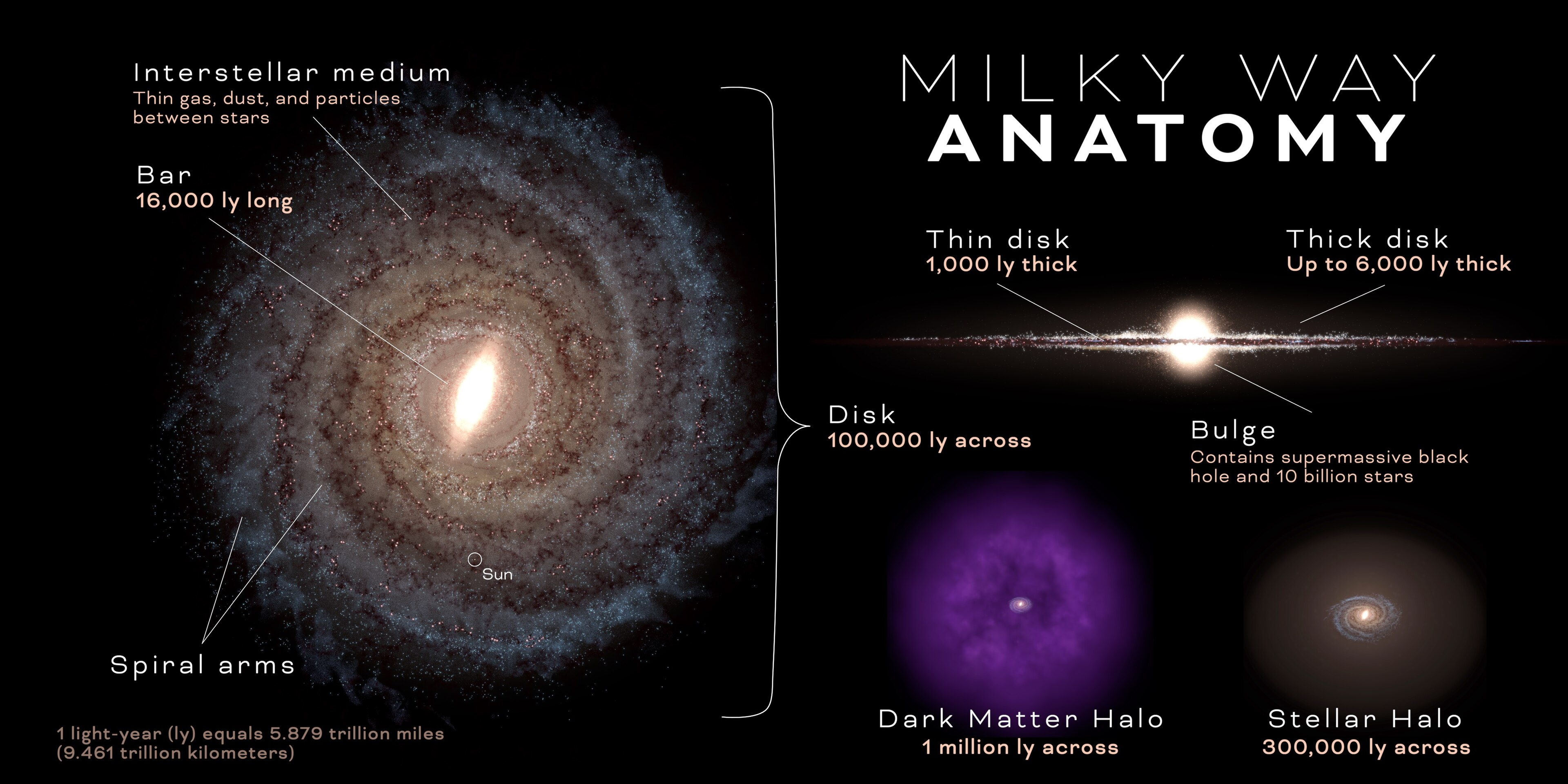
The Milky Way is the galaxy that contains the Solar System: a large barred spiral whose disk spans about 100,000 light-years, with roughly 100–400 billion stars and a total mass of about 1.5 trillion solar masses — most of it dark matter. Astronomers map it from the inside with ESA's Gaia mission, and test the laws of gravity on stars whipping around Sagittarius A*, the four-million-solar-mass black hole at the centre.
Overview
The Milky Way is our home galaxy — a spiral whose disk of stars spans more than 100,000 light-years.1 It is the galaxy in which the Solar System resides, classed as a relatively large barred spiral.2 Earth lies along one of the galaxy's spiral arms, about halfway from the centre.1 It is one galaxy among many billions — and the only one astronomers can study from the inside.1 A bar runs through the centre of the disk, and the whole system sits inside halos of stars and dark matter.2
In the night sky, that galaxy shows itself only as a faint band extending across the sky.2 Its centre lies in the direction of the constellation Sagittarius.2 A bright, dense radio source marks that direction — an object astronomers have known since the 1970s, later identified as Sagittarius A*.3
The galaxy is an aggregate of about 100-400 billion stars.2 Its mass comes to roughly 1.5 trillion times that of the Sun.4 The Sun itself sits about 26,600 light-years from the centre.2 One full circuit of the galaxy takes the Solar System about 240 million years.1 That circuit is the Sun's galactic year.1
Why it is called the Milky Way
The name began as a description of that band — the irregular luminous strip of stars and gas clouds that stretches across the sky as seen from Earth.5 The whole star system takes its name from it.5
Britannica frames the whole system in full: a large spiral system of several hundred billion stars, the Sun among them.5 In 1917 Harlow Shapley made the first reliable measurement of the size of the Milky Way.5 He assumed that the globular clusters outlined the Galaxy and determined a diameter of about 100,000 light-years — a value that has held up remarkably well over the years.5
Structure: disk, bar, bulge and halo
Most of the galaxy's stars and gas live in a thin disk extending about 100,000 light-years along its plane, roughly 1,000 light-years thick.2 Around that disk lies a much sparser stellar halo, including globular clusters of stars.2 Beyond even the outermost stars, the surrounding dark matter halo reaches to much larger distances.2 At the centre, a bulge of mostly older stars is elongated in one direction, forming a bar.2 Deep inside, the centre hosts a supermassive black hole of millions of solar masses.2 The gas and dust of the interstellar medium are confined mostly to the disk.2 The elongated bulge — the bar — is what earns the galaxy its barred-spiral classification.2
Much of this architecture is invisible from within; infrared images from NASA's Spitzer Space Telescope brought it into focus.6 What emerged was a simpler, more elegant skeleton: two major arms wrapping off the ends of a thick central bar of stars.6 The two major arms are Scutum-Centaurus and Perseus; the two minor arms, once counted major, are Norma and Sagittarius.6
Structure at a glance
A summary of the whole, from the disk that holds the stars to the dark matter halo that reaches far beyond them.2
| Component | Size or range | What it contains | Landmark |
|---|---|---|---|
| Disk diameter | About 100,000 light-years across2 | The stars, gas and dust of the galactic disk2 | First reliably measured in 1917, a value that has held up remarkably well5 |
| Disk thickness | About 1,000 light-years in the thin disk2 | The thin disk where most stars and gas live2 | Contrasted with the much sparser stellar halo2 |
| Stars | 100-400 billion2 | An aggregate of stars spread through disk, bar and halo2 | Britannica counts several hundred billion, one of them the Sun5 |
| Bar and bulge | Elongated across the centre, around the black hole2 | Older stars, plus the supermassive black hole2 | Sagittarius A* — about 4 million solar masses4 |
| Major spiral arms | Two — Scutum-Centaurus and Perseus6 | The highest densities of young and old stars6 | Revealed in infrared by NASA's Spitzer Space Telescope6 |
| Minor spiral arms | Two — Norma and Sagittarius6 | Mainly gas, with pockets of star formation6 | Less distinct, lying between the major arms6 |
| Globular clusters | About 150 orbiting the galaxy4 | Compact islands of hundreds of thousands of stars4 | Among the oldest objects, at about 12.5 billion years2 |
| Dark matter halo | Extends far beyond the stars2 | Most of the galaxy's mass, in invisible form4 | Mapped with Hubble and Gaia out to nearly 1 million light-years4 |
Spiral arms in infrared light
Infrared light is the key to the arms, because the dust that hides the galaxy's interior from visible light lets longer wavelengths pass.6 A radio-telescope survey of gas uncovered a further arm, called the Far-3 kiloparsec arm.6 The arm is shorter than the two major arms and lies along the bar of the galaxy.6
Star for star, the major arms hold the highest densities of young and old stars alike, while the minor arms are mostly gas, punctuated by pockets of star formation.6 More recently, Gaia mapped the disc of the Milky Way by tracing weak signals seen in starlight — faint imprints of the gas and dust that floats between the stars.7 The same architecture — two grand arms and two lesser ones — appears in gas maps as well as in infrared starlight.6
The galactic center and Sagittarius A*
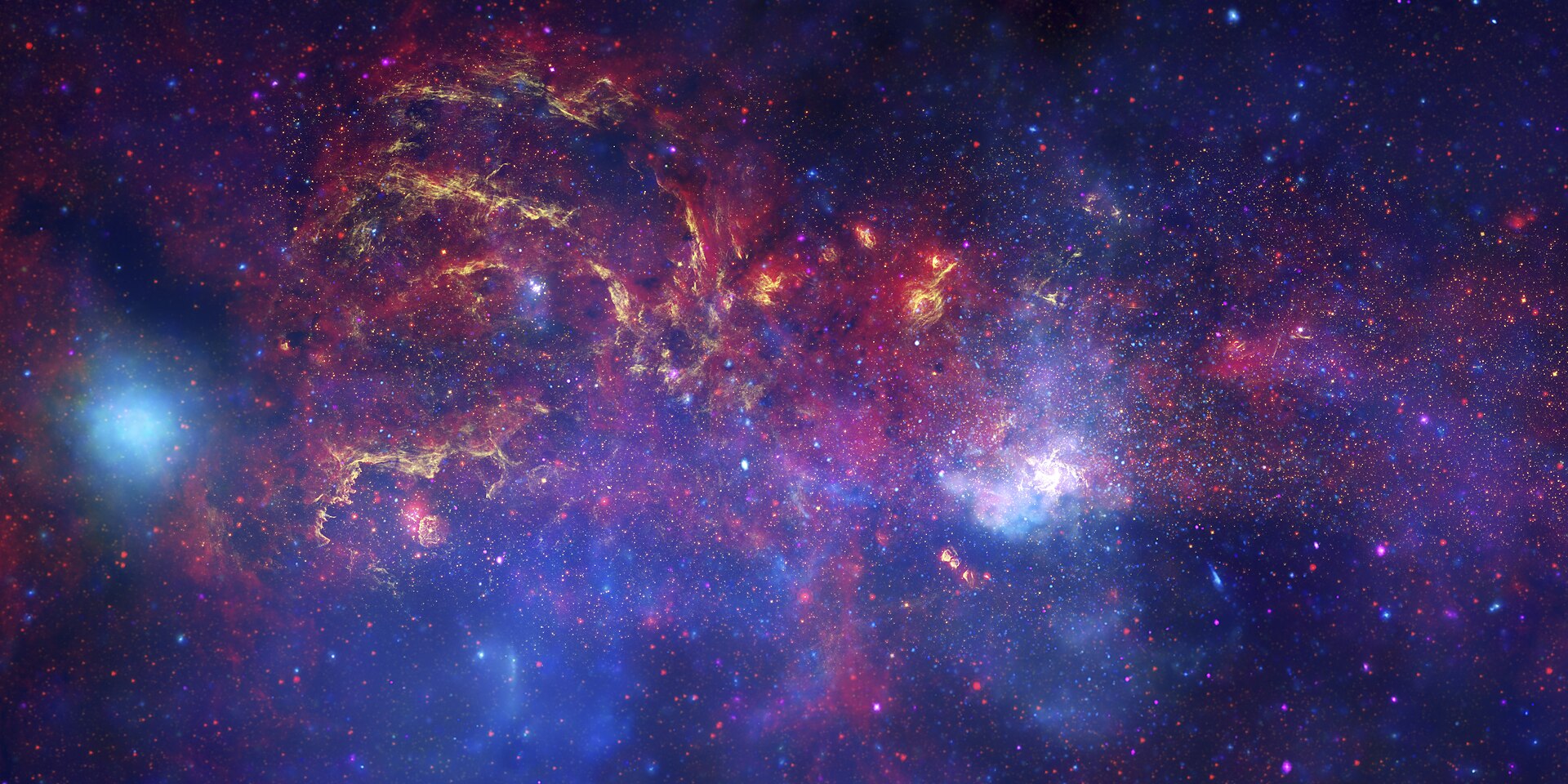
The galactic centre lies about 27,000 light-years, or 8 kiloparsecs, from the Solar System.8 Thick clouds of absorbing dust hide it from visible light, and the closest supermassive black hole to Earth lies there.9 At the heart of the Galaxy lies the compact radio source Sagittarius A*, the supermassive black hole of approximately 4.5 million solar masses.8 The centre of the Milky Way hosts a supermassive black hole about 4 million times the mass of the Sun.2
Around it, millions of older stars form the nuclear star cluster.8 Several young, massive stars orbit close in as well.8 By measuring the orbits of several stars over a period of 30 years, teams mapped the gravitational field at the centre.3
Testing Einstein with the star S2
The star S2 swings around Sagittarius A* on a highly elliptical orbit that takes 16 years to complete.10 In May 2018 it made its closest passage, coming within less than 20 billion kilometres of the black hole — about 120 times the distance from Earth to the Sun, and about 1,500 times the black hole's Schwarzschild radius.9 At that point it was moving at over 25 million kilometres per hour, almost three percent of the speed of light.9 The change in the wavelength of light from S2 agreed precisely with Einstein's theory of general relativity.9 Piece by piece, the orbit had been tracked with increasingly precise measurements over nearly 30 years before that passage.11
In 2020, after 27 years of tracking S2 and more than 330 measurements with GRAVITY, SINFONI and NACO, the collaboration announced the detection of Schwarzschild precession in the star's orbit.11 The orbit is shaped like a rosette rather than the ellipse that Newtonian gravity predicts.11 It was the first time a star orbiting the supermassive black hole was seen to move just as relativity predicts.11 Because the measurements follow general relativity so well, they set stringent limits on how much invisible material — such as dark matter or smaller black holes — is present around Sagittarius A*.11 The S2 data are inconsistent with pure Newtonian dynamics.10
GRAVITY combines the light of all four 8-metre VLT telescopes into a super-telescope with the resolution of a 130-metre mirror.11 Earlier in the campaign, the instruments SINFONI and NACO carried the observations.11 GRAVITY has also caught clumps of gas swirling at about 30% of the speed of light on a circular orbit just outside the black hole's event horizon.12 The emission appeared as three prominent bright flares and matched theoretical predictions for hot spots orbiting a black hole of four million solar masses.12 Such flares originate at the innermost stable orbit — the closest point where material can circle without being drawn in.12 The flares come from the accretion disc — the belt of gas orbiting Sagittarius A* at relativistic speeds.12
Mass and dark matter
To weigh it, astronomers turned to globular star clusters, using Hubble and Gaia to measure their three-dimensional movement around the galaxy.4 The study combined Gaia measurements for 34 globular clusters out to 65,000 light-years with Hubble measurements for 12 clusters out to 130,000 light-years.4 Used like pins on a map, those data points let astronomers estimate the distribution of the galaxy's mass out to nearly 1 million light-years from Earth.4 The Hubble measurements came from images taken over a 10-year period.4 The latest measurements put the galaxy's weight at about 1.5 trillion solar masses.4 The result, announced on 7 March 2019, sits near the middle of the range that earlier estimates had implied.4 Earlier research over several decades had produced estimates ranging between 500 billion and 3 trillion solar masses.4
Only a tiny percentage of that mass sits in the stars — roughly 200 billion of them — plus the 4-million-solar-mass black hole at the centre.4 Most of the rest of the mass is locked up in dark matter, the invisible substance that keeps the stars in their galaxies.4 The clusters mapped in those studies are compact islands of stars that orbit the galactic centre like bees around a hive.4
Gaia's three-dimensional map
Gaia's goal was to create the largest and most precise three-dimensional map of the Milky Way, surveying about 1% of the galaxy's 100 billion stars.13 It launched on 19 December 2013 and began surveying the sky on 25 July 2014.13 In its observation mode, Gaia spins once every six hours, sweeping its two telescopes across the entire sky onto a single digital camera — the largest flown in space — with nearly a billion pixels.13 From 27 July 2014 to 15 January 2025, Gaia made more than three trillion observations of two billion stars and other objects.14 The very first dataset had arrived on 14 September 2016, carrying positions of about one billion stars.13 The second data release, in April 2018, produced the richest star catalogue to date, with high-precision measurements of nearly 1.7 billion stars.15 Parallax and proper motion were listed for more than 1.3 billion stars.15 The third release then contained data on over 1.8 billion stars.7
The third data release arrived on 13 June 2022, building on the earlier catalogue.16 It added mean radial velocities for 33 million stars.16 Some 6.6 million quasar candidates are listed with redshift estimates for most of them.16 Astrophysical parameters are provided for about 470 million sources.17 Solar-system results cover 158,000 sources, including 31 planetary satellites.16 For more than 150,000 asteroids, the release pinpoints positions over nearly double the previous timespan, making most of the orbits 20 times more precise.7 In total, the release amounts to 10 TB of data.18 It also builds on an interim catalogue issued in December 2020.16
How the galaxy formed
These dates come from the ages of stars read out of the Gaia catalogue.19 The old thick disk of the galaxy started to form approximately 13 billion years ago, only 0.8 billion years after the Big Bang.19 That start came about 2 billion years before the final assembly of the inner halo.19 Most of these stars formed around 11 billion years ago, when the Gaia-Sausage-Enceladus satellite merged with our Galaxy.19
The galactic disk formed 8-10 billion years ago.2 Over the next 5-6 billion years, the Galaxy experienced continuous chemical element enrichment, ultimately increasing by a factor of 10 while the star-forming gas managed to stay well mixed.19 Globular clusters, with ages of about 12.5 billion years, are among the oldest objects in the Galaxy.2
The Local Group and the wider neighbourhood
The Milky Way sits in a neighbourhood with over 50 other galaxies called the Local Group.1 Its members range in size from dwarf galaxies, with up to a few billion stars, to Andromeda, our nearest large galactic neighbour.1 Andromeda is the nearest large galaxy beyond our own.1 The Local Group sits just off the edge of the Virgo cluster and is part of the Laniakea supercluster.1
Gaia's data have been used to derive the orbits of 75 globular clusters and 12 dwarf galaxies revolving around the Milky Way.15 Those orbits trace how the galaxy's gravity holds its outermost members.15 The catalogue also reaches far beyond the galaxy, including millions of galaxies and quasars.7 The third release contained data on over 1.8 billion stars, building a complete view of the Milky Way and beyond.7
In their words
Three voices, from the black-hole hunters to the star surveyor's agency, tell the story of what these measurements mean.11
This observational breakthrough strengthens the evidence that Sagittarius A* must be a supermassive black hole of 4 million times the mass of the Sun
Reinhard Genzel, Director at the Max Planck Institute for Extraterrestrial Physics
It's mind-boggling to actually witness material orbiting a massive black hole at 30% of the speed of light
Oliver Pfuhl, scientist at the Max Planck Institute for Extraterrestrial Physics (MPE)
Today, ESA's Gaia mission releases a goldmine of knowledge about our galaxy and beyond
European Space Agency, on the Gaia focused product release, 10 October 2023
Milestones in the exploration of the Milky Way
Harlow Shapley measures the size of the Galaxy
Assuming that the globular clusters outline the Galaxy, Shapley determines that it has a diameter of about 100,000 light-years - a value that has held up remarkably well over the years.
The radio source at the galactic centre becomes known
Astronomers come to know the bright, dense radio source at the centre of the Milky Way, in the direction of the constellation Sagittarius - the object later identified as Sagittarius A*.
Gaia launches to map the galaxy
ESA's Gaia spacecraft lifts off on a Soyuz-ST-B/Fregat-MT from the CSG/ELS pad, beginning a mission to chart a three-dimensional map of the Milky Way.
Gaia begins its five-year survey
After four months of calibration, alignment and focusing of its telescopes, Gaia begins its five-year mission, spinning once every six hours to sweep the sky.
First Gaia data release
ESA releases its first dataset from Gaia: positions and G magnitudes for about one billion stars, based on observations from 25 July 2014 to 16 September 2015.
The richest star catalogue of its time
Gaia's second data release pins down positions of nearly 1.7 billion stars and gives parallax and proper motion for more than 1.3 billion, based on 22 months of charting the sky.
S2 sweeps past the supermassive black hole
The star S2 passes less than 20 billion kilometres from the black hole at over 25 million kilometres per hour; ESO's GRAVITY and SINFONI detect the gravitational redshift predicted by general relativity.
Gas seen orbiting at 30% of the speed of light
GRAVITY observes clumps of gas swirling on a circular orbit just outside the event horizon of Sagittarius A*, confirming the black hole status of the Milky Way's centre.
Hubble and Gaia weigh the Milky Way
Combining Hubble and Gaia measurements of globular cluster motions, astronomers put the galaxy's mass at about 1.5 trillion solar masses - most of it dark matter.
Schwarzschild precession detected in S2's orbit
After 27 years of tracking S2 and over 330 measurements with GRAVITY, SINFONI and NACO, the GRAVITY collaboration finds the star's rosette-shaped orbit - general relativity confirmed in an extreme gravitational field.
Gaia Early Data Release 3
Gaia EDR3 delivers the full astrometric solution - positions, parallax and proper motion - for around 1.46 billion sources.
First image of the black hole at the heart of our galaxy
The Event Horizon Telescope, linking eight radio observatories into an Earth-sized virtual telescope, reveals the image of Sagittarius A*.
Gaia Data Release 3
DR3 adds radial velocities for 33 million stars, astrophysical parameters for 470 million objects, 6.6 million quasar candidates and results for 158,000 solar-system sources on top of the EDR3 catalogue.
Focused product release from Gaia
An interim release adds half a million new and faint stars in a massive cluster's core, 381 solid candidates for lensed quasars, and improved orbits for more than 150,000 asteroids.
Gaia ends science operations
After making more than three trillion observations of two billion stars and other objects, Gaia stops collecting science data; DR4, based on 66 months of data, is expected in December 2026.
The Milky Way: quick answers
How big is the Milky Way?
Its disk of stars spans more than 100,000 light-years, and the Sun sits about 26,600 light-years from the centre.2 The thin disk of stars and gas is about 1,000 light-years thick.2
How many stars does the galaxy contain?
The Milky Way is an aggregate of about 100-400 billion stars.2 Britannica counts several hundred billion in the large spiral system, and one of those stars is the Sun.5
What is at the centre of the Milky Way?
The compact radio source Sagittarius A*, a supermassive black hole of approximately 4.5 million solar masses, orbited by several young, massive stars.8 Millions of older stars surround it in the nuclear star cluster.8
How much does the Milky Way weigh?
About 1.5 trillion solar masses, according to the latest measurements.4 Only a tiny percentage is in the approximately 200 billion stars; most of the rest is dark matter.4
How long does the Sun take to orbit the galaxy?
One full circuit takes about 240 million years.1 The Sun makes the journey from a distance of about 26,600 light-years from the centre.2
What are the spiral arms of the Milky Way?
Two major arms, Scutum-Centaurus and Perseus, wrap off the ends of the central bar.6 Two less distinct minor arms, Norma and Sagittarius, lie between them, primarily filled with gas and pockets of star formation.6
The Milky Way in numbers
Sources & citations
Every factual claim in this article is drawn from the sources below. Bracketed numbers in the text link to the corresponding source.
- 1
- 2
- 3
- 4
- 5
- 6
- 7
- 8
- 9
- 10
- 11
- 12
- 13
- 14
- 15
- 16
- 17
- 18
- 19