Mercury (Planet)
The innermost planet of the solar system: its fast 88-day orbit, slow 59-day rotation, extremes of temperature, cratered surface and shrinking scarps, weak magnetic field, thin exosphere — and the missions that revealed it.
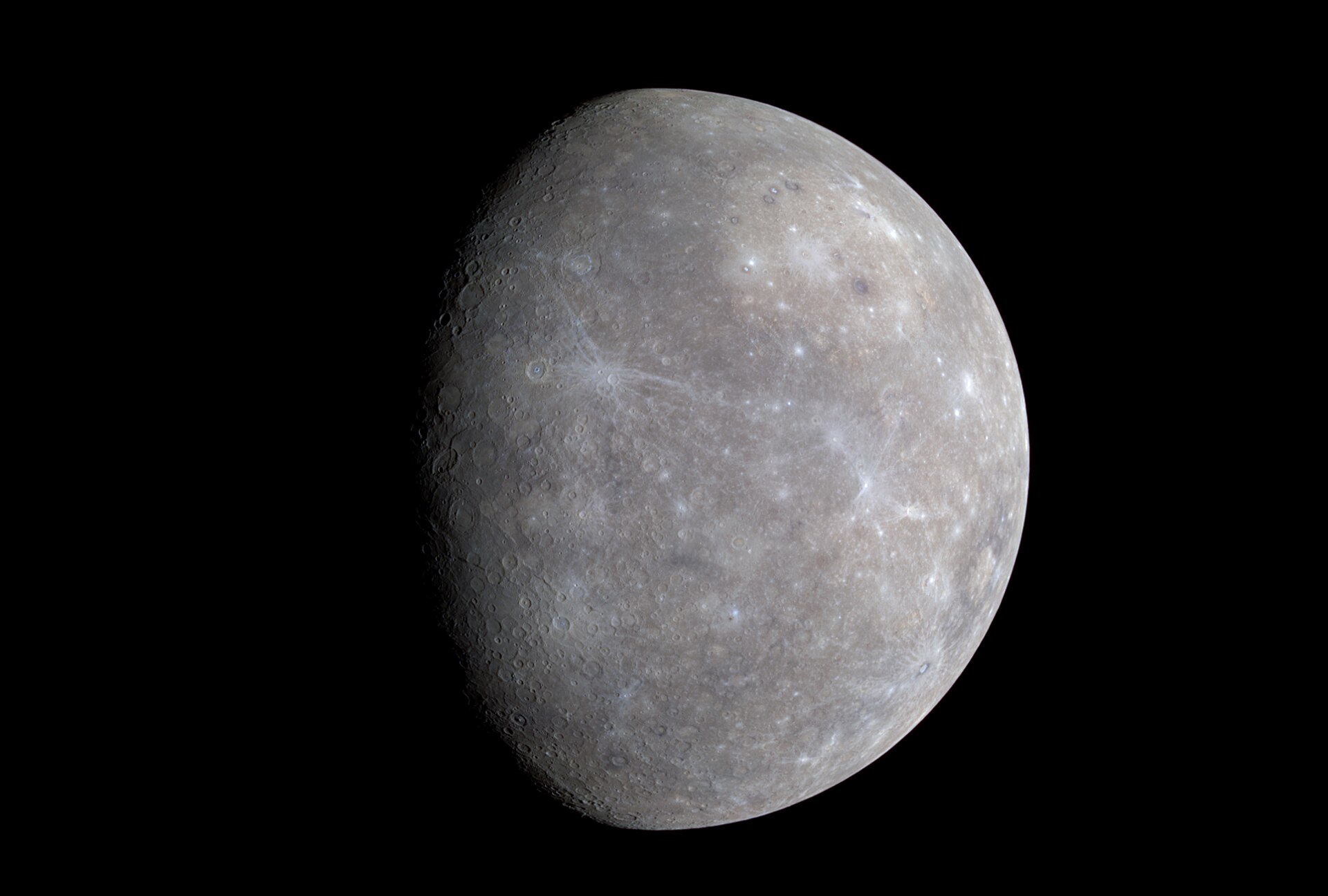
Mercury is the smallest planet in the solar system and the closest to the Sun, orbiting once every 88 Earth days and rotating on its axis once every 59. Its airless, cratered surface swings from about 430 C in daylight to -180 C at night, and it retains a weak magnetic field offset from its equator plus a thin exosphere of oxygen, sodium, hydrogen, helium and potassium. Mariner 10, MESSENGER and BepiColombo have provided the close-up record of the planet, including evidence of water ice in permanently shadowed polar craters.
In this article
Orbit and Rotation
Mercury follows a highly eccentric, egg-shaped orbit, with an eccentricity of 0.2056, so its distance from the Sun varies from 46 to 70 million kilometers. Its orbital velocity ranges from 59.0 km/sec at perihelion to 38.9 km/sec at aphelion. From an average distance of 36 million miles (58 million kilometers), Mercury is 0.4 astronomical units from the Sun, and sunlight takes 3.2 minutes to travel from the Sun to Mercury. The planet's mean distance from the Sun is 57,909,227 km (0.39 AU).
Mercury spins slowly on its axis, completing one rotation every 59 Earth days. Giuseppe (Bepi) Colombo was the first to see that an unsuspected resonance causes Mercury to rotate on its axis three times for every two revolutions around the Sun. The planet's axial tilt is 2 degrees.
The length of Mercury's day was not determined until the 1960s.
Mercury's rotational axis is tilted almost zero, so its polar regions never see sunlight. This near-zero tilt allows water ice to remain frozen in polar locations that are permanently shadowed.
Mercury completes one orbit around the Sun every 88 Earth days.
A solar day on Mercury—noon to noon—lasts 176 Earth days, twice as long as its 88-day year. Its sidereal rotation period is 58.646 Earth days.
1. Physical Characteristics
The planet's mean density is 5.43 g/cm3 3Mercury | Facts, Color, Size, & Symbol · Encyclopaedia Britannica ↗.
Mercury is only slightly larger than Earth's Moon 6Mercury · NASA Science ↗.
With a mean radius of 2,440 km (1,516 mi), it is a little more than one-third the width of Earth 2Mercury Facts · NASA Science ↗.
Mercury has a diameter of 2,440 km (1,516 mi), a little more than one-third the width of Earth 6.
2. Surface and Geology
Mercury's surface is scarred by impact craters, and it is the most cratered planet in the Solar System. Large areas of the surface are smooth, but the planet also carries cliffs some hundreds of miles long and up to a mile high. These cliffs rose as the interior cooled and contracted over the billions of years since Mercury formed.
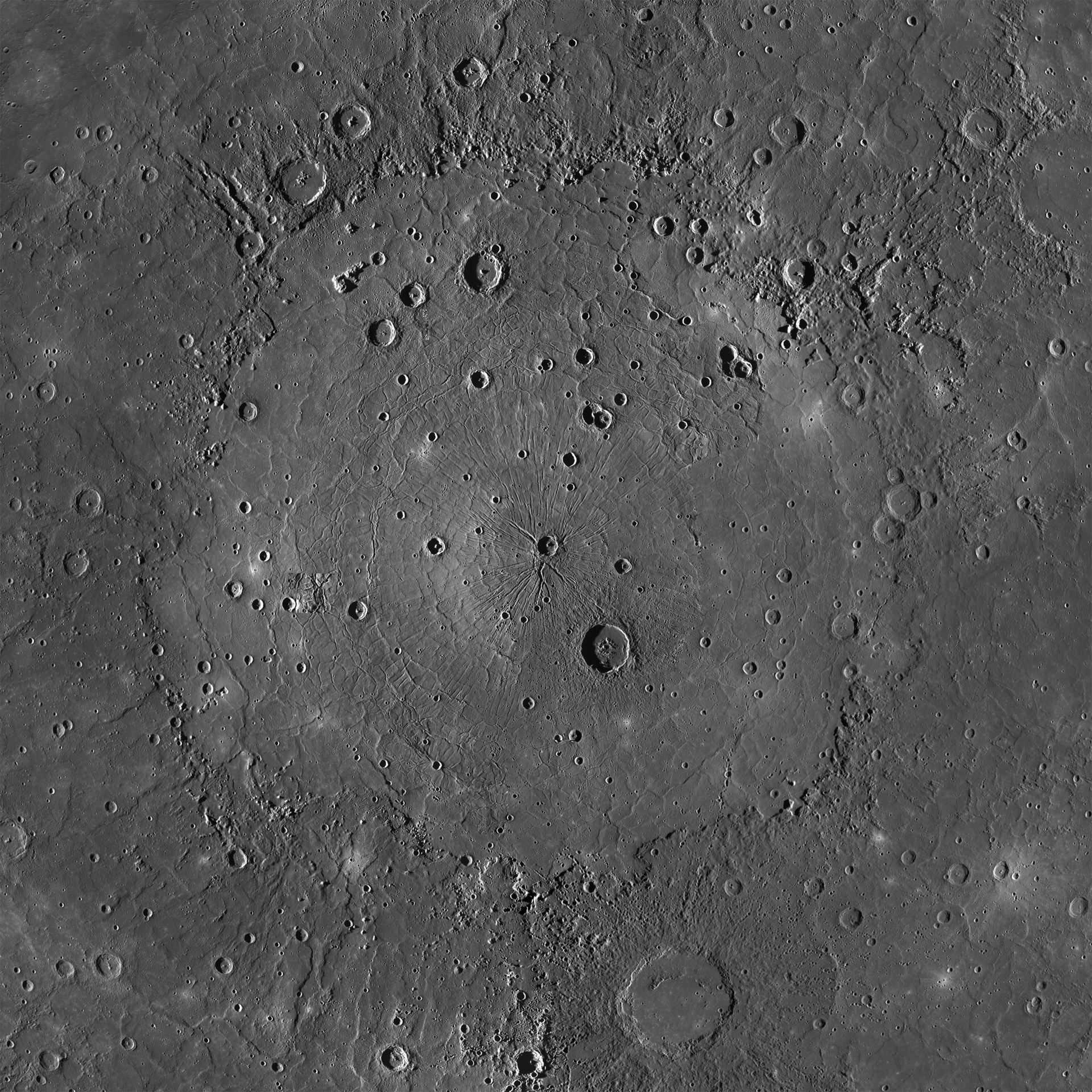
The largest impact basin on Mercury is Caloris, about 950 miles (1,525 kilometers) across and ringed by mile-high mountains. It is defined by a ring of mountains 1,300 km in diameter, with individual massifs typically 30 to 50 km long. The basin has been flooded by lava, and post-flooding craters have excavated low-reflectance material from beneath the surface lavas, likely giving a glimpse of the original basin floor material.
Lobate scarps are widely distributed over Mercury and consist of sinuous to arcuate scarps that transect preexisting plains and craters. King, a professor of geosciences at Virginia Tech, reported in Nature Geoscience that mantle convection, the loss of heat from the mantle through the crust, also played a role in the formation of lobate scarps on Mercury.
Mercury's oldest surface is its intercrater plains, level to gently rolling terrain between and around large craters that probably formed by widespread volcanism early in mercurian history.
3. Interior and Magnetic Field
Beneath its cratered crust, Mercury holds a large metallic core with a radius of about 1,289 miles (2,074 kilometers), roughly 85% of the planet's radius. This makes Mercury far denser than the Moon, its metallic core taking up about 61 percent of its volume, compared with 4 percent for the Moon and 16 percent for Earth.
Mercury's measured normalized polar moment of inertia of 0.333 ± 0.005 points to a high degree of internal differentiation. Internal structure models consistent with the geodetic constraints possess a solid inner core with a radius between 0.3 and 0.7 that of the outer core.
Though weak, Mercury's magnetic field interacts with the solar wind to create intense magnetic tornadoes. Among MESSENGER's discoveries was a significant northward offset of Mercury's magnetic field from the planet's center.
4. Atmosphere and Exosphere
Mercury has no true atmosphere; what surrounds the planet is a thin exosphere composed of oxygen, sodium, hydrogen, helium, and potassium. This envelope is not a settled gas layer but a population of atoms blasted off the surface by the solar wind and by striking meteoroids.
The mean surface temperature is 440 K (332 F, 167 C), while extremes reach 700 K (800 F, 430 C) and fall to 90 K (-300 F, -180 C). Because there is no atmosphere to retain heat, night temperatures can dip as low as -290 F (-180 C).
5. MESSENGER Mission
MESSENGER — short for Mercury Surface, Space Environment, Geochemistry and Ranging — was the seventh Discovery-class mission and the first spacecraft to orbit Mercury, with a primary goal of studying the planet's geology, magnetic field, and chemical composition. Before reaching its target, the probe embarked on a 4. It finally entered orbit around Mercury on 18 March 2011 after nearly seven years of flight and started formal data collection on 4 April.
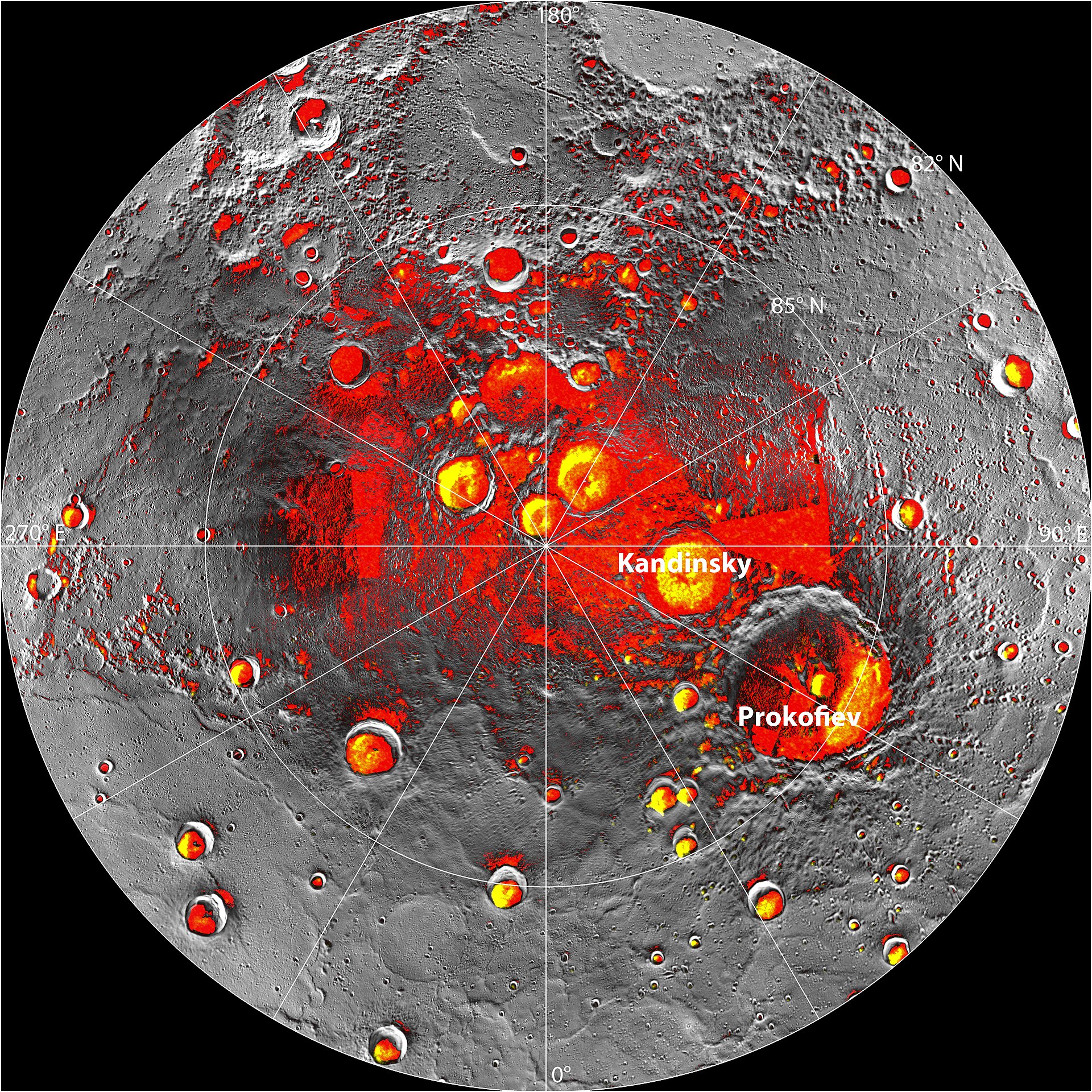
Among MESSENGER's initial discoveries were high concentrations of magnesium and calcium on Mercury's night side and evidence of past volcanic activity on the surface. The spacecraft found evidence of water ice at Mercury's poles, frozen at locations that never see sunlight. It also provided the first optical images of ice and other frozen volatile materials within permanently shadowed craters near Mercury's north pole.
On 30 April 2015 at 19:26 UT MESSENGER slammed into Mercury's surface at about 8,750 miles per hour (14,080 kilometers per hour), creating a new crater on Mercury. The last of seven orbit-correction maneuvers was executed on 28 April 2015 and kept MESSENGER aloft for an additional month so its instruments could collect critical information. In the course of its work, MESSENGER determined Mercury's surface composition, revealed its geological history, and verified that its polar deposits are dominantly water ice.
Two decades before MESSENGER, Earth-based radar images of Mercury revealed the polar deposits, postulated to consist of water ice; the hypothesis was later confirmed by MESSENGER through a combination of neutron spectrometry, thermal modeling and infrared reflectometry. The imaging campaign zeroed in on Prokofiev, the largest crater in Mercury's north polar region found to host radar-bright material.
6. BepiColombo Mission
It is only the third spacecraft to visit Mercury. The mission is named after Professor Giuseppe (Bepi) Colombo (1920-1984) of the University of Padua, Italy, who was the first to determine that a resonance makes Mercury rotate on its axis three times for every two revolutions around the Sun.
Its science questions include why there is ice in the polar craters of the scorched planet, why Mercury has a magnetic field, and what the mysterious hollows on its surface are.
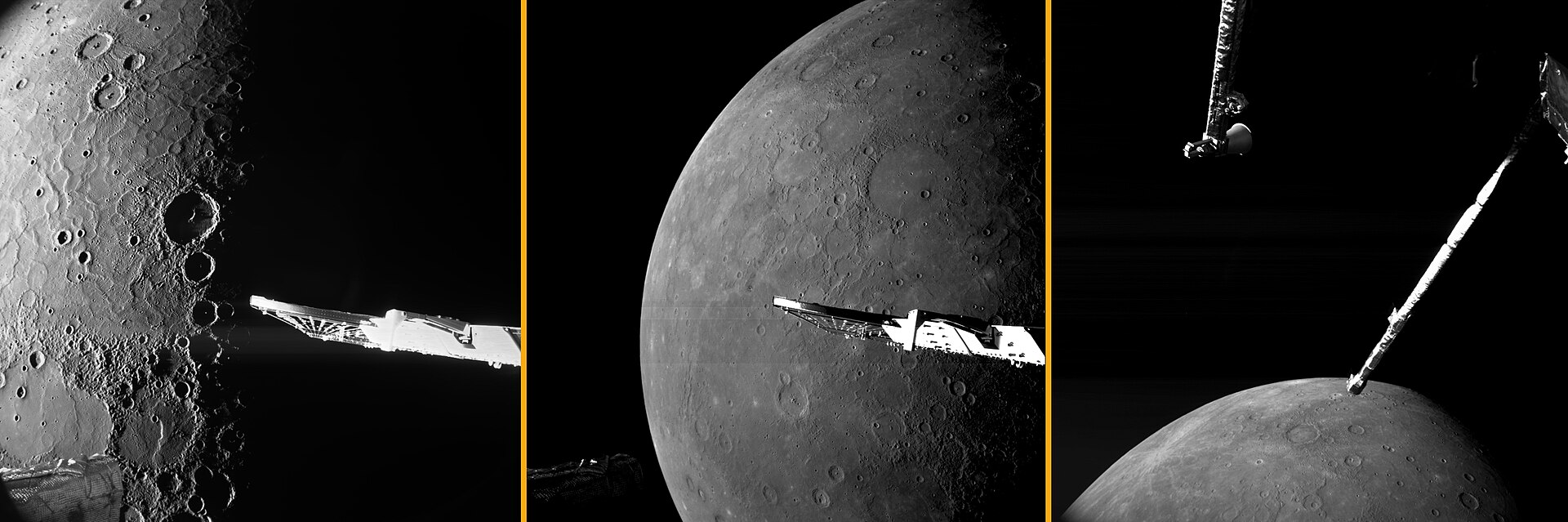
Its journey milestones include an Earth flyby in April 2020 and two Venus flybys, followed by six Mercury flybys between October 2021 and January 2025 before arrival at the planet.
The Mercury Planetary Orbiter and the Mercury Magnetospheric Orbiter enter Mercury orbit on 21 November 2026 and separate on 9-10 December 2026 before science operations begin in April 2027.
Close to the Sun and more difficult for an orbiter to reach than Saturn, Mercury is the least explored planet of the inner Solar System. The Sun's enormous gravity makes it difficult to place a spacecraft into a stable orbit around Mercury; even more energy is needed than sending a mission to Pluto.
7. Observation and Transits
Because Mercury is so close to the Sun it is hard to directly observe from Earth except during dawn or twilight, when the Sun's brightness does not outshine the small planet. As seen from Earth only transits of the inner planets Mercury and Venus are possible, and planetary transits are far more rare than eclipses of the Sun by the Moon. The planet's closeness to the Sun and its smallness make it the most elusive of the planets visible to the unaided eye.
On average there are 13 transits of Mercury each century, while transits of Venus usually occur in pairs eight years apart and more than a century elapses between each transit pair. During the seven centuries from 1601 to 2300 Earth experiences 94 transits of Mercury across the Sun: 31 in May at the descending node and 63 in November at the ascending node. Transits of Mercury are relatively rare, averaging about 13 or 14 per century in May or November, and they usually come in pairs separated by 3 years, with each pair separated by about a decade.
In 1627 Johannes Kepler finished his star catalogue and planetary tables and predicted that Mercury would pass in front of the Sun on 7 November 1631; he died in 1630 without witnessing his prediction. Gassendi, along with two other people, became the first known humans to observe a transit of Mercury, and only Gassendi wrote about his observations, revealing for the first time the size of a planet compared to the Sun. In 1716 Edmond Halley published a paper describing exactly how transits could be used to measure the Sun's distance, thereby establishing the absolute scale of the solar system from Kepler's third law.
The first transit ever observed was of Mercury in 1631 by the French astronomer Pierre Gassendi, who used Kepler's predictions and projected the Sun's image through his Galilean telescope in a darkened room, initially thinking he was seeing a sunspot because Mercury was so small.
8. Cultural and Historical Notes
Mercury was known at least by Sumerian times, some 5,000 years ago; in Classical Greece it was called Apollo when it appeared as a morning star and Hermes when it appeared as an evening star. The planet's nearness to the Sun gave scientists bound to Earth many observational hurdles, which were overcome only by the MESSENGER probe.
Among the terrestrial planets Mercury is an extreme: the smallest, the densest, the one with the oldest surface and largest daily variations in surface temperature.
9. Timeline: from Sumerian observations to BepiColombo in orbit
- c. 3000 BCEFirst records of Mercury in Sumerian timesMercury was known to sky observers at least by Sumerian times, some 5,000 years ago.
- 1627Kepler predicts a transit of MercuryJohannes Kepler finished his star catalogue and planetary tables and predicted that Mercury would pass in front of the Sun on 7 November 1631.
- 7 November 1631Gassendi observes the first transit of MercuryPierre Gassendi became the first known human to observe a transit of Mercury, the first transit ever observed; the catalog of Mercury transits begins with this event.
- 7 November 1677Halley observes a transit from Saint HelenaEdmond Halley observed the 1677 transit of Mercury from the island of Saint Helena, which inspired his later campaign to measure the distance from the Earth to the Sun.
- 1716Halley's paper on measuring the Sun's distanceEdmond Halley published a paper describing how transits could be used to measure the Sun's distance, establishing the absolute scale of the solar system from Kepler's third law.
- 29 March 1974Mariner 10's first flyby of MercuryThe closest encounter of Mariner 10's first Mercury flyby came at 20:47 UT on 29 March 1974 at a range of 437 miles (703 kilometers); the photos showed a very Moon-like surface.
- 16 March 1975Mariner 10's final, closest flybyThe third flyby came at 22:39 UT on 16 March 1975 at a range of about 200 miles (327 kilometers); last contact with the spacecraft was on 24 March 1975.
- 3 August 2004MESSENGER launchedMESSENGER launched at 06:15:57 UT on 3 August 2004, to become the first spacecraft to orbit Mercury.
- 14 January 2008MESSENGER's first Mercury flybyMESSENGER made the first of its three Mercury flybys on 14 January 2008, passing close over the planet to gather data for the orbital mission.
- 18 March 2011MESSENGER enters orbit around MercuryMESSENGER finally entered orbit around Mercury at 00:45 UT on 18 March 2011, nearly seven years after launch, becoming the first spacecraft ever to orbit the planet.
- 15 October 2014First optical images of polar iceMESSENGER provided the first optical images of ice and other frozen volatile materials within permanently shadowed craters near Mercury's north pole.
- 30 April 2015MESSENGER impacts MercuryAfter more than four years and 4,105 orbits at Mercury, MESSENGER slammed into the planet's surface at about 8,750 miles per hour, creating a new crater.
- 20 October 2018BepiColombo launchedBepiColombo, an ESA and JAXA mission carrying two orbiters, launched on 20 October 2018 at 01:45:28 UT on an Ariane 5 from the Guiana Space Centre.
- 1 October 2021BepiColombo's first Mercury flybyBepiColombo made its first flyby of Mercury on 1 October 2021, sending back several images; five more Mercury flybys followed.
- 8 January 2025BepiColombo's sixth and final Mercury flybyBepiColombo's sixth Mercury flyby on 8 January 2025 was its last, using the planet's gravity to steer the spacecraft on course for entering orbit.
- 21 November 2026BepiColombo enters Mercury orbitThe Mercury Planetary Orbiter and the Mercury Magnetospheric Orbiter enter orbit around Mercury on 21 November 2026, with science operations due to start in April 2027.
References (22)
- 1Seven Century Catalog of Mercury Transits: 1601 CE to 2300 CE — NASA Goddard Space Flight Center (Eclipse Web) 1601 WebView source
- 2Mercury Facts — NASA Science Web↩View source
- 3Mercury | Facts, Color, Size, & Symbol — Encyclopaedia Britannica Web↩View source
- 4BepiColombo Fact Sheet — ESA Science & Technology (sci.esa.int) WebView source
- 5MESSENGER (MErcury Surface, Space ENvironment, GEochemistry, and Ranging) — NASA Science WebView source
- 6Mercury — NASA Science Web↩View source
- 7BepiColombo factsheet — European Space Agency WebView source
- 8Mercury's Caloris Basin — NASA Science WebView source
- 9The Geological History of Mercury (Spudis; Mercury: Space Environment, Surface, and Interior, 2001) — Lunar and Planetary Institute (Universities Space Research Association) 2001 WebView source
- 10Mercury's shifting, rolling past — Virginia Tech News 2008 WebView source
- 11Geodetic evidence that Mercury has a solid inner core (Genova et al. 2019, Geophysical Research Letters) — PubMed Central, U.S. National Library of Medicine 2019 WebView source
- 12MESSENGER Provides First Optical Images of Ice Near Mercury's North Pole — Johns Hopkins University Applied Physics Laboratory WebView source
- 13NASA Completes MESSENGER Mission with Expected Impact on Mercury's Surface — Johns Hopkins University Applied Physics Laboratory WebView source
- 14BepiColombo — NASA Science WebView source
- 15BepiColombo — Investigating Mercury's mysteries — European Space Agency WebView source
- 16Journey to Mercury — European Space Agency WebView source
- 17Mercury Exploration — NASA Science WebView source
- 18Planetary Transits Across the Sun — NASA Goddard Space Flight Center (Eclipse Web) WebView source
- 19Mercury in Transit: The History and Future of Measuring Transits — Carnegie Institution for Science (Earth & Planets Laboratory) WebView source
- 20November 11 Mercury Transit — Lowell Observatory WebView source
- 21MESSENGER — Our Contribution — Johns Hopkins University Applied Physics Laboratory WebView source
- 22Mariner 10 — NASA Science WebView source
 Nikola Tesla
 The Sun
 Jupiter