Isaac Newton
The Lincolnshire farmer's son who joined the fall of an apple to the orbit of the Moon — the documented record of the plague-year discoveries, the Principia, the Mint and the Royal Society, with the myths (the apple, the "giants") separated from the evidence.
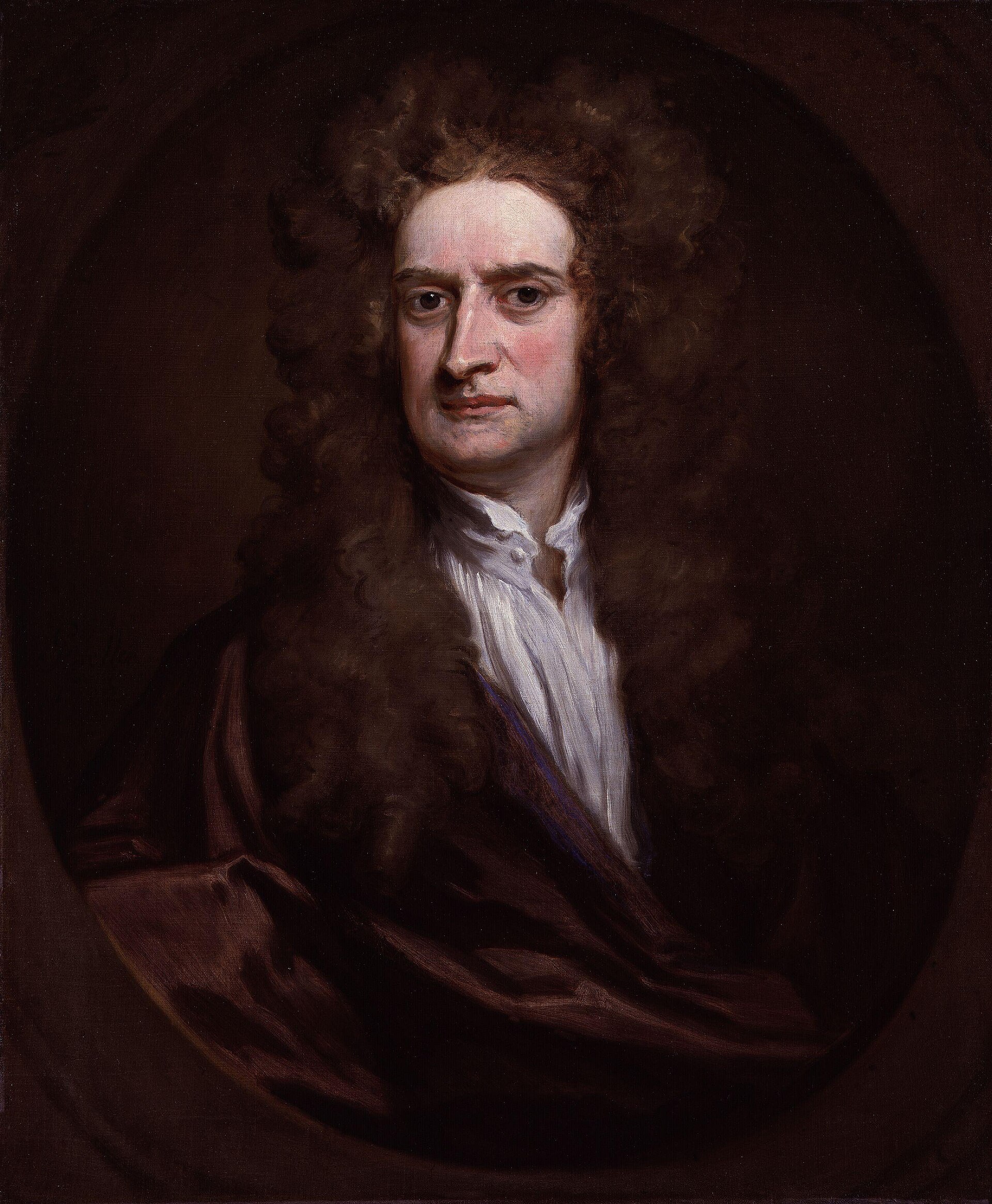

Isaac Newton (25 December 1642 [4 January 1643, New Style], Woolsthorpe, Lincolnshire — 20 March 1727, London; aged 84) was an English physicist and mathematician and the culminating figure of the Scientific Revolution. Admitted to Trinity College, Cambridge, in 1661, he spent the plague years 1665–67 at Woolsthorpe, where he established the fundamentals of the calculus, separated white light by refraction and — as he later told William Stukeley — began thinking about gravity when he saw an apple fall. Elected a Fellow of the Royal Society in 1672 after his reflecting telescope caused a sensation, he quarrelled with Robert Hooke over light and (in a 1676 letter) wrote that if he had seen further it was by “standing on the sholders of Giants”. Prompted by Edmond Halley in 1684, he sent the tract De Motu, which in two and a half years grew into Philosophiae Naturalis Principia Mathematica, published in July 1687 entirely at Halley’s expense; its three laws of motion and law of universal gravitation made it, in Britannica’s words, one of the most important works in the history of modern science. Warden of the Mint from 1696 and Master from Christmas Day 1699, President of the Royal Society from 1703 and knighted in 1705, he died unmarried at Kensington on 20 March 1727 and lies in Westminster Abbey, where Rysbrack’s monument shows him among instruments, coins and books. His alchemical and theological manuscripts — over which he waged a bitter priority dispute with Leibniz — became public largely after World War II, and his scientific papers are now a UNESCO Memory of the World collection.
A Lincolnshire childhood and Trinity College (1642-1669)
Isaac Newton was born on 25 December 1642 by the Old Style calendar, 4 January 1643 by the Gregorian, at Woolsthorpe in Lincolnshire.1 His father, an illiterate but well-to-do yeoman farmer also named Isaac Newton, had married Hannah Ayscough in April 1642 and died that October, before the child was born.1 Tiny and weak, the infant was not expected to survive.2
In 1646 Hannah Newton married Barnabas Smith, rector of North Witham, and moved to his parish, leaving young Isaac at Woolsthorpe in the care of her mother, Margery.1 Barnabas Smith died in 1653, and Hannah returned with the three children of her second marriage, Mary, Benjamin and Hannah.1 Enrolled in 1654 at King's School, Grantham, Newton boarded with the town apothecary Mr Clark — his first stimulus towards chemistry — and rose from poor scholar to the top of the class.1
Taken from school around 1658 to learn estate management, he proved thoroughly incompetent; only the Grantham schoolmaster Henry Stokes and his uncle William persuaded his mother to send him back to be trained for university.1 He was admitted to Trinity College, Cambridge, on 5 June 1661 and matriculated on 8 July, entering as a sub-sizar who paid lower fees and served fellows or wealthier students.3 He graduated BA in 1665 and became a Fellow of Trinity in 1667, subscribing to the Thirty-Nine Articles, vowing celibacy and promising holy orders within seven years; his MA followed in 1668.1
The plague years and the secrets of light (1665-1672)
Detained at Woolsthorpe by plague from the summer of 1665 until March 1667, with only a short stay in Cambridge in spring 1666 before the disease returned, Newton was almost entirely self-taught in mathematics and optics.1 He set down the basic rules of differentiation and integration in a paper of October 1666 and demonstrated the heterogeneity of white light through its separation by refraction.1 His optical experiments on his own eyes brought him close to blindness.1
Tradition connects this period with a falling apple, which Newton himself is said to have recalled decades later as the moment his attention turned to gravity.1 What Woolsthorpe yielded was the recognition that the Moon's orbital motion is maintained by a force of the same kind as terrestrial gravity — though universal gravitation was not fully worked out for another twenty years.1
About 1668-1669 Newton constructed the first functioning reflecting telescope; in 1671 Isaac Barrow persuaded him to let it be demonstrated to the Royal Society, where it caused a sensation.1 Elected to the Fellowship on 11 January 1671/2, he saw his Theory about Light and Colors printed in the Philosophical Transactions in early 1672.1 Criticism, especially from the Society's Curator of Experiments Robert Hooke, brought furious responses and four years of polemical exchanges, during which he repeatedly declared himself unwilling to engage in further scientific publication.1
The quarrel with Hooke and the letter of 1676
The critical reaction to his light-and-colours paper drew Newton into furious exchanges that lasted four years, during which he repeatedly declared himself unwilling to publish or correspond on science again.1 It fed a lifelong pattern: deeply introverted and fiercely protective of his privacy, he was implacable in pursuit of anyone by whom he felt threatened.4
The quarrel's most famous sentence came in 1676, in a letter to Hooke, conceding that if he had seen further than the ancients it was by standing on the shoulders of giants.5 The image was not his invention; it was already a familiar proverb, the child on a giant's shoulders who sees further than the giant himself, and Haycock records that the remark had clearly become common property.5
Modest phrasing did not mean a modest temper: a 2026 review in Nature, tracing the long making of the Principia, finds in that history Newton's hatred of hypotheses and a habit of courting controversy.6 The pattern born in the Hooke quarrel would surface again in the calculus dispute.1
Calculus: Newton, Leibniz, and a war of priority (1669-1716)
In 1669 Newton wrote De analysi per aequationes numero terminorum infinitas, another milestone on the road to calculus; Barrow then retired as Lucasian Professor to become chaplain to Charles II and recommended Newton as his successor, which he became on 19/29 October 1669.1 Two years later came De methodis serierum et fluxionum, expounding the principles of calculus, though it was not published until 1736.1 The first calculus to reach print was in Book I of the Principia, where a geometric theory of limits gave Newton's dynamics its mathematical basis.7
In October 1676 Leibniz, visiting London, was shown a copy of the De Analysi by John Collins without Newton's knowledge; Leibniz had already independently established the fundamental principles of calculus, though he later acknowledged learning much from Newton's work on series.1 Open accusations began in 1699, when Fatio de Duillier asserted Newton's priority and heavily implied that Leibniz had stolen the idea; Leibniz replied in the Acta Eruditorum in 1700, and the dispute was thereafter waged largely through third parties and anonymous publication.1
The Royal Society's role became the ugliest phase: the 1712 committee reviewing the controversy was selected by the Society's President, Newton, who also compiled its report — which emphatically and correctly asserted Newton's priority, and heavily and unjustly implied plagiarism on Leibniz's part.1 Published in 1713 as Commercium epistolicum, the report was reviewed by Newton himself, anonymously, in 1715, in almost an entire issue of the Philosophical Transactions.1 The Newton Project's judgement is blunt: a carefully orchestrated campaign, driven by Newton's quite unfair belief that Leibniz had stolen the calculus.4
From De Motu to the Principia (1684-1687)
The turning point came from an old adversary: Newton's correspondence with Hooke in 1679-1680 about the path of falling bodies gave him the key dynamic concepts of inertia and centripetal attraction.1 In August 1684 Edmond Halley visited Newton, troubled by the problem of orbital dynamics, and extracted his promise to send a demonstration.7 Three months later the answer came: the nine-page tract De Motu Corporum in Gyrum, whose solution to the orbital problem was an ellipse, provided the velocity is not too high.8
Over the next two and a half years De Motu grew into Philosophiae Naturalis Principia Mathematica.7 The earlier tract had stated neither the law of universal gravitation nor any of the three laws of motion; only while revising it did Newton embrace the principle of inertia and arrive at the second law.7 By 1686 he had fully formulated universal gravitation: every object in the universe attracts and is attracted to every other object.1
The Principia was published in July 1687, largely at Halley's urging and entirely at Halley's expense; few outside England were initially convinced by the theory of gravity, yet the book established Newton's reputation throughout Europe as one of the greatest mathematicians and scientific thinkers of his day.1 In a June 1686 letter to Halley, Newton had claimed a right to the ellipse, remarking that Kepler knew the orbit to be oval rather than circular and guessed it elliptical.8
The Principia in context: what it contained and what it changed
Britannica describes the Principia as the first scientific synthesis that applied mathematics to nature comprehensively, the culmination of a scientific revolution that began with Copernicus and Galileo; its three laws of motion became the basic principles of modern physics.7 Trinity College notes that universal gravitation and the laws of motion dominated the scientific view of the physical universe for the next three centuries.9
The laws were stated with axiomatic economy. A body perseveres in its state of rest or of uniform straight motion unless impressed forces compel a change.8 Force equals the change in momentum per change in time, and for every action in nature there is an equal and opposite reaction.10
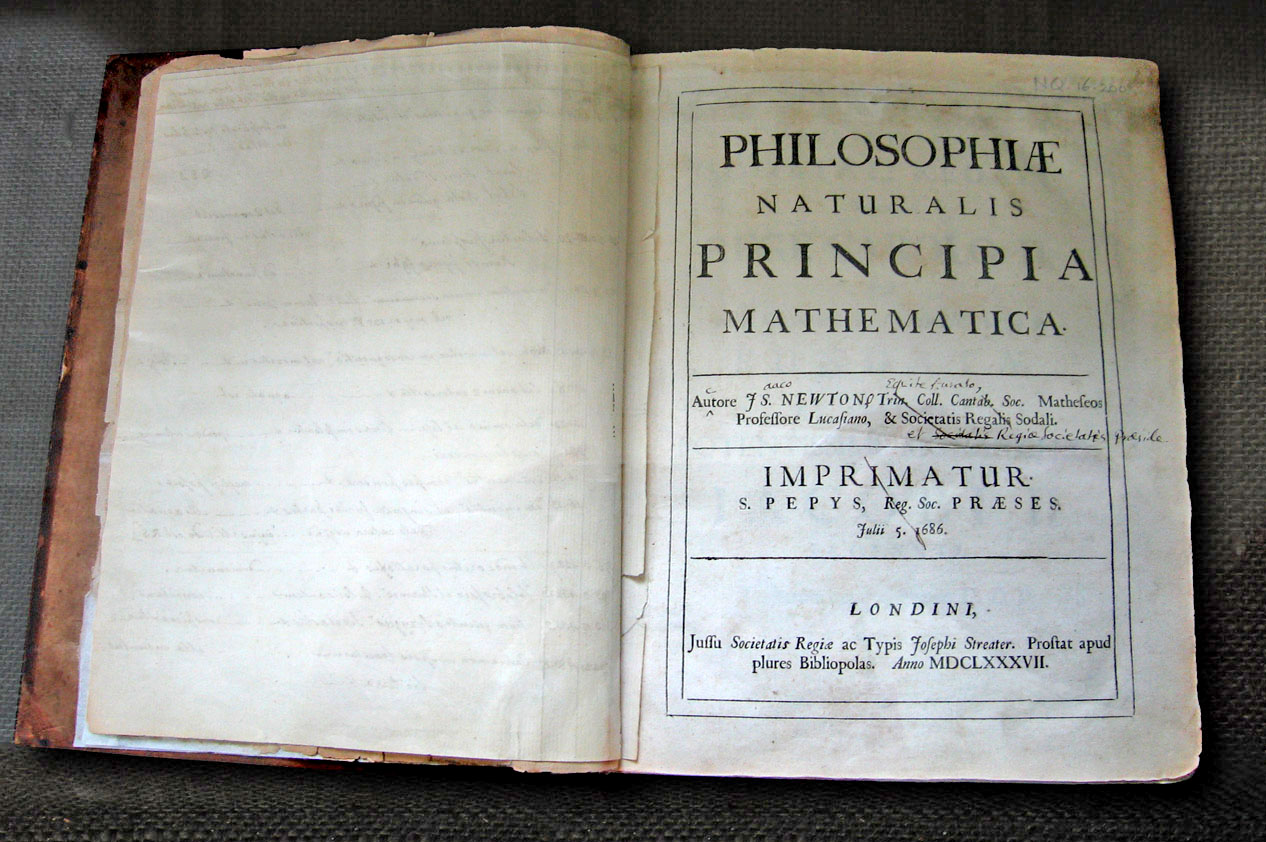

Christiaan Huygens, reading the copy Newton sent him, wrote that Newton had brushed aside the Cartesian vortices and shown that the planets are retained in their orbits by their gravitation toward the Sun, the eccentrics necessarily becoming elliptical.8 Later editions carried the argument further: the second edition of 1713 toned down acknowledgments of Leibniz, excised references to Flamsteed, added a General Scholium on God and Creation and prefaced the work with Roger Cotes's denunciation of Leibniz; a third edition appeared in 1726, the year before Newton's death.1 The Royal Society preserves the printer's draft, MS/69, annotated by Newton and Edmond Halley.11
Newton's works: the principal publications
| Work | First published | Subject | Evidence of note |
|---|---|---|---|
| Philosophiae Naturalis Principia Mathematica | Latin, July 1687; second edition 1713, third 17261 | Mechanics, fluids and gravity; the three laws of motion and universal gravitation16 | The masterwork, published largely at Halley's urging and entirely at his expense; the Royal Society holds the printer's draft (MS/69) annotated by Newton and Halley111 |
| Opticks | English 1704; Latin 1706; second English edition 171712 | Refraction, colour and the corpuscular nature of light; the later editions added the Queries112 | Its first edition carried Newton's first published work on the calculus12 |
| De analysi per aequationes numero terminorum infinitas | Written 16691 | Infinite series; a milestone on the road to calculus1 | Barrow recommended Newton for the Lucasian Chair soon after1 |
| De methodis serierum et fluxionum | Written 1671; published 17361 | The principles of calculus — the method of series and fluxions1 | Britannica lists The Method of Fluxions and Infinite Series among his notable works2 |
| Commercium epistolicum | 17131 | The Royal Society's report on the calculus controversy1 | Reviewed anonymously by Newton himself in 17151 |
| Praxis | Withheld — never published by Newton12 | Alchemy; his principal treatise on the subject12 | Written but withheld among his chymical studies12 |
Of the writings above, the calculus treatise De methodis waited until 1736 for print, and the alchemical Praxis was withheld altogether.112 Britannica names Opticks, Principia and The Method of Fluxions and Infinite Series among his notable works.2
London: the Mint, the Royal Society, knighthood (1689-1705)
In 1687 Newton played a significant role in orchestrating opposition to James II's demand that Sidney Sussex College award an MA to a Benedictine monk, Alban Francis, without the statutory oath of allegiance; he and other delegates faced examination by Judge Jeffreys and the Vice Chancellor was sacked, but the college stood its ground and the degree was never conferred.1 He sat as MP for Cambridge University from 1689 and was elected again in 1701.1
Appointed Warden of the Royal Mint on 19/29 March 1696, when it was housed in the Tower of London, Newton left Cambridge in April to settle in London and — to the annoyance of the other Mint officers — took his duties far more seriously than the sinecure they had been, campaigning against endemic corruption and inefficiency.1 The Mint was then consumed by the recoinage of old silver coins dating back to the reign of Elizabeth I; auxiliary mints were set up and the enormous operation was completed within three years.13 Newton successfully prosecuted a large number of counterfeiters, including the greatest of them all, William Chaloner, and reorganised the Mint's workings through pioneering time-and-motion studies.14
When the Mastership fell vacant on the death of Thomas Neale, Newton took it up with effect from Christmas Day 1699 and remained Master until his death in March 1727.13 Elected President of the Royal Society in 1703, he held the post by annual re-election until his death, and Queen Anne knighted him in 1705.112 The South Sea Bubble of 1720 is said to have cost him 20,000 pounds.1
Theology, alchemy, and the private Newton
From about 1673 Newton studied the textual history of the Bible and the Church Fathers intensively; the study occupied him for the rest of his life and led him to conclude that the doctrine of the Trinity was a heretical error introduced in the 4th century AD.1 In 1675 he obtained a dispensation from taking holy orders, the statutes of Trinity College being altered for his benefit, and in 1690 he wrote to John Locke on the corruptions of Scripture, explicitly stating his anti-Trinitarian convictions.1
He bought chemical apparatus and alchemical treatises from 1669 and kept up experiments in chemistry across his career, writing — but withholding — his principal alchemical treatise, Praxis.12 Across sixty years of intense intellectual activity he put no less effort into chemical and alchemical research and into theology and biblical studies than into mathematics and physics.12 Much of that chymistry and radical theology became public only after World War II.12
The private man remains hard to reach: no private diaries are known, and hardly any correspondence touches his private life or state of mind.4 What is documented is a deeply introverted character, fiercely protective of his privacy, insecure even in maturity and prone to fits of depression and outbursts of violent temper.4 In mid-1693 came what would now be called a nervous breakdown: after five nights without sleep he temporarily lost all grip on reality and believed that Locke and Pepys were conspiring against him, though he seems to have recovered fully by the end of the year.4
The apple and the giants: separating evidence from legend
In his own words
The sentences that follow are quoted in the exact wording of the sources that preserve them, from a 1660s student notebook to the printed books of his last decades.3
If I have seen further [than the ancients] it is by standing on the sholders of Giants.5
Isaac Newton to Robert Hooke, letter of 1676 (The Newton Project, OTHE00018)
If I have seen further it is by standing on ye shoulders of Giants.9
The same remark as Trinity College, Cambridge, records it
I have not as yet been able to deduce from phenomena the reason for these properties of gravity, and I do not feign hypotheses.8
General Scholium, added to the second edition of the Principia (Stanford Encyclopedia of Philosophy)
My Design in this Book is not to explain the Properties of Light by Hypotheses, but to propose and prove them by Reason and Experiments17
Opticks, opening of Book I, 1704 (The Newton Project)
the cause of gravity is what I do not pretend to know18
Isaac Newton to Richard Bentley, 17 January 1692/3 (The Newton Project)
Plato is my friend, Aristotle is my friend, but my greatest friend is truth.19
Newton's student notebook, MS Add. 3996, Trinity College, Cambridge (Cambridge University Digital Library)
Death, burial, and legacy (1727-)
Newton presided over his last Royal Society meeting on 19 February/2 March 1727; shortly afterwards he took to his bed with a new bladder stone, and on 20/31 March he died, having refused the last rites.1 He died unmarried at Kensington and was buried in Westminster Abbey on 28 March; before the funeral his body lay in state in the Jerusalem Chamber, and most of the Fellows of the Royal Society followed his coffin to its grave.20 He was 84 at his death.2
He lies in an area of the nave known as Scientists' Corner, in front of the choir screen, where the Latin inscription records that here lies what was mortal of Isaac Newton.20 The nearby monument, executed by the sculptor Michael Rysbrack to designs of the architect William Kent, was finished in August 1730 and unveiled the following year.20 Its relief shows boys using instruments of his mathematical and optical work — a telescope, a prism — and others carrying pots of coins, alluding to his work at the Mint.20
Cambridge University Library holds the largest and most important collection of his scientific works, from early papers and College notebooks to the Waste Book and his own annotated copy of the first edition of the Principia.19 In 1872 the fifth Earl of Portsmouth passed all the Newton manuscripts he held to the University of Cambridge, and the papers now dispersed across Cambridge University Library, the Fitzwilliam Museum, Trinity College, King's College, the Royal Society and the National Library of Israel were added to the UNESCO Memory of the World Register.19 Trinity's Ante-Chapel holds Roubiliac's statue of 1755, and his influence endured: Newtonianism was firmly rooted in Britain within the first decade of the eighteenth century, while on the Continent it was delayed by opposition from such figures as Christiaan Huygens and Leibniz.912
Timeline: Isaac Newton, 1642-1727
Birth at Woolsthorpe
Isaac Newton is born at Woolsthorpe, Lincolnshire, the posthumous son of a yeoman farmer who had died that October; he is so small and weak that he is not expected to survive.
King’s School, Grantham
Newton is enrolled at King’s School, Grantham, boarding with the apothecary Mr Clark — his first stimulus towards chemistry — and rises from poor scholar to top of the class.
Admitted to Trinity College, Cambridge
Newton enters Trinity College as a sub-sizar, paying his way by acting as a servant for wealthier students; he matriculates on 8 July.
The plague years at Woolsthorpe
Detained at Woolsthorpe by plague, Newton sets down the basic rules of differentiation and integration (October 1666), separates white light by refraction, and — as he claimed decades later — is set thinking about gravity by a falling apple.
Lucasian Professor of Mathematics
After Newton writes ‘De analysi’, Isaac Barrow recommends him as his successor in the Lucasian Chair, which Newton takes up at the age of 26.
Fellow of the Royal Society; the light-and-colours paper
Elected FRS after Barrow demonstrates his reflecting telescope; his ‘Theory about Light and Colors’ appears in the Philosophical Transactions and draws Hooke’s criticism, beginning four years of polemic.
The letter to Hooke: “standing on the sholders of Giants”
In a famous remark made in 1676, Newton declares in a letter to Robert Hooke that ‘If I have seen further [than the ancients] it is by standing on the sholders of Giants’ — an image Stukeley already treats as a familiar proverb.
Halley’s visit and De Motu
Halley visits Newton in August; three months later Newton sends the nine-page tract De Motu Corporum in Gyrum answering the orbital problem with “an ellipse, provided the velocity is not too high”.
Publication of the Principia
Largely at Halley’s urging and entirely at Halley’s expense, Newton publishes Philosophiae Naturalis Principia Mathematica — three volumes in Latin proposing the laws of motion and universal gravitation.
MP for Cambridge University
Newton is elected Member of Parliament for Cambridge University (again in 1701), moving into public life in London.
Warden of the Royal Mint
Newton is appointed Warden of the Royal Mint at the Tower of London and throws himself into the recoinage and the pursuit of counterfeiters instead of treating the post as a sinecure.
Master of the Royal Mint
On the death of Thomas Neale, Newton takes up the Mastership with effect from Christmas Day 1699 and remains Master until his death in March 1727, reorganising the Mint and prosecuting counterfeiters including William Chaloner.
President of the Royal Society
Newton is elected President of the Royal Society and holds the post by annual re-election until his death.
Opticks; knighthood
Newton publishes Opticks (1704), his second masterpiece; the following year he is knighted by Queen Anne.
Commercium epistolicum; second edition of the Principia
The Royal Society’s calculus report is published as Commercium epistolicum, and the second edition of the Principia adds the General Scholium (“I do not feign hypotheses”) with Cotes’s preface against Leibniz.
Death and burial at Westminster Abbey
After presiding over his last Royal Society meeting on 19 February/2 March, Newton dies on 20/31 March, having refused the last rites, and is buried in the Abbey on 28 March; his monument by Rysbrack is finished in August 1730.
Frequently asked questions
When and where was Isaac Newton born?
He was born on 25 December 1642 by the Old Style calendar — 4 January 1643 by the Gregorian — at Woolsthorpe in Lincolnshire.1
What did Newton achieve during the plague years?
Detained at Woolsthorpe from 1665 until March 1667, he set down the basic rules of differentiation and integration in October 1666 and demonstrated the heterogeneity of white light by refraction.1
Did a falling apple really inspire the theory of gravity?
The story rests on Newton's own recollection of 1726, published by William Stukeley in 1752; the Royal Society calls the story one of the most famous, and most embellished, anecdotes in science.615
What is the Principia, and when did it appear?
Philosophiae Naturalis Principia Mathematica appeared in July 1687, largely at Halley's urging and entirely at his expense, proposing the laws of motion and the law of universal gravitation.16
Who invented calculus — Newton or Leibniz?
Newton established its fundamentals during the plague years and first published it in Book I of the Principia; Leibniz had already independently established the fundamental principles before he was shown Newton's De Analysi in 1676.71 The dispute that followed was, the Newton Project judges, a carefully orchestrated campaign against Leibniz.4
What did Newton do as Warden and Master of the Mint?
He oversaw the recoinage of old silver coin to completion within three years, reorganised the Mint's workings through time-and-motion studies and prosecuted counterfeiters including William Chaloner.1314
Was Newton married?
No — he never married; he died at Kensington on 20 March 1727 and was buried in Westminster Abbey on 28 March.20
Why are his alchemical and theological writings less known than his physics?
He withheld much of the work — the treatise Praxis was never published — and his chymistry and radical theology became public mostly after World War II.12
Connections
Sources & citations
Every factual claim in this article is drawn from the sources below. Bracketed numbers in the text link to the corresponding source.
- 1
- 2
- 3
- 4
- 5
- 6
- 7
- 8
- 9
- 10
- 11
- 12
- 13
- 14
- 15
- 16
- 17
- 18
- 19
- 20