Lightning
The physics, hazards and history of lightning, from charge separation in thunderclouds and the leader-return stroke mechanism to Franklin's kite, modern detection networks and the global records held by megaflashes.
Lightning is an electrostatic discharge that equalises charge separated inside cumulonimbus clouds, where rebounding ice and graupel collisions leave a negative base beneath a positive anvil. A stepped leader descends in invisible segments until an upward streamer meets it, and the return stroke that follows heats the channel to roughly 30,000 degrees Celsius and drives thunder. Human understanding moved from Franklin's 1752 kite experiment and the lightning rod to magnetic direction finding, time-of-arrival networks, satellite optical mappers and WMO-certified megaflash records.
In this article
- 1Overview
- 2Charge Separation and Cloud Electrification
- 3The Discharge Sequence
- 4Electrical and Thermal Characteristics
- 5Thunder
- 6Types of Lightning
- 7Volcanic Lightning
- 8Detection and Mapping
- 9Records and Extremes
- 10Catatumbo Lightning
- 11Effects on the Atmosphere and Landscape
- 12Hazards to People
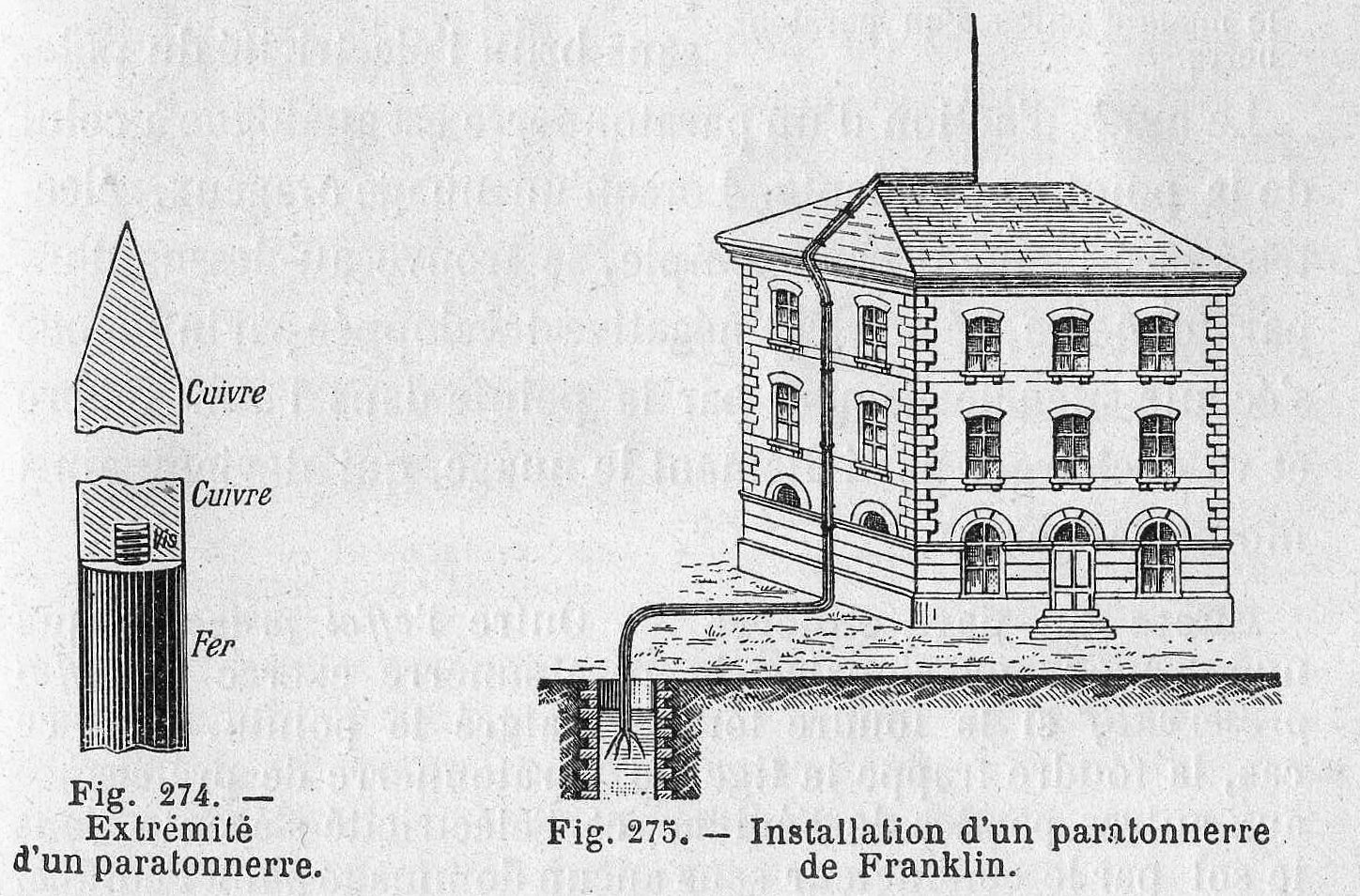
- 13Protection and Safety
- 14Historical Study
- 15Frequently Asked Questions
- 16Timeline: from Franklin's kite to satellite lightning mapping
- 17Knowledge graph
Overview
Lightning is a giant spark of electricity that can pass between clouds, through the air, or between cloud and ground. Although thunderstorms are its familiar setting, lightning has also been observed in volcanic eruptions, intense forest fires, surface nuclear detonations, heavy snowstorms and hurricanes.
Satellite research indicates about 40 flashes per second worldwide, a figure that revised an earlier estimate of 100 per second made in 1925. At any moment about 2,000 thunderstorms are active around the globe, amounting to more than 14.5 million storms a year.
1. Charge Separation and Cloud Electrification
The electrification of a thunderstorm begins with its vertical motion. Updrafts carry small water droplets to heights between 35,000 and 70,000 feet, miles above the freezing level, while downdrafts bring hail and ice down from the frozen upper storm. Within this churning mixture, collisions shear electrons from ascending particles onto descending ones, giving a storm cloud a negative base and a positive top. The process is thought to begin with graupel pellets about a quarter millimetre to a few millimetres in diameter.
The separation of charge follows the sorting of ice by weight. Lighter ice crystals acquire positive charge and rise while heavier hail carries negative charge downward, leaving the cloud top positive and its middle and base negative. Collisions and air movements reinforce this arrangement, so that the top of a thunderstorm is positively charged and its middle and lower parts negatively charged.
2. The Discharge Sequence
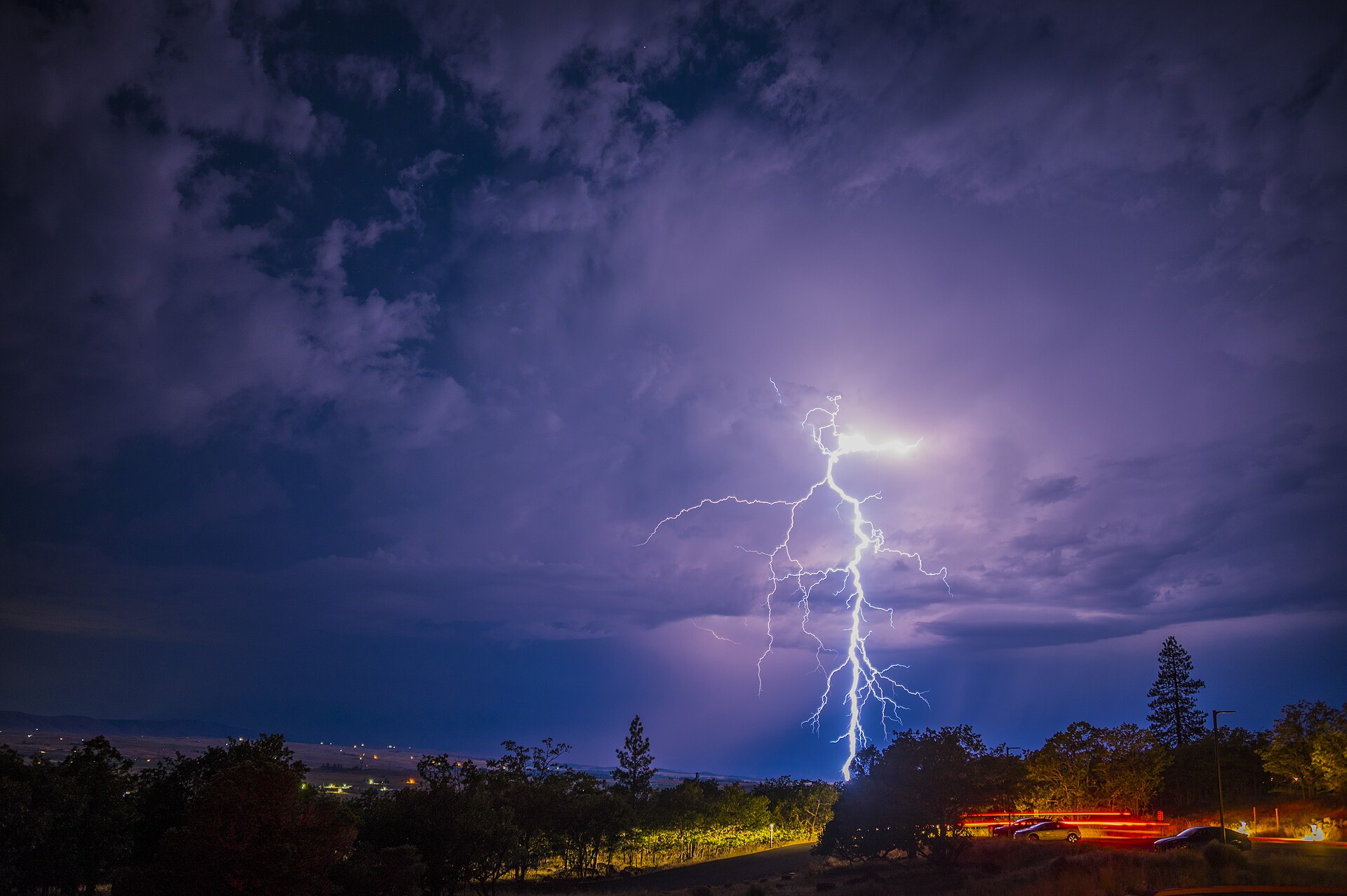
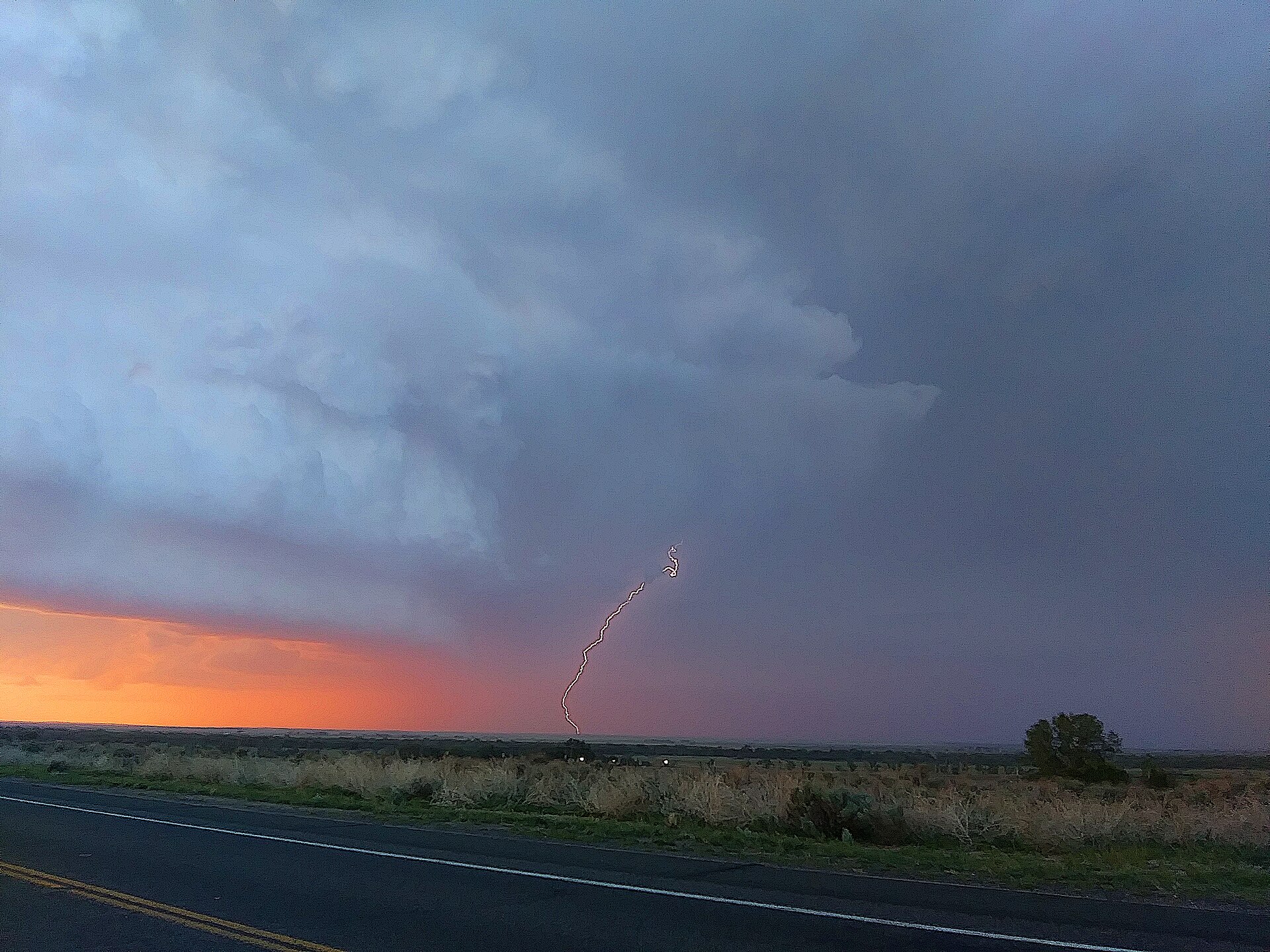
The visible flash begins with an invisible precursor: a stepped leader that descends toward the ground in short segments, reaching the surface in about a hundredth of a second. As it nears the ground an upward connecting discharge of opposite polarity rises to meet it about 30 metres above the surface. The junction completes the conductive path between cloud and earth.
Along that path the return stroke then travels back to the cloud at about 60,000 miles per second, roughly one-third the speed of light, and produces more than 99 percent of the flash's luminosity. A typical flash contains three or four leader-return sequences, and a single negative flash may hold up to 20 return strokes. Peak temperatures in the return-stroke channel reach about 30,000 degrees Celsius.
Subsequent strokes are carried by dart leaders, which follow the decaying channel at intervals of about a tenth of a second and are relatively straight rather than stepped.
3. Electrical and Thermal Characteristics
The electrical scale of a lightning discharge is set by the potential difference between cloud and ground, which reaches 10 to 100 million volts. Peak return-stroke currents approach 30,000 amperes. Before air can break down and conduct, tens or hundreds of millions of volts must accumulate.
Within the discharge channel the temperature climbs to about 30,000 °C (54,000 °F), roughly five times hotter than the surface of the Sun. Measured more broadly, channel temperatures span 18,000 to 60,000 degrees Fahrenheit.
4. Thunder
Air heated within a fraction of a second expands explosively, compressing the air ahead of it into a shock wave much like a sonic boom. That shock wave decays within about ten yards and becomes the sound wave heard as thunder, which can be audible 25 miles away.
A nearby channel yields a sharp crack, while a discharge several miles away gives a prolonged rumble. Sound needs about five seconds to travel a mile, so dividing the flash-to-thunder delay by five gives the distance in miles.
5. Types of Lightning
Cloud-to-ground flashes divide into two polarities with distinct behaviour. Positive cloud-to-ground flashes normally have a single return stroke but are more likely to carry a sustained current. Because of that sustained current they are more likely to strike 5 to 10 miles from the rain core, transfer more charge and ignite fires more easily.
A bolt from the blue leaves the side of a storm and reaches the ground under clear sky several miles from the cloud. Almost all lightning occurs within 10 miles of the parent storm, yet detection equipment has confirmed bolts striking almost 50 miles away.
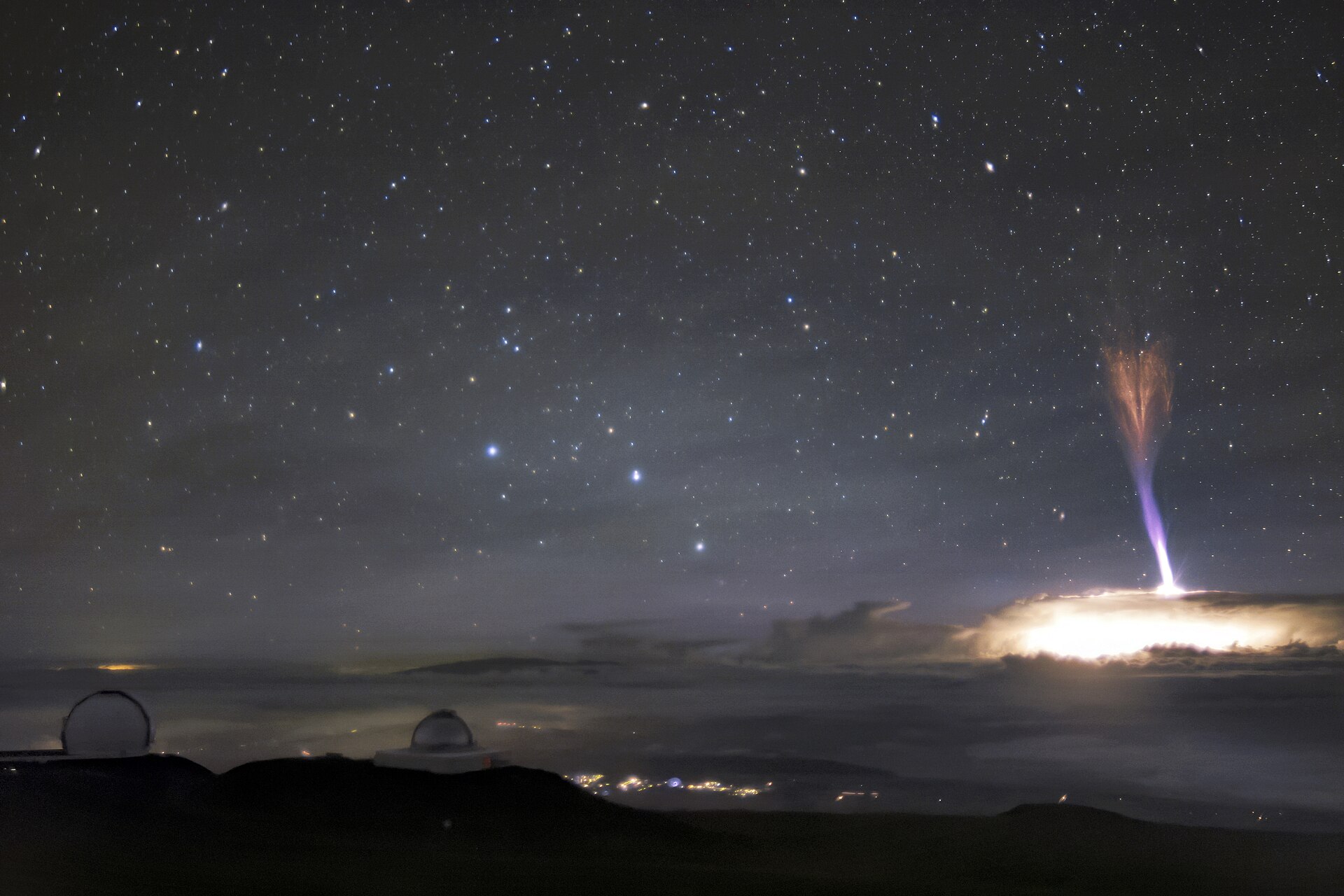
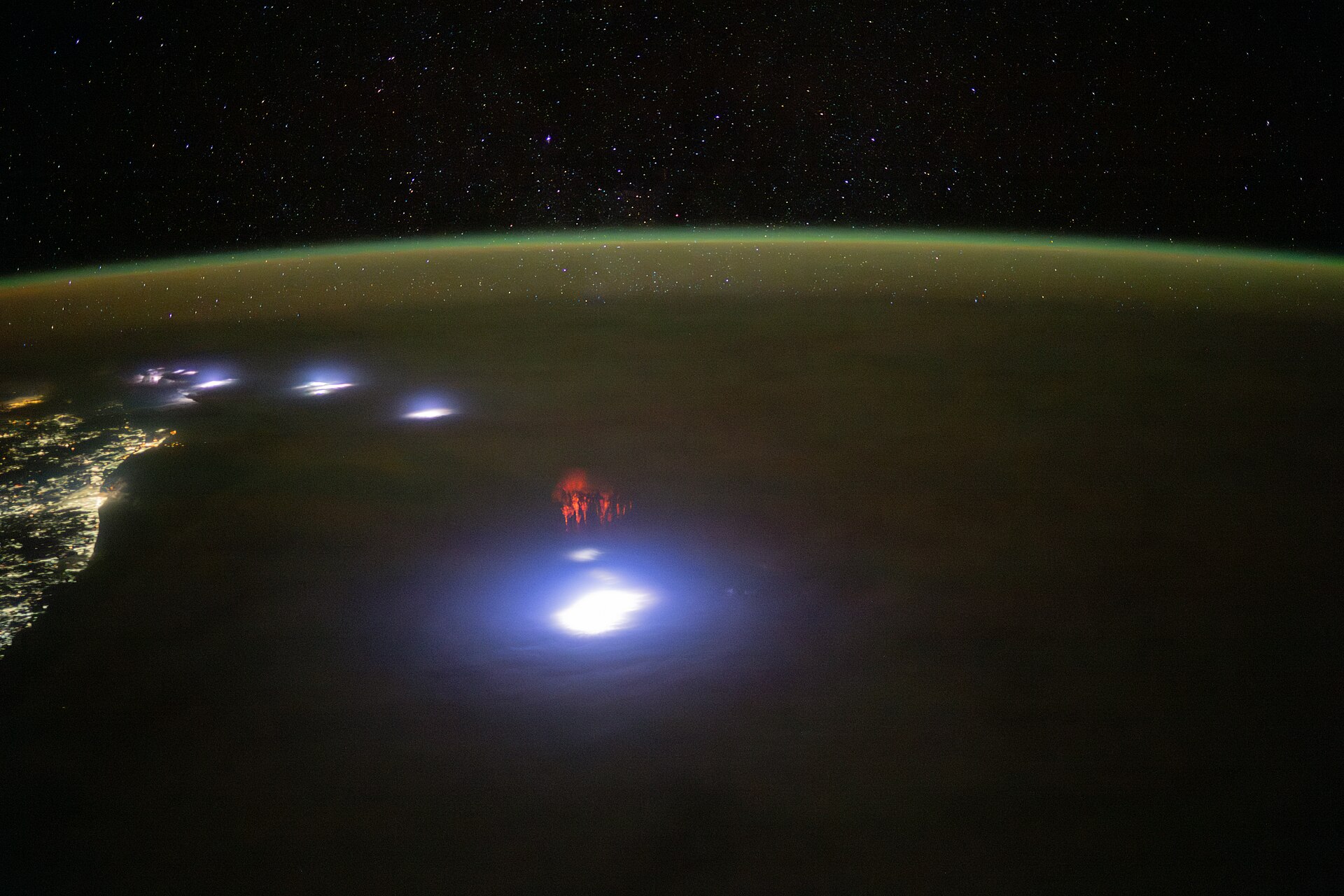
Transient luminous events occur high above storms. Sprites are mostly red, last no more than a few seconds and take shapes resembling jellyfish, carrots or columns. Elves are disk-shaped glows up to 300 miles across that last less than a thousandth of a second and appear above active cloud-to-ground lightning.
6. Volcanic Lightning
Lightning is often observed during explosive volcanic eruptions and is commonly associated with ash plumes. Within an eruption column the discharges are not confined to a single level: they occur in the gas-thrust region above the vent, in the rising convection column and in the umbrella region.
7. Detection and Mapping
Two networks map lightning in real time over the United States: Vaisala's National Lightning Detection Network and the Earth Networks Total Lightning Network. Ground-based systems of this kind locate a stroke by comparing the time of arrival of radio signals at three or more stations. Vaisala reports detecting and locating more than two billion lightning events every year, within seconds of each flash.
Lightning Mapping Arrays take a different approach, locating very high frequency radiation near 60 MHz from six or seven stations and resolving sources in three dimensions.
8. Records and Extremes
The World Meteorological Organization has certified a single flash that spanned 768 kilometres across the southern United States on 29 April 2020 as the longest distance ever recorded for lightning 14WMO certifies two megaflash lightning records · World Meteorological Organization ↗. That mark displaced the previous distance record of 709 kilometres across southern Brazil on 31 October 2018 which was sixty kilometres shorter than the new figure 14. For duration the longest-duration flash lasted 17.102 seconds over Uruguay and northern Argentina during June 2020 according to the World Meteorological Organization 14.
| Record | Value | Date/Location |
|---|---|---|
| Longest flash distance | 768 kilometres | 29 April 2020 across the southern United States |
| Longest flash duration | 17.102 seconds | June 2020 over Uruguay and northern Argentina |
| Previous distance record | 709 kilometres | 31 October 2018 across southern Brazil |
9. Catatumbo Lightning
Where the Catatumbo River meets Lake Maracaibo, lightning recurs at the same time and place on about 300 days a year. Shortly after dusk the lake is struck about twenty-eight times a minute for up to nine hours. People around Lake Maracaibo are struck by lightning three to four times more often than people in the United States.
10. Effects on the Atmosphere and Landscape
A typical thunderstorm flash produces about 250 moles of nitrogen oxides, equivalent to 3.5 kilograms of nitrogen. The best estimate of the global nitrogen mass released as lightning-produced nitrogen oxides is 5 teragrams a year, with an uncertainty of 3 teragrams.
A strike into sandy soil can fuse dirt and clay into a glassy, convoluted tube known as a fulgurite.

11. Hazards to People
In a direct strike part of the current flashes over the skin while the rest passes through the body, often along the cardiovascular or nervous systems. Most indoor lightning casualties come from conduction along wiring, plumbing or metal surfaces connected to the outside.
Over the thirty years from 1989 to 2018 the United States averaged 43 reported lightning fatalities each year.
12. Protection and Safety
The 30-30 rule gives a simple test for when a storm has come close enough to threaten. A flash-to-thunder delay of 30 seconds or less means the storm is close enough to be dangerous, so shelter should be sought without delay. The rule also governs when it is safe to resume activity: at least 30 minutes should pass after the last thunder before leaving shelter.
Shelter is not equal in value. A fully enclosed, substantially constructed building with wiring and plumbing offers the best protection from lightning. A car with a metal roof and sides gives second-best protection because the metal shell, not the rubber tires, shields the occupants. The lightning crouch is no longer recommended.
13. Historical Study
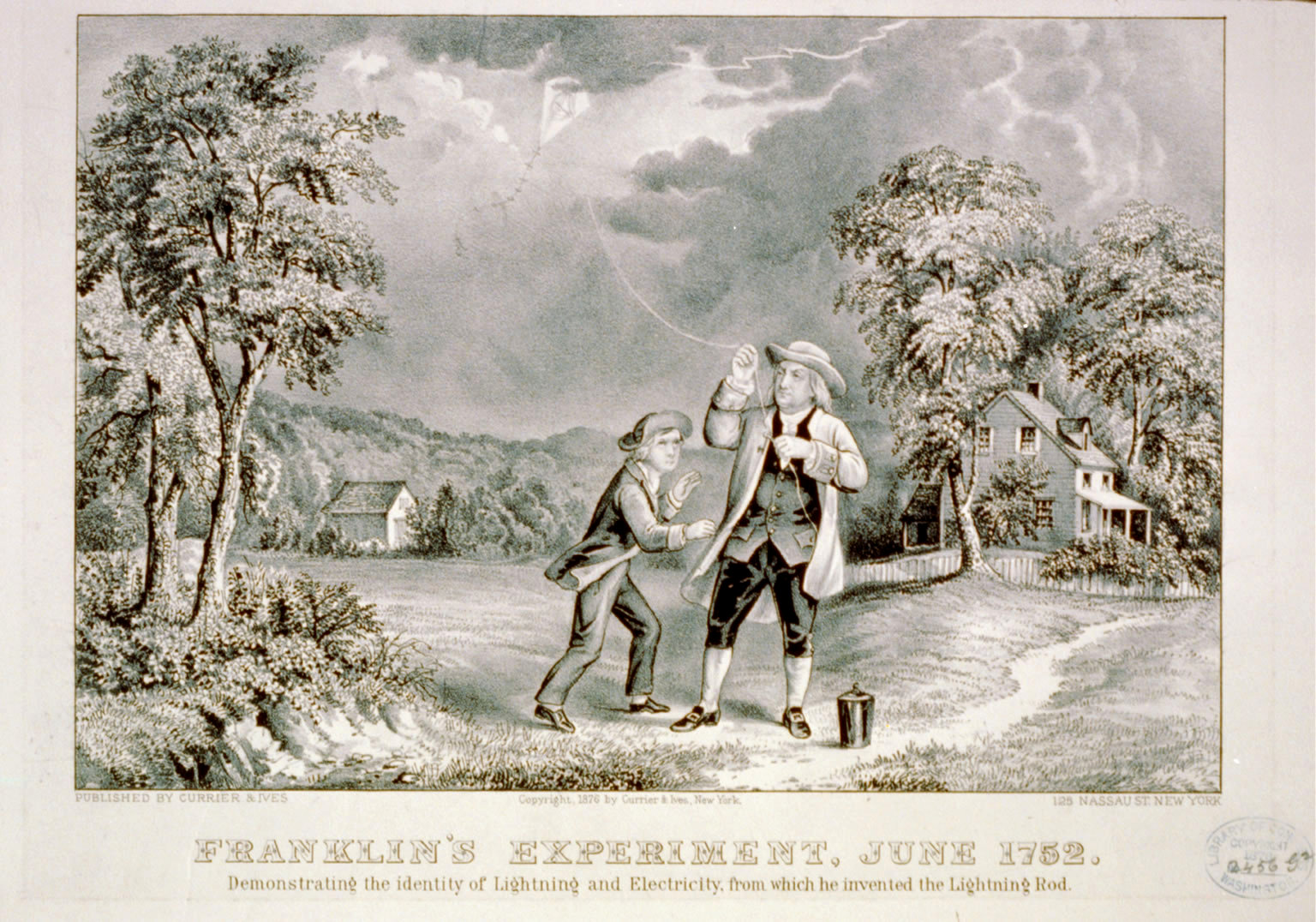
The study of lightning as an electrical phenomenon rests on a small set of documented experiments and their consequences. On a June afternoon in 1752 Franklin flew a silk kite in a Philadelphia field during a thunderstorm to test the electrical nature of lightning. A month before Franklin's experiment Thomas-Francois Dalibard demonstrated the electrical nature of lightning in northern France. The protective device that followed from this line of inquiry was tested in practice: the large pointed rod on the Maryland State House, the biggest Franklin rod of his lifetime, had only one recorded instance of lightning damage.
-
1746Franklin encounters electrical experimentsFranklin meets electrical experiments in Boston.
-
July 1747Positive and negativeFranklin is using the terms positive and negative.
-
1750The iron rod proposedFranklin proposes an iron rod about 8 or 10 feet long.
-
1752Dalibard in northern FranceA month before Franklin's experiment, Dalibard demonstrates the electrical nature of lightning.
-
June 1752The silk kiteFranklin flies a silk kite in a Philadelphia field during a thunderstorm.
-
a year afterRichmann killedRichmann is killed by ball lightning.
-
reign of George IIIThe blunt rod at the palaceKing George III fits his palace with a blunt rod.
-
Franklin's lifetimeThe Maryland State House rodThe largest Franklin rod of his lifetime records only one instance of lightning damage.
14. Frequently Asked Questions
How many lightning flashes occur in the United States each year?
The National Weather Service estimates that about 25 million lightning flashes occur in the United States every year 4Understanding Lightning Science · NOAA National Weather Service ↗.
How far away can thunder from a lightning flash be heard?
Thunder from a lightning flash is normally audible only about ten miles away 8Understanding Lightning: Thunder · NOAA National Weather Service ↗.
What should I do when I hear thunder?
What fraction of lightning flashes never leaves the cloud?
Because the electric field inside a storm is stronger than the field between cloud base and ground, roughly 75 to 80 percent of flashes stay inside the cloud 3How Lightning is Created · NOAA JetStream ↗.
How many cloud-to-ground flashes does the United States record in a year?
Since the detection network covered the contiguous United States in 1989 it has recorded an average of 20 million cloud-to-ground flashes each year 17Frequently Asked Questions About Lightning · NOAA National Severe Storms Laboratory ↗.
How accurate is the National Lightning Detection Network?
Which lightning mechanism causes the most deaths and injuries?
Ground current spreading outward from a strike causes more lightning deaths and injuries than any other mechanism, and it also kills livestock 18Lightning Science: Five Ways Lightning Strikes People · NOAA National Weather Service ↗. It can be fatal up to 100 feet away, fanning out in a tendril pattern across the surface 10Lightning: Frequently Asked Questions · NOAA JetStream ↗.
What are my lifetime odds of being struck by lightning?
For the years 2013 through 2022 the odds of being struck in a given year were about one in 1,509,000 and about one in 18,864 over a lifetime 10. Of those struck, only about ten percent are killed, leaving ninety percent with disabilities of varying severity 19How Dangerous is Lightning? · NOAA National Weather Service ↗.
How do satellites map lightning?
Geostationary Lightning Mappers on the GOES-R series satellites launched in 2016 and 2018 map total lightning over the Americas day and night 12Severe Weather 101: Lightning Detection · NOAA National Severe Storms Laboratory ↗. The instrument records about 500 images per second at a spatial resolution of roughly 8 kilometres, fast enough to track lightning through a cloud 12.
15. Timeline: from Franklin's kite to satellite lightning mapping
- 1746Franklin takes up electricityBack in Boston, Franklin encountered other scientists' electrical experiments and turned his home into a laboratory.
- July 1747Positive and negativeFranklin adopted the terms positive and negative for electricity, replacing vitreous and resinous, and sent his results to Peter Collinson in London.
- 1750The lightning rod proposedFranklin described an iron rod about 8 or 10 feet long, sharpened to a point, that would draw electrical fire from a cloud before it could strike.
- May 1752Dalibard draws lightning in FranceThomas-Francois Dalibard demonstrated the electrical nature of lightning in northern France a month before Franklin's kite flew.
- June 1752Franklin's kite experimentFranklin flew a silk kite carrying a wire and a key during a thunderstorm in Philadelphia and collected electric charge from the cloud.
- 19 October 1752Kite experiment publishedFranklin's account appeared in the Pennsylvania Gazette, with instructions for repeating the trial using a pointed wire and a key.
- 1753Richmann killed in St PetersburgGeorg Wilhelm Richmann died while attempting a similar experiment when ball lightning struck him.
- 1753Copley Medal awardedThe Royal Society gave Franklin its Copley Medal for his experiments and observations on electricity.
- 1925First global flash-rate estimateResearchers estimated the worldwide lightning rate at about 100 flashes per second, a figure later revised downward by satellite measurements.
- 1975Twenty-one killed in ZimbabweA single flash killed 21 people who had huddled for safety in a hut, an extreme recorded by the WMO as a direct-strike disaster.
- 1989NLDN covers the continental United StatesOnce the National Lightning Detection Network covered the country it began recording an average of 20 million cloud-to-ground flashes a year.
- 1992Elves discovered from the Space ShuttleA low-light video camera on the Space Shuttle first recorded elves, disk-shaped glows above active thunderstorms.
- 1994Dronka oil-tank disasterLightning struck a set of oil tanks at Dronka in Egypt and burning oil flooded the town, killing 469 people.
- 2016GLM begins mapping from geostationary orbitThe Geostationary Lightning Mapper on GOES-16 began continuous optical mapping of total lightning over the Americas.
- 29 April 2020Longest megaflash measuredA single flash spanned 768 kilometres across the southern United States, 60 kilometres beyond the previous record.
- 18 June 2020Longest-duration flash measuredA flash over Uruguay and northern Argentina lasted 17.102 seconds and was certified by the WMO in 2022.
References (22)
- 1Severe Weather 101: Lightning Basics — NOAA National Severe Storms Laboratory WebView source
- 2Lightning — NOAA JetStream WebView source
- 3How Lightning is Created — NOAA JetStream Web↩View source
- 4Understanding Lightning Science — NOAA National Weather Service Web↩View source
- 5Lightning — Encyclopaedia Britannica ArchiveView source
- 6What is Lightning? — NOAA National Weather Service, Flagstaff WebView source
- 7The Sound of Thunder — NOAA JetStream WebView source
- 8Understanding Lightning: Thunder — NOAA National Weather Service Web↩View source
- 9Severe Weather 101: Lightning Types — NOAA National Severe Storms Laboratory WebView source
- 10Lightning: Frequently Asked Questions — NOAA JetStream Web↩View source
- 11Lightning in Volcanic Ash Plumes — U.S. Geological Survey WebView source
- 12Severe Weather 101: Lightning Detection — NOAA National Severe Storms Laboratory Web↩View source
- 13Lightning Detection Data, Software and Systems — Vaisala Web↩View source
- 14WMO certifies two megaflash lightning records — World Meteorological Organization Web↩View source
- 15The Maracaibo Beacon — NASA Earthdata WebView source
- 16The global lightning-induced nitrogen oxides source — Atmospheric Chemistry and Physics 2007 WebView source
- 17Frequently Asked Questions About Lightning — NOAA National Severe Storms Laboratory Web↩View source
- 18Lightning Science: Five Ways Lightning Strikes People — NOAA National Weather Service Web↩View source
- 19How Dangerous is Lightning? — NOAA National Weather Service Web↩View source
- 20Lightning Safety Facts — NOAA National Weather Service Web↩View source
- 21Benjamin Franklin and the Kite Experiment — The Franklin Institute WebView source
- 22Franklin's Lightning Rod — The Franklin Institute WebView source
 Genghis Khan
 Dubai
 Great Wall of China


