Kite
The history and science of the kite, from its origins in China and Southeast Asia through its military, religious and scientific uses to the festivals and aerodynamics of the modern kite.
The kite is an ancient flying object that appeared independently of written records in China, Southeast Asia and Polynesia, where it served for fishing, signalling, warfare and ritual. Chinese tradition places the wooden muyuan in the Warring States period and the silk and paper kite in the Tang dynasty, and by the ninth century kites had become recreation as well as instrument. Kites carried Franklin's lightning experiment in 1752, gave Cayley and Hargrave their first winged flying machines, let the Wright brothers test control from the ground, lifted weather instruments at Blue Hill, served as naval gunnery targets in the Second World War, and now fill the skies of Weifang and Gujarat at festivals that draw makers and fliers from around the world.
In this article
- 1Overview
- 2Origins in China
- 3Chinese Kite Making and Design
- 4Belief, Custom and Festival
- 5Spread to Japan, India and Europe
- 6Kites in Science and Early Flight
- 7Meteorology and Military Use
- 8Aerodynamics
- 9Collections, Heritage and Industry
- 10Timeline
- 11Timeline: from ancient China to the modern kite festival
- 12Knowledge graph
Overview
The kite is a Chinese invention that has been described as the forerunner of the modern aeroplane. Kites were used for communication, military signalling, measuring distances and even holding people aloft.
1. Origins in China
The earliest kites were made of wood and shaped like birds, and were known as muyuan; they date to the Warring States Period between 475 BCE and 221 BCE. These first Chinese kites served military purposes rather than play, carrying men aloft to observe enemy movements and scattering propaganda leaflets.
Between 618 CE and 907 CE craftsmen began making kites first with silk and bamboo, then with paper and bamboo. After the invention of paper Chinese kites were made of the new material and called zhiyuan, or paper kites. Paper is believed to have been invented in China around 105 CE, made from a wide variety of plant fibres that depended on which plants were native to a papermaking region.
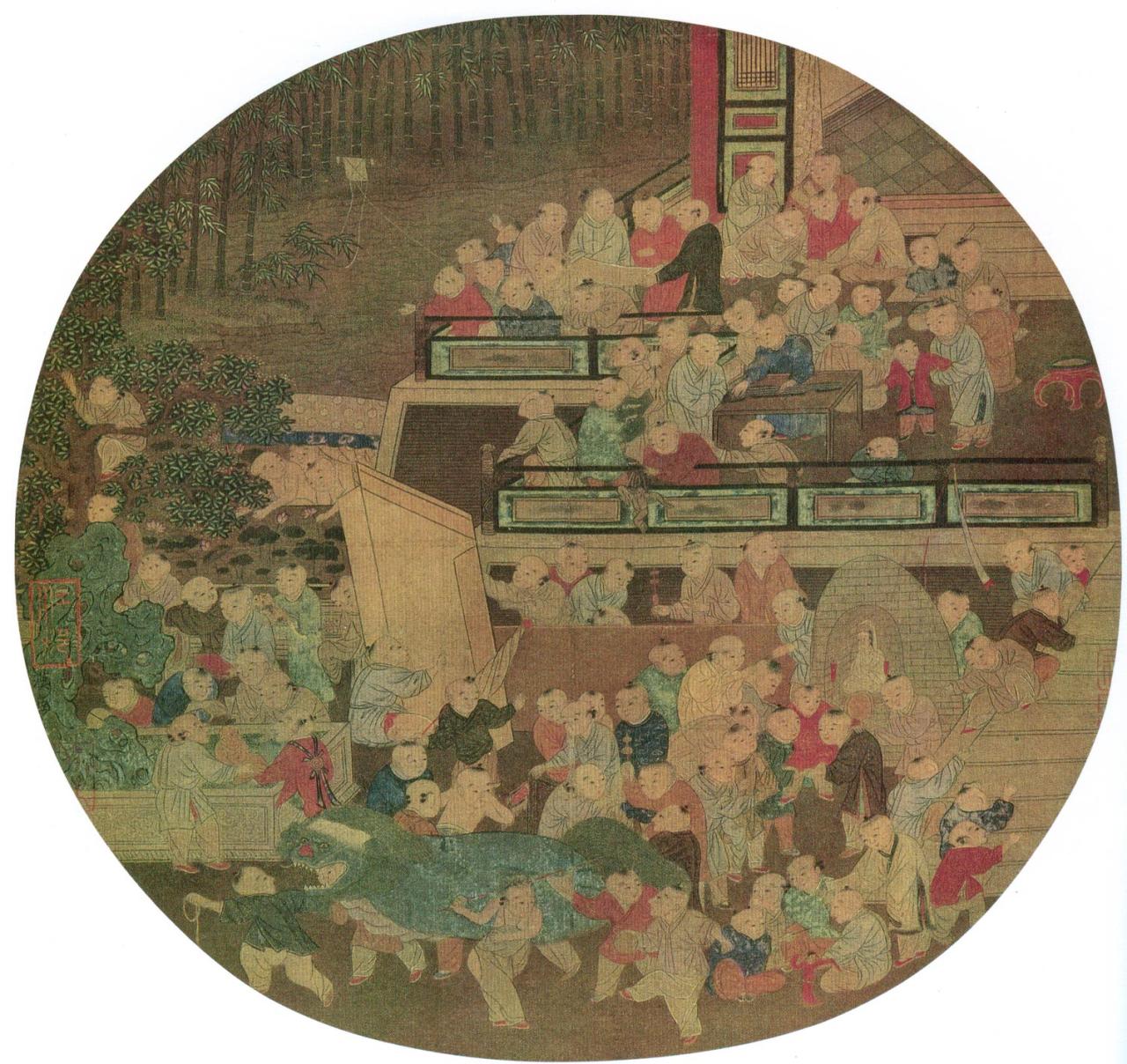
During the Tang Dynasty people fixed bamboo strips to kites so they rang in the breeze like a zheng, and the kite became known as fengzheng.
When Emperor Wudi of the Liang Dynasty was besieged at Taicheng in Nanjing he used a kite to send out an S.O.S.
2. Chinese Kite Making and Design
The Chinese kite begins with bamboo split lengthwise into canes, so that rods of different thickness can serve different structural requirements. Thicker bamboo rods give the kite rigidity and strength, while thinner, more flexible rods are bent into curving forms for wings and other body parts. The frame is then covered with one or two layers of Chinese paper wrapped over the front and fixed with a starch-based adhesive, attached in such a way that it could billow slightly to help catch the wind. The paper was probably made from paper mulberry, straw and the bark of the blue sandalwood tree, a stock commonly called xuan.
Decoration was painted on with pigments ground from plants and minerals and mixed with an animal glue binder, a medium known as gouache or opaque watercolour. Traditional kites were built from bamboo frames covered with paper and silk, and their designs varied from region to region. Swallow-shaped kites were popular in Beijing, while whistle kites known as banyao are associated with Nantong in Jiangsu Province.
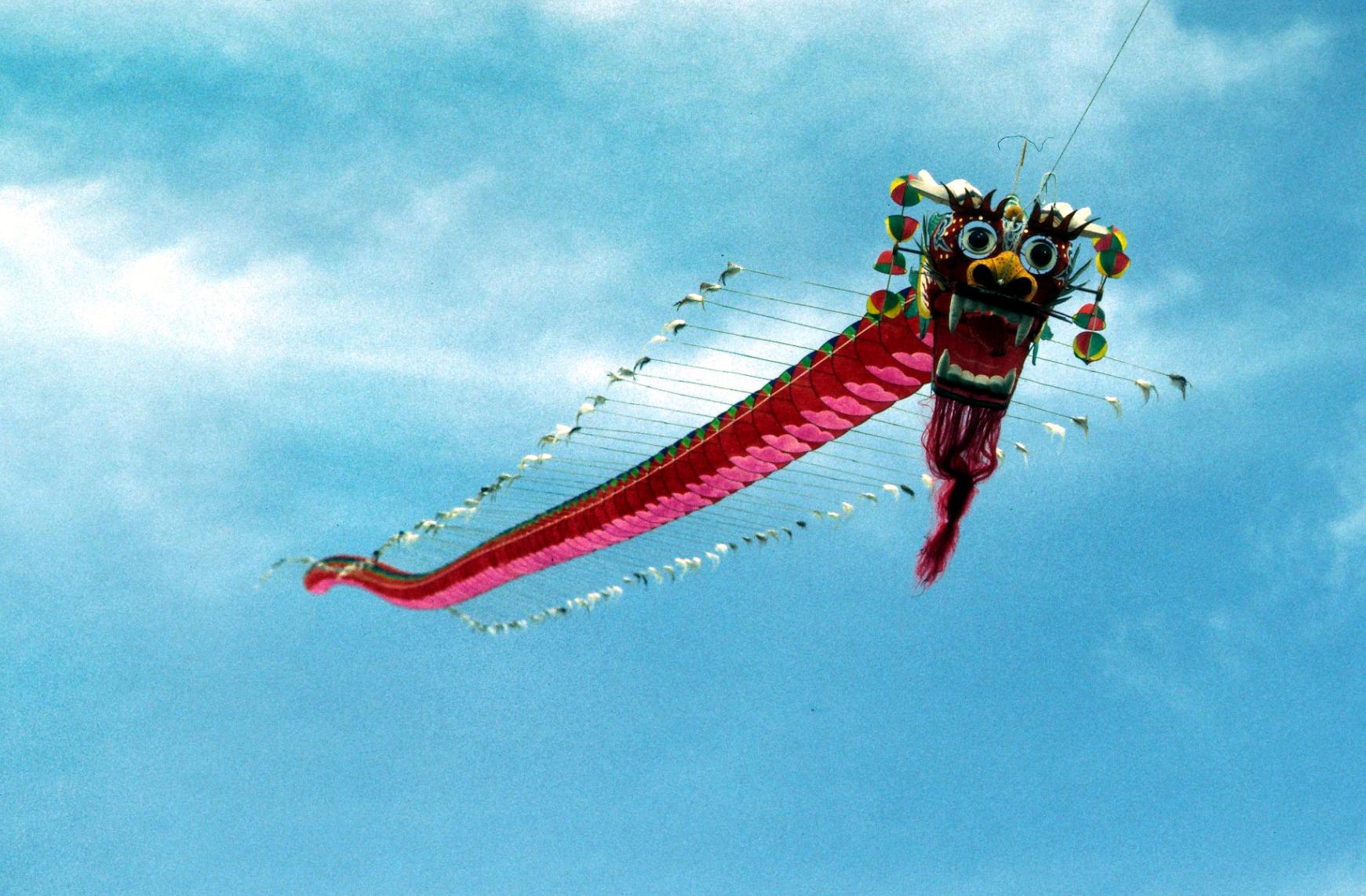
Chinese kites are divided into those with detachable wings and those with fixed wings, the fixed-frame type flying better and higher in a steady wind. Classified by design they include no less than 300 varieties, among them human figures, fish, insects, birds, animals and written characters.
3. Belief, Custom and Festival
In China and Japan kites were understood to frighten away bad spirits and to draw good ones near, and some Chinese kites carried whistles and spinning discs made for that purpose. Under the Qing Dynasty the belief took a different form: flying a kite and then releasing it was thought to carry off bad luck and illness, so a kite found lying on the ground was left untouched.
Kites also enter the traditional beliefs of Polynesia, where a kite god was known among the native peoples of New Zealand, Hawaii and other islands. In both Polynesia and China kites bearing a torch or lantern served for nighttime reconnaissance in war.
Among the Maya a spiritual tradition of kite flying developed independently, expressed in giant round kites that honour the dead on the Day of the Dead. The tradition is thought to be only about one hundred years old, yet it has become a unique kite celebration.
By 900 CE people had adapted kites for recreation, among other uses flying them to welcome the spring during the Qing Ming Festival. In 1983 a large-scale kite-flying competition was held in Tianjin, where a dragon-headed centipede kite of a hundred sections was flown by a squad of young men.
On the day of Uttarayan almost all normal activity in Gujarat shuts down and everyone takes to the rooftops and roadways to fly kites and compete with neighbours. Competition kites are attached to a spool of manja, a string coated with glue and glass so that it can cut rival strings. Production fills the streets of Ahmedabad from November, and in the week before the festival the old city's Patang Bazaar stays open around the clock.
4. Spread to Japan, India and Europe
Japanese history records that kites were brought to Japan by Chinese monks between the 6th and 8th century CE. Japan's Edo period of isolation began in 1603 and the country developed its own distinct forms and uses of kites during it.
Kites are believed to have reached India either with Muslim traders coming eastward through Persia or with Buddhist pilgrims travelling from China in search of sacred texts.
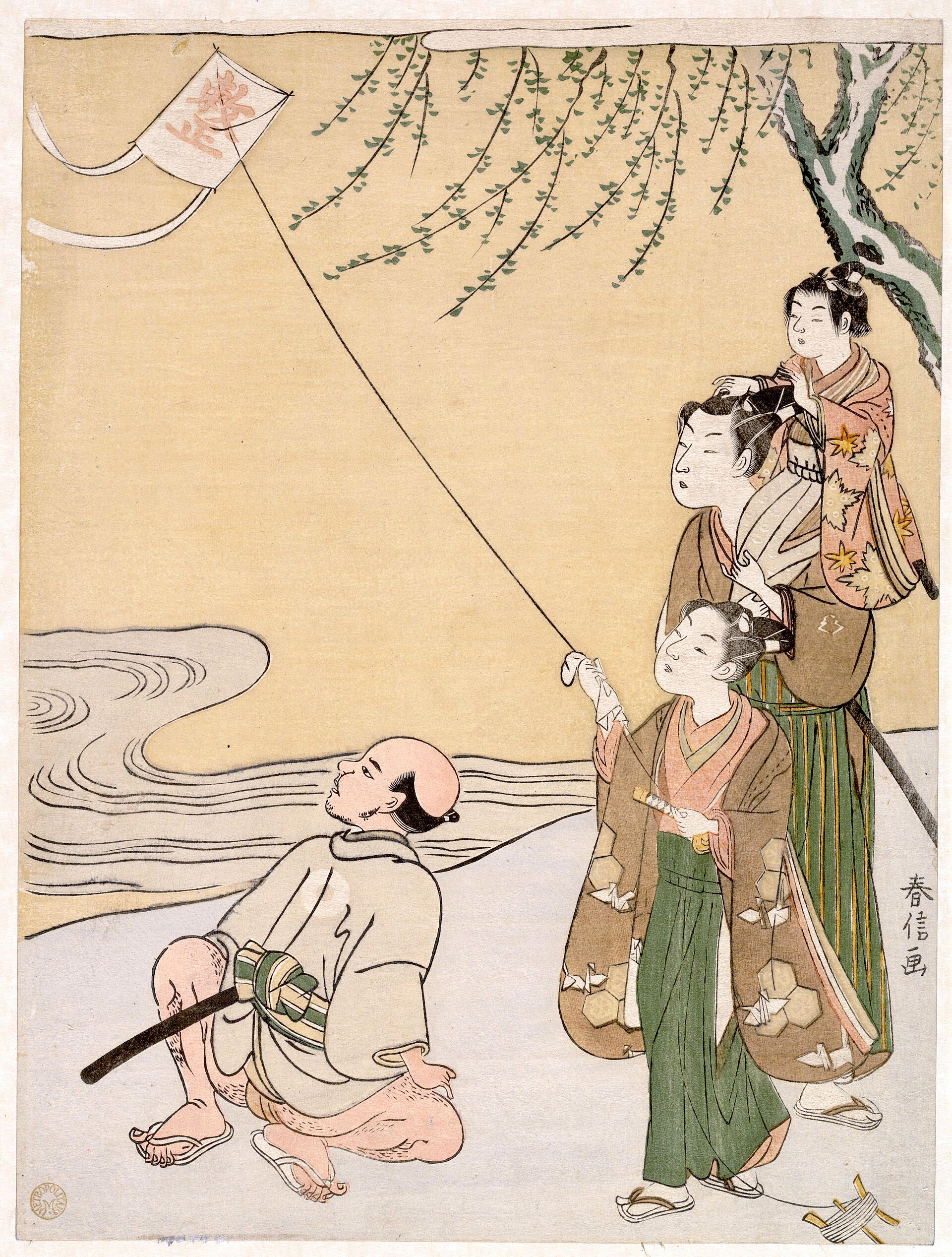
The sacred dimension of kites did not travel with them to Europe as they gained popularity there in the 16th century, nor onward with the colonization of the Americas.
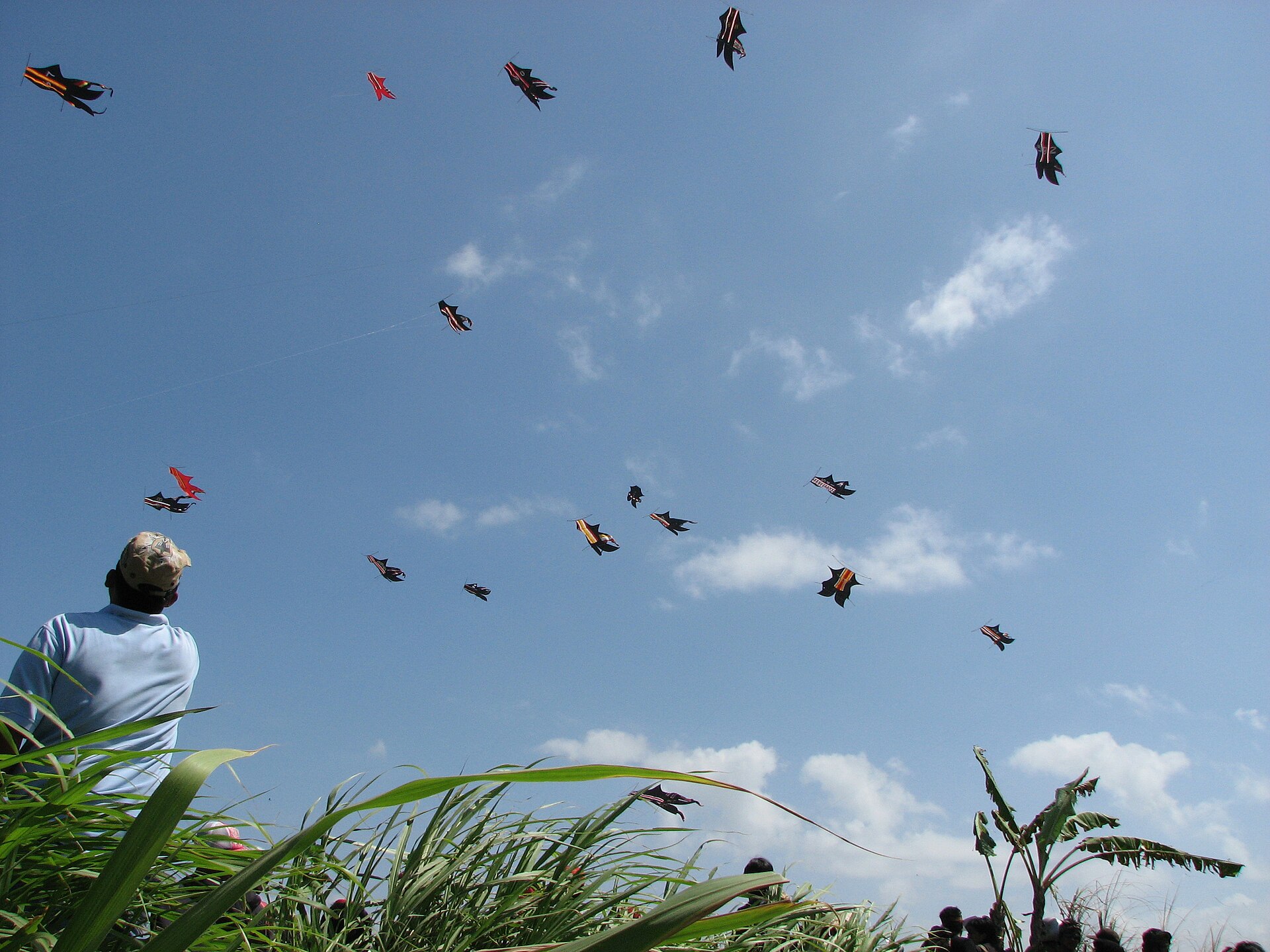
Kites have been used for fishing since prehistoric times, a practice that appears to have begun in Malaysia with kites made from leaves and other vegetation. Fighting kites, in which flyers try to bring down an opponent's kite, may have first emerged in China and spread through Asia, South Asia and the Middle East.
5. Kites in Science and Early Flight
In June 1752 in a field near Philadelphia Benjamin Franklin flew a kite with his son William, the kite made with a large silk handkerchief, a hemp string and a silk string, his equipment including a house key, a Leyden jar and a sharp length of wire. The kite was not struck by lightning; it picked up the ambient electrical charge from the storm, demonstrating the connection between lightning and electricity.
A brief statement of the experiment appeared in the Pennsylvania Gazette on 19 October 1752 and was read to the Royal Society on 21 December. The paper was not a narrative of the experiment but a statement that it had taken place, followed by instructions for repeating it, beginning with a small cross of two light cedar strips long enough to reach the corners of a large thin silk handkerchief tied to them as the body of the kite.
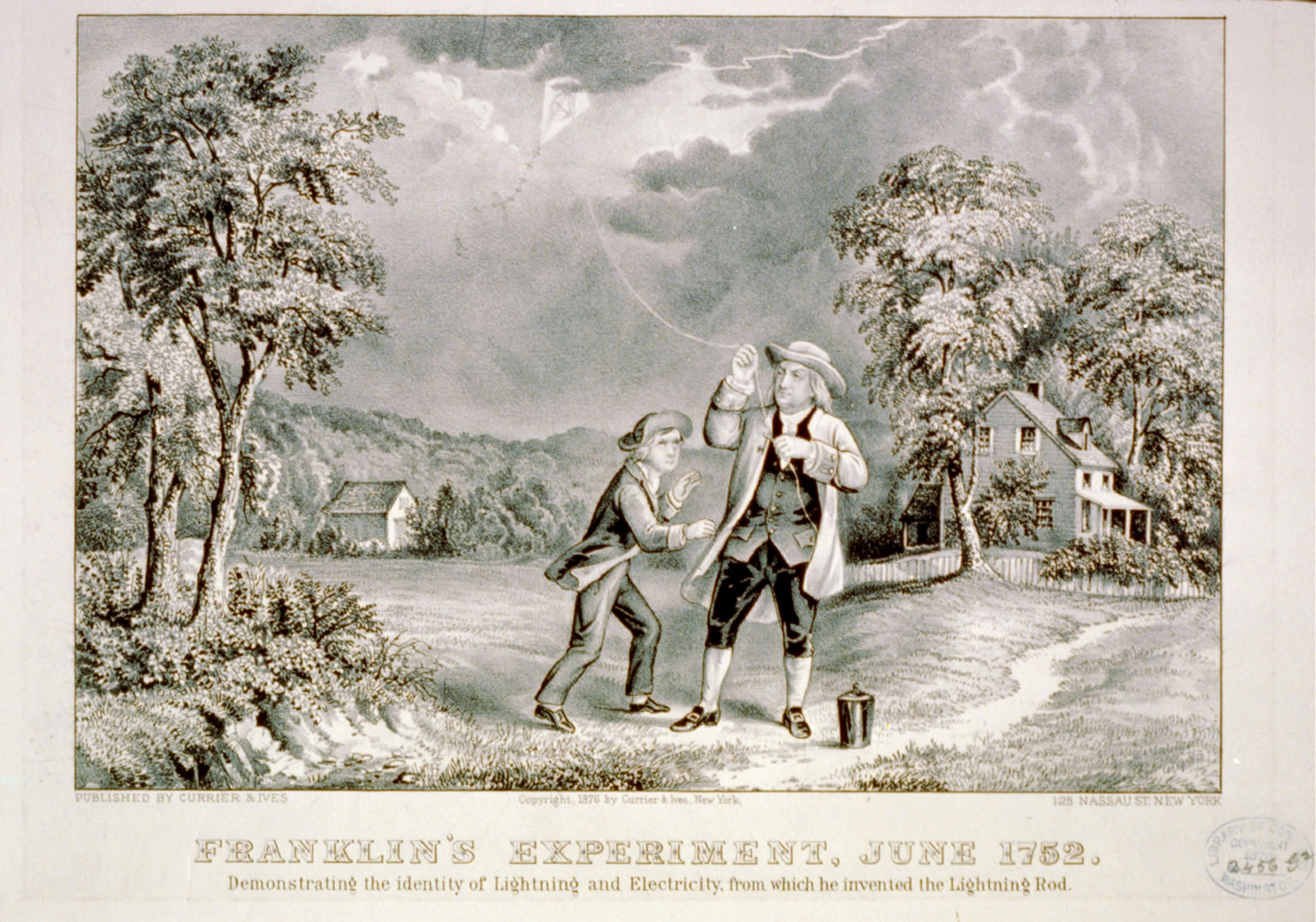
Franklin was not the first to demonstrate the electrical nature of lightning; Dalibard succeeded a month earlier in France, on 10 May 1752 at Marly. An attempt to replicate the lightning-rod experiment killed Georg Wilhelm Richmann in Saint Petersburg in August 1753; he was thought to be the victim of ball lightning.
Observing that birds soared by twisting their arched wings, George Cayley deduced that fixed-wing machines would fly if the wings were cambered, and in 1804 he flew a model glider; a full-scale version was flown as a kite in 1808. A small boy whose name is not recorded made a short flight in a Cayley glider in 1849 and was the first person in history to fly; in 1853 a man-carrying Cayley glider rose from Brompton Dale with the coachman aboard.
From 1893 Lawrence Hargrave investigated box kites after experiments with curved surfaces, becoming convinced that cellular kites had greater stability and lift than monoplanes. In 1889 he built a compressed air engine powered by three rotating cylinders, one of the great inventions of his career. On 12 November 1894 he connected four box kites of his own design, added a seat and flew 16 feet (4.8 metres) above the ground, showing that a safe heavier-than-air machine was possible. His box kite designs were taken up by other inventors including Octave Chanute, whose work was later incorporated by the Wright brothers into the Wright Flyer.
In 1899 the Wright brothers tested their ideas on a large box kite flown at Dayton, using multiple control lines to twist the wing tips and move the kite from side to side. When their 1900 glider generated less lift than expected, the brothers flew it primarily as a kite, putting a scale on the line to measure lift and drag. The forces acting on a kite are the same as those on an airliner in flight, except that the tension in the line replaces thrust, which allowed the Wright brothers to test their theories of flight by flying their aircraft as kites between 1900 and 1902 to check control and lift from the ground.
6. Meteorology and Military Use
At Blue Hill a thermograph was carried aloft to an altitude of 1,400 feet on 4 August 1894 using a series of Malay tail-less kites. The observatory itself was founded by Abbott Lawrence Rotch on 635-foot Great Blue Hill in Milton, Massachusetts. It keeps the oldest continuous weather record in North America, with observations dating back to 1885 and still running.
Target kites were ordered in batches of six, then a hundred, then a thousand, and by the end of the Second World War some 300,000 had been built. They could loop, dive, climb and make figure-eights under manual control by a reel and harness worn at the waist, with the outline of an enemy aircraft on the front. In his later years Paul Garber founded the Smithsonian Kite Festival, an annual kite-flying celebration held for decades on the National Mall in Washington.
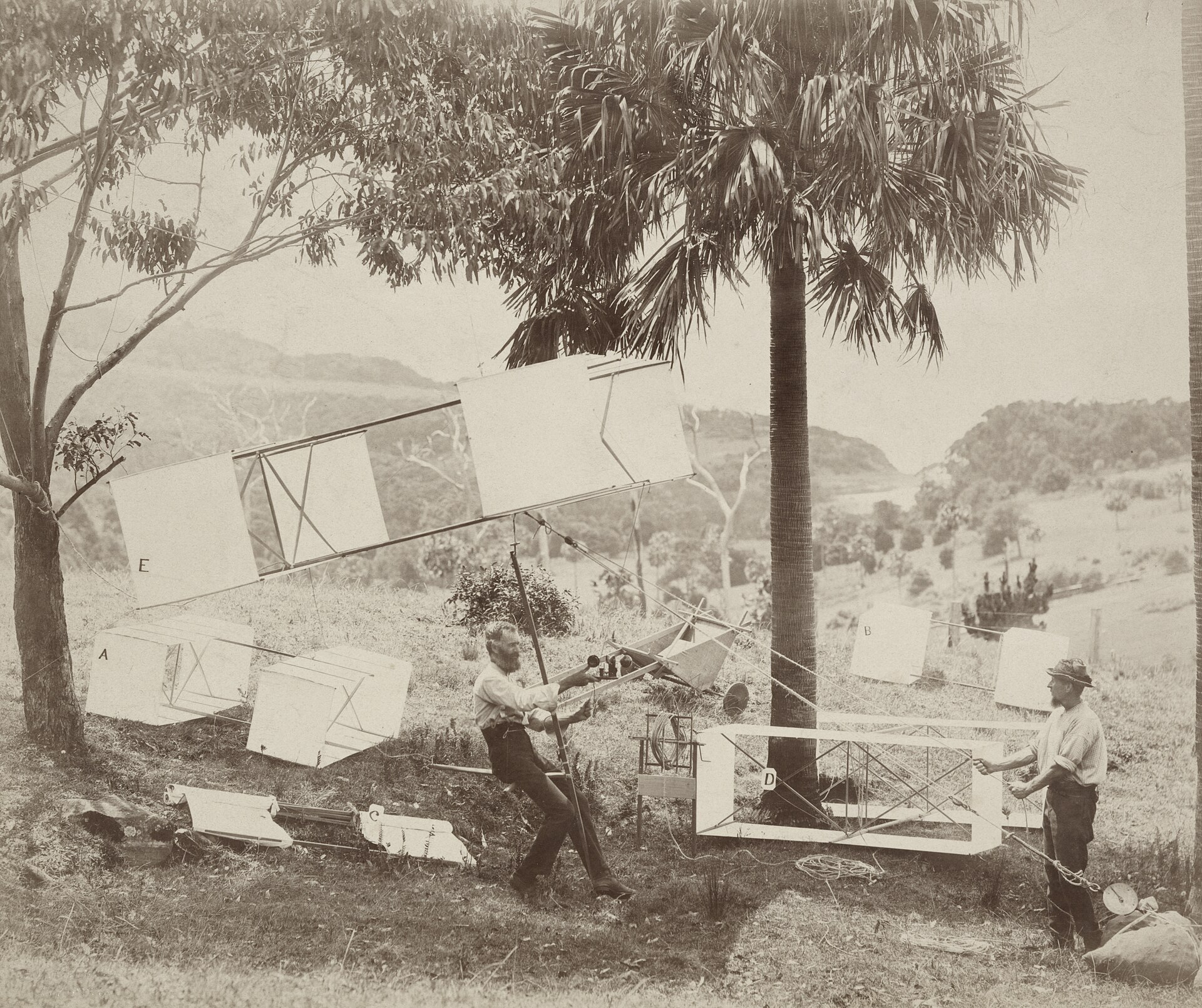
Kites carried lights, noise makers and pyrotechnics aloft at night to frighten enemy troops, and Chinese and Japanese tales suggest the first humans to fly did so aboard large kites.
7. Aerodynamics
The lift acting on a kite is the product of a lift coefficient, the projected surface area, the air density, and one half the square of the wind velocity. For calculations NASA gives the standard sea level air density as 1.229 kilograms per cubic metre and notes that the aerodynamic forces change with the square of the velocity. To launch a kite the lift force must be greater than the weight of the kite, and what matters is the relative velocity between the air and the kite.
For a thin flat plate at a low angle of attack the lift coefficient is twice pi times the angle of attack expressed in radians. Most kites have a low aspect ratio, defined as span squared divided by area, so downwash from the wing tips must be included in the lift coefficient. For a thin flat plate the drag coefficient equals 1.28 times the sine of the angle of attack. Low aspect ratio wings have significantly less lift than wings of higher aspect ratio, and the extra drag produced is called induced drag or drag due to lift.
Wind velocity normally increases with altitude and becomes steadier above the atmospheric boundary layer, where the lift force becomes fairly constant. Once launched, a kite cruises at the altitude and attitude where all forces and torques balance, and pulling on the control line increases velocity and lift so that the kite climbs.
8. Collections, Heritage and Industry
Some of the oldest human-made flying objects in the National Air and Space Museum collection are Chinese kites displayed at the 1876 Philadelphia exposition. A group of 43 kites from the 1876 exposition was donated to the Smithsonian, becoming part of the collection of the National Museum of Natural History. By the end of the nineteenth century the Smithsonian held twenty Chinese kites, whose structures, imagery and spirit reach back centuries. The curator Tom Crouch describes kites as the first flying objects crafted by human hands, used for everything from fishing to signalling. Because Chinese paper of the period was short-fibred it embrittled easily, and repairs with modern craft-paper tape caused further degradation.
In 2008 the kite designs of the Beijing maker Ha Yiqi were inscribed on China's national list of intangible cultural heritage.
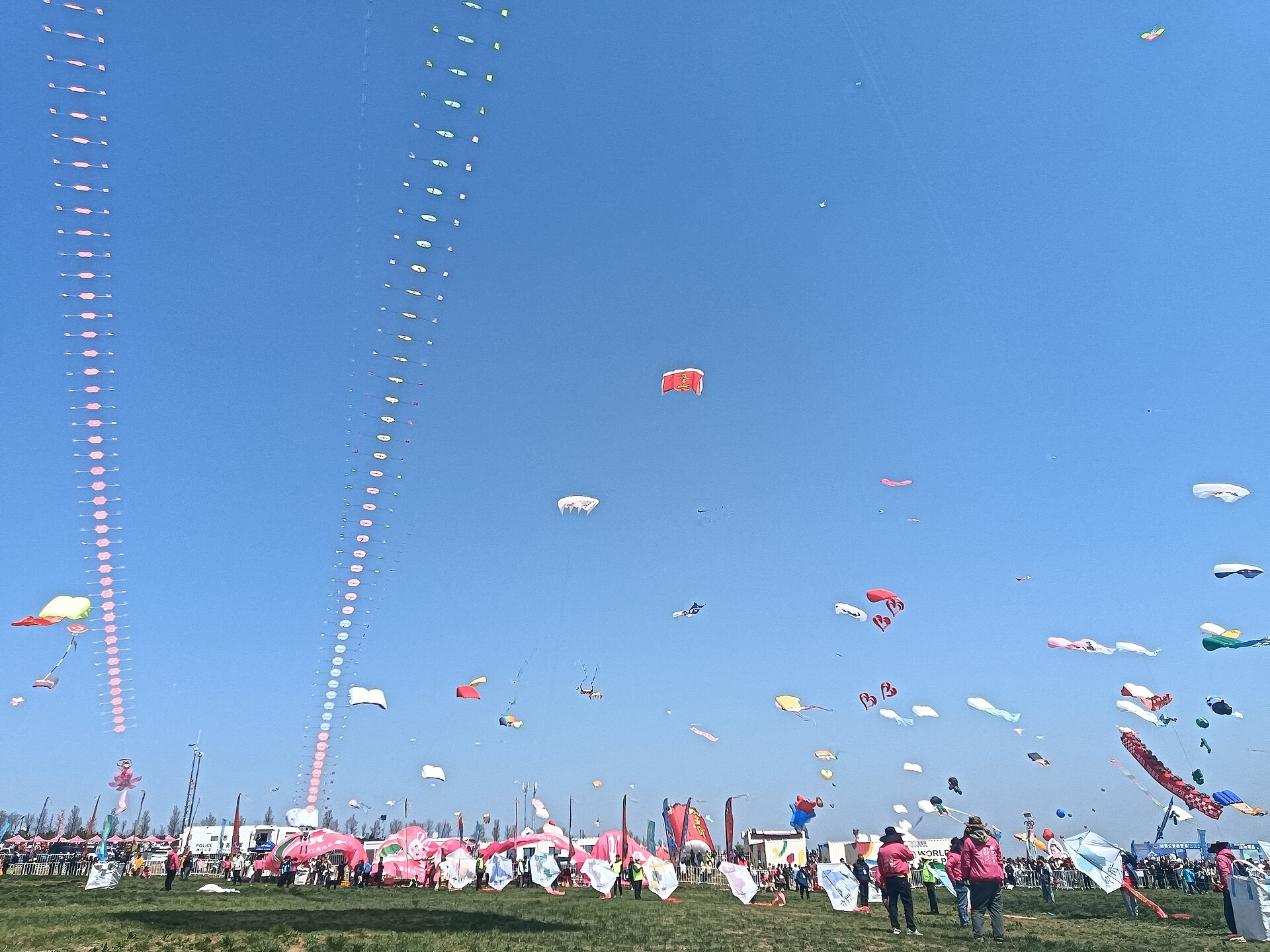
The first Weifang International Kite Festival took place in 1984 after David Checkley, then chairperson of the Seattle Kite Association, visited Chinese kite makers and suggested an international event. It attracted kite fans from eleven countries and regions, among them the United States, Britain, Japan, the Netherlands and Australia. Weifang was named kite capital of the world at an early festival, and its ten-day trade volume stood at one billion yuan, a significant amount at the time. In the 1930s two kite festivals were held in Weifang before the Japanese invasion interrupted the event, and today one of the city's main roads is named Yuanfei, meaning kite flying. Weifang is home to more than 300 kite manufacturers whose products are sold to more than 40 countries and regions.
9. Timeline
-
475 BCE to 221 BCEEarliest kites in ChinaThe earliest kites are associated with China.3Conserving the Museum's Chinese Kites · Smithsonian National Air and Space Museum — Inside the Conservation Lab ↗
-
618 CE to 907 CELighter kite materialsSilk-and-bamboo kites gave way to lighter paper-and-bamboo designs.3
-
6th to 8th century CEKites reach JapanChinese monks brought kites to Japan.4Kites Rise on the Wind: The Origin of Kites · Library of Congress — Folklife Today (American Folklife Center) ↗
-
1603Edo period isolation beginsJapan entered a period of isolation.4
-
10 May 1752Dalibard's lightning experimentDalibard carried out a lightning experiment at Marly.7The Kite Experiment, 19 October 1752 · National Archives — Founders Online (The Papers of Benjamin Franklin) ↗
-
June 1752Franklin's kite experimentFranklin conducted his kite experiment near Philadelphia.6Benjamin Franklin and the Kite Experiment · The Franklin Institute ↗
-
19 October 1752Franklin's account publishedFranklin's brief statement of the kite experiment appeared in the Pennsylvania Gazette.7
-
21 December 1752Account read to the Royal SocietyFranklin's account was read to the Royal Society.7
-
August 1753Richmann killedRichmann was killed in Saint Petersburg.8Kite experiment · Wikipedia ↗
-
1804Cayley's model gliderCayley built a model glider.9Sir George Cayley · San Diego Air & Space Museum — International Air & Space Hall of Fame ↗
-
1808Cayley's full-scale versionCayley's full-scale version was flown as a kite.9
-
1849Boy carried aloftA small boy whose name is not recorded made a short flight in a Cayley glider and was the first person in history to fly.9
-
1853Coachman flies at Brompton DaleA man-carrying Cayley glider rose from Brompton Dale with the coachman aboard.9
-
1889Hargrave's compressed air engineHargrave produced a compressed air engine.10Hargrave, Lawrence (1850-1915) · Australian Dictionary of Biography, National Centre of Biography, ANU ↗
-
4 August 1894First kite sounding at Blue HillThe first kite sounding was made at Blue Hill.15Blue Hill Observatory: 125 Years Watching the Weather · Blue Hill Observatory and Science Center ↗
-
12 November 1894Hargrave's box-kite flightHargrave flew a box kite at Stanwell Park.11Lawrence Hargrave's first flight · National Museum of Australia — Defining Moments ↗
-
1899Wright brothers' biplane kiteThe Wright brothers built a five-foot biplane kite at Dayton.13Road to First Flight · U.S. National Park Service — Dayton Aviation Heritage / Wright Brothers ↗
-
1984First Weifang International Kite FestivalThe first Weifang International Kite Festival was held.21Weifang flies high on wings of its kites · China Daily (Shandong) — Xinhua report ↗
-
2008Ha Yiqi designs inscribedThe kite designs of the Beijing maker Ha Yiqi were inscribed on China's national list of intangible cultural heritage.2Kites, Beijing and Jiangsu Province · Smithsonian Folklife Festival 2014 (China: Tradition and the Art of Living) ↗
10. Timeline: from ancient China to the modern kite festival
- 475-221 BCEThe Warring States periodThe earliest Chinese kites were made of wood and called muyuan, dating as far back as the Warring States Period.
- c. 220 BCEKites are invented in ChinaChinese kites of about this date were used for communication, military signalling, measuring distances and holding people aloft.
- 549 CEA kite carries an SOS from TaichengSurrounded at Taicheng in Nanjing, Emperor Wudi of the Liang Dynasty sent a kite out with a call for help.
- 618-907 CELighter kites and the name fengzhengCraftsmen began building kites of silk and bamboo and then of paper and bamboo, and bamboo strips that rang in the wind gave the kite the name fengzheng.
- By 900 CEKites become recreation in ChinaKites were adapted for play and seasonal celebration, including flying them to welcome spring at the Qing Ming Festival.
- 1603Japan's isolated kite traditionWith the Edo period's isolation, Japan developed its own distinct kite forms and uses.
- June 1752Franklin flies the electrical kiteFranklin raised a silk kite with a pointed wire and drew electric fire down a wet hemp string to a key, proving that lightning is electricity.
- August 1753Richmann is killed by ball lightningGeorg Wilhelm Richmann died in Saint Petersburg while attempting to repeat the lightning experiment.
- 1804Cayley's kite-winged gliderGeorge Cayley flew a model glider whose wing was a kite surface, and in 1808 a full-scale version was flown as a kite.
- 1876Chinese kites reach the SmithsonianKites displayed at the Philadelphia Centennial Exposition were shipped to Washington, and 43 of them entered the national collections.
- 4 August 1894Kites sound the atmosphere at Blue HillA series of Malay tail-less kites lifted a thermograph to 1,400 feet above the Blue Hill Observatory.
- 12 November 1894Hargrave rides a train of box kitesLawrence Hargrave connected four box kites, climbed into a seat and rose 16 feet above Stanwell Park beach.
- 1899The Wright brothers' control kiteThe brothers tested wing warping on a large box kite flown at Dayton, twisting the wing tips with multiple control lines.
- 1900The Wrights fly a glider as a kiteAt Kitty Hawk the 1900 glider was flown mainly as a kite while the brothers measured lift and drag from the ground.
- By 1940Target kites for naval gunneryPaul Garber's maneuverable target kites entered U.S. Navy training, and some 300,000 were built before the war ended.
- 1 April 1984The first Weifang International Kite FestivalWeifang held the first of its international festivals, with kite fans from eleven countries and regions.
References (21)
- 1The Kite — Embassy of the People's Republic of China in Nepal — Culture Exchange WebView source
- 2Kites, Beijing and Jiangsu Province — Smithsonian Folklife Festival 2014 (China: Tradition and the Art of Living) 2014 Web↩View source
- 3Conserving the Museum's Chinese Kites — Smithsonian National Air and Space Museum — Inside the Conservation Lab Web↩View source
- 4Kites Rise on the Wind: The Origin of Kites — Library of Congress — Folklife Today (American Folklife Center) 2017 Web↩View source
- 5International Kite Festival (Uttarayan) — Tourism Corporation of Gujarat Limited WebView source
- 6Benjamin Franklin and the Kite Experiment — The Franklin Institute Web↩View source
- 7The Kite Experiment, 19 October 1752 — National Archives — Founders Online (The Papers of Benjamin Franklin) 1752 Web↩View source
- 8Kite experiment — Wikipedia Web↩View source
- 9Sir George Cayley — San Diego Air & Space Museum — International Air & Space Hall of Fame Web↩View source
- 10Hargrave, Lawrence (1850-1915) — Australian Dictionary of Biography, National Centre of Biography, ANU 1850 Web↩View source
- 11Lawrence Hargrave's first flight — National Museum of Australia — Defining Moments Web↩View source
- 12Wright Brothers' Unpowered Aircraft (1900-1902) — NASA Glenn Research Center — Beginner's Guide to Aeronautics 1900 WebView source
- 13Road to First Flight — U.S. National Park Service — Dayton Aviation Heritage / Wright Brothers Web↩View source
- 14Forces on a Kite — NASA Glenn Research Center — Beginner's Guide to Aeronautics WebView source
- 15Blue Hill Observatory: 125 Years Watching the Weather — Blue Hill Observatory and Science Center Web↩View source
- 16Paul Garber's Target Kites — Smithsonian National Air and Space Museum WebView source
- 17The Splendor of Chinese Kites — Smithsonian Magazine — Air & Space WebView source
- 18Kite Flying — NASA Glenn Research Center — Beginner's Guide to Aeronautics WebView source
- 19Kite Lift — NASA Glenn Research Center — Beginner's Guide to Aeronautics WebView source
- 20Kite Drag and Downwash — NASA Glenn Research Center — Beginner's Guide to Aeronautics WebView source
- 21Weifang flies high on wings of its kites — China Daily (Shandong) — Xinhua report 2018 Web↩View source
 Venice
 Ibn Battuta
 Gravity