Apollo 11
The first crewed landing on the Moon: in July 1969 Neil Armstrong, Buzz Aldrin and Michael Collins flew to the Sea of Tranquility — and humanity walked on another world for the first time.
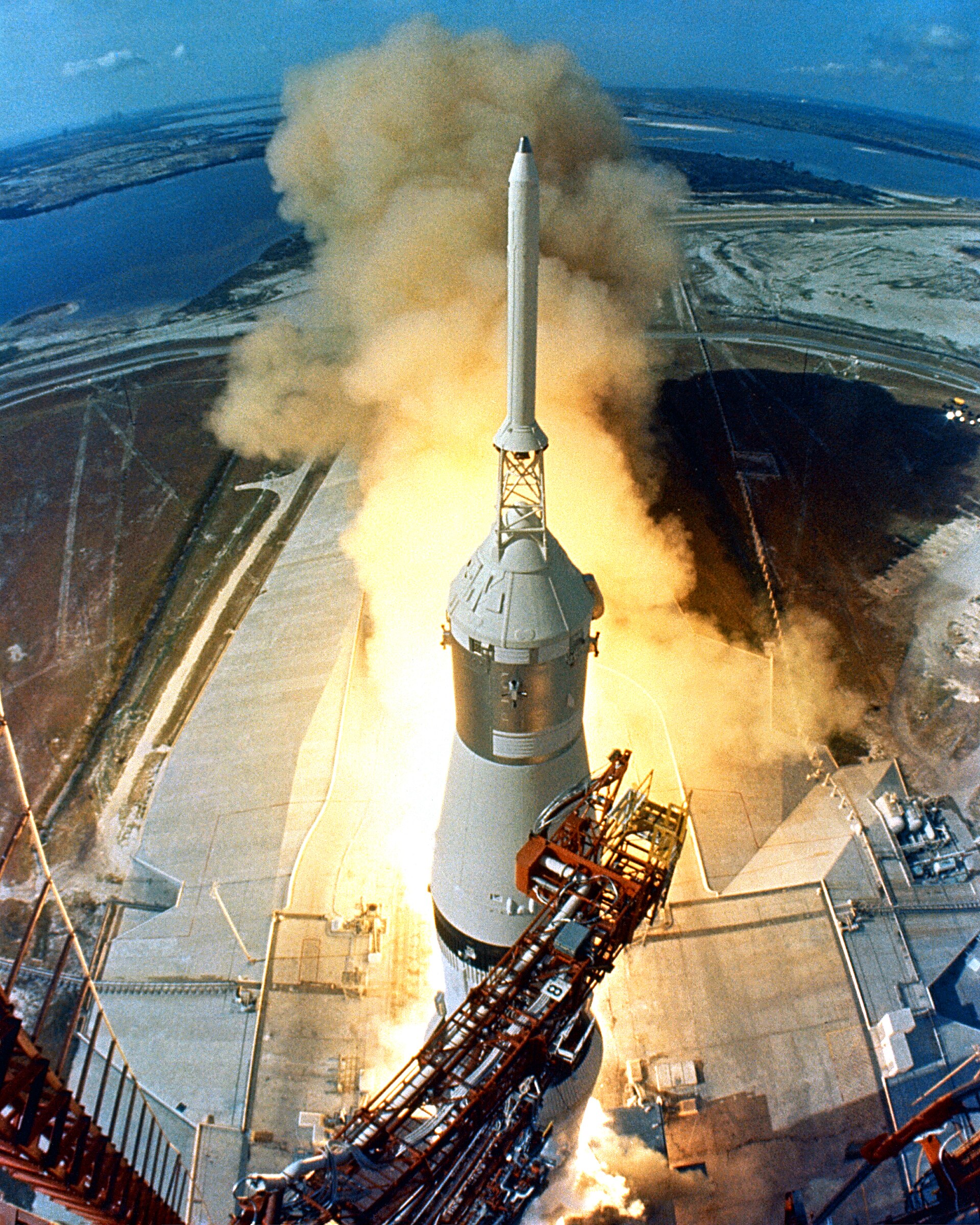
Apollo 11 was NASA's first crewed Moon landing, flown 16–24 July 1969. Neil Armstrong, Michael Collins and Edwin “Buzz” Aldrin launched atop a Saturn V, and on 20 July 1969 the lunar module Eagle landed in the Sea of Tranquility while Collins orbited overhead in the command module Columbia. Armstrong and Aldrin spent 21 hours 36 minutes on the surface, collected 48 pounds of lunar material, deployed science experiments and left a flag and plaque behind. An estimated 650 million people watched the first steps on television. The crew returned on 24 July and spent 21 days in quarantine as a planetary-protection precaution.
The mission in brief
Apollo 11 was NASA's first crewed Moon landing, flown from 16 to 24 July 1969.1 On 20 July 1969 humans walked on the Moon for the first time.2 Neil Armstrong and Buzz Aldrin landed in the lunar module Eagle while Michael Collins orbited overhead in the command module Columbia.2
| Item | Record |
|---|---|
| Type | Crewed lunar landing, the first in history.1 |
| Crew | Neil Armstrong (commander), Buzz Aldrin (lunar module pilot) and Michael Collins (command module pilot).1 |
| Launch | 16 July 1969; the engines fired at 9:32 a.m.; Launch Pad 39A, Kennedy Space Center; the Saturn V flew as AS-506.3 |
| Landing | 20 July 1969 at 4:17 p.m.; 20:17 UTC.4 Sea of Tranquility (Mare Tranquillitatis), Site 2, at 0.67408 degrees north and 23.47297 degrees east.2 |
| First step | 20 July 1969 at 10:56 p.m.; Neil Armstrong became the first human on the Moon.5 |
| Splashdown | 24 July 1969 at 12:50 p.m.; Pacific Ocean; recovered by USS Hornet.1 |
| Duration | 8 days, 3 hours, 18 minutes and 35 seconds; 953,054 miles flown.1 |
Apollo 11's objective was the national goal President John Kennedy had set on 25 May 1961: to perform a crewed lunar landing and return the crew safely to Earth.1 The mission completed that goal with five months to spare in the decade, and all three astronauts returned safely.1
Kennedy's challenge and the road to the Moon
On 12 April 1961 the Soviet Union launched Yuri Gagarin, the first human in space.2 Within days, President Kennedy asked Vice President Lyndon Johnson to find a space program in which the United States could win.2 On 25 May 1961 Kennedy set the national goal that Apollo 11 would complete: a crewed lunar landing and a safe return to Earth.1
The vehicle for the attempt was the Saturn V, a three-stage rocket.5 The flight control team had only about 40 hours of total training in the simulators, essentially one week's worth.6 In the final training runs the team met computer program alarms it had never seen or studied, and guidance officer Steve Bales decided to abort.6 The simulator supervisor told them they should not have aborted over those alarms: they should have checked that guidance, navigation and thrusters were still working.6 When a controller checked overnight, he told Kranz that the simulator supervisor had been right.6 Michael Collins later summed up the sequence: Apollo 8 had been about leaving, and Apollo 11 was about arriving.7
The crew: Armstrong, Collins and Aldrin
| Astronaut | Role | Earlier spaceflights | Background |
|---|---|---|---|
| Neil Armstrong | Commander.1 | Gemini 8 in 1966.1 | Joined NASA's predecessor NACA as an aeronautical research scientist and pilot in 1955; one of nine men chosen for NASA's second astronaut group in 1962.1 |
| Buzz Aldrin | Lunar module pilot.1 | Gemini XII.1 | An engineer and fighter pilot in the Korean War, selected in NASA's third astronaut class in 1963.1 |
| Michael Collins | Command module pilot.1 | Gemini X in 1966.1 | Named in NASA's third group of astronauts in October 1963; over 266 hours logged in space.1 |
Armstrong had joined NASA's predecessor NACA in 1955 as an aeronautical research scientist and pilot, and he flew on the Gemini 8 mission in 1966 before being assigned to Apollo 11.1 The backup crew was James Lovell as commander, William Anders as command module pilot and Fred Haise as lunar module pilot.2 While Armstrong and Aldrin worked on the surface, Michael Collins remained in lunar orbit in Columbia.2 After the others docked with Columbia, Collins said that for the first time he really felt they were going to carry the thing off.5
Launch: 16 July 1969
The day before the launch, Ralph Abernathy led a protest to the gates of the Kennedy Space Center drawing attention to economic and racial inequality.2 Apollo 11 lifted off from Cape Kennedy on 16 July 1969 carrying Neil Armstrong, Michael Collins and Buzz Aldrin, and entered an initial Earth orbit of 114 by 116 miles.3 The engines fired at 9:32 a.m., and Apollo 11 cleared the launch tower.5 More than a million spectators came to watch the liftoff, among them Vice President Spiro Agnew and former President Lyndon Johnson.2 The rocket was the three-stage Saturn V, 363 feet tall, producing 7.5 million pounds of thrust.5
Two hours 44 minutes after launch, the S-IVB stage reignited for a burn of five minutes 48 seconds, placing Apollo 11 on a translunar trajectory.3 It was the last Apollo mission to fly a free-return trajectory, which would enable a return to Earth with no engine firing and a ready abort at any time before lunar orbit insertion.3 The launch had a literary precedent: Jules Verne's 1865 novel From the Earth to the Moon placed its fictional Moon shot in Florida, where one solitary town, Tampa Town, staked its claim on the launch site.8
The voyage to the Moon
Columbia, the command module, was the living quarters for the three-person crew during most of the mission.9 The flight plan was a minute-by-minute timeline of activities for the crew and Mission Control in Houston.10 A midcourse correction came on 17 July, and the crew checked out the lunar module on 18 July.3 Lunar orbit insertion followed on 19 July, after Apollo 11 had flown behind the Moon out of contact with Earth.3 At about 75 hours 50 minutes into the flight, a retrograde firing of the service propulsion system for 357.5 seconds placed the spacecraft into an initial elliptical lunar orbit of 69 by 190 miles.3
Eagle undocked from Columbia at 100 hours 12 minutes into the flight so that the lunar module could be inspected visually.3 From a descent orbit of 9 by 67 miles, powered descent began at 102 hours 33 minutes, with the descent engine burning for 756.3 seconds.3 After eight minutes the module passed through high gate, about 26,000 feet above the surface and about five miles from the landing site.3
Descent: “The Eagle has landed”
The final approach was a running conversation with Mission Control, preserved word by word in the mission transcripts.4
It's a 1202.
Neil Armstrong, during powered descent
Roger. 1201 alarm. (Pause) We're Go. Same type. We're Go.
Mission Control, Houston
60 seconds (of fuel left before the 'Bingo' call).
Mission Control, as the fuel ran low
Houston, Tranquility Base here. The Eagle has landed.
Neil Armstrong, 20 July 1969
Roger, Twan...(correcting himself) Tranquility. We copy you on the ground. You got a bunch of guys about to turn blue. We're breathing again. Thanks a lot.
Charlie Duke, capsule communicator, Mission Control
The alarms were symptoms rather than failures: the 1202 came from data overflow in the lunar module's guidance computer.4 Armstrong said afterwards that in the real flight the crew were spring-loaded to the land position rather than to abort.4 He also said that if he had run out of fuel he would have put the module down right there, but that with any choice of a more promising spot he was going to take it.11 The lunar module touched down with only about 30 seconds of fuel remaining.5 Aldrin's call of contact light came at 20:17:40 GMT, the moment the landing was announced.4 The National Archives record touchdown as scheduled on 20 July, 102 hours 47 minutes and 11 seconds after launch.10
Touchdown came about four miles downrange of the predicted point and almost one and a half minutes earlier than scheduled.3 The powered descent ran only a nominal 40 seconds longer than planned, because Armstrong had to translate the module to avoid a crater in the final phase.3 In the last minutes he flew the module manually to avoid a sharp-rimmed crater about 180 meters across and 30 meters deep known as West.2 Eagle landed about 6 km from the originally intended site, roughly 400 meters west of West crater.2 Shortly after landing, Houston confirmed that all the crew's consumables were solid and that they looked good in every respect.12 Flight director Gene Kranz has said that for the flight controller failure is not an option.6
One small step: the first moonwalk
At about 109 hours 42 minutes after launch, Armstrong stepped onto the Moon.3 More than half a billion people were watching on television as he prepared to plant the first human foot on another world.5
I'm going to step off the LM now.
Neil Armstrong, at the foot of the ladder
That's one small step for (a) man; one giant leap for mankind.
Neil Armstrong, as he stepped onto the surface
“magnificent desolation.”
Buzz Aldrin, describing the lunar surface
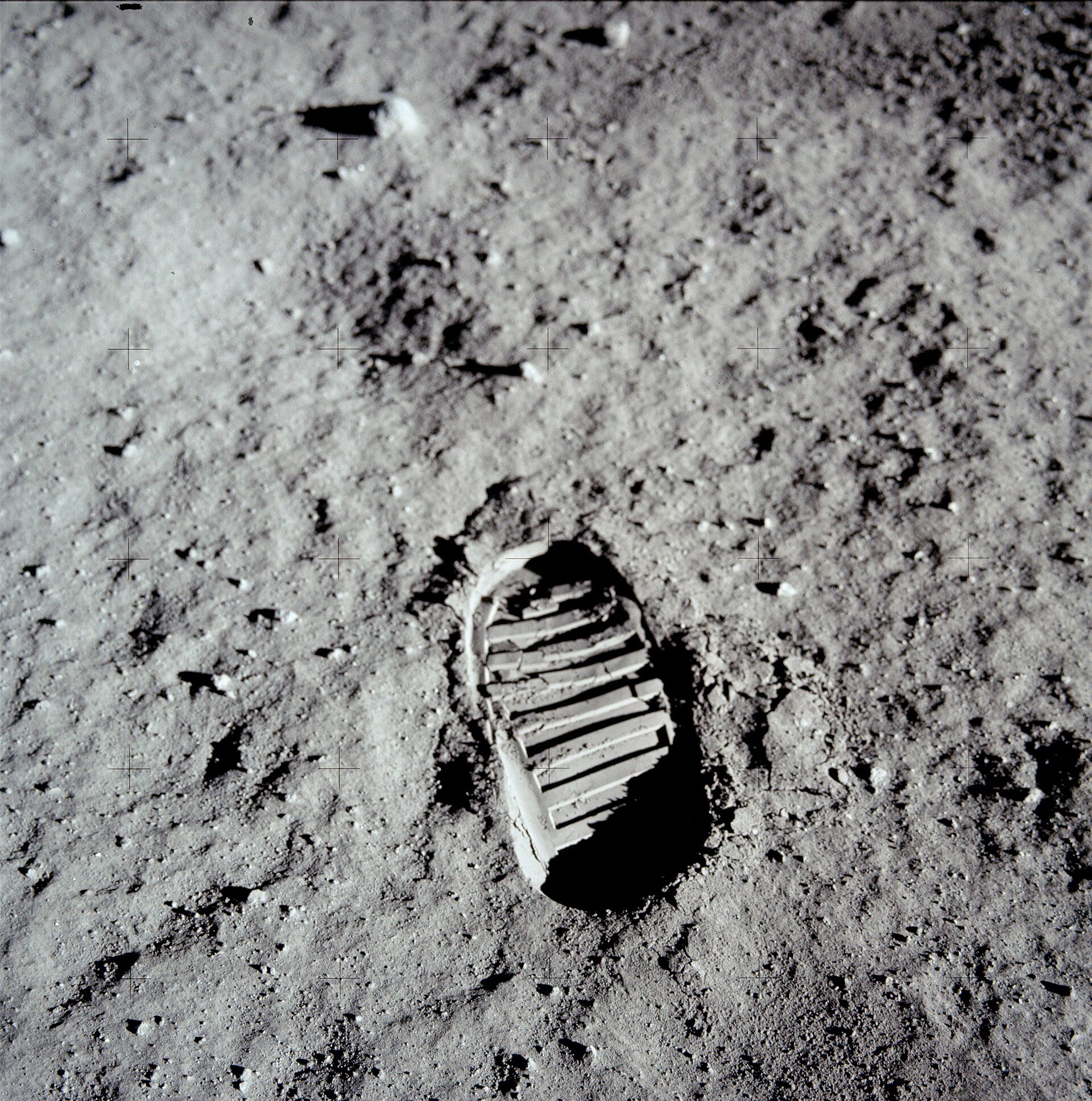
At the foot of the ladder, Armstrong reported that the footpads sank only about 1 or 2 inches into a surface that was very fine grained and looked almost like a powder up close.13 He was surprised that kicking the surface raised no cloud of dust: each particle simply followed its own ballistic arc.4 He was also surprised by the apparent closeness of the lunar horizon.4
In the United States, 93% of televisions were tuned in to see Armstrong walk on the Moon.2 An estimated 650 million people watched Armstrong's televised image and heard his voice during the landing.3 Armstrong and Aldrin spent 21 hours and 36 minutes on the Moon's surface.3 Aldrin re-entered the module after spending one hour 33 minutes on the surface, and Armstrong followed him 41 minutes later.3 The entire spacewalk lasted more than two and a half hours, ending at 111 hours 39 minutes into the mission.3
Work on the Moon: science, symbols and a phone call
During the spacewalk the two astronauts ranged up to 300 feet from Eagle, and Aldrin deployed the Early Apollo Scientific Experiments Package while both men gathered and described lunar samples.3 They left behind an American flag, a patch honoring the fallen Apollo 1 crew, and a plaque on one of Eagle's legs.5 Commemorative medallions bearing the names of the three Apollo 1 astronauts who lost their lives in a launch pad fire, and two cosmonauts who also died in accidents, were left on the surface.3 A one-and-a-half inch silicon disk containing micro-miniaturized goodwill messages from 73 countries, and the names of congressional and NASA leaders, stayed behind as well.3 Reading the plaque on Eagle's landing gear, Armstrong reported that it carried the signatures of the three crew members and of the President of the United States.13 The plaque stated that the crew came in peace for all mankind.5
| Experiment | Deployment or purpose | Fate |
|---|---|---|
| Solar Wind Composition | Rolled up by Armstrong at the end of the spacewalk.14 | The sample container reached the Lunar Receiving Laboratory on 26 July 1969.14 |
| Passive Seismic Experiment | Levelled by Aldrin on the uneven surface until a small ball was centred in its cup.15 | Returned useful data for three weeks, then fell silent on 24 August 1969, most likely from overheating in the lunar Sun.14 |
| Laser Ranging Retro-Reflector | Measures the distance between Earth telescopes and the Moon, tests general relativity and studies internal motions of the Earth and Moon.15 | Astronomers sent the first successful beam to it on 1 August 1969, and it remained available for use decades later.14 |
President Richard Nixon spoke to the astronauts by telephone from the Oval Room of the White House, and called it the most historic telephone call ever made.16 Armstrong replied that it was a great honor and privilege to represent not only the United States but men of peace of all nations.16
The return, splashdown and quarantine
After a rest period that included seven hours of sleep, the ascent stage engine fired at 124 hours 22 minutes.3 It shut down 435 seconds later with Eagle in an initial orbit of 11 by 55 miles, while Columbia was on its 25th revolution.3 Eagle docked with Columbia on the command module's 27th revolution, 128 hours and three minutes into the mission.3 Trans-Earth injection began on 21 July, when the service propulsion system fired for two and a half minutes while Columbia was behind the Moon.3 A single 11.2-second burn of the service propulsion system was the only midcourse correction needed on the return flight.3
After a flight of 195 hours 18 minutes 35 seconds, about 36 minutes longer than planned, Apollo 11 splashed down in the Pacific Ocean, 13 miles from the recovery ship USS Hornet.3 The splashdown point was 13 degrees 19 minutes north latitude and 169 degrees nine minutes west longitude.3 The splashdown was near Hawaii.2 Once aboard USS Hornet, the astronauts walked ten steps from the recovery helicopter to the Mobile Quarantine Facility, wearing Biological Isolation Garments.17 They completed their 21-day quarantine in the Lunar Receiving Laboratory at what is now NASA's Johnson Space Center in Houston.14 Scientists began examining the first Moon rocks two days after splashdown, while the astronauts were still inside their quarantine.17
What Apollo 11 brought back
Scientists in the Lunar Receiving Laboratory examined the 48 pounds of lunar material the Apollo 11 astronauts returned from the Sea of Tranquility.14 In total, the returned material weighed 22 kg: 11 kg of rock fragments more than 1 cm across and 11 kg of smaller particulate material.18
The first box of Moon rocks reached the Lunar Receiving Laboratory, and less than 48 hours after splashdown the first lunar rock was documented.17 The preliminary science report described the surface at the site as relatively soft to depths ranging from 5 to 20 cm.18 The soil could be scooped easily, offered low resistance to penetration and gave low lateral support for staffs, poles or core tubes.18 Because spoken observations are far easier to study from a written record than from the spoken description alone, the Lunar Geology Experiment team prepared a transcript of all communication between the lunar module and the Capcom, from descent through the end of the spacewalk.19
Aftermath: parades, Apollo 12 and the plaque
The crew's 21-day quarantine ended on 10 August 1969.14 New York's ticker-tape parade drew an estimated four million people, and Chicago's drew two million.14 The homecoming brought together 44 governors and 83 ambassadors.14 The parade day ended with a state dinner hosted by President Nixon in Los Angeles.14 Collins left an inscription inside Columbia calling it the best ship to come down the line.14
Apollo 12 was announced on 29 July 1969 for a launch in November.14 Collins judged that everything worked on Apollo 11 so extraordinarily well that there were no embarrassments to explain away afterwards.7 For the 50th anniversary of the mission, the National Archives highlighted its records about NASA and the space program.20 It presented events and exhibits in Washington, DC, and at Presidential Libraries.20
Legacy and details that get argued about
Timeline
Kennedy sets the national goal
President John F. Kennedy sets the goal that Apollo 11 will complete: to perform a crewed lunar landing and return to Earth. 1
Gagarin's flight opens the space race
The Soviet Union launches Yuri Gagarin, the first human in space; within days Kennedy asks Vice President Lyndon Johnson to find a space program in which the United States could win. 2
Liftoff from Cape Kennedy
At 9:32 a.m. EDT the Saturn V's engines fire; more than a million spectators watch Apollo 11 clear the tower, and about 12 minutes later the crew is in Earth orbit. 5
Into lunar orbit
About 75 hours 50 minutes after launch, a 357.5-second retrograde firing of the service propulsion system places Apollo 11 into an initial elliptical lunar orbit of 69 by 190 miles. 3
Descent and touchdown
Eagle separates from Columbia, powered descent begins at 102 hours 33 minutes, and the lunar module lands in the Sea of Tranquility at 4:17 p.m. EDT with only about 30 seconds of fuel remaining. 5
“The Eagle has landed”
Armstrong radios “Houston, Tranquility Base here. The Eagle has landed.” and Capcom Charlie Duke replies that Mission Control's tension has broken: “You got a bunch of guys about to turn blue. We're breathing again.” 4
First step on the Moon
At 10:56 p.m. EDT Armstrong climbs down the ladder and becomes the first human to walk on another world; Aldrin follows and calls the scene “magnificent desolation.” 5
Nixon calls Tranquility Base
President Richard Nixon speaks to the astronauts by telephone and calls it the most historic telephone call ever made; Armstrong replies that the crew represents “men of peace of all nations.” 16
Liftoff from the Moon
After 21 hours 36 minutes on the surface, the ascent stage engine fires at 124 hours 22 minutes and Eagle docks with Columbia on the command module's 27th revolution. 3
Homeward bound
Behind the Moon, the service propulsion system burns for two and a half minutes to send the crew homeward; only one 11.2-second midcourse correction will be needed on the return flight. 3
Splashdown and recovery
After 195 hours 18 minutes 35 seconds of flight — about 36 minutes longer than planned — Apollo 11 splashes down in the Pacific Ocean, 13 miles from the recovery ship USS Hornet. 3
First Moon rocks opened
The first box of Moon rocks reaches the Lunar Receiving Laboratory, and less than 48 hours after splashdown the first lunar rock is documented. 17
First laser beam to the Moon
Astronomers send the first successful laser beam to the retroreflector deployed by Armstrong and Aldrin — an experiment that remains available for use decades later. 14
Quarantine ends
The crew completes its 21-day quarantine and leaves the Lunar Receiving Laboratory; celebrations follow in New York, Chicago, Los Angeles and Houston. 14
Ticker-tape parades
An estimated four million people line New York's parade route, Chicago draws two million, and the day ends with a state dinner hosted by President Nixon in Los Angeles. 14
55 years on
NASA marks the 55th anniversary of Apollo 11, retelling the mission from launch through splashdown and the crew's three-week postflight quarantine. 17
Frequently asked questions
What was Apollo 11?
Apollo 11 was NASA's first crewed Moon landing, flown from 16 to 24 July 1969.1 It completed the national goal President John Kennedy set on 25 May 1961: a crewed lunar landing and a safe return to Earth.1
Who was on the Apollo 11 crew?
The crew was Neil Armstrong as commander, Michael Collins as command module pilot and Buzz Aldrin as lunar module pilot.1 Armstrong and Aldrin landed on the Moon while Collins remained in lunar orbit in Columbia.2
When did Apollo 11 land on the Moon?
The lunar module Eagle touched down on 20 July 1969 at 20:17 UTC.4 Armstrong stepped onto the surface later that day at 10:56 p.m., the first human to do so.5
What was the 1202 program alarm?
It was produced by data overflow in the lunar module's guidance computer during powered descent.4 Mission Control answered that the crew were Go.4
How long did the astronauts spend on the Moon?
Armstrong and Aldrin spent 21 hours and 36 minutes on the surface.3 The spacewalk itself lasted more than two and a half hours, ending at 111 hours 39 minutes into the mission.3
What did they leave behind on the Moon?
An American flag, a patch honoring the fallen Apollo 1 crew, and a plaque on one of Eagle's legs.5 Commemorative medallions and a silicon disk carrying goodwill messages from 73 countries stayed behind as well.3
Knowledge graph
Sources & citations
Every factual claim in this article is drawn from the sources below. Bracketed numbers in the text link to the corresponding source.
- 1
- 2
- 3
- 4
- 5
- 6
- 7
- 8
- 9
- 10
- 11
- 12
- 13
- 14
- 15
- 16
- 17
- 18
- 19
- 20