Aristotle
The life, works and legacy of the Greek philosopher who founded the Lyceum, created formal logic, and shaped Islamic and Christian thought for two millennia.
Aristotle (384–322 BCE) was a Greek philosopher and scientist, born at Stagira and educated in Plato's Academy, who tutored Alexander the Great and founded the Lyceum at Athens in 335 BCE. His surviving treatises — from the Organon and Metaphysics to the Nicomachean Ethics, Politics and Poetics — created formal logic, founded biology as a science, and set the framework of philosophy for the next two thousand years. Translated into Syriac, Arabic and Latin, his works became the intellectual spine of medieval Islamic philosophy and Christian scholasticism.
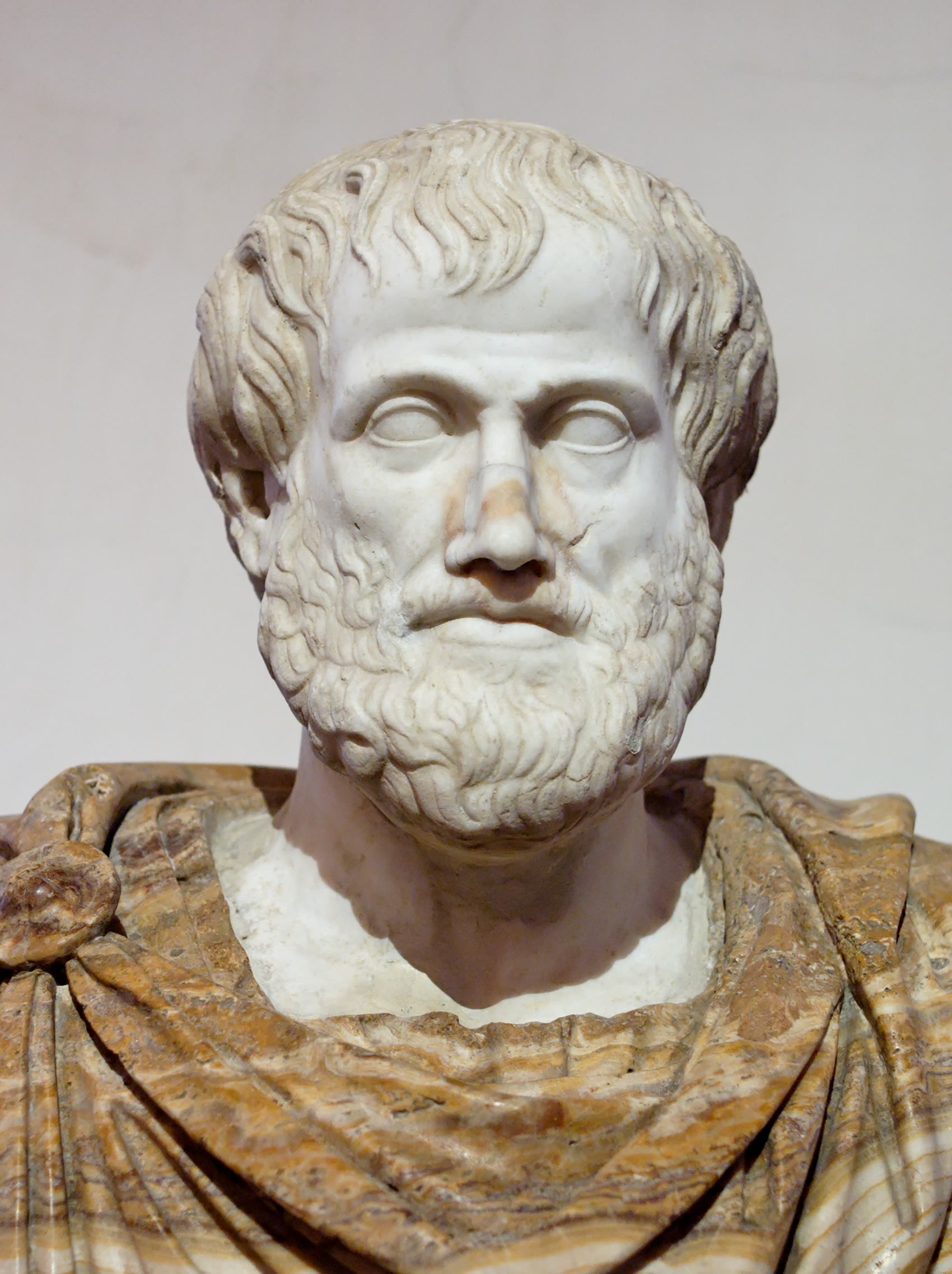
Overview
Aristotle was an ancient Greek philosopher and scientist, counted among the greatest intellectual figures of Classical antiquity and of Western history. In his own time he was known as the man who knew everything, and later simply as The Philosopher. He has been described as the first genuine scientist in history.
1. Life
Aristotle was born in 384 bce at Stagira in Chalcidice. His father, Nicomachus, was a court physician to King Amyntas of Macedonia, and his mother, Phaestis, came from Chalcis in Euboea. At about the age of seventeen he was sent to Athens to study in Plato's Academy, then a pre-eminent place of learning in the Greek world. He studied under Plato for twenty years, remaining associated with the Academy until Plato's death in 347 bce.
After leaving Athens he went to Assos, on the northwest coast of present-day Turkey, and after approximately three years there he moved to the nearby coastal island of Lesbos. In 343 bce, at the request of Philip, king of Macedon, he left Lesbos for Pella, the Macedonian capital, to tutor the king's thirteen-year-old son, the future Alexander the Great, whom he taught from age 13 to 16. After some five further years in Stagira or Macedon, he returned to Athens for the second and final time in 335 bce and set up his own school in a public exercise area dedicated to the god Apollo Lykeios, whence its name, the Lyceum.
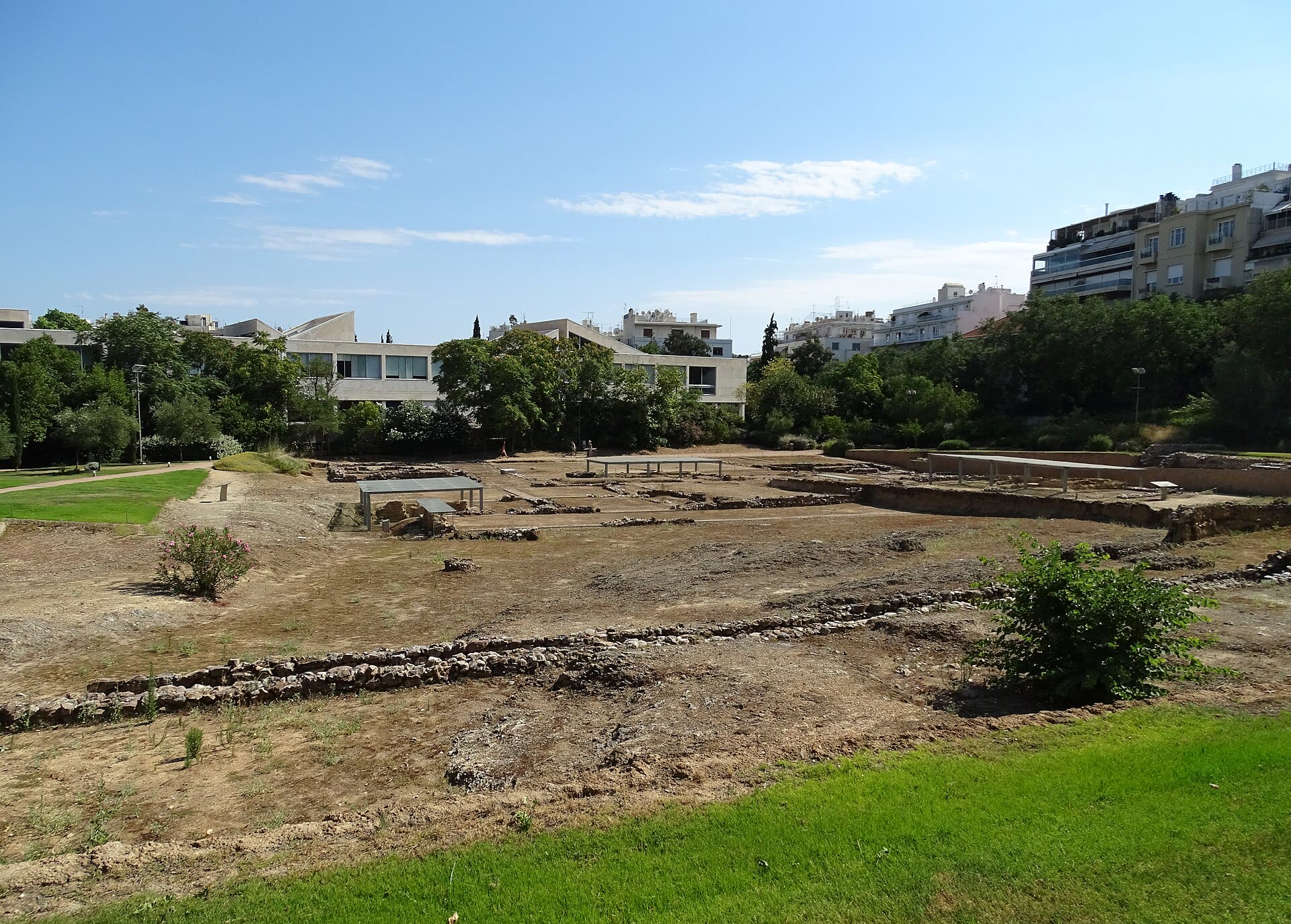
He left Athens fearing for his safety because of his connections to Macedon, remarking that he saw no reason to permit Athens to sin twice against philosophy, and withdrew directly to Chalcis on Euboea. He died there of natural causes in 322 bce, at age 63.
2. Works and Writings
Aristotle was a prolific writer, lecturer and polymath who wrote dialogues and as many as 200 treatises in his lifetime, of which only 31 survive. These surviving works take the form of lecture notes and draft manuscripts never intended for general readership. During this period he authored most of his surviving texts, which have the appearance of lecture transcripts edited to be read aloud in his absence.
His notable works include the Metaphysics, the Nicomachean Ethics, the Politics, the Poetics, the Physics, On the Soul, and the History of Animals.
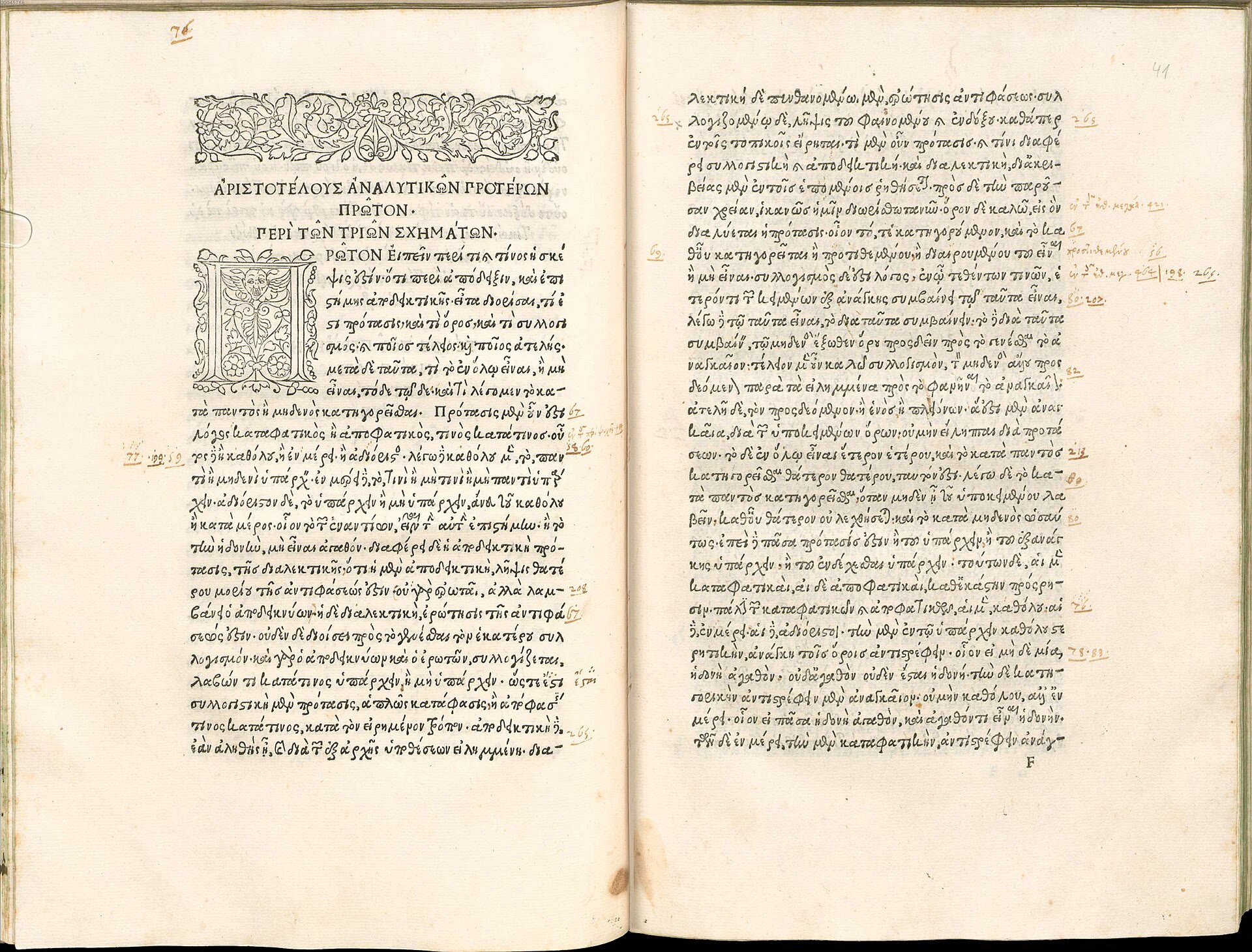
3. Logic
Aristotle invented the field of formal logic, and his name is attached to the syllogism among his notable ideas. He defines a deduction as speech in which, certain things having been supposed, something different from those supposed results of necessity; the things supposed are premises and the result is the conclusion. The ancient commentators grouped his logical treatises under the title Organon, comprising the Categories, On Interpretation, Prior Analytics, Posterior Analytics, Topics, and On Sophistical Refutations.
Within this system Aristotle distinguishes ten kinds of predication, or categories: what-it-is, quantity, quality, relative, where, when, being-in-a-position, having, doing, and undergoing. A demonstration (apodeixis) is a deduction that produces knowledge, and the Posterior Analytics contains his account of demonstrations and their role in knowledge. The premises of demonstrations must be true and primary and so prior to their conclusions; the premises of dialectical deductions, by contrast, need only be accepted (endoxos).
4. Metaphysics and Natural Philosophy
Metaphysics, or first philosophy, is the science that studies being qua being; unlike the departmental sciences it does not study beings in some specialized way but in so far as they are beings. Individual substances in the category of substance are called primary substances (prôtai ousiai), since without them nothing else would exist. Matter, form, and the compound of matter and form may all be considered subjects, but Aristotle asks which of them is substance.
Aristotle distinguishes four different kinds of cause, or four senses of the term, and notes that one and the same thing can be a cause in more than one sense: form, mover, and telos often coincide. The distinction between potentiality (dunamis) and actuality (entelecheia), or activity (energeia), is connected with the matter/form distinction and is the main topic of Metaphysics Book Θ. Among his notable ideas are counted the four causes and hylomorphism, together with formal logic and the syllogism, virtue as a mean, and the unmoved mover.
For Aristotle nature is an inner principle of change and of being at rest: when an entity moves or rests in accordance with its nature, reference to that nature serves as an explanation of the event. The elements move to their natural places, light bodies up and heavy bodies down; Aristotle explains this by an appeal to their respective natures as causes, it being simply their nature to move somewhere. The Physics argues for specific theses about motion, causation, place and time and establishes in book 8 the existence of the unmoved mover, a supra-physical entity without which the physical domain could not remain in existence. The same work defines motion as the actuality of the potential in so far as it is potential — a special kind of actuality of an entity's capacity for change, not an independent potentiality for motion.
5. Biology and Psychology
Aristotle's zoology divides animals into blooded and bloodless kinds, and the History of Animals treats the innards of blooded animals before turning to bloodless kinds such as crustaceans, testaceous mollusks, cephalopods and insects. Much of his scientific research concerned the classification of animals into genus and species, and more than 500 species figure in his treatises, many of them described in detail. His biological inquiries drew on empirical sources: he consulted bee-keepers, fishermen and sponge divers and performed, or had performed under his guidance, a great many dissections of a wide variety of animals, at least some recorded in diagrams. The History of Animals records detailed observations of the chick embryo: in the hen's egg the first signs appear after three days and nights, sooner in smaller birds and later in larger ones.
In animal generation the male makes no material contribution to the offspring — the semen is a mere vehicle — while the female contributes not seed but what may be called 'prepared matter'. In Aristotle's biology teleological connections form a hierarchy: one activity serves another more basic one, and subordinate parts serve more important ones, as inhaling serves respiration and the windpipe serves the lung.
Because Aristotle regards the soul as a general principle of life, his psychology studies all living beings, not merely humans; De Anima accordingly gives an account of the life activities of plants and animals alongside those of humans. In De Anima the soul is characterized as a first actuality of a natural organic body and as substance in the sense of the form of a natural body that has life in potentiality. Aristotle ranks the faculties of soul in a hierarchy: whatever has reason has perception, whatever perceives can take on nutrition and reproduce, but not conversely; plants have only the nutritive soul, animals add perception, and humans possess all three. Beyond the central faculties, Aristotle discusses imagination and desire, appealing to them in his account of thinking and in his philosophy of action; imagination is regarded as a subordinate faculty integrated with nutrition, perception and thought.
6. Ethics and Politics
Aristotle takes eudaimonia (happiness) to be the highest good, and holds that the highest good has three characteristics: it is desirable for itself, it is not desirable for the sake of some other good, and all other goods are desirable for its sake. Happiness is chosen always for its own sake and never with a view to anything further, whereas honour, pleasure, intellect, and every excellence are chosen both for their own sakes and for the sake of happiness. His function argument asks what the ergon (function, task, work) of a human being is, and argues that it consists in activity of the rational part of the soul in accordance with virtue.
Every ethical virtue is a condition intermediate between two other states — one involving excess and the other deficiency — a doctrine popularly known as the golden mean. Virtue is a state that exercises deliberate choice, occupying the relative mean and determined by reason as a person of practical wisdom would determine. Aristotle distinguishes two kinds of akrasia — impetuosity (propeteia) and weakness (astheneia): the weak person deliberates and makes a reasoned choice, but acts under the influence of a passion instead. He examines the two remaining alternatives for the best life — politics and philosophy — and presents arguments showing that the philosophical life, devoted to theoria (contemplation, study), is best.
In Politics I.2 Aristotle defends the thesis that human beings are by nature political animals, who naturally want to live together. He combines the distinction between correct and deviant constitutions with the observation that government may consist of one person, a few, or a multitude, yielding six possible constitutional forms. Aristotle defines the citizen as a person who has the right (exousia) to participate in deliberative or judicial office. He thinks that the rule of a master over natural slaves is justified, since such slaves (he asserts without evidence) lack a deliberative faculty and need a natural master to direct them.
7. Rhetoric and Poetics
Aristotle treats rhetoric as a counterpart (antistrophos) to dialectic, and he also describes it as an outgrowth or offshoot of dialectic and the study of character. Within this art he distinguishes three ways in which speech produces persuasion: through the character (ethos) of the speaker, the emotional state (pathos) of the listener, or the argument (logos) itself. The argumentative instrument proper to public speech is the enthymeme, which for Aristotle has the function of a proof or demonstration and is said to be a sullogismos, since a demonstration is a kind of sullogismos. He further divides public speech into three genres: judicial (forensic), dealing with past events and the just or unjust; deliberative (political), about future events and advantage or harm; and epideictic, which praises or blames with regard to the present.
In the Poetics, Aristotle holds that epic poetry, tragedy, comedy, dithyrambic poetry, and the music of the flute and lyre are all in their general conception modes of imitation, differing from one another in medium, objects, and manner. Mimesis, on his account, has both a static or pictorial aspect, in which the receiver of a mimetic work recognizes a resemblance, and a dynamic or theatrical aspect. He defines tragedy as an imitation of a serious, complete action of a certain magnitude, presented in the form of action rather than narrative, which through pity and fear effects the proper purgation of these emotions. The plot counts as the most important means of tragedy and receives the most expansive treatment, while other elements such as character depiction and expression come next. Writing poetry, he argues, is more philosophical and more worthy than writing history, because poetry tends towards a general picture (katholou), whereas history tells of particular case studies.
8. Legacy and Influence
Aristotle's philosophical and scientific system became the framework and vehicle for both Christian Scholasticism and medieval Islamic philosophy. His thought eventually became the intellectual framework of Western Scholasticism, the system of philosophical assumptions and problems characteristic of philosophy in western Europe during the Middle Ages. In the 13th century Thomas Aquinas undertook to reconcile Aristotelian philosophy and science with Christian dogma, and through him the theology and intellectual worldview of the Roman Catholic Church became Aristotelian. In the Middle Ages Aristotle's works were translated into Arabic, which led to generations of Islamic Aristotelians such as Ibn Bajjah and Ibn Rushd.
Theophrastus, the first in the succession of heads of Aristotle's school, and his immediate successor Strato developed Aristotle's physical doctrines, and in the first century BCE Andronicus of Rhodes edited Aristotle's works. In late antiquity the chief commentators on Aristotle were John Philoponus and Simplicius, and in 529 CE the Athenian school was closed by order of the emperor Justinian, after which the exiled philosophers found temporary refuge in Persia.
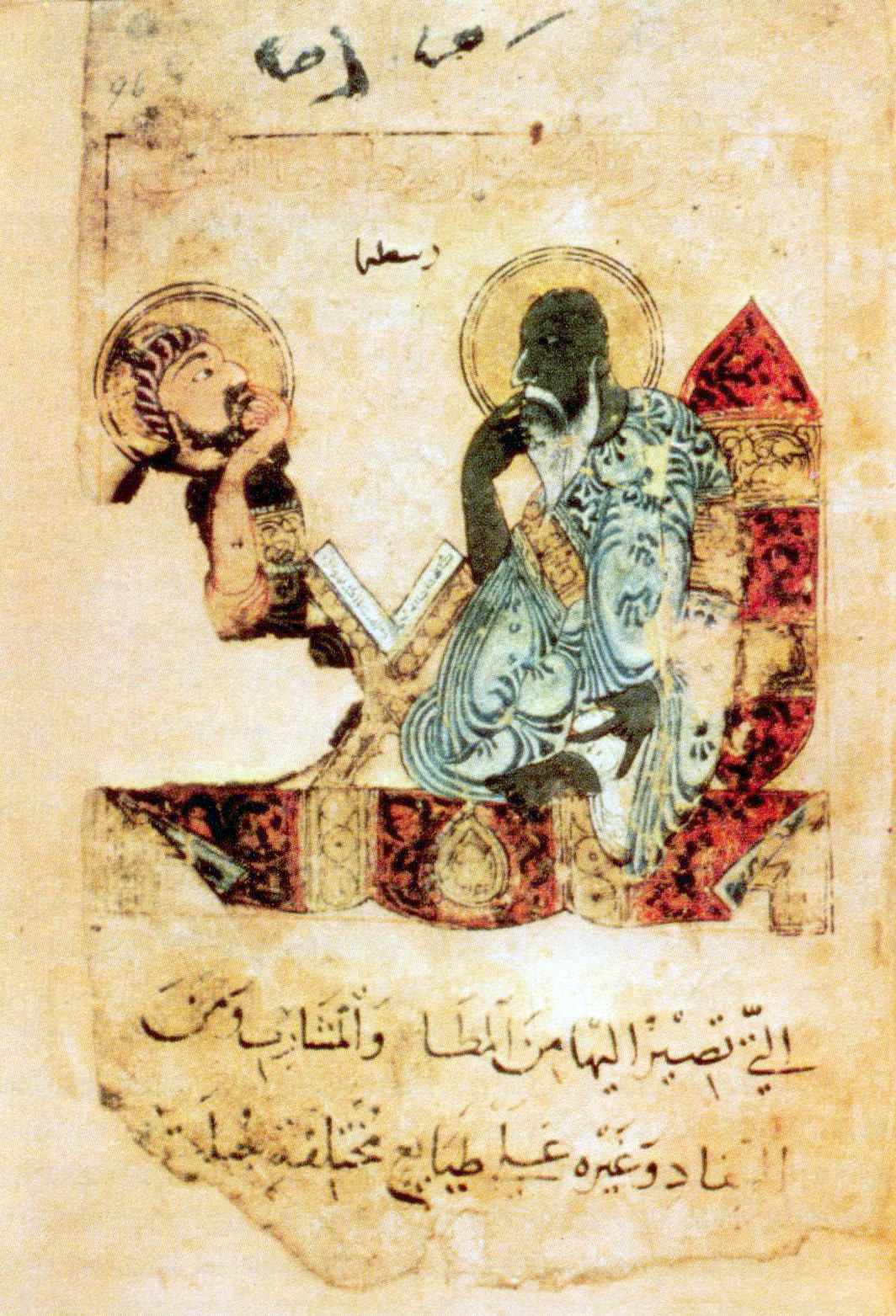
About the middle of the ninth century the Arabians, under the reign of the Abbasids, experienced a literary revival and obtained their knowledge of Aristotle's writings from the school of Baghdad. In the twelfth century the Arabian tradition and the Byzantine tradition met in Paris, and Aristotle's metaphysical, physical and ethical works were translated partly from the Arabian and partly from the Greek text. In the twelfth and thirteenth centuries the rest of Aristotle's works untranslated by Boethius, namely the non-logical writings and the Posterior Analytics, was put into Latin, sometimes first via Arabic. In 1255 the statutes of the Parisian arts faculty declared all known works of Aristotle mandatory reading for the students, which helped make Averroes' commentaries the principal secondary literature of Latin university culture.
9. Timeline: from 384 BCE to 1277
- 384 BCEBirth at StagiraAristotle was born at Stagira, a Greek city in Chalcidice in the Macedonian region of northeastern Greece.
- c. 367 BCEAristotle joins Plato's AcademyAt about the age of seventeen Aristotle was sent to Athens and entered Plato's Academy, where he remained until Plato's death.
- 348/347 BCEPlato dies; Aristotle leaves AthensAfter Plato's death Aristotle left Athens for Atarneus and Assos in Asia Minor, later moving to the island of Lesbos, where he married Pythias.
- 343/342 BCETutor to AlexanderPhilip, king of Macedon, summoned Aristotle to Pella to tutor his teenage son Alexander, the future Alexander the Great.
- 335 BCEThe Lyceum is foundedAristotle returned to Athens and set up his own school, the Lyceum, a rival to Plato's Academy.
- 323 BCEAlexander dies; Aristotle withdrawsAmid resurgent anti-Macedonian feeling after Alexander's death in Babylon, Aristotle left Athens and withdrew to Chalcis on Euboea.
- 323 BCETheophrastus heads the schoolWhen Aristotle was forced to retire, his pupil Theophrastus became the head of the Lyceum.
- 322 BCEDeath at ChalcisAristotle died at age 63 in Chalcis, on the island of Euboea.
- 1st century BCEAndronicus of Rhodes edits the corpusAndronicus of Rhodes edited Aristotle's works; his edition remained in use in the Peripatetic school during the first centuries of the common era.
- 529 CEThe Athenian school is closedThe Athenian school was closed by order of the emperor Justinian; exiled philosophers found refuge in Persia, where the works of Aristotle were translated and explained.
- c. 850 CEAristotle reaches the Arab worldUnder the Abbasids the Arabians, experiencing a literary revival, obtained their knowledge of Aristotle's writings from the school of Baghdad.
- 12th centuryArabian and Byzantine traditions meet in ParisThe two currents of Aristotelian learning met in Paris, where Aristotle's metaphysical, physical and ethical works were translated partly from Arabic and partly from Greek.
- c. 1230Averroes becomes 'the Commentator'Latin translations of Ibn Rushd's commentaries on Aristotle began around 1220 with Michael Scot; by the 1230s he was known in Christian Europe as 'the Commentator'.
- 1255Paris makes Aristotle compulsory readingThe statutes of the Parisian arts faculty declared all known works of Aristotle mandatory reading for students, making Averroes' commentaries the principal secondary literature of the Latin universities.
- 1277Condemnation at ParisThe Bishop of Paris directed a condemnation against thinkers in the university, among the targets being Siger and Boethius of Dacia.
References (22)
- 1Aristotle — Encyclopaedia Britannica WebView source
- 2Aristotle — The Catholic Encyclopedia (New Advent) WebView source
- 3Aristotle (384 BC - 322 BC) — MacTutor History of Mathematics Archive, University of St Andrews WebView source
- 4Aristotle — Stanford Encyclopedia of Philosophy WebView source
- 5Aristotle — Internet Encyclopedia of Philosophy WebView source
- 6Alexander the Great — Encyclopaedia Britannica WebView source
- 7Aristotle's Logic — Stanford Encyclopedia of Philosophy WebView source
- 8Aristotle's Metaphysics — Stanford Encyclopedia of Philosophy WebView source
- 9Aristotle's Natural Philosophy — Stanford Encyclopedia of Philosophy WebView source
- 10Aristotle's Biology — Stanford Encyclopedia of Philosophy WebView source
- 11Aristotle's Psychology — Stanford Encyclopedia of Philosophy WebView source
- 12Aristotle's Ethics — Stanford Encyclopedia of Philosophy WebView source
- 13The Nicomachean Ethics of Aristotle — Project Gutenberg WebView source
- 14Aristotle's Political Theory — Stanford Encyclopedia of Philosophy WebView source
- 15Aristotle's Rhetoric — Stanford Encyclopedia of Philosophy WebView source
- 16The Poetics of Aristotle (trans. S. H. Butcher) — Project Gutenberg 1974 WebView source
- 17Aristotle's Aesthetics — Stanford Encyclopedia of Philosophy WebView source
- 18Medieval Philosophy — Stanford Encyclopedia of Philosophy WebView source
- 19Influence of Arabic and Islamic Philosophy on the Latin West — Stanford Encyclopedia of Philosophy WebView source
- 20Theophrastus — Encyclopaedia Britannica WebView source
- 21Aristotle — World History Encyclopedia WebView source
- 22Ibn Rushd [Averroes] — Stanford Encyclopedia of Philosophy WebView source
 Tutankhamun and His Tomb
 Spain
 Babylon
