Halley's Comet
The most famous comet — its roughly 76-year orbit, the 1705 prediction that proved comets return, the 1066 Bayeux Tapestry record, the panics of 1910, the 1986 spacecraft armada and the next return in 2061.
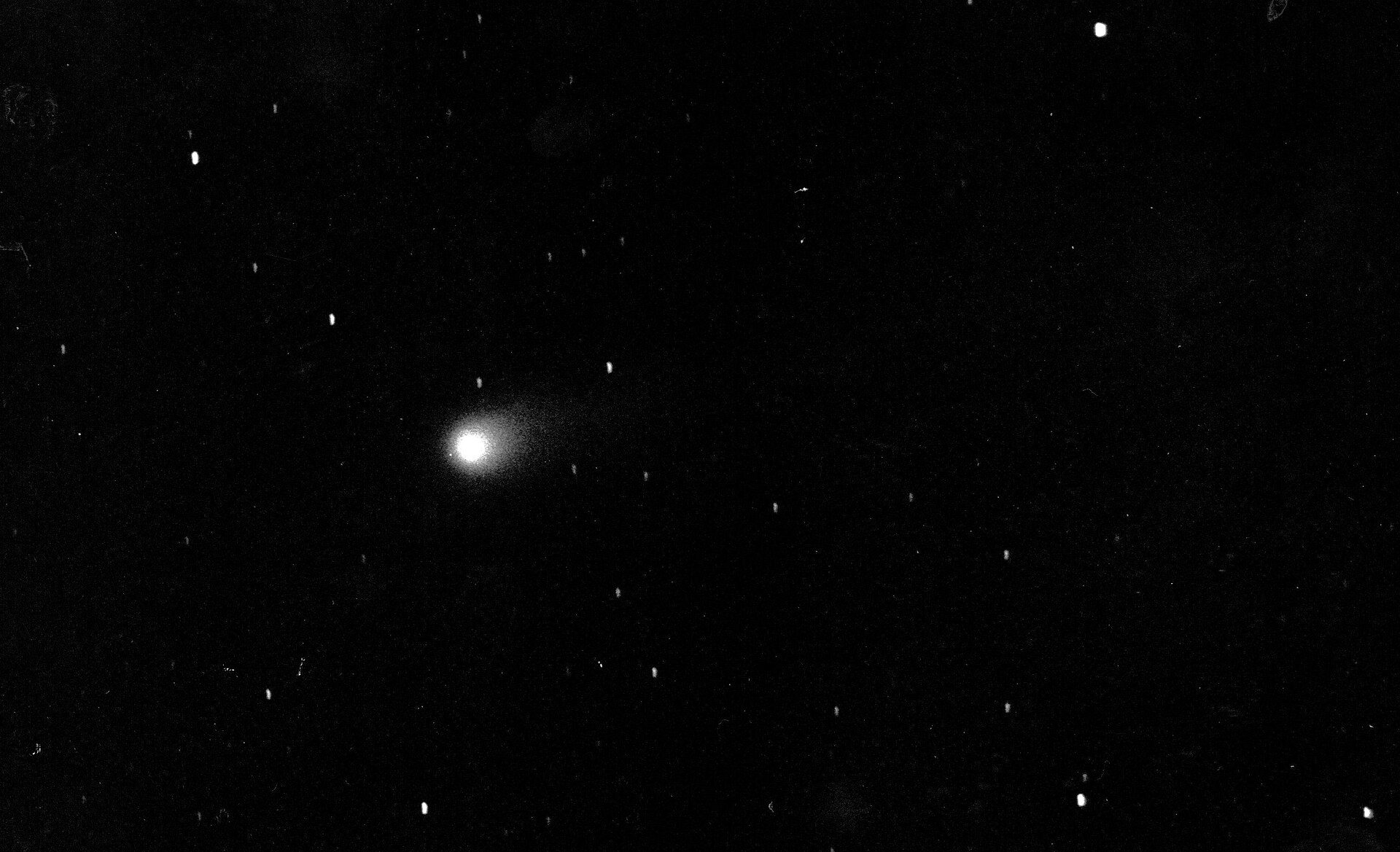
Halley's Comet, officially 1P/Halley, is a periodic comet that returns to the inner solar system about every 76 years. Edmond Halley's 1705 calculation linked apparitions seen in 1531, 1607 and 1682 to a single object and predicted its return in 1758 — the first successful prediction of a comet's return. Its visits are recorded for more than two millennia, from Chinese chronicles and the Bayeux Tapestry to the 1910 passage, when Earth crossed the comet's tail amid a worldwide panic that science itself had helped to stoke. In 1986 an international fleet of spacecraft, led by ESA's Giotto, flew past its dark 15-kilometre nucleus, and the comet will next return in 2061.
In this article
- 1Overview
- 2Orbit and Motion
- 3Apparitions and Approaches to Earth
- 4The Nucleus
- 5Historical Observations
- 6Edmond Halley and the Prediction
- 7The 1066 Apparition and the Bayeux Tapestry
- 8The 1910 Apparition
- 9The 1986 Apparition and the Spacecraft Fleet
- 10Meteor Showers
- 11Timeline: from ancient records to the 2061 return
- 12Knowledge graph
Overview
Halley's Comet is often called the most famous comet because it was the first comet whose periodic return was understood by astronomers. It is officially designated 1P/Halley, where P denotes a periodic comet, and it takes its name from Edmond Halley, the English astronomer who predicted its return.
1. Orbit and Motion
Halley's Comet travels backward around the Sun, opposite to the direction of Earth's own motion, in a plane tilted 18 degrees to Earth's orbit. Its greatest distance from the Sun, the aphelion, is about 35.25 AU, placing it well beyond the orbit of Neptune.
Perihelion during the 1986 apparition fell on February 9, 1986, at 0.5871 AU (87.8 million km).
The comet's orbital period averages about 76 Earth years, corresponding to an orbital circumference of about 7.6 billion miles (12.2 billion kilometers), though the period varies between appearances because of the gravitational effects of the planets.
Halley is a young, highly active comet, and with 30 recorded appearances its nature and orbit are perhaps the best understood of any comet.
Measured from one perihelion passage to the next, Halley's period has ranged from as short as 74.42 years between 1835 and 1910 to as long as 79.25 years between 451 and 530 CE.
Halley's Comet will next appear in the night sky in 2061, having previously been seen in 1758, 1835, 1910, and 1986, when it was last observed from Earth.
2. Apparitions and Approaches to Earth
The comet's closest recorded approach to Earth occurred on April 10, 837, when it passed at 0.033 AU (4.94 million km) 11P/Halley · NASA Science ↗. On that occasion it shone at about magnitude -3.5, nearly as bright as Venus at its greatest brilliance 1.
| Apparition/date | Event type | Distance from Earth or Sun | Notes |
|---|---|---|---|
| April 10, 837 | Closest recorded approach to Earth | 0.033 AU (4.94 million km) | Shone at about magnitude -3.5, nearly as bright as Venus at its greatest brilliance |
| 1948 | Aphelion | 35.25 AU | Well beyond the orbit of Neptune |
3. The Nucleus
Halley's nucleus measures roughly 9.3 by 5 miles (15 by 8 kilometers) and takes the form of a dark peanut-shaped body. It ranks among the darkest objects in the solar system, with an albedo of 0.03 that reflects only 3 percent of the light falling on it. The nucleus turns on its axis once in about 2.2 Earth days.
Its density was determined to be fairly low, at less than 0.6 grams per cubic centimeter.
A comet the size of Halley loses an estimated 1 to 3 meters (3 to 10 feet) of surface material with each orbit. An average periodic comet is calculated to survive about 1,000 trips around the Sun.
Only about 10 percent of the nucleus was active during the 1986 flybys.
4. Historical Observations
Possible records of Halley's Comet from its 467 BCE apparition may be found in Greece and China, but the first positive observations date to 240 BCE in the Chinese chronicle known as the Shiji, or Records of the Grand Historian. Over the following centuries observations of the comet appear in records from Babylonia, China, Japan, India, the Middle East, Europe and possibly even petroglyphs in North America. A sighting of the comet in the years 684 to 693 is recorded much later, in an important incunable — the Nuremberg Chronicle, an illustrated encyclopaedia first published in 1493 and part of the earliest period of printing in Europe.
The spacecraft Giotto was named after the Italian painter Giotto di Bondone, who observed the comet in 1301.
-
467 BCEPossible early recordsPossible records of Halley's Comet from its 467 BCE apparition may be found in Greece and China 2955 Years Ago: Halley's Comet and the Battle of Hastings · NASA History ↗. Some have speculated that a comet observed in Greece between 467 and 466 BCE was Halley 8Halley's Comet | Astronomy, Facts & History · Encyclopaedia Britannica ↗.
-
240 BCEFirst positive observations
-
684 to 693Recorded in the Nuremberg ChronicleA sighting of the comet in the years 684 to 693 is recorded much later, in an important incunable — the Nuremberg Chronicle, an illustrated encyclopaedia first published in 1493 and part of the earliest period of printing in Europe 6Halley's Comet: Collisions with history · Science Museum Group, London ↗.
-
1301Observed by Giotto di BondoneGiotto was named after the Italian painter Giotto di Bondone, who observed Halley's Comet in 1301 and depicted as the star of Bethlehem in his Adoration of the Magi in the Scrovegni Chapel 7Giotto overview · European Space Agency ↗.
5. Edmond Halley and the Prediction
Edmond Halley was an English astronomer, born on November 8 of 1656, who died on January 14 of 1742 at Greenwich, and who was a supporter of Newton. As a young man he catalogued 341 southern hemisphere stars from St Helena. There, on November 7 of 1677, he made the first complete observation of a transit of Mercury, and he later proposed using such transits to determine the distance of the Sun.
From around 1695 Halley studied cometary orbits; where Newton favoured parabolic orbits, Halley believed that elliptical orbits might exist. Until his time comets were believed to make only one pass through the solar system. In 1705 he used Isaac Newton's theories of gravitation and planetary motions to compute the orbits of several comets.
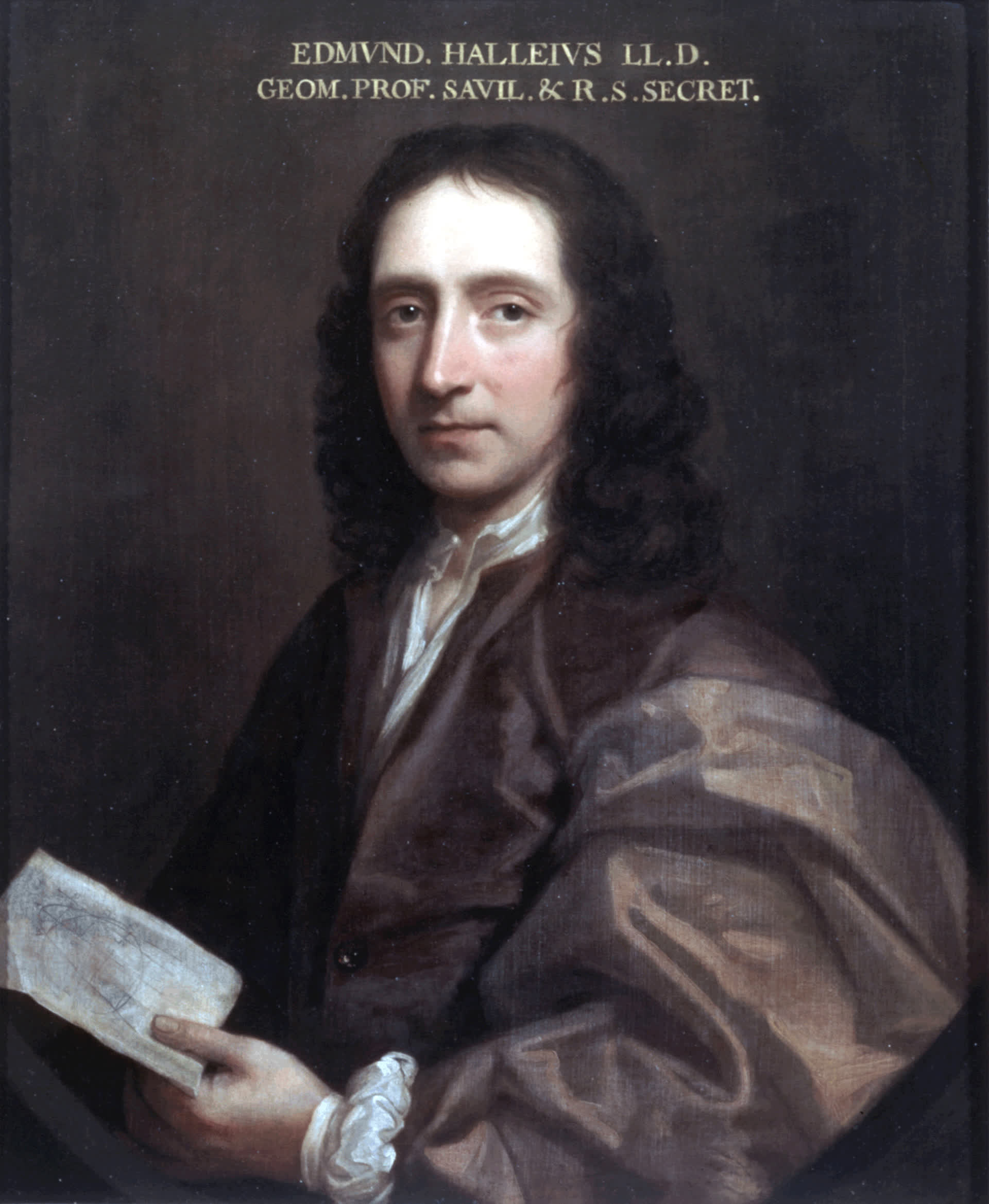
Halley did not live to see his prediction come true, for he died in 1742. He had been dead for fifteen years when his comet was sighted on December 25 of 1758 — slightly later than he had expected — and the success made his name lasting. The comet was sighted late in 1758, passed perihelion in March of 1759, and was named in his honour.
He published in 1705 a prediction that it would return in 76 years and appear in December 1758, a difficult calculation because it had to account for perturbations produced by Jupiter.
In 1705 he published the first catalog of the orbits of 24 comets, drawing on Newton's theories of gravitation, planetary motions and calculus to identify the comets of 1531, 1607 and 1682 as one and the same object.
6. The 1066 Apparition and the Bayeux Tapestry
The apparition fell in the year of the Battle of Hastings, a bad omen for King Harold II in one reading and, for William the Conqueror, a sign from heaven of his upcoming victory.
It is an embroidery of wool yarn on woven linen made in the eleventh century, 70 metres long and 50 centimetres high, recounting the conquest of England in 1066 led by William the Conqueror. A comet appears in it between the death of King Edward the Confessor and the election of Harold Godwinson; the inscription calls it only a 'star,' but its hairy tail shows it is Halley's Comet. Scenes 32 and 33 show Harold II and his people cowering in fear as the comet passes.
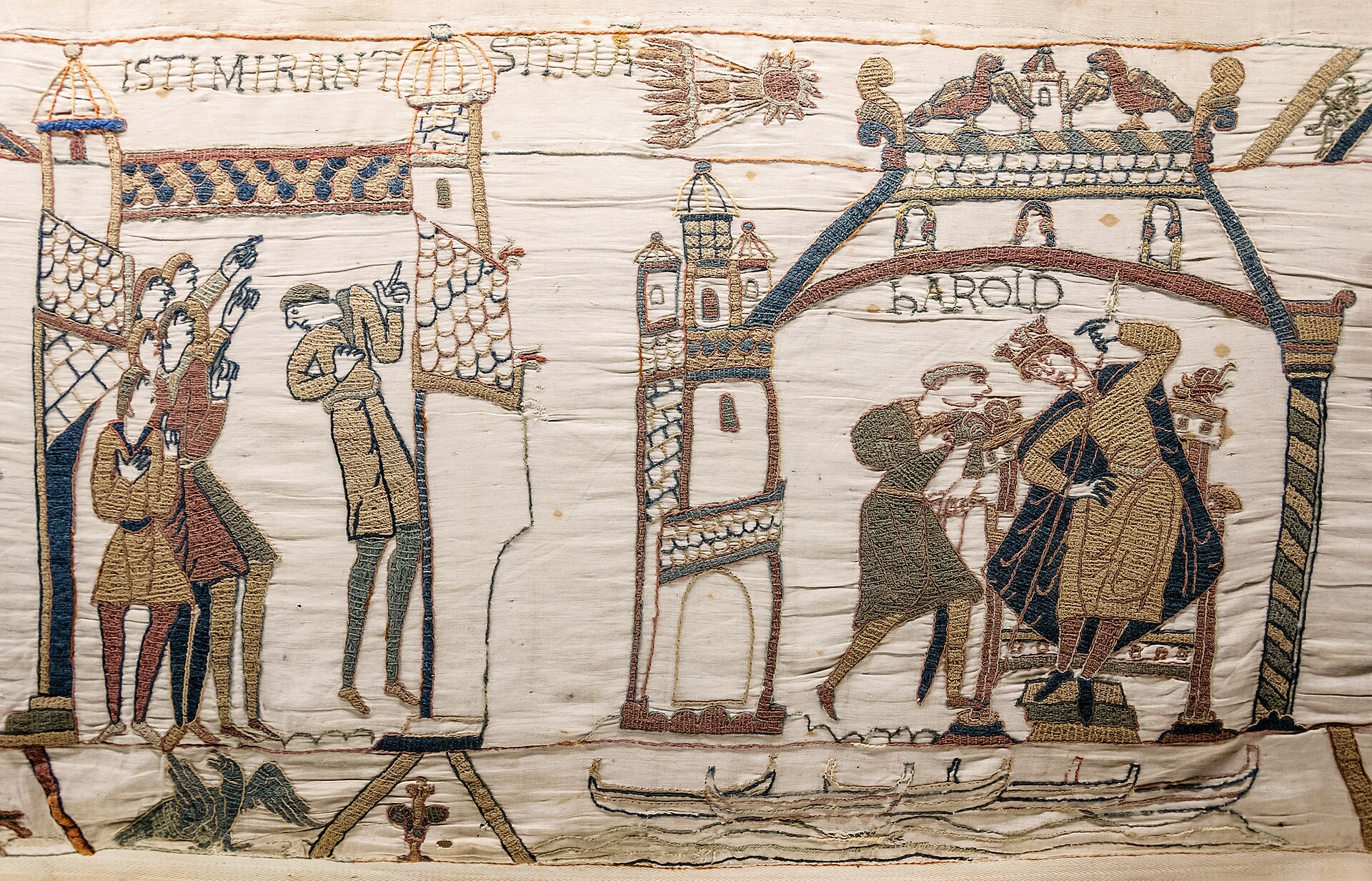
William's army landed in England in late September and on October 14 in 1066 defeated Harold's army at the Battle of Hastings, killing the Anglo-Saxon king; William was crowned that December. The tapestry was most probably commissioned by Bishop Odon, William's half-brother, to decorate Bayeux Cathedral during its consecration on July 14 of 1077, and it recounts the conquest of England by William, Duke of Normandy, who defeated the English at Hastings. Its illustration unmistakably shows Halley's Comet, but its creators connected it to the sequence of Edward's death and Harold's coronation likely for political reasons and with hindsight, and it remains unknown when the tapestry was made, where, by whom or for what reason.
During its 1066 appearance the comet approached within about nine million miles (15 million kilometers) of Earth on April 23, after its closest approach to the Sun on March 23 of that year.
7. The 1910 Apparition
The apparition of 1910 produced the first photographs of Halley's Comet, and it also carried Earth through the comet's tail, a circumstance that gave rise to widespread popular unease. Barnard observed that people in the United States and around the world were full of anxiety before the sighting, stuffing their keyholes to prevent comet gases from entering their homes or taking anti-comet pills.
In a historical quirk, the American writer Mark Twain, who was born two weeks after the perihelion of 1835, died the day after the perihelion of 1910.
8. The 1986 Apparition and the Spacecraft Fleet
Giotto flew as part of an international armada — two Soviet, two Japanese and one NASA spacecraft — and went last, helped in its final targeting by information from the Soviet Vega probes. NASA's ISEE-3 spacecraft was renamed the International Cometary Explorer, or ICE, after a series of complex Moon flybys redirected it and it became the first spacecraft to fly past a comet.
Vega 1 returned the first images of the comet on March 4 in 1986 and passed within 5,525 miles of its nucleus two days later, while Vega 2 made its closest approach on March 9 at a distance of 4,990 miles. ICE also contributed to the Halley campaign by measuring the solar wind about 25 million miles (40.2 million kilometers) sunward of the comet on March 28 of 1986 while the fleet closed in on Halley.
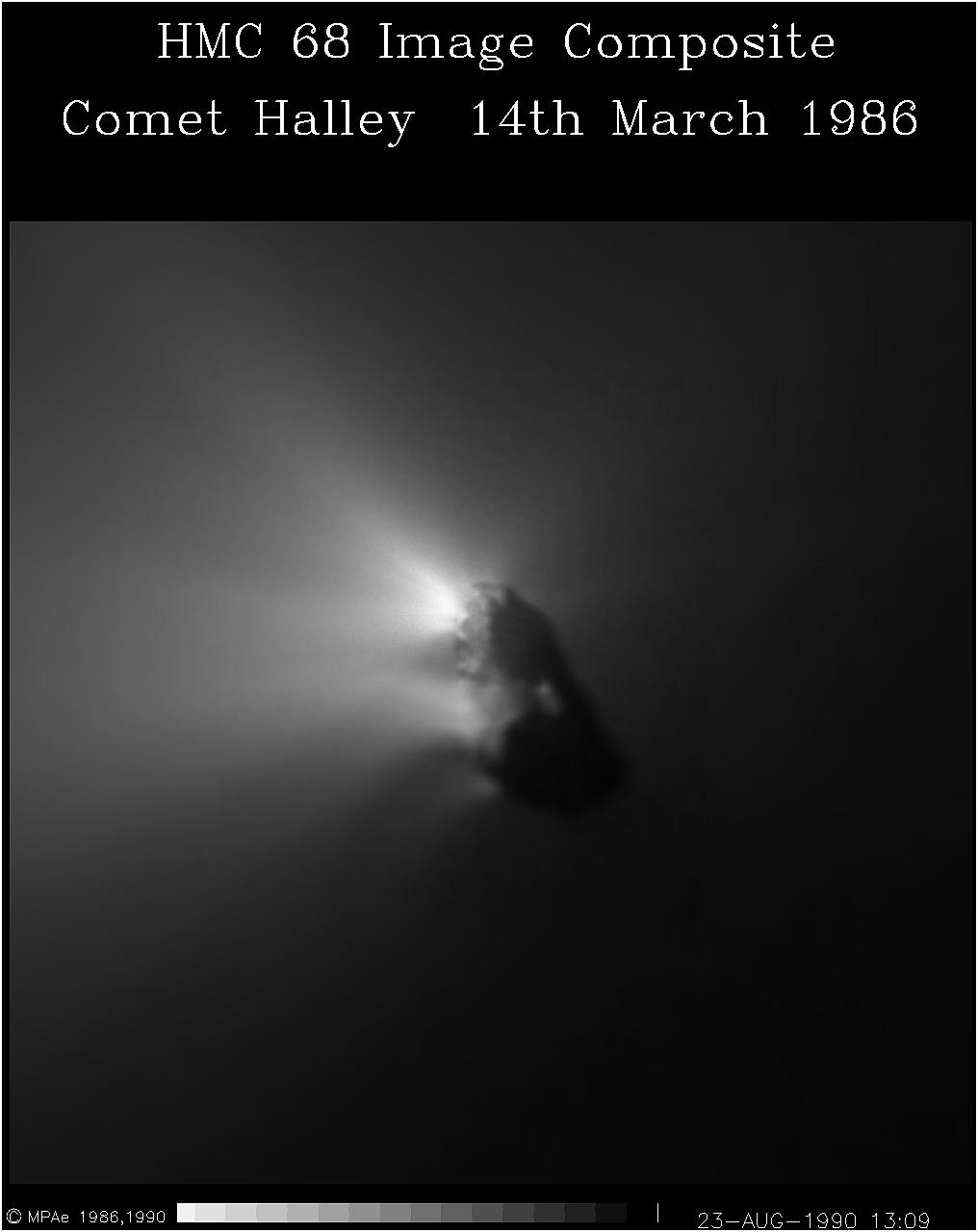
Giotto encountered Halley on March 14 in 1986 while travelling at 68 kilometers per second relative to the nucleus, and the first of about 12,000 dust impacts was recorded 122 minutes before closest approach. In total 2112 images of Halley's nucleus were returned by Giotto, the last from a distance of 1372 kilometers about 18 seconds before closest approach.
Giotto passed only 596 kilometers (370 miles) from Halley's nucleus before dust disabled its camera.
9. Meteor Showers
Each time Halley returns to the inner solar system, its nucleus sprays ice and rock into space, and this debris stream produces two weak meteor showers every year: the Eta Aquarids in May and the Orionids in October. The dust grains shed by the nucleus eventually become the Eta Aquariids in May and the Orionids in October when they collide with Earth's atmosphere.
The Orionids originate from 1P/Halley and radiate from just north of the bright star Betelgeuse in Orion, yielding roughly 10 to 20 meteors per hour under dark skies. Orionid meteors are known for their brightness and for their speed, travelling at about 41 miles (66 kilometers) per second into Earth's atmosphere. The shower peaks each year in mid-October.

Eta Aquariid meteors are known for their speed, entering the atmosphere at about 40.7 miles (65.4 kilometers) per second, and the shower peaks during early May each year. During the peak of the Eta Aquariids about 50 meteors can be seen per hour, and the Southern Hemisphere is preferable for viewing the shower.
10. Timeline: from ancient records to the 2061 return
- 240 BCEEarliest positive observationThe first positive observations of the comet date to 240 BCE in the Chinese chronicle known as the Shiji, or Records of the Grand Historian; possible records from its 467 BCE apparition exist in Greece and China.
- 451 CEOmen of Attila's defeatPeople of the age often linked an appearance of the comet with dramatic political events, such as the defeat of Attila the Hun in 451 CE.
- April 10, 837Closest approach to EarthHalley's closest recorded approach to Earth occurred on April 10 in 837, at a distance of 0.033 AU (4.94 million kilometers); it shone at about magnitude -3.5, nearly as bright as Venus at its best.
- April 1066Halley's Comet over EnglandThe comet had its closest approach to the Sun on March 23 in 1066 and came within 15 million kilometers of Earth on April 23; it appears in the Bayeux Tapestry, embroidered before the Battle of Hastings.
- 1301The painter Giotto's sightingThe Florentine painter Giotto di Bondone observed the comet in 1301 and is thought to have depicted it as the star of Bethlehem in his Adoration of the Magi in the Scrovegni Chapel.
- 1531-1682Three visits become one cometBright comets reported in 1531 and 1607 and 1682 had very similar orbits, which Edmond Halley later showed to belong to a single comet making return trips.
- 1705Halley's predictionEdmond Halley published the first catalog of comet orbits in 1705 and predicted that the comet seen in 1682 would return about 76 years later, in 1758.
- December 25, 1758The predicted returnThe comet was observed on December 25 in 1758, confirming Halley's prediction after his death; it passed perihelion in March 1759.
- 1835Return of 1835The comet returned as expected in 1835; the American writer Mark Twain was born two weeks after that perihelion and died the day after the 1910 perihelion.
- May 1910The great 1910 passageEarth passed through the comet's tail on May 19 in a passage that had caused worldwide alarm; the world did not end, but charlatans had sold comet pills and churches had held all-night prayer vigils.
- July 2, 1985Giotto launchedThe European Space Agency launched its Giotto spacecraft on July 2 in 1985 on an Ariane 1 rocket from Kourou, French Guiana, bound for an encounter with Halley's nucleus.
- March 13-14, 1986The Halley Armada arrivesGiotto passed within 596 kilometers of the nucleus on March 14 in 1986, after the Soviet Vega probes and the Japanese Suisei and Sakigake had flown past; its camera captured the first close-up images of a comet nucleus before dust disabled it.
- 2061Next returnHalley's comet will next appear in the night sky in the year 2061.
References (15)
- 11P/Halley — NASA Science Web↩View source
- 2955 Years Ago: Halley's Comet and the Battle of Hastings — NASA History Web↩View source
- 3Giotto, ESA's first deep-space mission: 25 years ago — European Space Agency WebView source
- 4When will Halley's comet return? — Cool Cosmos, IPAC / Caltech WebView source
- 5Giotto 20 Years On — ESA Science & Technology WebView source
- 6Halley's Comet: Collisions with history — Science Museum Group, London Web↩View source
- 7Giotto overview — European Space Agency Web↩View source
- 8Halley's Comet | Astronomy, Facts & History — Encyclopaedia Britannica Web↩View source
- 9Edmond Halley (1656 - 1742) - Biography — MacTutor History of Mathematics Archive, University of St Andrews 1656 WebView source
- 102023 Press Kit — The Bayeux Tapestry — Bayeux Museum (Ville de Bayeux) 2023 WebView source
- 11The significance of Halley's Comet in the Bayeux Tapestry — Leiden University / Sidestone Press BookView source
- 12ISEE-3/ICE — NASA Science WebView source
- 13Eta Aquariids — NASA Science WebView source
- 14Orionids — NASA Science WebView source
- 15Apocalypse postponed: how Earth survived Halley's comet in 1910 — The Guardian 1910 WebView source
 Telescope
 Rainbow