Frida Kahlo
The Mexican painter who turned her body, her pain and her identity into some of the 20th century's most recognisable images — from the blue house in Coyoacán to a $54.7 million auction record.
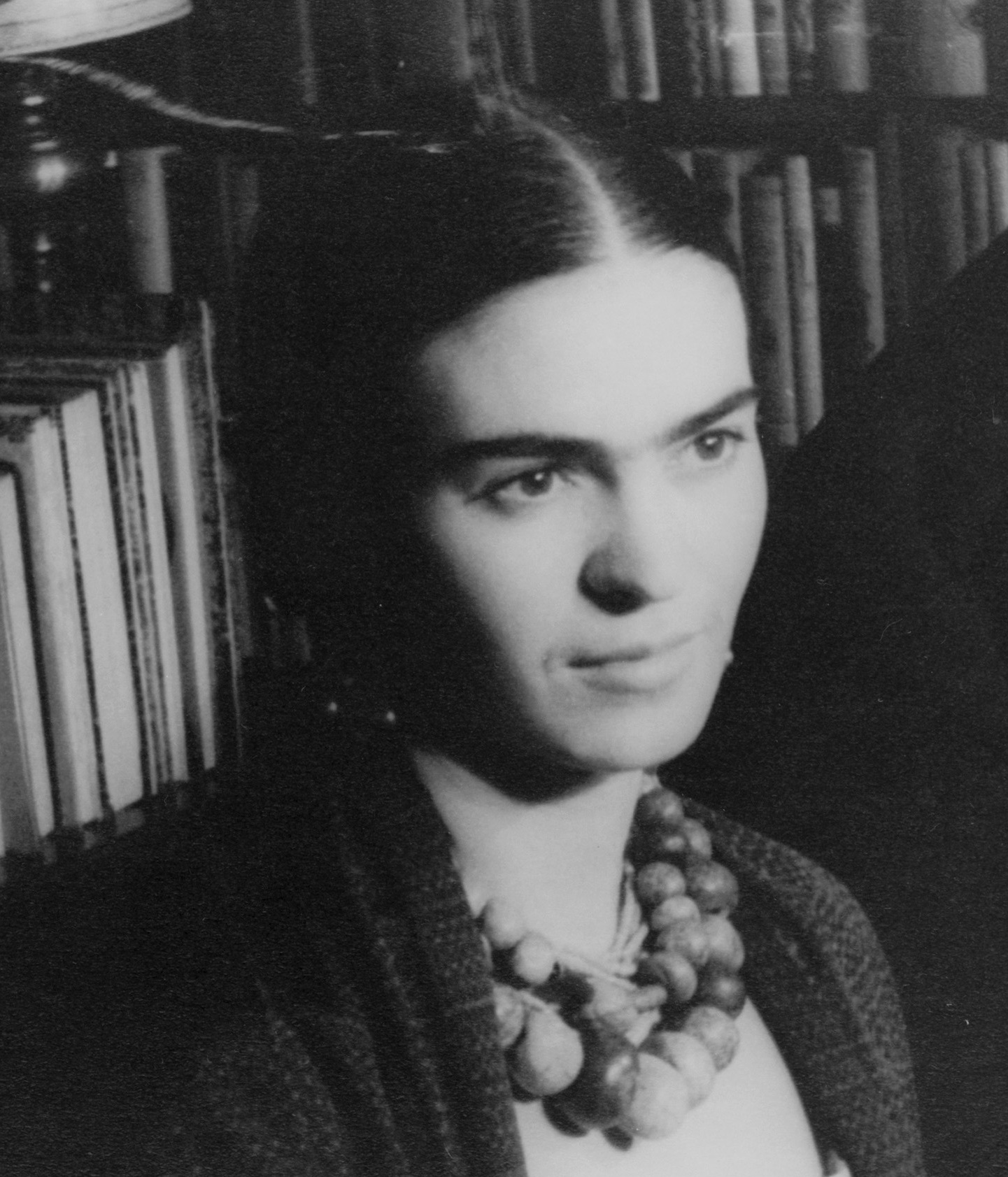
Frida Kahlo (born July 6, 1907, Coyoacán, Mexico — died July 13, 1954, Coyoacán) was a Mexican painter best known for her uncompromising, brilliantly colored self-portraits dealing with identity, the human body and death. In 1925, at eighteen, the bus she was riding home from school collided with a trolley: multiple fractures of the spine, right leg, collarbone, ribs and pelvis, a dislocated shoulder, a crushed foot, and an abdomen punctured by an iron handrail. She taught herself to paint while bedridden, using a mirror fixed above her bed, and underwent more than thirty medical procedures in the following decades. In 1929 she married the muralist Diego Rivera — they divorced in 1939 and remarried in 1940 — and the couple hosted Leon Trotsky at her family home, the Casa Azul, from 1937. Breton promoted her work as self-taught surrealism; her first solo exhibition came at New York's Julien Levy Gallery in November 1938, and in 1939 the French state bought The Frame, making her the first 20th-century Mexican artist in its collection. Her most famous works — The Two Fridas (1939), Self-Portrait with Cropped Hair (1940), The Broken Column (1944) and Viva la Vida (1954, painted days before her death at 47) — are now divided among Mexico's museums and MoMA. The Casa Azul opened as a museum in July 1958; her reputation, dismissed in her lifetime as secondary to Rivera's, grew into what critics call 'Fridamania'. In November 2025 her painting El Sueño (The Dream) sold for $54.7 million — the highest auction price ever paid for a work by a woman.
The documented life: who Frida Kahlo was
Frida Kahlo was born on July 6, 1907, in Coyoacán, Mexico, and died there on July 13, 1954.1 She was a Mexican painter best known for her uncompromising and brilliantly coloured self-portraits dealing with identity, the human body and death.1 She was born Magdalena Carmen Frida Kahlo Calderón, the third of the four daughters of the Kahlo Calderón household.2
Her art was shaped by her experiences: lifelong health struggles and disability after a near-fatal bus accident, her Mexican and European heritage, and a complicated marriage to the muralist Diego Rivera.1 That marriage had three dates: married in 1929, divorced in 1939, remarried in 1940.1 She was born to a German father of Hungarian descent and a Mexican mother of Spanish and Native American descent.1
Childhood in Coyoacán: the blue house, polio, and the Preparatoria
She was especially close to her father, a professional photographer, and she frequently assisted him in his studio, where she acquired a sharp eye for detail.1 She was the third of four daughters: Matilde, Adriana, Frida and Cristina.2 Frida was closest to Cristina, whom she called Kitty.2
The family home was the Casa Azul, the blue house that Guillermo Kahlo built in 1904 on an 800 m² plot at the corner of Londres and Allende in the Del Carmen district of Coyoacán.2 He built it with an inheritance from his father.2 The Kahlo Calderón family moved in that same year.2 Frida was born in the house and would live in it for much of her life.4
At six years old Kahlo contracted poliomyelitis.2 Because of the disease, her right leg became shorter and thinner than the left.2 She spent nine months in bed recovering, and when she returned to school her classmates teased her about the leg.5
At the Escuela Nacional Preparatoria, where she wanted to study medicine, she was one of only 35 women accepted into a student body of 2,000 men.2 She also worked in a lumber yard, registering arrivals and departures, to help her family.2 In her father's photographic studio she learned to colour photographs with a brush.2 There she joined the student group Los Cachuchas, seven men and two women united by reading and left-wing politics, among them Alejandro Gómez Arias, who became her boyfriend.2
17 September 1925: the accident that defined a life
On 17 September 1925 the bus Kahlo was riding home from school with Alejandro Gómez Arias was struck by a trolley.2 She spent a month in the Cruz Roja hospital, where her elder sister Matilde visited her.2 The accident left multiple fractures in her spine, right leg, collarbone, ribs and pelvis, a dislocated shoulder, a crushed right foot, and her abdomen and uterus punctured by an iron handrail.1
While recovering in bed, Kahlo had a mirror fixed above her and an easel made so that she could paint lying down.2 Her first self-portrait was a gift for Alejandro Gómez Arias.2 Bedridden, she taught herself to paint and read frequently, studying the art of the Old Masters.1 She had begun to paint in 1925, while recovering from the near-fatal accident that devastated her body and marked the beginning of lifelong physical ordeals.6
The injuries plagued her for the rest of her life, and she underwent more than 30 medical procedures in subsequent decades.1 The Museo Frida Kahlo counts about 23 operations over her lifetime.2 In Self-Portrait Wearing a Velvet Dress (1926) she painted herself at waist length against a dark background with stylized waves, her exaggeratedly long neck and fingers revealing an interest in the Mannerist painter Il Bronzino.1
Frida and Diego: the elephant, the dove, and the Casa Azul
After her convalescence Kahlo joined the Mexican Communist Party, where she met Rivera again; she showed him her work and he encouraged her to keep painting.1 In 1928 she joined the League of Young Communists, formed a close friendship with the photographer Tina Modotti, and developed a warm acquaintance with Rivera.2 For the rest of her life painting would remain a constant friend.5
On 21 August 1929 Kahlo, then 22, married Diego Rivera at the Coyoacán town hall.2 The muralist was a little over 20 years her senior, and her mother called the union one of 'an elephant and a dove'.2 Soon after the wedding she adopted the traditional Tehuana dress that became her trademark: a flowered headdress, a loose blouse, gold jewellery and a long ruffled skirt.1 Her 1931 painting Frieda and Diego Rivera records both the new attire and her new interest in Mexican folk art, with the towering Rivera holding a palette and brushes beside the petite Kahlo.1
From 1930 to 1933 Kahlo accompanied Rivera to the United States, where he had mural commissions in San Francisco, Detroit and New York City, and she lost several pregnancies during her time abroad.1 After suffering a miscarriage in Detroit and later the death of her mother, she painted some of her most harrowing works.1 Henry Ford Hospital (1932) shows her haemorrhaging on a hospital bed amid a barren landscape, and My Birth (1932) depicts a taboo scene of a woman giving birth.1 Henry Ford Hospital records her second, spontaneous miscarriage; painted on a metal sheet like one of the ex-votos she collected, it was first titled El deseo perdido, The Lost Desire.2 Her mother, Matilde Calderón, had died on 15 September 1932 at the age of 58, from complications of gallbladder surgery.2
In 1934 she was hospitalized three times: for an appendectomy, for a third miscarriage at three months, and for ulcers on her right foot.2 Having discovered around this time that her sister Cristina and Rivera were having an affair, she travelled to New York to recover her spirits and painted a curly-haired self-portrait as a gift for the marriage of Ella and Bertram Wolfe.2
In 1934 the couple moved into their functionalist house in San Ángel, designed by their friend the architect Juan O'Gorman, with a bridge connecting Frida's and Diego's spaces.2 Rather than live under one roof, they chose separate homes joined by a skywalk; the compound is today the Museo Casa Estudio Diego Rivera y Frida Kahlo.7 Thanks to Rivera's intervention with President Lázaro Cárdenas, Leon Trotsky received political asylum in Mexico, and, invited by Frida and Diego, he and his wife Natalia Sedova lived for two years at the Casa Azul in Coyoacán.2
Kahlo's Self-Portrait Dedicated to Leon Trotsky commemorates the brief affair she had with him shortly after his arrival in Mexico in 1937.8 The painting hung in his private study at the Casa Azul until the Trotskys moved to a new safe house in 1939.9 She and Rivera divorced officially on 6 November 1939.2 A year after their separation they remarried in San Francisco, on 8 December 1940.2
The works: key paintings and where they are today
The world's largest collection of Kahlo's works, more than two dozen pieces, is at the Museo Dolores Olmedo in Xochimilco, Mexico City, including The Broken Column and Henry Ford Hospital.7 The Museum of Modern Art holds three works online, among them Self-Portrait with Cropped Hair, My Grandparents, My Parents, and I and Fulang-Chang and I.6 In Self-Portrait with Cropped Hair, painted after the divorce of late 1939, Kahlo cast off the feminine attributes of her earlier self-portraits — the embroidered Tehuana dresses and the flowers in her hair — for a loose-fitting man's suit and a short-clipped haircut.6 The National Museum of Women in the Arts holds the Self-Portrait Dedicated to Leon Trotsky, a gift of Clare Boothe Luce in 1988.8 The Two Fridas belongs to the Museo de Arte Moderno in Mexico City.2
| Year | Work | Where it is today |
|---|---|---|
| 19261 | Self-Portrait Wearing a Velvet Dress1 | Not documented in the sources consulted1 |
| 19311 | Frieda and Diego Rivera1 | San Francisco Museum of Modern Art (SFMOMA)2 |
| 19321 | Henry Ford Hospital1 | Museo Dolores Olmedo, Xochimilco7 |
| 19322 | Frida and the Cesarean Operation7 | On display at the Casa Azul7 |
| 19366 | My Grandparents, My Parents, and I6 | The Museum of Modern Art, New York6 |
| 19376 | Fulang-Chang and I (assembled after 1939)6 | The Museum of Modern Art, New York6 |
| 19378 | Self-Portrait Dedicated to Leon Trotsky8 | National Museum of Women in the Arts, Washington, D.C.8 |
| 19392 | The Two Fridas2 | Museo de Arte Moderno, Mexico City2 |
| 19406 | Self-Portrait with Cropped Hair6 | The Museum of Modern Art — oil on canvas, 40 x 27.9 cm, gift of Edgar Kaufmann, Jr.6 |
| 19447 | The Broken Column2 | Museo Dolores Olmedo, Xochimilco7 |
| 19542 | Viva la Vida2 | On display at the Casa Azul7 |
New York, Paris: the breakthrough years (1938–1940)
Between 1937 and 1938 Kahlo made 20 paintings, more than she ever painted in a single year, and many of them she showed in New York.2 In 1938 André Breton travelled to Mexico intending to interview Trotsky, and the father of surrealism found similarities between Kahlo's work and his movement, offering to promote her art internationally.2 Her first solo exhibition opened in November 1938 at Julien Levy's New York gallery, curated by Breton, and she sold several paintings there while her work won excellent reviews in the printed press.2
The same year brought one of her first major sales, when the American actor Edward G. Robinson bought four of her paintings.1 Vanity Fair editor Clare Boothe Luce commissioned her to paint a tribute to the actress Dorothy Hale, who had died by suicide earlier that year.1
In Paris, Marcel Duchamp made possible her exhibition at the Galerie Renou et Colle in the centre of the city.2 She fell ill there and had to be hospitalized.2 The French government bought one of her works, The Frame, making Kahlo the first 20th-century Mexican artist to be included in the state's collection.1 It is today in the permanent display of the Centre Pompidou in Paris.2
Breton promoted her work as self-taught surrealism.1 Kahlo's own account was plainer: she painted her own reality, not dreams.9 For the fourth International Exhibition of Surrealism she painted The Two Fridas, connecting her European heritage and Mexican tradition heart to heart.2 Like many Mexican artists working after the revolutionary decade that began in 1910, she was influenced in her art and life by the nationalistic fervour known as Mexicanidad.8
In her own words
Her own words survive in a diary, in letters, and in the records of the museums that hold her paintings.2
I paint self-portraits because I am so often alone, because I am the person I know best.
Frida Kahlo, as quoted by The Museum of Modern Art on Self-Portrait with Cropped Hair
I never painted dreams. I painted my own reality.
Frida Kahlo — National Museum of Women in the Arts, 'Between the Curtains'
Pies para qué los quiero si tengo alas pa' volar
Feet, what do I need you for when I have wings to fly — written in her diary after the amputation of her right leg in August 1953 (Museo Frida Kahlo)
Mira que si te quise fue por el pelo. Ahora que estás pelona, ya no te quiero.
The popular Mexican song Kahlo transcribed on Self-Portrait with Cropped Hair, 1940; MoMA's translation reads: 'Look, if I loved you it was because of your hair. Now that you are without hair, I don't love you anymore.'
Viva la Vida
The words she painted on her watermelon canvas days before her death in 1954 (Museo Frida Kahlo)
The broken column: illness and invention in the 1940s and 50s
In 1944 Kahlo painted one of her best-known works, The Broken Column, showing her physical vulnerability through nails in her skin, the largest near her heart.2 After multiple surgeries, about 23 operations by the end of her life, her interior is held up by a classical column, but a broken one, against an arid and lonely background.2 The same year she began to write, paint and draw in a diary which, filled with thoughts, reflections, poems and notes, covers the last ten years of her life.2
In 1946 she travelled to New York for a spinal fusion, spent more than sixty days in the hospital, and on returning to Mexico had to wear a steel corset for eight months.2 The same year she painted The Wounded Deer and Tree of Hope, Stay Firm and received an honorary mention in the National Prize for Sciences and Arts.2
In 1950 she spent almost a year in and out of the ABC Medical Center in Mexico City, undergoing seven spinal interventions and the amputation of two toes of her right foot.2 Increasingly she had to pass long periods in bed, the posture to which she grew accustomed in order to paint.2
From 1942 Kahlo was a professor at the National School of Painting and Sculpture 'La Esmeralda'.2 Because of her poor health she taught from her house, where four students stayed at her side and became known as Los Fridos.2 In 1943 Diego Rivera published an article on her painting and Mexican art, calling her work the finest evidence of a Mexican artistic renaissance.2
A 2006 article in the journal European Neurology by V. Budrys related her biography and works to neurology: a congenital spinal anomaly, spina bifida, poliomyelitis, spine injury and neuropathic pain.10 Budrys counted her among the very few artists bold enough to show their sick, nude body.10 The article belongs to a wider medical reading of her life and paintings, which it ties closely to her neurological history.10
1953–1954: the last exhibition, the amputation, and 'Viva la Vida'
On 13 April 1953 the photographer Lola Álvarez Bravo opened at her Galería de Arte Contemporáneo the only solo exhibition Kahlo had in Mexico during her lifetime.2 Kahlo arrived by ambulance and took part in the event lying in a hospital bed.2
In August 1953 gangrene had developed in her leg and her right leg was amputated from the knee down.2 In her diary she wrote the famous line asking what use feet were to her when she had wings to fly.2 The amputation came after years of interventions on the leg, which had already cost her two toes in 1950.2
In June 1954 she was hospitalized with pneumonia, and during her convalescence, disobeying her doctors, she attended the protest against the United States' intervention in Guatemala.2 On 2 July she was photographed in a wheelchair beside Diego Rivera, her left fist raised.2
She died on 13 July 1954 at the age of 47.2 Days before her death she had written 'Viva la Vida' on her watermelon canvas, naming the work and leaving a last testimony of resilience and hope.2 One canvas remained unfinished: 'Marxism Will Give Health to the Sick'.2
The Casa Azul museum and the making of 'Fridamania'
Frida and Diego wanted their house kept as a museum for all Mexicans.11 After her death their friend, the poet and museographer Carlos Pellicer, planned the museum display, and the administration was entrusted to the Fideicomiso de los Museos Diego Rivera y Frida Kahlo, constituted by Rivera himself in 1957.11 The Casa Azul opened as a museum in July 1958, its rooms kept largely as she had lived in them.11 Rivera had donated the home and its contents so that Kahlo's legacy would live on.7
In the artist's bedroom visitors find her bed with the mirror her mother placed there after the accident, where Frida, immobile for nine months, began to paint.11 The studio holds the easel that Nelson Rockefeller gave her.11On display are Viva la Vida (1954), Frida and the Cesarean Operation and Portrait of My Father Wilhelm Kahlo (1952), along with her wheelchair and the plaster corset she wore after her spinal surgeries.7
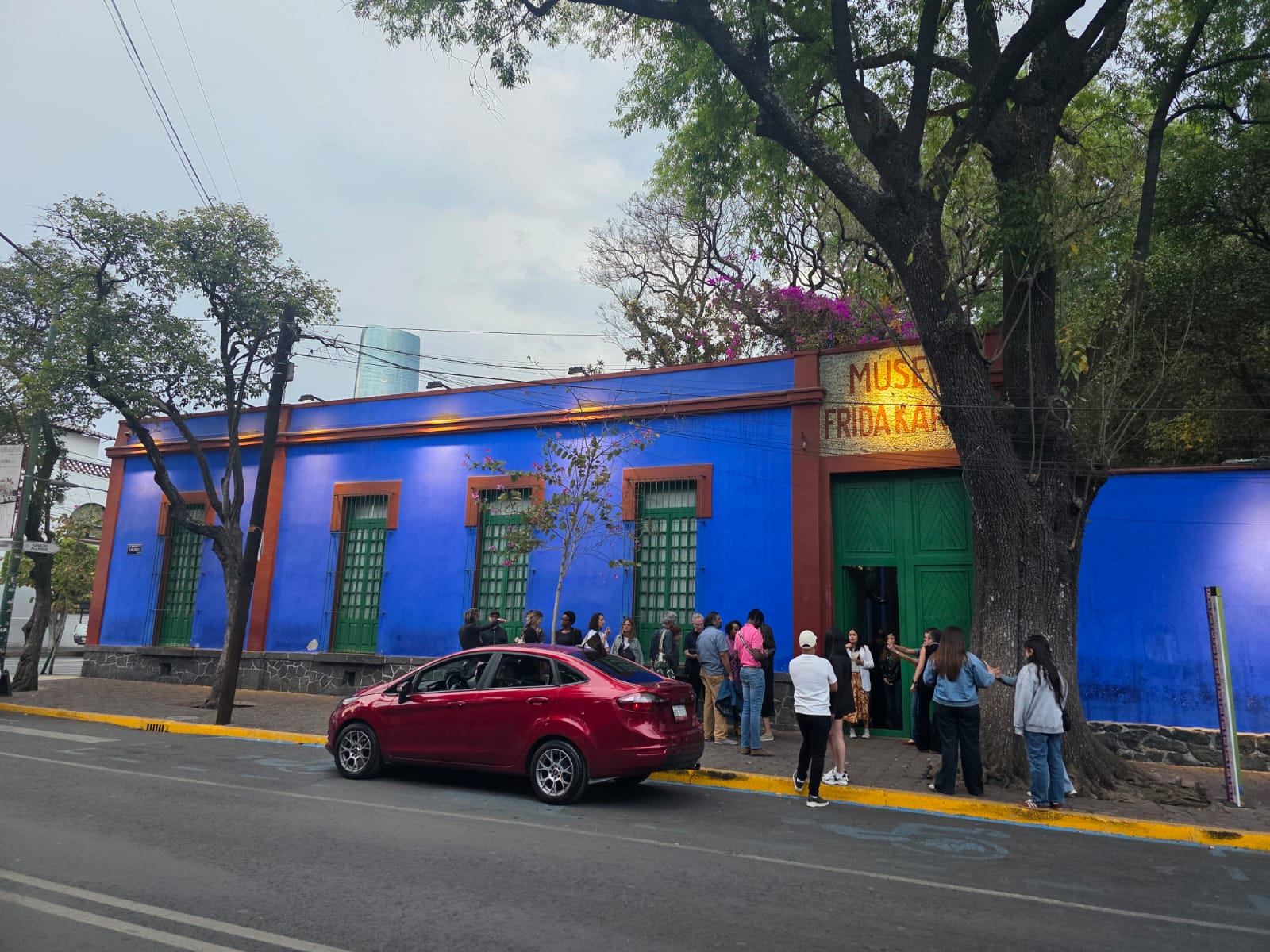
Beyond the house, the world's largest collection of Kahlo's works, more than two dozen pieces, is at the Museo Dolores Olmedo in Xochimilco.7 The National Museum of Women in the Arts holds the Self-Portrait Dedicated to Leon Trotsky, the gift of Clare Boothe Luce in 1988.8 The Metropolitan Museum of Art holds Nickolas Muray's 1939 portrait photograph of her.12
Legacy: records, museums, and what remains debated
Of the 143 paintings Kahlo created, 55 are self-portraits, often portraying the artist alongside animals and nature.3 MoMA puts the self-portraits at 'sixty', while the Museo registers more than 150 works.3 The figures differ by how works are counted.3
On the market, her auction record before the 2025 sale stood at $34.9 million for Diego and I (1949), a self-portrait showing Rivera's face on her forehead.3 El Sueño itself shows her sleeping, blanketed by vines, in a wooden four-poster bed, with a skeleton wrapped in explosives holding a bouquet on top of the bed.3 The previous record for a female artist was Georgia O'Keeffe's Jimson Weed/White Flower No. 1 (1932), which sold for $44.4 million in 2014.3 Adjusted for inflation that price comes to $60.5 million in today's dollars, slightly higher than The Dream (The Bed)'s, the New York Times notes.3
After Rivera paid off the Casa Azul mortgage upon marrying Kahlo, her parents moved into a nearby red house, the Casa Roja, in 1930.14 The Kahlo Foundation announced that the Casa Roja would become the Museo Casa Kahlo, designed by the New York architecture firm Rockwell Group and officially opened on 27 September 2025.14 Letters marked by homesickness, love and grief illuminate the importance of Kahlo's family in her life, the scholar Luis-Martín Lozano told National Geographic.14
Her life is documented in depth: Hayden Herrera's biography appeared from Harper & Row in 1983, its chapter list running from the blue house on Londres Street through the accident, Trotsky and the remarriage.15 Her diary was published in 1995 as 'The Diary of Frida Kahlo: An Intimate Self-Portrait', by H.N. Abrams in New York and La Vaca Independiente in Mexico.16 The Benezit Dictionary of Artists catalogues her under the full name Kahlo (y Calderón), (Magdalena Carmen) Frida, in a 2011 entry.17
Frida Kahlo: a life in dated milestones
Birth in Coyoacán
Magdalena Carmen Frida Kahlo Calderón is born in Coyoacán — the third of the four daughters of the Kahlo Calderón household. Britannica gives July 6, 1907, Coyoacán, as her birth date.
Polio at the age of six
Frida contracts poliomyelitis; her right leg will be shorter and thinner as a result. Tate records that she spent nine months in bed and that classmates teased her about the leg.
Entering the Escuela Nacional Preparatoria
Wanting to study medicine, Kahlo enters the National Preparatory School — one of only 35 women accepted into a student body of 2,000 men. She also works in a lumber yard and learns to colour photographs in her father's studio.
The bus accident
The bus taking Kahlo home from school with her boyfriend Alejandro Gómez Arias is struck by a trolley. She spends a month in the Cruz Roja hospital with fractures of the spine, right leg, collarbone, ribs and pelvis, a dislocated shoulder, a crushed right foot, and an abdomen punctured by an iron handrail.
First self-portrait, painted in bed
After months lying in bed, her mother fixes a mirror above her and her parents have an easel made so she can paint lying down; her first self-portrait is a gift for Alejandro Gómez Arias.
Marriage to Diego Rivera
Frida, 22, marries Diego Rivera at the Coyoacán town hall; the muralist is 'a little over 20' years older. Her mother calls the union that of 'an elephant and a dove'.
Detroit: Henry Ford Hospital, and the death of her mother
In July, in Detroit, Kahlo paints Henry Ford Hospital, her second miscarriage rendered like one of the ex-votos she collected; its first title was El deseo perdido. On 15 September her mother, Matilde Calderón, dies at 58 after complications of gallbladder surgery.
Leon Trotsky arrives at the Casa Azul
Thanks to Rivera's intervention with President Lázaro Cárdenas, Leon Trotsky is granted political asylum in Mexico; invited by Frida and Diego, Trotsky and his wife Natalia Sedova live for two years in the Casa Azul in Coyoacán.
First solo exhibition, in New York
Julien Levy invites Kahlo to exhibit in his New York gallery and shows open in November, curated by André Breton — Kahlo's first solo exhibition. She sells several paintings; the actor Edward G. Robinson buys four of her works, one of her first major sales.
Paris, 'The Frame', and the divorce
Marcel Duchamp makes possible her showing at Galerie Renou et Colle in the 'Mexique' exhibition, which opens on 10 March; the French government buys her self-portrait The Frame — she becomes the first 20th-century Mexican artist in the French state collection. On 6 November she and Rivera divorce.
Trotsky murdered; remarriage in San Francisco
On 21 August Leon Trotsky is assassinated in Mexico City by Ramón Mercader; Frida is interrogated for twelve hours and spends two days in jail with her sister Cristina. On 8 December she remarries Diego Rivera in San Francisco.
'The Broken Column' and the diary begins
Kahlo paints The Broken Column — nails in her skin, the largest near her heart, her interior held up by a shattered classical column after multiple surgeries (about 23 operations by the end of her life). The same year she begins the diary that records her last ten years.
The Mexico City exhibition, then the amputation
Lola Álvarez Bravo opens the only solo exhibition Kahlo has in Mexico during her lifetime at her Galería de Arte Contemporáneo; she arrives by ambulance and attends lying in a hospital bed. In August, after gangrene develops, her right leg is amputated below the knee; in her diary she writes 'Pies para qué los quiero si tengo alas pa' volar'.
The last photograph, and 'Viva la Vida'
Defying her doctors during convalescence from pneumonia, Kahlo is photographed on 2 July in her wheelchair beside Diego Rivera, left fist raised, at the protest against the US intervention in Guatemala. She dies on 13 July aged 47; days earlier she wrote 'Viva la Vida' on her watermelon canvas.
The Casa Azul opens as a museum
Frida and Diego wanted their house kept as a museum for all Mexicans; after her death their friend, the poet and museographer Carlos Pellicer, planned the display, and in 1957 Rivera constituted the trust that administers it. The museum opens in July 1958, its rooms kept largely as Kahlo lived in them.
$54.7 million for 'El Sueño' — the record for a woman artist
At Sotheby's, Kahlo's 1940 self-portrait El Sueño (The Dream) sells for $54.7 million — the highest price ever paid at auction for an artwork by a woman or Latin American artist, surpassing Georgia O'Keeffe's $44.4 million (2014). It had been expected to fetch $40–60 million.
Frequently asked questions
Who was Frida Kahlo?
Frida Kahlo was a Mexican painter best known for her uncompromising and brilliantly coloured self-portraits dealing with identity, the human body and death.1 She was born on July 6, 1907, in Coyoacán, Mexico, and died there on July 13, 1954.1
What happened to Frida Kahlo in 1925?
On 17 September 1925 the bus she was riding home from school was struck by a trolley, and she spent a month in the Cruz Roja hospital.2 The accident left multiple fractures in her spine, right leg, collarbone, ribs and pelvis, a dislocated shoulder, a crushed right foot, and her abdomen and uterus punctured by an iron handrail.1
Whom did Frida Kahlo marry, and when?
She married the muralist Diego Rivera at the Coyoacán town hall on 21 August 1929, when she was 22 and he was a little over 20 years her senior.2 They divorced on 6 November 1939 and remarried in San Francisco on 8 December 1940.2
Why did Leon Trotsky live at the Casa Azul?
Thanks to Rivera's intervention with President Lázaro Cárdenas, Trotsky received political asylum in Mexico, and he and his wife Natalia Sedova lived for two years at the Casa Azul in Coyoacán.2 The same period produced Kahlo's Self-Portrait Dedicated to Leon Trotsky, which commemorates the brief affair she had with him.8
What is the Casa Azul today?
The Casa Azul is the house where Kahlo was born, lived and died.4 She and Rivera wanted it kept as a museum for all Mexicans, and it opened in July 1958 after their friend the poet Carlos Pellicer planned the display.11
How many paintings did Frida Kahlo make?
Of the 143 paintings she created, 55 are self-portraits, often portraying her alongside animals and nature.3 Other counts differ: MoMA puts the self-portraits at 'sixty', while the Museo registers more than 150 works.3
How much did El Sueño (The Dream) sell for?
Kahlo's 1940 self-portrait El Sueño (The Dream) sold in November 2025 for $54.7 million, the highest price ever paid at auction for an artwork by a woman or Latin American artist.3 The previous female-artist record, Georgia O'Keeffe's $44.4 million in 2014, still edges it when the price is adjusted for inflation, the New York Times notes.3
Key works and where they are now
Sources & citations
Every factual claim in this article is drawn from the sources below. Bracketed numbers in the text link to the corresponding source.
- 1
- 2
- 3
- 4
- 5
- 6
- 7
- 8
- 9
- 10
- 11
- 12
- 13
- 14
- 15
- 16
- 17