Piano
The story of the piano: Bartolomeo Cristofori's invention in Florence, the Viennese and English traditions of making, the square, upright and grand forms, the action, pedals and strings of the modern concert grand, and the piano's place in the home and the concert hall.
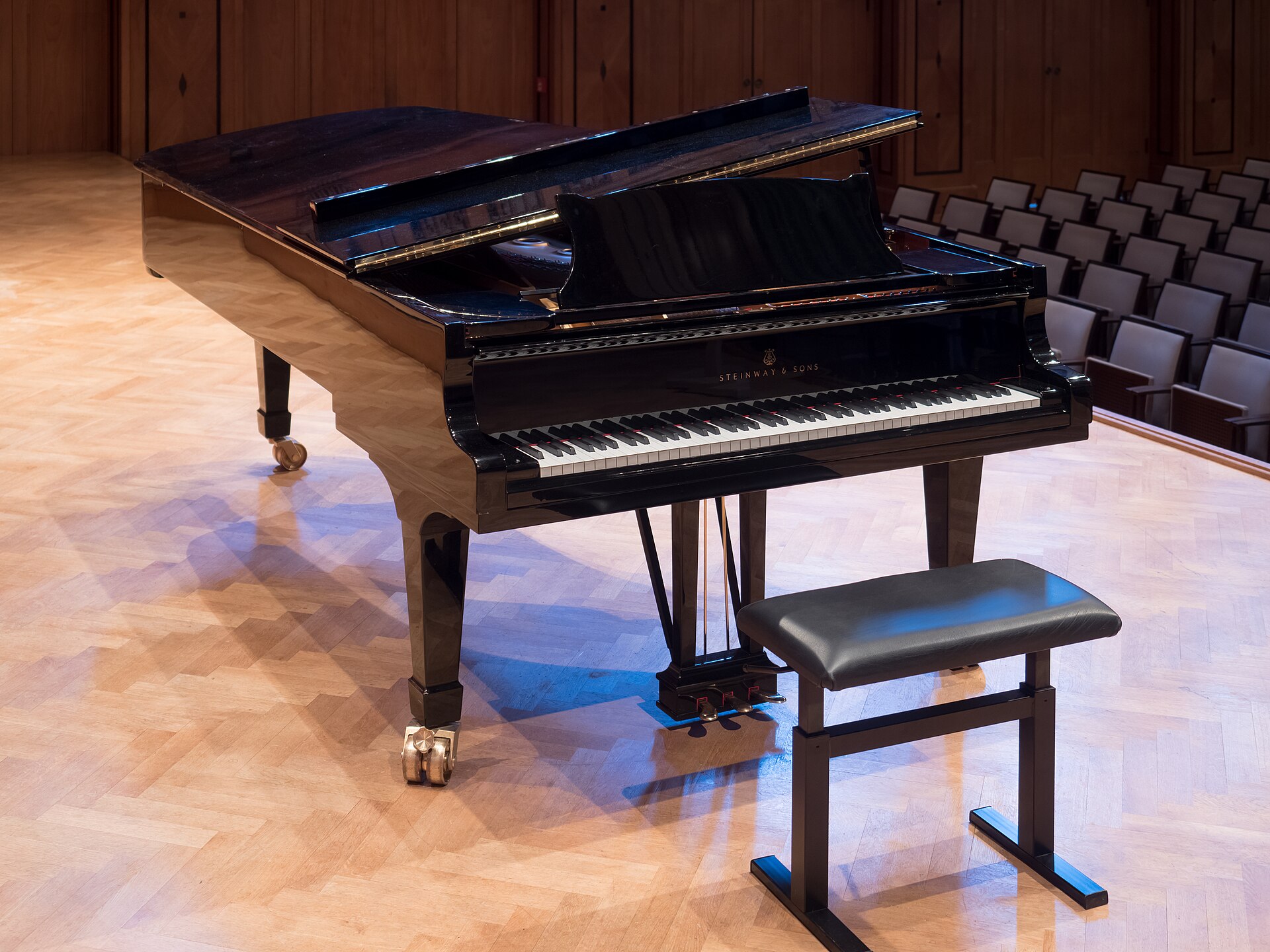
The piano is a keyboard instrument whose wire strings sound when struck by felt-covered hammers; Bartolomeo Cristofori devised it in Florence, and Scipione Maffei named it the pianoforte in 1711. Through the Viennese and English schools of making, the square, upright and grand forms, and inventions such as Érard's double-escapement action, it became the central instrument of Western music and of middle-class households. The modern concert grand has 88 keys, a one-piece cast-iron frame, overstringing and string tension of as much as 30 tons.
In this article
- 1Overview
- 2Definition and Construction
- 3Acoustics and Tone
- 4Invention and Early History
- 5The Viennese and English Schools
- 6Technical Developments of the Nineteenth Century
- 7Sébastien Érard
- 8Steinway & Sons
- 9The Piano in Musical Life
- 10Player Pianos and Electronic Instruments
- 11Timeline of Key Developments
- 12Frequently Asked Questions
- 13Timeline: from Cristofori's invention to the modern concert grand
- 14Knowledge graph
Overview
The piano is a keyboard musical instrument whose wire strings sound when struck by felt-covered hammers operated from a keyboard. It is broadly defined as a stringed keyboard instrument with a hammer action, as opposed to the jack and quill action of the harpsichord, and it is capable of gradations of soft and loud. The standard modern piano contains 88 keys and has a compass of seven full octaves plus a few keys.
1. Definition and Construction
The piano produces sound through a chain of mechanical transfers. The vibration of the strings is transmitted to a soundboard by means of a bridge over which the strings are stretched, and the soundboard amplifies the sound and affects its tone quality. The hammers are affixed to a mechanism that rests on the far ends of the keys; hammer and mechanism together compose the action.
The frame determines how heavily a piano can be strung. The modern piano has a cast-iron frame capable of withstanding the tremendous tension of the strings, whereas early pianos had wood frames and could only be lightly strung. String tension was determined at 16 tons in 1862 and increased to as much as 30 tons in modern instruments.
The modern piano contains 12,000 parts, most of which are found in the action. The modern grand piano action is a simplified version of Érard's double-escapement action of 1821.
Most pianos carry three pedals. The damper pedal on the right lifts all the felt dampers, the left pedal shifts the keyboard and action sideways to strike only one of the unison strings, and the middle pedal holds up the dampers only of the keys depressed.
2. Acoustics and Tone
The piano's sound begins with a mechanical act: the player presses a key, and a complicated key-and-lever action throws a felt hammer against the string. The hammer is made of wool felt, and it behaves as a nonlinear spring rather than a simple striking mass.
The natural frequencies of a string rise when the string is shorter, when its tension is higher, or when its density is lower. One complete cycle occurs at the fundamental frequency of the string; on the middle C string, the pulse races down and back 262 times every second.
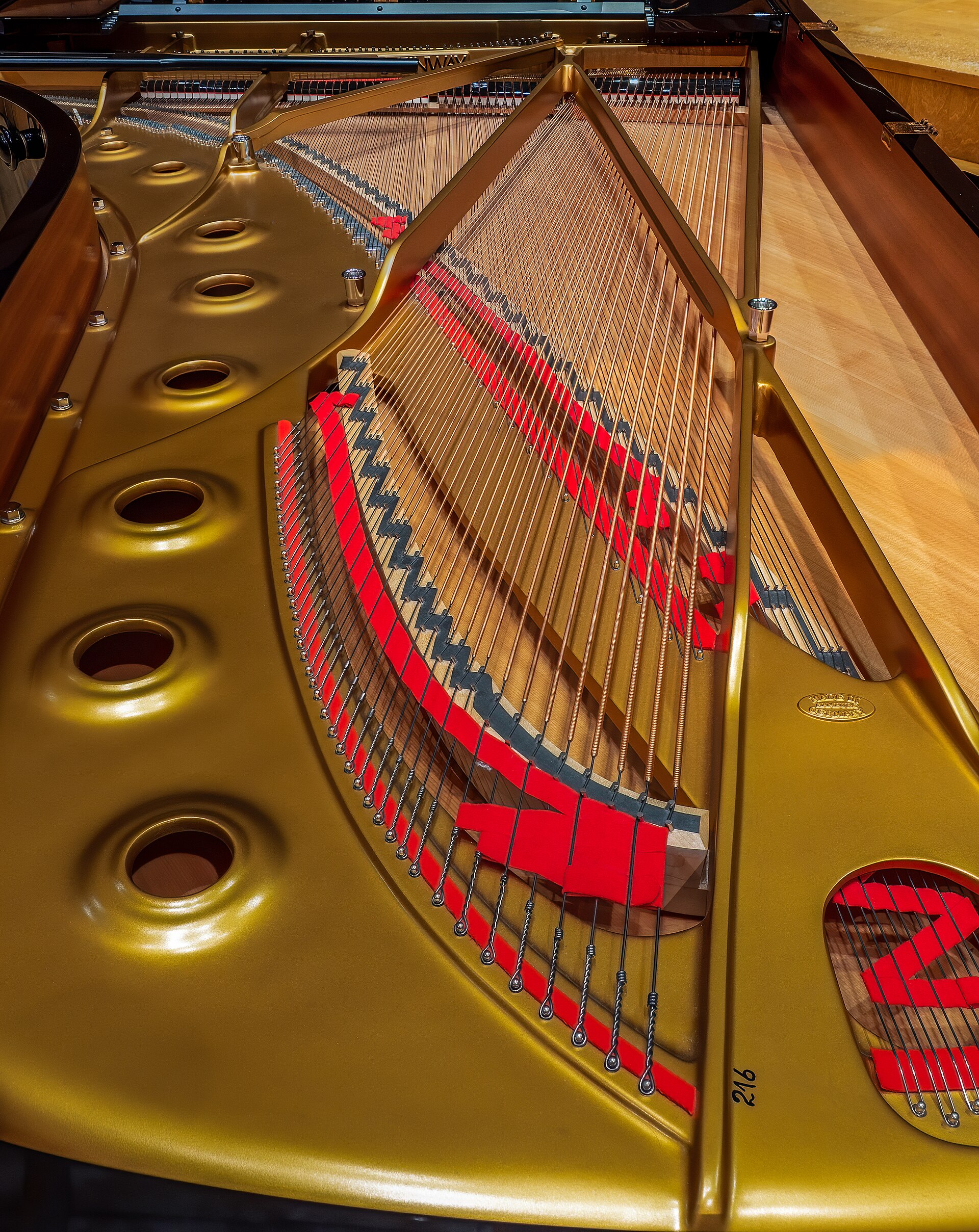
Because the copper-wound steel string possesses stiffness, its higher frequency components travel faster than its lower ones, and the initial pulse shape becomes distorted as it travels.
Pianos have strong transients, which means that their sounds are not periodic. Most notes are served by three strings tuned slightly differently to assist sustain, producing chorus effects, while the partials of thick steel strings are sharper than true harmonics, so the resulting sound is not exactly harmonic. The frequency ratio of octaves is slightly greater than two to one, a discrepancy most pronounced in the very high and very low notes and especially in small pianos.
The second resonance of a struck string usually has a frequency slightly higher than twice that of the first, an effect traceable to the finite bending stiffness of the string. Listeners adapt to equal temperament and may even come to prefer it to other tunings, though string quartets sometimes have trouble playing quintets with piano.
3. Invention and Early History
The principle of a keyboard striking action existed as early as about 1440, but the first true piano was invented almost entirely by Bartolomeo Cristofori of Padua, an Italian harpsichord maker generally credited with the invention. He was appointed in 1688 to the Florentine court of Grand Prince Ferdinando de' Medici to care for its musical instruments.
A 1700 Medici inventory mentions an arpicimbalo, an instrument resembling a harpsichord, newly invented by Cristofori with hammers and dampers, two keyboards, and a range of four octaves. The Florentine court musician Federigo Meccoli inscribed that Cristofori first made the arpi cimbalo del piano e' forte in 1700.
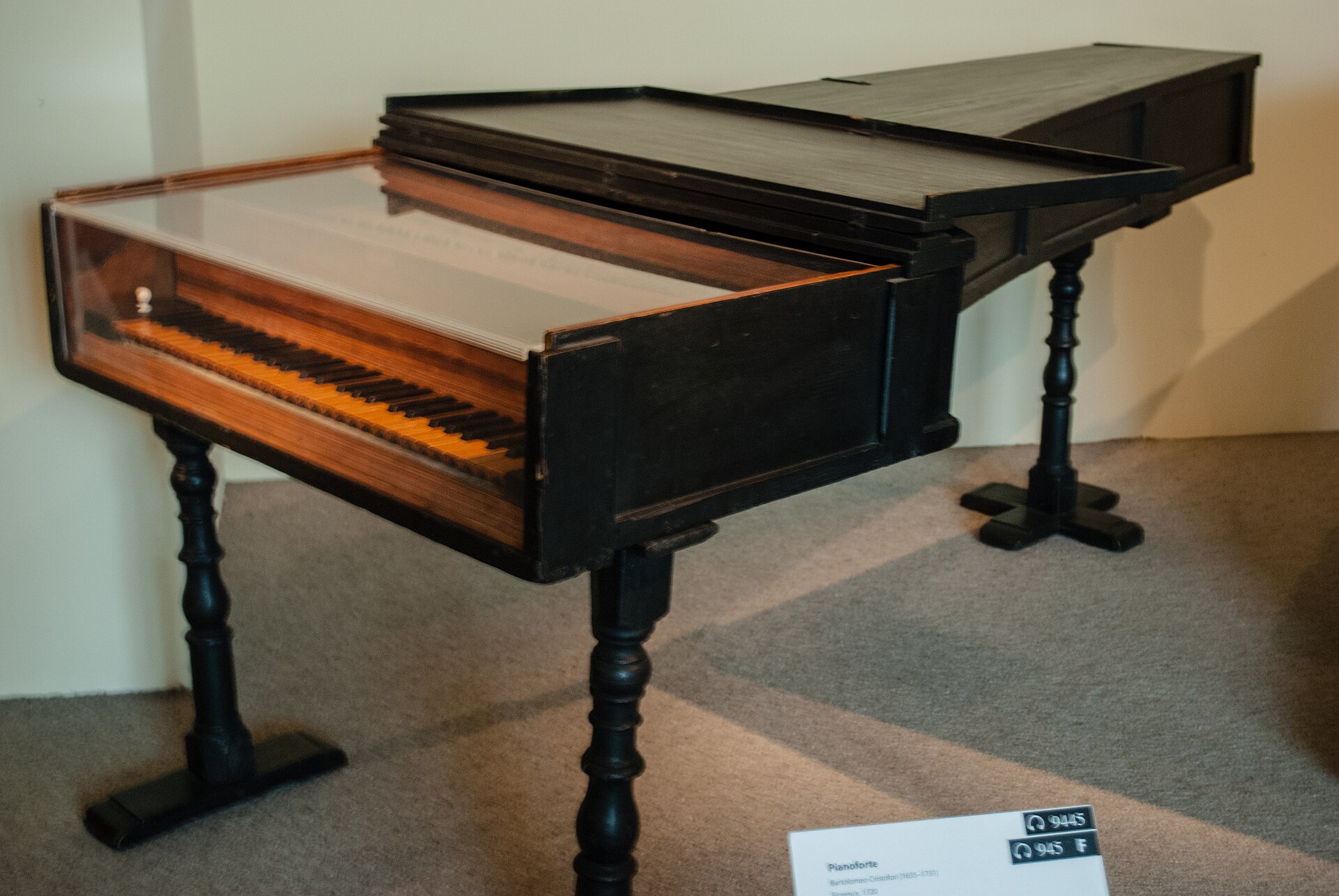
Cristofori achieved the piano's dynamic effect by replacing the plucking mechanism of the harpsichord with a hammer action capable of striking the strings with greater or lesser force. His action included an escapement that let the hammer fall away from the string instantly after striking it, a check that kept the fast-moving hammer from bouncing back, and a dampening mechanism to silence the string when not in use.
The poet and journalist Scipione Maffei, in his 1711 description, named Cristofori's instrument a gravicembalo col piano, e forte — the first time it was called by its eventual name, pianoforte.
Cristofori moved from Padua to Florence about 1690 at the request of Prince Ferdinando de' Medici, an accomplished harpsichordist. In 1713 Ferdinando died and Cristofori remained in the service of the grand duke Cosimo III, later becoming responsible for the care of an instrument collection of 84 instruments, 7 of them his own harpsichords or spinets. He had arrived at all the essentials of the modern piano action by 1726, and it is from Cristofori's piano that the modern piano stems.
Cristofori's frames were made of wood in the manner of a harpsichord and were not capable of withstanding the string tension that allowed later pianos their more powerful tone. His design was largely ignored in Italy but soon became known and adopted in Germany through articles in dictionaries of music. Three pianos by Cristofori survive, at the Metropolitan Museum of Art, at the Museo Strumenti Musicali in Rome, and at the Musikinstrumenten-Museum of Leipzig University.
The 1720 Cristofori piano has a range of 54 keys rather than the modern 88 keys, and its thinner strings and harder hammers give it a timbre closer to a harpsichord than a modern Steinway.
Lodovico Giustini's twelve sonatas, printed in Florence in 1732, were the earliest music definitely written and published specifically for the piano.
Gottfried Silbermann began work on his own pianos in the 1730s based on Cristofori's design, and an early model was dismissed by Johann Sebastian Bach as having too heavy a touch and too weak a treble. Bach later praised Silbermann's pianos and became a sales agent for his instruments, extending the influence of Cristofori's creation in central Europe.
4. The Viennese and English Schools
The Viennese school of piano making produced one of the two distinct types of piano to develop in the eighteenth century, the other being the English piano. The basic form of the Viennese piano was invented in Augsburg by the organist and keyboard maker Johann Andreas Stein.
Stein's Prellmechanik action was developed perhaps as early as 1769 and perfected through the 1770s. Stein simplified the complicated action of Cristofori by dispensing with the intermediate lever and placing the hammer in direct contact with the key. He is credited with introducing knee-lever controls for the dampers and with a redesign of the case with bracings better suited to a hammer action piano.
Mozart visited Stein in Augsburg in 1777, and a concert there included a performance of his triple-clavier concerto using three of Stein's pianos. Musicians such as Mozart, Joseph Haydn, Johann Nepomuk Hummel, and the young Ludwig van Beethoven played these early Viennese instruments and helped drive the demand for them. By 1800 there were approximately sixty known makers building pianos in Vienna.
The instrument's compass expanded from the somewhat standard five octaves of the late eighteenth century to a full seven octaves by the middle of the nineteenth century. Loudness grew partly by increasing the number of unison-tuned strings per note from two in the eighteenth century to three by the early nineteenth century. The invention of overstrung strings, thick strings that could withstand great tension, allowed the bass notes of the piano to become louder. The strings in early pianos ran parallel to one another, and in the 1830s it was realized that the bass strings could be made longer and their tone improved if they were made to fan out over the treble strings.
During the second half of the nineteenth century English action pianos, especially as perfected by the American firms of Chickering and Steinway, came to dominate the world market for pianos.
The piano was widely popular in the mid-18th century, and German piano makers, preferring a lighter and less expensive instrument with a softer touch, perfected the square piano. Johannes Zumpe introduced the square piano in 1766, and his design was a small, rectangular piano that was affordable and appealed to members of the growing middle class.
Johannes Christopher Zumpe emigrated from Germany to England during the 1750s and set up business as a piano maker in London in 1761. The Zumpe square pianoforte of 1767 has a single English action and is described as the precursor of the modern piano. Johann Christian Bach gave the first public pianoforte recital in England in 1768 on an instrument that he had acquired from Zumpe.
In the V&A's 1767 Zumpe square piano the sharps are of ebony and the naturals are covered with ivory, and the range is fifty-five notes. Zumpe developed a simple mechanism which enabled the hammers to strike the strings and was easy to reproduce cheaply, though the hammers could bounce back and hit the strings again while the key was still pressed down. The Met's Zumpe square piano of 1767 has a 58 note range with a dummy low G-sharp key, and its internal mechanism is known as the English single action. Johann Christian Bach, the Queen's music master, endorsed Zumpe's instrument in 1768.
5. Technical Developments of the Nineteenth Century
The first successful action permitting a note to be restruck before the key returned to rest position was devised by Sébastien Érard, whose first repetition or double-escapement action was patented in 1808 and an improved version that is the basis of the modern action was patented in 1821.
The pedal that kept the dampers off the strings only for notes already held down was invented in 1862 by Claude Montal of Paris and appears as the middle pedal on three-pedal pianos, with the damper pedal at the right and the una corda pedal at the left.
In 1855 Steinway & Sons built a grand piano with a complete cast-iron frame embodying the overstrung plan, in which the treble and middle strings fan out over most of the soundboard and the bass strings cross over them at a higher level.
Since the abandonment of the square piano, only upright and grand pianos are regularly manufactured, and grand pianos range in length from a minimum of about 5 feet for a baby grand to a maximum of about 9 feet for a concert grand.
By roughly 1860 the upright piano had virtually replaced the square piano for home use, and by taking the strings down to floor level, John Isaac Hawkins made the upright piano shorter and more suitable for small rooms.
Modern pianos are much louder than were those of the 18th century, an increase in loudness necessitated in part by the size of 19th-century concert halls.
6. Sébastien Érard
Sébastien Érard was a French maker of pianos and harps, and his improvements to both instruments were largely responsible for the forms they take today.
He was apprenticed to a harpsichord builder in Paris. At a workshop on the estate of the Duchess of Villeroi he made the first French square piano, an instrument with a rectangular case and horizontal stringing.
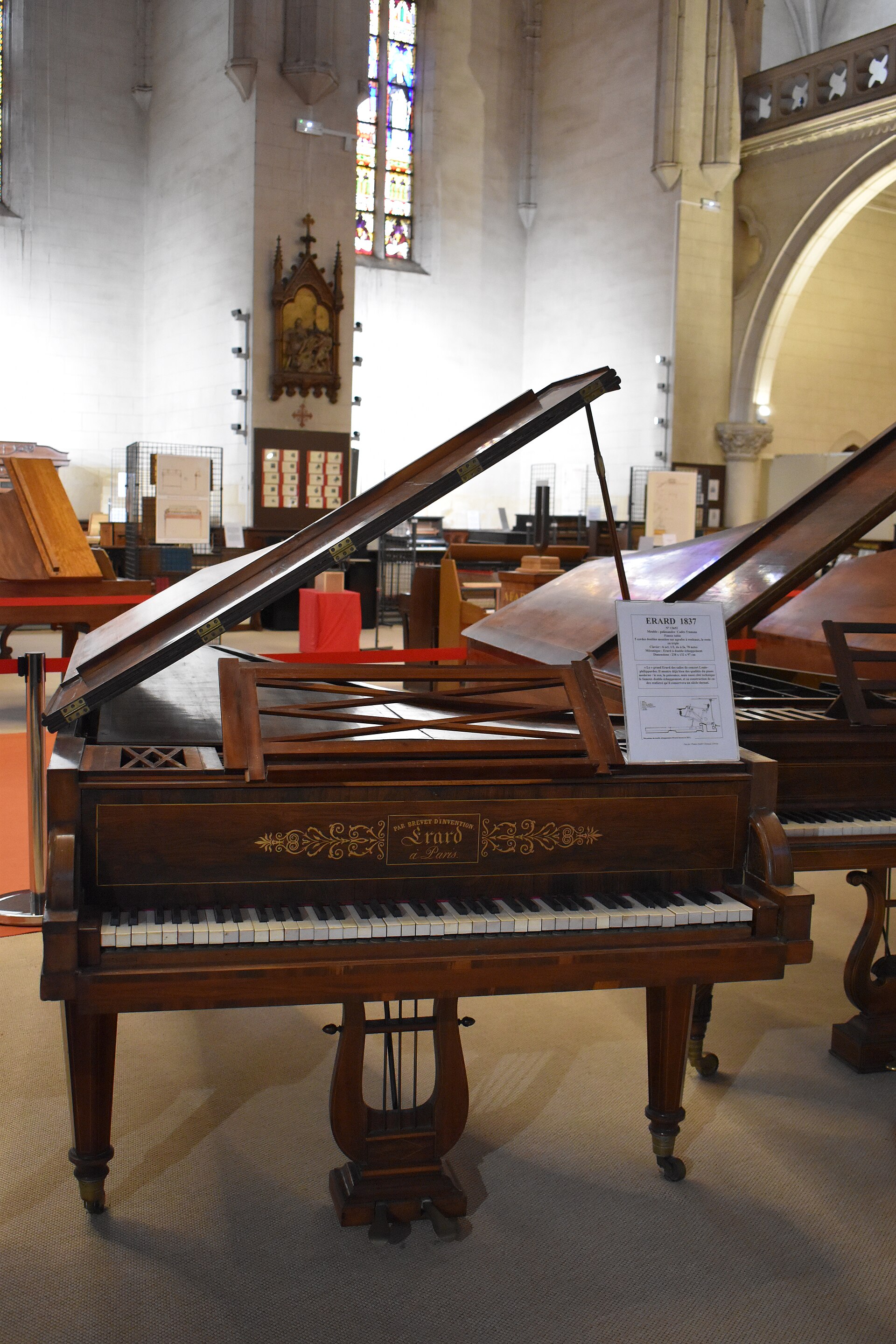
Among the Érard inventions were a novel grand piano action dated 1809, which allowed quicker repetition of notes, and new methods of constructing harp and piano frames. By the end of the 19th century the Érard firm had produced about 100,000 instruments, and in the early 20th century it pioneered in building harpsichords.
7. Steinway & Sons
Steinway & Sons was founded in 1853 by the German immigrant Henry Engelhard Steinway in a Manhattan loft on Varick Street. Over the thirty years that followed its founding, Henry Engelhard Steinway and his sons developed the modern piano.
The first Steinway & Sons patent was granted in 1857, and the company has since been granted more than 150 additional patents. Every Steinway consists of more than 12,000 individual parts and has its own musical character.
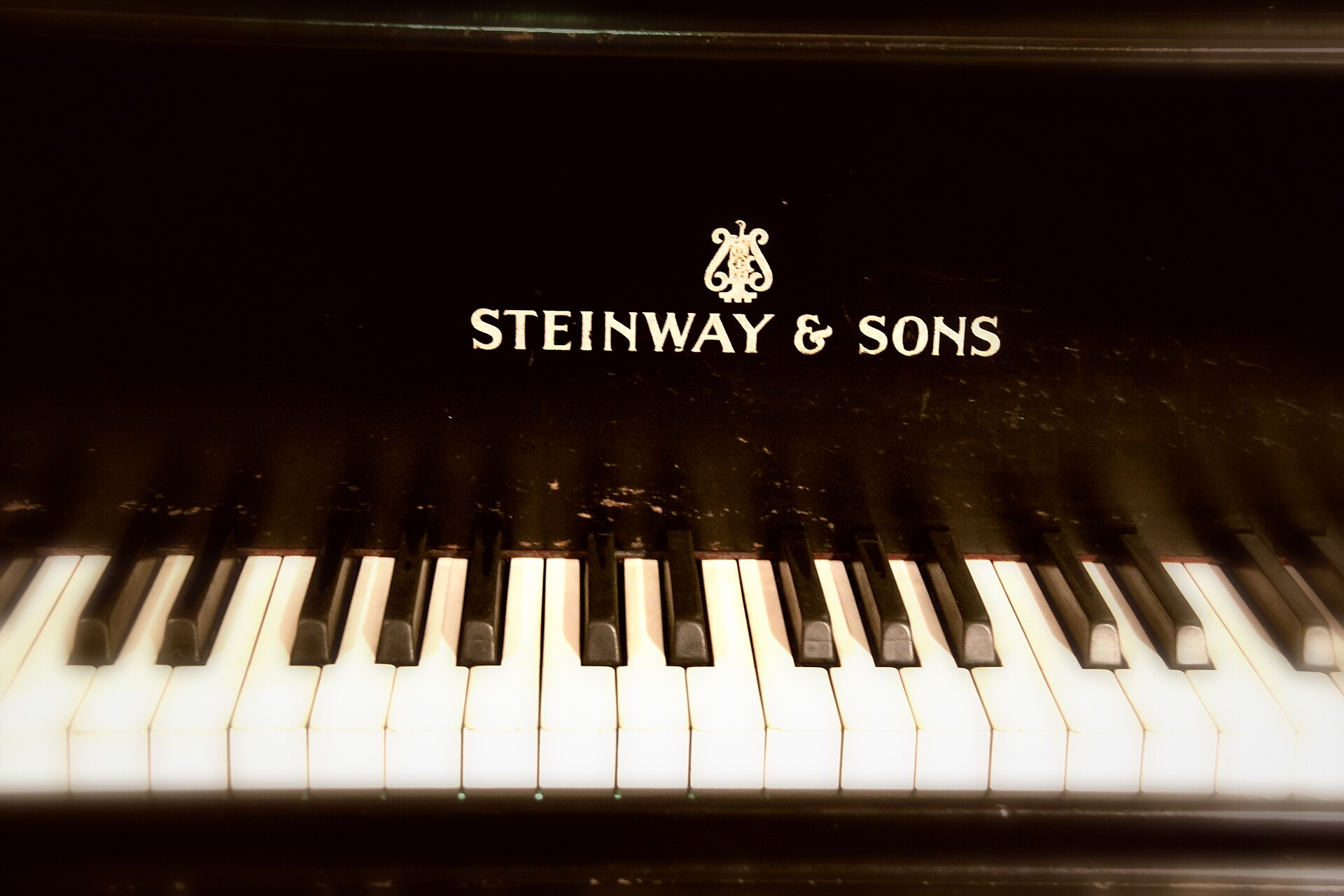
The Steinway D-274 concert grand measures 157 cm in width and 274 cm in length, and at a length of 274 cm it is the largest of all Steinway grand pianos; it weighs 500 kg. The very first Steinway grand piano built was a concert grand, and since 1884 the D-274 has remained unchanged in design.
More than 2,500 Steinway Artists worldwide, among them Lang Lang, Daniel Barenboim, and Christoph Eschenbach, prefer the concert grand by Steinway & Sons. The Steinway became the choice for approximately ninety-seven percent of concertizing artists, none of whom are compensated to endorse the instrument.
Steinway & Sons describes its Spirio as the world's finest high resolution player piano.
8. The Piano in Musical Life
When Mozart and Muzio Clementi began to write for the piano, a distinctively pianistic style of playing and composing developed, and the piano became the preferred medium for salon music, chamber music, concerti, and song accompaniments.
Chopin's work helped make the piano the most popular musical instrument of the 19th century. His piano style, with its strong emphasis on single notes and great variations in speed, was a break from traditional keyboard playing. His compositions, particularly their idiomatic and thoroughly modern style regarding both keys and pedals, influenced many later composers from Franz Liszt to Sergei Rachmaninoff.
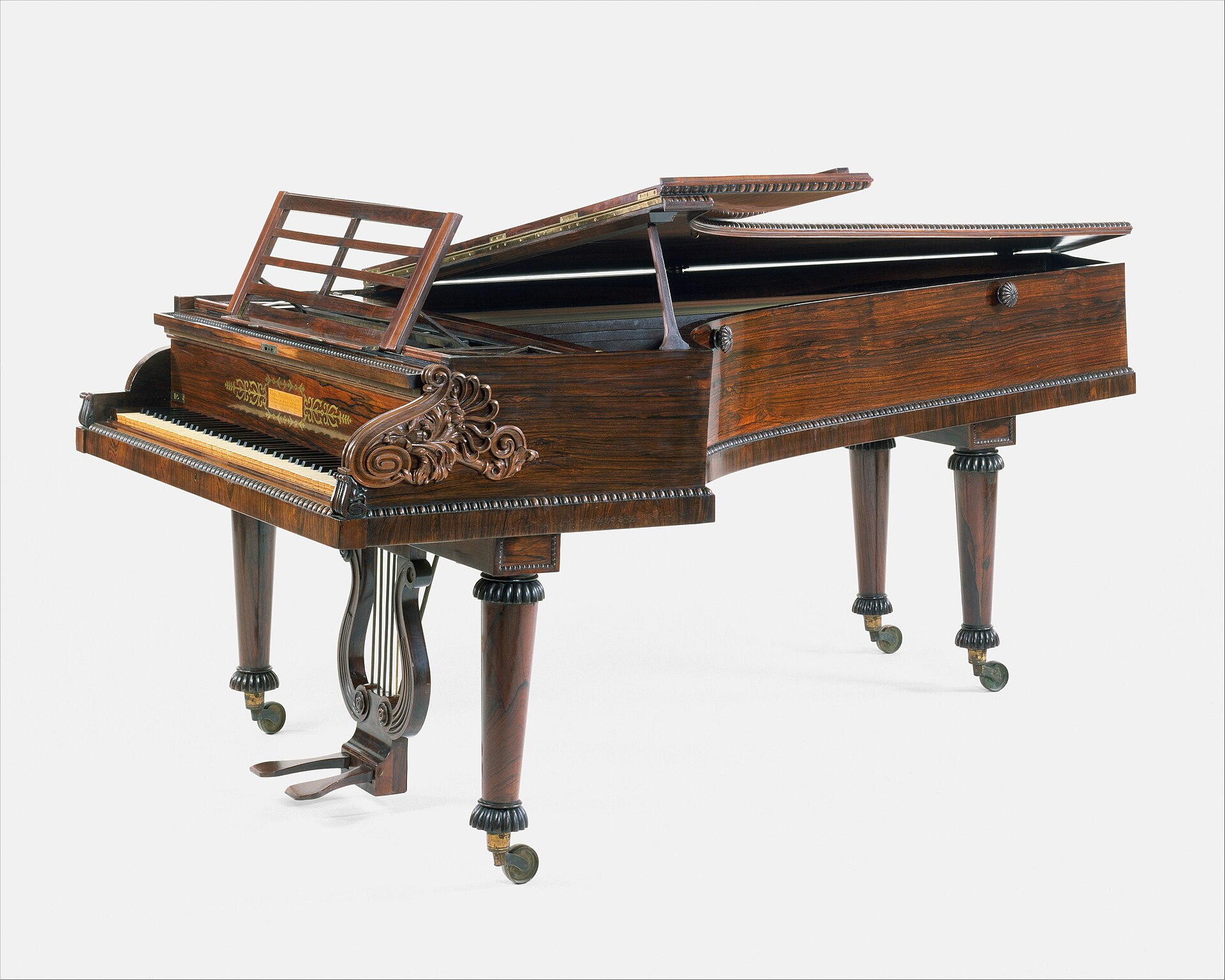
The firm of John Broadwood began producing grand pianos, in addition to their celebrated square pianos, in the late eighteenth century. The composer Joseph Haydn was impressed with Broadwood's improved model of 1788, which boasted increased dynamic range and flexibility. In the 1842 Broadwood grand piano, the frame is made from cast iron, a product of the industrial revolution, and its two pedals shift the keyboard and raise the dampers.
Yale's collection of keyboard instruments comprises more than 100 organs, clavichords, harpsichords, spinets, virginals, and pianos, representing every major regional school over three centuries.
9. Player Pianos and Electronic Instruments
A player piano is a piano that mechanically plays music recorded by means of perforations on a paper roll or digital memory on a computer disc.
In its original form as the Pianola, patented in 1897 by the American engineer E.S. Votey, the player piano was a cabinet called a piano player that was stationed in front of an ordinary piano and had a row of wooden fingers projecting over the keyboard. In the cabinet a paper roll passed over a tracker bar that activated the release of air by pneumatic devices that set in motion the wooden fingers that struck the notes on the keyboard.
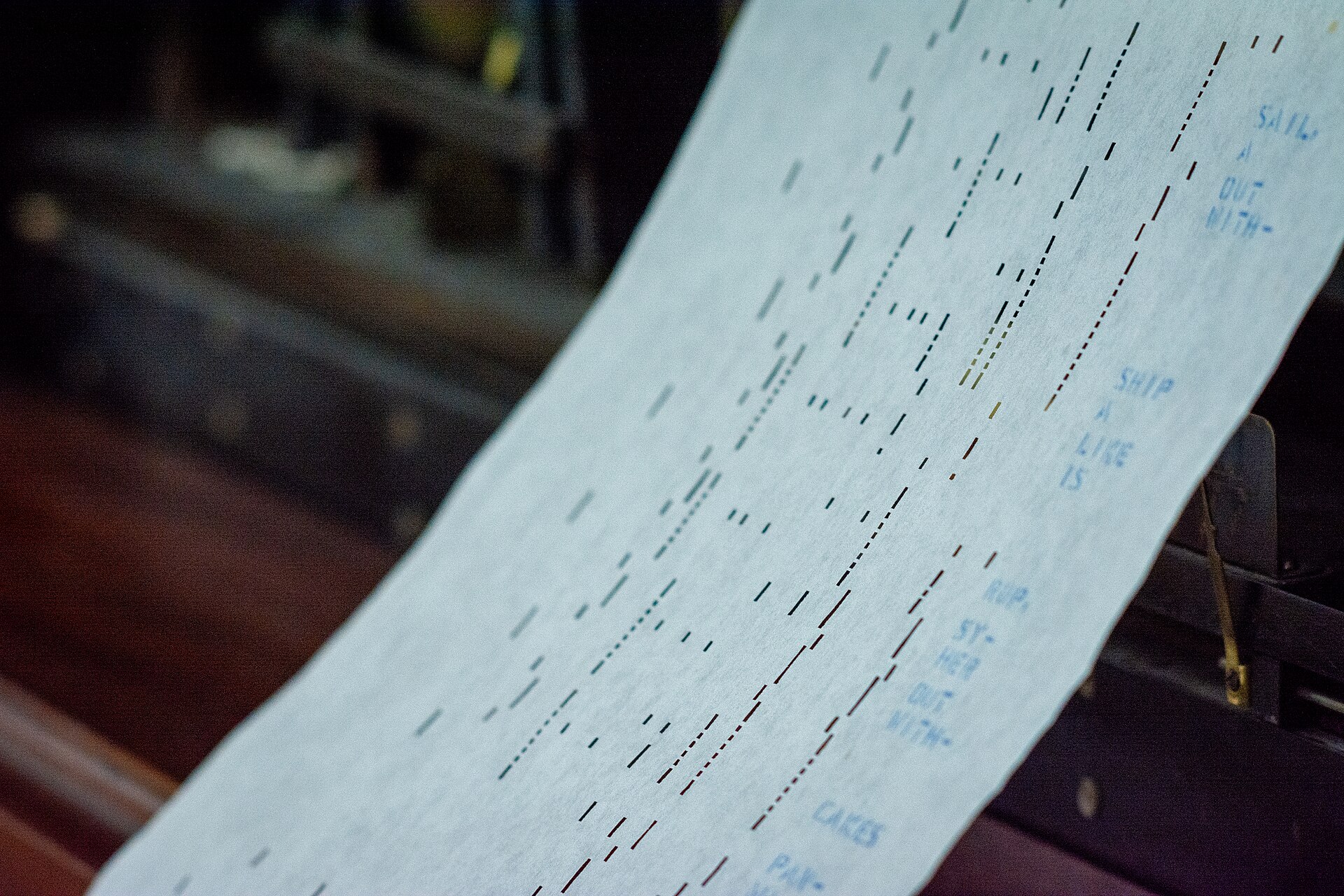
Player-piano manufacturers eventually incorporated devices into the player-piano roll that could approximate the performing nuances of an artist, and these highly sophisticated reproducing pianos came to be powered by electricity, serving homes and coin-operated amusement centres.
The player piano attracted composers who could write pieces without concern for the limitations of the human hand, including Igor Stravinsky's Etude for Pianola of 1917 and Paul Hindemith's Toccata for mechanical piano of 1926.
The vogue of the traditional player piano declined with the increasing popularity of the radio and phonograph in the 1930s; by the 1990s the Yamaha Corporation had introduced the Disklavier, an acoustic player piano equipped with a computer that could re-create on the piano virtually every nuance of a performance.
A significant development beginning in the 1930s was the electronic or electric piano, which relied on electroacoustic or digital methods of tone production heard through an amplifier and loudspeaker.
10. Timeline of Key Developments
-
about 1440Keyboard striking principleThe principle of the keyboard striking action already existed. 3Keyboard instrument: Overstringing (The piano) · Encyclopaedia Britannica ↗
-
1688Cristofori at the Medici courtBartolomeo Cristofori of Padua was appointed to the Florentine court of Grand Prince Ferdinando de' Medici to care for its musical instruments. 2The Piano: The Pianofortes of Bartolomeo Cristofori (1655-1731) · The Metropolitan Museum of Art, Heilbrunn Timeline of Art History ↗
-
about 1690Move to FlorenceCristofori moved from Padua to Florence. 2
-
1700First documented instrumentA Medici inventory mentions Cristofori's arpicimbalo, and an inscription by Meccoli records the instrument. 2
-
1711The name 'gravicembalo col piano, e forte'Maffei named the instrument gravicembalo col piano, e forte. 2
-
1713Death of FerdinandoFerdinando died, and Cristofori thereafter served Cosimo III. 2
-
1720Cristofori piano with 54 keysA Cristofori piano of this year has 54 keys. 2
-
1726Essentials of the modern actionCristofori had arrived at all the essentials of the modern piano action. 2
-
1732Giustini's sonatasGiustini's twelve sonatas were printed in Florence. 2
-
1730sSilbermann's pianosGottfried Silbermann began work on his own pianos based on Cristofori's design; an early model was dismissed by Johann Sebastian Bach as having too heavy a touch and too weak a treble. 2
-
1761Zumpe in LondonZumpe set up business as a piano maker in London. 2
-
1766The square pianoZumpe introduced the square piano. 2
-
1767Zumpe square pianoforteZumpe square pianofortes of this year are held by the V&A and the Met. 2
-
1768First public pianoforte recital in EnglandJohann Christian Bach gave the first public pianoforte recital in England and endorsed Zumpe's instrument. 2
-
1769Stein's PrellmechanikStein developed his Prellmechanik action, perhaps as early as this year. 2
-
1777Mozart visits SteinMozart visited Stein in Augsburg. 2
-
1786Érard in LondonÉrard opened a London branch. 2
-
1788Broadwood's improved modelBroadwood produced an improved model. 2
-
1800Vienna's makersApproximately sixty known makers were building pianos in Vienna. 2
-
1808Érard's double escapementÉrard's first double-escapement action was patented. 2
-
1809Érard grand actionÉrard's novel grand piano action is dated to this year. 2
-
1821Improved double escapementÉrard's improved double-escapement action was patented. 2
-
1826Felt hammer patentJean-Henri Pape patented the felt hammer. 2
-
1830sFanning bass stringsThe realization came that bass strings could fan out over treble strings. 3
-
1842Broadwood cast-iron frameA Broadwood grand piano was built with a cast-iron frame. 3
-
1853Steinway & Sons foundedSteinway & Sons was founded. 3
-
1855Complete cast-iron frame and overstringingSteinway & Sons built a grand piano with a complete cast-iron frame embodying the overstrung plan, in which the treble and middle strings fan out over most of the soundboard and the bass strings cross over them at a higher level; felt use became universal after this year. 3
-
1857First Steinway patentSteinway's first patent was granted. 3
-
1860Upright displaces squareThe upright piano had virtually replaced the square piano for home use. 3
-
1862String tension and the middle pedalString tension was determined at 16 tons, and Claude Montal invented the middle pedal. 3
-
1884D-274 design fixedThe D-274 has been unchanged in design since this year. 3
-
1897Pianola patentedThe Pianola was patented by E.S. Votey. 3
-
1930sElectronic piano and player declineThe electronic piano appeared, and the traditional player piano declined. 3
-
1990sYamaha DisklavierThe Yamaha Disklavier was introduced. 3
11. Frequently Asked Questions
What are the three pedals found on most pianos?
The damper pedal at the right lifts all the felt dampers; the left pedal, called the una corda, shifts the keyboard and action sideways so that only one of the unison strings is struck; and the middle pedal holds up the dampers only of the keys that are depressed. 1Piano · Encyclopaedia Britannica ↗
Who devised the pedal that sustains only notes already held down?
Claude Montal of Paris invented it in 1862; it appears as the middle pedal on three-pedal pianos. 3
When were the patents granted for the repetition action that underlies the modern action?
Sébastien Érard patented his first repetition, or double-escapement, action in 1808, and an improved version that is the basis of the modern action in 1821. 3
How many keys did the earliest surviving pianos have?
The 1720 Cristofori piano in the Metropolitan Museum of Art has 54 keys.2
When did the piano first appear in published music?
Twelve sonatas by Lodovico Giustini, printed in Florence in 1732, were the first music published for the piano.2
What was the first piano designed for the home rather than the concert room?
The square piano, introduced in 1766 by Johannes Zumpe in London, was a small rectangular instrument affordable to the growing middle class.8Square Piano by Johannes Zumpe, 1767 · The Metropolitan Museum of Art ↗
How did piano hammers change in the nineteenth century?
Felt-covered hammers were patented in 1826 by Jean-Henri Pape of Paris, though felt did not replace leather universally until after 1855.3
What was the first mechanical piano that played itself?
The Pianola was patented in 1897 by the American engineer E.S. Votey.16Player piano · Encyclopaedia Britannica ↗
How many parts go into a modern piano?
A modern piano contains 12,000 parts, most of them in the action.3
12. Timeline: from Cristofori's invention to the modern concert grand
- 1700Cristofori builds his first pianoA Florentine court inscription by Federigo Meccoli records that Cristofori first made the arpi cimbalo del piano e' forte, and a Medici inventory of the same year lists an arpicimbalo newly invented by him.
- 1711The instrument is named pianoforteScipione Maffei's enthusiastic description calls Cristofori's instrument a gravicembalo col piano, e forte, the first use of its eventual name.
- by 1726Cristofori reaches the essentials of the modern actionBy 1726 Cristofori had arrived at all the essentials of the modern piano action.
- 1732First music published for the pianoLodovico Giustini's twelve sonatas printed in Florence are the earliest music definitely written and published specifically for the piano.
- 1766Zumpe introduces the square piano in LondonJohannes Zumpe introduced the square piano, a small rectangular design that was affordable and appealed to the growing middle class.
- 1768First public pianoforte recital in EnglandJohann Christian Bach gave the first public pianoforte recital in England on an instrument he had acquired from Zumpe.
- about 1769Stein develops the PrellmechanikJohann Andreas Stein developed the Viennese Prellmechanik action, the first successful action to differ significantly from Cristofori's invention.
- 1777Mozart visits Stein in AugsburgMozart visited Stein, and a concert in Augsburg used three of Stein's pianos for a performance of his triple-clavier concerto.
- by 1800Vienna counts sixty piano makersBy 1800 there were approximately sixty known makers building pianos in Vienna.
- 1821Erard patents the modern double-escapement actionSébastien Érard's improved repetition action, patented in 1821, became the basis of the modern grand piano action.
- 1853Steinway & Sons is foundedHenry Engelhard Steinway founded Steinway & Sons in a Manhattan loft on Varick Street.
- 1855First overstrung grand with a complete cast-iron frameSteinway & Sons built a grand piano with a complete cast-iron frame embodying the overstrung plan.
- 1862String tension measured at sixteen tonsString tension was determined at 16 tons in 1862, rising to as much as 30 tons in modern instruments.
- since 1884The D-274 design settlesSince 1884 the Steinway D-274 concert grand has remained unchanged in design.
- 1897The Pianola is patentedThe Pianola, the player piano in its original cabinet form, was patented by the American engineer E.S. Votey.
- from the 1930sThe electric piano appearsA significant development beginning in the 1930s was the electronic, or electric, piano, which relied on electroacoustic or digital methods of tone production.
References (16)
- 1Piano — Encyclopaedia Britannica Web↩View source
- 2The Piano: The Pianofortes of Bartolomeo Cristofori (1655-1731) — The Metropolitan Museum of Art, Heilbrunn Timeline of Art History 1655 Web↩View source
- 3Keyboard instrument: Overstringing (The piano) — Encyclopaedia Britannica Web↩View source
- 4The Struck String (pianos) — Pennsylvania State University, Graduate Program in Acoustics (Dan Russell) WebView source
- 5Acoustics FAQ (music acoustics) — University of New South Wales, Music Acoustics WebView source
- 6Bartolomeo Cristofori — Encyclopaedia Britannica WebView source
- 7The Piano: Viennese Instruments — The Metropolitan Museum of Art, Heilbrunn Timeline of Art History WebView source
- 8Square Piano by Johannes Zumpe, 1767 — The Metropolitan Museum of Art 1767 Web↩View source
- 9Square Piano by Johannes Christopher Zumpe, 1767 — Victoria and Albert Museum, London 1767 WebView source
- 10Sébastien Érard — Encyclopaedia Britannica WebView source
- 11About Steinway & Sons — Steinway & Sons WebView source
- 12Steinway D-274 Concert Grand — Steinway & Sons WebView source
- 13Frédéric Chopin — World History Encyclopedia WebView source
- 14Mendelssohn Gallery 5 - Grand piano (John Broadwood & Sons, ca. 1842) — Yale University, Art and Music in Britain: Four Encounters 1842 WebView source
- 15View the Collection - Morris Steinert Collection of Musical Instruments — Yale School of Music WebView source
- 16Player piano — Encyclopaedia Britannica Web↩View source
 History of Paper
 Sistine Chapel