The Industrial Revolution
How Britain exchanged muscle and hand tools for coal, iron and steam — and built the factory world, 1709–1833
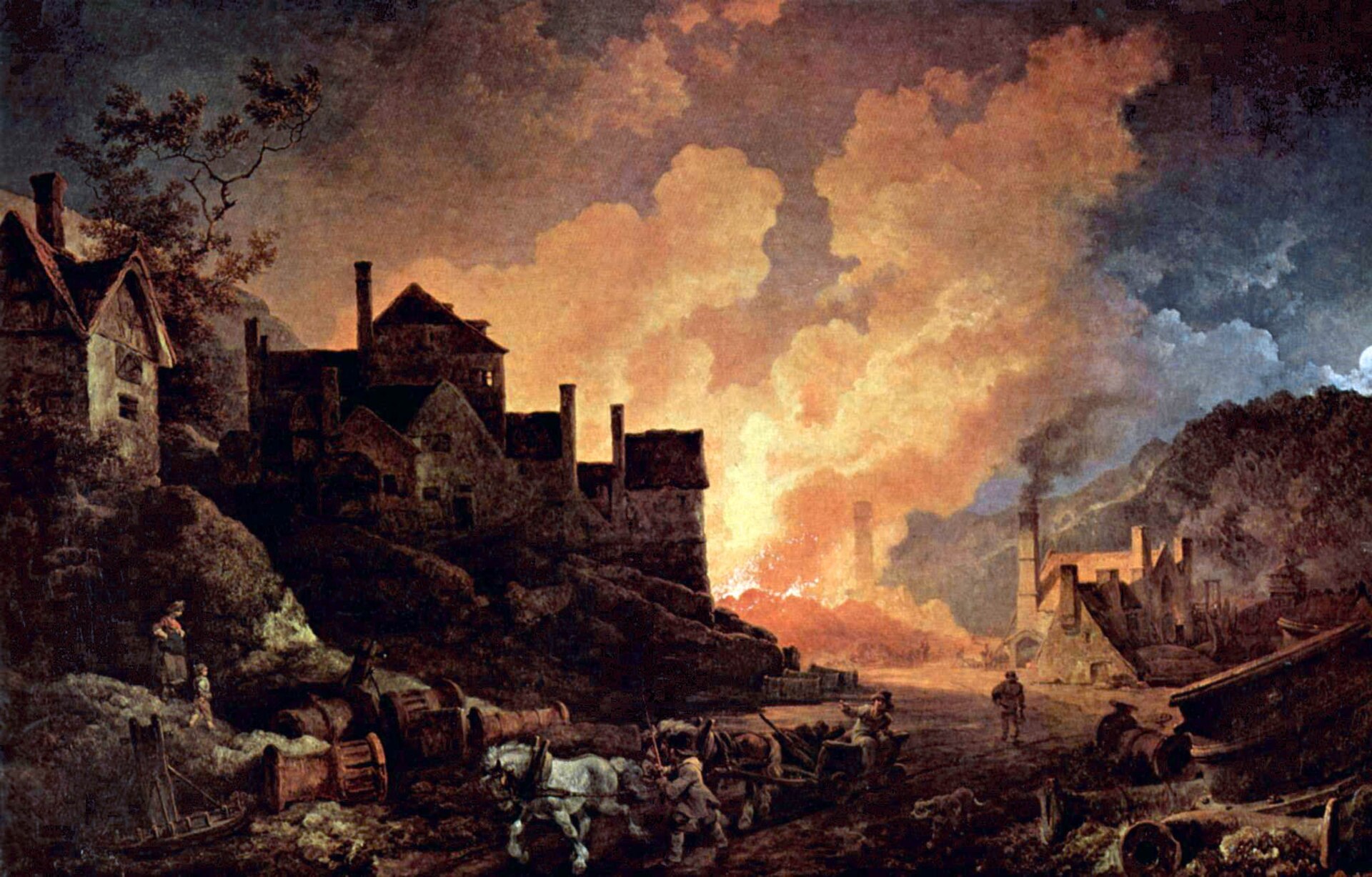
The Industrial Revolution was the transformation, beginning in 18th-century Britain, of an economy of small workshops, farms and hand tools into one dominated by machines, factories and mineral energy. Coal replaced wood and muscle; coke-smelted iron and improved steam engines powered new textile machines such as the spinning jenny and the power loom; canals, turnpike roads and then railways tied the country together. Enormous wealth was created — and with it child labour, crowded cities, and the first factory laws, as the transformation spread from Britain to the world.
What the Industrial Revolution was
The Industrial Revolution was the process of change from an agrarian and handicraft economy to one dominated by industry and machine manufacturing.1 It began in Britain in the 18th century and from there spread to other parts of the world.1 These technological changes introduced novel ways of working and living and fundamentally transformed society.1 Its main features were technological, socioeconomic and cultural.1
The term Industrial Revolution was first popularized by the English economic historian Arnold Toynbee (1852-83) to describe Britain's economic development from 1760 to 1840.1 Historians divide the revolution into two roughly consecutive parts.1 The first Industrial Revolution lasted from the mid-18th century to about 1830 and was mostly confined to Britain.1 The second lasted from the mid-19th century until the early 20th century and took place in Britain, continental Europe, North America and Japan.1
Why it began in Britain
Robert Allen argues that in Britain wages were high and capital and energy were cheap compared with other countries in Europe and Asia.2 The breakthrough technologies of the industrial revolution were therefore uniquely profitable to invent and use in Britain.2 These were the steam engine, the cotton mill and the substitution of coal for wood in metal production.2 The high-wage economy of pre-industrial Britain also fostered industrial development, because more people could afford schooling and apprenticeships.2
Contrary to traditional views of the earlier period as one of Malthusian stagnation, GDP per capita showed a persistent upward trend and doubled between 1270 and 1700.3 The transition to modern economic growth built on those earlier foundations.3 On the eve of the Industrial Revolution, Britain was already a highly developed, commercialised and sophisticated economy.4 A large proportion of its labour force was engaged in non-agricultural activities.4
In the early 18th century, British industry was still small-scale and largely a cottage industry.5 Demand for coal and the changes in agriculture — cheap rural labour and urban growth — set the scene for large-scale factories.5 For contemporaries it was the great age of steam, canals and factories, and it changed the face of the British economy forever.5
Textiles: the first machine age
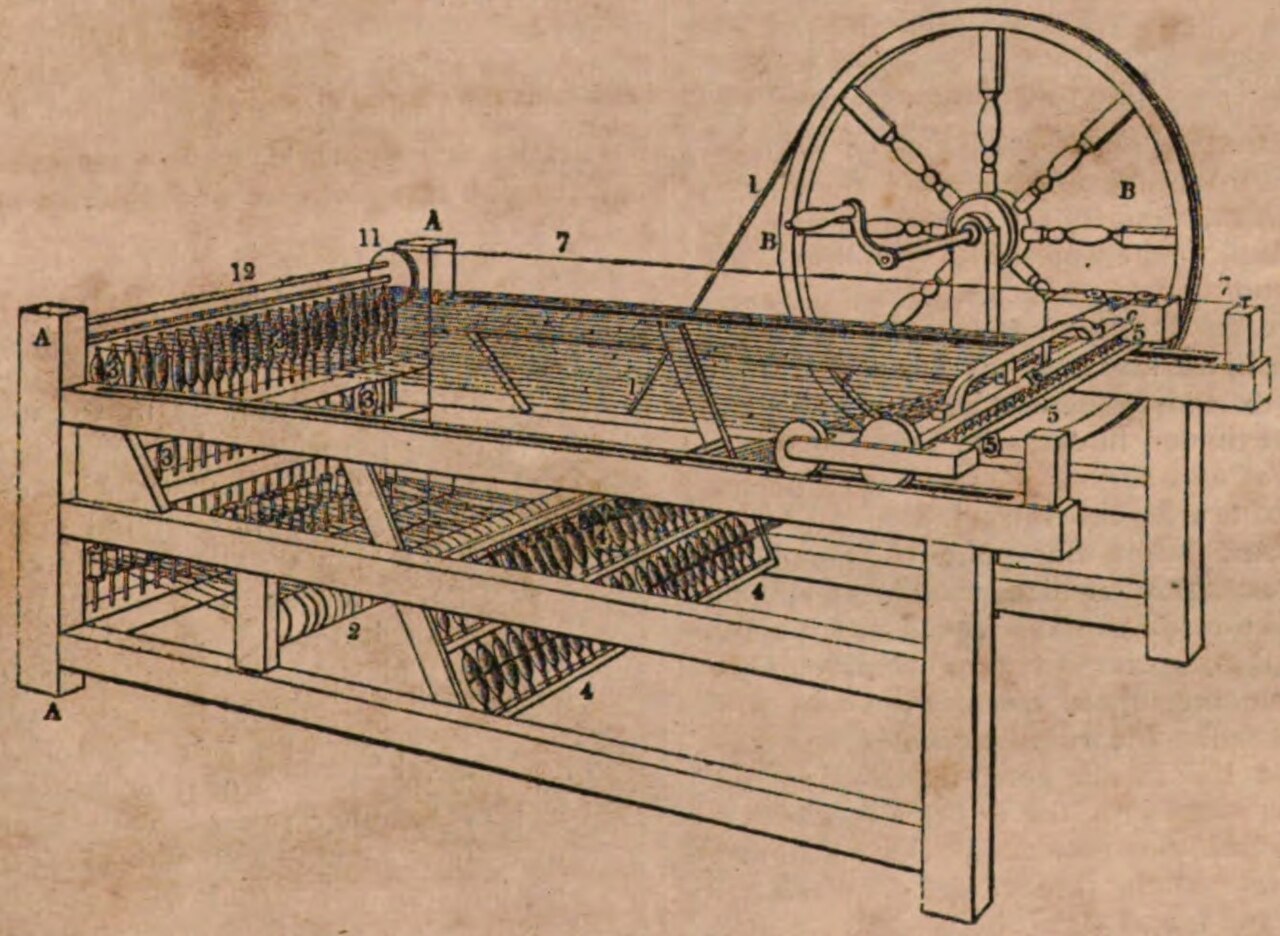
The flying shuttle, invented by John Kay in 1733, represented an important step toward automatic weaving.6 John Kay's flying shuttle sped up weaving, leading to a demand for faster yarn production.7 The hand-powered spinning jenny was patented by James Hargreaves in 1770.8 It was an early multiple-spindle machine for spinning wool or cotton.8
The development of the spinning wheel into the spinning jenny was a significant factor in the industrialization of the textile industry, though its product was inferior to Richard Arkwright's water frame.8 Arkwright became interested in spinning machinery at least by 1764, when he began construction of his first machine, patented in 1769.9 His water frame, so called because it operated by waterpower, produced a cotton yarn suitable for warp.9 With several partners, Arkwright opened factories at Nottingham and Cromford, and within a few years he was operating factories equipped with machinery for carrying out all phases of textile manufacturing from carding to spinning.9
Edmund Cartwright patented the first, inadequate power-driven loom in 1785.7 Subsequent improvements, including dressing machines to prepare warps and better take-up motions for winding cloth, made the power loom a practical tool.7 The shift from water to steam power further increased the speed of these machines, solidifying the factory system for textile production.7 Cartwright's power loom, developed in the 1780s, allowed for the mass production of the cheap and light cloth that was desirable both in Britain and around the Empire.5
The modern factory owes its origins to the mills at Cromford, where Richard Arkwright's inventions were first put into industrial-scale production.10 It was not until Arkwright constructed a water-powered spinning mill at Cromford in 1771, and a second, larger mill in 1776-77, that the "Arkwright System" was truly established.10 The Derwent Valley saw the birth of the factory system, when new types of building were erected to house the new technology for spinning cotton developed by Arkwright in the late 18th century.10 Richard Arkwright's cotton factories in Nottingham and Cromford employed nearly 600 people by the 1770s, including many small children, whose nimble hands made light work of spinning.5 Workers' housing associated with the mills survives intact across 24 km of the Derwent valley.10
The inventions at a glance
The first Industrial Revolution was carried by a small set of inventions in textiles, steam power and iron.1 New machines such as the spinning jenny and the power loom permitted increased production with a smaller expenditure of human energy.1
| Invention | Inventor | Date | What it changed |
|---|---|---|---|
| Flying shuttle | Invented by John Kay.6 | Patented in 1733.6 | An important step toward automatic weaving; its speed-up of weaving created a demand for faster yarn production.7 |
| Newcomen engine | Developed by Thomas Newcomen.11 | About 1712.11 | Allowed the more efficient pumping of deep mines.5 |
| Spinning jenny | Patented by James Hargreaves.8 | 1770.8 | Spun multiple spindles of yarn at once; a significant factor in the industrialization of the textile industry.8 |
| Water frame | Developed by Richard Arkwright.9 | Patented in 1769.9 | Produced a cotton yarn suitable for warp, stronger than jenny thread.9 |
| Watt's separate condenser and patent | Conceived by James Watt.12 | May 1765; patented in 1769.12 | Fuel-efficient steam power that in time opened factories to rotary machines.12 |
| Grooved rollers and puddling | Patented by Henry Cort.13 | 1783 and 1784.13 | Wrought iron in bulk; in the next 20 years British iron production quadrupled.13 |
| Power loom | Invented by Edmund Cartwright.7 | Patented in 1785.7 | Factory weaving, once later improvements made the machine practical.7 |
| Rocket | Built by Robert and George Stephenson.14 | Rainhill trials, October 1829.15 | A practical locomotive, winning at 36 miles per hour.14 |
| 1833 Factory Act | Passed by the British government.16 | 1833.16 | Reform of child labour in the textile mills.16 |
Steam: from Newcomen to Watt
In 1698 Thomas Savery patented a pump with hand-operated valves to raise water from mines by suction produced by condensing steam.11 In about 1712 another Englishman, Thomas Newcomen, developed a more efficient steam engine with a piston separating the condensing steam from the water.11 Newcomen's steam-driven piston engine allowed the more efficient pumping of deep mines.5 By 1800 perhaps 2,000 steam engines were at work in Britain.5
While repairing a model Newcomen steam engine in 1764, James Watt was impressed by its waste of steam.12 In May 1765 he arrived at the separate condenser, his first and greatest invention.12 In 1769 Watt took out the famous patent for a method of lessening the consumption of steam and fuel in fire engines.12 After the patent was extended by an act of Parliament, Watt and Matthew Boulton began a partnership in 1775 that lasted 25 years.12 In 1781 Watt devised the sun-and-planet gear for rotary motion, and in 1782 he patented the double-acting engine, in which the piston pushed as well as pulled.12 Watt's steam engine opened an entirely new field of application, enabling steam engines to operate rotary machines in factories such as cotton mills.12
Iron, coal and the making of an industrial landscape
It was in Coalbrookdale in 1709 that the Quaker Abraham Darby I developed the production technique of smelting iron with coke, which began the great 18th-century iron revolution.17 The blast furnace of Coalbrookdale, built in 1708, stands as a reminder of the discovery of coke.17 The Iron Bridge is the first known metal bridge, built in 1779 by Abraham Darby III from the drawings of the architect Thomas Farnolls Pritchard.17 The bridge at Ironbridge, the first bridge constructed of iron, had a considerable influence on developments in the fields of technology and architecture.17 Ironbridge is known throughout the world as the symbol of the Industrial Revolution.17 The Ironbridge Gorge World Heritage property covers 5.5 square kilometres (550 ha) at Telford, Shropshire, approximately 50 km north-west of Birmingham.17
In 1760 Roebuck introduced at the Carron ironworks a new kind of blast furnace by which iron ore could be smelted with coal as fuel, and in 1790 the steam engine was introduced to cause the blast.18 In 1783 Henry Cort obtained a patent for grooved rollers that produced iron bars more quickly and economically than the old methods of hammering, and the following year he patented his puddling process for converting pig iron into wrought iron.13 Cort's two inventions together had a tremendous effect on the iron-making industry in Britain; in the next 20 years British iron production quadrupled.13 Demand from iron smelting and steam engines drove coal output to more than ten million tons a year before the 18th century closed.18 In 1815 Davy's safety lamp was introduced to make mining safer.18
Canals, roads and railways: shrinking distances
In 1761 the Duke of Bridgewater opened a canal between his colliery at Worsley and the rapidly growing town of Manchester.5 Within weeks of the canal's opening, the price of coal in Manchester halved.5 By 1815, over 2,000 miles of canals were in use in Britain, carrying raw materials and manufactured goods by horse-drawn barge.5
New techniques in road construction, developed by pioneering engineers such as John McAdam and Thomas Telford, transformed the turnpike roads and led to the great road boom of the 1780s.5 The gains made by 18th-century road builders were remarkable.5 By the 1830s the stagecoach journey from London to Edinburgh took just two days, compared to nearly two weeks only half a century before.5
Richard Trevithick had completed the first successful steam-powered locomotive to haul a load on rails in 1804, long before the Stephensons' engine.15 On 27 September 1825, the first public passenger train, pulled by Stephenson's Locomotion, ran from Darlington to Stockton, transporting 450 people at 15 miles per hour, marking the birth of railway transportation.14 The Rainhill trials ran over nine days in October 1829 on a purpose-built line outside Liverpool, drawing over 10,000 spectators on the first day alone.15 Stephenson's Rocket, built with his son Robert, won the competition held as the Liverpool and Manchester line neared completion in 1829 and achieved a speed of 36 miles per hour.14 Investors saw the potential, and in a few short years Britain was in the grip of Railway Mania.15
Factories, cities and the price of progress
Many factories were dismal and dangerous places, likened by contemporaries to prisons.5 A working day of 12 hours was not uncommon, and accidents happened frequently.5 Children from workhouses worked hot, dusty shifts between fast-moving machines.5
As the Industrial Revolution gathered pace, thousands of unregulated factories sprang up all over the country.16 Dangerous machinery was used that could, and frequently did, cause serious injuries to workers.16 Perhaps one of the worst features of this new industrial age was the use of child labour.16 Very young children worked extremely long hours and could be severely punished for any mistakes.16
The factory system involved the adoption of machinery and artificial power, the use of a vastly greater amount of capital, and the collection of scattered labourers into great, strictly regulated establishments.18 The change was, comparatively speaking, sudden, all its main features having been developed within the period between 1760 and 1800; and it resulted in the raising of many new and difficult social problems.18 With the growth of factories and the increase in the size of business establishments, the employer and employee came to be farther apart, while at the same time the employees in any one establishment or trade were thrown more closely together.18 Trade unions naturally sprang up against the last Combination Acts of 1799 and 1800, which were an undisguised exercise of the power of the employing class to legislate in their own interest through Parliament.18
Reform: the 1833 Factory Act and after
In 1833 the Government passed a Factory Act to improve conditions for children working in factories.16 Young children had been working very long hours in workplaces where conditions were often terrible.16 The 1833 Act limited children aged 9-13 to no more than nine hours of work a day.16 It limited children aged 13-18 to no more than 12 hours a day.16 Under the Act, children were not to work at night.16 Two hours of schooling each day were required for the children.16 No child workers under nine were to be employed in the textile mills, and four factory inspectors were appointed to enforce the law.16
| Year | Act | What it provided |
|---|---|---|
| 1833 | Factory Act, textiles.16 | No child workers under nine; nine hours a day for ages 9-13 and 12 hours for ages 13-18; no night work; two hours of schooling daily; four factory inspectors.16 |
| 1844 | Textiles act.16 | Children 8-13 years could work six half-hours a day.16 |
| 1847 | Factory Act.16 | Women and children under 18 years of age could not work more than ten hours a day.16 |
Passing the Act did not stop mistreatment overnight.16 Enforcement depended on the four factory inspectors appointed under the Act.16 Inspectors' reports of 1836 and 1867 show how far enforcement fell short.16
A second Industrial Revolution and a global spread
The second Industrial Revolution lasted from the mid-19th century until the early 20th century, in Britain, continental Europe, North America and Japan.1 Its industries were electricity, steel and chemicals, and its emblematic products included the light bulb, the telephone, the internal-combustion engine and mass-produced automobiles.1 New energy sources including electricity, petroleum and the internal-combustion engine joined coal and steam.1
It was only when British engineers made the new technologies more cost-effective during the 19th century that the industrial revolution would spread around the world.2 China and India did not begin their first industrial revolutions until the 20th century.2
Legacy and debate
Findings published in the 1990s by Crafts and Harley and others reduced estimates of the rate of economic growth during the classic years of the industrial revolution, 1760 to 1830.4 As a macroeconomic phenomenon, Mokyr writes, the Industrial Revolution in its classical years stands today diminished and weakened.4 It is now also widely realised that the Industrial Revolution was not the same thing as industrialisation.4 For all that, the classic economic history judges the term Industrial Revolution neither exaggerated nor unsuitable for the transformation it names.18
The Industrial Revolution increased the overall amount of wealth and distributed it more widely than had been the case in earlier centuries, helping to enlarge the middle class.1 Workers acquired new and distinctive skills, and instead of being craftsmen working with hand tools they became machine operators, subject to factory discipline.1 The replacement of the domestic system of industrial production with the factory system and mass production consigned large numbers of people, including women and children, to long hours of tedious and often dangerous work at subsistence wages.1 Their miserable conditions gave rise to the trade union movement in the mid-19th century.1
In their own words
The passages below are quoted verbatim from the sources, from the pin factory to the historians' reckoning.19
Those ten persons, therefore, could make among them upwards of forty-eight thousand pins in a day.
Adam Smith, An Inquiry into the Nature and Causes of the Wealth of Nations (1776)
It was, comparatively speaking, sudden, all its main features having been developed within the period between 1760 and 1800; and it resulted in the raising of many new and difficult social problems.
Edward Potts Cheyney, An Introduction to the Industrial and Social History of England (1901)
[Never] on any occasion were so many scientific gentlemen and practical engineers collected together on one spot.
The Times (1829), on the Rainhill trials — as quoted by the National Railway Museum
As a macroeconomic phenomenon, then, the Industrial Revolution in its ‘classical years’, 1760–1830, stands today diminished and weakened.
Joel Mokyr, Accounting for the Industrial Revolution (2004)
Timeline of the Industrial Revolution, 1709–1833
Abraham Darby I smelts iron with coke at Coalbrookdale
It was in Coalbrookdale in 1709 that the Quaker Abraham Darby I developed the production technique of smelting iron with coke which began the great 18th century iron revolution. The blast furnace built there in 1708 survives, and UNESCO calls Ironbridge the “symbol of the Industrial Revolution.”
Newcomen’s steam-driven piston engine
As early as 1712 Thomas Newcomen first unveiled his steam-driven piston engine, which allowed the more efficient pumping of deep mines — the first practical use of steam power on an industrial scale.
John Kay patents the flying shuttle
The flying shuttle, invented by John Kay in 1733, represented an important step toward automatic weaving: using it, one weaver could weave fabrics of any width more quickly than two could before. Its speed-up of weaving created a demand for faster yarn production.
The Bridgewater Canal opens
The Duke of Bridgewater opened a canal between his colliery at Worsley and the rapidly growing town of Manchester. Within weeks of the canal’s opening the price of coal in Manchester halved. It was the first of the canal network that would exceed 2,000 miles by 1815.
Hargreaves’s spinning jenny multiplies the spindles
James Hargreaves’s spinning jenny (1764) mechanized spinning with multiple spindles at once; the hand-powered machine was patented in 1770. Its thread, suitable only for weft, was nevertheless “a significant factor in the industrialization of the textile industry.”
Watt conceives the separate condenser
While repairing a model Newcomen steam engine in 1764, Watt was impressed by its waste of steam. In May 1765 he suddenly came upon a solution — the separate condenser, his first and greatest invention — and in 1769 he took out the famous patent for “A New Invented Method of Lessening the Consumption of Steam and Fuel in Fire Engines.”
Arkwright patents the water frame
Richard Arkwright began construction of his first spinning machine by 1764 and patented it in 1769. His water frame — so called because it operated by waterpower — produced a cotton yarn suitable for warp, stronger than jenny thread; he soon opened factories at Nottingham and Cromford.
Arkwright’s Cromford mill: the factory system is born
It was not until Richard Arkwright constructed a water-powered spinning mill at Cromford in 1771, and a second, larger mill in 1776–77, that the “Arkwright System” was truly established. UNESCO says the Derwent Valley saw the birth of the factory system; the modern factory owes its origins to these mills.
Boulton and Watt form their partnership
After Watt’s patent was extended by an act of Parliament, he and Matthew Boulton in 1775 began a partnership that lasted 25 years, bringing capital and manufacturing skill to the steam engine — and adding rotary motion, the double-acting engine and the centrifugal governor that put steam power into factories.
The Iron Bridge is erected at Ironbridge
The community of Ironbridge draws its name from the famous Iron Bridge erected in 1779 by Abraham Darby III, built from the drawings of the architect Thomas Farnolls Pritchard. It is the first known metal bridge and, with the Coalbrookdale blast furnace, exerted great influence on the development of techniques and architecture.
Cort’s rollers and puddling transform iron-making
In 1783 Henry Cort obtained a patent for grooved rollers producing iron bars more quickly and economically than hammering, and the following year he patented his puddling process for converting pig iron into wrought iron. In the next 20 years British iron production quadrupled.
Cartwright patents the power loom
Edmund Cartwright patented the first inadequate power-driven loom in 1785; subsequent improvements, including dressing machines and better take-up motions, made the power loom a practical tool, and the shift from water to steam power further increased its speed, solidifying the factory system for textile production.
Trevithick’s Penydarren locomotive runs on rails
Engineer Richard Trevithick had completed the first successful steam-powered locomotive to haul a load on rails in 1804 — the product of a 500-guinea bet between the ironmasters Samuel Homfray and Richard Crawshay. It hauled 11 tons of iron and 70 men at a speed of 2.4 mph.
The first public passenger train
On September 27, 1825, the first public passenger train, pulled by Stephenson’s Locomotion, ran from Darlington to Stockton, transporting 450 people at 15 miles per hour, marking the birth of railway transportation.
The Rainhill trials and Rocket’s victory
Conducted over nine days in October 1829 on a purpose-built line near Rainhill, outside Liverpool, the trials drew over 10,000 spectators on the first day. Rocket — designed by Robert Stephenson, entered by Henry Booth and George Stephenson — won with a multi-tube boiler and self-regulating blast-pipe exhaust, and reached 36 miles per hour. The Liverpool & Manchester Railway ordered four more locomotives, and within a few years Britain was in the grip of “Railway Mania.”
The 1833 Factory Act regulates child labour
In 1833 the Government passed a Factory Act to improve conditions for children working in factories: no child workers under nine; no more than nine hours a day for ages 9–13 and 12 hours for 13–18; no night work; two hours of schooling daily; and four factory inspectors to enforce the law. Later acts extended protection — six half-hours for ages 8–13 in 1844, and a ten-hour limit for women and under-18s in 1847.
Frequently asked questions
What was the Industrial Revolution?
It was the process of change from an agrarian and handicraft economy to one dominated by industry and machine manufacturing.1 It began in Britain in the 18th century and from there spread to other parts of the world.1
Why did the Industrial Revolution begin in Britain?
In Britain wages were high and capital and energy were cheap compared with other countries in Europe and Asia, so the breakthrough technologies were uniquely profitable to invent and use there.2 On the eve of the Industrial Revolution Britain was already a highly developed, commercialised and sophisticated economy.4
Who first popularized the term Industrial Revolution?
The term was first popularized by the English economic historian Arnold Toynbee (1852-83), who used it to describe Britain's economic development from 1760 to 1840.1 Historians divide the revolution into a first part, mostly confined to Britain, and a second spanning Britain, continental Europe, North America and Japan.1
What was the spinning jenny, and what was its weakness?
It was an early multiple-spindle machine for spinning wool or cotton, and the hand-powered model was patented by James Hargreaves in 1770.8 Its thread lacked the strength of Arkwright's cotton yarn and was suitable only for weft.9
What was the Rocket, and how fast did it go?
Stephenson's Rocket, built with his son Robert, won the competition held as the Liverpool and Manchester line neared completion in 1829 and achieved a speed of 36 miles per hour.14 The Rainhill trials ran over nine days in October 1829, drawing over 10,000 spectators on the first day.15
What did the 1833 Factory Act do?
It improved conditions for children working in factories, limiting children aged 9-13 to nine hours of work a day and children aged 13-18 to 12 hours.16 Night work was banned, two hours of schooling each day were required, and four factory inspectors were appointed to enforce the law.16
The Industrial Revolution in numbers
Sources & citations
Every factual claim in this article is drawn from the sources below. Bracketed numbers in the text link to the corresponding source.
- 1
- 2
- 3
- 4
- 5
- 6
- 7
- 8
- 9
- 10
- 11
- 12
- 13
- 14
- 15
- 16
- 17
- 18
- 19