Alhambra
The Nasrid palace-city of Granada — its sultans, courts, gardens and inscriptions, from the 13th-century founding to the UNESCO World Heritage listing of 1984.
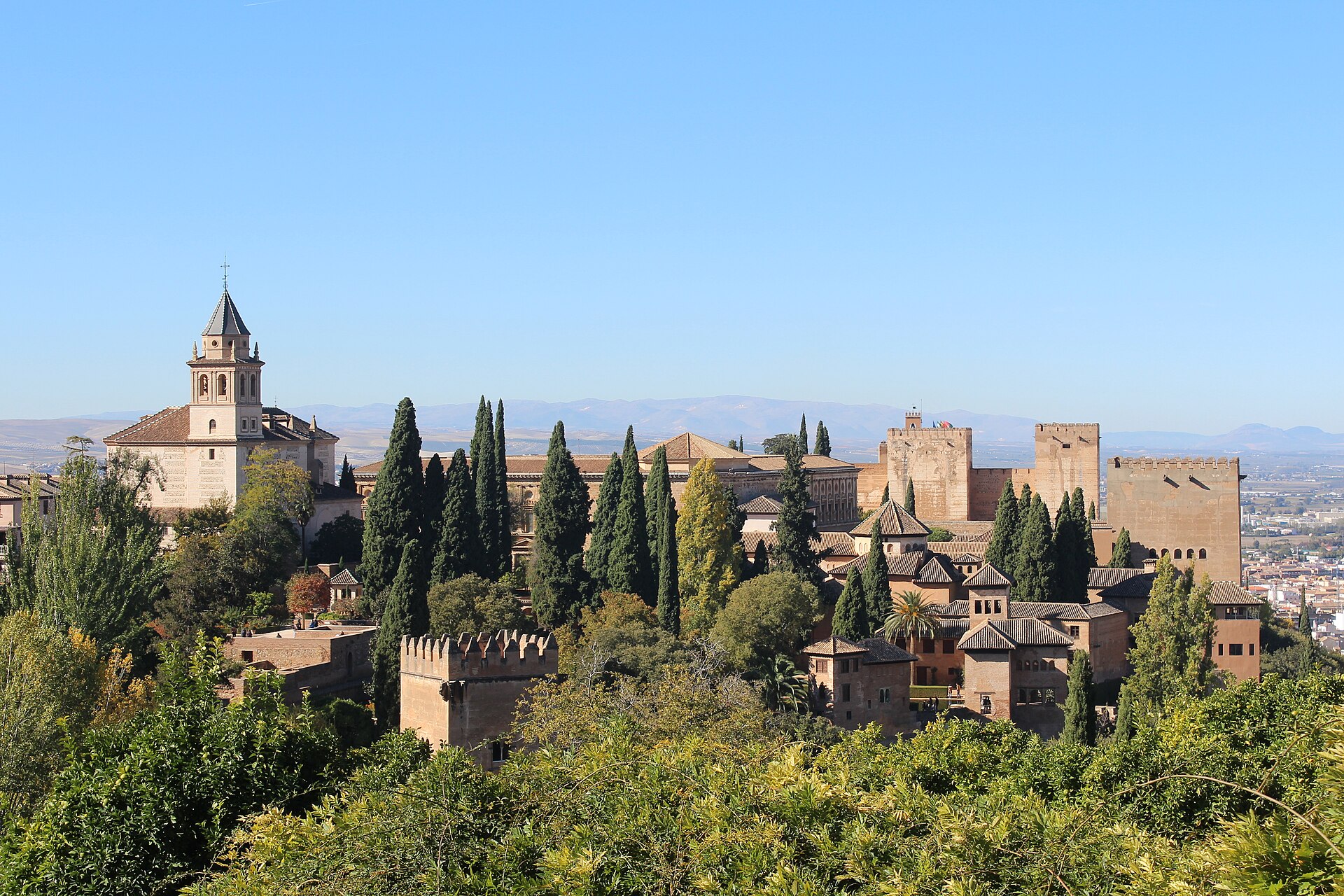
The Alhambra is the fortified palatine city built by the Nasrid sultans on the Sabika hill above Granada, chiefly between 1238 and 1358, and the only preserved palace-city of the Islamic period in the western Mediterranean. Its Nasrid palaces — the Mexuar, the Comares Palace with the Court of the Myrtles, and the Palace of the Lions — preserve some of the finest stucco, tile and muqarnas decoration of al-Andalus, while the adjoining Generalife served as the sultans' summer palace and gardens. After the conquest of Granada in 1492 the complex became a royal residence, Charles V added a Renaissance palace, and the site suffered damage in the Peninsular War before restoration began in 1828; it was inscribed on the UNESCO World Heritage List in 1984, extended in 1994 to include the Albayzín.
In this article
- 1Overview
- 2Name
- 3Setting and Enclosure
- 4History
- 5Nasrid Palaces and Principal Structures
- 6Alcazaba
- 7Generalife
- 8Palace of Charles V and Museum
- 9Gardens, Woodland and Biodiversity
- 10World Heritage Listing
- 11Management and Conservation
- 12Visiting
- 13Timeline
- 14Timeline: from the Zirid taifa to the World Heritage listing
- 15Frequently asked questions
- 16Knowledge graph
Overview
The Alhambra is the fortified palatine city of the Nasrid rulers of Granada, serving at once as palace and fortress. It stands in Granada, in Andalusia, Spain, on the hill of Sabika above the Darro river and opposite the Albaicín. It is one of the most visited historic sites in the world.
The Alhambra is currently the only preserved palatine city of the Islamic period, and it constitutes the best example of Nasrid art in its architecture and decorative aspects. It was conceived as a royal city rather than merely a fortified palace.
1. Name
The name Alhambra signifies "the red" in Arabic and is probably derived from the reddish colour of the tapia, or rammed earth, of which the fortress's outer walls were built. The name also appears in various forms, the most common being al-Qalat al-Hamra, meaning the red castle or the red fort.
2. Setting and Enclosure
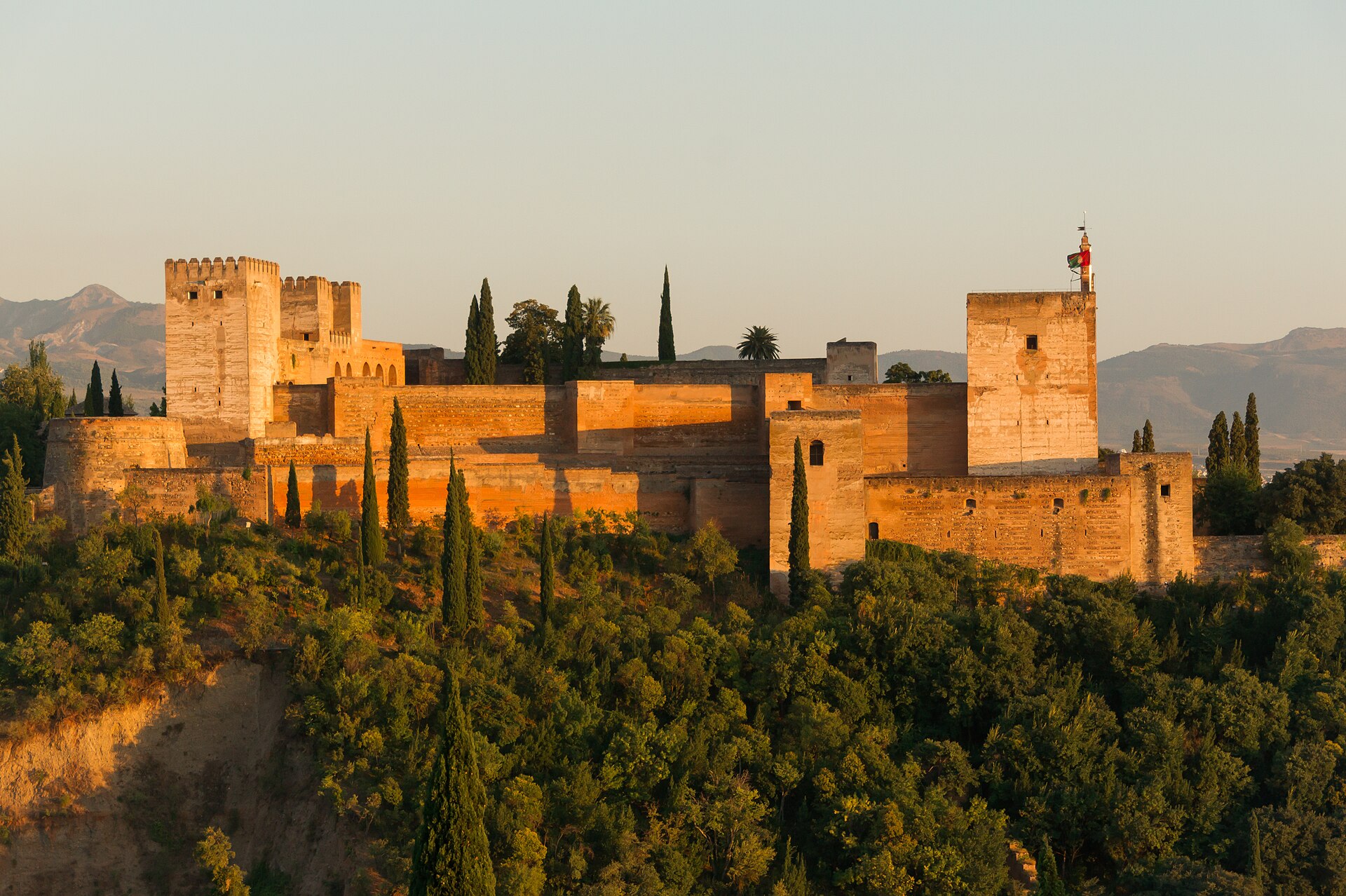
The Alhambra is the main enclave of a complex territorial structure and demonstrates its importance through its dominion over the city of Granada. Nearly 26 acres were enclosed within four main gates. Within that enclosure stood structures of three distinct purposes: a residence for the ruler and close family, the Alcazaba citadel with barracks for the elite guard, and a medina near the Puerta del Vino where court officials lived and worked. The complex has four large gateways in the Almohad tradition, the most monumental of which is the Gateway of Justice.
3. History
The first Nasrid sultan, Muhammad I, came to power in 1232 and founded the complex, which underwent frequent additions and changes. The Nasrid dynasty, founded by Muhammad I ibn Nasr of Arjona, ruled from 1232 to 1273 over Granada and the neighboring cities of Jaén, Almería, and Málaga in the southern Iberian Peninsula. Much of the splendid interior decoration of the Alhambra is ascribed to Yusuf I (died 1354).
In January 1492 Granada, the seat of the Moorish kingdom and the final stronghold of the Moors in Spain, fell to the Catholic Monarchs Ferdinand II and Isabella I. When the Reconquista was completed in 1492 the population of the Albayzin quarter of Granada rose to 60,000 inhabitants.
The Napoleonic occupation was a negative episode for the Alhambra because of the demolition in 1812 upon the withdrawal of the French army, and only the courage of a Spanish soldier prevented its almost total destruction.
The Council of the Alhambra oversees the refurbishment and restoration activities of the monument's historic buildings and spaces. The Alhambra and Generalife Trust is an autonomous body attached to the Ministry of Culture of the Junta of Andalusia and was created by Decree 59/1986 of the 19th of March.
4. Nasrid Palaces and Principal Structures
Three royal palaces were built during the fourteenth century: the Comares Palace, the Palace of the Lions and the Partal Palace. A large fourth palace was later begun by the Christian ruler Carlos V. The palaces that survive are the Partal Palace, the Palace of the Myrtles and the Palace of the Lions.
Beyond the Comares façade a dark winding passage leads to a covered patio around a large courtyard with a pool, now known as the Court of the Myrtles, the focal point of the palace. The Comares Tower, the largest tower of the Alhambra, contains the Hall of the Ambassadors, a throne room built by Yusuf I that exhibits the most diverse decorative and architectural arts in the Alhambra. The hall is lit by double arched windows and by arched grille windows set high in the walls; its walls at eye level are lavishly decorated with tiles laid in intricate geometric patterns, and the remaining surfaces are covered with intricately carved stucco motifs.
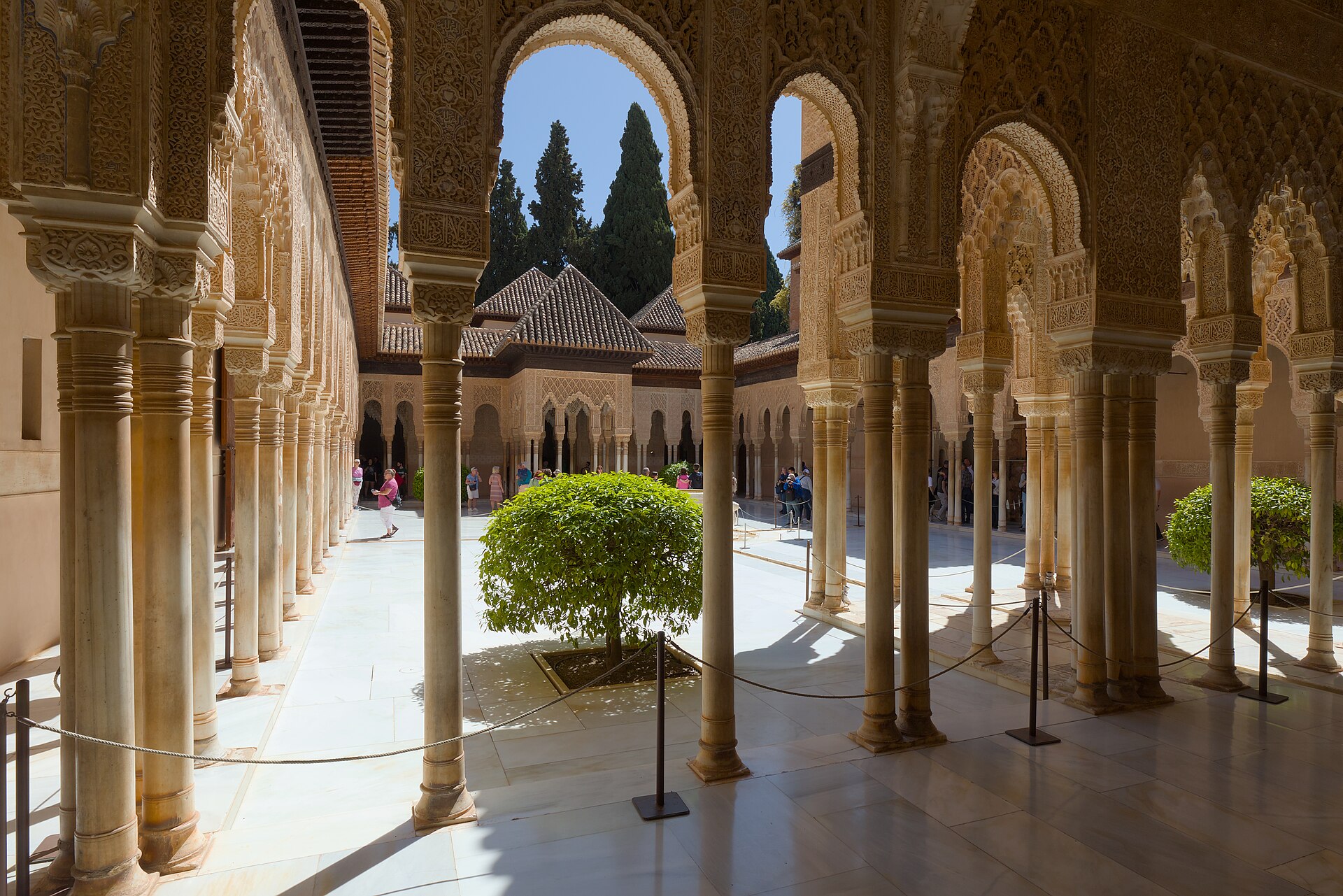
The Fountain of the Lions, built by Muhammad V, is the most celebrated feature of the Palace of the Lions: a fountain with a complex hydraulic system whose alabaster basin rests on the backs of twelve white marble lions, emblems of strength and courage, at the intersection of two water channels that form a cross in the centre of the Court of the Lions. Two other halls, the Hall of the Two Sisters and the Hall of the Abencerrajes, were residential apartments with rooms on the second floor, each with a large domed room sumptuously decorated with carved and painted stucco in muqarnas forms and elaborate star motifs.
The Nasrid palace areas included the Mexuar for state affairs, the Comares Palace around the Court of the Myrtles and the private Palace of the Lions. The most important part of the Bath of Comares is the bayt al-maslaj, popularly known as the Room of the Beds, which has two large, slightly raised bed-chambers on each side of the main room.
5. Alcazaba
The Alcazaba, or citadel, is the oldest part of the Alhambra, and only its massive outer walls, towers, and ramparts are left. It served as the fortress that guarded the royal palace, which forms only a part of a stronghold whose walls, studded with towers, stretch around the crest of a hill and overlook the city. In the 13th century the Nasrids gave the Alcazaba its current appearance, adding large towers including the Vela tower to the west and the Homenaje, Quebrada and Adarguero towers to the east, while the whole enclosure was surrounded on the exterior with a patrol road and an important access through the Puerta de las Armas.
6. Generalife
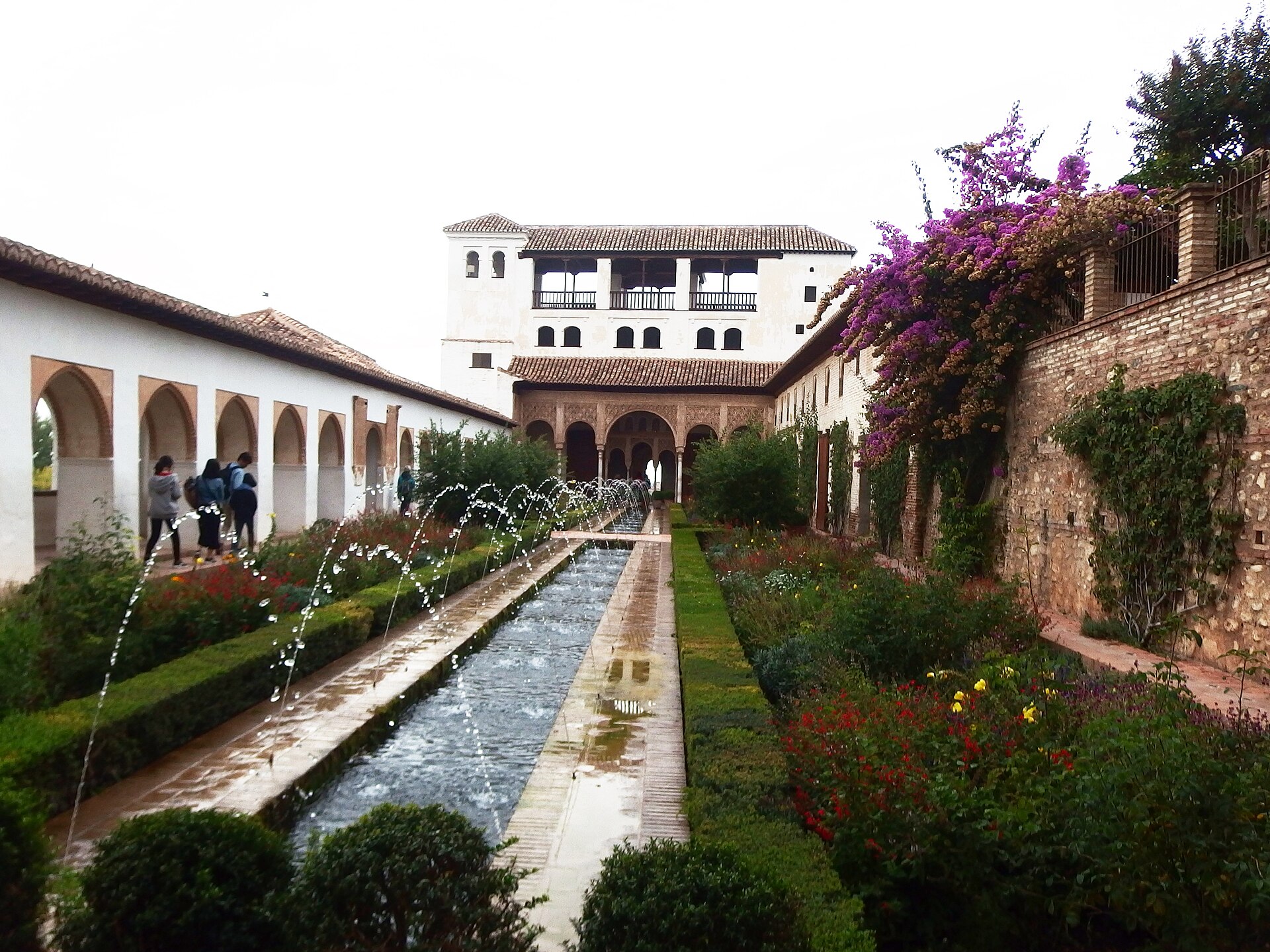
The gardens of the Generalife lie to the east of the Alhambra fortress and residence, and stand as an example of a rural residence of the emirs built during the 13th and 14th centuries. The Nasrid rulers did not limit themselves to building within the walls of the Alhambra, and one of the best preserved Nasrid estates just beyond those walls is the Generalife. Its name comes from the Arabic Jannat al-arifa, in which jannat means paradise and, by association, a garden or place of cultivation.
The Generalife area of the site is presented through its theatre, the Court of the Main Canal, the Promenade of the Cypress Trees, the Walk of the Oleanders, the lower and high gardens, the Generalife palace and the Water Stairway.
7. Palace of Charles V and Museum
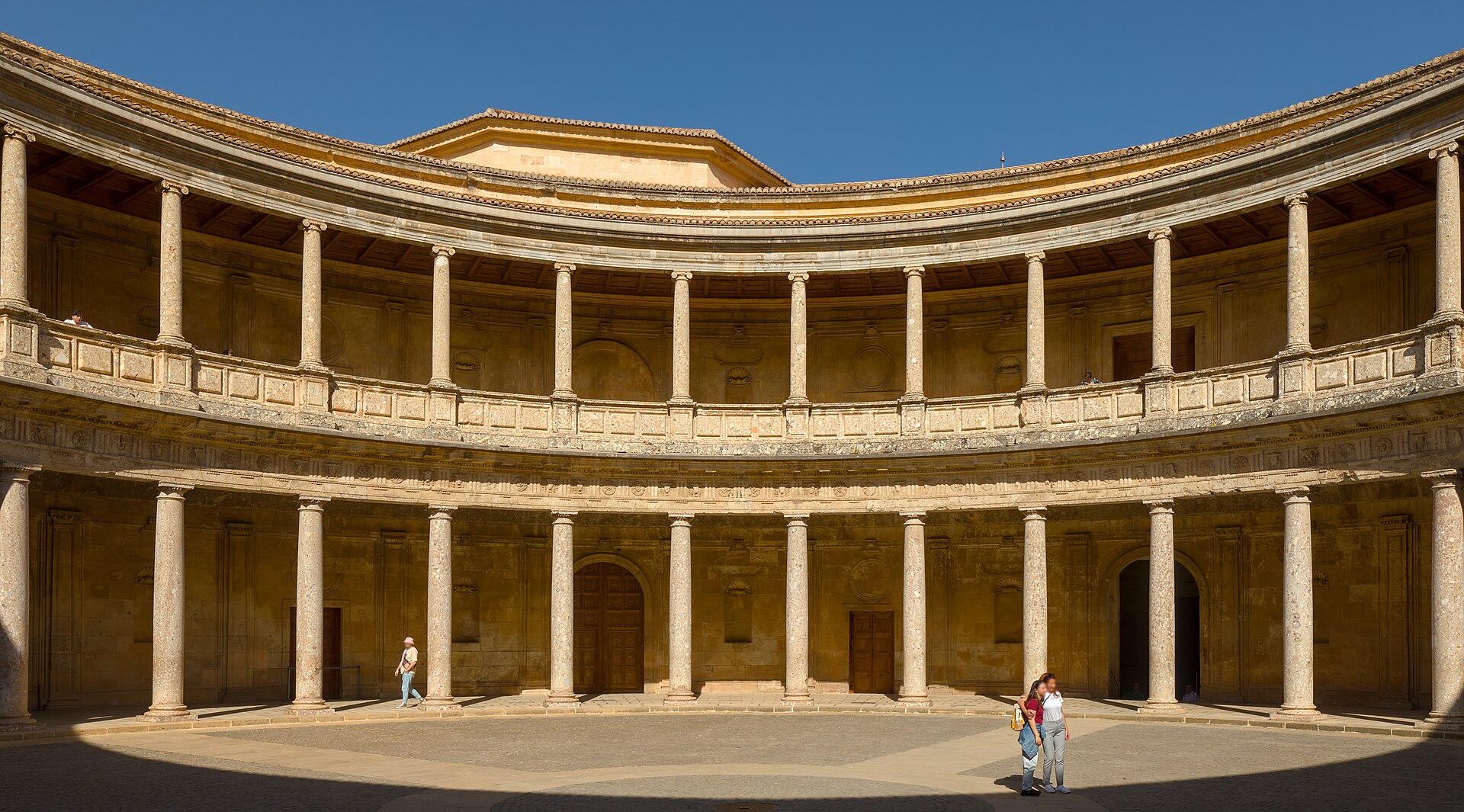
The Palace of Charles V is a Renaissance palace commissioned by Charles V in 1526 and designed by Pedro Machuca, raised in the Italianate manner after the emperor destroyed part of the complex to make room for it. The Museum of the Alhambra occupies the ground floor of that palace, laid out in seven rooms dedicated to culture and Hispano-Muslim art.
The Museum holds the best collection of Nasrid art in the world, its specimens drawn from artefacts found in excavations and restoration work at the Alhambra. A separate institution, the Museum in Honour of Ángel Barrios, gathers instruments, scores and correspondence dedicated to the Granada-born composer.
8. Gardens, Woodland and Biodiversity
The Alhambra and Generalife complex is described as a valuable cultural landscape and a large environmental unit, made up of different units of vegetation capable of accommodating rich and varied biodiversity. The Green Alhambra is the living part of the monumental complex, formed by its flora and fauna and the natural territory on which it stands, and it also comprises the gardens, the vegetable gardens, the croplands and the forests.
9. World Heritage Listing
The property was inscribed on the World Heritage List in 1984 under criteria (i), (iii) and (iv), and its boundaries were significantly modified in 1994. The listed property is Alhambra, Generalife and Albayzín, Granada (property 314), with an area of 450 ha and a buffer zone of 67 ha.
Under criterion (i) the Alhambra and the Generalife contain all the known artistic techniques of the Hispano-Muslim world on the basis of a proportional system, with particular emphasis on the aesthetic value of water and vegetation. Under criterion (iii) the use of plaster, wood and ceramics as decorative elements is unique, and Arabic epigraphy transformed the constructions into an ensemble of talking architecture. Under criterion (iv) they bear exceptional testimony to Muslim Spain in the 13th and 15th centuries and form a remarkable example of palatine residences of medieval Islam.
The inscribed components are complementary and form a coherent whole, while the Albayzín remains remarkably well preserved and maintains its original residential character. The property stands on two adjacent hills separated by the river Darro, its components representing the residential district of the Albayzín and the Alhambra.
In its 1984 evaluation ICOMOS recommended that the Spanish Government define a large area of protection below the monumental zone of the Alhambra and the Generalife in order to prevent the construction of future buildings and parking lots. The Albayzin quarter, which is the oldest part of the ensemble, should not be considered a buffer zone because its universal value is complementary to and chronologically earlier than the site already on the List. ICOMOS recommended that the proposed extension of World Heritage monument number 314 be approved under the existing criteria (i), (iii) and (iv), and did not consider inscription under criterion (v) necessary or appropriate.
10. Management and Conservation
The inscribed property is administered by the Council of the Alhambra and the Generalife, an autonomous body that includes a Plenary and a Permanent Commission, and by the Albayzín Municipal Foundation of the Granada Town Hall.
11. Visiting
The General Day Tour, which covers the Alcazaba, the Nasrid Palaces and the Generalife, is offered in the official ticket listing at 22.27 EUR. A combined ticket that adds the Rodríguez-Acosta Foundation to the Alcazaba, the Nasrid Palaces and the Generalife costs 25.45 EUR. The Alhambra Experiences option combines a night visit to the Nasrid Palaces with a daytime visit to the Alcazaba, the gardens and the Generalife Palace.
A ticket for the Andalusian monuments costs 8.48 EUR. Group visits are arranged for parties with a minimum of 11 and a maximum of 30 people. The usual ways to reach the Alhambra are on public transport, in a private vehicle or on foot.
12. Timeline
-
1238–1358Chief constructionThe Alhambra was built chiefly in these years, on a plateau overlooking Granada, in the reigns of Ibn al-Ahmar, founder of the Nasrid dynasty, and his successors. 5Alhambra · Encyclopaedia Britannica ↗
-
1492Expulsion of the MoorsAfter the expulsion of the Moors, much of the Alhambra's interior was effaced. 5
-
1526Charles V's demolitionCharles V destroyed part of the complex to build a new palace and rebuilt portions in the Renaissance style. 5
-
1828Repair program begunAn extensive repair and rebuilding program was undertaken by the architect José Contreras. 5
-
1830Endowment by Ferdinand VIIThe repair program was endowed by Ferdinand VII. 5
-
1847Rafael Contreras continues the workAfter the death of José Contreras, his son Rafael continued the work for nearly four decades. 5
13. Timeline: from the Zirid taifa to the World Heritage listing
- 1031Collapse of the Caliphate of CórdobaAfter the civil war that followed the fall of the Caliphate of Córdoba the capital of the province moved from Elvira to Granada, where the Zirids established their taifa kingdom and their court in the Albaicín, and Samuel ibn Nagrella built a palace on the abandoned hill of Sabika.
- 1232Muhammad I founds the Nasrid dynastyMuhammad I ibn al-Ahmar came to power in 1232, founding the Nasrid dynasty, which ruled Granada and neighbouring Jaén, Almería and Málaga in the southern Iberian Peninsula.
- 1238Construction of the Alhambra beginsMuhammad I established the Nasrid residence on the Sabika hill; the Alhambra was built chiefly between 1238 and 1358 in the reigns of Ibn al-Ahmar and his successors.
- 1302Partal Palace builtThe Partal Palace was built during the reign of Muhammad III, one of the palace units of the Alhambra that survive today.
- 1314Work on the Palace of the MyrtlesUnder Isma'il I the palace complex around the Court of the Myrtles was begun, to be continued under Yusuf I and Muhammad V.
- 1333Yusuf I builds the Hall of the AmbassadorsYusuf I, whose reign began in 1333, built the Hall of the Ambassadors inside the Comares Tower, the largest tower of the Alhambra.
- 1362Muhammad V and the Palace of the LionsIn the second reign of Muhammad V, from 1362 to 1391, the Palace of the Lions was built around its courtyard with the twelve-lion fountain.
- 2 January 1492Granada falls to the Catholic MonarchsGranada, the seat of the Moorish kingdom and the final stronghold of the Moors in Spain, fell to Ferdinand II and Isabella I, ending Nasrid rule in al-Andalus.
- 1526Charles V commissions a Renaissance palaceCharles V decided to build a Renaissance palace inside the Alhambra, designed by Pedro Machuca, in direct juxtaposition with the Nasrid palaces.
- 1812French troops blow up towersDuring the Peninsular War a French force under Horace-François-Bastien Sébastiani blew up some of the towers of the Alhambra, and the rest of the buildings narrowly escaped the same fate.
- 1828Restoration begins under José ContrerasAn extensive repair and rebuilding programme was undertaken by the architect José Contreras and endowed by Ferdinand VII in 1830.
- 1829Washington Irving lodges in the AlhambraWashington Irving, who had visited Granada in 1828, returned the following year and was lent the Governor's apartments in the Alhambra, where he gathered the material for The Alhambra.
- 1870Declared a national monumentThe Alhambra, which had been a palatial city, a Christian royal household and the seat of the General Captaincy of the Kingdom of Granada, was declared a Monument in 1870.
- 1984UNESCO World Heritage inscriptionThe Alhambra and the Generalife were inscribed on the World Heritage List under criteria (i), (iii) and (iv).
- 1994Albayzín added to the listingThe Albayzín quarter was added to the World Heritage listing in 1994, extending the property to the medieval Moorish town opposite the Alhambra.
14. Frequently asked questions
When did people first build on the hill of Sabika?
In the 9th century there was already news of constructions on the hill of Sabika, where the Alhambra would later be built, although it is believed that some construction existed in the Roman period and even earlier 11History of the Alhambra · Patronato de la Alhambra y Generalife ↗. After the civil war that followed the Caliphate of Córdoba, the Zirids established the Granada Taifa Kingdom and set up their court in the Cadima or Vieja Alcazaba in the Albaicín, and the first minister Samuel ibn Nagrella reconstructed the abandoned buildings on the hill of Sabika and installed his palace there 11.
How did the Alhambra change after the Christian conquest?
From 1492 the Alhambra was established as the Royal Household with a separate jurisdiction placed in the charge of Tendilla, and the Catholic Monarchs ordered extensive repairs carried out mainly by Moorish craftspeople 11. It was at once a palatial city, a Christian Royal Household, the seat of the General Captaincy of the Kingdom of Granada and a military fortress, and in 1870 it was declared a Monument 11.
What damage did the Alhambra suffer in the nineteenth century?
In 1812 a French force under Horace-François-Bastien Sébastiani blew up some of the towers of the Alhambra during the Peninsular War, and in 1821 an earthquake caused further damage to the complex 5.
How much woodland and garden does the site contain?
More than 15 ha of woodland, over 150.000 square metres in the source, lie within the site, together with about 12 ha of gardens 17The Green Alhambra: gardens, woodland and biodiversity · Patronato de la Alhambra y Generalife ↗.
Who was the last Nasrid ruler, and how did Nasrid rule end?
The marriage of Ferdinand and Isabella united the Christian kingdoms of Castile and Aragon and helped bring about the downfall of the Nasrids; their last ruler, Muhammad XII, known as Boabdil, was exiled to the Maghrib in 1492 and the end of Nasrid rule closed almost 800 years of Islamic presence on the Iberian Peninsula 4The Art of the Nasrid Period (1232-1492) · The Metropolitan Museum of Art, Heilbrunn Timeline of Art History ↗.
How did the Alhambra come to be written about in the English-speaking world?
Irving visited Granada in 1828 and returned the following year, when the Governor's apartments in the Alhambra were lent to him as lodgings 14The Alhambra (Washington Irving, 1911 Macmillan edition) · Project Gutenberg ↗. His affection for the Alhambra prompted him to describe its courts and gardens and to record its legends 14.
References (18)
- 1Alhambra — Archnet, Aga Khan Trust for Culture WebView source
- 2The Enclave: location and territory of the Alhambra — Patronato de la Alhambra y Generalife WebView source
- 3Alhambra, Generalife and Albayzin, Granada — UNESCO World Heritage Centre WebView source
- 4The Art of the Nasrid Period (1232-1492) — The Metropolitan Museum of Art, Heilbrunn Timeline of Art History Web↩View source
- 5Alhambra — Encyclopaedia Britannica Web↩View source
- 6Alhambra (Discover Islamic Art monument record) — Museum With No Frontiers WebView source
- 7Alhambra — HISTORY (A&E Television Networks) WebView source
- 8The Alhambra — Smarthistory WebView source
- 9Granada — Encyclopaedia Britannica WebView source
- 10Advisory Body Evaluation No. 314bis: Alhambra, Generalife and Albayzin, Granada (extension) — ICOMOS / UNESCO World Heritage Centre WebView source
- 11History of the Alhambra — Patronato de la Alhambra y Generalife Web↩View source
- 12Conservation and Restoration at the Alhambra — Patronato de la Alhambra y Generalife WebView source
- 13The Council of the Alhambra and the Generalife (Patronato) — Patronato de la Alhambra y Generalife WebView source
- 14The Alhambra (Washington Irving, 1911 Macmillan edition) — Project Gutenberg 1911 Web↩View source
- 15Buildings and Places of the Alhambra and the Generalife — Patronato de la Alhambra y Generalife WebView source
- 16Museum of the Alhambra and Museum in Honour of Angel Barrios — Patronato de la Alhambra y Generalife WebView source
- 17The Green Alhambra: gardens, woodland and biodiversity — Patronato de la Alhambra y Generalife Web↩View source
- 18Visits to the Alhambra: tickets, types of visit and access — Patronato de la Alhambra y Generalife WebView source