Ephesus
The Ionian port whose library faced a brothel across the street.
Overview
Ephesus was an ancient Greek city on the coast of Ionia, in present-day Selçuk in İzmir Province, Turkey 1Ephesus — wiki · Wikipedia ↗. In its day the city was famous for the nearby Temple of Artemis, completed around 550 BC, which has been designated one of the Seven Wonders of the Ancient World 1. The settlement was founded as an Attic-Ionian colony in the 10th century BC on a hill now known as the Ayasuluk Hill, three kilometers (1.9 miles) from the centre of ancient Ephesus 2Ephesus — sec6 · Wikipedia ↗.
The temple that brought the city its renown was dedicated to a localised form of the goddess Artemis, equated with the Roman Diana 3Ephesus — artemis · Reference ↗. It was destroyed and rebuilt many times in antiquity, and its last incarnation was destroyed in 262 AD 3. Ephesus appears to have subsequently cultivated a close relationship with the Persian Empire; during the suppression of the Ionian revolt by Darius the Great in 494 BC the city was spared and emerged as the dominant Greek city in Ionia 4Ephesus — heraclitus · Reference ↗.
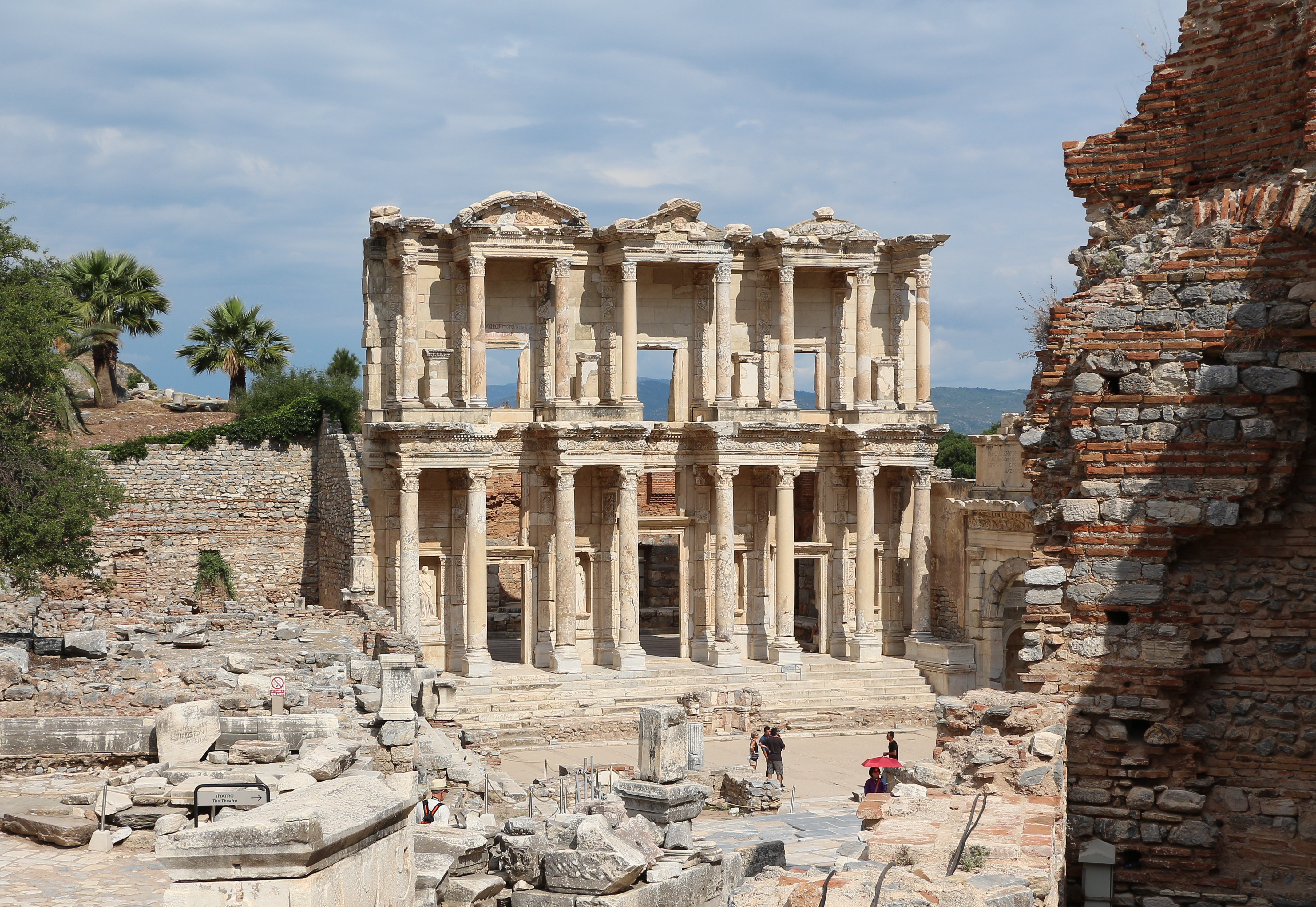
The Library of Celsus, an ancient Roman building in Ephesus, Anatolia, stands near the modern town of Selçuk in the İzmir Province of western Turkey 5Ephesus — celsus · Reference ↗. It was built in honor of the Roman Senator Tiberius Julius Celsus Polemaeanus and completed in AD 135 by Celsus' son, Tiberius Julius Aquila Polemaeanus 6Ephesus — libraries · Reference ↗. The library was part of the triumvirate of libraries in the Mediterranean, which included the Library of Pergamum and the great Library of Alexandria 7Ephesus — w · Reference ↗.
Human presence around Ephesus reaches back to the Neolithic Age (about 6000 BC), attested by finds from excavations at the nearby höyük — artificial mounds known as tells — of Arvalya and Cukurici 8Ephesus — sec1 · Wikipedia ↗. In the Late Bronze period Hittite sources record that the capital of the kingdom of Arzawa, an independent state in Western and Southern Anatolia, was Apasa (or Abasa), and some scholars suggest this is the same place the Greeks later called Ephesus 9Ephesus — sec3 · Wikipedia ↗.
The identification of Apasa with Ephesus is a scholarly proposal rather than a settled conclusion 10Ephesus — sec5 · Wikipedia ↗. The Greek city stood on the coast of Ionia, the ancient region encompassing the central part of the western coast of Anatolia 11Ephesus — ionia · Reference ↗, and Heraclitus, the son of Blyson, came from it — a port on the Cayster River on the western coast of Asia Minor 4.
The Temple of Artemis, also called the Artemision or the Temple of Diana, was a Greek temple dedicated to a localised form of the goddess Artemis, equated with the Roman goddess Diana 3. Artemis herself is the goddess of hunting, the wilderness, wild animals, transitions, nature, vegetation, childbirth, care of children, and chastity 12Ephesus — artemis · Reference ↗, and her numerous epithets — titles applied to her name — indicate the diversity of her functions and roles 13Ephesus — artemis · Reference ↗.
Celsus Polemaeanus was a wealthy and popular citizen and benefactor of Ephesus, buried in a sarcophagus beneath the Library of Celsus, which his son Tiberius Julius Aquila Polemaeanus built as a mausoleum in his honor 14Ephesus — polemaeanus · Reference ↗. The library is dated to 135–262 A.D. 7.
1. Early Settlement and Foundation
Human presence around Ephesus reaches back to the Neolithic Age (about 6000 BC), when people had already begun inhabiting the surrounding area; the evidence comes from excavations at the höyük, the artificial mounds known as tells, of Arvalya and Cukurici8. Intensely settled Mycenaean sites have likewise been identified at Ephesus to the south and at numerous other nearby sites15Ephesus — claros · Reference ↗.
The names Apasa and Ephesus appear to be cognate, and recently found inscriptions seem to pinpoint the places in the Hittite record9. The same identification of the two names is repeated in the epigraphic evidence gathered for the site8.
According to the legend, the founder established Ephesus on the very place where the oracle of Delphi became reality, in the words "A fish and a boar will show you the way"2. The Delphic sanction of the foundation is preserved in the same legendary account of the city's origins16Ephesus — sec7 · Wikipedia ↗.
In the archaic period Ephesus became an important ally to the kingdom of Lydia because, like other Ionian cities, it had a port that provided land locked Lydia with trade17Ephesus — sec8 · Wikipedia ↗. In the 6th century BC Ephesus, like other cities in Ionia, lived under the effects of both the rise of Lydia under Croesus and his overthrow by Cyrus the Great4. This may explain why in 640 BC Ephesus and the sanctuary of Artemis were raided, following Sardis, by the Cimmerians, a warlike people who had destroyed the kingdom of Phrygia in central Anatolia decades before17.
Ephesus was an ancient Greek city on the coast of Ionia, in present-day Selçuk in İzmir Province, Turkey1. Ionia itself was an ancient region encompassing the central part of the western coast of Anatolia11. The city stood on a port on the Cayster River, on the western coast of Asia Minor4.
Hittite sources record that the capital of the kingdom of Arzawa, another independent state in Western and Southern Anatolia, was Apasa (or Abasa), and some scholars suggest that this is the same place the Greeks later called Ephesus9.
In its day the city was famous for the nearby Temple of Artemis, completed around 550 BC, which has been designated one of the Seven Wonders of the Ancient World1. The Artemision, also known as the Temple of Diana, was a Greek temple dedicated to a localised form of the goddess Artemis, equated with the Roman goddess Diana3. Artemis is the goddess of hunting, the wilderness, wild animals, transitions, nature, vegetation, childbirth, care of children, and chastity12, and her numerous epithets indicate the diversity of her functions and roles13. In one account she is born first and then assists Leto in the birth of the second twin, Apollo12.
The Library of Celsus is an ancient Roman building in Ephesus, Anatolia, located near the modern town of Selçuk in the İzmir Province of western Turkey5. It was built in honor of the Roman Senator Tiberius Julius Celsus Polemaeanus and completed in AD 135 by Celsus' son, Tiberius Julius Aquila Polemaeanus, consul in 1106. Celsus was a wealthy and popular citizen and benefactor of Ephesus, buried in a sarcophagus beneath the library, which was built as a mausoleum in his honor by his son14. The library, dated 135–262 A.D., was part of the triumvirate of libraries in the Mediterranean which included the Library of Pergamum and the great Library of Alexandria7.
Among the other settlements of the region were Magnesia on the Maeander, an ancient Greek city in Ionia, considerable in size, at an important location commercially and strategically in the triangle of Priene, Ephesus and Tralles18Ephesus — maeander · Reference ↗, and Claros, an ancient Greek sanctuary on the coast of Ionia15. Didyma was an ancient Greek sanctuary on the coast of Ionia in the domain of the famous city of Miletus19Ephesus — didyma · Reference ↗.
2. Archaic and Classical History
The sanctuary at Didyma, also called the Didymaion, honoured Apollo as its main deity and contained temples to both Apollo and his twin sister Artemis, with other deities also receiving worship there19. Artemis herself was one of many kourotrophic, or child-nurturing, deities, and she protected children, especially girls, as well as animal cubs12. In one account she is born first and then assists Leto in the birth of the second twin, Apollo12.
Ionia proper comprised a narrow coastal strip running from Phocaea in the north near the mouth of the river Hermus, now the Gediz, to Miletus in the south near the mouth of the river Maeander, and it included the islands of Chios and Samos11.
The temple of Artemis was destroyed and rebuilt many times in antiquity3. Its last incarnation was destroyed in 262 AD, although Artemis continued to be worshipped at the site until around 401 AD3.
Roman building at the site is represented by the structure commissioned in the years 110s CE by the consul Tiberius Julius Aquila Polemaeanus as a funerary monument for his father Tiberius Julius Celsus Polemaeanus, former proconsul of Asia5. It was completed during the reign of the Emperor Hadrian, sometime after Aquila's death5.
Human occupation around Ephesus reaches back to the Neolithic Age, roughly 6000 BC, a dating supported by finds from excavations at the artificial mounds, or tells, of Arvalya and Cukurici near the site8. Hittite records name Apasa, or Abasa, as the capital of the kingdom of Arzawa, an independent state in western and southern Anatolia, and some scholars identify this place with the settlement the Greeks later called Ephesus9.
The city stood on the coast of Ionia, the ancient region covering the central stretch of Anatolia's western seaboard, at the site of present-day Selçuk in İzmir Province, Turkey1. Its port lay on the Cayster River, and it was from this Ionian city that Heraclitus, son of Blyson, came4. In its day Ephesus was renowned for the nearby Temple of Artemis, completed around 550 BC and counted among the Seven Wonders of the Ancient World1. The Artemision, also called the Temple of Diana, was a Greek temple serving a localised form of Artemis, whom the Romans equated with Diana3.
The Library of Celsus, an ancient Roman building near modern Selçuk, was raised as a mausoleum honouring the Roman senator Tiberius Julius Celsus Polemaeanus, a wealthy and popular citizen and benefactor of Ephesus5. His son Tiberius Julius Aquila Polemaeanus, consul in 110, built it in his father's honour and completed it in AD 1356. Celsus was buried in a sarcophagus beneath the structure14. The library, in use from 135 to 262 AD, belonged to a Mediterranean trio of great libraries alongside those of Pergamum and Alexandria7.
Ionia's sacred landscape included Didyma, an ancient Greek sanctuary on the coast within the territory of Miletus, and Claros, another coastal sanctuary1915. Inland stood Magnesia on the Maeander, a city of considerable size whose commercial and strategic position lay within the triangle formed by Priene, Ephesus and Tralles18. Artemis herself was goddess of hunting, the wilderness, wild animals, transitions, nature, vegetation, childbirth, care of children and chastity, and the many epithets attached to her name reflect the diversity of her functions and roles1213.
3. The Temple of Artemis
The Artemision, also called the Temple of Diana, was a Greek temple dedicated to a localised form of Artemis equated with the Roman Diana6. It was completed around 550 BC and counted among the Seven Wonders of the Ancient World1.
In antiquity the temple was repeatedly destroyed and rebuilt20Ephesus — ephesus · Reference ↗. Its last incarnation was destroyed in 262 AD1.
Worship of Artemis continued at the site until around 401 AD20.
The sanctuary stood in the town of Selçuk, near Ephesus2. Its renown attached to the city itself, which was famous in its day for the nearby temple20. The temple was destroyed and rebuilt many times in antiquity, and the last incarnation of the temple was destroyed in 262 AD, although Artemis continued to be worshipped at the site until around 401 AD3.
In 640 BC Ephesus and the sanctuary of Artemis were raided, following Sardis, by the Cimmerians, a warlike people who had destroyed the kingdom of Phrygia in central Anatolia decades before17.
4. Monumental Buildings
The monumental buildings of Ephesus included the Library of Celsus and a theatre capable of holding 24,000 spectators1. The same pairing of library and theatre is recorded among the city's many monumental buildings20.
The library was built to store 12,000 scrolls and to serve as a monumental tomb for Celsus6.
The Library of Celsus is an ancient Roman building in Ephesus, in Anatolia, situated near the modern town of Selçuk in the İzmir Province of western Turkey5. It was built in honor of the Roman Senator Tiberius Julius Celsus Polemaeanus and was completed in AD 135 by Celsus' son, Tiberius Julius Aquila Polemaeanus, who was consul in 1106. Celsus himself was a wealthy and popular citizen and benefactor of Ephesus, and he was buried in a sarcophagus beneath the library, which was built as a mausoleum in his honor by his son14. The building is dated to 135–262 A.D. and belonged to a triumvirate of libraries in the Mediterranean that also included the Library of Pergamum and the great Library of Alexandria7.
5. The Library of Celsus
The Library of Celsus stands among the ruins of Ephesus in Anatolia, in ground that now belongs to Selçuk in Turkey 6. It was commissioned in the years 110s CE by Tiberius Julius Aquila Polemaeanus, a consul of the Roman Empire, who intended it as a funerary monument to his father 5. The father, Tiberius Julius Celsus Polemaeanus, had served as proconsul of Asia 5. The building was completed during the reign of the Roman Emperor Hadrian, sometime after Aquila's death 5.
A second account fixes the completion in AD 135 and names the son as consul in 110 6. The structure was raised in honor of the Roman Senator Tiberius Julius Celsus Polemaeanus by that same son 6. In this way a public building and a family memorial were made one and the same 5.
The Library of Celsus is considered an architectural marvel 5. It is one of the few remaining examples of the great libraries of the ancient world located in the Roman Empire 5. Its survival allows the building type of the ancient library to be read directly in stone rather than reconstructed from texts 5.
The building served two purposes at once: it was raised to store 12,000 scrolls and to function as a monumental tomb for Celsus 6. In this reading it was less a library in the modern sense than a tomb and a shrine for the deceased Tiberius Julius Celsus Polemaeanus, the man whose name it carries 7. Celsus was a wealthy and popular citizen and benefactor of Ephesus, and he was buried in a sarcophagus beneath the library his son built as a mausoleum in his honor 14.
The library is dated to the span 135–262 A.D. and stood within the city of Ephesus 7. It belonged to a trio of libraries in the Mediterranean that also counted the Library of Pergamum and the great Library of Alexandria 7. Among the monumental buildings of Ephesus it stood alongside a theatre capable of holding 24,000 spectators 1.
The man commemorated was born around 45 CE into a family of Ancient Greek origin, at either Ephesus or Sardis 14. The library itself is an ancient Roman building near the modern town of Selçuk, in the İzmir Province of western Turkey 5.
6. Key dates
- 6000 BCEHistory Neolithic age Humans had begun inhabiting the area surrounding EphHistory Neolithic age Humans had begun inhabiting the area surrounding Ephesus by the Neolithic Age , as shown by evidence from excavations at the nearby höyük of Arvalya and Cukurici .
- 640 BCEThis may explain why in 640 BC, Ephesus and the sanctuary ofThis may explain why in 640 BC, Ephesus and the sanctuary of Artemis were raided, following Sardis , by the Cimmerians , a warlike people who had destroyed the kingdom of Phrygia in central Anatolia decades before.
- 550 BCEThe city was famous in its day for the nearby Temple ofThe city was famous in its day for the nearby Temple of Artemis , which has been designated one of the Seven Wonders of the Ancient World.
- 494 BCEEphesus appears to have subsequently cultivated a close relationship withEphesus appears to have subsequently cultivated a close relationship with the Persian Empire; during the suppression of the Ionian revolt by Darius the Great in 494 BC, Ephesus was spared and emerged as the dominant Greek city in Ionia.
7. Frequently asked questions
Where was Ephesus located in the ancient world?
Who was Celsus Polemaeanus, the man the library commemorates?
Was the Library of Celsus really a library, or a tomb?
What did the Hittite records call the place the Greeks knew as Ephesus?
Which philosopher came from Ephesus?
Heraclitus, the son of Blyson, was from the Ionian city of Ephesus, a port on the Cayster River, on the western coast of Asia Minor in modern-day Turkey 4.
Which cities made up the Ionian League alongside Ephesus?
The twelve cities were, from south to north, Miletus, Myus, Priene, Ephesus, Colophon, Lebedos, Teos, Erythrae, Clazomenae and Phocaea, together with the islands of Samos and Chios 11.
References (20)
- 1Ephesus — wiki — Wikipedia Web↩View source
- 2Ephesus — sec6 — Wikipedia Web↩View source
- 3Ephesus — artemis — Reference Web↩View source
- 4Ephesus — heraclitus — Reference Web↩View source
- 5Ephesus — celsus — Reference Web↩View source
- 6Ephesus — libraries — Reference Web↩View source
- 7Ephesus — w — Reference Web↩View source
- 8Ephesus — sec1 — Wikipedia Web↩View source
- 9Ephesus — sec3 — Wikipedia Web↩View source
- 10Ephesus — sec5 — Wikipedia Web↩View source
- 11Ephesus — ionia — Reference Web↩View source
- 12Ephesus — artemis — Reference Web↩View source
- 13Ephesus — artemis — Reference Web↩View source
- 14Ephesus — polemaeanus — Reference Web↩View source
- 15Ephesus — claros — Reference Web↩View source
- 16Ephesus — sec7 — Wikipedia Web↩View source
- 17Ephesus — sec8 — Wikipedia Web↩View source
- 18Ephesus — maeander — Reference Web↩View source
- 19Ephesus — didyma — Reference Web↩View source
- 20Ephesus — ephesus — Reference Web↩View source