Delos
The sacred island where Apollo was said to be born.
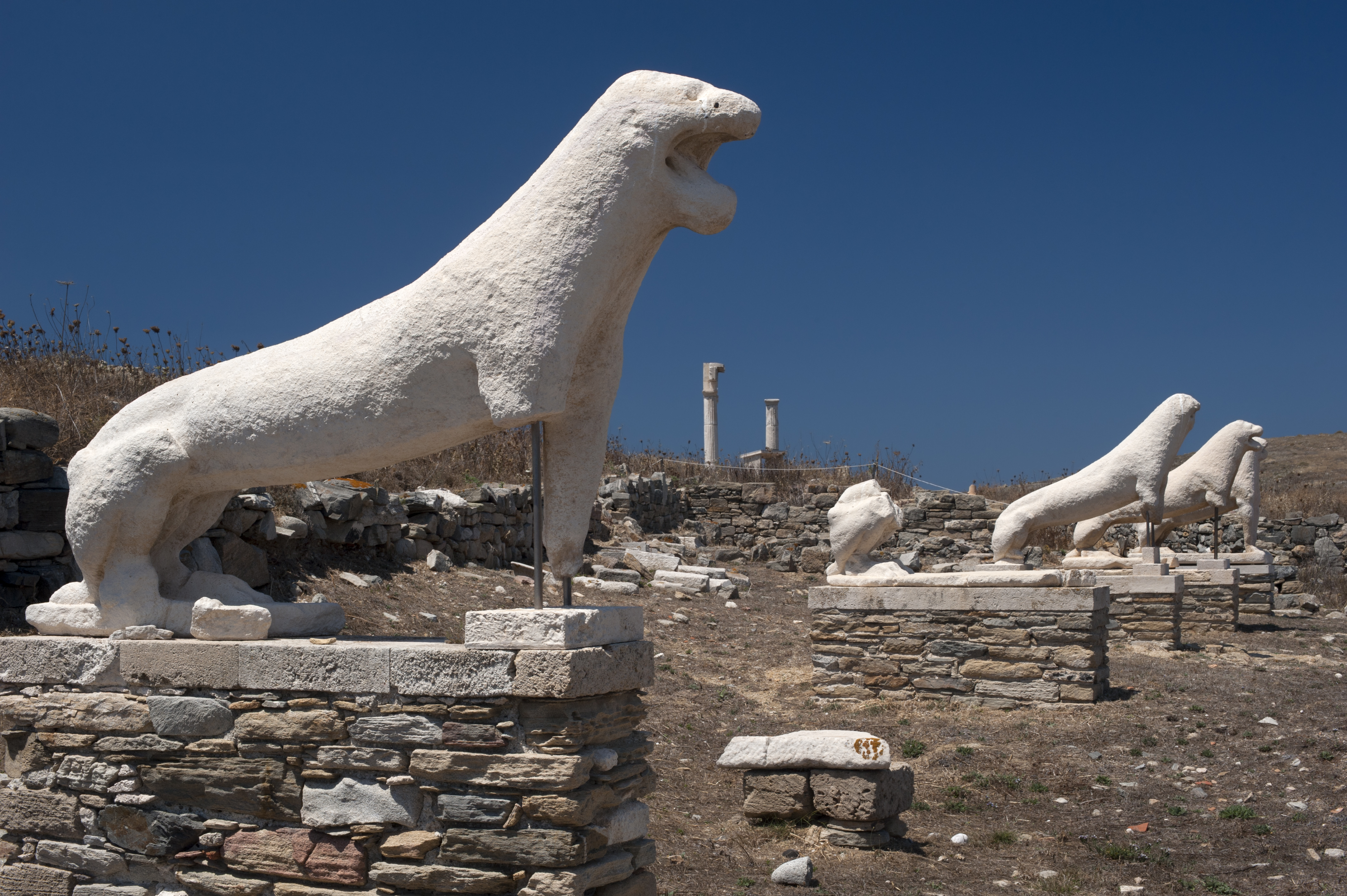
Overview
Delos, also called Dilos, is a small Greek island near Mykonos, close to the centre of the Cyclades archipelago 1Delos — delos · Reference ↗. It held a position as a holy sanctuary for a millennium before Olympian Greek mythology made it the birthplace of Apollo and Artemis 1. By the writing of the Odyssey the island was already famous as the birthplace of the twin gods Apollo and Artemis, although some confusion seems to exist over whether Artemis was born on Delos or on the island of Ortygia 2Delos — sec1 · Wikipedia ↗.
Investigation of ancient stone huts found on the island indicates that it has been inhabited since the third millennium BC 2. The ongoing excavations there are among the most extensive in the Mediterranean, and many of the artefacts found are displayed at the Archaeological Museum of Delos and the National Archaeological Museum of Athens 1. The Archaeological Museum of Delos is a museum on the island, near Mykonos in the South Aegean 3Delos — delos · Reference ↗.
The island's modern name for its alliance derives from its role as the official meeting place of the Delian League, where congresses were held within the sanctuary of the Temple of Apollo; contemporary authors referred to the organization simply as "the Athenians and their Allies" 4Delos — league · Reference ↗. Strabo writes that in 166 BC the Romans converted Delos into a free port, partly motivated by seeking to damage the trade of Rhodes, at the time the target of Roman hostility 5Delos — sec3 · Wikipedia ↗.
The Temple of the Delians is the largest of the three Greek temples dedicated to Apollo within the temenos of the Sanctuary of Apollo on the island 6Delos — delians · Reference ↗. It contained the cult statue of Apollo and centuries of precious offerings 6. The small sacred lake in its circular bowl, now intentionally left dry by the island's caretakers to suppress the spread of malaria-bearing mosquitoes, is a topographical feature that determined the placement of later features 7Delos — sec4 · Wikipedia ↗. The Minoan Fountain was a rectangular public well hewn in the rock with a central column; it formalized the sacred spring in its present sixth-century BC form, reconstructed in 166 BC according to an inscription 7.
The mosaics of Delos form a significant body of ancient Greek mosaic art 8Delos — delos · Reference ↗. Most of the surviving mosaics date to the last half of the 2nd century BC and early 1st century BC, during the Hellenistic period and the beginning of the Roman period of Greece 8. The Delos Synagogue is the name given to a second century Hellenic structure located in Delos, in the Mykonos Municipality of the South Aegean region of modern-day Greece 9Delos — synagogue · Reference ↗.
The Hyperborean Maidens is a modern term for a collection of smaller groups of mythical virgins who travelled from Hyperborea to Delos 10Delos — maidens · Reference ↗. The cults around them were generally specific to Delos, and some credit them with bringing worship of Artemis and Apollo to the island, though some ancient sources dispute this 10. As a member of the French School of Athens, Pierre Roussel participated in the research program established by Théophile Homolle in Delos and worked on the epigraphy of the site 11Delos — epigrapher · Reference ↗.
The island appears under several forms of its name: Delos or Dilos, rendered in Greek as Δήλος, in Attic Greek as Δῆλος Dêlos and in Doric Greek as Δᾶλος Dâlos 12Delos — wiki · Wikipedia ↗.
A temple on the mountain is attested in several historical sources, both literary and epigraphical, among them references in 2 Maccabees from the second century BCE and two Greek inscriptions found on Delos and dating to the same period, which mention a sanctuary on the mountain 13Delos — temple · Reference ↗. Excavations on Mount Gerizim's main peak revealed remnants of the sacred precinct, or temenos, that enclosed the temple 13.
1. Geography and Sacred Topography
From the Sacred Harbour the three conical mounds are visible that have been taken to identify landscapes sacred to a goddess, presumably Athena 1 12.
The Minoan Fountain was a rectangular public well hewn in the rock with a central column 7. It formalized the sacred spring in its present sixth-century BC form and was reconstructed in 166 BC according to an inscription 7.
By the Sacred Harbour the Hellenistic Agora of the Competaliasts retains in its stone paving the postholes for market awnings 7.
The small sacred lake lies in a circular bowl and is now intentionally left dry by the island's caretakers to suppress the spread of malaria-bearing mosquitoes; as a topographical feature it determined the placement of later features 7.
2. Early Cult and Mythology
Delos was initially a religious pilgrimage for the Ionians2. Eventually acquiring Panhellenic religious significance, the island became a sanctuary of more than local reach14Delos — sec2 · Wikipedia ↗.
The Hyperborean Maidens are a modern term for groups of mythical virgins who travelled from Hyperborea to Delos10. Their cults were generally specific to Delos, and some credit them with bringing the worship of Artemis and Apollo to the island, though some ancient sources dispute this10. They are closely tied to the Hyperborean Offerings brought to Delos each year, as the origin myth of this tradition centred around their travel from Hyperborea to Delos10. Two tombs were found in excavations of Delos that were attributed to the Hyperborean Maidens10.
The Temple of the Delians, dedicated to Apollo, is a classic example of the Doric order7. The temple contained the cult statue of Apollo and centuries of precious offerings6.
For a millennium before Olympian Greek mythology made it the birthplace of Apollo and Artemis, Delos already held the position of a holy sanctuary112.
Between 900 BC and 100 AD, Delos was a major cult centre, where the gods Dionysus and Leto, mother of the twin deities Apollo and Artemis, were revered214.
Before the end of the first century BC, trade routes had changed; Delos was replaced by Puteoli as the chief focus of Italian trade with the east, and as a cult centre, too, it entered a sharp decline5.
Most of the surviving mosaics from Delos, Greece, an island in the Cyclades, date to the last half of the 2nd century BC and early 1st century BC, during the Hellenistic period and beginning of the Roman period of Greece8.
Delos held its standing as a holy sanctuary for a millennium before Olympian Greek mythology made it the birthplace of Apollo and Artemis1.
3. Sanctuaries and Monuments
The Temple of the Delians is the largest of the three Greek temples dedicated to Apollo within the temenos of the Sanctuary of Apollo on the island of Delos6.
The Minoan Fountain was a rectangular public well hewn in the rock, with a central column7. It formalized the sacred spring in its present sixth-century BC form7. The fountain was reconstructed in 166 BC according to an inscription7.
The Delos Synagogue is the name given to a second century Hellenic structure that is located in Delos, in the Mykonos Municipality of the South Aegean region of modern-day Greece9.
The temple housed the cult statue of Apollo together with centuries of precious offerings6. The sanctuary of the Temple of Apollo also served as the meeting place of the Delian League, whose modern name derives from the island where its congresses were convened; contemporary authors knew the organization simply as "the Athenians and their Allies"4.
The small sacred lake, held in a circular bowl, is a topographical feature that determined the placement of later features; it is now intentionally left dry by the island's caretakers to suppress the spread of malaria-bearing mosquitoes7.
The mosaics of Delos form a significant body of ancient Greek mosaic art8. Most of the surviving examples date to the last half of the 2nd century BC and the early 1st century BC, spanning the Hellenistic period and the beginning of the Roman period of Greece8.
The Hyperborean Maidens is a modern term for a collection of smaller groups of mythical virgins who travelled from Hyperborea to Delos10. The cults around them were generally specific to Delos, and some credit them with bringing the worship of Artemis and Apollo to the island, though some ancient sources dispute this10.
The Archaeological Museum of Delos is a museum on the island, near Mykonos in the South Aegean, Greece3. The ongoing excavations on the island are among the most extensive in the Mediterranean, and many of the artefacts found are displayed at the Archaeological Museum of Delos and the National Archaeological Museum of Athens1.
Delos is a small Greek island near Mykonos, close to the centre of the Cyclades archipelago1. Investigation of ancient stone huts found on the island indicates that it has been inhabited since the third millennium BC2. By the writing of the Odyssey the island was already famous as the birthplace of the twin gods Apollo and Artemis, although some confusion seems to exist over whether Artemis was born on Delos or on the island of Ortygia2.
Strabo writes that in 166 BC the Romans converted Delos into a free port, a measure partially motivated by the wish to damage the trade of Rhodes, at the time the target of Roman hostility5.
A city was built adjacent to the sacred sites and acquired monumental form during the reigns of Alexander the Great's successors; Cassander took a great interest in the city, erecting strong walls and public buildings, so that in Hellenistic times Dion was renowned far and wide for its fortification and splendid monuments15Delos — pieria · Reference ↗. For this reason Dion was the sacred place of the Ancient Macedonians15.
The temple on Mount Gerizim is attested in several historical sources, both literary and epigraphical, including references in 2 Maccabees from the second century BCE and two Greek inscriptions found on the island of Delos, also dating to the same period, which mention a sanctuary on the mountain13. Archaeological excavations on the mountain's main peak revealed remnants of the sacred precinct, or temenos, that enclosed the temple13.
As a member of the French School of Athens, Pierre Roussel participated in the research program established by Théophile Homolle in Delos and worked on the epigraphy of the site11.
4. Delian League
With the withdrawal of certain states a congress was called on the holy island of Delos to institute a new alliance to continue the fight against the Persians, and from this gathering the modern designation "Delian League" arises 4. The League's modern name derives from its official meeting place, the island of Delos, where congresses were held within the sanctuary of the Temple of Apollo 4. Contemporary authors did not use the label later ages gave the alliance; they referred to the organization simply as "the Athenians and their Allies" 4.
The League's treasury initially stood in Delos until, in a symbolic gesture, Pericles moved it to Athens in 454 BC 4.
By 454 the treasury of the Delian League had been transferred from the island of Delos to the Parthenon in Athens 4.
The transfer of the treasury is recorded in two complementary forms: the League's funds initially stood in Delos until Pericles moved them to Athens in 454 BC as a symbolic gesture 4, and by 454 the treasury had passed from the island to the Parthenon in Athens 4.
5. Hellenistic and Roman History
The site underwent major expansion during the Hellenistic period during the reign of Antiochus III (223–187 BCE), when a large fortified town and a new sacred precinct were constructed.13
The Roman destruction of Corinth in 146 BC allowed Delos to at least partially assume Corinth's role as the premier trading centre of Greece.5 Delos' commercial prosperity, construction activity, and population waned significantly after the island was assaulted by the forces of Mithridates VI of Pontus in 88 and 69 BC, during the Mithridatic Wars with Rome.5
Before the end of the first century BC trade routes had changed; Delos was replaced by Puteoli as the chief focus of Italian trade with the east, and as a cult centre too it entered a sharp decline.5
In 167 or 166 BC, after the Roman victory in the Third Macedonian War, the Roman Republic ceded Delos to the Athenians, who expelled most of the original inhabitants.5 Strabo writes that in 166 BC the Romans converted Delos into a free port, a measure partially motivated by seeking to damage the trade of Rhodes, at the time the target of Roman hostility.5
Among Hellenistic Greek archaeological sites, Delos contains one of the highest concentrations of surviving mosaic artworks,8 and approximately half of all surviving tessellated Greek mosaics from the Hellenistic period come from Delos.8 Most of the surviving mosaics from the island, which lies in the Cyclades, date to the last half of the 2nd century BC and early 1st century BC, spanning the Hellenistic period and the beginning of the Roman period of Greece.8 The Hellenistic Agora of the Competaliasts by the Sacred Harbour retains the postholes for market awnings in its stone paving.7
Investigation of ancient stone huts found on the island indicates that it has been inhabited since the third millennium BC.2 In 1872 the French School at Athens began excavating on Delos, in a project on a massive scale, which is still ongoing today.3
A city was built adjacent to the sacred sites that acquired monumental form during the reigns of Alexander the Great's successors, and Cassander took a great interest in the city, erecting strong walls and public buildings, so that in Hellenistic times Dion was renowned far and wide for its fortification and splendid monuments.15
6. Mosaics
The mosaics of Delos form a significant body of ancient Greek mosaic art, preserved on an island in the Cyclades. Most of the surviving mosaics date to the last half of the 2nd century BC and the early 1st century BC, a span falling within the Hellenistic period and the beginning of the Roman period of Greece 8.
Among Hellenistic Greek archaeological sites Delos contains one of the highest concentrations of surviving mosaic artworks 8. Approximately half of all surviving tessellated Greek mosaics from the Hellenistic period come from Delos 8.
Delos is a small Greek island near Mykonos, close to the centre of the Cyclades archipelago 1. Investigation of ancient stone huts found on the island indicates that it has been inhabited since the third millennium BC 2. By the writing of the Odyssey the island was already famous as the birthplace of the twin gods Apollo and Artemis, although some confusion seems to exist over whether Artemis was born on Delos or on the island of Ortygia 2.
The Temple of the Delians is the largest of the three Greek temples dedicated to Apollo within the temenos of the Sanctuary of Apollo on the island 6. The temple contained the cult statue of Apollo and centuries of precious offerings 6. The Hyperborean Maidens is a modern term for a collection of smaller groups of mythical virgins who travelled from Hyperborea to Delos 10. The cults around them were generally specific to Delos, and some credit them with bringing worship of Artemis and Apollo to Delos, but some ancient sources dispute this 10.
The League's modern name derives from its official meeting place, the island of Delos, where congresses were held within the sanctuary of the Temple of Apollo; contemporary authors referred to the organization simply as "the Athenians and their Allies" 4. Strabo writes that in 166 BC the Romans converted Delos into a free port, which was partially motivated by seeking to damage the trade of Rhodes, at the time the target of Roman hostility 5. The Delos Synagogue is the name given to a second century Hellenic structure located in Delos, in the Mykonos Municipality of the South Aegean region of modern-day Greece 9.
The ongoing excavations on the island are among the most extensive in the Mediterranean, and many of the artefacts found are displayed at the Archaeological Museum of Delos and the National Archaeological Museum of Athens 1. The Archaeological Museum of Delos is a museum on the island of Delos, near Mykonos in the South Aegean, Greece 3. As a member of the French School of Athens, Pierre Roussel participated in the research program established by Théophile Homolle in Delos and worked on the epigraphy of the site 11.
The island of Delos was painted by Carl Anton Joseph Rottmann in 1847, and the theatre is among the monuments that have drawn visitors and scholars to the site 2. The small sacred lake lies in a circular bowl and has been intentionally left dry by the island's caretakers to suppress the spread of malaria-bearing mosquitoes; this topographical feature determined the placement of later features 7.
The temple on Mount Gerizim is attested in several historical sources, both literary and epigraphical, including references in 2 Maccabees from the second century BCE and two Greek inscriptions found on the island of Delos, also dating to the same period, which mention a sanctuary on the mountain 13. Archaeological excavations on Mount Gerizim's main peak revealed remnants of the sacred precinct, or temenos, that enclosed the temple 13.
Dion was for this reason the "sacred place" of the Ancient Macedonians 15.
7. Excavation and Museum
The ongoing excavations on the island are among the most extensive in the Mediterranean1.
Many of the artefacts found are displayed at the Archaeological Museum of Delos and the National Archaeological Museum of Athens12.
Chosen by Ulrich von Wilamowitz-Moellendorff to edit the catalog of dedications and decrees of Delos (1914) for issue IV of the Inscriptiones Graecae he defended his thesis in 191611.
The Archaeological Museum of Delos is a museum on the island of Delos, near Mykonos in the South Aegean, Greece3.
Although the museum has a considerable collection, it does not contain all of the items found in Delos: a large quantity are on display in Athens at the National Archaeological Museum3.
In addition to Delos, he directed excavations at Malia, Thasos and Philippi11.
Two tombs were found in excavations of Delos that were attributed to the Hyperborean Maidens10.
Excavation on the main peak of Mount Gerizim has revealed remnants of the sacred precinct, or temenos, that enclosed the temple13.
8. Key dates
- 900 BCEBetween 900 BC and 100 AD, Delos was a major cult centreBetween 900 BC and 100 AD, Delos was a major cult centre, where the gods Dionysus and Leto , mother of the twin deities Apollo and Artemis, were revered.
- 454 BCEThe League's treasury initially stood in Delos until, in a symbolic gesturThe League's treasury initially stood in Delos until, in a symbolic gesture, Pericles moved it to Athens in 454 BC.
- 187 BCEThe site underwent major expansion during the Hellenistic period during thThe site underwent major expansion during the Hellenistic period during the reign of Antiochus III , when a large fortified town and a new sacred precinct were constructed.
- 166 BCERoman era Strabo writes that in 166 BC, the Romans converted DelosRoman era Strabo writes that in 166 BC, the Romans converted Delos into a free port, which was partially motivated by seeking to damage the trade of Rhodes , at the time the target of Roman hostility.
- 146 BCEThe Roman destruction of Corinth in 146 BC allowed Delos to atThe Roman destruction of Corinth in 146 BC allowed Delos to at least partially assume Corinth's role as the premier trading centre of Greece , but Delos' commercial prosperity, construction activity, and population waned significantly after the island was assaulted by the forces
- 1847History Ancient Greece Further information: Mosaics of Delos The island ofHistory Ancient Greece Further information: Mosaics of Delos The island of Delos, Carl Anton Joseph Rottmann , 1847 The theatre Investigation of ancient stone huts found on the island indicate that it has been inhabited since the third millennium BC.
- 1872== History == In 1872, the French School at Athens began excavating== History == In 1872, the French School at Athens began excavating on Delos, in a project on a massive scale, which is still ongoing today.
- 1914Chosen by Ulrich von Wilamowitz-Moellendorff to edit the catalog of dedicaChosen by Ulrich von Wilamowitz-Moellendorff to edit the catalog of dedications and decrees of Delos for issue IV of the Inscriptiones Graecae, he defended his thesis in 1916.
9. Frequently asked questions
How much of the island's ancient art ended up in Athens rather than on Delos?
Although the Archaeological Museum of Delos has a considerable collection, it does not contain all of the items found on the island: a large quantity are on display in Athens at the National Archaeological Museum 3.
What does the museum on Delos actually hold?
Six rooms contain the statues and reliefs found in Delos, two rooms contain the pottery, and another room contains items used in everyday life in ancient Greece 3.
Where exactly did the Delos Synagogue stand within the city?
What was the most celebrated image inside the Temple of the Delians?
One of the treasures of the temple was a statue of Apollo made by "Angelion and Tektaos, sons of Dionysiodotos", who depicted the god with three Charites (Graces) in his hand 6.
Besides Delos, where else did Pierre Roussel dig?
In addition to Delos, he directed excavations at Malia, Thasos and Philippi 11.
How does Strabo describe the setting of the sanctuary?
Strabo describes the myth behind the ancient worship of Apollo and Artemis in Delos: the city which belongs to Delos, as also the temple of Apollon and the Letoion (Temple of Leto), are situated in a plain, and above the city lies Kynthos, a bare and rugged mountain, while a river named Inopos flows through the island — not a large river, for the island itself is small 6.
References (15)
- 1Delos — delos — Reference Web↩View source
- 2Delos — sec1 — Wikipedia Web↩View source
- 3Delos — delos — Reference Web↩View source
- 4Delos — league — Reference Web↩View source
- 5Delos — sec3 — Wikipedia Web↩View source
- 6Delos — delians — Reference Web↩View source
- 7Delos — sec4 — Wikipedia Web↩View source
- 8Delos — delos — Reference Web↩View source
- 9Delos — synagogue — Reference Web↩View source
- 10Delos — maidens — Reference Web↩View source
- 11Delos — epigrapher — Reference Web↩View source
- 12Delos — wiki — Wikipedia Web↩View source
- 13Delos — temple — Reference Web↩View source
- 14Delos — sec2 — Wikipedia Web↩View source
- 15Delos — pieria — Reference Web↩View source