Great Auk
The flightless North Atlantic seabird, described from its remains by Symington Grieve in 1885.
The great auk (Alca impennis) was a large flightless seabird of the North Atlantic. Grieve's 1885 book gathered what the early accounts recorded of its form, its swimming, its single egg on bare rock, and the remains that survive of it.
Overview
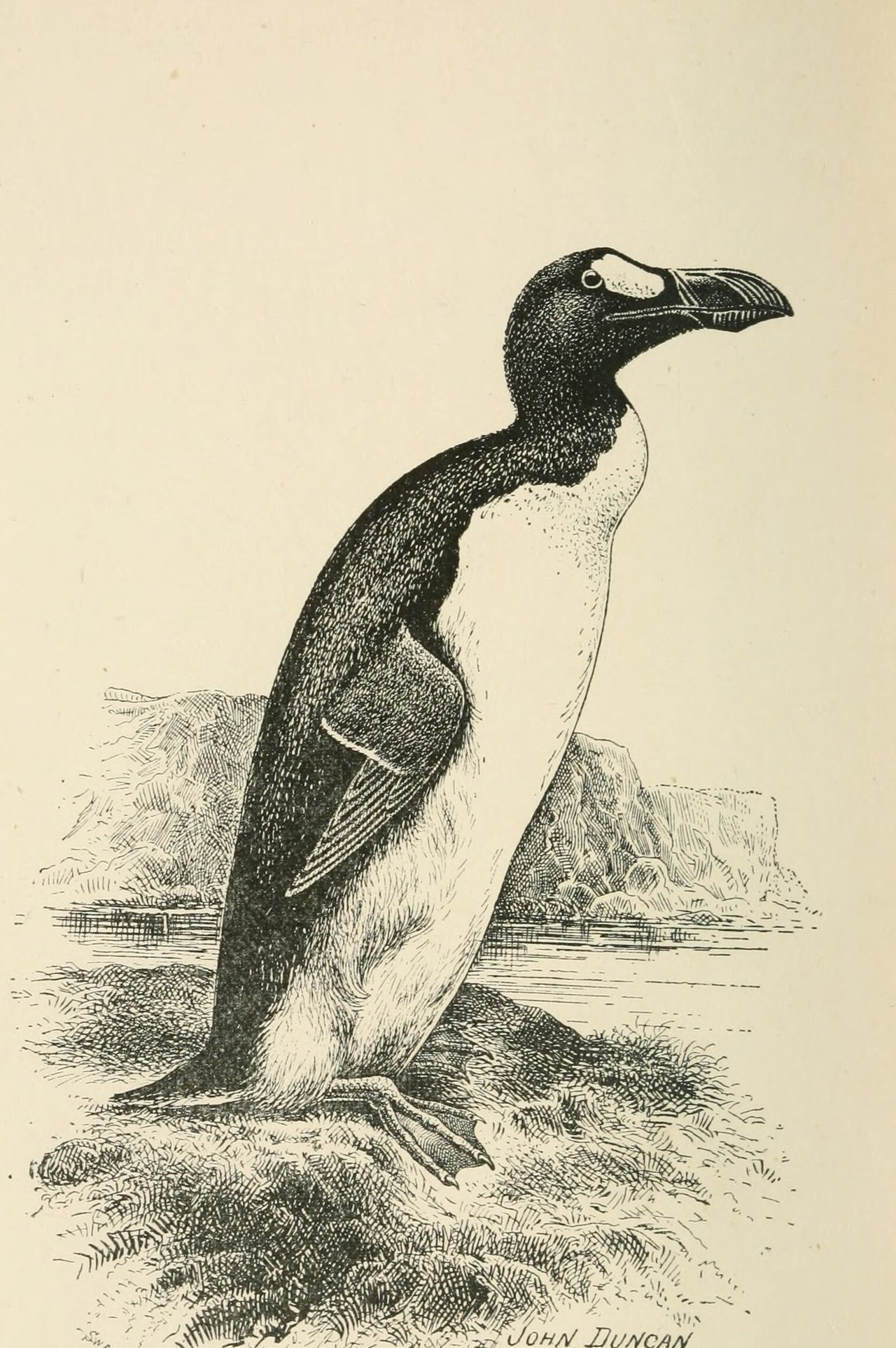
The great auk was a flightless seabird of the North Atlantic, known to Grieve's account as a bird that flies not at all. Its wings were short, and its body was above the size of a solan goose, while its bill was long and broad. In plumage it was black, with red about the eyes, and it stood stately with its whole body erected. These features together describe a bird built for the water rather than the air, and Grieve's book is valuable precisely because it assembles such observations of a species that can no longer be studied alive. 1The Great Auk, or Garefowl (Alca impennis, Linn.); its History, Archaeology, and Remains · T. C. Jack, London (via Internet Archive) ↗
The bird's habits were those of a diver. It was fitted for swimming and diving, dived as soon as alarmed, and swam with its heads much lifted up. On land it sat more upright than either the guillemots or razorbills, a posture that distinguished it from its neighbours on the cliffs. Its food was taken from the sea: it fed on Cottus scorpius and on Cyclopterus lumpus. The picture is of an animal whose life was concentrated in the water and on the bare rock, not in the air. 1
Its breeding was equally austere. The great auk laid its eggs upon the bare rock, without the nest that most seabirds build, and laid only one egg each year. The young were hatched out by the middle of June. A single egg, laid on naked stone, left the species with little margin, and this fact bears directly on its later history. 1
Grieve's book matters because it preserves this account of the great auk's appearance, posture, feeding and breeding at a time when the bird could still be observed. The details it records, from the long broad bill and the red about the eyes to the single egg and the upright stance on the rock, are the kind of evidence that later writers could not supply for themselves. The book is therefore a primary record of a bird that has passed out of the living world, and its value lies in the closeness of its observation rather than in any general description. 1
1. Form and Appearance
The great auk's form, as the early accounts describe it, was that of a heavy-bodied seabird whose proportions set it apart from the smaller divers with which it shared the northern cliffs. It stood above the size of a solan goose, a comparison that conveys bulk rather than precise measurement, and its wings were short. The bill was long and broad, a substantial feature rather than a slender one. In plumage the bird was black, with red about the eyes, a detail of colour that the observers evidently thought worth recording. The overall impression is of a solid, dark bird marked by a single vivid accent at the head. 1
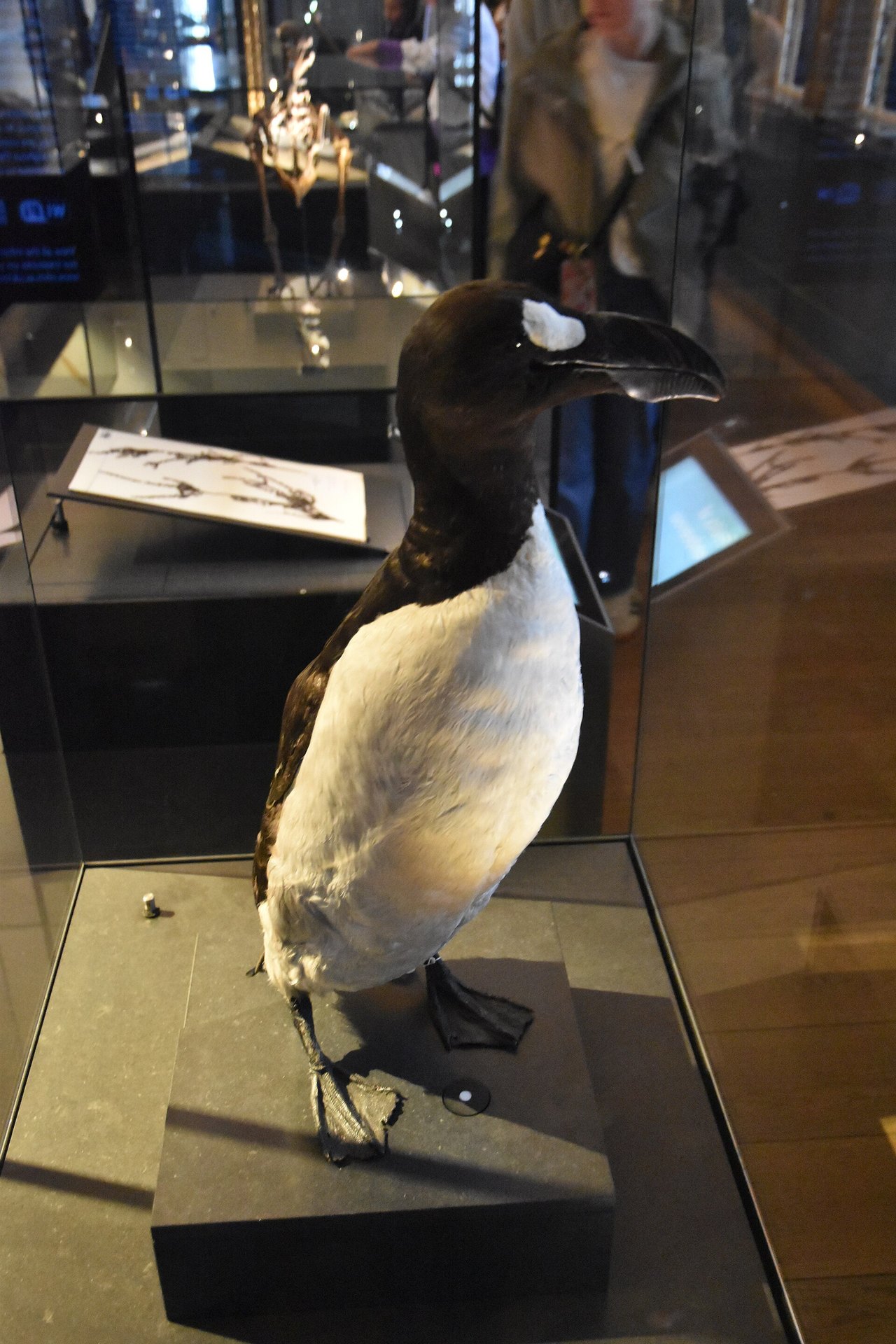
Its stance was equally distinctive. The great auk stood stately, its whole body erected, and on land it sat more upright than either the guillemots or the razorbills. This uprightness was not merely a matter of posture but a visible difference in bearing, one that separated the bird at a glance from its neighbours on the rock. The combination of a large body, short wings and an erect carriage produced an animal that looked, on land, unlike the other seabirds around it. 1
The short wings and the upright bearing together point to a bird whose powers lay elsewhere. It flew not at all, and its build was suited to a life spent largely in the water. The early observers noted that it swam with its head much lifted up, and that it dived as soon as alarmed. These habits, together with its form, describe a creature at home in the sea and awkward in the air, dependent on the water for escape and on the rock for rest. 1
What the accounts preserve, therefore, is not a list of attributes but a coherent picture: a large, black, red-eyed bird with a long broad bill, standing erect on the rock and swimming with its head raised. The value of such description lies in its closeness to the living animal. The details of size, colour, bill and stance are the kind of evidence that only direct observation could supply, and they remain the record of a bird that can no longer be seen. 1
2. Wings and Flight
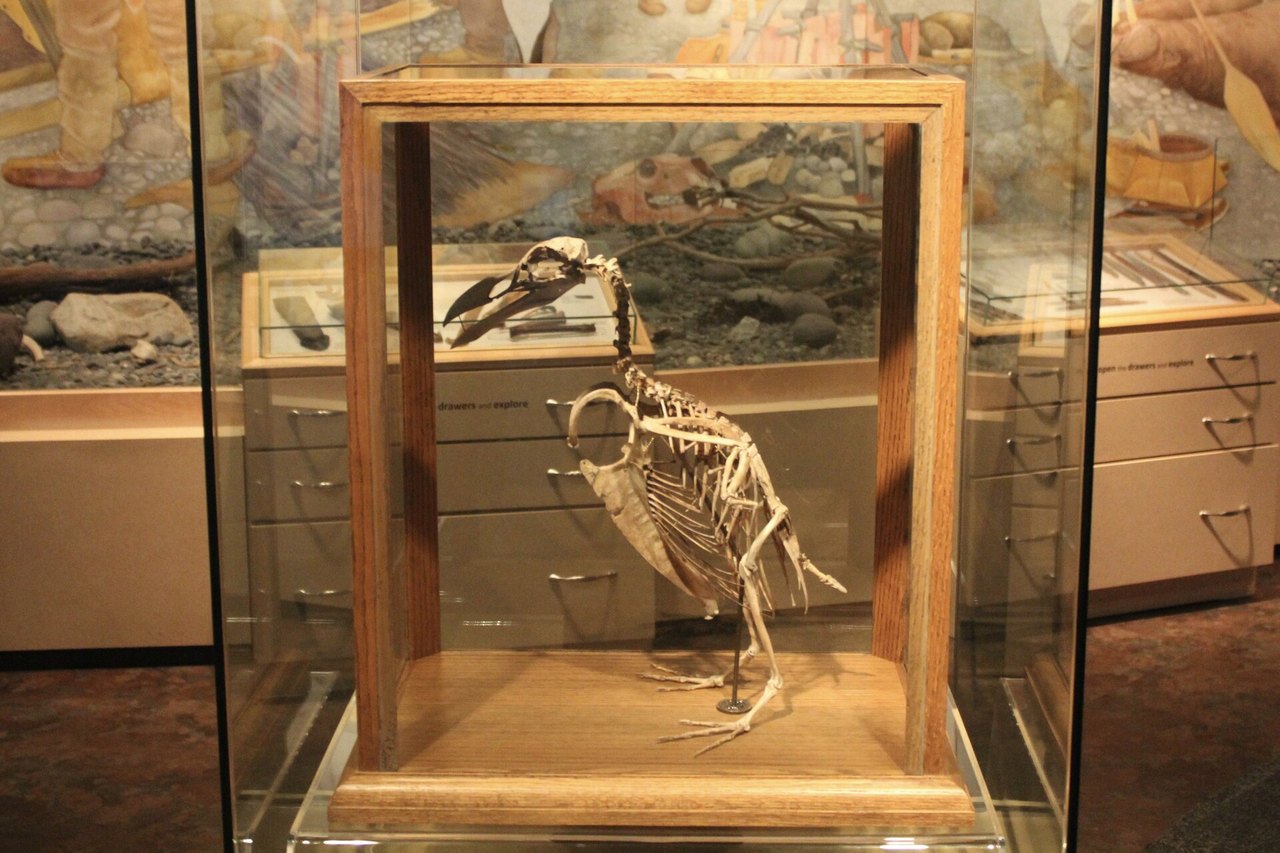
The great auk's wings were short, and the consequence was absolute: it flew not at all. Flightlessness in a seabird of such bulk was not a deficiency to be explained away but the organising fact of its existence, and the early accounts treat it without surprise. The bird's whole economy was built around the water, and the wings that could not lift it through the air served instead as organs of propulsion beneath the surface. The observers who recorded the species were clear that it was fitted for swimming and diving, and it is in that judgement, rather than in any catalogue of parts, that the meaning of its short wings is to be found. 1
What the great auk did instead of flying was to swim and dive, and it did both with a manner all its own. It swam with its head much lifted up, a habit noted alongside its diving, and it dived as soon as alarmed. The two behaviours belong together: a bird that cannot take to the air when pressed must take to the water, and the raised head in swimming suggests an animal alert to its surroundings even while afloat. Escape, for this species, lay downward rather than upward. 1
Its feeding followed the same pattern. The great auk fed on Cottus scorpius and on Cyclopterus lumpus, bottom-dwelling fishes that could be reached only by a bird able to pursue them beneath the surface. Here the short wings find their purpose, for the same reduction of the wing that foreclosed the air made possible the pursuit of prey in the sea. The bird's dependence on the water was therefore not merely a matter of refuge but of subsistence. 1
On land the great auk's flightlessness exposed it to a different order of risk. It laid its eggs upon the bare rock, and it laid only one egg each year, hatched out by the middle of June. A single egg, placed without a nest on open stone, represents a narrow margin, and a bird that could neither fly nor nest in concealment had no second means of escape when danger came. The short wings thus connect the several parts of the account: they explain the swimming and diving, the pursuit of bottom fishes, and the vulnerability of a species whose annual reproduction rested on one egg upon the rock. 1
3. Life at Sea
The great auk's bearing on the water was as distinctive as its bearing on land. It swam with its head much lifted up, a carriage that set it apart from the other diving birds of its range, and observers noted that it sat more upright than either the guillemots or razorbills. This erect habit was not confined to the sea; on shore it stood stately, its whole body erected. The same vertical poise thus ran through the bird's life whether it was afloat or ashore, and the lifted head in swimming may be read as an extension of that general carriage rather than an isolated trick of movement. 1
Its diving was immediate and unhesitating. The bird dived as soon as alarmed, and the readiness of that response indicates an animal whose first recourse lay beneath the surface. A bird that flies not at all has no upward escape, and the great auk's alarm behaviour reflects that constraint: the water was its refuge as well as its hunting ground. The short wings, useless in the air, served as the organs of propulsion in this submerged flight, and the observers who described the species were explicit that it was fitted for swimming and diving. 1
The bird's size gives some measure of what such journeys demanded. It was above the size of a solan goose, a bulk that a swimming and diving bird must carry through the water, and its long broad bill and the red about its eyes complete the picture of a heavy, strongly marked animal. Its food lay on the sea floor: it fed on Cottus scorpius and on Cyclopterus lumpus, fishes that could be reached only by diving to the bottom. The pursuit of such prey implies regular descent to considerable depths, and the bird's whole economy was therefore bound to the water rather than to the air. 1
The records of the species imply long sea journeys, for a flightless bird of this size could not have sustained itself on the bottom fishes of a single locality. Its movements were necessarily made by swimming, and the raised head and upright posture were the habits of an animal that spent much of its life afloat and travelling. In consequence the great auk's existence was divided between the bare rock where it laid its single egg and the open sea through which it swam, and the water was not merely a refuge but the medium of its going and coming. 1
4. Breeding on Bare Rock
The great auk laid its eggs upon the bare rock, without the nest of gathered material that most seabirds build. The single egg of each year was therefore committed directly to the stone, and the bird's whole reproductive effort rested on that one exposed object. Since only one egg was laid each year, the species had no surplus to absorb losses; the safety of the egg was the safety of the year's young, and there was no second attempt to make good a failure. 1
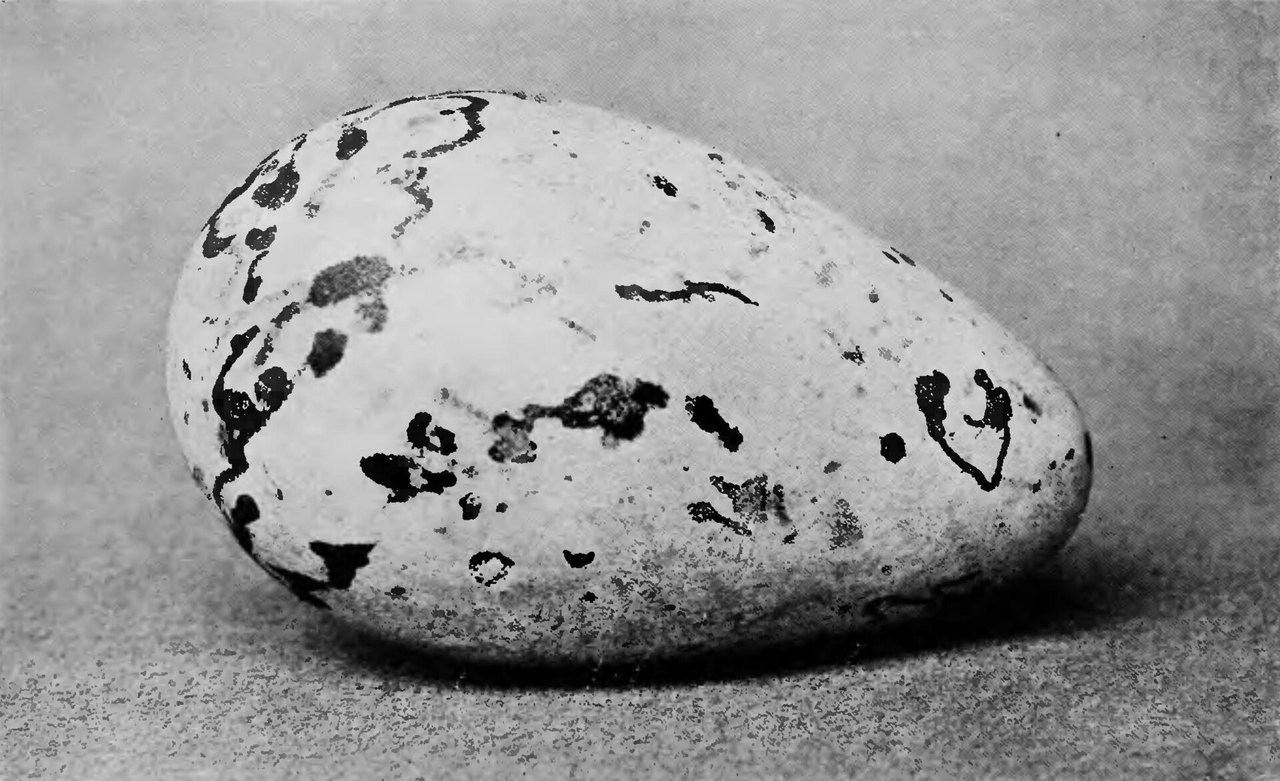
The season of hatching fixed the timing of this precarious arrangement. The eggs hatched out by the middle of June, so the period of incubation and the earliest days of the chick fell within a defined span of the year, after which the rock was no longer needed for its single purpose. The bird's presence on land was thus a seasonal episode set against the longer portion of its life spent at sea, and the bare rock was occupied only for the business of bringing one egg to hatching. 1
Nothing in the bird's build suggests any capacity to compensate for the exposure of the egg by flight or by rapid movement between nesting places. It flew not at all, and its short wings could not carry it from the rock in the manner of the birds that share such ledges. The choice of bare rock was therefore consistent with a creature whose only means of departure was the water, and whose nesting place lay close to the sea to which it was fitted for swimming and diving. 1
The single egg and the fixed hatching season together define a narrow margin. A bird that lays one egg upon bare stone and hatches it by mid-June has staked its continuance on a brief and unprotected interval, and the absence of flight leaves that interval without recourse. In this the breeding habit and the flightless body are of a piece: the same economy that made the water the bird's refuge made the rock the one place where its yearly single egg was set down. 1
5. Food
The great auk's prey is known from the contents of the stomach, and the record is a narrow one: the species fed on Cottus scorpius and on Cyclopterus lumpus. Both are fish of the sea floor rather than the open water above it, and the bird's taking of them accords with a body fitted for swimming and diving. The long broad bill was the instrument by which such prey was secured, and the pursuit of bottom-living fish explains why the bird's hunting was conducted beneath the surface rather than in the air. 1
How far this evidence actually reaches is another matter. The two fishes are the whole of the recorded diet, and nothing in the account establishes whether they were the staple of the bird's feeding or merely what was found in the individuals examined. No seasonal variation in diet is recorded, nor any difference between the food of one locality and another, nor any account of how the young were fed. The list is therefore best read as a minimum: it demonstrates that the great auk fed on these fishes, not that it fed on nothing else. 1
What the food does confirm is the manner of the bird's life. Prey that must be chased and caught under water belongs to a creature that dived as soon as alarmed and that swam with its head much lifted up when at the surface. The diet is thus consistent with the whole economy of a flightless seabird whose hunting was done in the sea and whose only means of escape was the water. 1
The evidence stops short, however, of any fuller picture of how the bird obtained its living. Nothing recorded describes the depth to which it descended in pursuit of Cottus scorpius or Cyclopterus lumpus, the season in which either was taken, or the quantity needed to sustain a bird above the size of a solan goose. On the question of diet, therefore, the record establishes the kinds of prey and the manner of their capture, and leaves the rest unmeasured. 1
6. Vulnerability
The great auk's flightlessness was absolute: it flew not at all, and its wings were short. On the open rock where it laid its eggs, this left the bird without any means of leaving the ground when danger approached. A bird that cannot take wing from the nesting site has no recourse but the sea, and the sea lay at some distance from the bare rock on which the egg was set down. The posture that observers noted, standing stately with its whole body erected, and sitting more upright than either the guillemots or the razorbills, placed the bird conspicuously on the rock rather than concealed against it. Its plumage of a black colour, with red about the eyes, offered no protection by way of concealment, and its size, above that of a solan goose, made it a conspicuous object on the nesting ledge. 1
The bird's habits compounded this defencelessness. It laid only one egg each year, and that egg was deposited upon the bare rock without the shelter of a nest. The single egg, hatched out by the middle of June, represented the whole of the year's reproductive effort, so that any loss at the nesting site was total for that season. A flightless bird that lays one egg on open rock thus had no margin against disturbance: it could neither move the egg nor defend it by flight, and the loss of the single egg could not be made good until the following year. 1
The bird's only resource was the water. It dived as soon as alarmed, and it was fitted for swimming and diving; when at the surface it swam with its head much lifted up. These habits show that escape lay in the sea rather than in the air, and that the bird's safety depended on reaching the water before danger closed. On the nesting rock, however, that resource was not immediately available, and the same body that made the water a refuge made the rock a place of exposure. The long broad bill and the short wings belonged to a bird built for the sea, not for the land, and the land was where its single egg was laid. 1
The pattern is not unique to this bird. The dodo of Mauritius lost its flight on an island without enemies and was destroyed once people arrived, and the same weakness is visible in the penguin, which kept its flightlessness but survived by living where its enemies were fewer. 1
7. What Remains
What remains of the great auk is a scattered and exiguous body of material: skins, bones and eggs, preserved by chance and dispersed among collections. The scarcity of these remains is itself a consequence of the bird's history. A species that laid only one egg each year, and that egg upon the bare rock, could not have yielded the numbers of specimens that a more prolific bird would have supplied; and the same single egg, hatched out by the middle of June, means that the eggs which survive represent a fraction of a fraction of the annual reproductive output. The skins and bones that remain are therefore not the residue of abundance but the residue of rarity, and their sparseness records the narrowness of the species' margin rather than the care of its collectors. 1
The eggs deserve particular attention, because the bird's reproductive habit gives them a meaning beyond the merely antiquarian. Since only one egg was laid each year, and since it was deposited upon the bare rock without shelter, each surviving egg stands for a whole season's reproductive effort that was not lost. The loss of an egg at the nesting site was total for that year, and could not be made good until the following season; in consequence, the eggs that survive are the record of the years in which the bird succeeded, and their small number is a measure of how little margin the species possessed against disturbance. 1
The bones and skins, for their part, preserve the anatomy of a bird built for the sea rather than the land. The long broad bill and the short wings belonged to a creature fitted for swimming and diving, which dived as soon as alarmed and swam with its head much lifted up. Its plumage of a black colour, with red about the eyes, and its size above that of a solan goose, are known from these remains; so too is the posture that observers noted, standing stately with its whole body erected, and sitting more upright than either the guillemots or the razorbills. The material record thus confirms what the written accounts describe: a bird conspicuous on the rock and at home only in the water. 1
The scarcity of these remains therefore carries a double meaning. It is the practical reason why the great auk is now known chiefly through a handful of preserved specimens, and it is also a symptom of the biological narrowness that made the species vulnerable. A bird that flew not at all, laid one egg on open rock, and depended on the sea for escape left behind it only what chance preserved, and that little is all the evidence there is. 1
8. Key Facts
| Attribute | Value |
|---|---|
| Size in early accounts | above the size of a solan goose 1 |
| Plumage | of a black colour, red about the eyes 1 |
| Bill | a long broad bill 1 |
| Stance | stands stately, its whole body erected 1 |
| Flight | flies not at all 1 |
| Wings | wings short 1 |
| Nesting site | lays its eggs upon the bare rock 1 |
| Eggs per year | laid only one egg each year 1 |
| Hatching | hatched out by the middle of June 1 |
| Food reported | fed on Cottus scorpius 1 |
9. Frequently asked questions
What was the great auk?
A large flightless seabird of the North Atlantic, described by Grieve in 1885. 1
Could it fly?
No: its wings were short, and the accounts say plainly that it did not fly at all. 1
Where did it nest?
On bare rock, where it was defenceless against people. 1
How many eggs did it lay?
One egg each year, hatched by the middle of June. 1
What did it eat?
The records name the bull-head and the lump-fish, though Grieve doubted these were its main food. 1
10. Timeline
- 1885Symington Grieve publishes his history of the great auk.Symington Grieve publishes his history of the great auk.
References (1)
- 1The Great Auk, or Garefowl (Alca impennis, Linn.); its History, Archaeology, and Remains — T. C. Jack, London (via Internet Archive) Archive↩View source