Penguin
The family Spheniscidae - penguin species and distribution from Antarctica to the equator, their swimming and huddling adaptations, diet and breeding cycles, and the conservation threats they face.
Penguins are flightless seabirds of the Southern Hemisphere, grouped in the family Spheniscidae: 18 species that range from the emperor penguin of Antarctica, 115 cm tall and 25-40 kg, to the little penguin of Australia and New Zealand, just over 25 cm and about 1 kg. Their wings are stiff flippers for underwater flight, they hunt fish, squid and krill, and they breed in colonies - emperor penguins famously through the Antarctic winter, the male carrying a single egg on his feet for 9 weeks. Sea ice loss, overfishing, introduced predators and oil spills are the main threats, and on 9 April 2026 the emperor penguin was moved from Near Threatened to Endangered on the IUCN Red List.
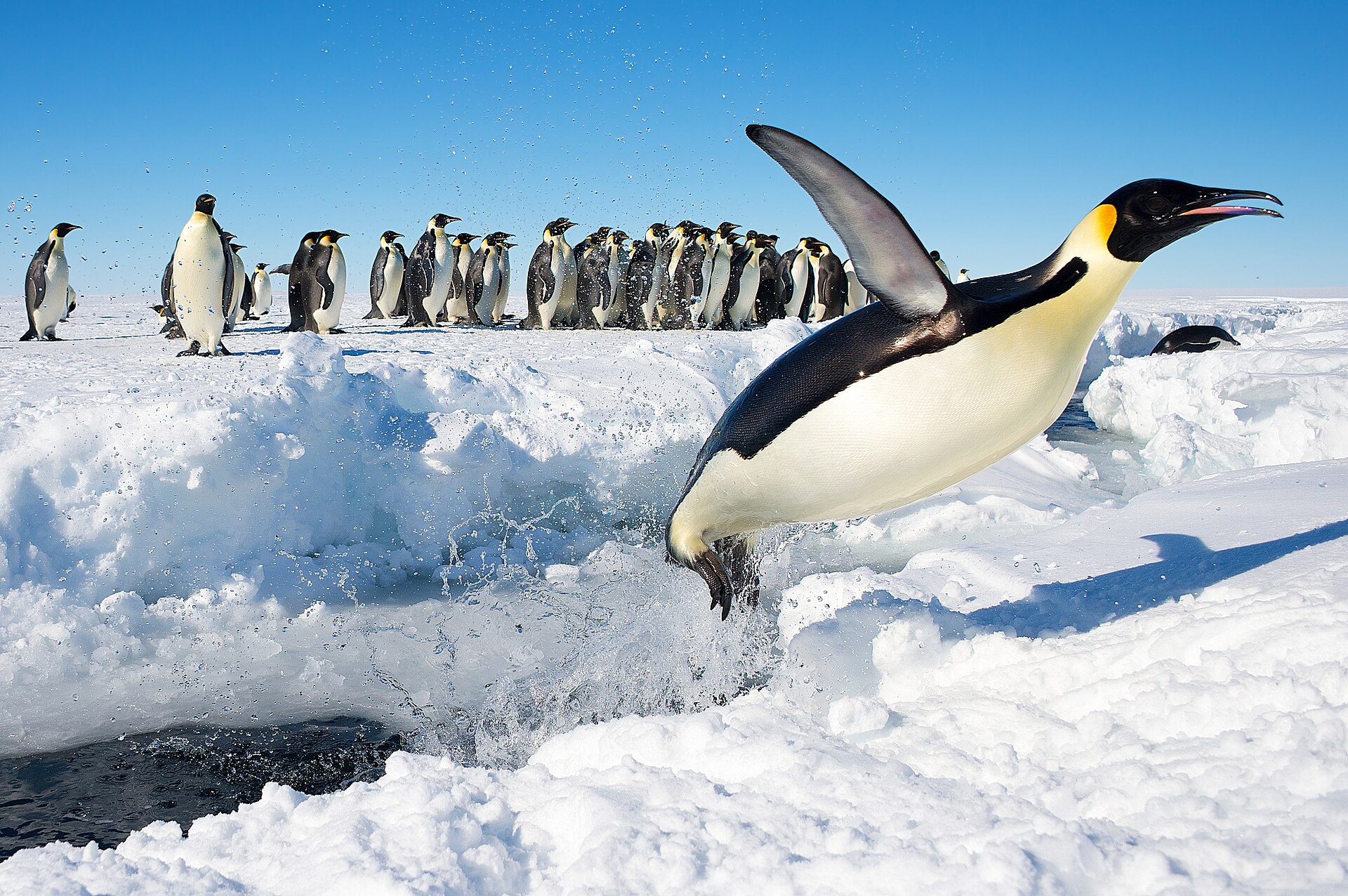
In this article
- 1Taxonomy and Evolution
- 2Distribution and Habitat
- 3Emperor Penguin: Breeding and Life Cycle
- 4Emperor Penguin: Colonies and Huddling
- 5Emperor Penguin: Diet and Diving
- 6Little Penguin
- 7Conservation Status and Threats
- 8Research and Monitoring
- 9Timeline of Key Discoveries and Events
- 10Timeline: from the first emperor penguin specimens to the 2026 Red List update
- 11Knowledge graph
Taxonomy and Evolution
The penguins constitute the order Sphenisciformes, which contains a single family, Spheniscidae, divided into six genera and 17 species. Britannica, by contrast, describes penguins as any of 18–21 species of flightless marine birds that live only in the Southern Hemisphere. A separate reckoning recognises 18 species, five of which live in Antarctica.
The penguin wing is modified as a flipper, its skeleton flattened and partially fused. In a feature unique to penguins, the biceps brachii muscle is absent.
The wings of a penguin were once used for flight by their distant ancestors, but they now serve as powerful swimming propellers. Their wingspans are shorter, and their bones are flattened, fused and dense, devoid of the air pockets that lighten the skeleton of flying birds.
Unlike flying birds, which replace feathers gradually, penguins undergo a catastrophic moult in which they replace their entire plumage at once over a two to five week period in late summer. During this time they cannot enter the sea.
The emperor penguin was first described scientifically and distinguished from its closest relative, the king penguin, in 1844 by George Robert Gray, head of ornithology at the British Museum.
1. Distribution and Habitat
Penguins are confined to the Southern Hemisphere, where they live as oceanic or coastal birds. The majority of species do not inhabit Antarctica itself but breed on islands lying between latitudes 45 and 60 degrees South. The greatest concentrations of the group are nonetheless found on Antarctic coasts and sub-Antarctic islands.
New Zealand has more penguin species on its shores than any other country. Thirteen of the world's 18 species have been recorded in the New Zealand region, including the Ross Dependency, and nine of these species breed there. The little penguin, the smallest species in the world, is widely distributed along the coastlines of the North, South, Stewart and Chatham Islands and their offshore islands.
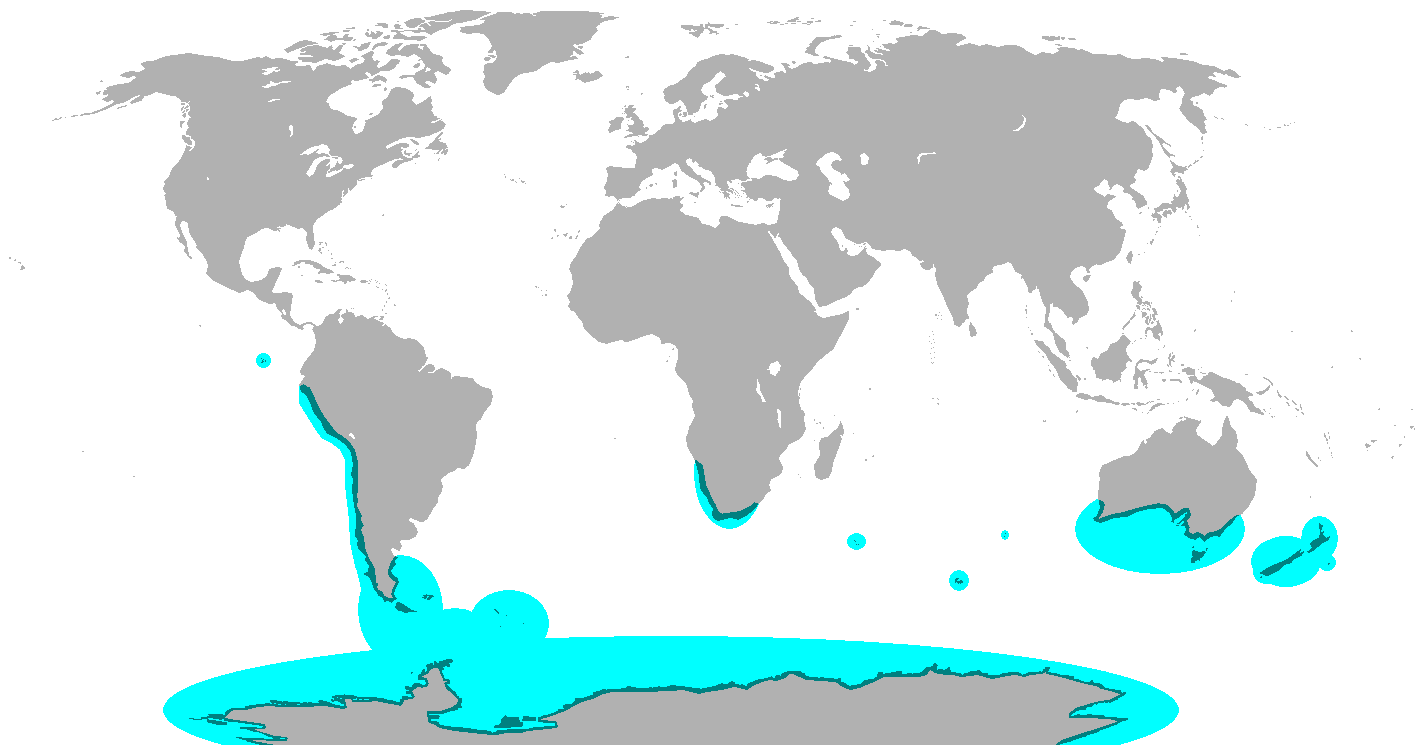
Penguins are birds of the ocean, spending up to 75 percent of their lives in the water.
2. Emperor Penguin: Breeding and Life Cycle
The emperor penguin breeds during the worst weather conditions on earth. Its colonies are scattered around the Antarctic continent, ranging in size from a few hundred to over 20,000 pairs, most of them on fast ice. Because the species depends on fast ice for its long-term survival, a breeding platform is not optional: without it, the birds have nowhere to go.
Prior to breeding, both the male and the female build their body reserves. The female lays a single egg, and the male fasts while undertaking the entire egg incubation during the Antarctic winter. He relies on a thick fat reserve for survival.
Eggs are laid in the Antarctic winter, from May to June. They hatch after 65 days. The chicks do not fledge until between December and January.
Emperor penguins are long-lived, reaching at least 40 years, and their annual reproductive output is low: each breeding pair can produce only one chick per year. Chick mortality is high once the young leave the colony, and perhaps only a third of each year's cohort may live to its first birthday.
A study reviewed over 150 studies on the emperor penguin species, its environment and its breeding biology, and recommended that the emperor penguin should be listed by the Antarctic Treaty as a Specially Protected Species.
Emperor penguins are the only animals that breed during the Antarctic winter.
3. Emperor Penguin: Colonies and Huddling
There are 66 known breeding colonies after the four new satellite discoveries of 2024. British Antarctic Survey scientists discovered four previously unknown emperor penguin breeding sites using satellites. Changing sea ice conditions along Antarctica's coastline have forced several emperor colonies to move in search of more stable sea ice, and some known colonies have already moved 30-40km to new breeding grounds.
In an emperor penguin huddle the birds take turns to occupy the warmest and coldest positions. Up to 10 emperors per square metre can be found in a huddle, and the huddle can shift 200 m during a 48-hour blizzard. Emperor penguins have excellent insulation in the form of several layers of scale-like feathers that resist winds over 60 knots or about 110 kilometres per hour.
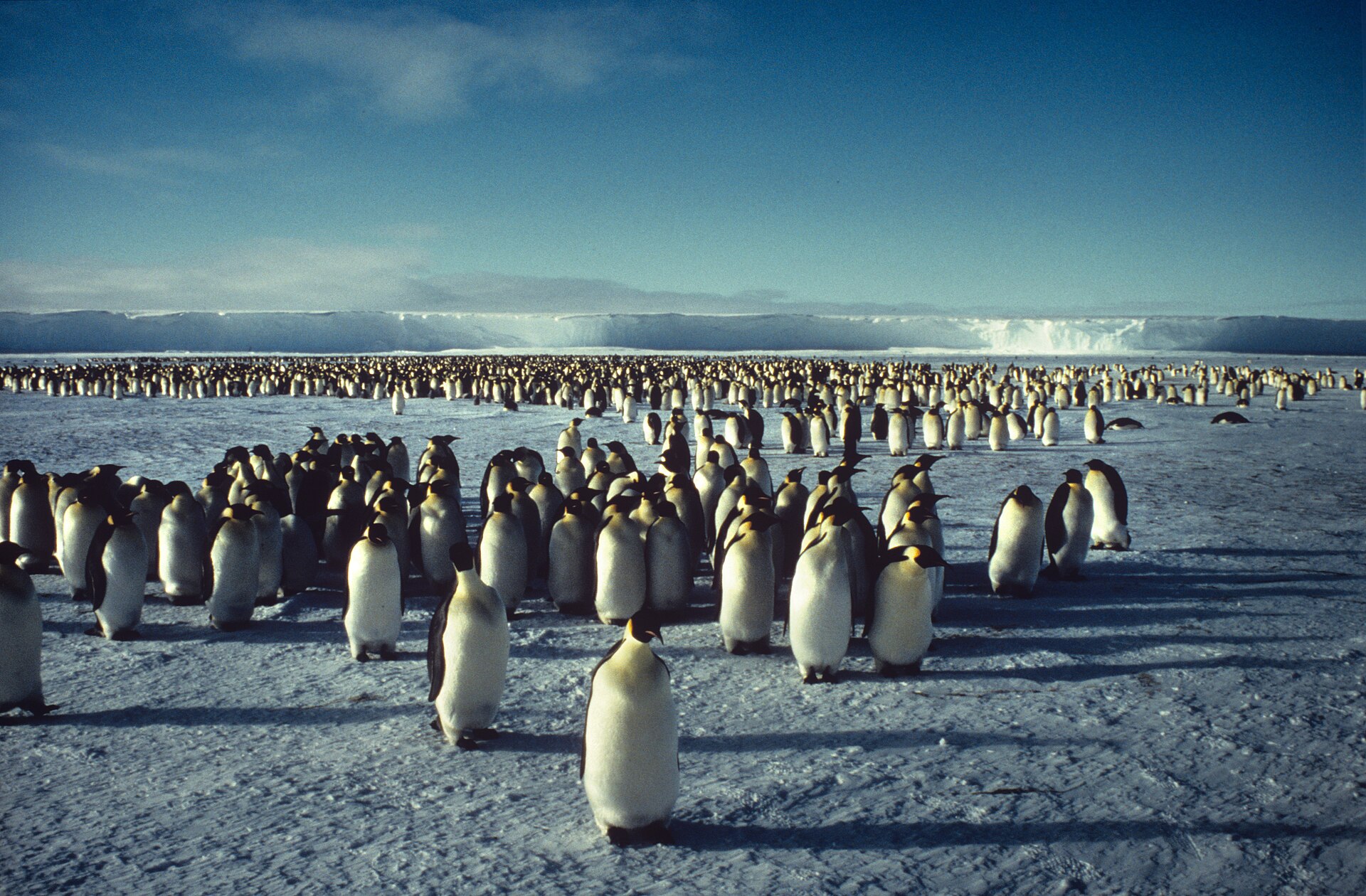
Most penguins breed in large colonies; one of the largest, the macaroni penguin colony in South Georgia, is estimated at five million pairs.
4. Emperor Penguin: Diet and Diving
An adult emperor penguin consumes 2–3 kg of food each day, and its intake can rise to as much as 6 kg per day when it is fattening up before a moult or at the start of the breeding season.
Most foraging dives by emperor penguins take place at depths of 150 to 250 metres. The deepest dive recorded for the species reached 565 metres, and the longest dive on record lasted 22 minutes.
The 2022 Bellingshausen Sea event was the first recorded incident of widespread emperor penguin breeding failure clearly linked with large-scale contractions in sea ice extent. Of the five emperor penguin breeding sites in the Bellingshausen Sea region, all but one experienced total breeding failure after sea ice break-up before the fledging period of the 2022 breeding season.
5. Little Penguin
The little penguin is the smallest penguin species in the world, standing just over 25 cm and weighing about 1 kg.
They nest in burrows dug in bare sand or under vegetation. Where the ground is too soft for a burrow, they also nest in caves and rock crevices.
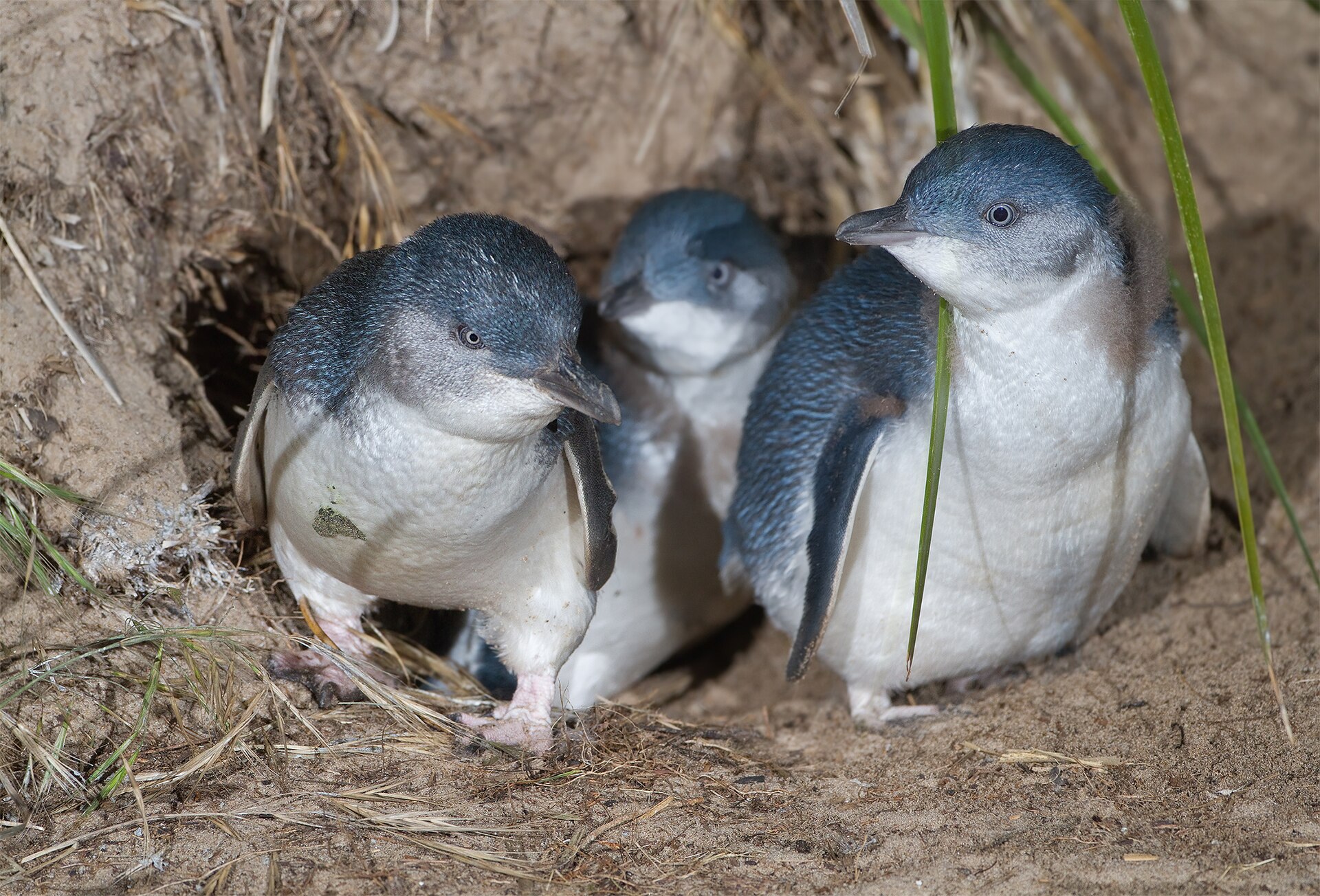
The little penguin feeds on fish, squid, krill and small crustaceans. A female little penguin lays two eggs, and the pair take turns incubating them in one or two day shifts; usually only one chick survives. Little penguins are monogamous within a breeding season and share incubation and chick rearing duties. They are the only penguin species capable of producing more than one clutch of eggs per season.
The largest known little penguin colonies include Motunau Island with 1650 nests and Pohatu Bay on Banks Peninsula with 1250 pairs. Little penguins must stay ashore continuously for about two weeks during the annual moult, mainly between January and March.
6. Conservation Status and Threats
The emperor penguin is listed as Endangered on the IUCN Red List as of 9 April 2026. Its move from Near Threatened to Endangered rested on projections that its population will halve by the 2080s.
Satellite images indicate a loss of around 10% of the emperor penguin population between 2009 and 2018 alone, amounting to more than 20,000 adult penguins. The IUCN SSC Penguin Specialist Group concluded that human-induced climate change poses the most significant threat to emperor penguins. Under current warming trends 80% of colonies are projected to be quasi-extinct by the end of the century.
The Galapagos penguin is the rarest of all penguin species and is categorized as Endangered on the IUCN Red List because of its small population and restricted distribution. Its current population is likely somewhere between 1,500 and 4,700 birds, suspected to be about half of what it was in the 1970s. The biggest threats to Galapagos penguins are climate change, introduced species, overfishing and mismanagement of fisheries.
At Punta Tombo, once the largest Magellanic penguin colony in the world, the population has decreased by about 40% since 1987. The global little penguin population is believed to average around 1,000,000 individuals but is declining because of introduced predators, decreasing prey populations and oil spills. In New Zealand its conservation status is At Risk-Declining. Little penguin populations have been declining in areas not protected from predators, while where predator control is in place populations have been stable or increasing.
A network of 51 cameras spanning the Antarctic Peninsula and the South Shetland Islands captures 12 photos per day during daylight hours, monitoring gentoo, Adélie and chinstrap penguins by observing stereotypical behaviours in the nest. Researchers typically visit these sites only once or twice a year to download photos and replace camera batteries.
In 2010, 120 artificial nests were constructed in the Galapagos as a conservation effort.
7. Research and Monitoring
NOAA Fisheries studies Adélie, chinstrap and gentoo penguins in order to provide ecosystem-based advice on fisheries management in the Southern Ocean. That research centres on the interactions of penguins with their primary prey, Antarctic krill, on the changing conditions in the Antarctic Peninsula region, and on the activity of the krill fishery.
At NOAA's Antarctic field camps, researchers conduct annual censuses and monitor reproductive success, diet and growth. They also track individual birds during foraging trips. Seabird studies at these Antarctic field sites date back to the late 1970s, which makes some of them among the longest time series available in the Antarctic Peninsula region.
Scientists can assess penguin populations without stepping on the Antarctic continent. The University of Minnesota Polar Geospatial Center scans satellite imagery for guano in order to count the penguins in a colony.
8. Timeline of Key Discoveries and Events
-
1819-1821First emperor penguin capturedThe first emperor penguin ever captured was probably taken during the Russian Naval Expedition of 1819-1821 under the command of Fabian Gottlieb von Bellingshausen. 6Study recommends special protection of emperor penguins · British Antarctic Survey ↗
-
1906Penguin eggs found in the GalapagosDarwin never saw penguins during his visit to the Galapagos Islands; penguin eggs were found there in 1906. 18Galapagos Penguin Project · Center for Ecosystem Sentinels, University of Washington ↗
-
1950s and 1960sFirst nests in the GalapagosA few penguin nests were discovered in the Galapagos in the 1950s and 1960s. 18
9. Timeline: from the first emperor penguin specimens to the 2026 Red List update
- 1819-1821First emperor penguin capturedThe first emperor penguin ever captured was probably taken during the Russian Naval Expedition of 1819-1821 under the command of Fabian Gottlieb von Bellingshausen.
- 1844Emperor penguin described scientificallyGeorge Robert Gray, head of ornithology at the British Museum, first described the emperor penguin and distinguished it from its closest relative, the king penguin, using specimens from the Ross expedition of 1839-1843.
- 1906Penguin eggs found in the GalapagosPenguin eggs were found on the Galapagos Islands in 1906; a few nests were discovered in the 1950s and 1960s.
- 1972Boersma surveys Galapagos penguinsDee Boersma, then a young graduate student starting her dissertation studies, discovered Galapagos penguins breeding at several sites on the islands during a 1972 survey.
- late 1970sNOAA begins long-term seabird monitoringSeabird studies at NOAA's Antarctic field sites date back to the late 1970s, producing some of the longest time series available in the Antarctic Peninsula region.
- 1987Punta Tombo baseline for Magellanic penguinsAt the start of the Magellanic Penguin Project, Punta Tombo in Argentina was the largest Magellanic penguin colony in the world; the colony has since decreased by about 40%.
- 2009-2018Emperor penguin population falls about 10%Satellite images indicate a loss of around 10% of the emperor penguin population between 2009 and 2018, more than 20,000 adult penguins.
- 2010120 artificial nests built in the GalapagosBoersma's project teamed up with the Galapagos National Park and Godfrey Merlen in 2010 to build 120 nests for Galapagos penguins.
- since 2016Record-low sea ice years clusterSince 2016 Antarctica has seen the four years with the lowest sea ice extents in the 45-year satellite record, with the two lowest in 2021/22 and 2022/23.
- July 2019UK raises emperor penguin threat at Antarctic Treaty meetingThe UK notified the Antarctic Treaty Consultative Meeting at its 2019 meeting in Prague that emperor penguins were threatened through the loss of their breeding habitat.
- 2022Bellingshausen Sea breeding failure linked to sea ice lossRecord low sea ice in 2022 led to the first recorded widespread breeding failure of emperor penguins: four of the five colonies in the Bellingshausen Sea region failed.
- January 2023New colony brings total to 62Scientists using satellite mapping discovered a new emperor penguin colony at Verleger Point, bringing the total of known colonies to 62, exactly half discovered by satellite imagery.
- January 2024Four new colonies bring total to 66BAS scientists found four previously unknown emperor penguin breeding sites; with the re-establishment of Halley Bay the total of known colonies stands at 66.
- 9 April 2026Emperor penguin listed as EndangeredThe emperor penguin moved from Near Threatened to Endangered on the IUCN Red List, based on projections that its population will halve by the 2080s.
References (21)
- 1Sphenisciformes (penguins) - Information — Animal Diversity Web, University of Michigan Museum of Zoology WebView source
- 2Penguin | Habitat, Species, Predators, & Facts — Encyclopaedia Britannica WebView source
- 3Penguins — Australian Antarctic Program (Australian Antarctic Division) WebView source
- 4Penguins — Smithsonian Ocean, Smithsonian Institution WebView source
- 5Penguins: Sea and shore birds — Department of Conservation Te Papa Atawhai, New Zealand WebView source
- 6Study recommends special protection of emperor penguins — British Antarctic Survey Web↩View source
- 7Little penguin | Korora — New Zealand Birds Online (Te Papa, DOC and Birds New Zealand) WebView source
- 8Emperor penguin — Australian Antarctic Program (Australian Antarctic Division) WebView source
- 9Adapting to a changing environment — Australian Antarctic Program (Australian Antarctic Division) WebView source
- 10Antarctic wildlife — British Antarctic Survey WebView source
- 11Four new emperor penguin colonies found by satellite — British Antarctic Survey WebView source
- 12Record low 2022 Antarctic sea ice led to catastrophic breeding failure of emperor penguins (Communications Earth & Environment 4, 273) — Nature Portfolio (Fretwell, Boutet & Ratcliffe) 2022 JournalView source
- 13Little penguin/korora — Department of Conservation Te Papa Atawhai, New Zealand WebView source
- 14Eudyptula minor (little penguin) - Information — Animal Diversity Web, University of Michigan Museum of Zoology WebView source
- 15Little Penguin (Eudyptula minor) — Australian Museum WebView source
- 16Emperor penguin and Antarctic fur seal now Endangered due to climate change - IUCN Red List — International Union for Conservation of Nature (IUCN) WebView source
- 17New emperor penguin colony discovered — British Antarctic Survey WebView source
- 18Galapagos Penguin Project — Center for Ecosystem Sentinels, University of Washington Web↩View source
- 19Magellanic Penguin Project — Center for Ecosystem Sentinels, University of Washington WebView source
- 20Remote Camera Network Tracks Antarctic Species at Low Cost — NOAA Fisheries (National Oceanic and Atmospheric Administration) WebView source
- 21Seabird Research in the Antarctic — NOAA Fisheries (National Oceanic and Atmospheric Administration) WebView source
 Monarch Butterfly
 Gray Wolf
 Megalodon