Octopus
The eight-armed cephalopod: anatomy and senses, camouflage and colour change, problem-solving research, species diversity, the semelparous life cycle and global fisheries.
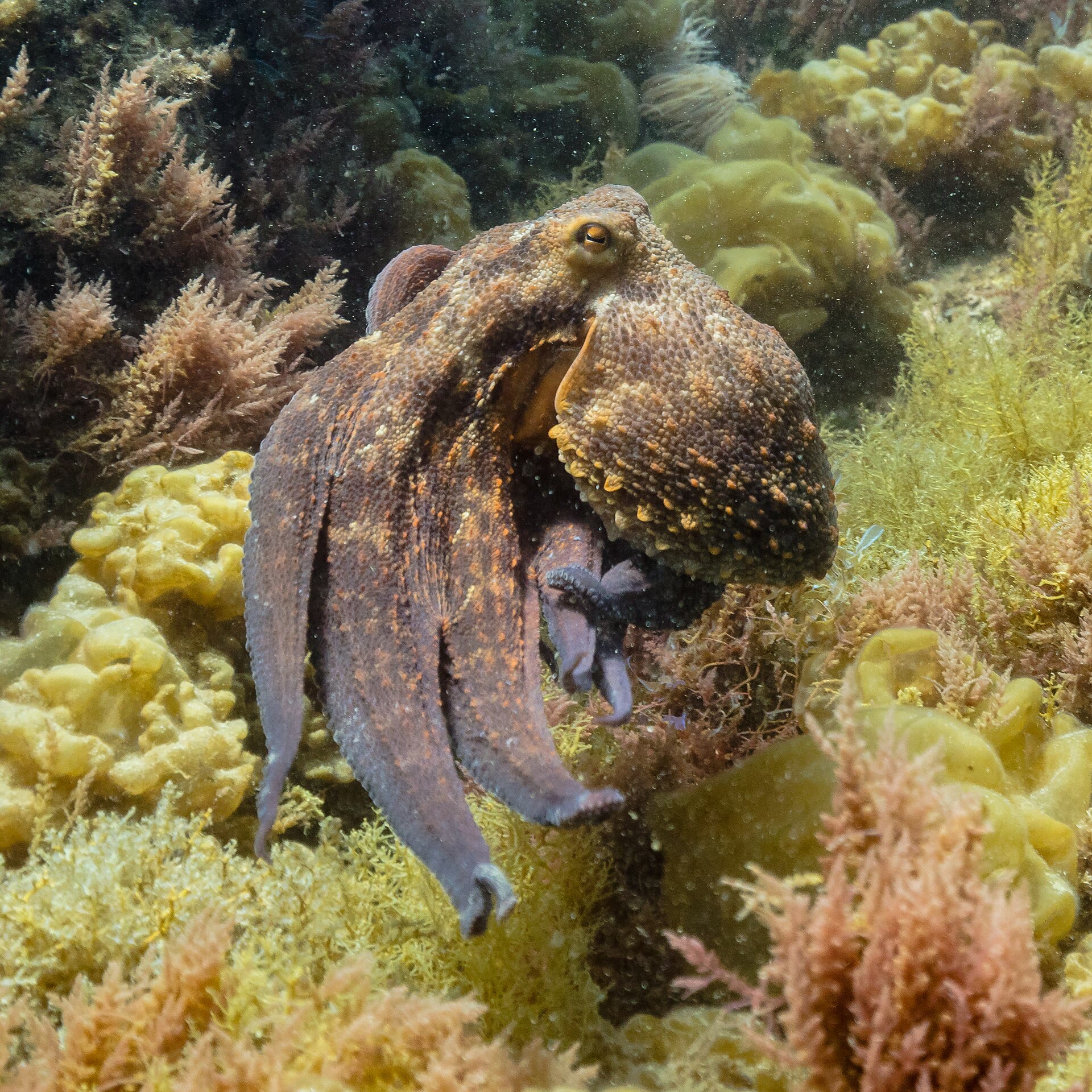
The octopus is a marine cephalopod of the order Octopoda, with eight arms, three hearts, blue copper-based blood and a large, complex nervous system distributed partly into its arms. Octopuses live in every ocean from the intertidal zone to at least 5 000 metres deep, ranging from pygmy species under a gram to arm spans of several metres, and they are famed for camouflage, problem-solving and a semelparous life cycle in which females spawn once and die around hatching. More than 300 species of benthic octopus are thought to exist, and total world octopus production exceeded 350 710 tonnes in 2010.
In this article
- 1Overview
- 2Classification and Diversity
- 3Anatomy and Physiology
- 4Size, Lifespan and Distribution
- 5Reproduction and Life Cycle
- 6Behaviour and Cognition
- 7Sleep and Neural Specialisation
- 8Genomics and RNA Editing
- 9Ecology and Habitat
- 10Fisheries and Human Interaction
- 11Research and Laboratory Culture
- 12Timeline: from Cuvier's description to genome and fossil discoveries
- 13Knowledge graph
Overview
Octopoda is an order within the class Cephalopoda, the cephalopod molluscs. The common octopus is known scientifically as Octopus vulgaris Cuvier, 1797.
Octopods are exclusively marine animals, and none of them has colonised fresh water habitats.
1. Classification and Diversity
The order Octopoda sits within the class Cephalopoda, the cephalopod molluscs, and is divided between the incirrate and cirrate octopuses. Octopods themselves fall into two major groups: the finless incirrate octopuses, which include the familiar benthic species, and the semi-gelatinous finned cirrate octopods. The class to which they belong is an ancient and varied one, with about 17,000 named species of fossil cephalopods known against 800 identified living species.
The shallow-water benthic octopuses of the family Octopodidae form the most diverse group of octopods, likely to total more than 300 species worldwide, many of which still lack formal scientific description.
The species name Octopus vulgaris, meaning common octopus, was originally described by Cuvier in 1797 and is presumed to have been based on specimens from the Mediterranean Sea. Octopus vulgaris is in fact a species complex comprising at least six closely related and morphologically similar species. Two members of that complex, Octopus americanus and Octopus insularis, were both formerly designated as O. vulgaris and are now considered cryptic species inhabiting the western Atlantic, while O. vulgaris sensu stricto inhabits the eastern Atlantic and Mediterranean.
The historical lack of distinction made between O. insularis in the scientific literature and fisheries statistics has hindered proper management of octopus fisheries in the western Atlantic.
2. Anatomy and Physiology
The circulatory system of octopods is built around three hearts: a central systemic heart and paired branchial, or gill, hearts, one positioned above each gill. One heart circulates blood around the body, while the other two pump it past the gills to pick up oxygen.
The blood these hearts move carries haemocyanin, a respiratory pigment built on copper rather than iron.
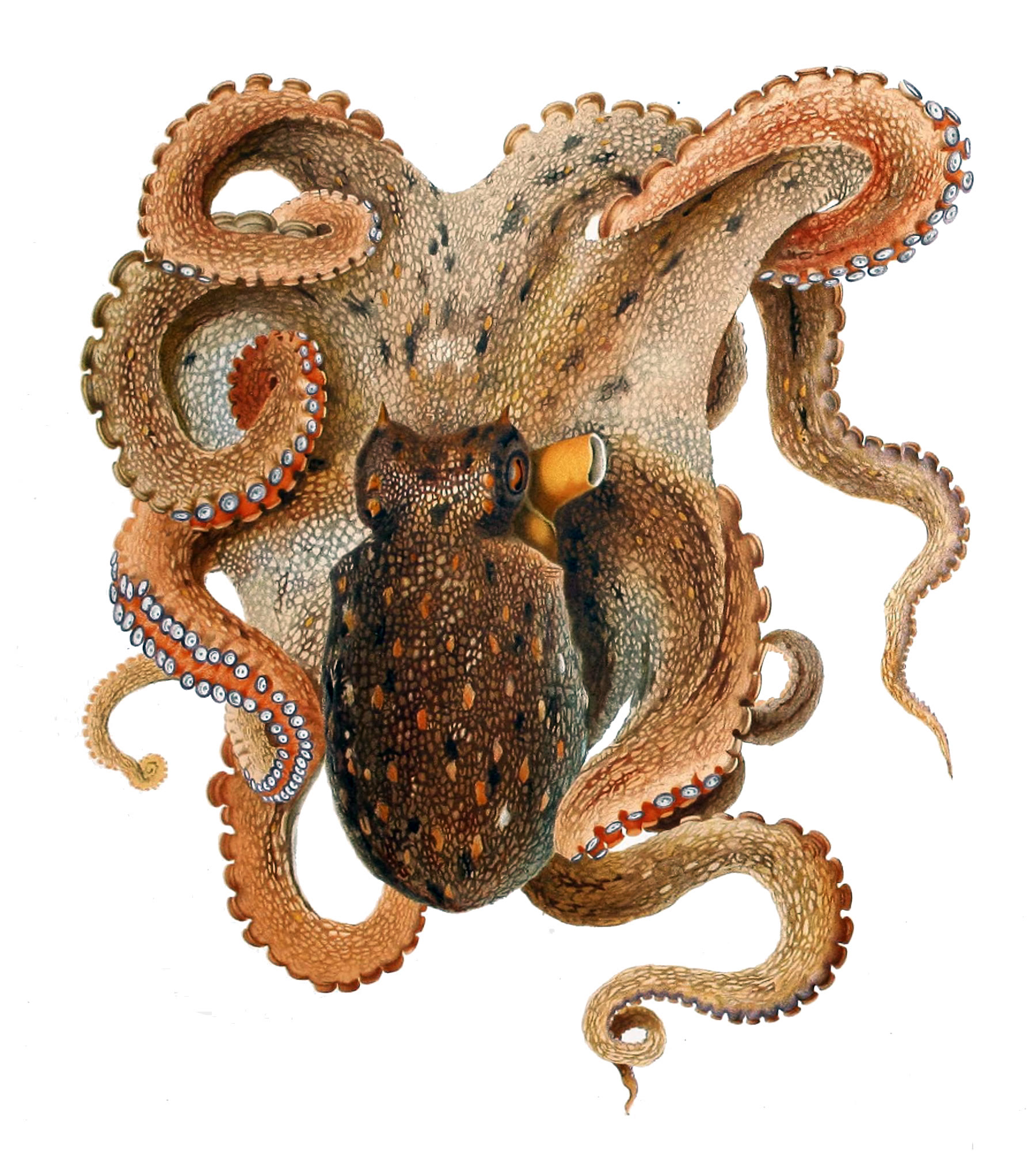

The octopus body carries eight arms. Each arm contains its own mini brain, and while the arms can act independently — able to taste, touch and move — the centralised brain can also exert top-down control over them. The organisation of this peripheral nervous system has drawn attention for the way a distributed neural network mediates the decisions of the central brain and the continuous actuation of the limbs.
The octopus brain is doughnut-shaped. For colour and pattern, the animal relies on millions of elastic chromatophore cells beneath the skin, which allow it to match the patterns and colours of its background almost perfectly, even though experiments show it is colour-blind. This capacity sits within a broader picture: cephalopods have the most centralised and largest nervous system of all invertebrates, with a brain-to-body size ratio greater than most fish and reptiles.
Feeding brings the radula into play, a hard, rough tongue used to scrape away softened shell material and create a tiny hole. Through that opening the octopus secretes a toxin that paralyzes its prey.
3. Size, Lifespan and Distribution
Within that common plan the order spans an extraordinary range of bulk, from pygmy species weighing under a single gram to animals whose arm spans are likely to exceed three to four metres.3Cephalopods of the World. An annotated and illustrated catalogue of cephalopod species known to date. Volume 3. Octopods and Vampire Squids · Food and Agriculture Organization of the United Nations (FAO) ↗ Most octopuses, by contrast, weigh less than 70 pounds and stretch to 15 feet or less.8The Giant Pacific Octopus (Marine Fisheries Review) · NOAA Scientific Publications Office ↗
Lifespan is brief for most of the order, generally no more than a year.6Giant Pacific octopus · Monterey Bay Aquarium ↗
The giant Pacific octopus, the largest of several species inhabiting coastal waters from California northward to Alaska and across to Japan, lives from the intertidal zone to depths greater than 100 fathoms.8
| Attribute | Value | Source |
|---|---|---|
| Size range | Pygmy species under one gram to arm spans likely exceeding 3–4 m | fao-ceph-vol3 |
| Record size (giant Pacific octopus) | 200 pounds; nearly 20 feet across | mbayaq-giant-pacific-octopus |
| Lifespan | Most octopuses no more than a year; giant Pacific octopus about 3–5 years | mbayaq-giant-pacific-octopus |
4. Reproduction and Life Cycle
The vast majority of incirrate octopods appear to be semelparous, meaning they undergo a single egg-producing event in their lifetime and die around the time their eggs hatch.
Octopus mothers guard their eggs, protecting them from predators and wafting water over them to oxygenate them. In shallow-water species, this brooding period can last up to about three months.
The deep-sea octopus Graneledone boreopacifica was observed brooding her clutch of eggs for 53 months, nearly four and a half years, the longest brooding period known for any animal.
The giant Pacific octopus produces an average of 50,000 eggs, making its population naturally resilient. After hatching, the young octopus drifts in surface waters eating plankton for up to three months and then settles to the seafloor weighing five grams.
Growth appears to be rapid, with individuals reaching weights greater than 100 pounds within about five years. Adults commonly die after breeding activities.
5. Behaviour and Cognition
The soft-bodied cephalopods, a group that includes octopus, cuttlefish and squid, are broadly considered the most cognitively advanced of all invertebrates, with perception, learning and memory abilities comparable to those found in some vertebrates. Cephalopods possess a centralised brain, the largest of all invertebrates, together with highly developed sense organs, and they are able to remember and to learn by example or through trial and error.
Tool-like behaviour has been documented in the veined octopus, Amphioctopus marginatus, which has been observed carrying coconut shells around as mobile dens, a behaviour thought to decrease the likelihood of predation. Cephalopods are also capable of reversal learning, in which a reward association is first learned for one of two stimuli and then for the alternative stimulus. A 1992 report that octopuses could learn a visual discrimination task by first observing a conspecific demonstrator has not been replicated, and the study was criticised for lacking controls.
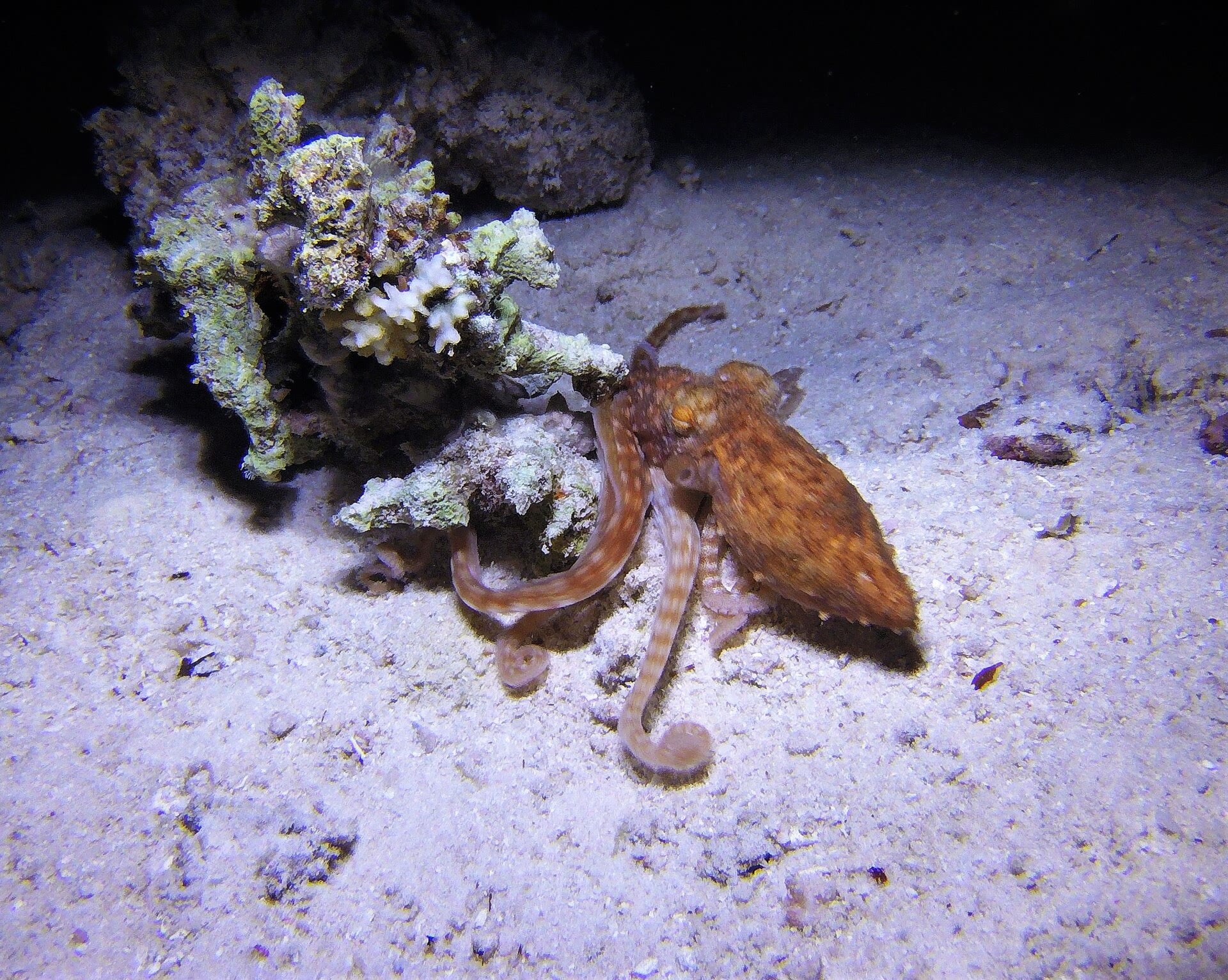
Each arm has about 100 suckers containing highly sensitive sensory organs, and the researcher Roger Hanlon describes each sucker as a chemo-tactile genius.
A study of octopuses in the wild produced the first full ethogram, or detailed catalogue, of octopus arm behaviours as related to foraging and locomotion. The octopuses frequently explored the mark via their arms, but mark-directed behaviours were also observed without a mirror and in sham-marked individuals, suggesting that proprioceptive stimuli drove these responses.
6. Sleep and Neural Specialisation
Octopuses pass through two distinct stages of sleep, and the active stage is marked by brain activity that resembles the waking state. This pattern is notable because octopuses diverged from vertebrates roughly 550 million years ago.
Quiet sleep in octopuses is rhythmically interrupted by bouts of pronounced body movements and rapid changes in skin patterning and texture, each lasting approximately 60 seconds. These active bouts are homeostatically regulated and rapidly reversible. They also come with an increased arousal threshold, a combination that the evidence treats as a distinct active sleep stage.
The strongest brain activity during active sleep occurs in the superior frontal and vertical lobes. These regions are associated with learning and memory function.
7. Genomics and RNA Editing
The first octopus genome to be sequenced came from the California two-spot octopus, Octopus bimaculoides. The resulting assembly captured more than 97% of expressed protein-coding genes and 83% of the estimated 2.7-gigabase genome.
Researchers found no evidence for whole-genome duplication in the octopus lineage, and the octopus Hox genes are completely atomised rather than organised into clusters. Nearly 45% of the assembled genome is composed of repetitive elements, with two bursts of transposon activity about 25 million and 56 million years ago.
The octopus genome shows massive expansions in two gene families previously thought to be uniquely enlarged in vertebrates: the protocadherins and the C2H2 zinc-finger transcription factors. Hundreds of cephalopod-specific genes showed elevated expression in specialised structures such as the skin, the suckers and the nervous system.
Extensive messenger RNA editing generates transcript and protein diversity in genes involved in neural excitability. More than 60 percent of RNA transcripts in the squid brain are recoded by editing, while in humans or fruit flies only a fraction of 1 percent of their RNAs have a recoding event. Editing is especially enriched in the coleoid nervous system, affecting proteins that are the key players in neural excitability and neuronal morphology.
High levels of RNA editing are not generally a molluscan trait but an invention of the coleoid cephalopods. To maintain recoding flexibility at the RNA level, coleoids have had to give up much of the ability to evolve in the surrounding genome regions.
MBL-led teams reported chromosomal-level assemblies of three cephalopod genomes, two squids and an octopus, all available for study at the MBL. Comparing the genomes showed they are highly rearranged, and the rearrangements may be involved in making novel cephalopod tissues including the large, elaborate nervous systems. An MBL team had earlier achieved the first gene knockout in a cephalopod, using CRISPR-Cas9 genome editing in the longfin inshore squid.
8. Ecology and Habitat
The common Sydney octopus, Octopus tetricus, is the largest octopus commonly seen in Sydney, with a size range of 80 cm. It sits in its lair during the day surrounded by rocks and rubble that it has collected to defend its home. At night it hunts using its sharp beak, feeding on crabs and molluscs such as snails and bivalves.
In 2012 scientists discovered in Jervis Bay, Australia, that the supposedly solitary gloomy octopus, Octopus tetricus, builds underwater cities from rock outcrops and discarded shells. Argonauts are pelagic octopuses of the ocean twilight zone that are rarely found in the wild, and only the females are able to create a shell.
9. Fisheries and Human Interaction
The most recent global catch statistics placed 2010 total world octopus production, the catch and culture of all species, at more than 350 710 tonnes. Global summary statistics list only four octopus species: the common octopus, the Mexican four-eyed octopus, the horned octopus and the musky octopus. A preliminary FAO list, by contrast, names more than 50 octopus species collected in small-scale to large-scale harvests around the world.
In the Bering Sea and Aleutian Islands, octopuses were managed as part of an other species complex through 2010; beginning in 2011 the management plan provided separate management and separate catch limits for octopus. There is still no reliable estimate of octopus biomass in the Bering Sea and Aleutian Islands, and the assessment recommends continued management in Tier 6 pending better data. Survey and fishery trawls catch predominantly small octopuses under 5 kg, while commercial pot gear catches or retains only large animals.
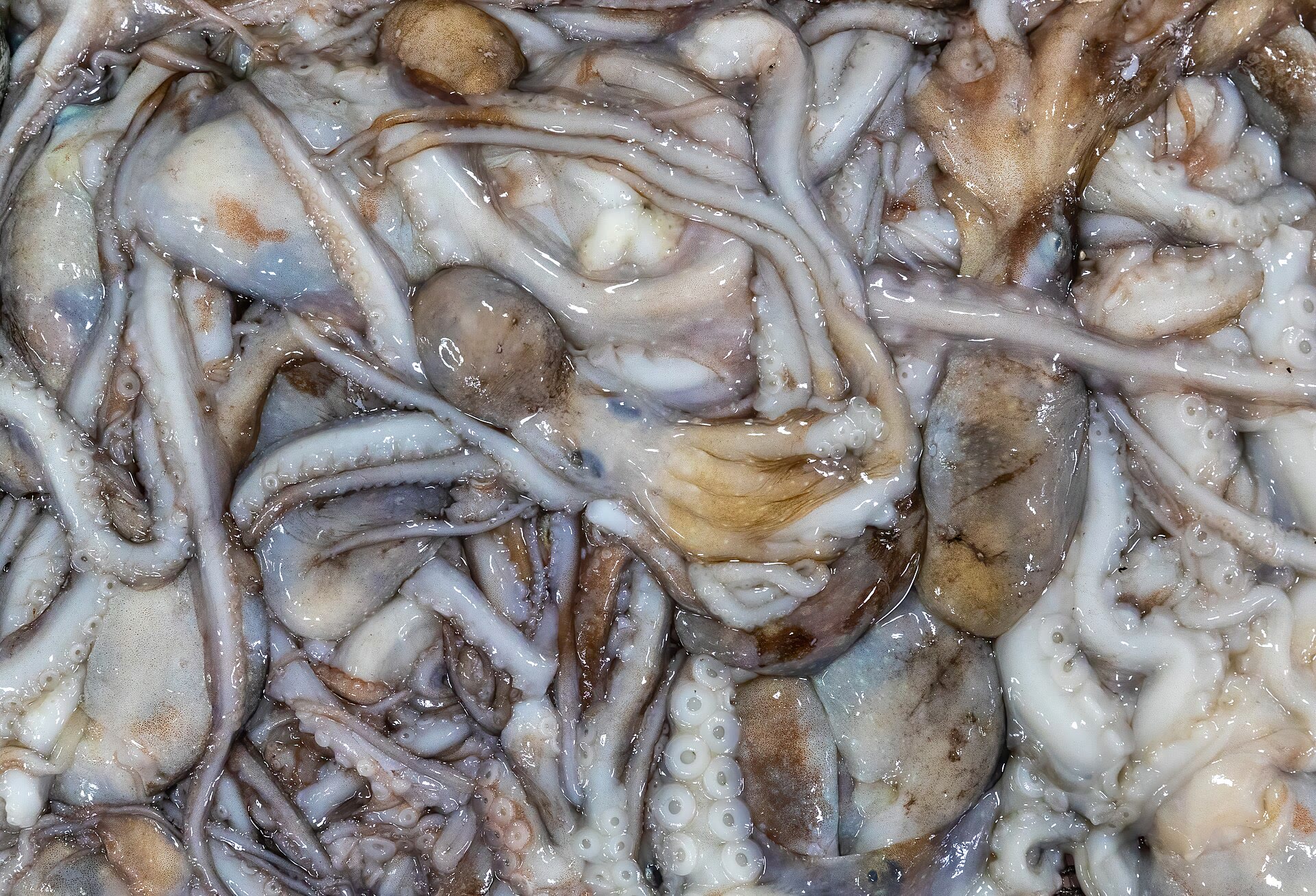
In the Gulf of Alaska the fisheries management plan was amended from 2011 to provide separate management for octopus, with its own annual catch limit for each species group. Although there is no targeted fishery for octopus in Alaska, octopuses are caught incidentally in trawl and pot gear. A NOAA Fisheries study suggested that the vast majority of octopus bycatch in commercial pot fisheries survives after being returned to sea. Because the findings mean fisheries that must close when they catch the overfishing limit of octopus could stay open longer, they have important implications for management.
Octopuses also enter human use outside the fishery. In China, Octopus ocellatus, Octopus variabilis and Octopus vulgaris are recorded as marine traditional Chinese medicine.
The estimated total catch for 2011 was the highest ever recorded at 918 tons, almost triple the catch amounts in preceding years.
10. Research and Laboratory Culture
The Marine Biological Laboratory operates the largest cephalopod culture operation in the United States, maintaining roughly 1,500 animals drawn from nine cephalopod species.
In 2019 the laboratory's cephalopod mariculture team bred the pygmy zebra octopus, Octopus chierchiae, through multiple generations — a global first known as closing the life cycle. Hatchlings of this species are about the size of a grain of rice and reach full size, roughly that of a table grape, within six months. Because researchers can mate these octopuses and know exactly when they will lay their eggs and how long the eggs will incubate, the species is well suited to laboratory study.
Behavioural research has examined whether octopuses respond to reflected images of themselves. Work on octopus arms has been partly funded by the U. Office of Naval Research, which hopes to develop robotic arms with both great flexibility and sensory capabilities.
11. Timeline: from Cuvier's description to genome and fossil discoveries
- 1797Cuvier describes the common octopusThe species name Octopus vulgaris was originally described by Cuvier, who is presumed to have based the description on specimens from the Mediterranean Sea, where it is the most commonly encountered octopus.
- 24 April 1992Observational learning reported in Octopus vulgarisUntrained observer octopuses watched conditioned demonstrators select one of two objects that differed only in colour, and then consistently selected the same object when tested in isolation.
- 2009Coconut-shell carrying reported in veined octopusesVeined octopuses, Amphioctopus marginatus, were observed carrying coconut shells around as mobile dens, a behaviour widely discussed as tool use and possible future planning.
- 2011Octopus given separate management in the Bering Sea and Aleutian IslandsThe fisheries management plan was amended to provide separate management for octopus along with sharks, skates and sculpins, setting separate catch limits for each species group.
- 2012Octopolis discovered in Jervis BayScientists made a surprising discovery in Jervis Bay, Australia: the supposedly solitary gloomy octopus, Octopus tetricus, builds underwater cities from rock outcrops and discarded shells.
- 12 August 2015The octopus genome is sequencedThe genome and multiple transcriptomes of the California two-spot octopus, Octopus bimaculoides, were published, revealing massive gene-family expansions and extensive RNA editing.
- April 2017RNA editing trade-off described in coleoid cephalopodsA Cell study found similarly high levels of RNA editing in two octopuses and a cuttlefish, with tens of thousands of evolutionarily conserved recoding sites.
- 2019Pygmy zebra octopus life cycle closed in the laboratoryThe MBL's cephalopod mariculture team bred Octopus chierchiae through multiple generations, a global first that made repeated experimental study of an octopus possible.
- 4 May 2022Chromosomal-level genome assemblies published for three cephalopodsMBL-led teams reported and compared chromosome-level assemblies of two squid genomes and an octopus genome in two studies in Nature Communications.
- 28 June 2023Two stages of sleep described in octopusesResearchers delineated neural and behavioural correlates of two sleep stages in octopuses, including an active stage with wake-like brain activity and skin patterning.
- 11 September 2025First full ethogram of wild octopus arm behaviourA study catalogued octopus arm movements as related to behaviours such as foraging and locomotion, reporting about 100 sensory suckers on each arm.
- 23 April 2026Nanaimoteuthis haggarti described from Cretaceous fossilsNew research estimated that this octopus relative, measuring up to 19 metres long, was a top predator in dinosaur-era oceans more than 80 million years ago.
References (24)
- 1The Cephalopoda — University of California Museum of Paleontology WebView source
- 2Review of the ecological aspects of sympatric species Octopus americanus and Octopus insularis (Cephalopoda: Octopodidae) in the Western Atlantic — PubMed Central / National Library of Medicine WebView source
- 3Cephalopods of the World. An annotated and illustrated catalogue of cephalopod species known to date. Volume 3. Octopods and Vampire Squids — Food and Agriculture Organization of the United Nations (FAO) Web↩View source
- 4Octopuses keep surprising us – here are eight examples how — Natural History Museum, London WebView source
- 5Lessons for Robotics From the Control Architecture of the Octopus — Frontiers in Robotics and AI 2022 JournalView source
- 6Giant Pacific octopus — Monterey Bay Aquarium Web↩View source
- 7How intelligent is a cephalopod? Lessons from comparative cognition — Biological Reviews (Schnell & Clayton); page retrieved via Internet Archive JournalView source
- 8The Giant Pacific Octopus (Marine Fisheries Review) — NOAA Scientific Publications Office Web↩View source
- 9How Many Ways Can an Octopus Flex its Supple Arms? Now We Know. — Marine Biological Laboratory (University of Chicago) WebView source
- 10A preliminary attempt to investigate mirror self-recognition in Octopus vulgaris — Frontiers in Physiology (Amodio & Fiorito) 2022 JournalView source
- 11Wake-like skin patterning and neural activity during octopus sleep — Nature (Pophale et al.) JournalView source
- 12The octopus genome and the evolution of cephalopod neural and morphological novelties — Nature (Albertin et al.) JournalView source
- 13“Smart” Cephalopods Trade Off Genome Evolution for Prolific RNA Editing — Marine Biological Laboratory (University of Chicago) WebView source
- 14Squid and Octopus Genome Studies Reveal How Cephalopods' Unique Traits Evolved — Marine Biological Laboratory (University of Chicago) WebView source
- 15Common Sydney Octopus — Australian Museum WebView source
- 16Pelagic octopus — Woods Hole Oceanographic Institution WebView source
- 17Assessment of the Octopus Stock Complex in the Bering Sea and Aleutian Islands (2022) — NOAA Alaska Fisheries Science Center 2022 WebView source
- 18Assessment of the Octopus Stock Complex in the Gulf of Alaska (2012) — NOAA Alaska Fisheries Science Center 2012 WebView source
- 19A New Study Finds That Octopus Are Survivors, And That Could Mean Fisheries Stay Open Longer — NOAA Fisheries WebView source
- 20Marine octopus: global distribution, extraction methods, bioactive biomaterials, and biomedical applications — Frontiers in Marine Science (Li et al.) 2025 JournalView source
- 21A Spotlight on Cephalopod Research — Marine Biological Laboratory (University of Chicago) WebView source
- 22MBL Team Succeeds in Culturing the Pygmy Zebra Octopus — Marine Biological Laboratory (University of Chicago) WebView source
- 23Observational Learning in Octopus vulgaris — Science (Fiorito & Scotto); page retrieved via Internet Archive JournalView source
- 24Largest ever octopus was top predator in dinosaur-era oceans — Natural History Museum, London 2026 WebView source