Teotihuacan
The city of 125,000 whose builders left no name.
Overview
The name derives from Nahuatl and means "place of the gods" 1Teotihuacan — municipality · Reference ↗. At its zenith, perhaps in the first half of the first millennium (1 CE to 500 CE), Teotihuacan was the largest city in the Americas 2Teotihuacan — wiki · Wikipedia ↗.
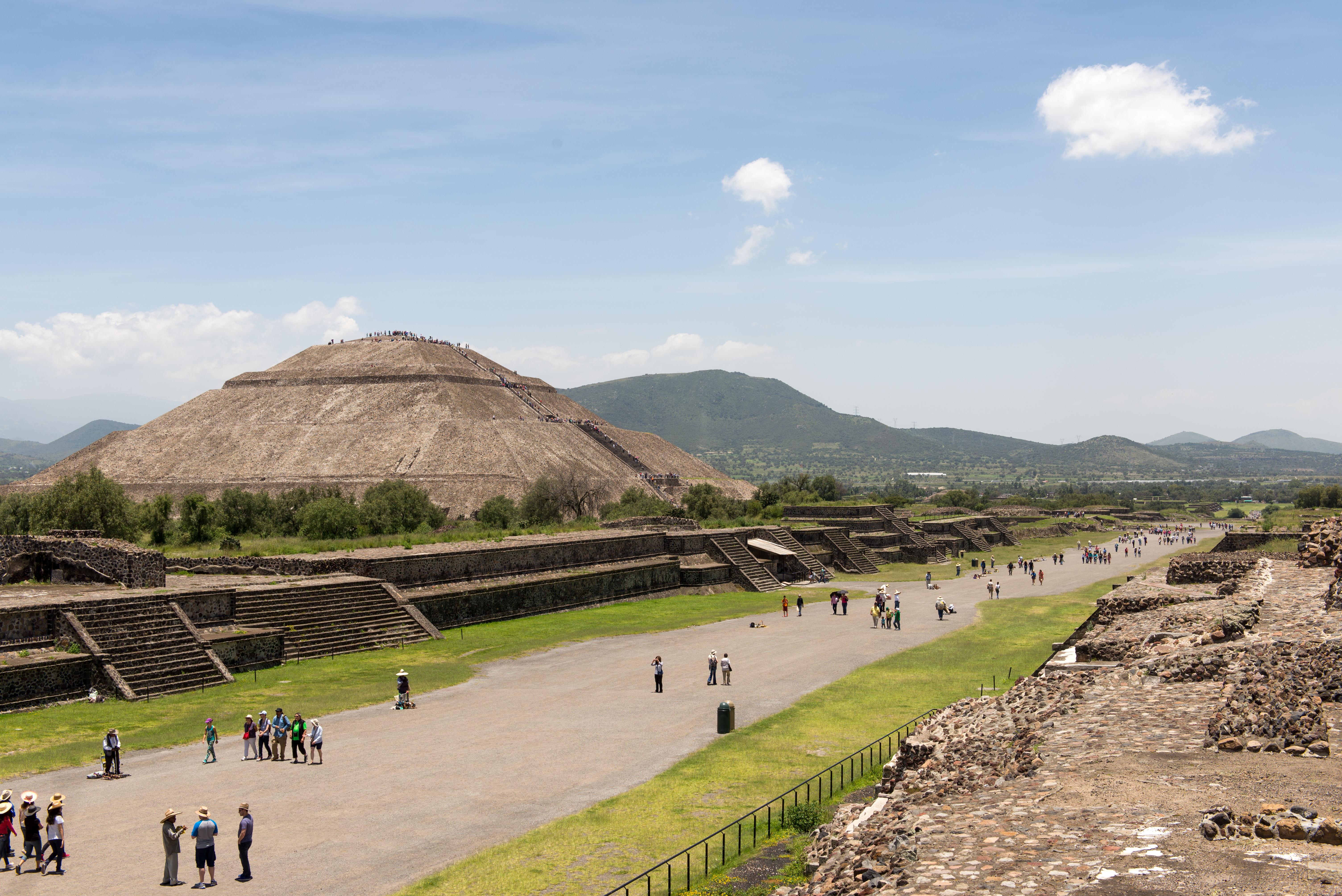
The site is known today for many of the most architecturally significant Mesoamerican pyramids built in the pre-Columbian Americas, namely the Pyramid of the Sun and the Pyramid of the Moon 2. The Pyramid of the Sun is the largest building in Teotihuacan and one of the largest in Mesoamerica 3Teotihuacan — sun · Reference ↗. The Pyramid of the Moon is the second-largest pyramid at the site, after the Pyramid of the Sun, and stands in modern-day San Martín de las Pirámides, Mexico 4Teotihuacan — moon · Reference ↗. The Temple of the Feathered Serpent is the third largest pyramid there, and the term Teotihuacan, or Teotihuacano, is also applied to the whole civilization and cultural complex associated with the site 5Teotihuacan — te · Reference ↗.
The first human establishment in the Teotihuacan area dates back to 600 BCE, and until 200 BCE the site consisted of scattered small villages 6Teotihuacan — sec2 · Wikipedia ↗. The total estimated population of the Teotihuacan Valley during this time was approximately 6,000 7Teotihuacan — sec3 · Wikipedia ↗. Cowgill argued that Teotihuacan's most rapid growth took place between about 100 BCE and 200 CE, when much of the Basin of Mexico population became concentrated in the city 8Teotihuacan — sec7 · Wikipedia ↗. Various districts in the city housed people from across the Teotihuacan region of influence, which spread south as far as Guatemala 8.
The origin of Teotihuacan's founders is uncertain, and the early history of the city remains quite mysterious 9Teotihuacan — sec4 · Wikipedia ↗. The Great Pyramid of Cholula, also called Tlachihualtepetl, a Nahuatl name meaning "constructed mountain", is a complex in Cholula, Puebla, Mexico 10Teotihuacan — cholula · Reference ↗. Measured by volume it is the largest pyramid in the world, standing in the east-central Mexican state of Puebla 11Teotihuacan — pyramids · Reference ↗.
Teotihuacan's reach extended well beyond the Valley of Mexico: the Classic period saw the intrusive intervention of this central Mexican city in Maya dynastic politics 12Teotihuacan — civilization · Reference ↗. During that time the city dominated much of the Maya region politically, economically, and militarily, while interacting with areas throughout Mesoamerica such as the great metropolis of Teotihuacan in the distant Valley of Mexico 13Teotihuacan — tikal · Reference ↗. Mesoamerica itself is a historical region and cultural area comprising the modern-day lands of central and southern Mexico, all of Belize, Guatemala, El Salvador, western Honduras, and the Greater Nicoya region of Nicaragua and Costa Rica 14Teotihuacan — mesoamerica · Reference ↗. Its geography describes the geographic features of a culture area in the Americas inhabited by complex indigenous pre-Columbian cultures exhibiting a suite of shared and common cultural characteristics 15Teotihuacan — mesoamerica · Reference ↗.
The apogee of Xochicalco came after the fall of Teotihuacan, and it has been speculated that Xochicalco may have played a part in the fall of the Teotihuacan empire 16Teotihuacan — xochicalco · Reference ↗. In the years leading up to 1942 a series of murals were found in the Tepantitla compound at Teotihuacan 17Teotihuacan — teotihuacan · Reference ↗. Thousands of people visit the site for the spring equinox event, many dressed in white with a red scarf or other accessory 18Teotihuacan — n · Reference ↗.
Mirrors in pre-Columbian Mesoamerica were fashioned from stone and served a number of uses, from the decorative to the divinatory 19Teotihuacan — culture · Reference ↗. One such object, a conch shell cut at the cross-section, was likely worn as a necklace by religious rulers, as comparable objects have been discovered in burials in archaeological sites throughout Mesoamerica, and it potentially symbolized patterns witnessed in hurricanes, dust devils, seashells, and whirlpools, elemental forces that had significance in Aztec mythology 20Teotihuacan — tl · Reference ↗.
1. Name and meaning
The name appears in Spanish as Teotihuacán and in Classical Nahuatl as Teōtīhuacān21Teotihuacan — teotihuacan · Reference ↗. The term has been glossed as "birthplace of the gods" or "place where gods were born" reflecting Nahua creation myths that were said to occur in Teotihuacan22Teotihuacan — sec1 · Wikipedia ↗.
The name belongs to the ancient city and World Heritage Site beside the municipal seat, and the same term serves for the whole civilization and cultural complex associated with the site15. The city itself lies in a sub-valley of the Valley of Mexico, in the State of Mexico, 40 kilometers (25 mi) northeast of modern-day Mexico City2.
A separate line of interpretation reads the name through Maya usage of the Classic period, where Teotihuacan appears to have been understood as a Place of Reeds, comparable to other Postclassic Central Mexican settlements that took the name of Tollan, among them Tula-Hidalgo and Cholula22. The origin of the city's founders remains uncertain, and its early history is described as quite mysterious9.
The site is known today for many of the most architecturally significant Mesoamerican pyramids built in the pre-Columbian Americas, namely the Pyramid of the Sun and the Pyramid of the Moon2. The Pyramid of the Sun is the largest building in Teotihuacan and one of the largest in Mesoamerica3, while the Pyramid of the Moon is the second-largest pyramid there and stands in modern-day San Martín de las Pirámides, Mexico4. The Temple of the Feathered Serpent is the third largest pyramid at the site5.
The first human establishment in the Teotihuacan area dates back to 600 BCE, and until 200 BCE the site consisted of scattered small villages6. Various districts in the city housed people from across the Teotihuacan region of influence, which spread south as far as Guatemala8. In years leading up to 1942 a series of murals were found in the Tepantitla compound17.
Thousands of people visit Teotihuacan for the spring equinox event, many dressed in white with a red scarf or other accessory18.
2. Origins and early settlement
What the evidence does show is a long period of modest occupation before the city rose. Until 200 BCE the site consisted of scattered small villages rather than a single urban center6. The first human establishment at the site is dated to 600 BCE6. Across the Teotihuacan Valley as a whole the population at this stage is estimated at approximately 6,0006.
A broader transformation of settlement patterns framed the city's emergence. Around 300 BCE people of the central and southeastern areas of Mesoamerica began to gather into larger settlements9.
Once growth began it proceeded relatively quickly. The population is estimated at 60,000-80,000 inhabitants5.
The early growth of the population was relatively quick, with an estimated population of 60,000-80,000 inhabitants5. It is suggested that the population reached up to 100,000 by the 300s5. By the 200s Teotihuacan had what is considered to be the largest complex of monumental structures in all of Mesoamerica5.
3. Growth and urban apogee
The city's expansion was not gradual throughout its history but concentrated in a decisive phase. Cowgill argued that Teotihuacan's most rapid growth took place between about 100 BCE and 200 CE, when much of the Basin of Mexico population became concentrated in the city 8.
Early growth of the population was relatively quick, with an estimated population of 60,000-80,000 inhabitants 5. It is suggested that the population reached up to 100,000 by the 300s 5.
By the 200s Teotihuacan had what is considered to be the largest complex of monumental structures in all of Mesoamerica 5.
The city's population was drawn from far beyond its own streets. Various districts in the city housed people from across the Teotihuacan region of influence, which spread south as far as Guatemala 8.
4. Monuments and architecture
The Pyramid of the Sun stands along the Avenue of the Dead, positioned between the Pyramid of the Moon and the Ciudadela and set in the shadow of the mountain Cerro Gordo, where it forms part of a large complex in the heart of the city 3. The Pyramid of the Moon is the second-largest pyramid in Teotihuacan, after the Pyramid of the Sun, and is located in modern-day San Martín de las Pirámides, Mexico 4.
The Pyramid of the Sun is the largest building in Teotihuacan and ranks among the largest in Mesoamerica 3. The Temple of the Feathered Serpent holds third place among the city's pyramids, at a pre-Columbian site in central Mexico where the name Teotihuacan also denotes the whole civilization and cultural complex associated with the place 5. Beyond Teotihuacan itself the largest pyramid in the world by volume is the Great Pyramid of Cholula, in the east-central Mexican state of Puebla 11; that complex, also called Tlachihualtepetl, a Nahuatl name meaning "constructed mountain", lies in Cholula, Puebla, Mexico 10.
The city occupies a sub-valley of the Valley of Mexico, in the State of Mexico, 40 kilometers (25 mi) northeast of modern-day Mexico City 2. Its earliest human settlement in the area reaches back to 600 BCE, and until 200 BCE the site amounted to scattered small villages 6. The early history of the city remains quite mysterious, and the origin of its founders is uncertain 9. Districts within the city housed people drawn from across the Teotihuacan region of influence, which spread south as far as Guatemala 8.
The architecture and iconography of Xochicalco show affinities with Teotihuacan, the Maya area, and the Matlatzinca culture of the Toluca Valley 16. Xochicalco reached its apogee after the fall of Teotihuacan, and it has been speculated that the site may have played a part in the fall of the Teotihuacan empire 16.
In the years leading up to 1942 a series of murals were found in the Tepantitla compound at Teotihuacan 17. Thousands of people visit the city for the spring equinox event, many dressed in white with a red scarf or other accessory 18.
5. Governance and foreign involvement
Evidence of a king or other authoritarian ruler is strikingly absent in Teotihuacan23Teotihuacan — sec5 · Wikipedia ↗. The year 378 marks the conquest of Tikal, an event tied to the city's wider projection of power23. The ruler known as Spearthrower Owl is associated with Teotihuacan culture in accounts of that conquest23.
A Tikal dynasty was founded by conquerors from Teotihuacan in the 4th century AD13. The Classic period also saw the intrusive intervention of the central Mexican city of Teotihuacan in Maya dynastic politics12.
In the Maya civilization of the Classic period, Teotihuacan appears to have been understood as a Place of Reeds22. This designation was similar to that carried by other Postclassic Central Mexican settlements that took the name of Tollan, such as Tula-Hidalgo and Cholula22.
Teotihuacan lies in a sub-valley of the Valley of Mexico, within the State of Mexico, 40 kilometers (25 mi) northeast of modern-day Mexico City2. The city's name is also applied to the whole civilization and cultural complex associated with the site5. Its early history is quite mysterious, and the origin of its founders is uncertain9. The first human establishment in the Teotihuacan area dates back to 600 BCE, and until 200 BCE the site consisted of scattered small villages6.
The urban fabric was built at monumental scale. The Pyramid of the Sun is the largest building in Teotihuacan and one of the largest in Mesoamerica3. The Pyramid of the Moon is the second-largest pyramid in the city, after the Pyramid of the Sun, and stands in modern-day San Martín de las Pirámides, Mexico4. The Temple of the Feathered Serpent is the third largest pyramid at the site5. For comparison, the largest pyramid in the world by volume is the Great Pyramid of Cholula, in the east-central Mexican state of Puebla11, a complex also known as Tlachihualtepetl, Nahuatl for "constructed mountain", located in Cholula, Puebla, Mexico10.
The city's reach was demographic as well as political. Various districts in the city housed people from across the Teotihuacan region of influence, which spread south as far as Guatemala8. During its dominance the Maya city of Tikal dominated much of the Maya region politically, economically, and militarily, while interacting with areas throughout Mesoamerica such as the great metropolis of Teotihuacan in the distant Valley of Mexico13. Mesoamerica itself is a historical region and cultural area comprising the modern-day lands of central and southern Mexico, all of Belize, Guatemala, El Salvador, western Honduras, and the Greater Nicoya region of Nicaragua and Costa Rica14, a culture area inhabited by complex indigenous pre-Columbian cultures exhibiting a suite of shared and common cultural characteristics15.
The end of Teotihuacan's dominance is tied to environmental stress. Its decline has been correlated to lengthy droughts related to the climate changes of 535–536, possibly caused by the eruption of the Ilopango volcano in El Salvador24Teotihuacan — sec8 · Wikipedia ↗. The apogee of Xochicalco came after the fall of Teotihuacan, and it has been speculated that Xochicalco may have played a part in the fall of the Teotihuacan empire16.
Material culture at the site includes stone mirrors, which in pre-Columbian Mesoamerica were fashioned from stone and served a number of uses, from the decorative to the divinatory19. A conch shell cut at the cross-section was likely worn as a necklace by religious rulers, as such objects have been discovered in burials in archaeological sites throughout Mesoamerica, and potentially symbolized patterns witnessed in hurricanes, dust devils, seashells, and whirlpools, elemental forces that had significance in Aztec mythology20. In years leading up to 1942 a series of murals were found in the Tepantitla compound in Teotihuacan17. Today thousands of people visit for the spring equinox event, many dressed in white with a red scarf or other accessory18.
6. Decline
This theory of ecological decline is supported by archeological remains that show a rise in the percentage of juvenile skeletons with evidence of malnutrition during the 6th century 24. Such evidence further supports the hypothesis of famine as one of the more plausible reasons for the decline of Teotihuacan 24.
The apogee of Xochicalco came after the fall of Teotihuacan 16. It has been speculated that Xochicalco may have played a part in the fall of the Teotihuacan empire 16.
7. Discovery and interpretation
8. Later observances at the site
Thousands of people visit Teotihuacan for the spring equinox event, many of them dressed in white with a red scarf or another accessory18. Observances at the site include dancing, the burning of incense and chanting18. The defining ritual, however, is to stand at the top of the Pyramid of the Sun with arms outstretched, facing the sun in the morning on the eastern horizon18.
The site is a pre-Columbian complex in central Mexico, and the name Teotihuacan — or Teotihuacano — also designates the civilization and cultural complex associated with it5. Within the city, the Temple of the Feathered Serpent ranks as the third largest pyramid5. The Pyramid of the Moon stands in the western part of the ancient city and mimics the contours of the mountain Cerro Gordo, just north of the site4.
The first human establishment in the Teotihuacan area dates back to 600 BCE, and until 200 BCE the site consisted of scattered small villages6. Teotihuacan is known today as the site of many of the most architecturally significant Mesoamerican pyramids built in the pre-Columbian Americas, namely the Pyramid of the Sun and the Pyramid of the Moon2.
A conch shell cut at the cross-section served as a talisman, likely worn as a necklace by religious rulers, as such objects have been discovered in burials in archaeological sites throughout Mesoamerica; it potentially symbolized patterns witnessed in hurricanes, dust devils, seashells and whirlpools, elemental forces that had significance in Aztec mythology20.
9. Key dates
- 600 BCEHistory Historical course Front view of the Pyramid of the Sun LeftHistory Historical course Front view of the Pyramid of the Sun Left side view of the Pyramid of the Sun The first human establishment in the Teotihuacan area dates back to 600 BCE, and until 200 BCE the site consisted of scattered small villages.
- 300 BCEAround 300 BCE, people of the central and southeastern areas of MesoamericAround 300 BCE, people of the central and southeastern areas of Mesoamerica began to gather into larger settlements.
- 100 BCECowgill argued that Teotihuacan’s most rapid growth took place between aboCowgill argued that Teotihuacan’s most rapid growth took place between about 100 BCE and 200 CE, when much of the Basin of Mexico population became concentrated in the city.
- 1942== Discovery and interpretation == In years leading up to 1942, a== Discovery and interpretation == In years leading up to 1942, a series of murals were found in the Tepantitla compound in Teotihuacan.
10. Frequently asked questions
What did the earliest known worship of a Feathered Serpent look like at Teotihuacan?
The earliest known documentation of the worship of a Feathered Serpent occurs in Teotihuacan in the first century BC or first century AD20.
Were mirrors made at Teotihuacan?
Which cultures are counted among the well-known Mesoamerican civilizations alongside Teotihuacan?
Several well-known Mesoamerican cultures include the Olmec, Teotihuacan, the Maya, the Aztec and the Purépecha15.
How does the Pyramid of the Moon relate to the surrounding landscape?
It is found in the western part of the ancient city of Teotihuacan and mimics the contours of the mountain Cerro Gordo, just north of the site4.
Did Teotihuacan's building style influence later cultures in the basin of Mexico?
They were related to the preceding cultures in the basin of Mexico such as the culture of Teotihuacan whose building style they adopted and adapted11.
How does the Great Pyramid of Cholula compare in scale?
References (24)
- 1Teotihuacan — municipality — Reference Web↩View source
- 2Teotihuacan — wiki — Wikipedia Web↩View source
- 3Teotihuacan — sun — Reference Web↩View source
- 4Teotihuacan — moon — Reference Web↩View source
- 5Teotihuacan — te — Reference Web↩View source
- 6Teotihuacan — sec2 — Wikipedia Web↩View source
- 7Teotihuacan — sec3 — Wikipedia Web↩View source
- 8Teotihuacan — sec7 — Wikipedia Web↩View source
- 9Teotihuacan — sec4 — Wikipedia Web↩View source
- 10Teotihuacan — cholula — Reference Web↩View source
- 11Teotihuacan — pyramids — Reference Web↩View source
- 12Teotihuacan — civilization — Reference Web↩View source
- 13Teotihuacan — tikal — Reference Web↩View source
- 14Teotihuacan — mesoamerica — Reference Web↩View source
- 15Teotihuacan — mesoamerica — Reference Web↩View source
- 16Teotihuacan — xochicalco — Reference Web↩View source
- 17Teotihuacan — teotihuacan — Reference Web↩View source
- 18Teotihuacan — n — Reference Web↩View source
- 19Teotihuacan — culture — Reference Web↩View source
- 20Teotihuacan — tl — Reference Web↩View source
- 21Teotihuacan — teotihuacan — Reference Web↩View source
- 22Teotihuacan — sec1 — Wikipedia Web↩View source
- 23Teotihuacan — sec5 — Wikipedia Web↩View source
- 24Teotihuacan — sec8 — Wikipedia Web↩View source