Akrotiri
A Minoan town sealed in ash by a Bronze Age eruption.
In this article
- 1Overview
- 2Akrotiri on Santorini: The Bronze Age Settlement
- 3The Minoan Civilization and Thera
- 4The Minoan Eruption and Its Date
- 5Wall Paintings and the Boxer Fresco
- 6Akrotiri in Crete
- 7Akrotiri and Dhekelia: The Sovereign Base Areas
- 8RAF Akrotiri
- 9Further Reading
- 10Key dates
- 11Frequently asked questions
- 12Knowledge graph
Overview
Akrotiri is a Greek term meaning "cape, promontory" and it designates several distinct places bearing the same name 1Akrotiri — wiki · Wikipedia ↗. Among them are a Cycladic Bronze Age settlement site on the volcanic Greek island of Santorini, a peninsula and former municipality in the Chania regional unit of Crete, and a military base area on the island of Cyprus 2Akrotiri — city · Reference ↗ 3Akrotiri — crete · Reference ↗ 4Akrotiri — cantonment · Reference ↗. The name also attaches to a Royal Air Force station on Cyprus 5Akrotiri — akrotiri · Reference ↗.
The settlement site on Santorini takes its name from a nearby village; what the site was called in antiquity is unknown 2. Santorini, officially Thira or Thera, lies in the southern Aegean Sea roughly 200 km (120 mi) southeast of the mainland and is the largest island of a small, circular archipelago formed by the Santorini caldera 6Akrotiri — santorini · Reference ↗. Around 1600 BC a disastrous earthquake followed by a volcanic eruption buried the site in a thick layer of pumice and ash, and this burial produced the remarkable conservation of frescoes from multiple buildings throughout the town 7Akrotiri — fresco · Reference ↗. The Minoan eruption behind this destruction devastated Thera circa 1600 BC and destroyed the Minoan settlement at Akrotiri together with communities and agricultural areas on nearby islands and on the coast of Crete through subsequent earthquakes and tsunamis 8Akrotiri — eruption · Reference ↗.
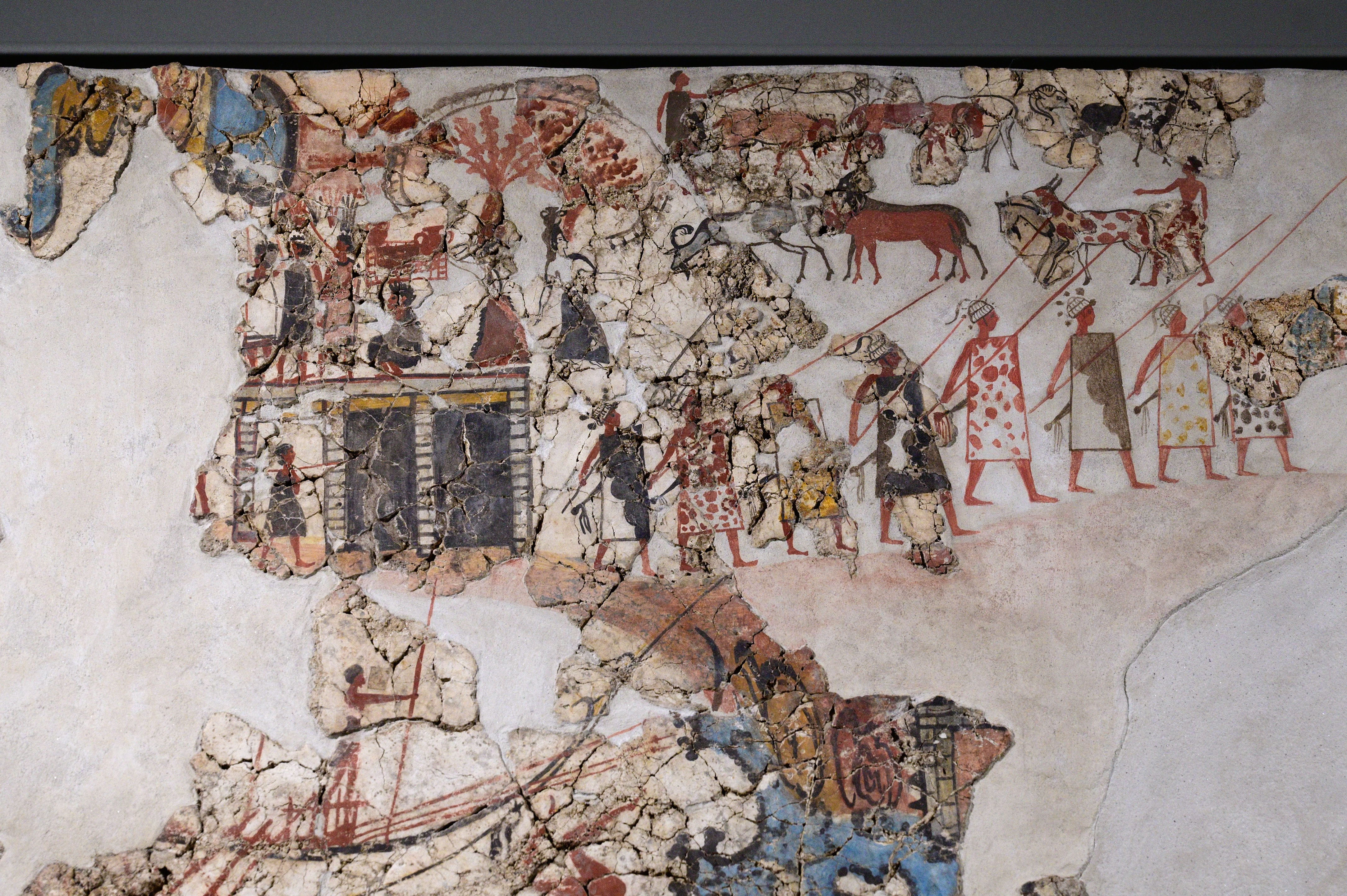
The wall paintings of ancient Thera are famous frescoes discovered by Spyridon Marinatos at the excavations of Akrotiri 9Akrotiri — thera · Reference ↗. They are regarded as part of Minoan art, although the culture of Thera differed somewhat from that of Crete and the political relationship between the two islands at the time is unclear 9. The Akrotiri Boxer Fresco, discovered in 1967, is one of these wall paintings and a leading example of Minoan painting, though the version usually shown includes large sections reconstructed by archaeologists, identifiable by their smooth texture 7. Such works belong to the wider record of Minoan, Mycenaean and related frescos and quasi-frescos — the last not completed before the plaster dried — found at Bronze Age sites on islands and around the shores of the Aegean Sea and elsewhere in the Eastern Mediterranean 10Akrotiri — frescos · Reference ↗.
The Minoan civilization was a Bronze Age culture centered on Crete, known for its monumental architecture and Minoan art and often regarded as the first civilization in Europe 11Akrotiri — civilization · Reference ↗. Its history is divided by Minoan chronology, a framework of dates built on two parallel schemes: one based on sequences of pottery styles, the other on the architectural phases of the Minoan palaces 12Akrotiri — chronology · Reference ↗.
On Cyprus the name belongs to Akrotiri and Dhekelia, officially the Sovereign Base Areas of Akrotiri and Dhekelia, a British Overseas Territory consisting of two separate areas on the island 13Akrotiri — dhekelia · Reference ↗. Despite being under British control, these areas are integrated with the surrounding Cypriot communities and economies 13. Akrotiri Cantonment, also simply called Akrotiri, is a military base within this territory, administered as the Sovereign Base Areas 4. RAF Akrotiri (IATA: AKT, ICAO: LCRA) is a large Royal Air Force military airbase on the Mediterranean island, located in the Western Sovereign Base Area, one of the two areas that comprise the territory 5.
The Cretan Akrotiri is a peninsula and former municipality in the Chania regional unit 3. A further echo of the name survives at Eğirdir, where the town and the lake were formerly called Eğridir, a Turkish pronunciation and possible appropriation of the town's old Greek name Akrotiri 14Akrotiri — irdir · Reference ↗.
1. Akrotiri on Santorini: The Bronze Age Settlement
Akrotiri is a Bronze Age settlement on the volcanic Greek island of Santorini, also called Thera 2. The site takes its name from the nearby village; its ancient name is not recorded 2. The earliest evidence for human habitation there reaches back to the fifth millennium BCE, when Akrotiri was a small fishing and farming village 2. Excavation has continued since 1967, following earlier work on the island 2.
The island lies within a small, circular archipelago formed by the Santorini caldera, and Santorini is the largest island of that group 6. The municipality of Santorini also includes the inhabited islands of Santorini and Therasia together with the uninhabited islands of Nea Kameni, Palaia Kameni, Aspronisi, Anydros, and Christiana 6. Santorini is the most active volcanic centre in the South Aegean Volcanic Arc 6. The region first became volcanically active around 3–4 million years ago, though volcanism on Thera itself began around 2 million years ago with the extrusion of dacitic lavas from vents around Akrotiri 6.
Immediately before the Minoan eruption the walls of the caldera formed a nearly continuous ring of islands, with the only entrance lying between Thera and the tiny island of Aspronisi 8. The Minoan eruption was a catastrophic volcanic event that devastated Thera circa 1600 BC 8. Around 1600 BC a disastrous earthquake, followed by a volcanic eruption, covered Akrotiri in a thick layer of pumice and ash 7. That burial resulted in the remarkable conservation of frescoes, including the Akrotiri Boxer Fresco, from multiple buildings throughout the town 7.
The eruption on Thera was one of the largest Plinian eruptions in the past 10,000 years, with a range of 30–40 cubic kilometres 7. Because tephra from the Minoan eruption serves as a marker horizon in nearly all archaeological sites in the Eastern Mediterranean, its precise date is of high importance and has been fiercely debated among archaeologists and volcanologists for decades, without coming to a definite conclusion 8. Carbon dating places the eruption of Thera around 1600 BC, while synchronism with Egyptian records would place it roughly a century later 12.
The Akrotiri Boxer Fresco, discovered in 1967, is one of the Wall Paintings of Thera and a leading example of Minoan painting, though the version usually shown includes large sections reconstructed by archaeologists, identifiable by their smooth texture 7. The paintings have the advantage of mostly being excavated in a more complete condition, still on their walls, than Minoan paintings from Knossos and other Cretan sites 9. They are regarded as part of Minoan art, although the culture of Thera was somewhat different from that of Crete and the political relationship between the two islands at the time is unclear 9. Though culturally rather different, the Wall Paintings of Thera are regarded as part of Minoan art, and all types form part of the wider grouping of Aegean art 10. Most of the frescos are now in the Prehistoric Museum of Thera on Santorini, or the National Archaeological Museum of Athens, which has several of the most complete and famous scenes 9.
The Minoan civilization developed from the local Neolithic culture around 3100 BC, with complex urban settlements beginning around 2000 BC 11. Largely forgotten after the Late Bronze Age collapse, it was rediscovered in the early twentieth century through archaeological excavation 11. Minoan chronology is the framework of dates used to divide the history of that civilization 12.
The eruption destroyed the Minoan settlement at Akrotiri and, through the earthquakes and tsunamis that followed, also struck communities and agricultural areas on nearby islands and along the coast of Crete 8. Santorini, officially Thira or Thera, is a Greek island in the southern Aegean Sea, about 200 km (120 mi) southeast from the mainland 6. The wall paintings of ancient Thera were brought to light by Spyridon Marinatos at the excavations of Akrotiri 9, and the work at the site from 1967 to 1979 is treated in Thera, Pompeii of the Ancient Aegean: Excavations at Akrotiri 1967-1979 10.
The Minoan civilization was a Bronze Age culture centered on the island of Crete 11. The frescos and related works found at Bronze Age sites on the islands and shores of the Aegean and elsewhere in the Eastern Mediterranean, including quasi-frescos not completed before the plaster dried, form the wider corpus to which the Thera paintings belong 10.
2. The Minoan Civilization and Thera
The Minoan civilization is known for its monumental architecture and Minoan art and is often regarded as the first civilization in Europe 11. Its relative chronology is reconstructed along two parallel lines: one rests on sequences of pottery styles, the other on the architectural phases of the Minoan palaces 12. The standard relative chronology divides Minoan history into three eras: Early Minoan (EM), Middle Minoan (MM) and Late Minoan (LM) 12. This system is based on the sequence of pottery styles excavated at Minoan sites 12. Today the ruins of the Minoan palaces at Knossos and Phaistos have become popular tourist attractions 11.
Thera lies within the same Aegean world, and its miniature wall paintings have been studied as evidence of Aegean culture and iconography 10. Geological evidence shows the Thera volcano erupted numerous times over several hundred thousand years before the Minoan eruption 8. As a result, several pieces of Minoan artwork, primarily the frescoes, were preserved as fragments in the rubble, and have been reassembled by archaeologists 7.
The Minoan civilization was a Bronze Age culture centered on the island of Crete 11. It developed from the local Neolithic culture around 3100 BC, with complex urban settlements beginning around 2000 BC 11. Largely forgotten after the Late Bronze Age collapse, it was rediscovered in the early twentieth century through archaeological excavation 11.
Santorini, officially Thira or Thera, is a Greek island in the southern Aegean Sea, about 200 km (120 mi) southeast from the mainland 6. The municipality of Santorini includes the inhabited islands of Santorini and Therasia, and the uninhabited islands of Nea Kameni, Palaia Kameni, Aspronisi, Anydros, and Christiana 6. The region first became volcanically active around 3–4 million years ago, though volcanism on Thera began around 2 million years ago with the extrusion of lava domes 6.
The Minoan eruption was a catastrophic volcanic eruption that devastated the Aegean island of Thera circa 1600 BC 8. It destroyed the Minoan settlement at Akrotiri, as well as communities and agricultural areas on nearby islands and the coast of Crete with subsequent earthquakes and tsunamis 8. The eruption on the island of Thera, now known as Santorini, was one of the largest Plinian eruptions in the past 10,000 years, with a range of 30–40 cubic kilometres 7. Immediately before it, the walls of the caldera formed a nearly continuous ring of islands, with the only entrance between Thera and the tiny island of Aspronisi 8.
Because tephra from the Minoan eruption serves as a marker horizon in nearly all archaeological sites in the Eastern Mediterranean, its precise date is of high importance and has been fiercely debated among archaeologists and volcanologists for decades, without coming to a definite conclusion 8. While carbon dating places the eruption of Thera around 1600 BC, synchronism with Egyptian records would place it roughly a century later 12.
The wall paintings of ancient Thera are famous frescoes discovered by Spyridon Marinatos at the excavations of Akrotiri on the Greek island of Santorini (or Thera) 9. They are regarded as part of Minoan art, although the culture of Thera was somewhat different from that of Crete, and the political relationship between the two islands at the time is unclear 9. All types form part of the wider grouping of Aegean art 10. They have the advantage of mostly being excavated in a more complete condition, still on their walls, than Minoan paintings from Knossos and other Cretan sites 9. The Akrotiri Boxer Fresco, discovered in 1967, is one of the Wall Paintings of Thera and a leading example of Minoan painting, though the version usually shown includes large sections reconstructed by archaeologists, which can be identified by their smooth texture 7.
3. The Minoan Eruption and Its Date
Around 1600 BC a disastrous earthquake struck Akrotiri and was followed by a volcanic eruption that buried the town beneath a thick layer of pumice and ash 7. The same eruption destroyed the Minoan settlement at Akrotiri together with communities and agricultural areas on nearby islands and on the coast of Crete, whose devastation came with subsequent earthquakes and tsunamis 8. The burial of the town under volcanic debris produced the remarkable conservation of frescoes from multiple buildings throughout the settlement, among them the Akrotiri Boxer Fresco 7.
The eruption was not an isolated event in the island's history but the culmination of a long volcanic record. The region first became volcanically active around 3–4 million years ago 6. Volcanism on Thera itself began around 2 million years ago with the extrusion of dacitic lavas from vents around Akrotiri 6. The vents that later fed the Bronze Age catastrophe thus lie within a system whose activity reaches back millions of years.
The Minoan eruption devastated the Aegean island of Thera, also called Santorini, circa 1600 BC 8. It ranks among the largest Plinian eruptions of the past 10,000 years, with a range of 30–40 cubic kilometres 7. Geological evidence shows that the Thera volcano had erupted numerous times over several hundred thousand years before the Minoan eruption 8. Immediately before that eruption the walls of the caldera formed a nearly continuous ring of islands, with the only entrance between Thera and the tiny island of Aspronisi 8.
The date of the eruption is not settled. Because tephra from the Minoan eruption serves as a marker horizon in nearly all archaeological sites in the Eastern Mediterranean, its precise date is of high importance and has been fiercely debated among archaeologists and volcanologists for decades, without coming to a definite conclusion 8. Carbon dating places the eruption of Thera around 1600 BC, while synchronism with Egyptian records would place it roughly a century later 12. Minoan chronology itself is a framework of dates used to divide the history of the Minoan civilization 12. One scheme rests on sequences of pottery styles, the other on the architectural phases of the Minoan palaces 12. The standard relative chronology divides Minoan history into three eras: Early Minoan (EM), Middle Minoan (MM) and Late Minoan (LM) 12, a system based on the sequence of pottery styles excavated at Minoan sites 12.
The civilization whose settlements the eruption struck was a Bronze Age culture centered on the island of Crete 11. It developed from the local Neolithic culture around 3100 BC, with complex urban settlements beginning around 2000 BC 11. Known for its monumental architecture and Minoan art, it is often regarded as the first civilization in Europe 11. Largely forgotten after the Late Bronze Age collapse, it was rediscovered in the early twentieth century through archaeological excavation 11, and today the ruins of the Minoan palaces at Knossos and Phaistos have become popular tourist attractions 11.
The Akrotiri Boxer Fresco, discovered in 1967, is one of the Wall Paintings of Thera and a leading example of Minoan painting, though the version usually shown includes large sections "reconstructed" by archaeologists, which can be identified by their smooth texture 7. As a result of the burial, several pieces of Minoan artwork, primarily the frescoes, were preserved as fragments in the rubble and have been reassembled by archaeologists 7. The Wall Paintings of Thera are regarded as part of Minoan art, although the culture of Thera was somewhat different from that of Crete and the political relationship between the two islands at the time is unclear 9; all types form part of the wider grouping of Aegean art 10. They have the advantage of mostly being excavated in a more complete condition, still on their walls, than Minoan paintings from Knossos and other Cretan sites 9.
4. Wall Paintings and the Boxer Fresco
The Wall Paintings of Thera are counted among the principal surviving works of Aegean art, and though the culture that produced them was rather different they are regarded as part of Minoan art10. Their standing rests in large part on how they came down to us: they have the advantage of mostly being excavated in a more complete condition, still on their walls, than Minoan paintings from Knossos and other Cretan sites9.
The Akrotiri Boxer Fresco was discovered in 1967 and stands as a leading example of Minoan painting7. The version usually shown, however, includes large sections reconstructed by archaeologists, and these additions can be told apart by their smooth texture7.
The paintings were brought to light by Spyridon Marinatos during excavations at Akrotiri on the Greek island of Santorini, also called Thera9. Their survival is owed to catastrophe: around 1600 BC a disastrous earthquake, followed by a volcanic eruption, buried Akrotiri under a thick layer of pumice and ash, and the result was the remarkable conservation of frescoes, the Boxer Fresco among them, from multiple buildings throughout the town7. Several pieces of Minoan artwork, primarily the frescoes, were nonetheless preserved only as fragments in the rubble and have been reassembled by archaeologists7.
Most of the frescoes are now held by the Prehistoric Museum of Thera on Santorini or by the National Archaeological Museum of Athens, which keeps several of the most complete and famous scenes9. The wider corpus to which they belong takes in Minoan, Mycenaean and related frescoes and quasi-frescoes — the last not completed before the plaster dried — found at Bronze Age sites on the islands and shores of the Aegean Sea and at other relevant places in the Eastern Mediterranean region10.
5. Akrotiri in Crete
Akrotiri is a peninsula and former municipality in the Chania regional unit of Crete in Greece3. The name renders the Greek word for "promontory"3. Geographically the site is a rocky promontory on the northern side of the island of Crete, standing in the Sea of Crete3.
The tombs of Eleftherios Venizelos and his son Sophoklis lie on Akrotiri at a site that overlooks Chania3.
The name Akrotiri means "cape, promontory"1. A variety of flora occur on the rocky promontory of Akrotiri including the herb Taraxacum minimum3.
Separate from the Cretan peninsula, Akrotiri is also a Cycladic Bronze Age settlement site on the volcanic Greek island of Santorini2. The name comes from the nearby village of Akrotiri, the name of the site in antiquity is unknown2. Akrotiri has been excavated since 1967, after earlier excavations on the island2. Around 1600 BC, a disastrous earthquake, followed by a volcanic eruption, covered Akrotiri, Greece in a thick layer of pumice and ash, which resulted in the remarkable conservation of frescoes, including the Akrotiri Boxer Fresco, from multiple buildings throughout the town7. It destroyed the Minoan settlement at Akrotiri, as well as communities and agricultural areas on nearby islands and the coast of Crete with subsequent earthquakes and tsunamis8. The Minoan civilization was a Bronze Age culture centered on the island of Crete11.
The Akrotiri Boxer Fresco, discovered in 1967, is one of the Wall Paintings of Thera and a leading example of Minoan painting, though the version usually shown (as here) includes large sections "reconstructed" by archaeologists, which can be identified by their smooth texture7. The wall paintings of ancient Thera are famous frescoes discovered by Spyridon Marinatos at the excavations of Akrotiri on the Greek island of Santorini (or Thera)9. They are regarded as part of Minoan art, although the culture of Thera was somewhat different from that of Crete, and the political relationship between the two islands at the time is unclear9. Thera, Pompeii of the Ancient Aegean: Excavations at Akrotiri 1967-197910.
The name Akrotiri also attaches to British military installations on Cyprus. Royal Air Force Akrotiri, commonly abbreviated RAF Akrotiri (IATA: AKT, ICAO: LCRA) is a large Royal Air Force (RAF) military airbase on the Mediterranean island of Cyprus5. It is located in the Western Sovereign Base Area, one of two areas which comprise Akrotiri and Dhekelia, a British Overseas Territory, administered as a Sovereign Base Area5. Akrotiri and Dhekelia, officially the Sovereign Base Areas of Akrotiri and Dhekelia (SBAs), is a British Overseas Territory that consists of two separate areas on the island of Cyprus13. Despite being under British control, Akrotiri and Dhekelia are integrated with the surrounding Cypriot communities and economies13. The areas are notable for their strategic geopolitical value and rich environmental features, including the Akrotiri Salt Lake, a protected wetland13. Akrotiri Cantonment, also simply named Akrotiri, is a military base in Akrotiri and Dhekelia, a British Overseas Territory on the island of Cyprus, administered as the Sovereign Base Areas4. The same is also with RAF Akrotiri, a Royal Air Force station on the island4.
In August 2014, RAF Panavia Tornado fighter-bombers were deployed to Akrotiri to carry out reconnaissance missions over Iraq, following the rise of Islamic State (ISIS) and in September 2014, British aircraft from the base intercepted and attacked an ISIS target, at the request of Iraqi Kurdish fighters5. In 2018, the station was used to support the 2018 missile strikes against Syria and, in 2024, Typhoons based in Akrotiri struck Houthi targets in Yeme5. However, the 1st Battalion under Army 2020 has already moved from Episkopi Cantonment (the capital of the British Overseas Territory called Akrotiri and Dhekelia) to Paderborn, Germany some time ago; and after all, it will move from there to be stationed at Bulford Camp4.
6. Akrotiri and Dhekelia: The Sovereign Base Areas
The United Kingdom desired to retain sovereignty over these areas, as this guaranteed the use of UK military bases on Cyprus, including Royal Air Force (RAF) Akrotiri, and a garrison of the British Army13.
In the Akrotiri Sovereign Base Area a tented refugee camp was set up at "Happy Valley", part of the Episkopi Cantonment, to house Turkish Cypriots fleeing from Limassol and the villages surrounding the Area13.
The 1st Battalion under Army 2020 has already moved from Episkopi Cantonment (the capital of the British Overseas Territory called Akrotiri and Dhekelia) to Paderborn, Germany some time ago; and after all, it will move from there to be stationed at Bulford Camp4.
Akrotiri and Dhekelia, officially the Sovereign Base Areas of Akrotiri and Dhekelia, is a British Overseas Territory made up of two separate areas on the island of Cyprus13. The territory is notable for its strategic geopolitical value and for rich environmental features, among them the Akrotiri Salt Lake, a protected wetland13. Despite being under British control, the areas are integrated with the surrounding Cypriot communities and economies13.
Akrotiri Cantonment, also simply named Akrotiri, is a military base in the territory, administered as the Sovereign Base Areas4. Akrotiri contains the village of Akrotiri and a portion of the villages Episkopi, Trachoni, Kolossi and Asomatos; the same arrangement applies to Episkopi Cantonment, the capital of both Sovereign Base Areas4. RAF Akrotiri, commonly abbreviated from Royal Air Force Akrotiri, is a large RAF military airbase on the Mediterranean island5, and it too stands in the same relation to the cantonment4. The airbase lies in the Western Sovereign Base Area, one of the two areas that comprise the territory5. Its station commander holds a dual role, also commanding the Akrotiri or Western Sovereign Base Area and reporting to the commander of British Forces Cyprus, who is likewise the Administrator5.
The airbase has served as a launch point for several operations. In August 2014 RAF Panavia Tornado fighter-bombers were deployed there to carry out reconnaissance missions over Iraq following the rise of Islamic State, and in September 2014 British aircraft from the base intercepted and attacked an ISIS target at the request of Iraqi Kurdish fighters5. In 2018 the station supported the missile strikes against Syria, and in 2024 Typhoons based at Akrotiri struck Houthi targets in Yemen5.
7. RAF Akrotiri
Royal Air Force Akrotiri, commonly abbreviated RAF Akrotiri (IATA: AKT, ICAO: LCRA), is a large Royal Air Force military airbase on the Mediterranean island of Cyprus 5.
In August 2014 RAF Panavia Tornado fighter-bombers were deployed to Akrotiri to carry out reconnaissance missions over Iraq, following the rise of Islamic State (ISIS) 5. In September 2014 British aircraft from the base intercepted and attacked an ISIS target, at the request of Iraqi Kurdish fighters 5.
In 2018 the station was used to support the 2018 missile strikes against Syria 5. In 2024 Typhoons based in Akrotiri struck Houthi targets in Yemen 5.
The airbase lies within the Western Sovereign Base Area, one of the two areas that make up Akrotiri and Dhekelia, a British Overseas Territory administered as a Sovereign Base Area 5. The United Kingdom sought to keep sovereignty over these areas precisely because it guaranteed continued use of its military bases on Cyprus, including RAF Akrotiri, together with a British Army garrison 13. The territory consists of two separate areas on the island, and despite remaining under British control they are integrated with the surrounding Cypriot communities and economies 13. The areas are noted for their strategic geopolitical value and for rich environmental features, among them the Akrotiri Salt Lake, a protected wetland 13.
The station shares its name with Akrotiri Cantonment, a military base in the territory also known simply as Akrotiri 4. Under Army 2020 the 1st Battalion had already moved from Episkopi Cantonment, the capital of the British Overseas Territory, to Paderborn in Germany, and was subsequently to move from there to be stationed at Bulford Camp 4.
8. Further Reading
Readers seeking a fuller treatment of the site may consult Thera, Pompeii of the Ancient Aegean: Excavations at Akrotiri 1967-1979 10. A second reference work, The miniature wall paintings of Thera: a study in Aegean culture and iconography, examines the site's painted imagery within its broader cultural setting 10.
The wall paintings of ancient Thera are famous frescoes discovered by Spyridon Marinatos at the excavations of Akrotiri on the Greek island of Santorini (or Thera) 9. Both works listed above take these discoveries as their subject 10.
The site itself is a Cycladic Bronze Age settlement on the volcanic island of Santorini 2. Its name derives from a nearby village, and what the settlement was called in antiquity is unknown 2. The word Akrotiri means "cape, promontory" 1. Santorini, officially Thira or Thera, lies in the southern Aegean Sea about 200 km (120 mi) southeast of the mainland and is the largest island of a small, circular archipelago formed by the Santorini caldera 6.
Around 1600 BC a disastrous earthquake, followed by a volcanic eruption, covered the settlement in a thick layer of pumice and ash 7. The Minoan eruption that devastated Thera is dated to circa 1600 BC and destroyed the Minoan settlement at Akrotiri along with communities and agricultural areas on nearby islands and the coast of Crete through subsequent earthquakes and tsunamis 8. The burial produced the remarkable conservation of frescoes, including the Akrotiri Boxer Fresco, from multiple buildings throughout the town 7. That fresco was discovered in 1967 and is a leading example of Minoan painting, though the version usually shown includes large sections "reconstructed" by archaeologists, identifiable by their smooth texture 7.
The paintings are regarded as part of Minoan art, although the culture of Thera differed somewhat from that of Crete and the political relationship between the two islands at the time is unclear 9. The Minoan civilization was a Bronze Age culture centered on Crete, known for its monumental architecture and Minoan art and often regarded as the first civilization in Europe 11. Its chronology is a framework of dates dividing Minoan history, built on two foundations: sequences of pottery styles and the architectural phases of the Minoan palaces 12. The broader corpus of Aegean painting extends beyond Thera to Minoan, Mycenaean and related frescos and quasi-frescos — the last not completed before the plaster dried — found at Bronze Age sites on islands and around the shores of the Aegean and elsewhere in the Eastern Mediterranean 10.
The name Akrotiri attaches to several unrelated places. On Cyprus it denotes Akrotiri and Dhekelia, officially the Sovereign Base Areas of Akrotiri and Dhekelia, a British Overseas Territory consisting of two separate areas on the island 13. Despite being under British control, these areas are integrated with the surrounding Cypriot communities and economies 13. RAF Akrotiri (IATA: AKT, ICAO: LCRA) is a large Royal Air Force military airbase on Cyprus, located in the Western Sovereign Base Area 5. Akrotiri Cantonment, also simply named Akrotiri, is a military base in the territory, administered as the Sovereign Base Areas 4. In Crete, Akrotiri is a peninsula and former municipality in the Chania regional unit 3. The town and lake formerly called Eğridir took that Turkish name as a possible appropriation of the town's old Greek name Akrotiri 14.
9. Key dates
- 3100 BCEThe Minoan civilization developed from the local Neolithic culture aroundThe Minoan civilization developed from the local Neolithic culture around 3100 BC, with complex urban settlements beginning around 2000 BC.
- 1600 BCEThe Minoan eruption was a catastrophic volcanic eruption that devastated tThe Minoan eruption was a catastrophic volcanic eruption that devastated the Aegean island of Thera circa 1600 BC.
- 1967The Akrotiri Boxer Fresco, discovered in 1967, is one of the WallThe Akrotiri Boxer Fresco, discovered in 1967, is one of the Wall Paintings of Thera and a leading example of Minoan painting, though the version usually shown includes large sections "reconstructed" by archaeologists, which can be identified by their smooth texture.
- 2014In August 2014, RAF Panavia Tornado fighter-bombers were deployed to AkrotIn August 2014, RAF Panavia Tornado fighter-bombers were deployed to Akrotiri to carry out reconnaissance missions over Iraq, following the rise of Islamic State and in September 2014, British aircraft from the base intercepted and attacked an ISIS target, at the request o
- 2018In 2018, the station was used to support the 2018 missile strikesIn 2018, the station was used to support the 2018 missile strikes against Syria and, in 2024, Typhoons based in Akrotiri struck Houthi targets in Yemen.
- 2020However, the 1st Battalion under Army 2020 has already moved from EpiskopiHowever, the 1st Battalion under Army 2020 has already moved from Episkopi Cantonment (the capital of the British Overseas Territory called Akrotiri and Dhekelia) to Paderborn, Germany some time ago; and after all, it will move from there to be stationed at Bulford Camp.
10. Frequently asked questions
Where exactly does Santorini lie?
Santorini, officially Thira or Thera, is a Greek island in the southern Aegean Sea, about 200 km (120 mi) southeast from the mainland 6.
What is the Akrotiri Cantonment?
Akrotiri Cantonment, also simply named Akrotiri, is a military base in Akrotiri and Dhekelia, a British Overseas Territory on the island of Cyprus administered as the Sovereign Base Areas 4. It contains the village of Akrotiri and a portion of the villages of Episkopi, Trachoni, Kolossi and Asomatos 4.
Who commands RAF Akrotiri?
The station commander has a dual role and is also the officer commanding the Akrotiri or Western Sovereign Base Area, reporting to the commander of British Forces Cyprus (BFC) who is also the Administrator 5. The station lies in the Western Sovereign Base Area, one of the two areas that comprise Akrotiri and Dhekelia 5.
What is notable about the Sovereign Base Areas besides their strategic value?
What grows on the rocky promontory of Akrotiri in Crete?
A variety of flora occur on the rocky promontory of Akrotiri, including the herb Taraxacum minimum 3.
Is there another place whose old Greek name was Akrotiri?
The town and the lake formerly called Eğridir bore a Turkish pronunciation and possible appropriation of the town's old Greek name Akrotiri 14.
References (14)
- 1Akrotiri — wiki — Wikipedia Web↩View source
- 2Akrotiri — city — Reference Web↩View source
- 3Akrotiri — crete — Reference Web↩View source
- 4Akrotiri — cantonment — Reference Web↩View source
- 5Akrotiri — akrotiri — Reference Web↩View source
- 6Akrotiri — santorini — Reference Web↩View source
- 7Akrotiri — fresco — Reference Web↩View source
- 8Akrotiri — eruption — Reference Web↩View source
- 9Akrotiri — thera — Reference Web↩View source
- 10Akrotiri — frescos — Reference Web↩View source
- 11Akrotiri — civilization — Reference Web↩View source
- 12Akrotiri — chronology — Reference Web↩View source
- 13Akrotiri — dhekelia — Reference Web↩View source
- 14Akrotiri — irdir — Reference Web↩View source