Knossos
The Minoan palace that gave Europe its first written script and a flushing toilet.
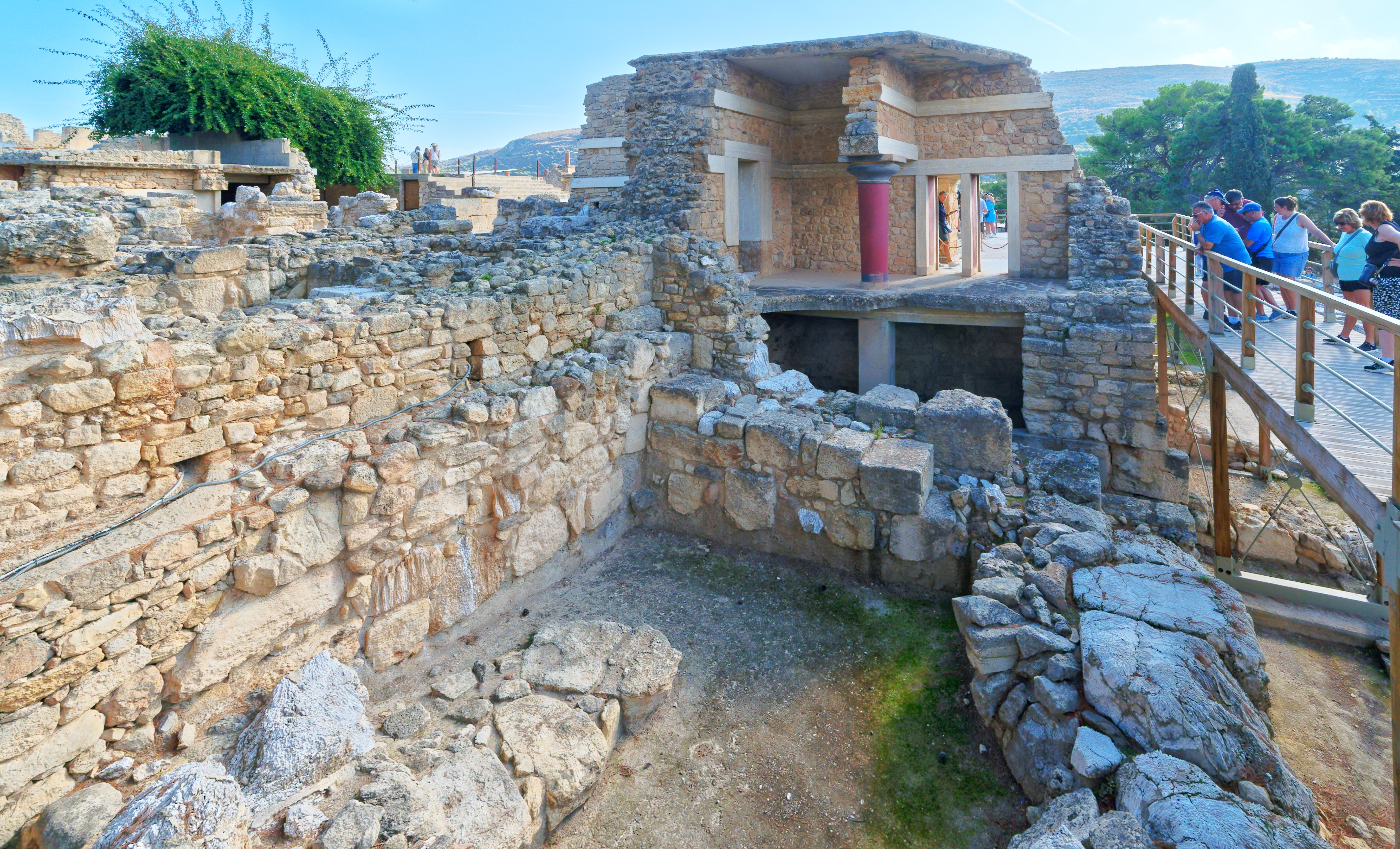
Overview
The site was occupied from the Neolithic period into the first millennium AD and became the largest and best-known centre of the Minoan civilisation 1Knossos — wiki · Wikipedia ↗. It is notable for the remains of a Minoan palace and the surrounding town 2Knossos — phaistos · Reference ↗.
Settlement on Kephala hill began around 7000 BC, making Knossos one of the earliest known Neolithic settlements on Crete 1. The earliest known settlement at Knossos dates to about 7000 BC, during the early Neolithic period 3Knossos — sec4 · Wikipedia ↗. The first community occupied the summit of Kephala hill, the later site of the palace 3.
Knossos became a leading centre of the Minoan civilisation, widely regarded as Europe's earliest advanced civilisation 1. It is also home to the ancient Knossos Palace, a major center of the Minoan civilization dating back to approximately 2000-1350 BCE, often considered Europe's oldest city 4Knossos — heraklion · Reference ↗. Like other Minoan palaces, the complex is generally interpreted as an administrative, economic, religious and ceremonial centre 1.
The Second Palace period, from about 1700 to 1450 BC, was the height of Minoan Knossos 5Knossos — sec8 · Wikipedia ↗. The palace was partially destroyed around 1450 BC, during a wider period of disruption affecting many Minoan sites 5. The palace is one of the most significant archaeological sites in Greece, second only to the Parthenon in terms of visitor numbers 4.
The Knossos Urban Landscape Project, a collaboration involving the British School at Athens and the Greek Archaeological Service, surveyed approximately 11 km (4.2 sq mi) around Knossos 6Knossos — sec2 · Wikipedia ↗. It includes remains of the surrounding Minoan town, later Greek and Roman occupation, cemeteries, roads, villas, sanctuaries and ritual buildings 6.
Knossos lies on Kephala hill, in the valley of the Kairatos river, within the modern municipality of Heraklion, about 5 km (3.1 mi) south of the historic centre 6. The location gave the ancient settlement access to the north coast of Crete, its harbour and routes into the island's interior 6.
The chronology of Knossos extends from the Neolithic to the Byzantine period 7Knossos — sec3 · Wikipedia ↗. Among the earliest material recovered are bowls with fork handles of the Early Neolithic, dated to 6500 to 5800 BC 3, alongside a ladle and a three-legged vessel from later periods 8Knossos — sec5 · Wikipedia ↗. The long sequence of occupation makes Knossos one of the earliest permanent settlements on Crete and one of the earliest long-lived settlements in the Aegean 3.
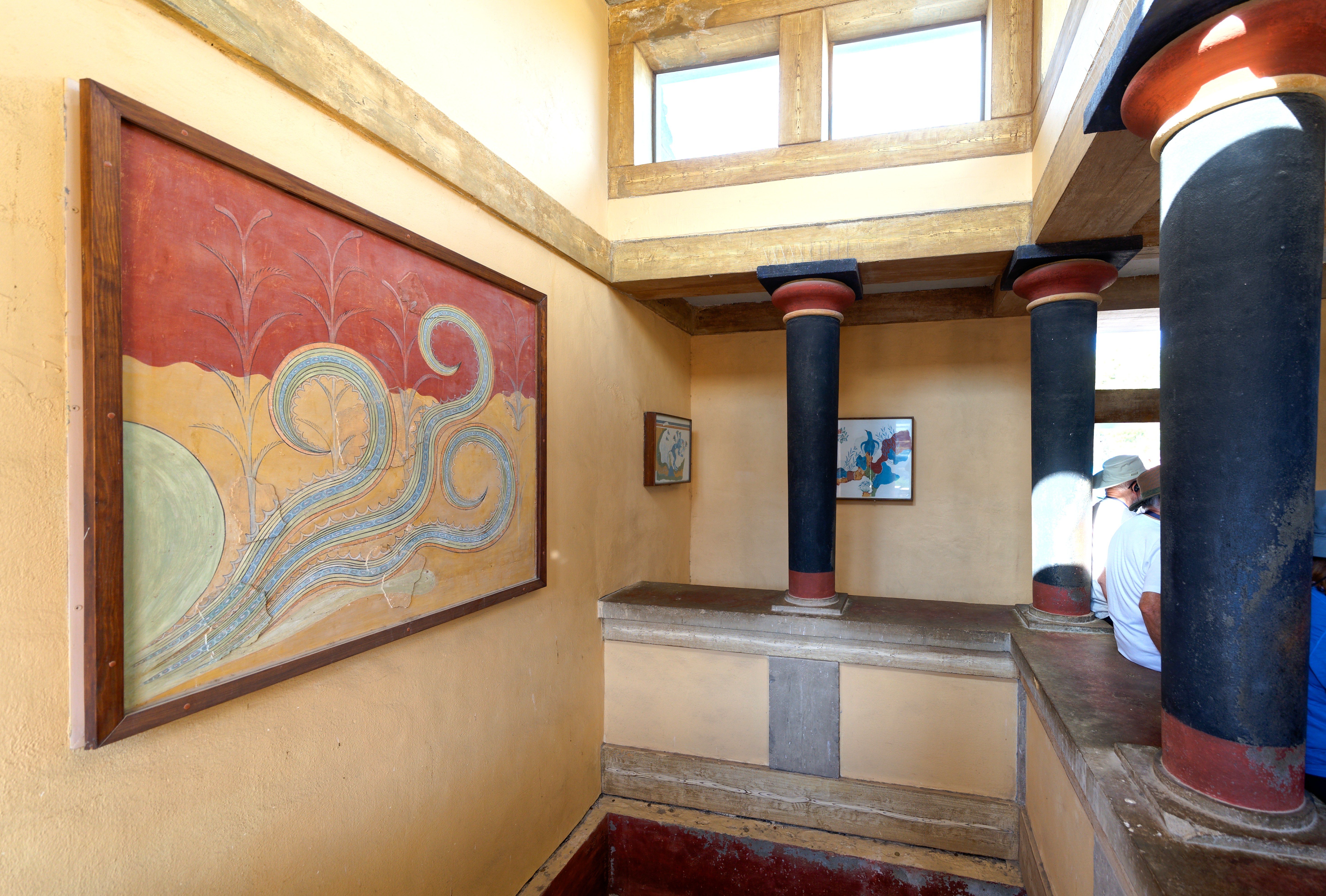
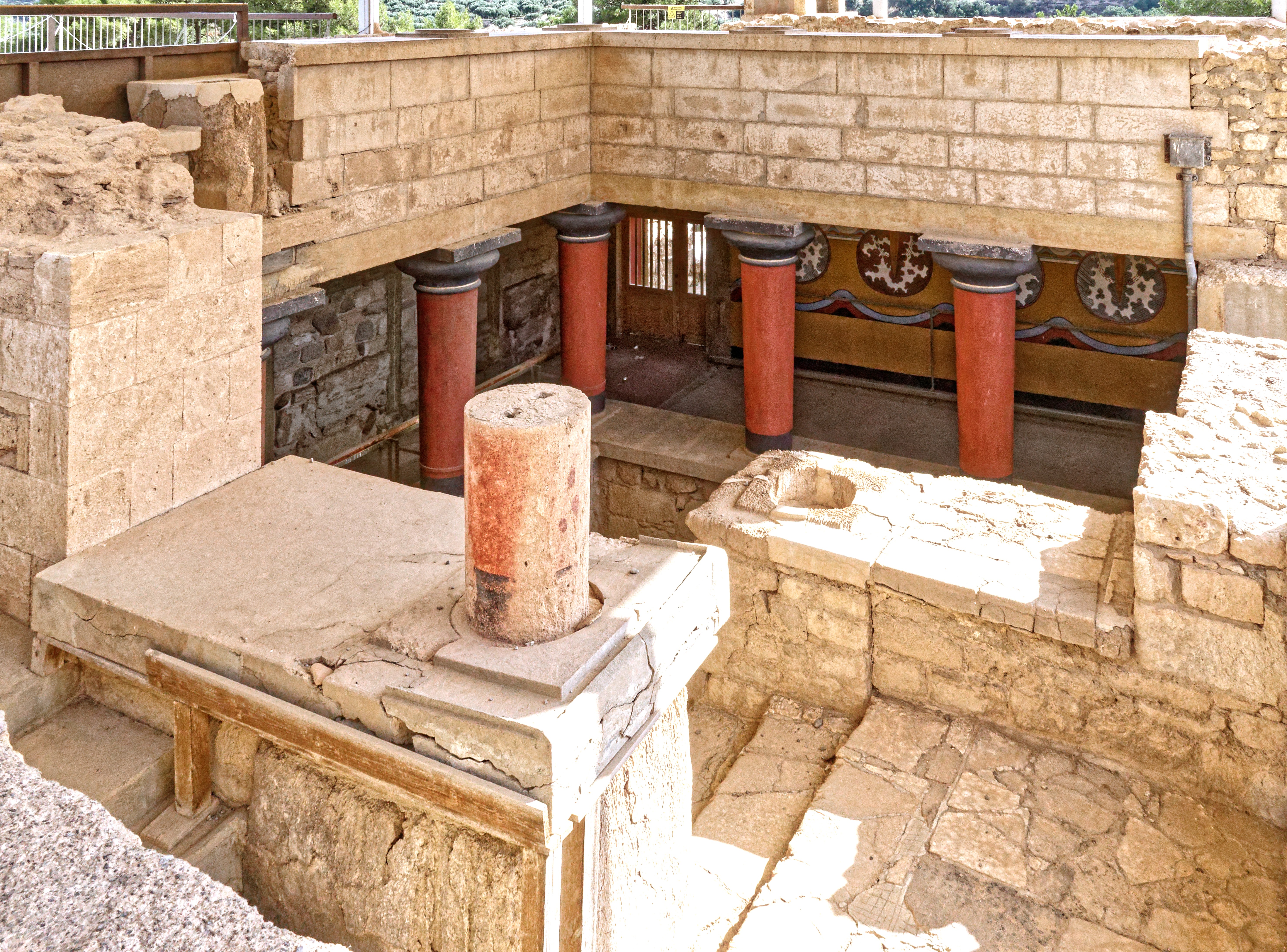
In its rebuilt form the palace was reconstructed with its central court, monumental entrances, staircases, magazines, reception rooms, ritual spaces, light wells, drainage systems and richly decorated wall paintings 5.
Knossos belongs to a wider network of Minoan sites on Crete. Malia, also written Mallia, is a Minoan and Mycenaean archaeological site on the northern coast in the Heraklion area, about 35 kilometers east of the ancient site of Knossos and 40 kilometers east of the modern city of Heraklion 9Knossos — stone · Reference ↗. Zakros, also called Zakro or Kato Zakro, is a Minoan site on the eastern coast in Lasithi, regarded as one of the six Minoan palaces, whose protected harbor and strategic location made it an important commercial hub for trade to the east 10Knossos — zakros · Reference ↗. Phaistos, also transliterated as Phaestos, Festos and Latin Phaestus, is a Bronze Age site at modern Faistos, a municipality in south central Crete, and its name survives from ancient Greek references to a city on Crete of that name at or near the current ruins 2.
1. Location and Setting
Knossos lies on Kephala hill, in the valley of the Kairatos river, within the modern municipality of Heraklion, about 5 km (3.1 mi) south of the historic centre 6. The first palace was built around 1900 BC on a hill that had already been occupied for several millennia 1. The location gave the ancient settlement access to the north coast of Crete, its harbour and routes into the island's interior 6.
In antiquity the area that would later become the city of Heraklion served as the port for the ancient city of Knossos, one of the centers of the Minoan civilization 4. The name Herakleion (Ηράκλειον) is derived from an ancient port of Heracleium that served as the harbour for Knossos 4. In antiquity it was located about 20 stadia (approximately 3.7 kilometers) from Knossos 4. Heraklion, Herakleion (hih-RAK-lee-ən; Greek: Ηράκλειο, Iráklio, pronounced [iˈrakli.o]) or Iraklion, is the largest city and the administrative capital of the island of Crete and capital of Heraklion regional unit 4.
During the Early Minoan period the site's hills were terraced and monumental buildings were constructed on them 2. During the Prepalatial period, about 3000 to 1900 BC, Knossos grew in size and complexity before the construction of the first palace 3. This makes Knossos one of the earliest permanent settlements on Crete and one of the earliest long-lived settlements in the Aegean 3.
The chronology of Knossos extends from the Neolithic to the Byzantine period 7. A bowl with fork handles from Knossos belongs to the Early Neolithic, 6500 to 5800 BC 3. The first palace was built in 1900 to 1700 BC, with the development of palatial administration, storage and ritual activity 7. It was rebuilt and expanded after a major destruction around 1700 BC and remained the central monument of Knossos into the Late Bronze Age 1. In 1700 to 1450 BC the palace was rebuilt and expanded again, reaching the peak of Minoan architecture, fresco painting and palace-centred organisation 7. In 1350 to 1100 BC use of the palace complex was reduced while occupation of the wider settlement continued 7.
It is notable for the remains of a Minoan palace and the surrounding town 2. The site was occupied from the Neolithic period into the first millennium AD and became the largest and best-known centre of the Minoan civilisation 1. Settlement on Kephala hill began around 7000 BC, making Knossos one of the earliest known Neolithic settlements on Crete 1. The earliest known settlement at Knossos dates to about 7000 BC, during the early Neolithic period 3.
The Second Palace period, from about 1700 to 1450 BC, was the height of Minoan Knossos 5. The palace was reconstructed with its central court, monumental entrances, staircases, magazines, reception rooms, ritual spaces, light wells, drainage systems and richly decorated wall paintings 5. The palace is one of the most significant archaeological sites in Greece, second only to the Parthenon in terms of visitor numbers 4. Heraklion is also home to the ancient Knossos Palace, a major center of the Minoan civilization dating back to approximately 2000-1350 BCE, often considered Europe's oldest city 4.
Other Minoan sites of Crete frame the setting. Malia (also Mallia) is a Minoan and Mycenaean archaeological site located on the northern coast of Crete in the Heraklion area, about 35 kilometers east of the ancient site of Knossos and 40 kilometers east of the modern city of Heraklion 9. Zakros (Greek: Ζάκρος also Zakro or Kato Zakro) is a Minoan archaeological site on the eastern coast of Crete in Lasithi, Greece 10. Phaistos (Greek: Φαιστός, pronounced [feˈstos]; Ancient Greek: Φαιστός, pronounced [pʰai̯stós], Linear B: 𐀞𐀂𐀵 Pa-i-to; Linear A: 𐘂𐘚𐘄 Pa-i-to), also transliterated as Phaestos, Festos and Latin Phaestus, is a Bronze Age archaeological site at modern Faistos, a municipality in south central Crete 2. The name Phaistos survives from ancient Greek references to a city on Crete of that name at or near the current ruins 2.
2. Chronology
| Period | Approximate date | Main characteristics |
|---|---|---|
| Neolithic | c. 7000 BC | — |
| Prepalatial | c. 3000 to 1900 BC | Settlement growth, increasing craft specialisation, exchange networks and social complexity 7 |
| First Palace period | c. 1900 to 1700 BC | Earlier structures levelled or reorganised to create the platform for the first palace 3 |
| Second Palace period | c. 1700 to 1450 BC | — |
| Mycenaean period | c. 1350 to 1100 BC | Reduced use of the palace complex; continued occupation of the wider settlement 7 |
| Early Iron Age | — | — |
The earliest firmly dated structures at the site belong to the Early Minoan IIB period 9. As at other large Minoan cities the palace stood in an area that had earlier been used for communal feasting 2. Before the first palace could be raised the ground was prepared: earlier structures were levelled or reorganised, creating the platform on which the first palace was built 3.
The Old Palace was built late in the Middle Minoan period and was then destroyed by a large seismic event 10. Extensive ruins of the palace remain and are a popular tourist destination 10.
The site's occupation runs from the Neolithic into the first millennium AD, and over that span Knossos became the largest and best-known centre of the Minoan civilisation 1. Settlement on Kephala hill began around 7000 BC, which places Knossos among the earliest known Neolithic settlements on Crete 1. The earliest known settlement at the site dates to about 7000 BC, in the early Neolithic period 3. A bowl with fork handles from Knossos belongs to the Early Neolithic and is dated to 6500 to 5800 BC 8. A ladle and a three-legged vessel represent later periods 3. These circumstances make Knossos one of the earliest permanent settlements on Crete and one of the earliest long-lived settlements in the Aegean 3.
The Second Palace period, from about 1700 to 1450 BC, marked the height of Minoan Knossos 5. In this phase the palace was reconstructed with its central court, monumental entrances, staircases, magazines, reception rooms, ritual spaces, light wells, drainage systems and richly decorated wall paintings 5. The ancient Knossos Palace, a major center of the Minoan civilization, is dated to approximately 2000-1350 BCE and is often considered Europe's oldest city 4.
It lies on Kephala hill, in the valley of the Kairatos river, within the modern municipality of Heraklion, about 5 km (3.1 mi) south of the historic centre 6. That position gave the ancient settlement access to the north coast of Crete, its harbour and routes into the island's interior 6. The palace is one of the most significant archaeological sites in Greece, second only to the Parthenon in terms of visitor numbers 4.
Comparisons with other Cretan sites frame the chronology. Malia is a Minoan and Mycenaean archaeological site on the northern coast of Crete in the Heraklion area, about 35 kilometers east of the ancient site of Knossos and 40 kilometers east of the modern city of Heraklion 9. Zakros is a Minoan archaeological site on the eastern coast of Crete in Lasithi, Greece, regarded as one of the six Minoan palaces, its protected harbor and strategic location making it an important commercial hub for trade to the east 10. Phaistos is a Bronze Age archaeological site at modern Faistos, a municipality in south central Crete, and the name survives from ancient Greek references to a city on Crete of that name at or near the current ruins 2. Heraklion is the largest city and the administrative capital of the island of Crete and capital of Heraklion regional unit 4.
3. Neolithic and Prepalatial Knossos
The earliest known settlement at Knossos dates to about 7000 BC during the early Neolithic period 3. The first community there occupied the summit of the Kephala hill the site on which the later palace would stand 8. This makes it one of the earliest permanent settlements on Crete and one of the earliest long-lived settlements in the Aegean 3.
The material record of the early Neolithic includes a bowl with fork handles dated to between 6500 and 5800 BC 8. A ladle and a three-legged vessel belong to later periods 3.
During the Prepalatial period about 3000 to 1900 BC the settlement grew in size and complexity 8. Earlier structures were levelled or reorganised to create a platform for the first palace 3.
Settlement on the Kephala hill began around 7000 BC, which places Knossos among the earliest known Neolithic settlements on Crete 1. Occupation of the site continued from the Neolithic period into the first millennium AD, and in the course of that long sequence Knossos became the largest and best-known centre of the Minoan civilisation 1. The wider chronology of the site therefore extends from the Neolithic to the Byzantine period 7.
The Prepalatial growth of the settlement, about 3000 to 1900 BC, took place before the construction of the first palace 3. The site lies on Kephala hill, in the valley of the Kairatos river, within the modern municipality of Heraklion, about 5 km (3.1 mi) south of the historic centre 6.
The Knossos Urban Landscape Project, a collaboration involving the British School at Athens and the Greek Archaeological Service, surveyed approximately 11 km (4.2 sq mi) around Knossos 6.
4. The Palaces
The First Palace period, running from 1900 to 1700 BC, saw its construction together with the development of palatial administration, storage and ritual activity 7. After a major destruction around 1700 BC the complex was rebuilt and expanded, and the Second Palace period, roughly 1700 to 1450 BC, marked the height of Minoan Knossos 7.
The palace was reconstructed with its central court, monumental entrances, staircases, magazines, reception rooms, ritual spaces, light wells, drainage systems and richly decorated wall paintings 5.
Between 1350 and 1100 BC the use of the palace complex was reduced, although the wider settlement remained occupied 7.
First Palace period: 1900 to 1700 BC — construction of the first palace and the rise of palatial administration, storage and ritual activity 7.
Second Palace period: about 1700 to 1450 BC — rebuilding and expansion after destruction, the height of Minoan Knossos 7.
Around 1450 BC — partial destruction amid wider disruption, followed by stronger Mycenaean Greek influence 7.
1350 to 1100 BC — reduced use of the palace complex while the wider settlement stayed occupied 7.
Knossos lies on Kephala hill, in the valley of the Kairatos river, within the modern municipality of Heraklion, about 5 km (3.1 mi) south of the historic centre 6. That position gave the ancient settlement access to the north coast of Crete, its harbour and routes into the island's interior 6.
Settlement on the hill began around 7000 BC, making Knossos one of the earliest known Neolithic settlements on Crete 1. The earliest known settlement at the site dates to about 7000 BC, during the early Neolithic period 3, and the Early Neolithic bowl with fork handles belongs to 6500 to 5800 BC 8. Occupation continued from the Neolithic period into the first millennium AD, and the site became the largest and best-known centre of the Minoan civilisation 1. The chronology of Knossos accordingly extends from the Neolithic to the Byzantine period 7.
Knossos is counted among the six Minoan palaces 10, the others being at Hagia Triada, Malia, Phaistos, Zakros and Gournia 9. The ancient Knossos Palace is a major centre of the Minoan civilization dating back to approximately 2000-1350 BCE and is often considered Europe's oldest city 4.
5. Regional Context
During the Second Palace period Knossos maintained strong links with other parts of Crete and the wider eastern Mediterranean5.
The town of Zakros was dominated by the Palace of Zakro, originally built around 1900 BC10. That palace was rebuilt around 1600 BC10. It was destroyed around 1450 BC along with the other major centers of Minoan civilization10.
Phaistos was first inhabited around 3600 BCE, slightly later than other early sites such as Knossos2.
Knossos lies on Kephala hill, in the valley of the Kairatos river, within the modern municipality of Heraklion, about 5 km (3.1 mi) south of the historic centre6. That position gave the ancient settlement access to the north coast of Crete, its harbour and routes into the island's interior6. Heraklion, also written Herakleion or Iraklion, is the largest city and administrative capital of Crete and capital of its regional unit4, and it is home to the ancient Knossos Palace, a major centre of Minoan civilisation dating back to approximately 2000-1350 BCE and often considered Europe's oldest city4. The palace is among the most significant archaeological sites in Greece, second only to the Parthenon in visitor numbers4.
The site was occupied from the Neolithic period into the first millennium AD and became the largest and best-known centre of the Minoan civilisation1; its chronology extends from the Neolithic to the Byzantine period7. Settlement on Kephala hill began around 7000 BC, making Knossos one of the earliest known Neolithic settlements on Crete1, and the earliest known settlement there dates to about 7000 BC, during the early Neolithic period3. This makes Knossos one of the earliest permanent settlements on Crete and one of the earliest long-lived settlements in the Aegean3. A bowl with fork handles from Knossos belongs to the Early Neolithic, 6500 to 5800 BC3; a ladle and a three-legged vessel come from later periods3.
The Second Palace period, from about 1700 to 1450 BC, was the height of Minoan Knossos5. In that phase the palace was reconstructed with its central court, monumental entrances, staircases, magazines, reception rooms, ritual spaces, light wells, drainage systems and richly decorated wall paintings5.
Zakros, also called Zakro or Kato Zakro, is a Minoan archaeological site on the eastern coast of Crete in Lasithi10. Malia, also written Mallia, is a Minoan and Mycenaean archaeological site on the northern coast of Crete in the Heraklion area9, about 35 kilometers east of the ancient site of Knossos and 40 kilometers east of the modern city of Heraklion9.
Phaistos, also transliterated as Phaestos, Festos and Latin Phaestus, is a Bronze Age archaeological site at modern Faistos, a municipality in south central Crete2. It is notable for the remains of a Minoan palace and the surrounding town2, and its name survives from ancient Greek references to a city on Crete of that name at or near the current ruins2.
6. Significance and Reception
Knossos became a leading centre of the Minoan civilisation, which is widely regarded as Europe's earliest advanced civilisation1. The site is also home to the ancient Knossos Palace, a major center of the Minoan civilization dating back to approximately 2000-1350 BCE4. That palace is often considered Europe's oldest city4.
The palace is one of the most significant archaeological sites in Greece, second only to the Parthenon in terms of visitor numbers4.
It lies on Kephala hill, in the valley of the Kairatos river, within the modern municipality of Heraklion, about 5 km (3.1 mi) south of the historic centre6. That position gave the ancient settlement access to the north coast of Crete, its harbour and routes into the island's interior6. Settlement on the hill began around 7000 BC, making Knossos one of the earliest known Neolithic settlements on Crete1; the earliest known settlement at the site dates to about 7000 BC, during the early Neolithic period3. This makes Knossos one of the earliest permanent settlements on Crete and one of the earliest long-lived settlements in the Aegean3. The site was occupied from the Neolithic period into the first millennium AD and became the largest and best-known centre of the Minoan civilisation1, and its chronology extends from the Neolithic to the Byzantine period7.
The Second Palace period, from about 1700 to 1450 BC, was the height of Minoan Knossos5. The palace was reconstructed with its central court, monumental entrances, staircases, magazines, reception rooms, ritual spaces, light wells, drainage systems and richly decorated wall paintings5. It is notable for the remains of a Minoan palace and the surrounding town2.
Knossos belongs to a wider network of Cretan sites. Malia, also Mallia, is a Minoan and Mycenaean archaeological site on the northern coast of Crete in the Heraklion area, about 35 kilometers east of the ancient site of Knossos and 40 kilometers east of the modern city of Heraklion9. Zakros, also Zakro or Kato Zakro, is a Minoan archaeological site on the eastern coast of Crete in Lasithi, Greece, regarded as one of the six Minoan palaces, and its protected harbor and strategic location made it an important commercial hub for trade to the east10. Phaistos, also transliterated as Phaestos, Festos and Latin Phaestus, is a Bronze Age archaeological site at modern Faistos, a municipality in south central Crete2; the name Phaistos survives from ancient Greek references to a city on Crete of that name at or near the current ruins2. Heraklion, or Iraklion, is the largest city and the administrative capital of the island of Crete and capital of Heraklion regional unit4.
7. Key dates
- 7000 BCEAlso a ladle and a three-legged vessel from later periods The earliestAlso a ladle and a three-legged vessel from later periods The earliest known settlement at Knossos dates to about 7000 BC, during the early Neolithic period.
- 5800 BCEHistory Neolithic period Bowl with fork handles from Knossos, Early NeolitHistory Neolithic period Bowl with fork handles from Knossos, Early Neolithic, 6500 to 5800 BC.
- 3600 BCE== History == === Bronze Age === Phaistos was first inhabited around== History == === Bronze Age === Phaistos was first inhabited around 3600 BCE, slightly later than other early sites such as Knossos.
- 1900 BCEThe town was dominated by the Palace of Zakro, originally built aroundThe town was dominated by the Palace of Zakro, originally built around 1900 BC, rebuilt around 1600 BC, and destroyed around 1450 BC along with the other major centers of Minoan civilization.
- 1700 BCEIt was rebuilt and expanded after a major destruction around 1700 BCIt was rebuilt and expanded after a major destruction around 1700 BC and remained the central monument of Knossos into the Late Bronze Age.
- 1450 BCEThe palace was partially destroyed around 1450 BC, during a wider periodThe palace was partially destroyed around 1450 BC, during a wider period of disruption affecting many Minoan sites.
- 1350to 1100 BC Reduced use of the palace complex; continued occupation of1350 to 1100 BC Reduced use of the palace complex; continued occupation of the wider settlement Early Iron Age c.
- 1700Second Palace period The Second Palace period, from about 1700 to 1450Second Palace period The Second Palace period, from about 1700 to 1450 BC, was the height of Minoan Knossos.
- 1900to 1700 BC Construction of the first palace; development of palatial admin1900 to 1700 BC Construction of the first palace; development of palatial administration, storage and ritual activity Second Palace period c.
- 2000It is also home to the ancient Knossos Palace, a major centerIt is also home to the ancient Knossos Palace, a major center of the Minoan civilization dating back to approximately 2000-1350 BCE, often considered Europe's oldest city.
8. Frequently asked questions
Where does Knossos stand in relation to other Minoan palaces?
How far is Knossos from Malia?
What is the earliest evidence of activity at Malia, and how does its palace compare in size?
What was found on the road from Epano Zakos?
References (10)
- 1Knossos — wiki — Wikipedia Web↩View source
- 2Knossos — phaistos — Reference Web↩View source
- 3Knossos — sec4 — Wikipedia Web↩View source
- 4Knossos — heraklion — Reference Web↩View source
- 5Knossos — sec8 — Wikipedia Web↩View source
- 6Knossos — sec2 — Wikipedia Web↩View source
- 7Knossos — sec3 — Wikipedia Web↩View source
- 8Knossos — sec5 — Wikipedia Web↩View source
- 9Knossos — stone — Reference Web↩View source
- 10Knossos — zakros — Reference Web↩View source