Mycenae
The citadel of Agamemnon and the Lion Gate.
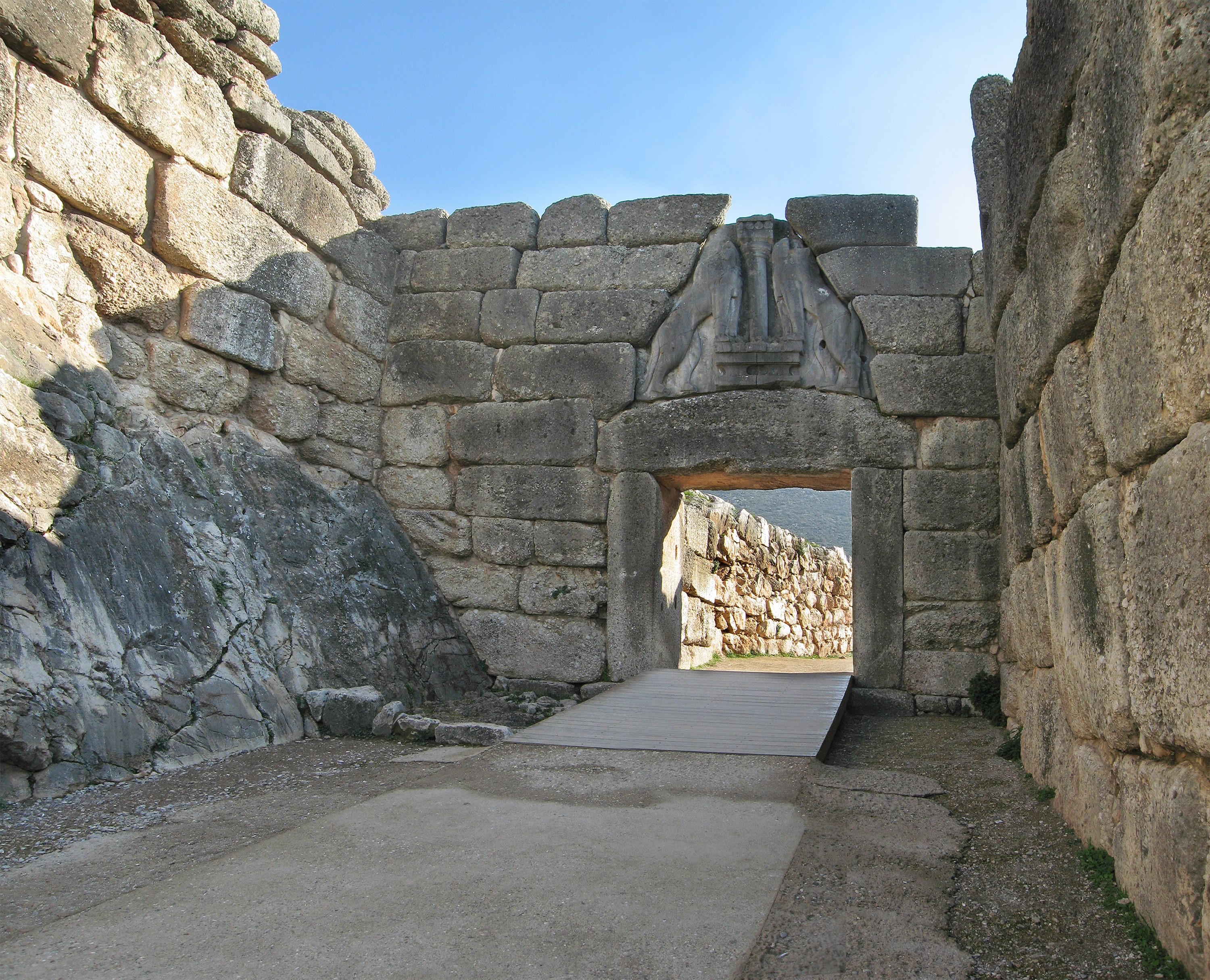
Overview
Mycenae is an archaeological site near Mykines in Argolis, in the north-eastern Peloponnese of Greece1Mycenae — wiki · Wikipedia ↗. It is a city in the Argolid, on the Peloponnese peninsula2Mycenae — mycenae · Reference ↗. The site is an acropolis built on a hill 900 feet (274 metres) above sea level, some 19 kilometres (12 miles) inland from the Gulf of Argolis3Mycenae — sec2 · Wikipedia ↗. Mycenae was the most prominent site of its era, and the culture of the period takes its name from it4Mycenae — greece · Reference ↗.
In the second millennium BC Mycenae was one of the major centres of Greek civilization, a military stronghold that dominated much of southern Greece, Crete, the Cyclades and parts of southwest Anatolia1. Late Bronze Age Greece was divided into a series of warrior kingdoms, the most important centred in Mycenae, Tiryns, Pylos and Thebes5Mycenae — greece · Reference ↗. The fortifications of Mycenae were built with Cyclopean masonry2.
Mycenaean Greece, also called the Mycenaean civilization, was the last phase of the Bronze Age in ancient Greece, spanning approximately 1750 to 1050 BC4. It was dominated by a warrior elite society and consisted of a network of palace-centred states that developed rigid hierarchical, political, social and economic systems4. The subsequent Tiryns culture grew into this civilization, known for its palatial states, urban organization, Mycenaean art and the Linear B writing system6Mycenae — civilization · Reference ↗. The Mycenaean language was spoken on the Greek mainland and Crete from the 16th to the 12th centuries BC7Mycenae — greek · Reference ↗, and it is named after Mycenae, one of the major centres of Mycenaean Greece7.
The Mycenaeans became the dominant power of the region, marking the beginning of the Mycenaean Koine era, a highly uniform culture that spread across mainland Greece and the Aegean8Mycenae — europe · Reference ↗. By 1450 BC the palace of Knossos was ruled by a Mycenaean elite who formed a hybrid Minoan-Mycenaean culture8, and in the same year the Aegean came under the cultural and perhaps political domination of the mainland Mycenaean Greeks, forming a hybrid culture that lasted until around 1100 BC6.
The city of Mycenae was initially destroyed in an earthquake in 1250 BC, as evidenced by crushed bodies buried in collapsed structures9Mycenae — collapse · Reference ↗. Destruction in Greece was heaviest at palaces and fortified sites, and none of the Mycenaean palaces of the Late Bronze Age survived, with the possible exception of the Cyclopean fortifications on the Acropolis of Athens9. The palace economy of Mycenaean Greece, the Aegean region and Anatolia broke apart into the small isolated village cultures of the Greek Dark Ages9. On the Greek mainland the Linear B script, used by Mycenaean bureaucrats to write the Greek language, ceased to be used10Mycenae — ages · Reference ↗, and pottery decoration after about 1050 BC lacked the figurative decoration of Mycenaean ware, restricted to simpler, generally geometric styles10.
The first correct identification of Mycenae in modern literature was in 1700, during a survey conducted by the Venetian engineer Francesco Vandeyk1.
Because documents and objects that can be precisely dated are lacking, events at Mycenae can be fixed only relatively, within the constraints of Helladic chronology, which relies on categorising stratified material objects — mainly pottery — inside an agreed historical framework11Mycenae — sec6 · Wikipedia ↗. The span encompassing the LHIIIA and LHIIIB phases is known as the Mycenaean Age11.
From the 15th century BC Mycenaean power expanded towards the Aegean, the Anatolian coast and Cyprus5. Knossos continued to function after its takeover, but under stronger Mycenaean Greek influence12Mycenae — knossos · Reference ↗. Tablets have also been found at Mycenae itself, at Tiryns and Thebes, and at Chania in western Crete7. Argos, a strategic location on the fertile plain of Argolis, was a major stronghold during the Mycenaean era13Mycenae — peloponnese · Reference ↗.
Mycenaean palaces began to come to an end around 1200 BC, and the process concluded decades later through internal tensions within the cities, which rejected palatial authority and administration — a rejection patent in the disappearance of Linear B writing and of palatial architecture10. The first half of the 12th century BC also saw the Sea Peoples invasions, the collapse of Mycenaean Greece and of the Kassites in Babylonia, and the carving of the Merneptah Stele9.
Earlier Helladic and Middle Helladic material was found beneath the walls and floors of the palace, on the summit of the acropolis and outside the Lion Gate in the area of the ancient cemetery3.
1. Name and Chronological Framework
The period of Greek history from about 1600 BC to about 1100 BC is called Mycenaean in reference to Mycenae 1. The span up to 1200 BC (encompassing LHIIIA and LHIIIB) is known as the Mycenaean Age 11. Mycenaean Greece is the period before the so-called Greek Dark Ages 7.
In the absence of documents and objects that can be precisely dated, events at Mycenae can be dated only relatively within the constraints of Helladic chronology, which relies on categorisation of stratified material objects, mainly pottery, within an agreed historical framework 11.
Mycenae is an archaeological site near Mykines in Argolis, in the north-eastern Peloponnese of Greece 1. It is a city in the Argolid, on the Peloponnese peninsula 2. The acropolis was built on a hill 900 feet (274 metres) above sea level, some 19 kilometres (12 miles) inland from the Gulf of Argolis 3. In the second millennium BC it was one of the major centres of Greek civilization, a military stronghold that dominated much of southern Greece, Crete, the Cyclades and parts of southwest Anatolia 1.
Late Bronze Age Greece was divided into a series of warrior kingdoms, the most important centred on Mycenae, Tiryns, Pylos and Thebes 5. The culture of the era takes its name from Mycenae, the most prominent of these sites 4, and the language spoken there is likewise named after Mycenae, one of the major centres of Mycenaean Greece 7. That language was spoken on the Greek mainland and Crete in the 16th to 12th centuries BC 7. Mycenaean Greece, also called the Mycenaean civilization, was the last phase of the Bronze Age in ancient Greece, spanning approximately 1750 to 1050 BC 4. The wider Aegean civilization encompasses the Minoan civilization of Crete, the Cycladic culture on the Cyclades, and the Helladic cultures of the mainland, whose later phases are known as the Mycenaean civilization 6.
From the 15th century BC Mycenaean power began expanding towards the Aegean, the Anatolian coast and Cyprus 5. By 1450 BC the palace of Knossos was ruled by a Mycenaean elite who formed a hybrid Minoan-Mycenaean culture 8, and after this event Knossos continued to function, but with stronger Mycenaean Greek influence 12. As a strategic location on the fertile plain of Argolis, Argos was a major stronghold during the Mycenaean era 13. The fortifications of Mycenae were built with the use of Cyclopean masonry 2. Further Early Helladic and Middle Helladic material was found beneath the walls and floors of the palace, on the summit of the acropolis and outside the Lion Gate in the area of the ancient cemetery 3.
Mycenaean palaces began to come to an end around 1200 BC, and the process concluded decades later, owing to internal tensions within the cities that rejected palatial authority and administration, patent in the disappearance of Linear B writing and palatial architecture 10. The palace economy of Mycenaean Greece, the Aegean region and Anatolia that characterized the Late Bronze Age broke apart into the small isolated village cultures of the Greek Dark Ages 9. On the Greek mainland, the Linear B script, used by Mycenaean bureaucrats to write the Greek language, ceased to be used 10. Tablets in that script have been found at Mycenae itself, Tiryns and Thebes and at Chania, in Western Crete 7.
2. Mycenaean Civilization and Its Extent
Late Bronze Age Greece was divided into a series of warrior kingdoms, the most important of which were centered in Mycenae, Tiryns, Pylos and Thebes. Mycenaean Greece was dominated by a warrior elite society and consisted of a network of palace-centered states that developed rigid hierarchical, political, social and economic systems. Notable Mycenaean sites include Mycenae, Pylos, Tiryns, and Agios Vasileios.6
In the second millennium BC Mycenae was one of the major centres of Greek civilization, a military stronghold which dominated much of southern Greece, Crete, the Cyclades and parts of southwest Anatolia. From the 15th century BC Mycenaean power started expanding towards the Aegean, the Anatolian coast and Cyprus. Mycenaean settlements also appeared in Epirus, Macedonia, on islands in the Aegean Sea, on the south-west coast of Asia Minor, and on Cyprus, while Mycenaean-influenced settlements appeared in the Levant and Italy.
The Mycenaean Greeks introduced several innovations in the fields of engineering, architecture and military infrastructure, while trade over vast areas of the Mediterranean was essential for the Mycenaean economy.
Mycenaean Greece, also called Mycenaean civilization, was the last phase of the Bronze Age in ancient Greece, spanning the period from approximately 1750 to 1050 BC4. The term gathers the Minoan civilization of Crete, the Cycladic culture on the Cyclades, and the Helladic cultures of the mainland, whose later phases are known as the Mycenaean civilization6. The period of Greek history from about 1600 BC to about 1100 BC is called Mycenaean in reference to Mycenae1, and the language itself is named after Mycenae, one of the major centres of Mycenaean Greece7.
The Tiryns culture eventually grew into the Mycenaean civilization which is known today for its palatial states, urban organization, Mycenaean art, and Linear B writing system6. Linear B was spoken on the Greek mainland and Crete in Mycenaean Greece (16th to 12th centuries BC)7. Mycenae itself was an acropolis site built on a hill 900 feet (274 metres) above sea level, some 19 kilometres (12 miles) inland from the Gulf of Argolis3. Argos was a major stronghold of Mycenaean times, and along with the neighbouring acropolis of Mycenae and Tiryns became a very early settlement because of its commanding positions in the midst of the fertile plain of Argolis13.
Mycenaean armies shared several common features with other contemporary Late Bronze Age powers: they were initially based on heavy infantry, with spears, large shields and in some occasions armor5. The Mycenaeans became the dominant power of the region, marking the beginning of the Mycenaean 'Koine' era (from Greek: Κοινή, common), a highly uniform culture that spread in mainland Greece and the Aegean8. In 1450 BC the palace of Knossos was ruled by a Mycenaean elite who formed a hybrid Minoan-Mycenaean culture8, and after about 1450 BC Knossos became an important Mycenaean administrative centre12. After this event, Knossos continued to function, but with stronger Mycenaean Greek influence12.
Mycenaean palaces began to come to an end around 1200 BC, and the process concluded decades later, due to internal tensions within the cities which rejected palatial authority and administration, patent in the disappearance of Linear B writing and palatial architecture10. On the Greek mainland, the Linear B script, used by Mycenaean bureaucrats to write the Greek language, ceased to be used10. The palace economy of Mycenaean Greece, the Aegean region, and Anatolia that characterized the Late Bronze Age broke apart into the small isolated village cultures of the Greek Dark Ages9. The decoration on Greek pottery after about 1050 BC lacks the figurative decoration of Mycenaean ware and is restricted to simpler, generally geometric styles10.
3. Writing and Administration
Mycenaean bureaucrats used Linear B to write the Greek language. The script served administration on the Greek mainland and on Crete during Mycenaean Greece, in the 16th to 12th centuries BC. Tablets bearing it have also been found at Mycenae itself, at Tiryns and Thebes, and at Chania in Western Crete. The so-called Kafkania pebble has been claimed as the oldest known Mycenaean inscription, with a purported date to the 17th century BC.7
After about 1450 BC Knossos became an important Mycenaean administrative centre. The palace of Knossos was ruled by a Mycenaean elite who formed a hybrid Minoan-Mycenaean culture.8 After the Mycenaean takeover Knossos produced a major archive of Linear B tablets, written in an early form of Greek.12
The Mycenaean civilization, the final phase of the Bronze Age in ancient Greece, spanned approximately 1750 to 1050 BC.4 It grew out of the Tiryns culture and is known today for its palatial states, urban organization, Mycenaean art, and Linear B writing system.6 The most prominent site was Mycenae, after which the culture of this era is named.4 Late Bronze Age Greece was divided into a series of warrior kingdoms, the most important being centered in Mycenae, Tiryns, Pylos and Thebes.5 In the second millennium BC, Mycenae was one of the major centres of Greek civilization—a military stronghold which dominated much of southern Greece, Crete, the Cyclades and parts of southwest Anatolia.1 From the 15th century BC, Mycenaean power started expanding towards the Aegean, the Anatolian coast and Cyprus.5
The site of Mycenae is an acropolis built on a hill 900 feet (274 metres) above sea level, some 19 kilometres (12 miles) inland from the Gulf of Argolis.3 It lies near Mykines in Argolis, north-eastern Peloponnese, Greece.1 Mycenae is a city in the Argolid, in the Peloponnese peninsula of Greece.2 Its fortifications were built with the use of Cyclopean masonry.2 Further EH and MH material was found beneath the walls and floors of the palace, on the summit of the acropolis and outside the Lion Gate in the area of the ancient cemetery.3 As a strategic location on the fertile plain of Argolis, Argos was a major stronghold during the Mycenaean era.13
The tablets from Knossos are a major source for the study of Late Bronze Age Crete and Mycenaean administration.12 After the Mycenaean takeover Knossos continued to function, but with stronger Mycenaean Greek influence.12 The Aegean world of this period encompasses the Minoan civilization of Crete, the Cycladic culture on the Cyclades, and the Helladic cultures of the mainland, whose later phases are known as the Mycenaean civilization.6
Mycenaean palaces began to come to an end around 1200 BC, and the process concluded decades later, due to internal tensions within the cities which rejected palatial authority and administration, patent in the disappearance of Linear B writing and palatial architecture.10 On the Greek mainland, the Linear B script, used by Mycenaean bureaucrats to write the Greek language, ceased to be used.10 The palace economy of Mycenaean Greece, the Aegean region, and Anatolia that characterized the Late Bronze Age broke apart into the small isolated village cultures of the Greek Dark Ages.9 The years to 1200 BC (encompassing LHIIIA and LHIIIB) are known as the Mycenaean Age.11
In the absence of documents and objects that can be precisely dated, events at Mycenae can be dated only relatively within the constraints of Helladic chronology, which relies on categorisation of stratified material objects, mainly pottery, within an agreed historical framework.11
4. Fortifications and Citadel
The fortifications of Mycenae were raised in Cyclopean masonry, a construction that relied on sheer mass rather than dressed stone. Mycenae had a wall of large, irregular stones that were laid together without mortar2.
The pressures of the age drove the circuit outward. Due to high competition in the Mid to Late Bronze Age the citadel wall expanded significantly with the inclusion of Grave Circle A and the addition of the Lion Gate2.
The stratigraphy of the site is bound up with these structures. Further EH and MH material was found beneath the walls and floors of the palace, on the summit of the acropolis and outside the Lion Gate in the area of the ancient cemetery3.
Mycenae is a city in the Argolid, in the Peloponnese peninsula of Greece2. The acropolis site was built on a hill 900 feet (274 metres) above sea level, some 19 kilometres (12 miles) inland from the Gulf of Argolis3. In the second millennium BC it was one of the major centres of Greek civilization, a military stronghold that dominated much of southern Greece, Crete, the Cyclades and parts of southwest Anatolia1. Late Bronze Age Greece was divided into a series of warrior kingdoms, the most important being centered in Mycenae, to which the culture of this era owes its name, Tiryns, Pylos and Thebes5.
The citadel belonged to a wider world that the fortifications were meant to defend. Mycenaean Greece, also called Mycenaean civilization, was the last phase of the Bronze Age in ancient Greece, spanning the period from approximately 1750 to 1050 BC4. The most prominent site was Mycenae, after which the culture of this era is named4. From the 15th century BC Mycenaean power started expanding towards the Aegean, the Anatolian coast and Cyprus5. The Aegean world of the period encompasses the Minoan civilization of Crete, the Cycladic culture on the Cyclades, and the Helladic cultures of the mainland, whose later phases are known as the Mycenaean civilization6.
What the walls ultimately withstood, and what they did not, belongs to the end of the age. Destruction was heaviest at palaces and fortified sites, and none of the Mycenaean palaces of the Late Bronze Age survived, with the possible exception of the Cyclopean fortifications on the Acropolis of Athens9. The palace economy of Mycenaean Greece, the Aegean region, and Anatolia that characterized the Late Bronze Age broke apart into the small isolated village cultures of the Greek Dark Ages9. On the Greek mainland the Linear B script, used by Mycenaean bureaucrats to write the Greek language, ceased to be used10.
The dating of these developments rests on relative rather than absolute evidence. In the absence of documents and objects that can be precisely dated, events at Mycenae can be dated only relatively within the constraints of Helladic chronology, which relies on categorisation of stratified material objects, mainly pottery, within an agreed historical framework11. The span from approximately 1750 to 1050 BC, encompassing LHIIIA and LHIIIB, is known as the Mycenaean Age11. The script itself was spoken on the Greek mainland and Crete in Mycenaean Greece (16th to 12th centuries BC)7, and other tablets have been found at Mycenae itself, Tiryns and Thebes and at Chania, in Western Crete7.
The wider Aegean record shows how power and craft moved between centres. By 1450 BC the palace of Knossos was ruled by a Mycenaean elite who formed a hybrid Minoan-Mycenaean culture8. After this event Knossos continued to function, but with stronger Mycenaean Greek influence12. As a strategic location on the fertile plain of Argolis, Argos was a major stronghold during the Mycenaean era13.
5. Military Organization
Mycenaean armies shared several common features with other contemporary Late Bronze Age powers5. They were initially based on heavy infantry, with spears, large shields and in some occasions armor5.
Some representative types of Mycenaean armor and weapons were the boar's tusk helmet and the "Figure-of-eight" shield5.
In the 13th century BC Mycenaean units underwent a transformation in tactics and weaponry5. They became more uniform and flexible and their weapons became smaller and lighter5.
Late Bronze Age Greece was divided into a series of warrior kingdoms, the most important being centered in Mycenae, to which the culture of this era owes its name, Tiryns, Pylos and Thebes5. The most prominent site was Mycenae, after which the culture of this era is named4. In the second millennium BC, Mycenae was one of the major centres of Greek civilization—a military stronghold which dominated much of southern Greece, Crete, the Cyclades and parts of southwest Anatolia1.
From the 15th century BC, Mycenaean power started expanding towards the Aegean, the Anatolian coast and Cyprus5. The Mycenaean Greeks introduced several innovations in the fields of engineering, architecture and military infrastructure, while trade over vast areas of the Mediterranean was essential for the Mycenaean economy84. The fortifications of Mycenae were built with the use of Cyclopean masonry2.
Mycenaean Greece, also called Mycenaean civilization, was the last phase of the Bronze Age in ancient Greece, spanning the period from approximately 1750 to 1050 BC4. The subsequent Tiryns culture eventually grew into the Mycenaean civilization which is known today for its palatial states, urban organization, Mycenaean art, and Linear B writing system6. The Linear B script was used by Mycenaean bureaucrats to write the Greek language10, and it was spoken on the Greek mainland and Crete in Mycenaean Greece (16th to 12th centuries BC)7. Other tablets have been found at Mycenae itself, Tiryns and Thebes and at Chania, in Western Crete7.
The palace economy of Mycenaean Greece, the Aegean region, and Anatolia that characterized the Late Bronze Age broke apart into the small isolated village cultures of the Greek Dark Ages9. On the Greek mainland, the Linear B script ceased to be used10.
In the absence of documents and objects that can be precisely dated, events at Mycenae can be dated only relatively within the constraints of Helladic chronology, which relies on categorisation of stratified material objects, mainly pottery, within an agreed historical framework11.
6. Decline and Collapse
The palaces of the Mycenaean world began to come to an end around 1200 BC and the process concluded decades later due to internal tensions within the cities which rejected palatial authority and administration, patent in the disappearance of Linear B writing and palatial architecture 10. From then on Mycenaean expansion throughout the Aegean was unhindered until the massive disruption of society in the first half of the twelfth century (LHIIIC), which ended Mycenaean civilisation and culminated in the destruction of Mycenae itself 11.
Also occurring in the first half of the 12th century BC were the Sea Peoples invasions, the collapse of Mycenaean Greece and the Kassites in Babylonia, and the carving of the Merneptah Stele. The palace economy of Mycenaean Greece, the Aegean region, and Anatolia that characterized the Late Bronze Age broke apart into the small isolated village cultures of the Greek Dark Ages 9.
On the Greek mainland the Linear B script ceased to be used. The decoration on Greek pottery after about 1050 BC lacks the figurative decoration of Mycenaean ware and is restricted to simpler, generally geometric styles. There were also conflicts, in the region of Boeotia, between Mycenaean polities like Orchomenos, Gla, and Thebes.
Mycenaean Greece, also called the Mycenaean civilization, was the last phase of the Bronze Age in ancient Greece, spanning the period from approximately 1750 to 1050 BC 4. The most prominent site was Mycenae, after which the culture of this era is named 4. In the second millennium BC Mycenae was one of the major centres of Greek civilization—a military stronghold which dominated much of southern Greece, Crete, the Cyclades and parts of southwest Anatolia 1. Late Bronze Age Greece was divided into a series of warrior kingdoms, the most important being centered in Mycenae, to which the culture of this era owes its name, Tiryns, Pylos and Thebes 5.
Mycenae is a city in the Argolid, in the Peloponnese peninsula of Greece 2. The acropolis site was built on a hill 900 feet (274 metres) above sea level, some 19 kilometres (12 miles) inland from the Gulf of Argolis 3. Its fortifications were built with the use of Cyclopean masonry 2. Further EH and MH material was found beneath the walls and floors of the palace, on the summit of the acropolis and outside the Lion Gate in the area of the ancient cemetery 3.
From the 15th century BC Mycenaean power started expanding towards the Aegean, the Anatolian coast and Cyprus 5. The Linear B script was spoken on the Greek mainland and Crete in Mycenaean Greece (16th to 12th centuries BC) 7. Other tablets have been found at Mycenae itself, Tiryns and Thebes and at Chania, in Western Crete 7. As a strategic location on the fertile plain of Argolis, Argos was a major stronghold during the Mycenaean era 13.
The city of Mycenae was initially destroyed in an earthquake in 1250 BC as evidenced by the presence of crushed bodies buried in collapsed buildings 9. In the absence of documents and objects that can be precisely dated, events at Mycenae can be dated only relatively within the constraints of Helladic chronology, which relies on categorisation of stratified material objects, mainly pottery, within an agreed historical framework 11. The years to 1200 BC (encompassing LHIIIA and LHIIIB) are known as the Mycenaean Age 11.
7. Modern Identification
The first correct identification of Mycenae in modern literature was in 1700 during a survey conducted by the Venetian engineer Francesco Vandeyk on behalf of Francesco Grimani, the Provveditore Generale of the Kingdom of the Morea 1. Vandeyk used Pausanias's description of the Lion Gate to identify the ruins of Mycenae 1.
8. Key dates
- 1600 BCEThe period of Greek history from about 1600 BC to about 1100The period of Greek history from about 1600 BC to about 1100 BC is called Mycenaean in reference to Mycenae.
- 1450 BCEBC, the palace of Knossos was ruled by a Mycenaean elite who1450 BC, the palace of Knossos was ruled by a Mycenaean elite who formed a hybrid Minoan-Mycenaean culture.
- 1250 BCEThe city of Mycenae, for example, was initially destroyed in an earthquakeThe city of Mycenae, for example, was initially destroyed in an earthquake in 1250 BC as evidenced by the presence of crushed bodies buried in collapsed buildings.
- 1200 BCEBC are known as the Mycenaean Age.1200 BC are known as the Mycenaean Age.
- 1050 BCEThe decoration on Greek pottery after about 1050 BC lacks the figurativeThe decoration on Greek pottery after about 1050 BC lacks the figurative decoration of Mycenaean ware and is restricted to simpler, generally geometric styles: Early Protogeometric , Middle Protogeometric , Late Protogeometric , Early G
- 1700The first correct identification of Mycenae in modern literature was in 17The first correct identification of Mycenae in modern literature was in 1700, during a survey conducted by the Venetian engineer Francesco Vandeyk on behalf of Francesco Grimani, the Provveditore Generale of the Kingdom of the Morea.
- 1750Mycenaean Greece, also called Mycenaean civilization, was the last phase oMycenaean Greece, also called Mycenaean civilization, was the last phase of the Bronze Age in ancient Greece, spanning the period from approximately 1750 to 1050 BC.
- 1999Museum replicas of Mycenaean swords and cups ^ Velikovsky 1999 , EdwinMuseum replicas of Mycenaean swords and cups ^ Velikovsky 1999 , Edwin M.
9. Frequently asked questions
What was the final palace at Mycenae, and when does it date to?
The final palace, remains of which are currently visible on the acropolis of Mycenae, dates to the start of LHIIIA:211.
Where did Mycenaean settlements appear beyond the Greek mainland?
Mycenaean settlements also appeared in Epirus, Macedonia, on islands in the Aegean Sea, on the south-west coast of Asia Minor, and on Cyprus, while Mycenaean-influenced settlements appeared in the Levant and Italy4.
Which other stronghold in the Argolid rose early alongside Mycenae?
Argos was a major stronghold of Mycenaean times, and along with the neighbouring acropolis of Mycenae and Tiryns became a very early settlement because of its commanding positions in the midst of the fertile plain of Argolis13.
How did Knossos change after the Mycenaean takeover?
After this event Knossos continued to function, but with stronger Mycenaean Greek influence12.
What does the name of the Mycenaean script tell us about its origin?
The language is named after Mycenae, one of the major centres of Mycenaean Greece7.
What survives today as replicas of Mycenaean craftsmanship?
Museum replicas of Mycenaean swords and cups are recorded in the literature14Mycenae — sec7 · Wikipedia ↗.
References (14)
- 1Mycenae — wiki — Wikipedia Web↩View source
- 2Mycenae — mycenae — Reference Web↩View source
- 3Mycenae — sec2 — Wikipedia Web↩View source
- 4Mycenae — greece — Reference Web↩View source
- 5Mycenae — greece — Reference Web↩View source
- 6Mycenae — civilization — Reference Web↩View source
- 7Mycenae — greek — Reference Web↩View source
- 8Mycenae — europe — Reference Web↩View source
- 9Mycenae — collapse — Reference Web↩View source
- 10Mycenae — ages — Reference Web↩View source
- 11Mycenae — sec6 — Wikipedia Web↩View source
- 12Mycenae — knossos — Reference Web↩View source
- 13Mycenae — peloponnese — Reference Web↩View source
- 14Mycenae — sec7 — Wikipedia Web↩View source