Minoan Civilization
The Bronze Age civilization of Crete — its palaces at Knossos, Phaistos, Malia and Zakros, its scripts and frescoes, its maritime trade network, and the debates over the Thera eruption and the Minoan decline.
The Minoan civilization was a Bronze Age civilization of Crete that flourished from about 3000 to about 1100 BCE, named by Arthur Evans after the legendary King Minos following his excavations at Knossos from 1900. It built the palace complexes of Knossos, Phaistos, Malia and Zakros, used the undeciphered script Linear A and the later Linear B, produced celebrated frescoes and craftwork, and traded across the eastern Mediterranean, before destruction and Mycenaean takeover in the mid-15th century BCE and the abandonment of most sites by 1200 BCE.
In this article
- 1Discovery and Naming
- 2Chronology and Periodization
- 3Palaces and Architecture
- 4Scripts and Writing
- 5Art and Culture
- 6Trade and Economy
- 7Thera Eruption and Natural Disasters
- 8Decline and Mycenaean Influence
- 9Legacy and Significance
- 10Timeline: from the first settlement of Knossos to the excavation of Akrotiri
- 11Frequently asked questions
- 12Knowledge graph
Discovery and Naming
The civilization of Bronze Age Crete takes its name from the British archaeologist Sir Arthur Evans, who excavated the ruins of an ancient city at Knossos in 1900. Evans had acquired both the Knossos site and an excavation permit by early that year, and work began on 23 March. He was granted permission to dig by the Cretan authorities and began his excavation convinced that the building was the Labyrinth of myth. Excavating at Knossos from 1900 to 1905, he uncovered extensive ruins that confirmed the ancient accounts of a sophisticated Cretan culture and the possible site of the legendary labyrinth and palace of King Minos. It was Evans who coined the term Minoan in reference to this legendary Bronze Age king.
The name itself derives from Minos, either a dynastic title or the name of a particular ruler of Crete who has a place in Greek legend. Evans characterized the Bronze Age culture of Crete as Minoan after that legendary King Minos. The civilization he named was a Bronze Age culture of Crete that flourished from about 3000 BCE to about 1100 BCE. Its principal centers came to include Phaistos, Malia, and Zakros alongside Knossos.
Evans worked to complete the excavations of 1900–1905 and to publish them, chiefly in the six volumes called The Palace of Minos at Knossos. Other excavators soon followed him across the island. The Italians under Halbherr and Pernier began work at the Minoan palace of Phaistos and the villa at Hagia Triadha, while the Americans Harriet Boyd, Edith Hall and Richard Seager dug in east Crete at sites such as Kavousi, Gournia and Pseira, and the French eventually started excavating the Minoan palace at Malia in 1915 CE.
1. Chronology and Periodization
From the material he excavated at Knossos he devised a chronological scheme of nine periods for Minoan civilization on Crete 5Minoan Crete (Heilbrunn Timeline of Art History) · The Metropolitan Museum of Art ↗.
Scholars divide the Minoan period broadly into three stages: Early Minoan, the establishment of Minoan culture usually dated between 3000 and 2000 BCE; Middle Minoan; and Late Minoan 1Minoan civilization · Encyclopaedia Britannica ↗. Evans divided the island's Bronze Age into three phases largely based on different pottery styles: Early Minoan (3000-2100 BCE), Middle Minoan (2100-1600 BCE) and Late Minoan (1600-1100 BCE) 4Minoan Civilization · World History Encyclopedia ↗. The Middle Minoan phase, usually dated from about 2000 or 1900 BCE to either 1600 or 1450 BCE, was also called the Palatial period and was distinguished by the construction of palaces such as Knossos 1.
An alternative scheme created by Platon focuses on the events occurring in and around the major Minoan palaces, with four periods: Prepalatial (3000 - 2000/1900 BCE), Protopalatial (2000/1900 - 1700 BCE), Neopalatial (1700 - 1470/1450 BCE) and Postpalatial (1470/1450 - 1100 BCE) 4. The first certain palaces were constructed at Knossos and Phaistos in Middle Minoan IB (about 2000/1950-1900/1850 BC) 6Lesson 10: Middle Minoan Crete (Prehistoric Archaeology of the Aegean) · Dartmouth College (Jeremy B. Rutter) ↗. At Knossos and Phaistos the end of MM IIB is marked by a major destruction horizon, probably due to an earthquake, which defines the end of the Protopalatial or Old Palace period 6.
In the second millennium BCE, great palaces began to be built on Crete during the period known as the Neopalatial (circa 1700-1490 BCE) 7Rise and Fall of the Mighty Minoans · National Geographic ↗. One of the more distinctive features of the Neopalatial period is the existence for the first time of large and sumptuously appointed buildings which are neither palaces nor ordinary residential structures 8Lesson 13: Minoan Domestic and Funerary Architecture of the Neopalatial and Post-Palatial Periods · Dartmouth College (Jeremy B. Rutter) ↗. There is general agreement among historians that the palaces were independent from each other up to 1700 BCE, and thereafter they came under the sway of Knossos, as evidenced by a greater uniformity in architecture and the use of Linear A writing across various palace sites 4.
| Period | Dates | Key Features |
|---|---|---|
| Early Minoan | 3000–2000 BCE | Establishment of Minoan culture 1 |
| Middle Minoan | 2000/1900–1600/1450 BCE | Also called the Palatial period; distinguished by the construction of palaces such as Knossos 1 |
| Late Minoan | 1600/1450–1100 BCE | Coincided with the eruption of a dormant volcano on the island of Thera (modern Santorini), which may have caused the destruction of Knossos 1 |
| Prepalatial | 3000–2000/1900 BCE | Events occurring in and around the major Minoan palaces 4 |
| Protopalatial | 2000/1900–1700 BCE | First certain palaces constructed at Knossos and Phaistos in Middle Minoan IB (about 2000/1950-1900/1850 BC) 6 |
| Neopalatial | 1700–1470/1450 BCE | Great palaces began to be built on Crete 7 |
| Postpalatial | 1470/1450–1100 BCE | Palace culture on Crete declined 1 |
2. Palaces and Architecture
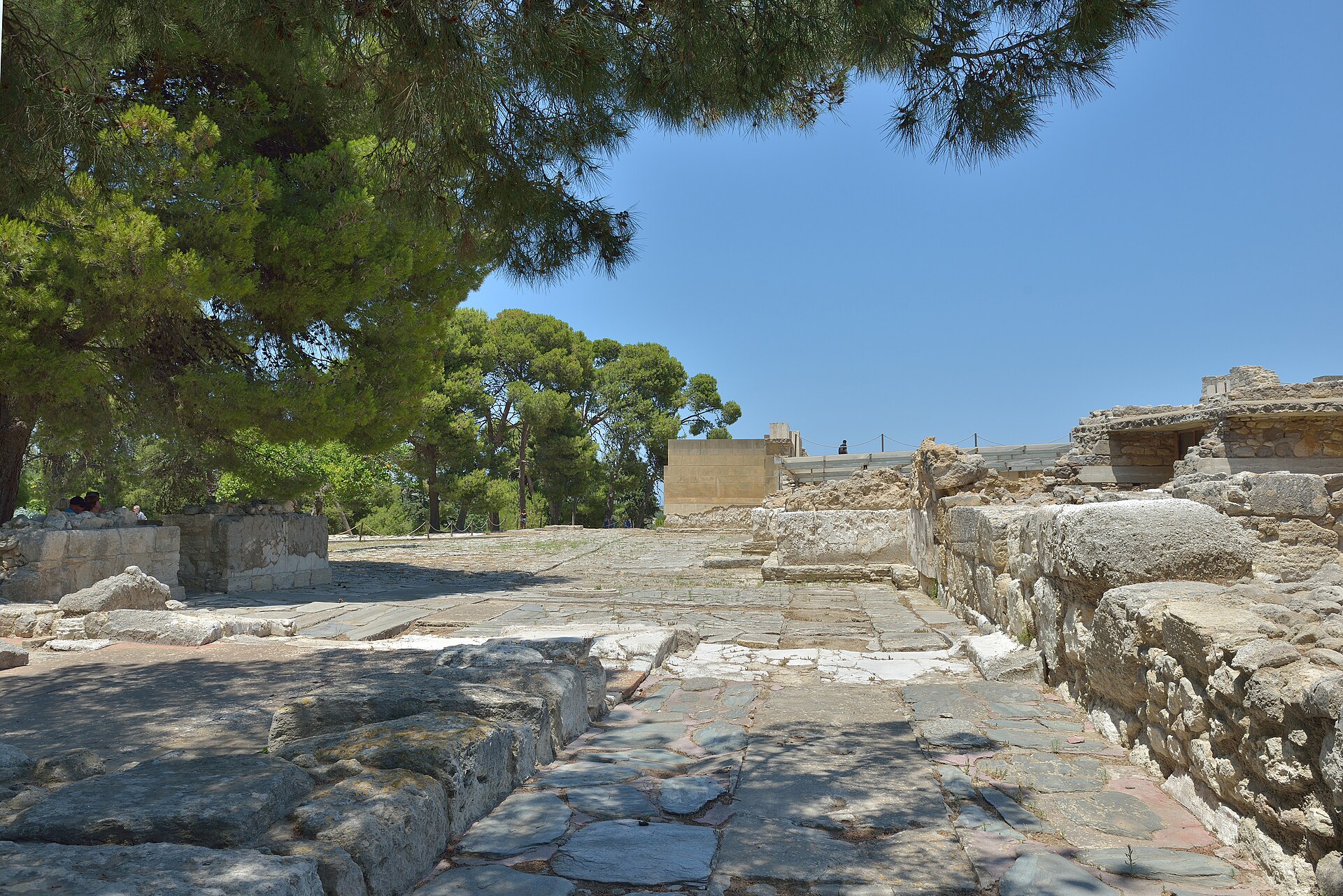
The great palace complexes of Bronze Age Crete functioned as political, economic, and ceremonial hubs, and Minoan civilization was remarkable for its great cities and palace complexes in the periods of its peak about 1600 BCE and again in the later 15th century BCE. Major palaces were built at Knossos and Mallia in the northern part of Crete, at Phaistos in the south, and at Zakros in the east, distinguished by their arrangement around a paved central court and sophisticated masonry. In general there were no defensive walls, although a network of watchtowers punctuating key roads on the island has been identified. The palaces exerted localised control, in particular in the gathering and storage of surplus materials such as wine, oil, grain, precious metals and ceramics. The administrative and ceremonial quarters of the palace at Knossos were on the west side of the central court, and the area also had long narrow basement rooms that served as storage magazines for wheat, oil, and treasure.
The site of Knossos stands on a knoll between the confluence of two streams and is located about 5 miles (8 km) inland from Crete's northern coast. Its throne room still contains the gypsum chair in which sat the kings of Knossos. About 1720 BCE a destructive earthquake leveled most of Knossos; the palace was rebuilt, this time with extensive colonnades and flights of stairs connecting the different buildings on the hilly site. An elaborate system of drains, conduits, and pipes provided water and sanitation for the palace at Knossos, and the whole urban complex was connected to other Cretan towns and ports by paved roads.
3. Scripts and Writing
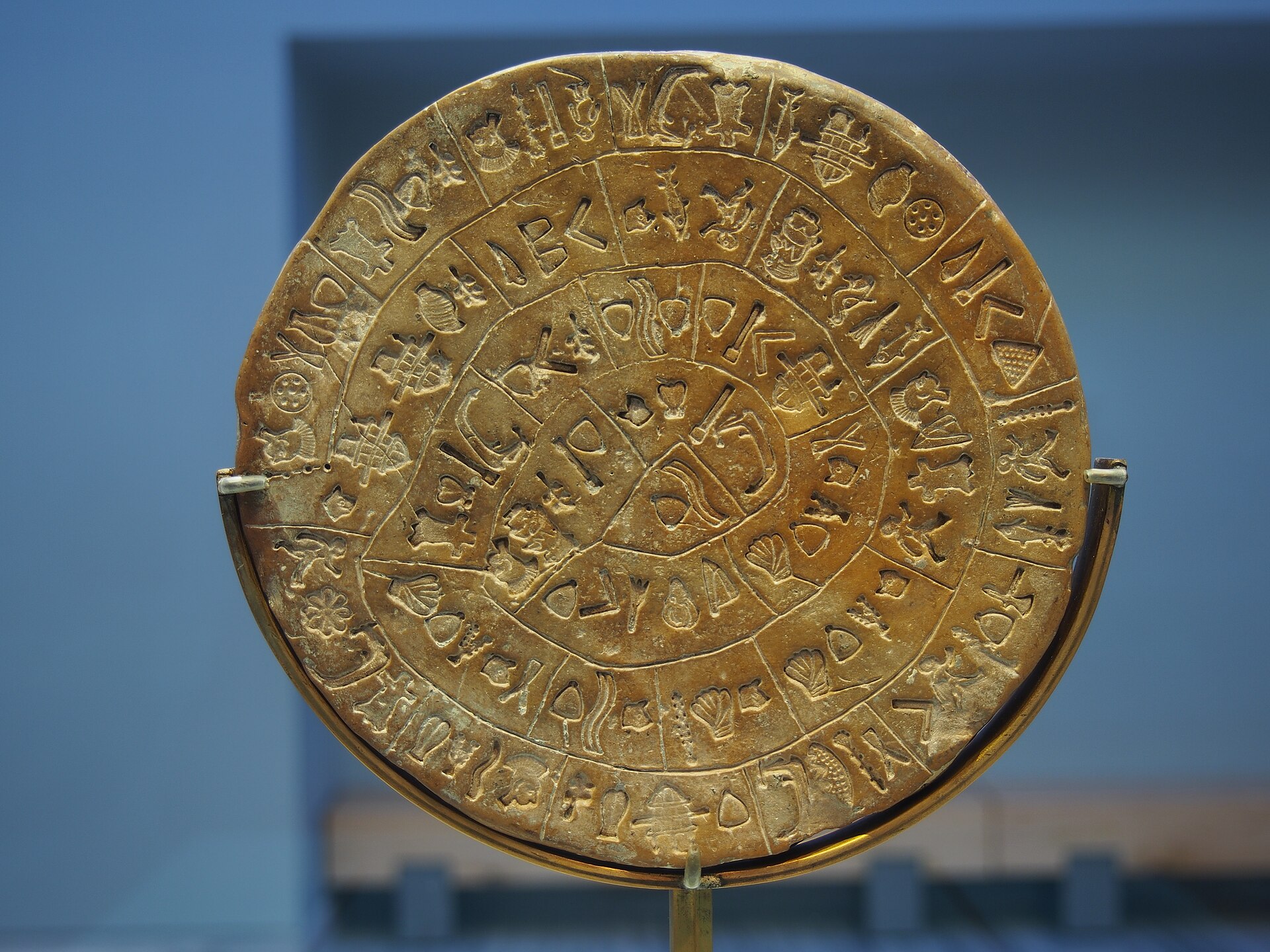
The Minoans on Crete employed two types of scripts: a hieroglyphic script whose source of inspiration was probably Egypt, and a linear script, Linear A, perhaps inspired by the cuneiform of the eastern Mediterranean. Linear A is a non-deciphered script found on Crete, in the Aegean islands and sporadically on the Greek Mainland and the western coast of Asia Minor, from the 18th to the 14th centuries BC. The Linear A syllabary, as it is currently known, is composed of 97 signs, some of which are also used as logograms. The approximate phonetic values of most syllabic signs used in Linear A are known from Linear B, but the language written in Linear A remains unknown; it must have been a pre-Hellenic language of Minoan Crete. Its relation to the so-called hieroglyphic Minoan script is uncertain; it is a syllabic script written from left to right.
Linear B is an adapted form of Linear A, which was borrowed from the Minoans by the Mycenaean Greeks probably about 1600 BCE, and its language is the Mycenaean Greek dialect. Linear B was deciphered as Greek in 1952 by Michael Ventris. Its 90 syllabic signs express open syllables, generally beginning without a consonant or with only one consonant, so that the script cannot represent groups of consonants or final consonants clearly; for instance sperma 'seed' is spelled pe-ma, and stathmos 'stable' is spelled ta-to-mo. Administrative records from this period are written in Linear B, the script of Mycenaean Greeks.
4. Art and Culture
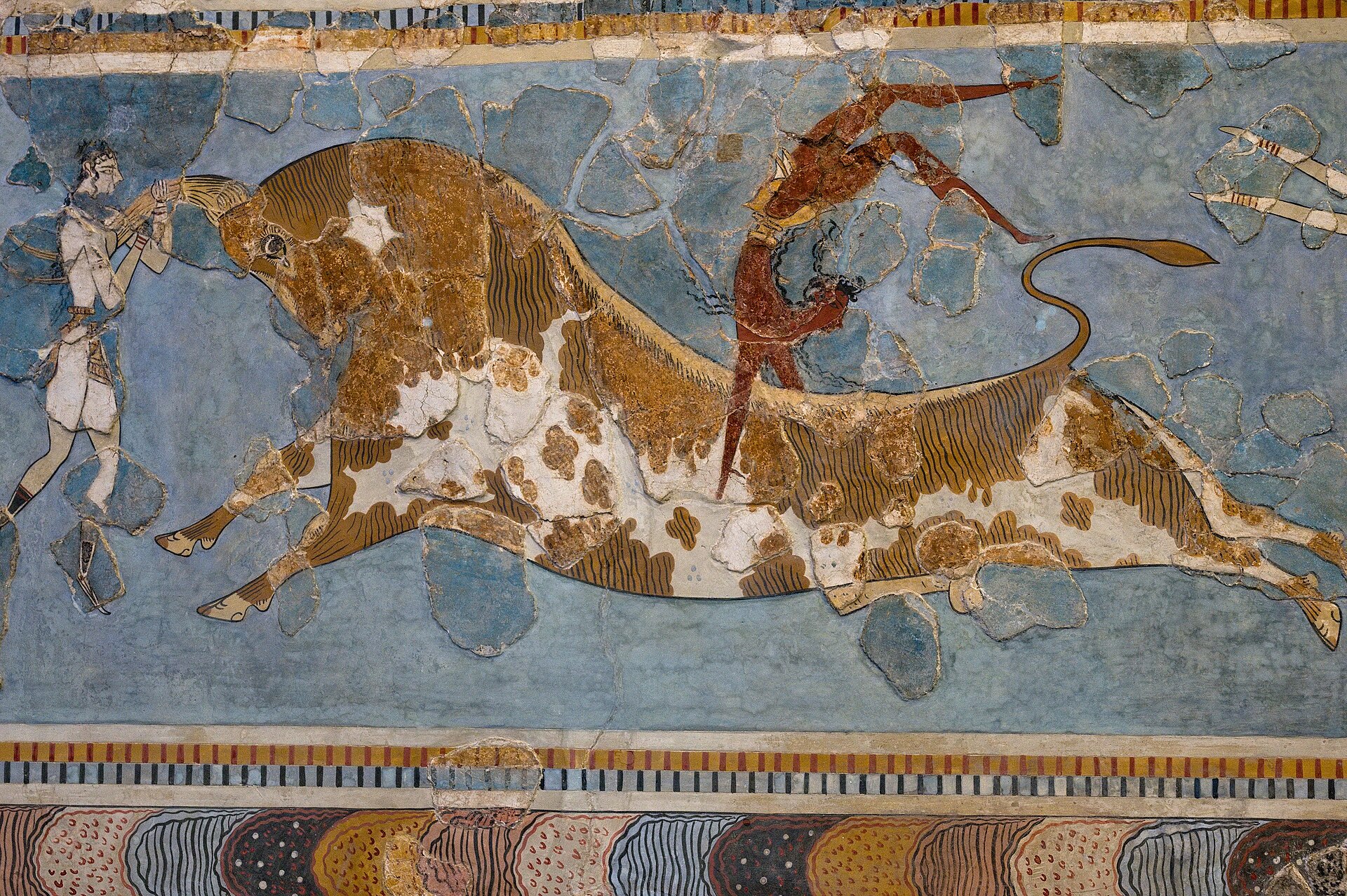
Minoan art encompassed elaborate seals and pottery, most notably the Kamares ware distinguished by its light-on-dark style of decoration, and above all the delicate, vibrant frescoes that adorned palace walls. The best-loved ancient illustration of bull sports, called the bull-leaping or Toreador fresco, comes from the site of Knossos on the island of Crete, and the wall painting as now reconstructed shows three people leaping over a bull, one at its front, another over its back, and a third at its rear. That fresco survives as a reconstruction from fragments, dated to about 1400 BCE and standing 78 cm high. The Dolphin Fresco from the Palace of Knossos is a magnificent seascape depicting two dolphins swimming among small blue, yellow and pink fish, with a light blue background representing the iridescent surface of the sea.
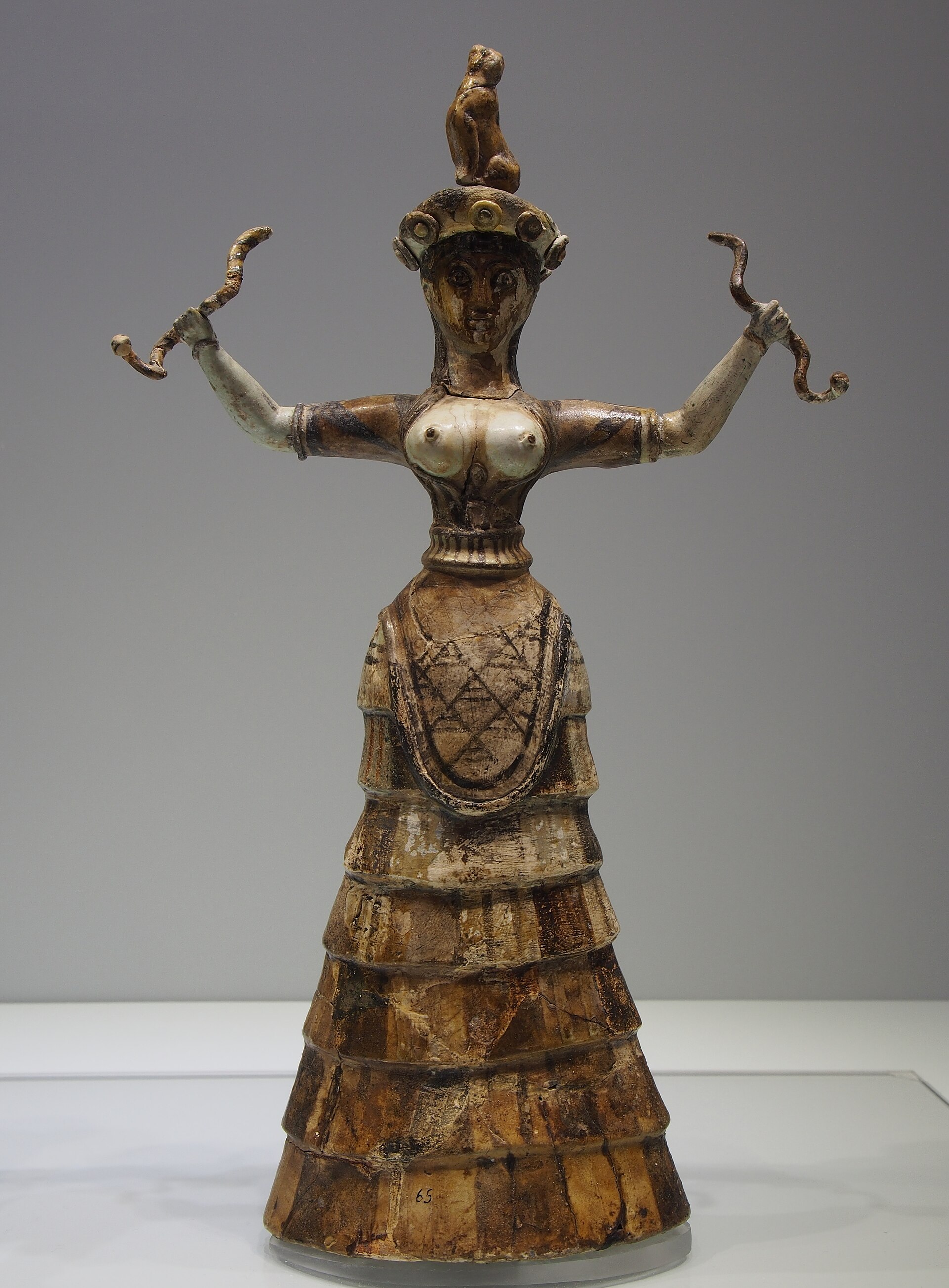
Among the most important exhibits of the Heraklion Archaeological Museum are the two famous statuettes known as the Snake Goddesses, iconic symbols of the Minoan civilisation and exquisite examples of Minoan miniature sculpture. The art of Minoan fresco painting reached its zenith at Knossos in the second palace period, with scenes of dancing, sports, and dolphins done in a naturalistic style. Despite its fragmentary state of preservation, the relief bull fresco from the Palace of Knossos is a crowning example of Minoan naturalistic art, rendering the bull's head and the dramatic tension of the scene with extraordinary realism.
5. Trade and Economy
Crete occupied a strategic position at a maritime crossroads between Greece, Anatolia, and Egypt, and this location made it the foremost site of Bronze Age culture in the Aegean Sea. From the island, Cretan exports consisted of timber, foodstuffs, cloth, and most likely olive oil, as well as finely crafted luxury goods. In exchange, the Minoans imported tin, copper, gold, silver, emery, fine stones, ivory, and some manufactured objects. Around 3000 BCE, the Minoan civilization emerged on the island of Crete and became a great maritime trading power.
Archaeological evidence shows that during the third millennium BCE, Crete lay at the center of an extensive trading network dealing in copper from the Cyclades and tin from Asia Minor; these materials were essential for producing bronze, a commodity that brought power and prestige to the Minoans. Minoan trade networks helped distribute Minoan artistic styles and luxury goods across the eastern Mediterranean. Artifacts found at Knossos were imported, suggesting that the city engaged in trade with mainland Greece, Cyprus, the Near East, Egypt, Italy and all over the Mediterranean. Cretan sherds of MM IB-IIA date have been found at Kahun and Harageh in Egypt in levels datable to the early 19th century BCE, attesting to Minoan contacts with Egypt.
6. Thera Eruption and Natural Disasters
The eruption of Thera was a devastating Bronze Age eruption of a long-dormant volcano on the Aegean island of Thera, also known as Santorini 16Eruption of Thera · Encyclopaedia Britannica ↗. It is thought to have been the largest of the Holocene in terms of volume, and highly explosive, with a Volcanic Explosivity Index (VEI) of 7 17Olive shrub buried on Therasia supports a mid-16th century BCE date for the Thera eruption · Scientific Reports (PubMed Central PMC10147620) ↗. Because it deposited a marker horizon of volcanic material, the eruption provides a critical synchronization point for the chronologies of the Aegean, Anatolia, the Levant, and Egypt 17.
The eruption is thought to have occurred about 1500 BCE, although on the basis of evidence obtained during the 1980s from a Greenland ice-core and from tree-ring and radiocarbon dating, some scholars believe that it occurred earlier, possibly during the 1620s BCE 16. The precise date of the 2nd millennium BCE eruption has long been a focus of controversy due to a discrepancy between archaeological and radiocarbon-based dating of materials from stratigraphic layers above and below tsunami, ash and pumice deposits resulting from the eruption 17. Radiocarbon work has continued to bear on the problem: one study reports radiocarbon dates from a second olive shrub found carbonized by the eruption deposits on Therasia (Santorini), near the Monastery of Panaghia Koimisis on the southern-most tip of the island of Therasia 17.
7. Decline and Mycenaean Influence
From 1500 BCE onward, influence from the Mycenaean culture of the Greek mainland pressed increasingly upon the island, and clear archaeological evidence points to widespread destruction around 1450 BCE. If the Mycenaeans did not themselves cause that destruction, they certainly took advantage of it, and the administrative records of the period are written in Linear B, the script of Mycenaean Greeks. By the middle of the 15th century BCE the palace culture on Crete had declined, in a period that may have involved a combination of natural disasters, internal disruptions, and growing Mycenaean influence from the mainland. The Mycenaeans achieved control over Knossos sometime in the 15th century BCE, and Linear B is identical to that used at Mycenae and is most generally deemed the prototype of Greek.
Whatever the cause of the catastrophe, most Minoan sites were abandoned by 1200 BCE. Crete would not return to the Mediterranean stage of history until the 8th century BCE, when it was colonised by Archaic Greeks. Some time after about 1400 BCE, what Evans called the "Last Palace" of Knossos was destroyed by a fire of uncertain origin, and fires destroyed many other Cretan settlements; Knossos was reduced to the status of a mere town, and the political focus of the Aegean world shifted to Mycenae on the Greek mainland.
8. Legacy and Significance
The Minoan civilization flourished in the Middle Bronze Age on the island of Crete, and through its unique art and architecture and the spread of its ideas through contact with other cultures across the Aegean, it made a significant contribution to the development of Western European civilization. Its influence reached neighboring islands and the Greek mainland, where it was reflected in the Mycenaean culture.
Knossos is considered to be Europe's oldest city, a Bronze Age metropolis that sprang up thanks to the Minoans, Europe's first advanced civilization. Objects from the site verify it as the location of the earliest known farming settlement in Europe, established in around 7000 BCE. The first human inhabitants of Knossos probably came from Anatolia in the 7th millennium BCE and established an agricultural society based on wheat and livestock raising. A discovery made in 1979 appeared to show evidence of a ritual human sacrifice, challenging the public perception of the Minoans as peaceful and providing a tantalizing hint of the Minotaur myth.
9. Timeline: from the first settlement of Knossos to the excavation of Akrotiri
- c. 7000 BCEFirst settlement at KnossosOn the hill of Knossos, under the ruins of the later Minoan palace, was excavated the longest-lived Neolithic installation in Crete; Knossos was the first permanent settlement established on the island.
- c. 3000 BCEEarly Minoan period beginsThe Early Minoan stage of Minoan culture, usually dated between 3000 and 2000 BCE, saw the establishment of Minoan culture on Crete.
- c. 2000 BCEFirst Minoan palacesThe first certain palaces were constructed at Knossos and Phaistos in Middle Minoan IB (about 2000/1950-1900/1850 BC).
- c. 1850 BCELinear A in useLinear A is attested in Crete and on some Aegean islands from approximately 1850 BCE to 1400 BCE.
- c. 1720 BCEEarthquake levels KnossosAbout 1720 BCE a destructive earthquake leveled most of Knossos; the palace was rebuilt with extensive colonnades and flights of stairs.
- c. 1600 BCEMinoan eruption of TheraAkrotiri's inhabitants abandoned the city after strong earthquakes; a volcanic eruption of the greatest magnitude around 1600 BC, the Minoan eruption of Thera, then buried the settlement in ash.
- c. 1580 BCEMinoan influence spreads to the mainlandBy about 1580 BCE Minoan civilization began to spread across the Aegean to neighboring islands and to the mainland of Greece, where it was further developed as the Mycenaean culture.
- c. 1450 BCEDestructions across CretePalaces and settlements show evidence of fire and destruction c. 1450 BCE, though not at Knossos; the rise of the Mycenaeans is the most likely cause of the end of Minoan dominance.
- Some time after 1400 BCEThe Last Palace of Knossos destroyedWhat Evans called the Last Palace of Knossos was destroyed by a fire of uncertain origin, and fires destroyed many other Cretan settlements at this time.
- c. 1200 BCEMinoan sites abandonedMost of the Minoan sites were abandoned by 1200 BCE, and Crete would not return to the Mediterranean stage of history until the 8th century BCE.
- 1878Kalokairinos discovers the remains at KnossosThe remains of an ancient building at Knossos were discovered by the Cretan businessman and scholar Minos Kalokairinos.
- 23 March 1900Evans begins excavation at KnossosBy early 1900 Evans had acquired both the Knossos site and an excavation permit, and work began on 23 March.
- 1901-1904Gournia excavatedGournia in eastern Crete was excavated from 1901 to 1904 by an expedition from the University of Pennsylvania under the direction of three women.
- 1952Linear B decipheredLinear B was deciphered as Greek in 1952 by Michael Ventris, the achievement that opened a new branch of scholarship on the Mycenaean world.
- 1967Akrotiri excavations beginSystematic excavations at Akrotiri on Santorini began in 1967 under Professor Spyridon Marinatos, with the support of the Archaeological Society of Athens.
10. Frequently asked questions
What was the Minoan civilization, and when and where did it exist?
Why is it called "Minoan"?
What were the principal Minoan palaces, and when were the first ones built?
What writing systems did the Minoans use, and have they been deciphered?
What happened to the Minoan palaces and settlements?
What was the Thera eruption, and when did it occur?
The Thera eruption was a devastating Bronze Age eruption of a long-dormant volcano on the Aegean island of Thera, also known as Santorini 16. Its traditional date is about 1500 BCE 16, while radiocarbon evidence points to the mid-16th century BCE, though a radiocarbon plateau makes the date debated 17.
References (18)
- 1Minoan civilization — Encyclopaedia Britannica Web↩View source
- 2Evans at Knossos (U2S2L4, Crete: Prehistory and Archaeology) — University of Oxford, Faculty of Classics BookView source
- 3Labyrinth: Knossos, Myth and Reality - press release — Ashmolean Museum, University of Oxford BookView source
- 4Minoan Civilization — World History Encyclopedia Web↩View source
- 5Minoan Crete (Heilbrunn Timeline of Art History) — The Metropolitan Museum of Art Web↩View source
- 6Lesson 10: Middle Minoan Crete (Prehistoric Archaeology of the Aegean) — Dartmouth College (Jeremy B. Rutter) Web↩View source
- 7Rise and Fall of the Mighty Minoans — National Geographic Web↩View source
- 8Lesson 13: Minoan Domestic and Funerary Architecture of the Neopalatial and Post-Palatial Periods — Dartmouth College (Jeremy B. Rutter) Web↩View source
- 9Knossos — Encyclopaedia Britannica WebView source
- 10Linear A — Mnamon - Scuola Normale Superiore, Pisa Web↩View source
- 11Linear A — Encyclopaedia Britannica Web↩View source
- 12Bull-leaping fresco from the palace of Knossos — Smarthistory WebView source
- 13Prehistoric exhibits — Heraklion Archaeological Museum (Hellenic Ministry of Culture) WebView source
- 14The Snake Goddesses — Heraklion Archaeological Museum (Hellenic Ministry of Culture) WebView source
- 15This Ancient City Was Three Times Bigger Than Archaeologists Suspected — Smithsonian Magazine WebView source
- 16Eruption of Thera — Encyclopaedia Britannica Web↩View source
- 17Olive shrub buried on Therasia supports a mid-16th century BCE date for the Thera eruption — Scientific Reports (PubMed Central PMC10147620) Web↩View source
- 18The archaeological site of Akrotiri on Santorini | The Pompeii of the Aegean — Greek News Agenda WebView source