Electric Battery
From Alessandro Volta's pile of 1799 through lead-acid, dry-cell and lithium-ion chemistry - the device that turned chemistry into portable electricity.
The electric battery stores chemical energy and releases it as electricity. Alessandro Volta built the first true battery, the voltaic pile, in 1799, and the 19th century followed with Georges Leclanche's cell, Gaston Plante's lead-acid accumulator and the sealed dry cells that made portable power a consumer product. In the 1970s and 1980s Whittingham, Goodenough and Yoshino developed the lithium-ion battery, commercialized by Sony in 1991, which now powers phones, laptops and electric vehicles and anchors grid-scale storage; the work earned the 2019 Nobel Prize in Chemistry.
In this article
- 1Overview
- 2The Voltaic Pile and the Beginning of Continuous Current
- 3Alessandro Volta
- 4The Lead-Acid Accumulator and the First Storage Battery
- 5The Leclanche Cell and the Dry Cell
- 6The Lithium-Ion Battery: Whittingham, Goodenough and Yoshino
- 7Later Cathode Development
- 8How Batteries Work
- 9Cell Voltages and Chemistry Comparison
- 10Applications
- 11Grid-Scale Storage
- 12Next-Generation Batteries
- 13Timeline: from Galvani's frogs to the lithium-ion age
- 14Knowledge graph
Overview
A battery is any of a class of devices that convert chemical energy directly into electrical energy; in strict usage the word means an assembly of two or more galvanic cells, though it is commonly applied to a single cell. Every cell comprises a positive cathode and a negative anode separated by an electrolyte, with electrode and electrolyte materials chosen and arranged so that sufficient electromotive force in volts and current in amperes can be developed. Batteries fall into two broad groups: primary cells, which are discarded once the voltage is too low to operate a device, and secondary or storage batteries, which can be recharged with direct current after discharge.
1. The Voltaic Pile and the Beginning of Continuous Current
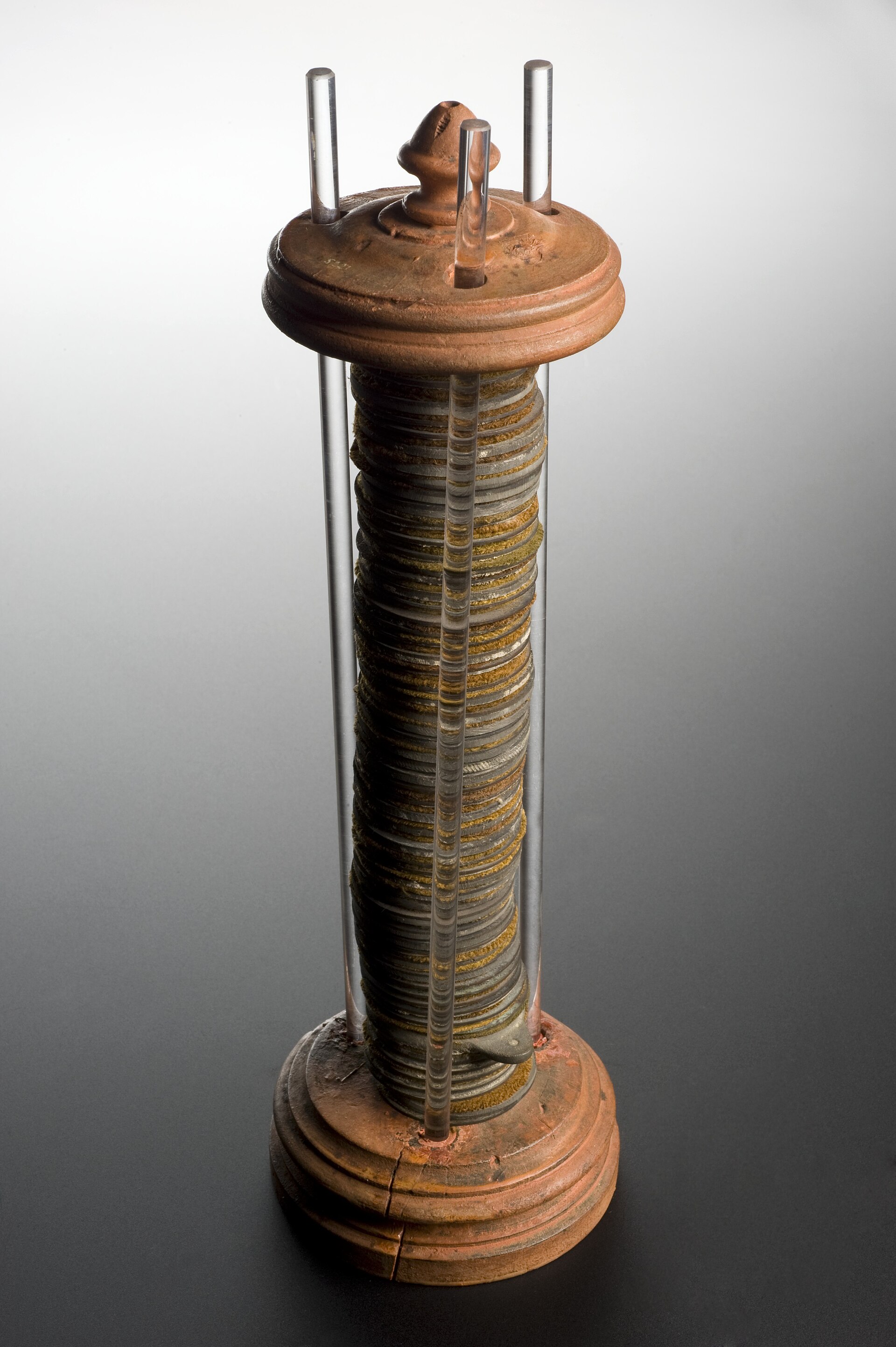
Until 1800 no source of continuous current existed, and electricity was widely assumed to arise from living beings rather than from inert matter. Alessandro Volta showed that electricity could instead be generated chemically, and his invention of the electric battery provided the first source of continuous current. His voltaic pile alternated copper and zinc discs, each pair separated by flannel soaked in weak acid. In a variant demonstration intended to prove that no animal parts were needed, he stacked alternating zinc and silver discs separated by brine-soaked cloth, building a pile of as many as thirty disks modelled on the electric organ of the torpedo fish.The pile established electrochemical principles that remain the basis of batteries today.
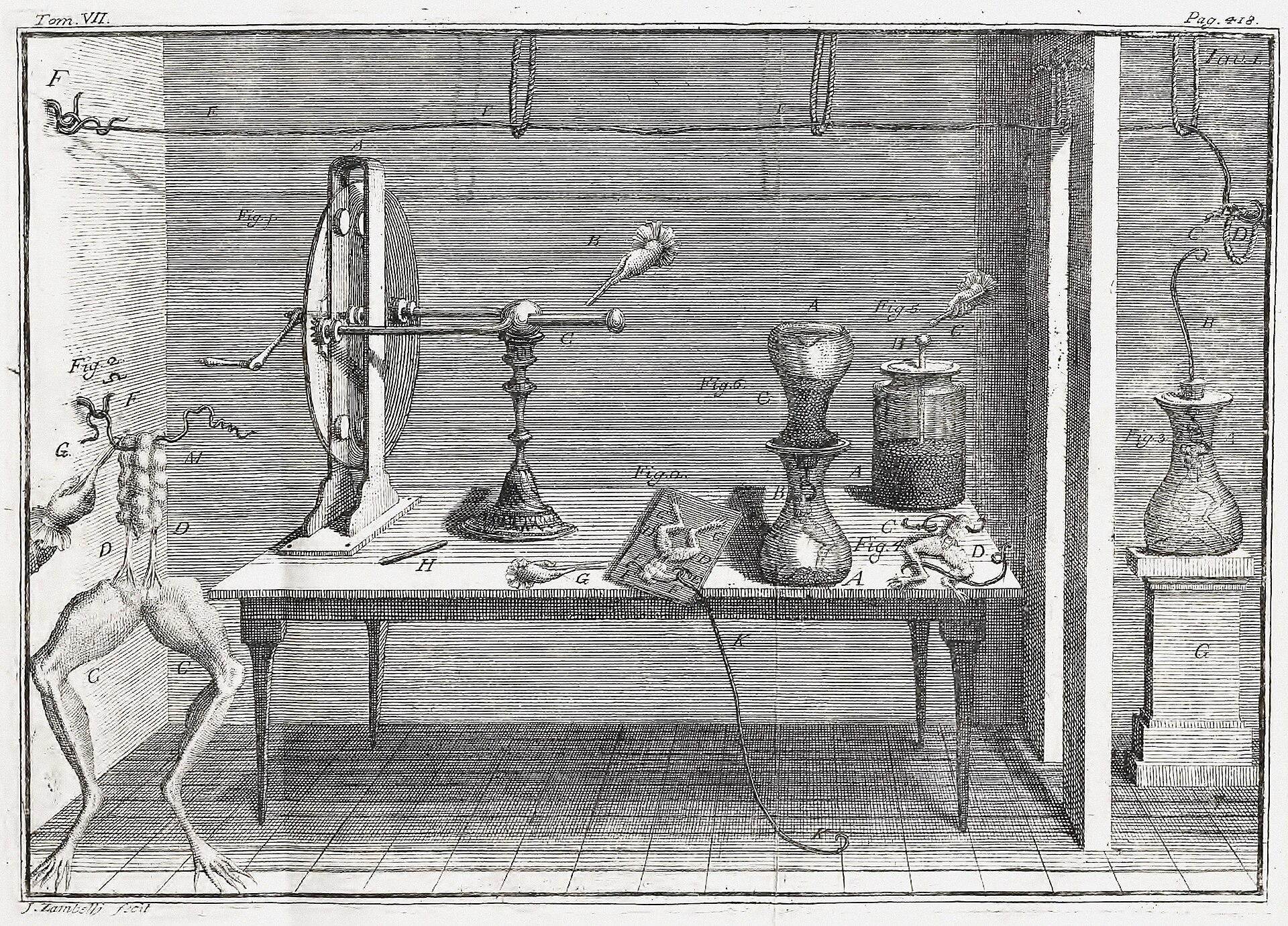
Volta argued that the effect came from two different metals joined by a moist conductor, a phenomenon he called metallic electricity, and in 1792 he began experimenting with metals alone. The controversy between animal-electricity adherents and metallic-electricity advocates was settled with Volta's announcement of the first electric battery in 1800, and victory was assured for Volta. His battery made electricity easily available in the laboratory, opening the way to sustained experimental work.
Volta first reported the electric pile in a letter dated 20 March 1800 to Joseph Banks, president of the Royal Society of London. Napoleon summoned him to Paris in 1801 and had a medal struck in his honor, and the unit of electric potential takes its name from Volta. Napoleon also recommended many honors for him, including making him a count in 1810; the invention brought Volta great renown, though he soon gave up most of his research and teaching.
2. Alessandro Volta
Alessandro Volta was an Italian physicist, born on 18 February 1745 at Como and died there on 5 March 1827. He taught at Pavia from 1774 to 1804 and was appointed to the chair of physics at the University of Pavia. He introduced the theory of electrical current and observed electricity separating water into hydrogen and oxygen. His friend Luigi Galvani announced in 1791 that contact of two different metals with a skinned frog's leg muscles generated an electric current.
3. The Lead-Acid Accumulator and the First Storage Battery
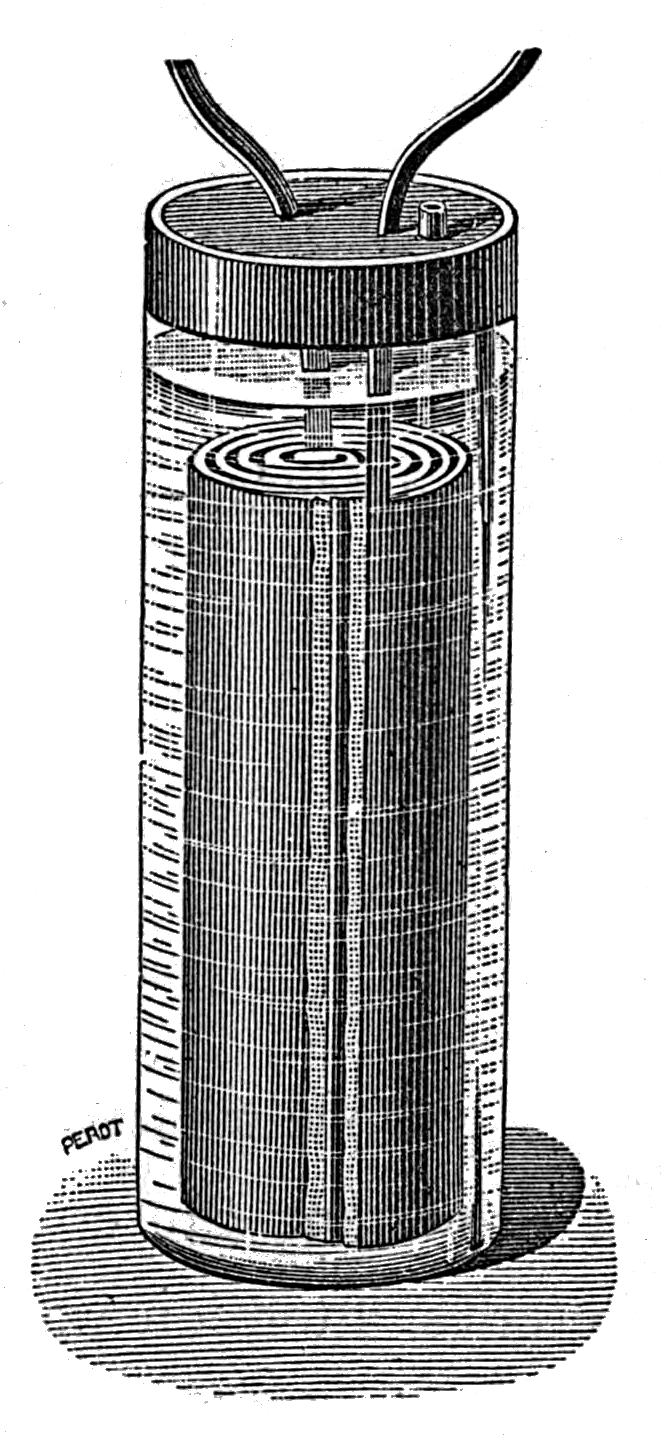
Gaston Planté, a French physicist, produced the first electric storage battery, or accumulator, in 1859; in improved form his invention is widely used in automobiles. His first model contained two sheets of lead separated by rubber strips, rolled into a spiral and immersed in a solution containing about 10 percent sulfuric acid.
The lead-acid battery remains inexpensive, safe, recyclable and reliable, though its low specific energy and poor cold-temperature behavior limit its use.
4. The Leclanche Cell and the Dry Cell
The battery that bears Georges Leclanché's name was devised in about 1866, built around a conducting solution of ammonium chloride, a negative terminal of zinc, and a positive terminal of manganese dioxide. Leclanché's improved wet cell met with immediate success and was in wide use in telegraph systems within two years of its development.
The first dry cell was the work of Carl Gassner in the 1880s, and it used the sealed zinc container itself as the anode. The National Carbon Company, forerunner of Energizer, was founded in Cleveland in 1886 by Washington H. In 1896 the company marketed the sealed, six-inch, 1.5-volt Columbia battery, the first battery intended for widespread consumer use and the first sealed dry cell made on a large scale. The carbon-zinc design served as the basis for all dry-cell batteries for sixty years, until Eveready introduced the alkaline battery in the late 1950s.
5. The Lithium-Ion Battery: Whittingham, Goodenough and Yoshino
Stanley Whittingham moved from Stanford to Exxon in 1972, and his research involved materials with atom-sized spaces where charged ions can attach, a phenomenon called intercalation. Goodenough's lithium cobalt oxide cathode was almost twice as powerful as Whittingham's at four volts. Goodenough also realized that batteries did not have to be manufactured charged, and in 1980 he published the new energy-dense cathode material.
In safety tests in 1986 Yoshino dropped a large piece of iron on the battery with nothing happening, while a pure-lithium cell exploded violently. He called this the moment when the lithium-ion battery was born.
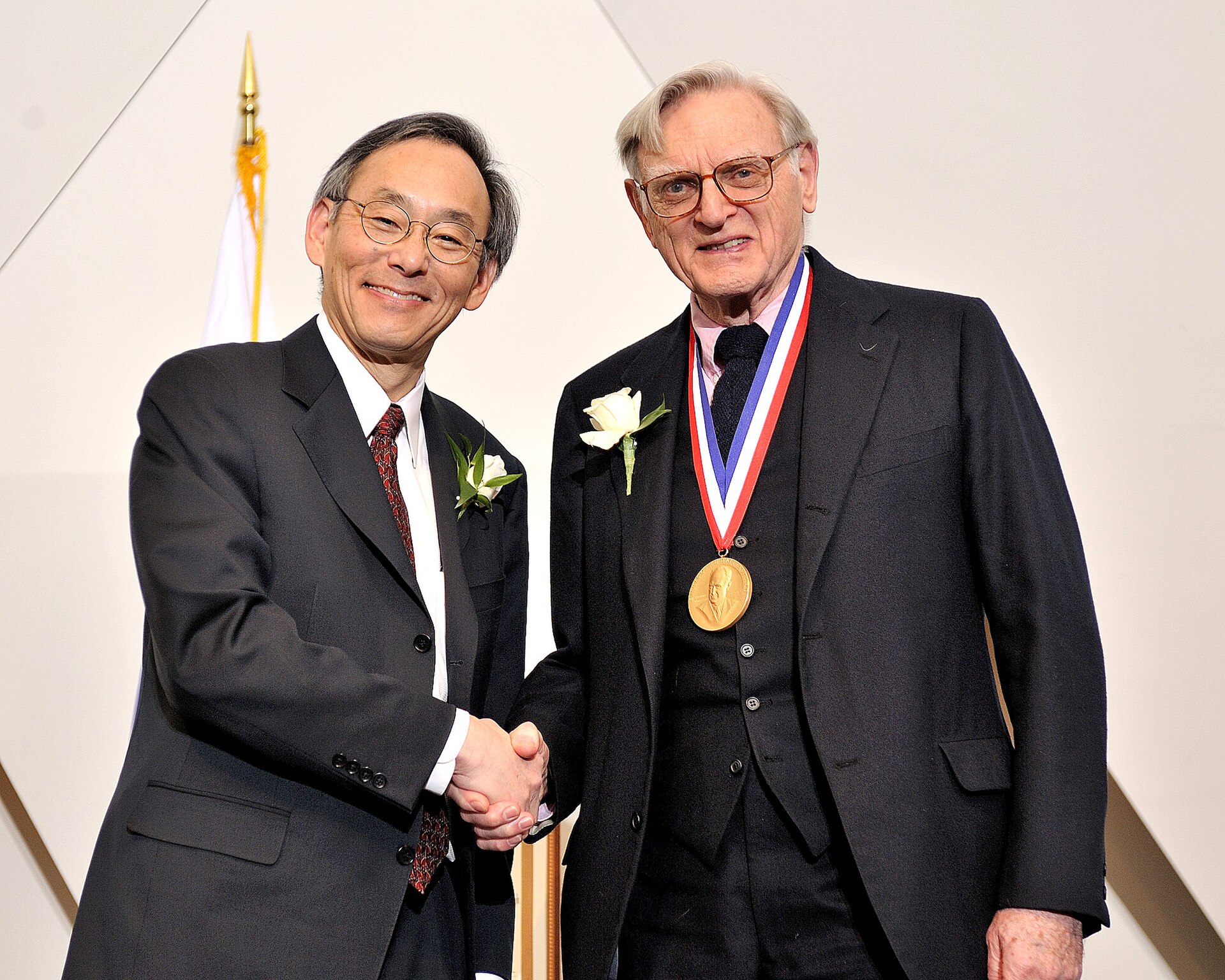
Goodenough won at age 100 in 2019, the oldest Nobel laureate.
6. Later Cathode Development
Michael Thackeray served as a postdoc for Goodenough at Oxford in 1981-1982; together they invented a manganese spinel cathode that was cheaper and safer than cobalt oxide, though with poorer performance. Thackeray later made a pivotal discovery: a lithium-rich nickel-manganese-cobalt oxide cathode, known as NMC, that improved performance, reliability and safety over the then-current lithium-ion technology.
Sony's 1991 battery suited small electronics but was not powerful enough for cars; later Argonne X-ray analysis of battery chemistry led to a new cathode that multiple car companies used in plug-in electric vehicle batteries.
7. How Batteries Work
A battery stores energy in chemical form and converts that chemical potential into electricity when it discharges. In a rechargeable battery the electrons and ions move in either direction; charging raises the chemical potential energy and discharging converts it back to electricity.
One chemical equivalent of each electrode yields one faraday of 96,485 coulombs, equal to 26.8 ampere-hours; at an average of 1.2 volts this would yield 32.2 watt-hours of DC energy. Commercial cells using very active lithium for the anode have delivered as much as 3.9 volts on load with very high current-carrying capability.
8. Cell Voltages and Chemistry Comparison
| Battery chemistry | Voltage per cell |
|---|---|
| alkaline zinc-manganese dioxide | 1.55 volts per cell |
| lithium-manganese dioxide | 2.8-3.2 volts per cell |
9. Applications
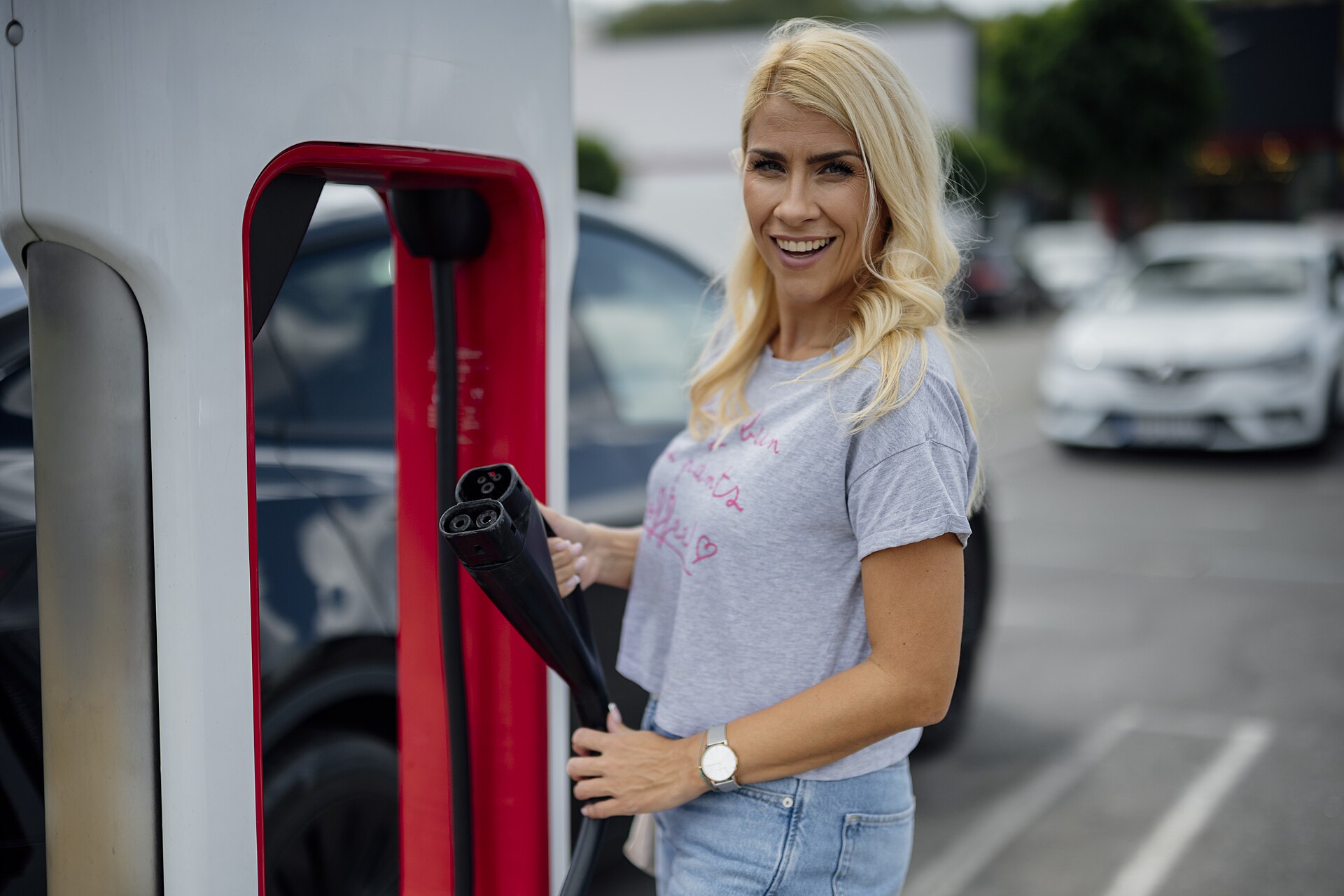
Batteries serve both mobile roles, such as electric vehicles, and stationary roles, such as utility-scale grid storage. They power portable electronics, transport from electric vehicles to ferries, grid-scale stationary storage, industrial backup power and implantable medical devices such as pacemakers and hearing aids. Lithium-ion batteries have enabled mobile phones and plug-in electric vehicles and are considered essential to a sustainable future in transportation and grid resiliency. Lithium-ion storage systems are growing in popularity because they can be installed nearly anywhere and have a small footprint, and the electric-vehicle market continues to drive down prices.
10. Grid-Scale Storage
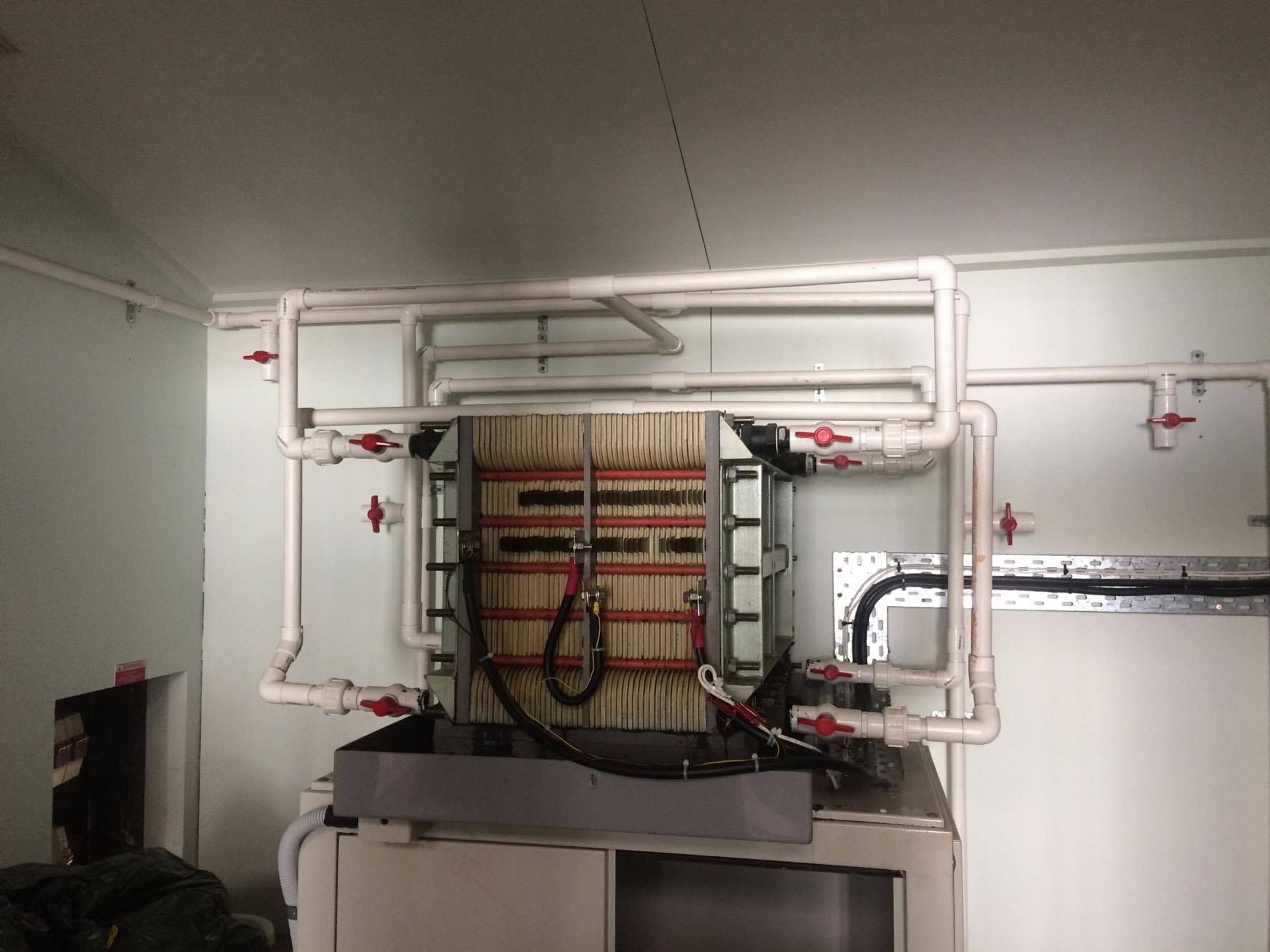
Most battery capacity operating in 2022 was installed after 2014; about 4,807 MW came in 2022 alone, and individual projects range up to the 409 MW Manatee Solar Energy Center in Florida. Large-capacity batteries can supply consistent power for several hours or more, while many battery systems also respond to demand fluctuations on sub-hourly timescales. Grid batteries balance supply and demand, move electricity from low-price to high-price periods in a strategy called arbitrage, and store renewable generation until it is needed.
11. Next-Generation Batteries
Next-generation designs including flow and solid-state batteries promise longer life between charges, better safety and reduced use of critical materials such as lithium. Solid-state batteries replace the liquid electrolyte with a solid, which makes them less prone to leakage from damage or swelling in hot temperatures.
12. Timeline: from Galvani's frogs to the lithium-ion age
- 1791Galvani's frog experimentsLuigi Galvani announced that contact of two different metals with the leg muscles of a skinned frog generated an electric current, which he interpreted as animal electricity.
- 1799Volta's first electrical batteryAlessandro Volta developed the first electrical battery, known as the voltaic cell or pile: two different metals immersed in a chemical solution.
- 20 March 1800Volta reports the pile to the Royal SocietyIn a letter to Joseph Banks, president of the Royal Society of London, Volta first reported the electric pile, the instrument that opened the age of continuous current.
- 1859Plante builds the first storage batteryGaston Plante produced the first electric storage battery, or accumulator, using lead sheets in dilute sulfuric acid; in improved form it is still used in automobiles.
- about 1866Leclanche invents his batteryGeorges Leclanche developed a battery with an ammonium chloride electrolyte, a zinc negative terminal and a manganese dioxide positive terminal; within two years Belgium's telegraph service adopted it.
- 1896The Columbia dry cell reaches the mass marketThe National Carbon Company marketed the sealed, six-inch, 1.5-volt Columbia battery, the first battery intended for widespread consumer use and the first sealed dry cell made on a large scale.
- 1972Whittingham moves to ExxonStanley Whittingham joined Exxon, where he worked on intercalation materials and developed the first functional lithium battery.
- 1976The first lithium battery is announced and patentedWhittingham announced his discovery, and Exxon patented a lithium-based battery; the cell began small-scale production for a Swiss clockmaker's solar-powered timepieces.
- 1980Goodenough's four-volt cobalt-oxide cathodeJohn Goodenough demonstrated that cobalt oxide with intercalated lithium ions could produce as much as four volts, an important breakthrough toward much more powerful batteries.
- 1985Yoshino builds the first commercially viable lithium-ion batteryAkira Yoshino used petroleum coke instead of reactive lithium in the anode, producing a lightweight, hardwearing battery that could be charged hundreds of times.
- 1991Lithium-ion batteries go on saleSony sold the first rechargeable lithium-ion battery, using Goodenough's lithium-cobalt oxide cathode and Yoshino's anode; computers and mobile phones still use the design.
- October 2019Nobel Prize in Chemistry for the lithium-ion batteryThe Royal Swedish Academy of Sciences awarded the 2019 Nobel Prize in Chemistry jointly to John B. Goodenough, M. Stanley Whittingham and Akira Yoshino for the development of lithium-ion batteries.
- 25 June 2023Goodenough dies at 100John B. Goodenough, the oldest person ever to win a Nobel Prize, died in Austin, Texas, at the age of 100.
References (20)
- 1Battery (electronics) - Composition, Types, & Uses — Encyclopaedia Britannica WebView source
- 2This Month in Physics History: March 20, 1800 - Volta Describes the Electric Battery — American Physical Society (APS News) 1800 WebView source
- 3Alessandro Volta - Biography, Facts, Battery, & Invention — Encyclopaedia Britannica WebView source
- 4Milestones: Volta's Electrical Battery Invention, 1799 — Engineering and Technology History Wiki (IEEE) 1799 WebView source
- 5Columbia Dry Cell Battery - National Historic Chemical Landmark — American Chemical Society WebView source
- 6Archives: History of IEEE Since 1984 - Technical Topics — Engineering and Technology History Wiki (IEEE) 1984 WebView source
- 7Gaston Plante - Battery inventor, Lead-acid cell, Electric storage — Encyclopaedia Britannica WebView source
- 8Batteries for Electric Vehicles — U.S. Department of Energy, Alternative Fuels Data Center WebView source
- 9Popular science background: They developed the world's most powerful battery — Nobel Prize Outreach (Royal Swedish Academy of Sciences) 2019 WebView source
- 10John B. Goodenough - Biography & Facts — Encyclopaedia Britannica WebView source
- 11Argonne's debt to 2019 Nobel Prize for lithium-ion battery — Argonne National Laboratory 2019 WebView source
- 12Charging Up the Development of Lithium-Ion Batteries — U.S. Department of Energy, Office of Science WebView source
- 13DOE Explains... Batteries — U.S. Department of Energy, Office of Science WebView source
- 14Breaking It Down: Next-Generation Batteries — U.S. Department of Energy, AMMTO WebView source
- 15Solar-Plus-Storage 101 — U.S. Department of Energy WebView source
- 16Energy storage for electricity generation — U.S. Energy Information Administration WebView source
- 17Batteries are a fast-growing secondary electricity source for the grid — U.S. Energy Information Administration (Today in Energy) WebView source
- 18Georges Leclanche - Battery inventor, Electrochemist & Chemist — Encyclopaedia Britannica WebView source
- 19The Nobel Prize in Chemistry 2019 - Press release — Nobel Prize Outreach (Royal Swedish Academy of Sciences) 2019 WebView source
- 20The Nobel Prize in Chemistry 2019 - Summary — Nobel Prize Outreach (Royal Swedish Academy of Sciences) 2019 WebView source