Narwhal
The story of the narwhal, the unicorn of the sea: the Arctic whale with a single spiralled tusk, its hidden anatomy and century-long life, its migrations under the pack ice, the Inuit hunt that still feeds northern communities, the ivory trade in its tooth, and the science and management now trying to keep its stocks alive.
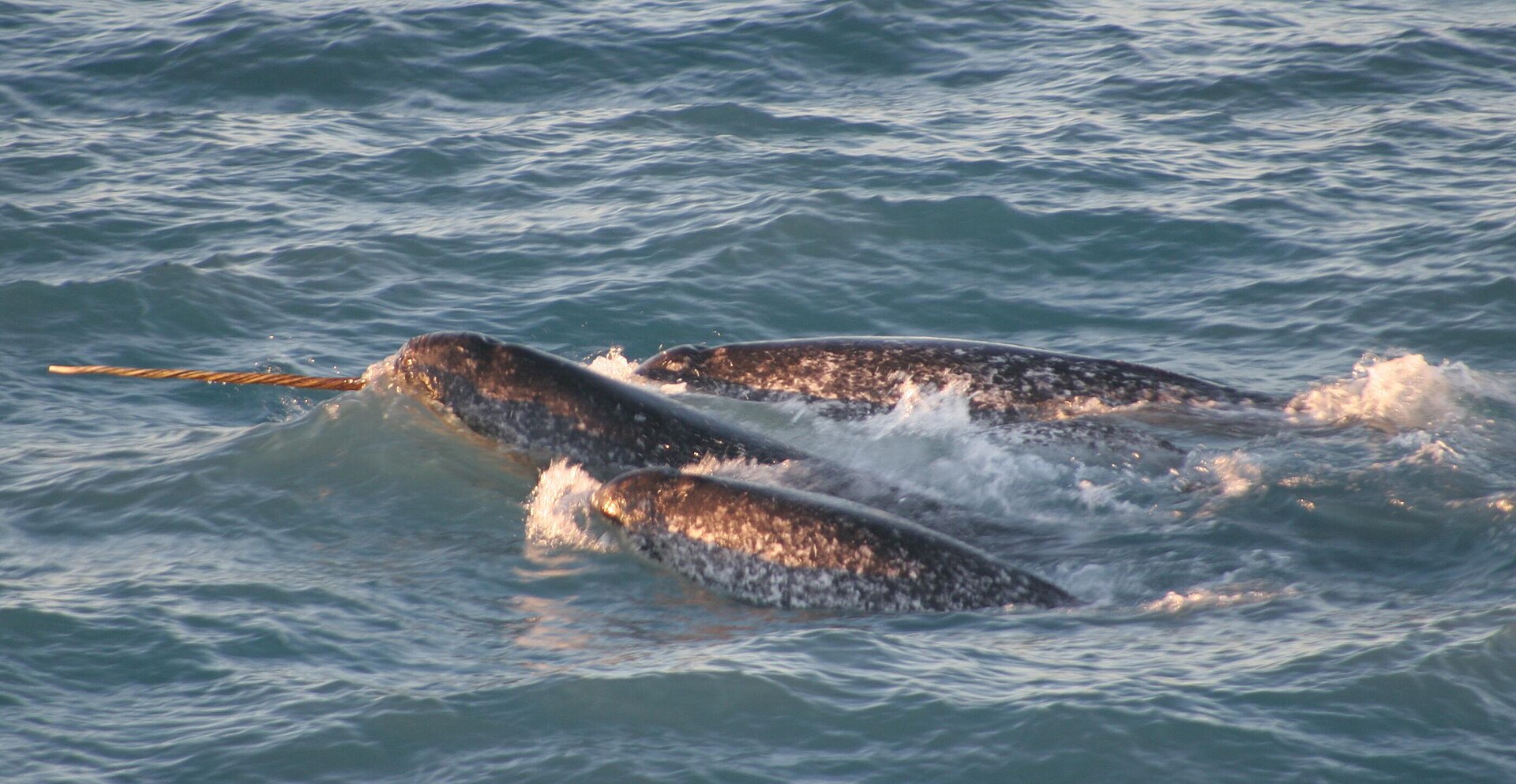
The narwhal (Monodon monoceros) is a medium-sized toothed whale of the family Monodontidae, whose only other living member is the beluga. It lives year-round in Arctic waters around Canada, Greenland, Svalbard and the Russian Arctic, feeding little in summer and heavily in winter on Greenland halibut, cod and squid taken in dives to 800 metres and more, some lasting 25 minutes. Males carry the famous tusk — a modified canine tooth that spirals left-handed and can exceed two metres — long prized as unicorn horn and still regulated under CITES. Narwhals can live for more than a hundred years and are among the few mammals that experience menopause. They are hunted by Inuit in Canada and Greenland under quotas and co-management; catches reported to NAMMCO's database reached 599 animals in Greenland in 2023. The species is listed as Least Concern globally, but several stocks — especially in East Greenland — are small and declining, and marine noise, shipping and sea-ice loss are growing pressures.
In this article
- 1Overview
- 2Taxonomy and Evolution
- 3Description
- 4Distribution and Habitat
- 5Behaviour and Ecology
- 6Reproduction and Lifespan
- 7Population and Stocks
- 8Conservation Status and Threats
- 9Hunting and Management
- 10Cultural and Historical Significance
- 11Timeline: from Museum Wormianum to zero-catch advice
- 12Knowledge graph
Overview
The narwhal is a medium-sized toothed whale and the sole living relative of the beluga within the family Monodontidae. Its scientific name, Monodon monoceros, was assigned by Linnaeus in 1758 and translates as the whale with one tooth and one horn, a direct reference to the animal's single tusk.
1. Taxonomy and Evolution
The narwhal is placed in the genus Monodon under the scientific name Monodon monoceros, described by Linnaeus in 1758. It belongs to the family Monodontidae, which contains only two living species: the narwhal and the beluga, Delphinapterus leucas. The two are distinguished in the skull, the narwhal having a relatively short rostrum and wide neurocranium, while the beluga has a more elongated and narrower cranium.
The two monodontids are not wholly isolated from one another reproductively. A narwhal-beluga hybrid skull known as a narluga was found at Disko Bay in Greenland in 1990 by researchers. At least 57 cases of hybridization have been described in cetaceans, of which 27 were natural and 30 in captivity. Narwhals also carry remarkably low genetic diversity, a pattern that suggests a population bottleneck in their recent history.
2. Description
The narwhal has a robust body and a small bulbous head with little or no beak, and it lacks a dorsal fin. Calves are about 1.60 m long and 80 kg at birth, while males can grow to 5.40 m and about 1935 kg. Females reach up to 4.94 m and about 1552 kg. Adult females can reach lengths up to 13.8 feet and 2,204 pounds, and adult males can reach 15.7 feet and 3,527.4 pounds. In a typical narwhal blubber makes up 30 to 35 percent of body weight, forming a layer 50 to 100 mm thick.
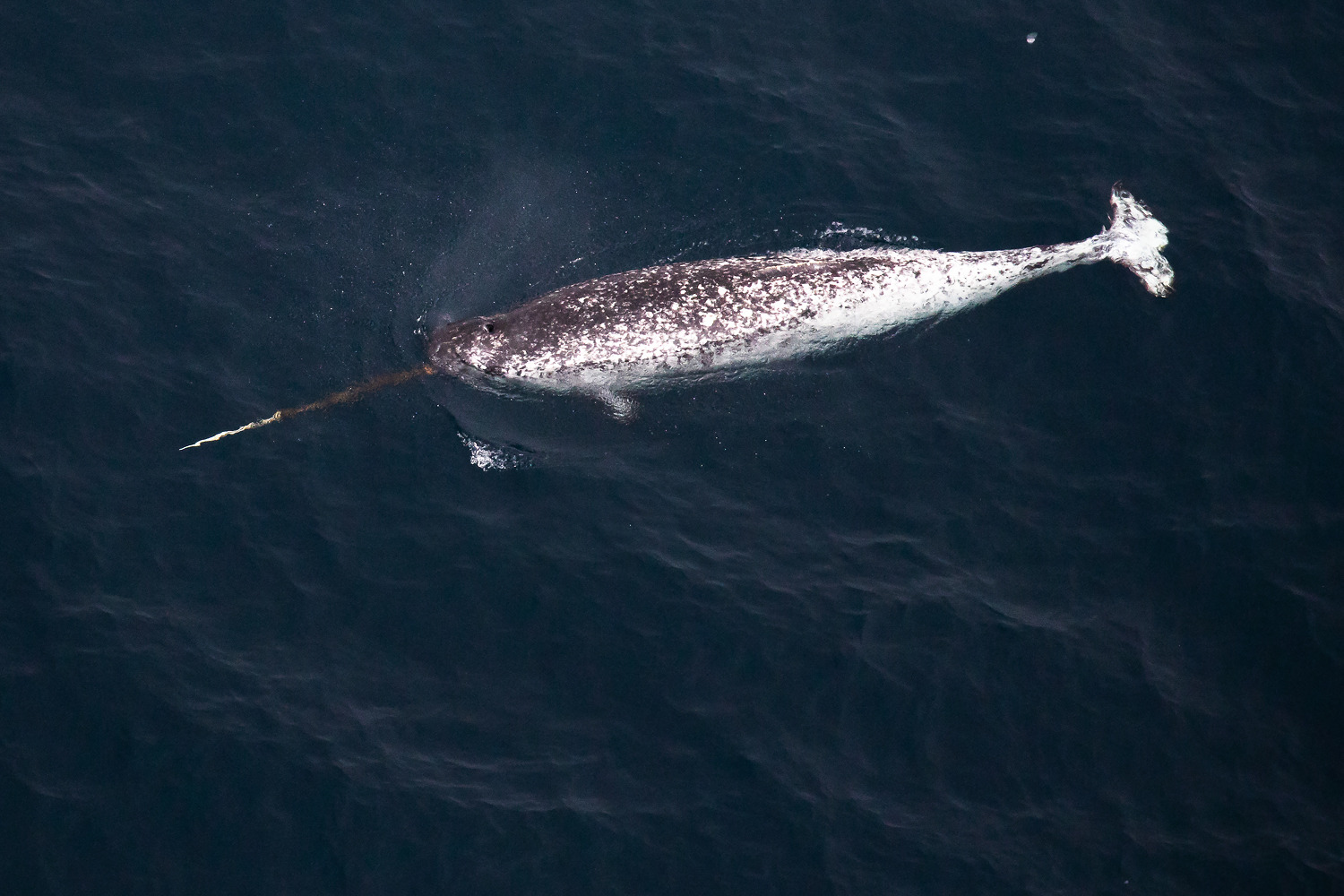
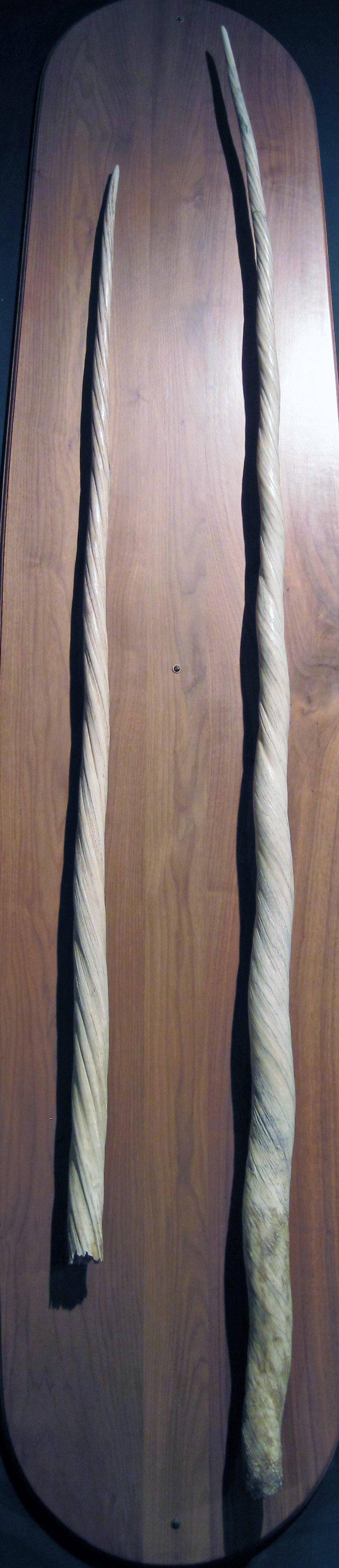
The tusk grows to more than 3 metres and is grooved on the surface in a left-handed spiral. Narwhal tusks are the only example of straight tusks in nature.
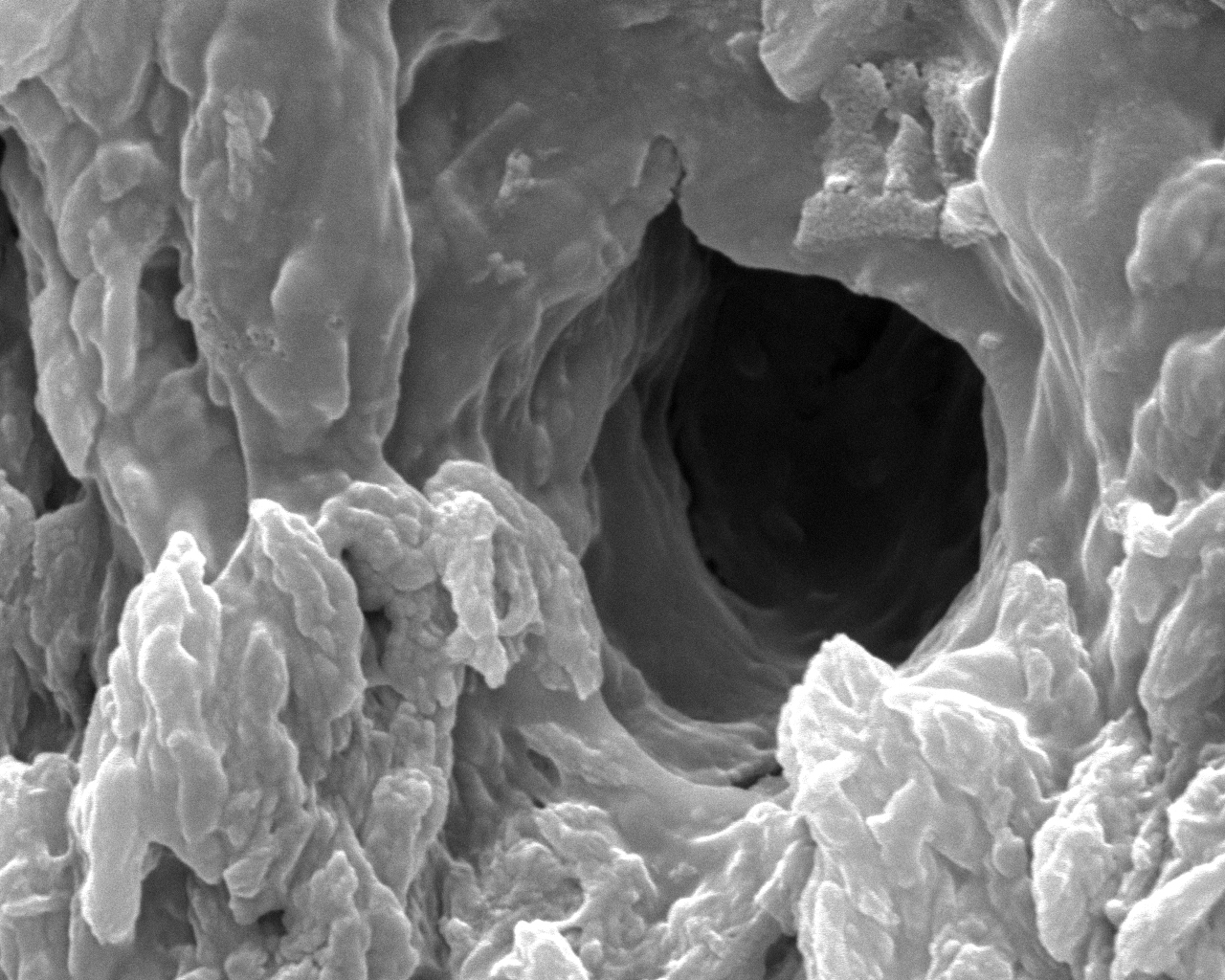
The macroscopic left-handed helix of the tusk is reproduced from mineralized collagen arranged in a molecular double helix of opposite chirality. Cementum has a left-hand helix of collagen fibrils while dentine has a right-hand arrangement across annual growth layers. The spiral pattern of the narwhal tusk is determined by the angular parameters of the arcs of the cementum layer, and the mean tangent of the angle of inclination of the spiral arcs is 2.39 in the study sample. The orientation of the twisting is oblique, indicating elongation of the spiral along the long axis of the tusk. Examination of the tusk revealed about ten million nerve endings, suggesting some sort of sensory function. In 2014 researchers discovered that the tusk is a sensory organ, and in 2017 drone footage showed narwhals stunning fish with the tusk before eating them.
3. Distribution and Habitat
Narwhals are most numerous in the eastern Canadian Arctic and along the coasts of Greenland, and they also occur in northern Svalbard and Franz Josef Land. Twelve populations are recognised on the Atlantic side of the Arctic Ocean, distributed across Canada, Greenland, Norway and Russia. In winter they reside in very heavy consolidated pack ice, using leads or polynyas to breathe. In Svalbard the species is protected, and although catches in its waters were recorded they were never in large numbers. Between 45,000 and 50,000 narwhals from the Baffin Bay population may summer in Canadian waters.
The narwhal has recently appeared more frequently in the eastern Beaufort Sea, west of its normal range. During the last Ice Age the species was restricted to the North Atlantic, and it spread across the Arctic as the ice retreated.
4. Behaviour and Ecology
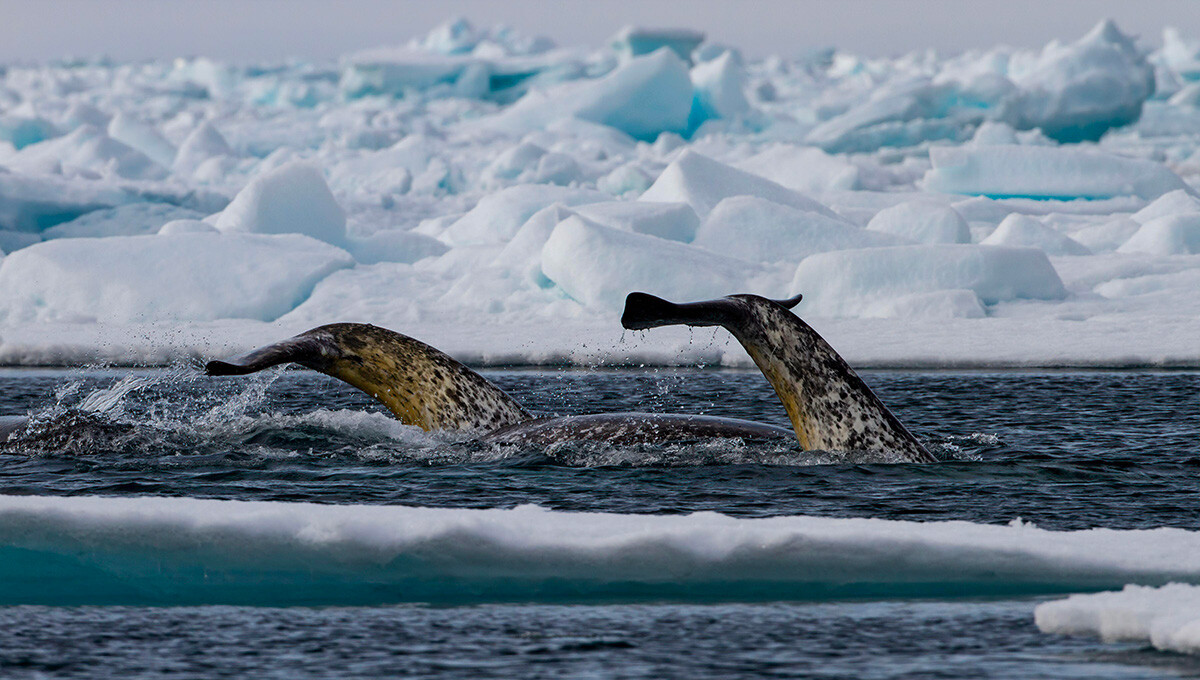
Narwhals feed on Greenland halibut, Arctic and polar cod, squid and shrimp, with heavy feeding concentrated in late autumn and winter on Gonatus squid and Greenland halibut; the composition of the diet differs regionally between populations, and little feeding occurs during summer. Winter diving brings them to the ocean bottom in deep water, with 5 to 25 dives per day to depths of 800 metres or more and repeated dives between 800 and 1,600 m. Maximum dive depths reach up to about 1,500 m, with dives of 25 to 30 minutes, though sources differ on dive duration.
Narwhals usually travel in groups of 15 to 20 animals, and herds of several thousand have been recorded. When threatened they move close to land or ice and form tight groups. Apart from humans, polar bears and killer whales are their dominant predators. They communicate through echolocation using clicks, whistles and pulsed calls, with recorded maximum amplitudes at 48kHz.
In summer narwhals migrate from Baffin Bay to northeastern Canada and northwest Greenland, where Inuit hunt them for subsistence. Wintering and summering areas may lie about 1,000 km or more apart. Because they must wait for cracks in the ice before moving far from open water, the spring migration is much slower than the autumn migration.
5. Reproduction and Lifespan
Mating in the narwhal takes place in May and June, and the calf is born the following year once the female has carried it for 11 to 15 months. Females reach sexual maturity between the ages of 7 and 9 and on average produce a single calf every 3 years. The species is among the few mammals known to undergo menopause. Narwhals are long-lived, with the longest-lived individuals possibly reaching between 105 and 125 years.
6. Population and Stocks
The 2017 Global Review recognized 12 narwhal stocks and compared the list with those of previous reviews. The High Arctic Cetacean Survey of August 2013 — the first survey to estimate all four Canadian Baffin Bay narwhal summer stocks in the same summer — returned the most recent abundance estimate for the Somerset Island stock, the largest, of 49,768 narwhals, and estimated 141,908 narwhals across six Canadian High Arctic stocks, with a 95% confidence interval of 102,464 to 196,536. A 2017 estimate put the global population at approximately 85,000 to 100,000 animals. The Baffin Bay population is estimated at 60,000 to 80,000 narwhals, while the Hudson population is about 5,000 animals.
7. Conservation Status and Threats
The narwhal is assessed on the IUCN Red List as Least Concern, a status assigned in 2017. Populations nonetheless carry high levels of some pollutants and heavy metals such as mercury, which can affect the health of populations.
Tagged narwhals altered their diving and foraging in response to ship sounds and seismic airgun pulses, showing extreme sensitivity to human-made noise. In one study six male narwhals were tagged in Scoresby Sound in East Greenland and their acoustic data analysed. Satellite-tagging studies of narwhals in Canada and West Greenland were initiated in 1993 and have been ongoing since then.
8. Hunting and Management
Hunting is the most apparent man-made pressure on marine mammals in the NAMMCO region, and whaling and sealing remain a reality for many northern coastal communities where marine mammals are abundant and other resources are scarce. Struck and lost animals are included in NAMMCO hunting statistics as known or estimated values. Loss estimates from community-based hunts suggest that at least 19 and perhaps as many as 46 narwhals are lost for every 100 landed. In 2008 more than 600 narwhals were caught in the ice in Eclipse Sound and 629 were harvested.
The Canada/Greenland Joint Commission on the Conservation and Management of Narwhal and Beluga manages shared stocks, while the NAMMCO-JCNB Joint Scientific Working Group has developed a catch-allocation model to assign narwhal catches to stocks. Quotas were introduced in 2004 for West Greenland and in 2008 for East Greenland. The Government of Greenland sets quotas based on user knowledge, cultural and meat needs, and advice from the JCNB and NAMMCO. Scientific advice for West Greenland in 2022 allocated the highest catch levels to Uummannaq with 123 narwhals and 54 narwhals to Disko Bay. The 2024 quotas included 88 animals for Qaanaaq and 154 for Uummannaq. Greenland plans to bring narwhal and beluga into its new digital reporting system, prepared in 2025 for implementation the following year. In 2025 Greenland reported a narwhal catch of 400 against a total quota of 665 animals. In 2019 the NAMMCO Scientific Committee recommended that catches in all management areas in East Greenland be reduced to zero. NAMMCO member countries report catch numbers for a given year by 1st February of the following year.
Narwhals have been listed on CITES Appendix II since 1979 and exports need permits and tusks exportable only after a non-detriment finding. The uncarved tusk with a broken tip sold for between USD925 and USD2,900 on the international market. Operation Longtooth involved approximately 250 narwhal tusks legally purchased in Canada and smuggled to the United States. Tusks counted in international trade from 2005 to 2009 imply a minimum of 1,142 narwhals, an average of 228 tusks per year. Global landings averaged 979 narwhals per year from 2007 to 2011 (621 in Canada and 358 in Greenland. Canadian landings from 1988 through 2001 averaged 327 narwhals annually from the Baffin Bay population and 40 from the Hudson Bay population. In 2002 the annual harvest limit for Repulse Bay was reduced from 100 to 72 narwhals. The United States Marine Mammal Protection Act of 1972 prohibited the import of narwhal parts.
9. Cultural and Historical Significance
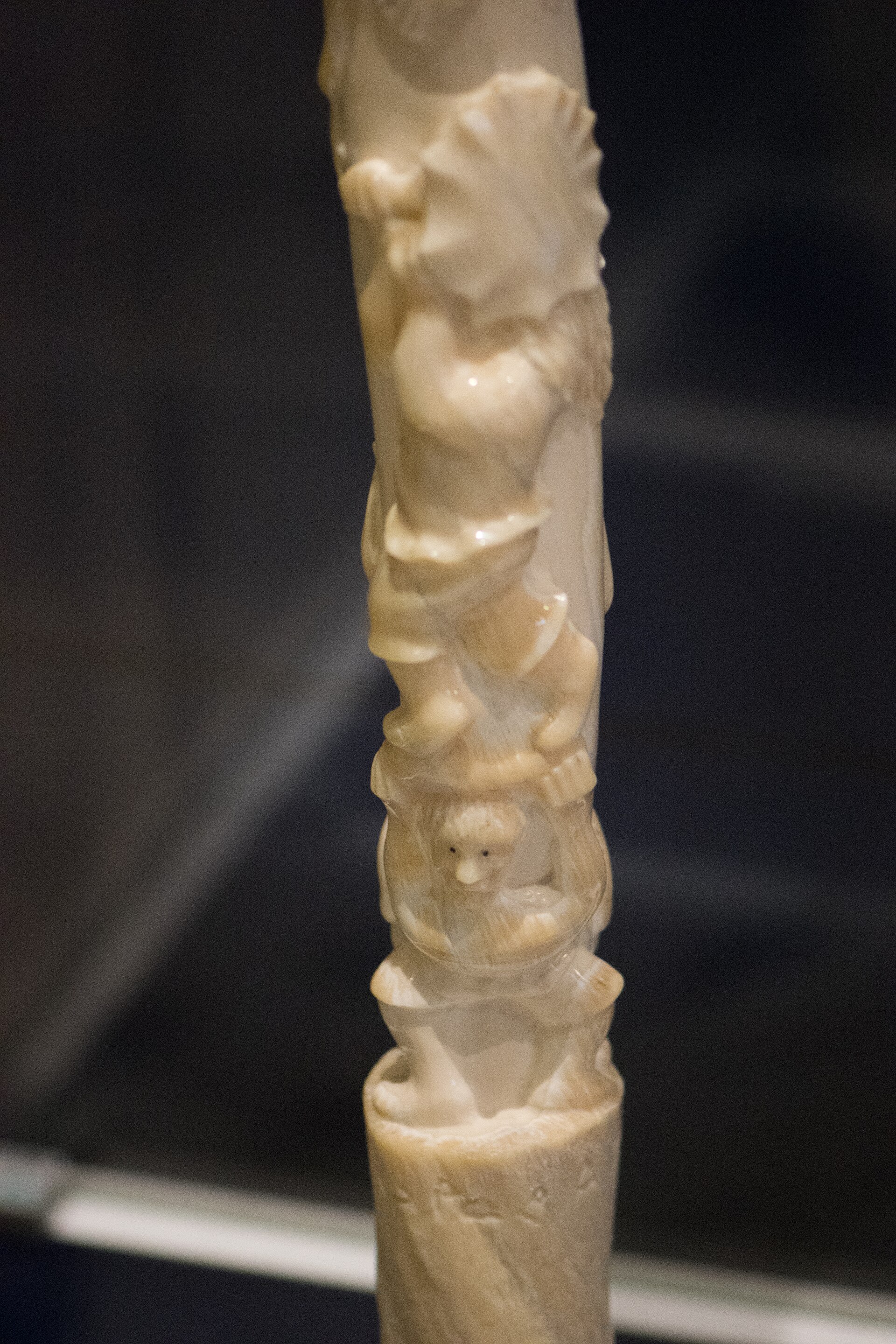
Hunted narwhals supplied more than their tusks: their blubber and oil were used for lighting, heating and cooking, while sinews served as thread. King Frederik III of Denmark-Norway ordered a coronation chair made entirely from narwhal tusks, completed in 1671 as a sign of power and status. Ole Worm's Museum Wormianum of 1655 describes skulls of a marine unicorn and concludes that unicorn horns must come from narwhals.
10. Timeline: from Museum Wormianum to zero-catch advice
- 1655Museum Wormianum on the marine unicornIn his Museum Wormianum Ole Worm described skulls of a marine unicorn and concluded that unicorn horns must come from narwhals.
- 1671A coronation chair of narwhal tuskKing Frederik III of Denmark-Norway had a coronation chair made entirely from narwhal tusks finished in 1671 as a sign of power and social status.
- 1758Linnaeus names the narwhalCarl Linnaeus published the scientific name Monodon monoceros in the 1758 edition of his work.
- 1949Greenland catch reporting beginsOfficial catch reporting for narwhals in Greenland began in 1949; before catch limits were introduced at Uummannaq in 2004 hunters took up to 1,000 animals in some years.
- 1972United States bans narwhal importsThe United States Marine Mammal Protection Act of 1972 prohibited the import of narwhal parts.
- 1979CITES Appendix II listingThe narwhal was listed on Appendix II of CITES, so exports of narwhal parts and derivatives require permits.
- 1990Narluga skull found at Disko BayA narwhal-beluga hybrid skull, known as a narluga, was found at Disko Bay in Greenland in 1990 by researchers from the Greenland Institute of Natural Resources.
- 1993Satellite tagging beginsSatellite-tagging studies of narwhals in both Canada and West Greenland were initiated in 1993 and have been ongoing since then.
- 2004West Greenland quotas introducedQuotas for narwhals were introduced in 2004 for West Greenland, with East Greenland following.
- 2006Greenland bans narwhal product exportsGreenland installed a ban in 2006 on all exports of narwhal products.
- November 2008Pond Inlet ice entrapmentIn November 2008 more than 1,000 narwhals were trapped in ice near Pond Inlet, Nunavut; all eventually died, most of them harvested by local Inuit.
- August 2013High Arctic Cetacean SurveyThe High Arctic Cetacean Survey of August 2013 was the first survey to estimate abundance of all four Canadian Baffin Bay narwhal summer stocks in the same summer.
- 2014The tusk shown to be a sensory organResearchers discovered in 2014 that the narwhal tusk is a sensory organ that can detect changes in the water around the animal.
- 2017Least Concern assessmentThe IUCN Red List assessment of 2017 listed the narwhal as Least Concern globally.
- 2019Zero-catch recommendation for East GreenlandThe NAMMCO Scientific Committee recommended that catches in all management areas in East Greenland be reduced to zero.
References (20)
- 1Narwhal — North Atlantic Marine Mammal Commission (NAMMCO) WebView source
- 2Skull ecomorphological variation of narwhals (Monodon monoceros, Linnaeus 1758) and belugas (Delphinapterus leucas, Pallas 1776) reveals phenotype of their hybrids — PLoS One (PMC9374245), PubMed Central 1758 WebView source
- 3Narwhal — WWF Global Arctic Programme WebView source
- 4Report of the NAMMCO Global Review of Monodontids (2018) — North Atlantic Marine Mammal Commission (NAMMCO) 2018 WebView source
- 5Narwhal — NOAA Fisheries (National Oceanic and Atmospheric Administration) WebView source
- 6COSEWIC assessment and status report: Narwhal (Monodon monoceros) — chapter 2, Executive Summary — COSEWIC / Environment and Climate Change Canada WebView source
- 7Monodon monoceros (narwhal) — Animal Diversity Web, University of Michigan Museum of Zoology WebView source
- 8Narwhal (Monodon monoceros) — Encyclopaedia Britannica WebView source
- 9The narwhal tusk assembles its macroscopic helix from building blocks with opposing twists — Nature Communications (PMC13486480), PubMed Central WebView source
- 10Data on the angular characteristics of the spiral structure of the narwhal tusk — Data in Brief (PMC6157606), PubMed Central WebView source
- 11Narwhal (Monodon monoceros) — Whale and Dolphin Conservation (WDC) WebView source
- 12Narwhal — Norwegian Polar Institute WebView source
- 13Narwhal Behaviours — WWF Global Arctic Programme WebView source
- 149 December 2020: New Article on Narwhal Abundance in the Canadian High Arctic — North Atlantic Marine Mammal Commission (NAMMCO) 2020 WebView source
- 15Narwhal — Hinterland Who's Who (Environment and Climate Change Canada / Canadian Wildlife Federation) WebView source
- 1616 August 2023: New Paper — Stuck in a corner: Anthropogenic noise threatens narwhals in their once pristine Arctic habitat — North Atlantic Marine Mammal Commission (NAMMCO) 2023 WebView source
- 17COSEWIC assessment and status report: Narwhal (Monodon monoceros) — chapter 8, Limiting Factors and Threats — COSEWIC / Environment and Climate Change Canada WebView source
- 18Greenland — Progress Report on Marine Mammals 2024 — NAMMCO / Greenland Institute of Natural Resources 2024 WebView source
- 19Marine Mammal Catch Database — North Atlantic Marine Mammal Commission (NAMMCO) WebView source
- 20Breaking the Ice: International Trade in Narwhals, in the Context of a Changing Arctic — WWF (TRAFFIC/WWF report) WebView source