Norse mythology
The gods, worlds, and stories of pre-Christian Scandinavia — from Odin and Thor to Yggdrasil and Ragnarök — and the Eddas that preserve them.
Norse mythology is the body of stories about the gods, giants, and worlds of pre-Christian Scandinavia, upheld during and around the Viking Age (about 790-1100 CE). Its chief sources are the Poetic Edda, a collection of mythological and heroic poems recorded in the 13th-century Codex Regius, and the Prose Edda of the Icelandic chieftain Snorri Sturluson, probably written in 1222-23. The myths describe the creation of the world from the giant Ymir, the nine worlds linked by the ash tree Yggdrasil, the Æsir and Vanir gods led by Odin and including Thor, Freyja, and Loki, and the destruction and rebirth of the world at Ragnarök.
In this article
- 1Overview
- 2Sources and Transmission
- 3The Poetic Edda and Codex Regius
- 4The Prose Edda and Snorri Sturluson
- 5Snorri Sturluson: Life
- 6The Codex Regius: Provenance
- 7Thor
- 8The Theft of Mjölnir
- 9Loki and Baldr
- 10Cosmology: Yggdrasil and the Nine Worlds
- 11Creation
- 12Ragnarök and the World to Come
- 13Worship and Survivals
- 14Days of the Week
- 15Timeline: from Tacitus to heimskringla.no
- 16Knowledge graph
Overview
Norse mythology is the Scandinavian mythological framework upheld during and around the time of the Viking Age, conventionally about 790 to 1100 CE. Its pantheon was polytheistic and headed by the one-eyed Odin, with many gods and goddesses venerated in customs integrated into daily life. The closest concept the Old Norse language had to religion was síður, meaning 'custom', a term that reflects how deeply the mythology was woven into the lives of the Vikings.
1. Sources and Transmission
The written record of Norse mythology rests on material that circulated orally long before it was set down, and knowledge of the Vikings' early beliefs is a patchwork quilt of information from many places, periods and people, often from a completely different background. The fullest and most detailed source for modern knowledge of Germanic mythology is the Edda, the body of ancient Icelandic literature contained in two 13th-century books commonly distinguished as the Prose, or Younger, Edda and the Poetic, or Elder, Edda. Because both Eddas were written by Christian historical writers, the sources do not always show how the Vikings saw the Nordic gods, but more how Christians perceived them.
Its remaining section, Gylfaginning ('The Beguiling of Gylfi'), describes in dialogue the visit of Gylfi, a king of the Swedes, to Asgard, the citadel of the gods.
The poems of the Elder Edda present a different problem of authorship: scholars do not know who composed the Eddaic poems, or when or where they were composed, and are not certain what an 'Edda' is. Icelandic tradition persisted in ascribing the Edda to Snorri's much earlier compatriot, Sæmund the Wise.
2. The Poetic Edda and Codex Regius
The Poetic Edda is a body of verse in which gods such as Odin and Baldr appear alongside legendary heroes, and it is best known from the manuscript Codex Regius, which preserves the twenty-nine poems of the collection.
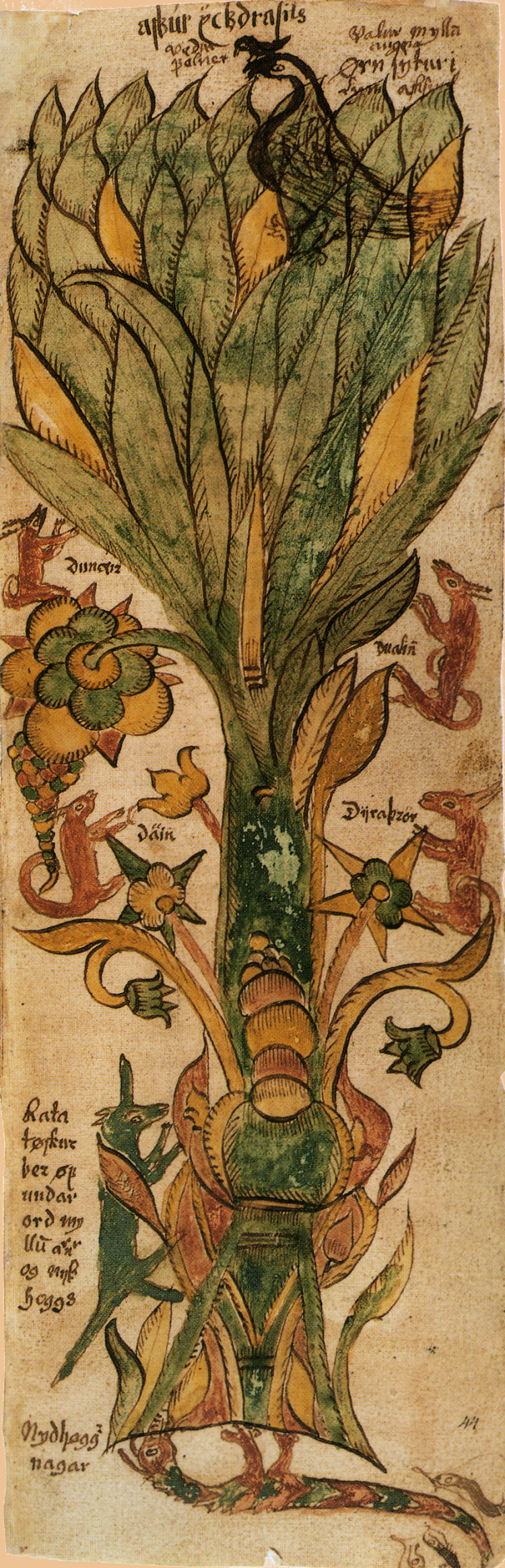
Among the poems of the collection, the Hávamál gives Odin's own account of his ordeal: he says that he hung on the windy tree for nights full nine, wounded with a spear and offered to himself. That windy tree is the ash Yggdrasil, on which Odin, in order to win the magic runes, hanged himself as an offering to himself, and wounded himself with his own spear. The world-ash is the tree of the nine worlds, its branches extending across the world while its roots reach various realms: one to Midgard, one to Utgard, home of the giants, and a third to Nifelhel, where Hel resides. Odin is the one-eyed Allfather, who sacrificed an eye in order to see everything that happens in the world. He is aided by several animals: his two ravens, Huginn and Muninn, fly across the world and report back what they have seen, and Geri and Freki are his wolves.
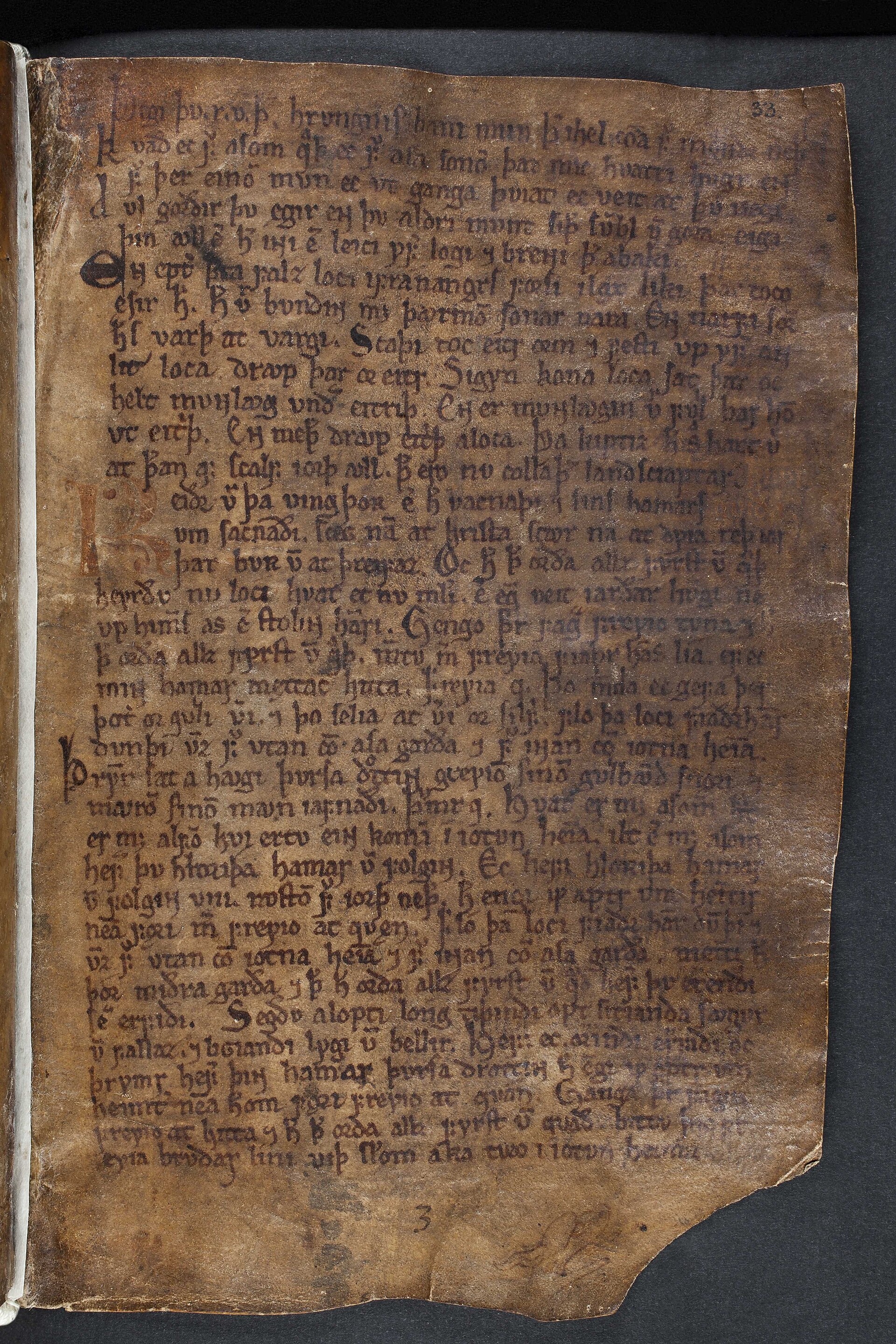
In the Völuspá the seeress first tells of the past: the creation of the world, the beginning of years, the origin of the dwarfs, the first man and woman, the world-ash Yggdrasil, and the first war between the gods and the Vanir. She recalls nine worlds in the tree with mighty roots beneath the mold. The poem closes on renewal: a new and beautiful world is to rise on the ruins of the old; Baldr comes back, and 'fields unsowed bear ripened fruit'.
3. The Prose Edda and Snorri Sturluson
In the Gylfaginning account of the beginning of things, the streams called Ice-waves carried yeasty venom that hardened like the slag from a fire and became ice, and when the ice halted and ceased to run it froze over above. Straightway after the rime dripped there sprang from it the cow called Audumla; four streams of milk ran from her udders, and she nourished Ymir. When the Æsir enticed Fenris-Wolf to take upon him the fetter Gleipnir, the wolf would not believe they would loose him until they laid Týr's hand into his mouth as a pledge. Angrboda was a giantess in Jötunheim with whom Loki had three children: the Fenris-Wolf, Jörmungandr, the Midgard Serpent, and Hel.
4. Snorri Sturluson: Life
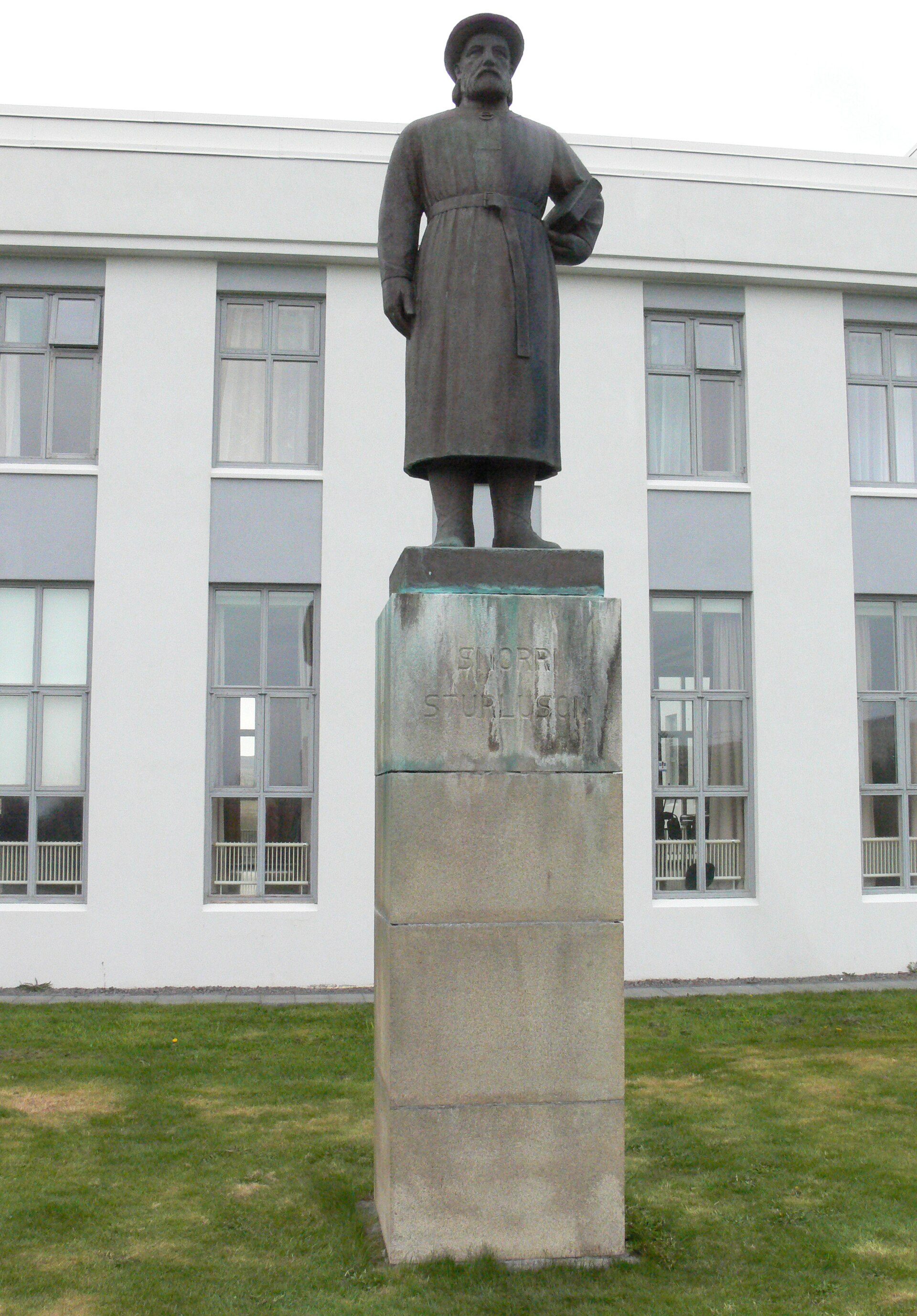
Snorri Sturluson was an Icelandic poet, historian, and chieftain, and the author of the Prose Edda and the Heimskringla. The Prose Edda, his textbook on poetics, was written in about 1222 and 1223, intended to provide for a Christian age an understanding of the mythological subjects of early poetry.
-
1179Birth at HvammurSnorri Sturluson was born at Hvammur in Iceland.10Snorri Sturluson | Icelandic writer · Encyclopaedia Britannica ↗
-
1220Return to IcelandSnorri returned to Iceland.10
-
after 1220Relations with Haakon deteriorateIn the years following his return, his relations with Haakon deteriorated.10
-
22 September 1241Assassination at ReykjaholtSnorri was assassinated by Haakon's order at Reykjaholt.10
5. The Codex Regius: Provenance
The Codex Regius is the oldest collection of its kind, the best-known of all Icelandic books, and an Icelandic national treasure; the vellum manuscript dates from about 1270 CE.
-
about 1270 CEThe vellum manuscriptThe vellum manuscript dates from about 1270 CE.11Codex Regius | Old Norse, Poetic Edda, Saga · Encyclopaedia Britannica ↗
-
1643Into the possession of Bishop Brynjólfur SveinssonWhen it came into the possession of Bishop Brynjólfur Sveinsson in 1643 the manuscript was missing 8 pages and consisted of just 45 pages.11
-
1662Sent to King Frederik III of DenmarkSveinsson sent the manuscript to King Frederik III of Denmark, and it stayed in Copenhagen's Royal Library until 1971.11
-
1971Returned to IcelandThe manuscript was returned to Iceland.11
6. Thor
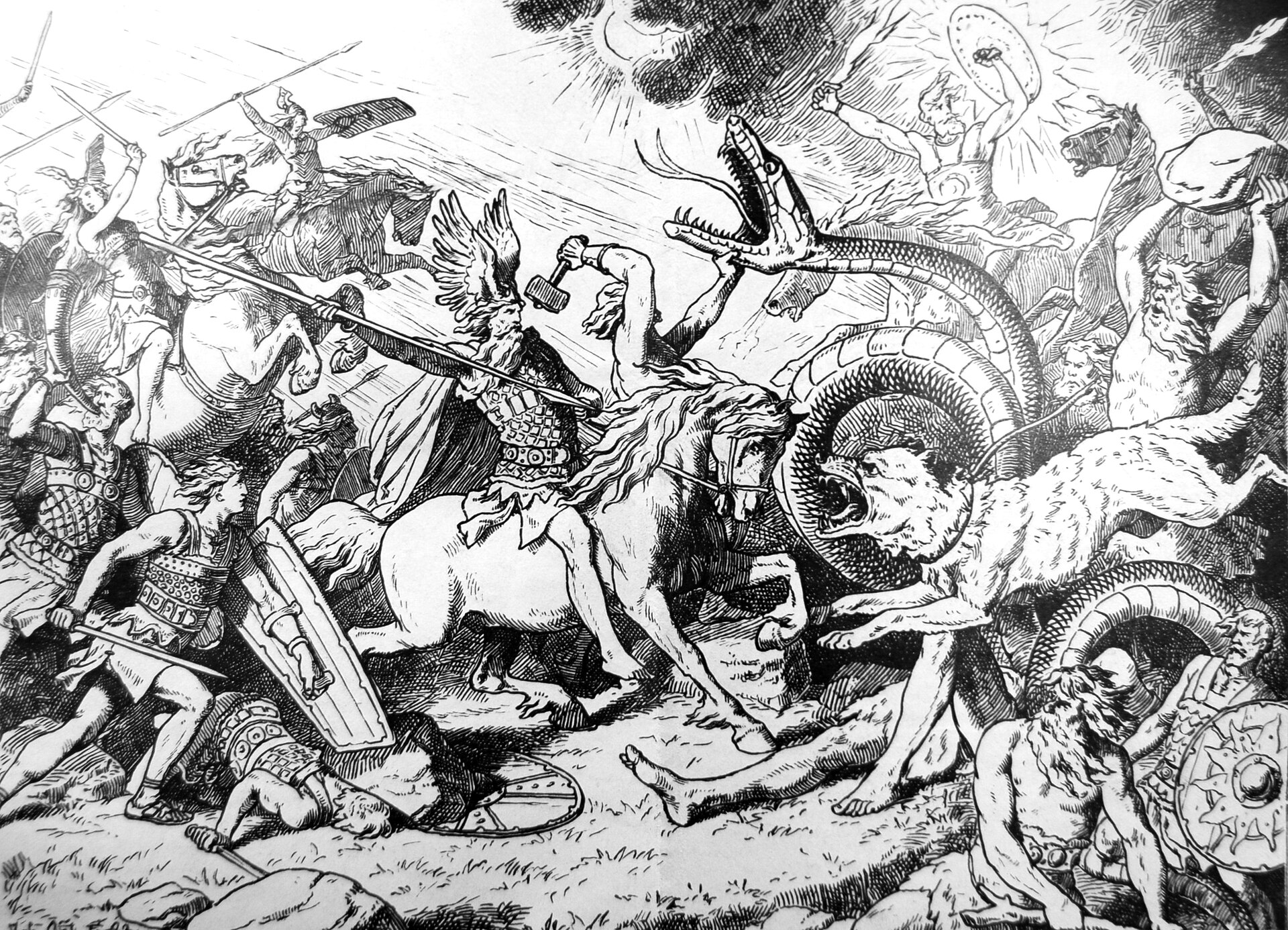
Thor is often called 'the Thunderer' for he commands thunder and lightning; he is also the god of farmers and free men, known for his fiery temper, red hair and thick, bushy brows. Thor is doomed to die at the Ragnarök, but falls only after killing the great serpent with his hammer Mjollnir, dying to its poison; his sons Magni and Modi survive and inherit the hammer. His three magical treasures were his hammer Mjollnir, his belt of strength Megingjörð, which doubled his strength when he wore it, and his great iron gloves which he needed to wield the hammer.
7. The Theft of Mjölnir
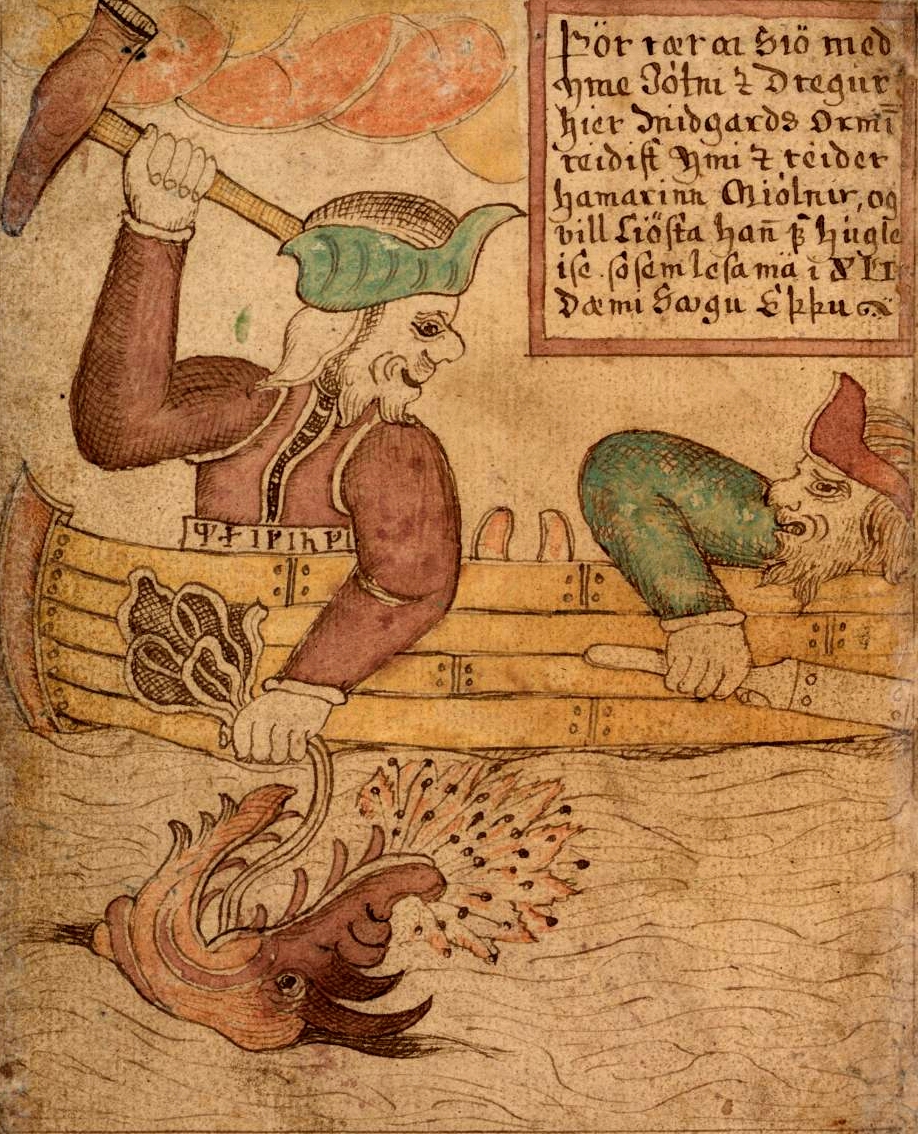
The legend of Thor's hammer tells that the giant Thrym once stole Mjölnir and buried it deep beneath the earth, leaving the gods and their whole world under threat. Heimdall suggested that Thor disguise himself in bridal attire with Freyja's necklace Brísingamen and go in her stead, and Loki accompanied him as bridesmaid. When Mjölnir was finally laid in the bride's lap, Thor revealed himself and brought the hammer crashing down upon the skulls of all the giants.
8. Loki and Baldr
Loki was a sworn brother of Odin, yet his name has many negative connotations because of his deceitful nature and his hand in the death of Baldr, which set in motion the coming of the Ragnarök. In the myth, Loki handed the blind god Hodr a mistletoe arrow, which Hodr unintentionally killed his brother Baldr with. Loki's surprising absence from Saxo Grammaticus' Gesta Danorum might indicate that he was more of a regional feature than an omnipresent figure in the Germanic world. In the Prose Edda the god Hermodr undertakes a desperate journey into the Underworld to ask its mistress, Hel, to let Baldr return.
9. Cosmology: Yggdrasil and the Nine Worlds
According to mythology there are nine worlds connected by the mighty tree Yggdrasil, among them Asgard, Vanaheim, Midgard, Jotunheim, Alfheim, Svartalfheim, Muspelheim and Nifelheim. The World Tree Yggdrasil stands in the gods' realm of Asgard. Norse mythology distinguishes two types of gods: the Aesir, who live in Asgard and are led by Odin, and the Vanir, associated with nature, vegetation and fertility. At the base of Yggdrasil lies Urd's well, where the three norns — Urd, Verdandi, and Skuld, representing the past, present and future — watch over human destinies. Around the world lies a great ocean containing the serpent Jörmungandr, which bites its own tail; it grew so large that any significant movement causes earthquakes.
10. Creation
According to Snorri, before anything else existed there were the opposing realms of icy Niflheim and fiery Muspelheim, separated by the empty void Ginnungagap. The Nordic mythological world includes a creation myth in which the first gods slay a giant and turn his body parts into the world. Forests, mountains, lakes, and stars all originate from the giant Ymir: his skull is the sky, his bones mountains, his flesh earth, his hair trees and grass, and his blood water. The first humans were given names: the male was called Askr and the female Embla, and of them mankind was begotten, receiving a dwelling-place under Midgard.
11. Ragnarök and the World to Come
Ragnarök, also given as Ragnarokkr ('Twilight of the Gods'), is the pivotal event that ends the mythic cycle beginning with the birth of the gods of Asgard and the creation of the Nine Realms. Traditionally, since the 13th century, Ragnarök has been understood as the end of the Nine Realms through dramatic climate changes, the breakdown of traditional values, and a final battle. Norse myth describes four phases of the world: creation, a dynamic phase in which time begins, destruction of the world at the Ragnarök, and the arising of a new world from the sea. Odin gathers slain warriors around him in Valhalla, his hall of the slain, and is eventually killed by the wolf Fenrir at the Ragnarök. Fighters slain in battle were collected by Odin's female handmaidens, the valkyries.
12. Worship and Survivals
There is evidence that the Nordic gods were worshipped as early as the Iron Age, at least 300 years before the beginning of the Viking period, with gold bracteates depicting Týr and Baldr.
Many think the old Nordic religion disappeared with the introduction of Christianity, but it survived, and today between 500 and 1000 people in Denmark believe in it and worship its ancient gods. Modern believers in the old Nordic religion meet in the open air just as the Vikings did, praising the gods, making offerings and honouring them with toasts and feasts.
13. Days of the Week
The names of the Nordic gods survive in the days of the week: Tuesday is Týr's day, Wednesday Odin's day, Thursday Thor's day and Friday either Frigg's or Freyja's day.2The old religion · National Museum of Denmark ↗
| Day of the week | God commemorated |
|---|---|
| Tuesday | Týr |
| Wednesday | Odin |
| Thursday | Thor |
| Friday | Frigg or Freyja |
14. Timeline: from Tacitus to heimskringla.no
- c. 98 CETacitus describes Germanic religionTacitus provided a lucid picture of the customs and religious practices of continental Germanic tribes in his Germania.
- c. 550 CEJordanes compiles the GeticaThe Getica, a history of the Goths by Jordanes, incorporates records of Gothic tradition and remarks about the gods the Goths worshipped.
- c. 800-1100 CEEddaic poems composedThe mythological and heroic poems of the Poetic Edda were composed over a long period, centuries before they were recorded in manuscripts.
- c. 1070 CEUppsala temple describedA great temple at Uppsala in Sweden housed images of Thor, Odin, and Freyr, to whom sacrifices were made in times of famine or disease, war, or weddings.
- 1179Snorri Sturluson bornSnorri Sturluson was born at Hvammur, Iceland, and would become the author of the Prose Edda and the Heimskringla.
- c. 1222-23Prose Edda writtenSnorri Sturluson wrote the Prose Edda, a handbook on poetics that preserves the Norse myths for a Christian age.
- 22 September 1241Death of Snorri SturlusonSnorri was assassinated at Reykjaholt by order of King Haakon of Norway.
- c. 1270Codex Regius writtenThe vellum manuscript Codex Regius, containing 29 poems of the Poetic Edda, dates from about 1270.
- 1643Codex Regius discoveredBishop Brynjólfur Sveinsson obtained the manuscript, which was already missing 8 of its pages.
- 1662Codex Regius sent to DenmarkSveinsson sent the manuscript to King Frederik III, and it entered the Royal Library in Copenhagen.
- 1971Codex Regius returns to IcelandThe manuscript was among the first documents of a vast body of Icelandic material returned to Iceland; it is now housed in the Árni Magnússon Institute.
- 1 August 2005heimskringla.no opens to the publicThe 'Norrøne Tekster og Kvad' project, making Old Norse literature freely accessible online, was opened to the public.
References (20)
- 1Norse Mythology — World History Encyclopedia WebView source
- 2The old religion — National Museum of Denmark Web↩View source
- 3Edda | Icelandic literature — Encyclopaedia Britannica WebView source
- 4The Poetic Edda: General Introduction (trans. Henry Adams Bellows) — Internet Sacred Text Archive WebView source
- 5The Poetic Edda: Hovamol (trans. Henry Adams Bellows) — Internet Sacred Text Archive WebView source
- 6The mythological world of the Vikings — Swedish History Museum (Historiska museet) WebView source
- 7Odin – leader of the gods — Swedish History Museum (Historiska museet) WebView source
- 8The Poetic Edda: Voluspo (trans. Henry Adams Bellows) — Internet Sacred Text Archive WebView source
- 9The Prose Edda: Gylfaginning (trans. Arthur Gilchrist Brodeur) — Internet Sacred Text Archive WebView source
- 10Snorri Sturluson | Icelandic writer — Encyclopaedia Britannica Web↩View source
- 11Codex Regius | Old Norse, Poetic Edda, Saga — Encyclopaedia Britannica Web↩View source
- 12Thor – a temperamental thunder-god — Swedish History Museum (Historiska museet) WebView source
- 13Thor — World History Encyclopedia WebView source
- 14Loki — World History Encyclopedia WebView source
- 15Ragnarök — World History Encyclopedia WebView source
- 16Odin — World History Encyclopedia WebView source
- 17The Viking gods — National Museum of Denmark WebView source
- 18The old Nordic religion today — National Museum of Denmark WebView source
- 19Germanic religion and mythology — Encyclopaedia Britannica WebView source
- 20About the project «Norrøne Tekster og Kvad» — heimskringla.no WebView source